
Perception of the Family Members of the Surgical Patient Regarding the Communication of the Nursing Staff
The perception process allows us to experience the world around us, the use of communication techniques can improve the satisfaction of patients' relatives, reduce anxiety and stress, as well as effective communication between nurses and patients/ relatives it is one of the most important elements to improve hospital stay and treatment compliance. The objective was to determine the perception of the relatives of the surgical patient regarding the communication of the nursing staff, through the application of semi-structured interviews. A descriptive design with a qualitative approach was used, framed in the phenomenological paradigm, a semi-structured interview was applied, with a duration of approximately 15 to 20 minutes, with an intentional convenience sampling, which justifies the selection of 20 relatives. of surgical patients recruited on the outskirts of a public hospital, where information saturation was reached. For the analysis of the data, a graph was prepared to represent the responses of the participants according to the categories previously established by the authors. It is concluded that in all the categories the informants, that is, the relatives of the surgical patients, expressed negative responses towards the effective communication of the nursing staff, which makes us aware that the health personnel must be more empathetic and social with users and the family environment, in order to meet the objective of providing quality care and warmth.
Introduction
Perception is the response of the sense organs to stimuli, involving not only these organs, but also constitutes a brain activity, which manifests meaning and organization to the events experienced and influences perceptions and the basic immediate experience triggered by simple and isolated stimuli [1]. According to the World Health Organization (WHO), effective, integrated and coordinated communication is fundamental to achieving WHO’s goal of improving the prospects and health of people worldwide [2].
Consequently, research related to patient safety is critical in the healthcare system, including the lack of a culture of safety and quality among healthcare professionals, the lack of information and systems for recording and analyzing incidents, and the lack of integration of risk management into the overall governance of healthcare [3].
Faced with this reality, perception surveys related to clinical safety were developed that provided information on the frequency of adverse events or asked whether patients feel safe. For example, in Europe and North America, adverse events affect 8.4% of hospitalized patients and 10.1% of primary care patients. Nine percent of Europeans, 5% of Australians and 3% of Canadians believe that errors are likely to be experienced and increase the risk of surgical failure [4].
Similarly, in Latin America a series of recommendations on patient safety are issued [5], including patient identification, clear communication, medication management (the five rights: patient, medication, route of administration, time and correct dose) and surgical rights: surgery and the procedure, the location of the surgery and the appropriate time, the use of protocols and guidelines, the prevention of patient falls and nosocomial infections, the safe environment, human factors and patient participation in decisions, these recommendations contribute to the promotion of good care for the user [6].
At the national level, the results of how patients perceive safety during their stay in the hospital and what types of clinical errors are the most common for patients are highlighted. The overall safety rating was 88%, indicating a high level of safety perceived by patients. Of them, 7.0% reported having suffered an error within the health system [7], so the research aimed to: Determine the perception of the surgical patient’s relatives regarding the communication of the nursing staff.
Methodology
The research approach is qualitative, framed in the phenomenological paradigm which encompasses a set of interests and opinions focused on the study of human actions and the effects produced in a specific context [8]. Based on this approach, the perception of surgical patients’ relatives was analyzed with greater breadth and richness, offering a greater understanding of the communicative aspects of health professionals and at the same time understanding the reason for their actions [9].
The research design included procedures, methods and techniques to carry out the study. Therefore, a descriptive design was adopted, which implies describing the behavior of one or several research subjects, without influencing them in any way. Consequently, the observation participants were in a completely natural and unchanging environment, which allowed them not to affect their behavior and to express their true feelings about the situation in which they were immersed.
The population is the complete group on which we sought to analyze and draw conclusions in relation to the research topic [10]. Under this precept, the study population was found to be constituted by the relatives of surgical patients, the same who were captured outside a public hospital, prior to the interview the informed consent was given which was structured under the ethical principles of the Declaration of Helsinki, the semi-structured interview was applied which consisted of 5 categories; The interview had a duration of 15 to 20 minutes per participant. In addition, we worked with an intentional convenience sampling, which justified the selection of 20 relatives of surgical patients, who met the established criteria and requirements. The participation of each of them allowed the saturation of information, to analyze the responses of the informants according to the categories previously indicated by the authors, a graph of textual data was made with ATLAS/ti, which allowed the evaluation of the perception of the communication of the nursing staff.
Discussion and Results
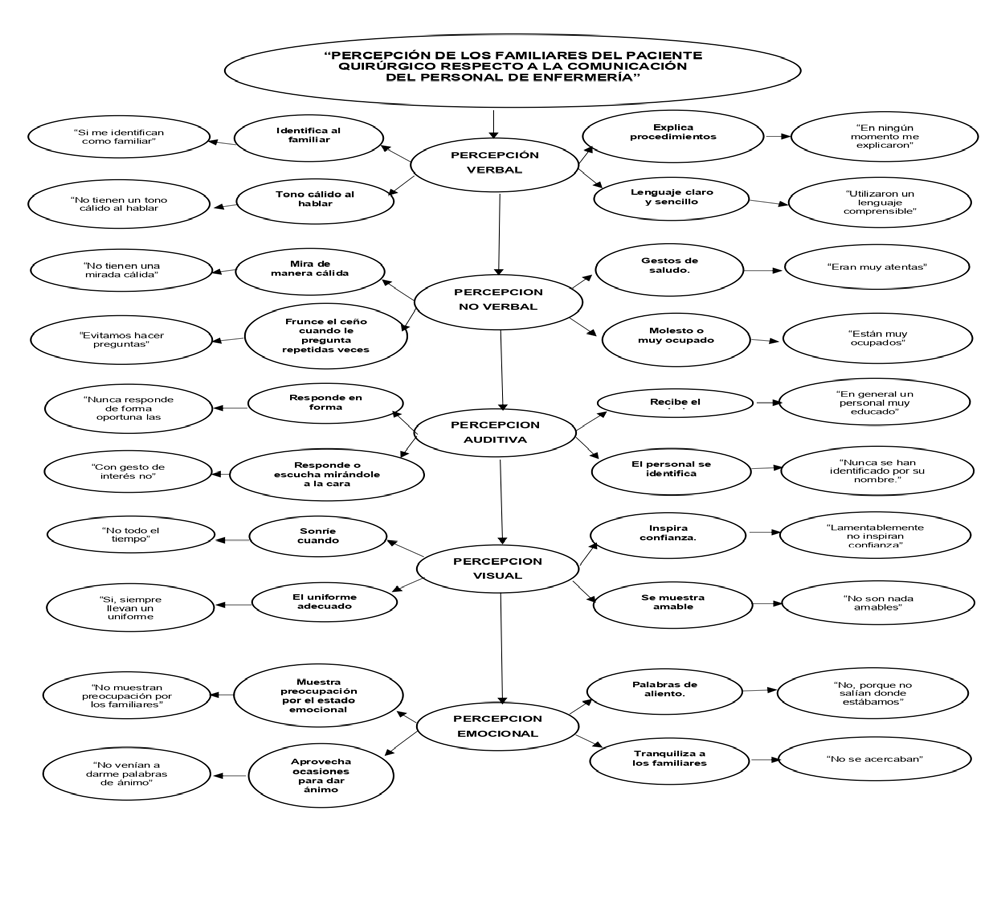
Perception Verbal Communication
The nursing staff explains to the family member about the general procedures they are going to perform on the patient: Of the total population interviewed, similar opinions were recognized. Of which 10 informants mentioned that “No, at no time was any procedure explained to me”, these negative aspects about the nursing staff not explaining the general procedures they perform, generates insecurity, uneasiness and uncertainty in the family members, who want to know what is happening in the operating room with their family members. However, 8 informants indicated that “Yes, the nurse explained to me what was going to be done and why”, so that the family members remain calmer during the surgical process. In addition, 2 informants expressed that “Yes, they explained to me about the procedures that were performed, because my daughter works in the hospital”, on the other hand, the nursing staff is more attentive and informs in detail about the procedures to be performed when the patients are recommended.
In this sense, a study by Escobar, et al. [11] states that nurses should collaborate with the medical team and be trained by it, but that they also have the professional responsibility to defend the rights, the quality of life of patients, and above all to communicate with patients, the role of the nursing staff being to explain to them the need for the procedure and warn them of the possible risks if they refuse to make a free decision about their state of health, and that the decision to accept or reject the treatment should be respected and facilitated.
The nursing staff identifies the patient’s family member: In relation to this question, there was a high positive criterion in the responses of the interviewees. Therefore, 19 informants indicated that “Yes, they identify me as the patient’s family member”, which is why the family members demonstrate confidence and security; since they affirmed that the nursing staff does identify the patient’s family members. On the contrary, only one person said “No, I was identified as a family member”; therefore, the family member may express concern about the lack of information provided by the nursing staff.
The results are similar to the research of Reyes, et al. [12], who mention that the care behaviors offered by nursing professionals are aimed at establishing empathy and individualized and humane treatment. In their work, the dimension with the highest degree of satisfaction was that the nurse identifies you and treats you as an individual person, the author indicates that thanks to these actions the relationship of trust is maintained and emphasizes the proximity of the nursing staff with the patient subject of care and his or her relatives.
The nursing staff uses clear and simple language when conversing with or responding to a family member’s concerns: Of the total number of people interviewed, 10 informants stated that “In my experience, they did use understandable language”, that is, in relation to the use of clear and simple language to maintain a conversation between the family member and the nursing staff. However, 10 informants indicated that “I did not have that experience since no nurse came out of the operating room to give us information”, so they did not have an adequate conversation and some of the questions were not answered or solved.
Regarding the question, the study by Villagaray, et al. [13] is different, since it indicates that most of the families rate the therapeutic relationship with the caregiver as positive. The therapeutic relationship is rated as positive, including face-to-face conversations, the use of clear language, a warm tone of voice and greetings at the meeting.
The nursing staff has a warm tone when speaking with the family member: Similar to the previous question, there was little difference in the responses of the respondents. Therefore, 11 informants mentioned that “They do not have a warm tone when speaking with any person outside the operating room”; therefore, family members are displeased when encountering nursing professionals who do not maintain a warm tone when speaking, unlike the remaining 9 informants, who highlighted comments such as “Yes, when speaking, it was with a warm tone”, “The nurses even came to sit next to me and talk very friendly. “In other words, the family members felt more confident when they saw that the nurses even sat close to the family members to talk or expressed themselves in the right way.
The results are similar to the research of Lascano, et al. [14], in which the author mentions that interaction with patients involves not only words and tone of voice, but also body language. Non-verbal communication, especially important in healthcare and innovations in the use of technology and care procedures, is an effective tool for capturing the messages with which the person expresses his or her feelings and needs.
Perception Nonverbal Communication
The nursing staff performs greeting gestures when the family member arrives: Regarding the question asked, of the total number of respondents, 12 stated that “Yes, they were very attentive”, therefore the nursing staff demonstrates their politeness and respect to the relatives of the surgical patients. However, 8 of the informants expressed that “No, because I think they are busy”. On the other hand, the staff does not show greeting gestures, so some of the causes may be that their character does not allow it, or their time is limited or overloaded with work.
Similar to the research of Padilla, et al. [15], who mention that nursing personnel exercise control over the emotions of patients and their families, operationalizing greeting gestures and determining feelings. This control of emotions is important because it represents a support in the state of health, since if it does not exist, mental integrity becomes vulnerable.
The nursing staff is annoyed or too busy to attend when the family member asks for information: According to the information provided by the patients’ relatives. Of the total population interviewed, 10 informants stated that “Yes, they are very busy because they do not go out to give information” and 3 interviewees said that “Yes, they refuse when we ask”, which shows that the nursing staff does not go out to give information to the relatives and even gets upset when the relatives ask about the patients who are in the operating room. Meanwhile, 7 family members expressed that “They always answered me, and when they could not attend me they told me that they would come back and always returned to answer my questions”, that is to say that at the moment of requesting information the nursing staff does not get upset and takes the necessary time to answer the questions of the family members.
In comparison to the results obtained, Beltrán, et al. [16], mention that the nursing staff, when going through situations related to patients and family members, a significant exhaustion can be noted. In their study, the participants reported the highest level of professional burnout syndrome, emotional exhaustion, depersonalization and work-related burnout.
The nursing staff looks at the patient in a warm manner when answering any of the family member’s questions: As with the previous question, 11 participants interviewed said that “They don’t really have a warm look”, which shows that the nursing staff does not always respond warmly to the family members’ questions. On the other hand, 9 family members responded that “Yes, there was a warm atmosphere”, that is to say that the family members felt confident to ask the nurses questions and therefore felt more confident and at ease.
In relation to the question, the research by Castaño, et al. [17] points out that nursing personnel, as public health officials, have the state and citizen responsibility to protect health as an essential, individual and collective right in order to provide an adequate quality of life. And this does not only refer to patients, but also to their relatives and family members.
The nursing staff frowns when the family member repeatedly asks about the same topic: According to the responses of the persons interviewed, 11 said that “Yes, for this reason, as a family member, we avoid asking questions so as not to see bad faces or feel bad”, which shows that the nursing personnel do frown when they ask repeated questions, which causes the family members to lose confidence and can lead to misunderstandings, simply because they are not sure of the answer they want to obtain. However, 9 interviewees mentioned that “No, on the contrary, they repeated several times so that I would understand”, that is, they affirm that they have not noticed this type of gestures, and that they have been very respectful.
Similar to Naranjo’s research [18], which mentions that in the interviews conducted, facial expressions were crucial to give an adequate analysis. In view of this, some of the most recognized expressions are the non-verbal expressions that should be taken care of in response to the response: frowning, opening the eyes in an expression of admiration, taking care of the tone of voice, listening actively, among others.
Auditory Perception
The nursing staff receives the greeting from the family member when entering: In response to the question posed, 16 participants mentioned that “Yes, in general the staff is very polite in this aspect”, in terms of responding to a greeting, the family members mentioned that they have all been attentive and respond to any type of greeting. The values, respect and auditory perception of the majority of the nursing staff stand out in this regard. However, 4 of the total of those interviewed expressed that “If they greet, but it does not feel honest”, that is to say that it will depend on the people who receive the greeting to interpret according to their criteria.
Similar to Camacho’s research [19], which has the same response pattern, since in his research, all the nursing personnel responded to the greeting. In view of this, the author notes that nursing is to provide comprehensive health care with quality, and they should maintain a person-person relationship where respectful treatment is identified from the greeting.
The nursing staff is identified when addressing family members: Of the total number of participants, 16 participants mentioned that “they have never identified themselves by name”, which means that the interview determined a negative pattern in relation to whether the nursing staff identifies themselves by name when addressing family members. On the other hand, 4 of the total stated that “Yes, they identified themselves”. Thus, they indicate that few nurses perform this action.
In response to this question, the research by Castelo, et al. [20] mentions that as regards the willingness to care, patients believe that the willingness of nurses to comfort patients and relatives by always calling them by name and listening to them attentively helps them to identify other types of physical, psychological and spiritual needs. This is consistent with the results of the present study, in which nurses identify themselves and address patients and family members by name and show responsibility for care.
The nursing staff responds in a timely manner to the questions and concerns raised by family members: According to the results, 9 informants mentioned that “Yes, they took the time to answer my questions” the nursing staff responds in a timely manner to the concerns of the patient’s family members and therefore there are no doubts. However, 11 interviewees stated that “They never respond in a timely manner to the questions that are asked” and therefore they are not clarified or answered in an adequate and timely manner and many times the questions generate more concerns and the information is not clear.
Under this argument, Hidalgo’s research [21] points out that it is necessary for the nursing staff to create a safe and trusting atmosphere to meet the needs identified at all times to listen and respond to the questions and concerns of family members about the patient’s health.
The nursing staff responds or listens by looking at the patient’s face with gestures of interest: In relation to the question 9 of those involved expressed that “with gestures of interest no” therefore the relatives of the surgical patients and the nursing staff do not create an atmosphere of trust since actions such as changes of face, looking elsewhere, preferring only to listen, show little interest on the part of the staff. On the other hand, 11 of the respondents said “Yes, since a person’s life is at stake”, that is to say that the nursing staff shows interest in the relatives and therefore in the patient and this leads to good treatment.
According to the study by Luna, et al. [22], an important element for initiating a good interpersonal relationship is the “greeting” at the beginning of care by the nurse. The conversation begins with the nurse asking the mother about the baby’s health and the mother responding, a method that has quite remarkable qualities.
Visual Perception
The nursing staff inspires confidence: According to the responses of the family members interviewed, 12 stated that “unfortunately they do not inspire confidence” because the nursing staff needs to be more empathetic and provide confidence to the family members, since they are at a time when they need to trust the staff, because it is a loved one who is undergoing a surgical procedure. The remaining 8 people said “Yes, because they were kind”, that is to say, if the staff shows their values, is cordial and empathetic, this generates an atmosphere of trust and therefore the family members will feel at ease.
In contrast to Bernárdez’s research [23], the concept of the humanistic psychotherapeutic relationship is based on emotional factors. Trust is also established between health professionals and patients, so that there is no hierarchical relationship. Trust is an important element that determines the quality of communication and strengthens the relationship.
The nursing staff is friendly: As in the previous question, 12 participants were of the opinion that “They are not kind at all”. The reasons for this result are experiences of indifferent treatment, not mentioning adequate information and even 2 of the participants mentioned that “Not at first, but after learning that my relative works in the hospital, they were kind”, that is, they were only kind when they were known or referred to them. As mentioned above, not all nurses show little interest in the patients’ relatives; there are those who get involved in making the relatives and therefore the patient feel good.
In view of this, the research by Garcia, et al. [24] stresses that nurses have learned that being close and willing to help people in need allows them to adapt their behavior and provide warm, quality care. Given that the great value of the care system lies in the people who make care possible, it is reasonable to assume that investing in the acquisition of effective coping resources will increase professionals’ resilience and optimal management of emotions.
The nursing staff smiles when attending to family members: According to the responses of the people interviewed, 12 mentioned that “Not all the time, but it does not make them less friendly” the nursing staff does not smile when attending, however, it is understood that not smiling is not synonymous with being disrespectful, many of the nursing staff are busy or must maintain seriousness in their activities, on the other hand 8 stated that “If they smile” therefore it attracts an atmosphere of tranquility and trust between staff and family members.
The results were similar to the research of Hernandez [25], who mentioned that most nurses do not smile. In addition, some opportunities for improvement were recognized, such as: staying closer to the patient, family members and optimizing interpersonal communication skills.
The nursing staff wears the appropriate uniform: The total number of positive responses to the question about whether the nursing staff wears the right uniform stands out, i.e. 20 of those interviewed mentioned that “Yes, they always wear an impeccable uniform”, opinions such as adequate cleanliness, identification by badges, order and neatness in their presentation are important for the nursing staff.
In relation to the research of Ferrer, et al. [26], the nursing staff should wear the appropriate uniform, since it is the hallmark of the country’s humanized health resources. As a consequence of wearing a good uniform, personal grooming, quality of medical care and trust on the part of patients and relatives are represented.
Emotional Support
The nursing staff gives words of encouragement when they observe sad or distressed family members: In terms of emotional support, negative opinions were identified, 12 of the participants stated that “No, because they did not go out where the family members were”, which makes the family members feel more uneasy and generates negative opinions about the nursing staff’s care. On the other hand, 8 stated that “Yes, they approached me to ask me what was wrong and to give me words of encouragement,” considering that the profile of a nurse is not to give false expectations or make comments that could be misinterpreted, even so they are empathetic.
In contrast to the research of Velazquez [27], who emphasizes that the nurses’ experience shows that they rely first and foremost on the unconditional support of all family members and conversely. However, nurses’ words of encouragement and reassurance are said to play an important role in putting family members at ease and creating a safe working environment.
Nurses reassure family members when they see signs of distress Similarly to the previous question, 11 mentioned that “They did not approach”, the family members of surgical patients indicated that the nursing staff does not approach to reassure them when they see someone in distress, therefore, they can feel a hostile environment where as a family member they cannot be calm while waiting for their family member. On the other hand, 9 of the interviewees expressed that “Yes, they were looking for a way to improve the situation”; there are few positive comments that focus on the attitude of the nurses to calm the situation and not to aggravate the situation in front of others.
In relation to the question, the research of Flores [28] differs from the results, since it emphasizes that nurses deal with other people from a human perspective and help them to overcome difficulties and make the most of their strengths. Nurses have to know themselves and people in order to help them. Therefore, it was emphasized that nurses should support family members and patients and try to reassure them when they feel they are about to cry or break down.
The nursing staff shows concern for the emotional state of the family members: Of the total number of interviewees, 11 relatives of surgical patients mentioned that “They do not show concern for the relatives”, the nursing staff does not show any concern about the emotional state of the relatives, so they may be more overwhelmed than usual in this situation. Meanwhile, 9 of the opinions described that “They do show concern, but in little importance, not as a priority”, they rarely ask about the emotional state, they give little importance and it is not a priority for the nurses to know how the family members are and as a nursing activity it should be one of the priorities.
According to Carranza’s research [29], it has been proven that health professionals have higher levels of psychological stress and perception of workload and anxiety. Some studies have also found a relationship between workload and burnout in healthcare professionals, and this syndrome has also been related to psychological distress, anxiety and depression in several studies.
Nurses take advantage of occasions to give encouragement to family members: Of the total number of participants, 12 stated that “They did not come to give me words of encouragement” the relatives of surgical patients mention that the nursing staff does not take advantage of occasions to give words of encouragement, so that the relatives feel alone at those moments, due to the lack of information and indifference on the part of the nursing staff. On the other hand, 8 informants expressed that “Yes, when they went out and passed by where we were, they did give words of encouragement”, which means that there are nurses who are empathetic and mention words of encouragement because they are concerned about the state of mind of the family members.
In contrast to the research of Espinoza [30], which highlights that the positive/negative expression of feelings by nurses was moderate in most of the items of this study, except for one item in which the expression of feelings was rated as optimal (encouraging patients to express their feelings).
Conclusion
The perception of the family members regarding the communication of the nursing staff according to the present investigation there are several negative criteria in all the categories, especially the emotional perception where the nursing staff is not concerned about the psychoemotional well-being of the family members, they do not give them words of encouragement, they do not show concern, nor do they reassure the family members when the patient is in a surgical process, since this is a fundamental point to fulfill the objective of a quality and warmth attention to the patient and his family environment.
In the category of verbal and non-verbal perception, several negative criteria were also evidenced by the participants, where the nursing staff should give information to the patient’s relatives, using clear language and showing gestures of understanding and kindness, taking into account the situation the relatives are going through.
At the level of visual perception, it was shown that the relatives of the surgical patients do not inspire confidence in the nursing staff simply because they are not friendly, affectionate and sociable, since when they learn that they are recommended patients their attitude changes notably and the other relatives become aware of the attitude taken by the staff.
Finally, in the auditory perception it was stated by the family members that the nursing staff does receive the greeting although it is not warm, and they respond to doubts but with scarce information, and what is most evident in this category is that the staff does not identify themselves by name when interacting with the family members, which is why this statement should be taken into account since it is mandatory for the staff to introduce themselves by name and position to the users entering a public facility.
Finally, this research on the perception of surgical patients’ relatives regarding the communication of the nursing staff will help to improve the attention to users and especially to the relatives, always taking into account the objective of providing quality and warmth attention, being empathetic without discriminating ethnicity, gender or social class, since all people deserve to be treated with respect and equality.
Conflicts of Interest
The authors declare that they have no conflicts of interest.
Funding
Own resources
Acknowledgments
I thank the participants who contributed their criteria for this research.
References
-
Barbosa MH, Neto JM, Oliveira KF, Nascimento KG, Felix MM, et al. (2018) Seguridad del paciente: percepción de enfermeros brasileños. Revista Cubana de Enfermería 34(4).
-
WHO (2019) Patient safety, World Health Organisation.
-
Blanco Nistal MM, Soler MT, Puente ZR, Puente Martínez MT, Martínez CM, et al. (2021) Percepción de los pacientes sobre los cuidados de enfermería en el contexto de la crisis del COVID-19. Enfermería Global 20(64): 26-60.
-
Carrasco Fernández JA, Diaz Manchay RJ, Cervera Vallejos MF, Saavedra Covarrubia ME, Rodríguez Cruz LD, et al. (2021) Percepción de las enfermeras sobre la seguridad durante la administración de fármacos al niño hospitalizado. Ene 15(1): 1-15.
-
Luz Jaimes VM, Leonardo Alvarado AA, Nathaly Mejía AC, Valentina López GA, Angélica Mancilla JV, et al. (2021) Correlación del grado de percepción y cultura de seguridad del paciente en una Institución de tercer nivel 2015-2019. Rev Cuid 12(1): e1092.
-
Campiño Valderrama SM, Duque PA, Cardozo VH, Campiño Valderrama SM, Duque PA, et al. (2019) Percepción del paciente hospitalizado sobre el cuidado brindado por estudiantes de enfermería. Universidad y Salud. diciembre de 21(3): 215-225.
-
Delgado JD, Brito CB, Delgado HCB (2019) Calidad de la atención de enfermería desde la percepción del paciente hospitalizado. Revistas Dilemas contemporáneos 2: 1-27.
-
Manterola C, Quiroz G, Salazar P, García N (2019) Metodología de los tipos y diseños de estudio más frecuentemente utilizados en investigación clínica. Revista Médica Clínica Las Condes 30(1): 36-49.
-
Amaiquema Marquez FA, Vera Zapata JA, Zumba Vera IY, Amaiquema Marquez FA, Vera Zapata JA, et al. (2019) Enfoques para la formulación de la hipótesis en la investigación científica. Conrado 5(70): 354-360.
-
Toscano F (2018) Metodología de la Investigación. Guía práctica con las preguntas más frecuentes en la elaboración de una tesis en Derecho.
-
Escobar Castellanos B, Cid Henriquez P (2018) El cuidado de enfermería y la ética derivados del avance tecnológico en salud. Acta bioethica junio de 24(1): 39- 46.
-
Reyes MOJ, Fuentes-González N (2018) Percepción de la calidad del cuidado de enfermería en pacientes diabéticos hospitalizados. Revista Investigación en Salud Universidad de Boyacá 5(2): 219-245.
-
Villagaray OLJ, Moreno TME (2017) Relación terapéutica entre enfermera y familia basada en la teoría de Joyce Travelbee, en un hospital de Lima. Peruvian Journal of Health Care and Global Health 1(1): 31-35.
-
Torre S del RLD la, Torres NAC (2022) Aplicación del Modelo de Joyce Travelbee en la relación persona a persona con adultos mayores. Salud, Ciencia y Tecnología 2: 1-10.
-
Padilla MLS, Alcántara SM, Macorra MZ (2019) Trabajo emocional y sus efectos en la salud del personal de enfermería del Hospital General de México, 2017. Rev Elec Psic Izt. 2 de abril de 22(1): 122-154.
-
Beltrán JM, Carvajal AB (2019) Agotamiento profesional en personal de enfermería y factores de riesgo psicosocial. Archivos Venezolanos de Farmacología y Terapéutica 38(4): 501-508.
-
Atehortúa S, Pineda YC, Restrepo Villa RO (2019) Situación de la enfermería en el desarrollo de la atención primaria en salud en Antioquia (Colombia): aproximación desde la perspectiva de los profesionales. Revista Gerencia y Políticas de Salud 18(36).
-
Hernández YN, Hernández LG, Carmenate MS, Hernández YN, Hernández LG, et al. (2018) Proceso Atención de Enfermería desde la perspectiva docente. Revista Archivo Médico de Camagüey. diciembre de 22(6): 831- 842.
-
Camacho KR, Alvarado MG (2019) Como perciben el trato de la enfermeras los paciente en la emergencia del hospital? Salud, Arte y Cuidado 12(1): 15-20.
-
Castelo Rivas WP, García Vela SV, Viñan Morocho JB, Castelo Rivas WP, García Vela SV, et al. (2020) Cuidado humanizado de enfermería a pacientes con pie diabético del Hospital General Santo Domingo- Ecuador. Revista Archivo Médico de Camagüey 24(6): e7169.
-
Hidalgo RL, Segura GAH, Torres RMG (2018) Percepción De Las Embarazadas De La Interacción Con El Personal De Enfermería En El Control Prenatal En San Cristóbal De Las Casas, Chiapas, México. Horizonte de Enfermería 29(3): 192-203.
-
Luna GCL, Solano MTM (2018) Rol educador de la enfermera en el proceso de vacunación – Centro Salud. José Quiñones – Chiclayo. Acc Cietna: Revista de la Escuela de Enfermería 5(1): 98-111.
-
Bernàrdez Carracedo S (2018) El papel del personal de enfermería en la promoción e implementación de las vacunaciones. Vacunas 19(1): 31-36.
-
García SA, Alboniga Mayor JJ, Iturrioz EB, García SA, Alboniga Mayor JJ, et al. (2020) Satisfacción y fatiga por compasión en personal de enfermería de oncología: estudio descriptivo y correlacional. Enfermería Global 19(60): 120-144.
-
Corral SH, Müggenburg-Rodríguez Vigil MC, Olvera- Arreola SS (2019) La técnica Delphi para el rediseño y validación de un instrumento que mide la comunicación enfermera-paciente. Enfermería universitaria 16(4): 351-361.
-
Ferrer Piquer M, Camaño Puig R (2017) Dotación de enfermeras en los hospitales españoles: análisis comparativo. Index de Enfermería. septiembre de 26(3): 223-227.
-
Velazquez CA, Benitez ODR (2020) Actitudes Del Personal De Enfermería En El Hogar Ante La Pandemia Covid-19. Academic Disclosure 1(1): 262-272.
-
Flores G, Castro R, Quipildor R (2019) Actitud del personal de Enfermería ante la muerte de pacientes en la Unidad de Cuidados Intensivos. Article of scientific and technological research 19(34): 26-36.
-
Carranza Esteban RF, Mamani-Benito OJ, Quinteros- Zúñiga D, Farfán-Solís R (2021) Preocupación por el contagio de la COVID-19 y carga laboral como predictores del malestar psicológico durante la emergencia sanitaria en personal de salud de Perú. Revista Colombiana de Psiquiatría, pp: 1-8.
-
Espinoza G de JV, Samaniego GFL, Soto JCC, Campos GEE (2022) Cuidado humanizado de enfermería en la atención de pacientes ingresados en los hospitales públicos de la ciudad de Milagro – Ecuador. Mediciencias UTA. 1 de enero de 6(1): 55-68.
- Epithelioid Granuloma; 3cases with Different Clinical Features
- Advancing Representation in Dermatology Clinical Trials: Ethical, Scientific, and Regulatory Imperatives for Inclusion Across all Fitzpatrick Skin Types
- A Case of Atopic Dermatitis with Concurrent Psoriasis Vulgaris: Successful Treatment with Upadacitinib
- Innovation Lifting Eyeshadow: A Synthesis of Makeup and Optical Illusion
- Distinguishing Superficial Actinic Porokeratosis from Actinic Keratosis with UVF Dermoscopy: A Case Report
- High Mobility Group Box 1 (HMGB1) in Cutaneous Inflammation: An Immune Modulator Bridging Cellular Stress, Ferroptosis and Danger Signaling