
Zimmermann-Laband Syndrome with Portal Hypertension: Case Report
Zimmermann-Laband Syndrome (ZLS) is an extremely rare illnessand is a sporadic craniofacial malformation syndrome. Its prevalence is reported to be less than 1/1000000 of the general population.
Introduction
Zimmerman-Laband Syndrome, is an extremely rare genetic disorder characterized by craniofacial and hands and feet abnormalities. Most children with this disorder have abnormally gingival fibromatosis.
Case Report
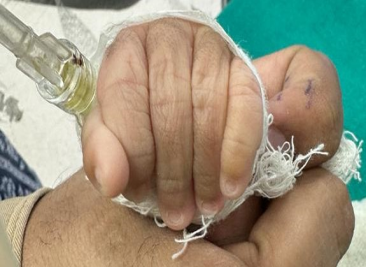
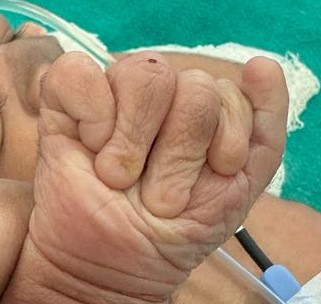
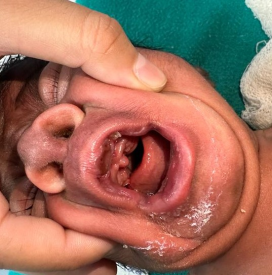
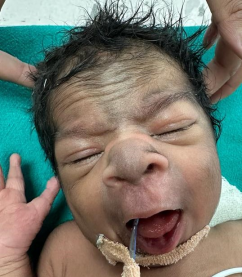
Here we report, a 3rd born male child, born via vaginal delivery to a non-consanguineous married parents in Mahila Chikitsalaya, SMS Medical College, Jaipur who was admitted in NICU due to respiratory distress. The baby was kept on CPAP and on oxygen by nasal prongs for 24 hours each (Figure 1). Then gradually oxygen was weaned off and feeds were started. On clinical examination, the baby had absent nails in the right hand (Figure 2), high arched palate and gum hypertrophy (Figure 3), depressed nasal bridge, coarse facial features and wide broad philtrum, wide nostrils with discoloration present around the philtrum (Figure 4), hypotonia, hoarse voice, hypertrichosis in both lower limbs (Figure 5). Central nervous system and cardio-vascular system examinations were within normal limits. In abdominal examination, liver was not palpable but splenomegaly was present with a span of 8 cm (as per age-distributed nomograms)in view of which ultrasound abdomen was done revealing altered echotexture of liver with dilated and tortuous hepatic artery, portal vein and their branches with multiple collaterals in peripancreatic region suggestive of portal hypertension.
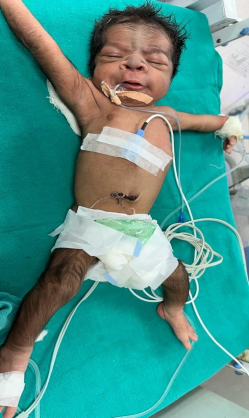
None of the family members had a history of genetic diseases, either from the mother or the father. No significant antenatal history was recorded with antenatal scans being normal. Rest of the vitals and routine investigations were normal.
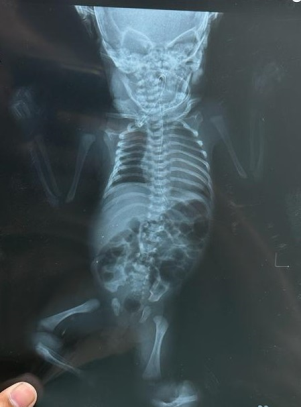
On the basis of clinical examination, we kept the possibilities of Zimmermann-Laband syndrome, Nicolaides Baraister Syndrome, Wiedemann-Steiner Syndrome, Coffin Siris Syndrome but all others except ZLS were ruled out as there were no other congenital anomalies, cardiac defects [2], no microcephaly or sparce anterior hair line (Nicolaides Baraister syndrome, Coffin Siris Syndrome); absent localized hypertrichosis, no hypertelorism, no down slanting and vertically narrow palpebral fissure with long eyelashes (Wiedemann-Steiner Syndrome). Infantogram did not reveal any skeletal abnormalities. We were not able to do genetic testing due to financial issues (Figure 6).
Discussion
ZLS is characterized bygingival fibromatosis, hypoplastic or missing nails and terminal phalanges, joint hypermobility, hepato-splenomegaly, mild hirsutism, dysmorphic facies, with a broad nasal bridge, large fleshy nose, full lips, and synophrys, and learning difficulties [3].
ZLS is genetically heterogeneous with gain of function missense variants in KCNH1(1q32.2), and KCNN3(1q21.3) genes have been described and, more rarely, recurrent missense variants in the ATP6V1B2(8p21.3) gene [4]. It is characterized by specific oral features of diffuse gingival fibromatosis in early childhood [1, 5]. Treatment of ZLS is symptomatic and supportive care involving multidisciplinary approach. Paediatricians, orthopaedic and dental surgeons, orthodontists, dentists, specialists who diagnose and treat skeletal abnormalities, periodontists who treat disorders affecting the tissues surrounding and supporting the teeth, and/or other health care professionals may need to collaborate. Early presentation of ZLS in a newborn has rarely been described. This case report describes a newborn patient with ZLS.
Conclusion
We found Zimmerman-Laband Syndrome had portal hypertension as an uncommon feature. Further, more case reports are need to label portal hypertension as an association with ZLS.
References
-
Jorgenson RJ, Cocker ME (1974) Variation in the inheritance and expression of gingival fibromatosis. J Periodontol 45(7): 472-473.
-
Pezzani L, Milani D, Tadini G (2015) Intellectual Disability: When the Hypertrichosis Is a Clue. J Pediatr Genet 4(3): 154-158.
-
Reddy M, Mehetre V, Gir PJ, Ranmare V (2018) An Extremely Rare Presentation of Zimmermann-Laband Syndrome in a Twin. Ann Maxillofac Surg 8(2): 352-354.
-
Gawron K, Łazarz-Bartyzel K, Potempa J, Chomyszyn- Gajewska M (2016) Gingival fibromatosis: clinical, molecular and therapeutic issues. Orphanet J Rare Dis 11: 9.
-
Mallela MK, Moogala S, Polepalle L, Reddy VC (2013) Zimmermann-Laband syndrome: a rare case report of father and son. J Dr NTR Univ Health Sci 2(2): 147-149.
- Epithelioid Granuloma; 3cases with Different Clinical Features
- Advancing Representation in Dermatology Clinical Trials: Ethical, Scientific, and Regulatory Imperatives for Inclusion Across all Fitzpatrick Skin Types
- A Case of Atopic Dermatitis with Concurrent Psoriasis Vulgaris: Successful Treatment with Upadacitinib
- Innovation Lifting Eyeshadow: A Synthesis of Makeup and Optical Illusion
- Distinguishing Superficial Actinic Porokeratosis from Actinic Keratosis with UVF Dermoscopy: A Case Report
- High Mobility Group Box 1 (HMGB1) in Cutaneous Inflammation: An Immune Modulator Bridging Cellular Stress, Ferroptosis and Danger Signaling