
Knowledge, Attitude, and Practices towards Leprosy among Nurses around Semarang, Indonesia
Introduction: Leprosy, a debilitating chronic infectious disease caused by Mycobacterium leprae, remains a public health challenge globally. Indonesia, with 14,376 new cases in 2023, is a WHO priority country. Nurses are crucial in leprosy patient care; however, insufficient knowledge can lead to fear and discrimination. Aim: To analyze the knowledge, attitudes, and practices of nurses in Semarang towards leprosy. Methods: This cross-sectional, descriptive study was conducted from January to February 2025, involving 50 nurses working in hospitals and primary healthcare facilities in Semarang. Data on age, gender, origin, knowledge, attitudes, and practices were collected using a questionnaire. Microsoft Excel was used for data analysis and presentation. Results: The study revealed that 28% of nurses had high knowledge, 62% moderate knowledge, and 10% low knowledge regarding leprosy. In terms of attitudes and practices, 56% demonstrated positive attitudes and practices, while 42% were neutral. No participants exhibited negative or undetermined attitudes and practices. Conclusion: While over half of the nurses demonstrated a moderate level of knowledge and generally positive attitudes and practices toward leprosy, the study revealed misunderstandings, particularly about transmission and prevention. These findings emphasize the need for targeted educational interventions to bridge knowledge gaps and enhance leprosy management among nurses.
Abbreviations
WHO: World Organization Health; CDC: Centers for Disease Control.
Introduction
Leprosy is a chronic infectious disease caused by Mycobacterium leprae that commonly affects the skin, peripheral nerves, mucosal layer of the upper respiratory tract, and eyes. It may lead to progressive and permanent disability if left untreated [1]. Leprosy is transmitted through nasal or oral droplets during close contact with untreated patients [2, 3]. Leprosy remains a global public health concern. In 2023, Indonesia reported 14,376 new cases of leprosy, ranking third globally in new cases. The prevalence in 2022 was 0.55 per 10,000 populations, showing an increase from 2021 [2]. Leprosy affects patients’ quality of life due to stigma in society, limiting their ability to work and socialize. The disease remains a health challenge in several regions, including Indonesia, requiring attention in prevention, early detection, management, and rehabilitation [1, 2, 4].
According to WHO, 182,815 new leprosy cases were detected globally in 2023, with Southeast Asia contributing a significant portion. Indonesia is among 23 global priority countries, reporting 14,376 new cases and a total of 17,251 cases by the end of 2023 [5]. Delays in early detection and treatment contribute to sustained incidence, ongoing transmission, and risk of disability in patients with leprosy [6, 7]. Nurses play a crucial role in patient care, particularly in improving its quality. They must have adequate knowledge, a positive attitude, and supportive behavior toward patients. Chavez CP, et al. [8] found that 62.3% of health workers, including nurses, with good knowledge of leprosy tend to have a more inclusive and professional attitude and practice when providing services to patients. In contrast, 10.6% of nurses lack knowledge of leprosy tends to have excessive fear and discrimination towards patients and tent to be carried away by community stigma [8]. Recent study by Desti and Rima [9] suggested that nurses’ knowledge, age, work experience, and education closely relate to their ability in initial patient care [9]. Methods This is an observational descriptive cross- sectional study. Observation or data collection was conducted once after the subject had completed the study questionnaire. The study was conducted in Semarang from January to February 2025. Subjects included in this study were nurses with a work experience of at least one year in a hospital or primary health facility in Semarang, between 20-57 years of age, willing to participate, and had a formal educational background of at least an Associate Degree of Nursing. The exclusion criteria in this study were subjects who did not attend the scheduled interview, were employed for special training during the study, or subjects with limitations in reading or understanding the instruments used for study purposes. The purposive sampling method was carried out to determine respondents who met the inclusion and exclusion criteria. The total subject of this study was 50 respondents. Data was collected with a validated questionnaire. The collected data was first checked to ensure all information was completed and eligible, followed by systematic processing. Coding was employed for grouping based on relevant categories. Data was later tabulated using Microsoft Excel software to ensure accuracy in calculating and presenting outcomes.
Knowledge of leprosy is defined as the general understanding of leprosy. Attitude is defined as the tendency to act or respond positively or negatively towards leprosy. Practice is defined as the actual observable or measurable actions that a person takes toward leprosy. A score of 1 is given for a correct answer and a score of 0 for an incorrect answer for each questionnaire item. To measure the overall knowledge, attitude, and practice of the study sample, we used Bloom’s cutoff points of >80% (≥7 out of 9), 60–80% (5–6 out of 9), and <60% (≤4 out of 9) for correct answers corresponding to high, medium, and low knowledge of leprosy; >80% (≥12 out of 16), 60–80% (9–11 out of 16), and <60% (≤8 out of 16) for positive answers (agree or strongly agree) corresponding to positive, intermediate, and negative attitude and practice towards leprosy.
Results
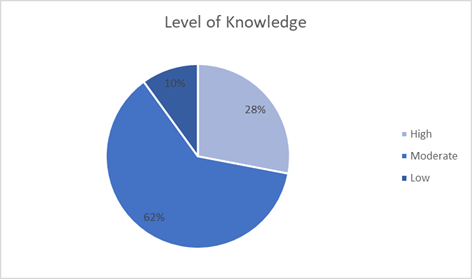
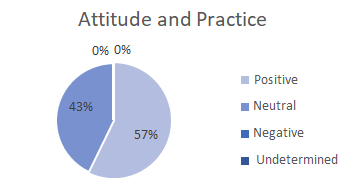
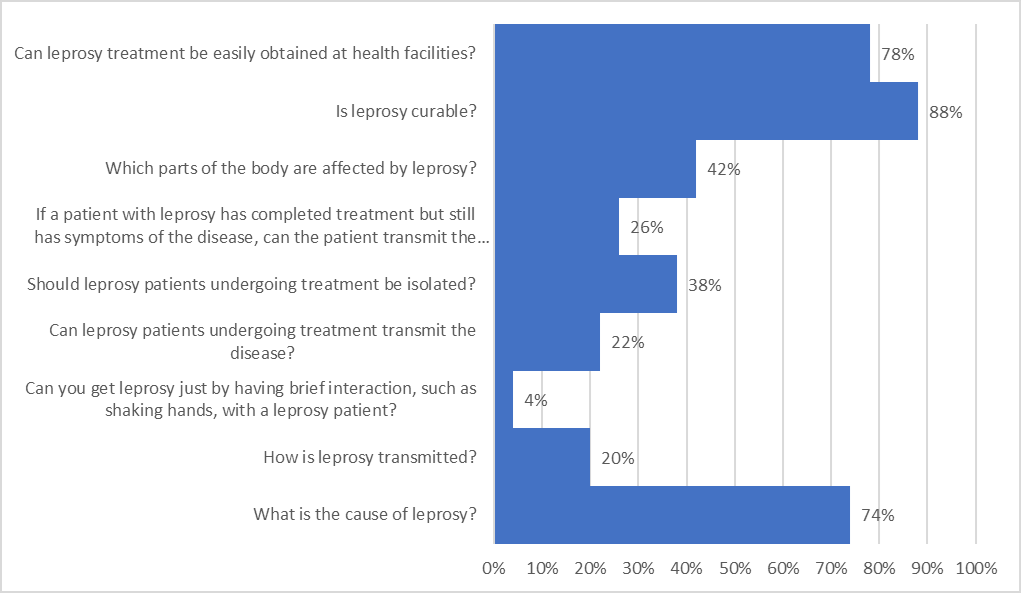
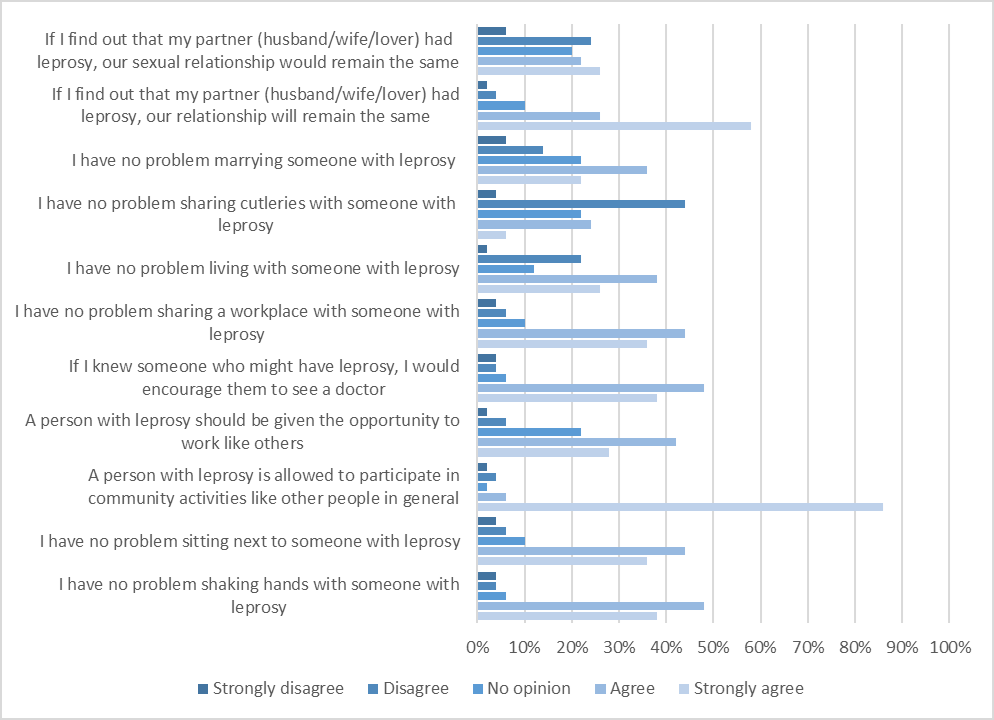
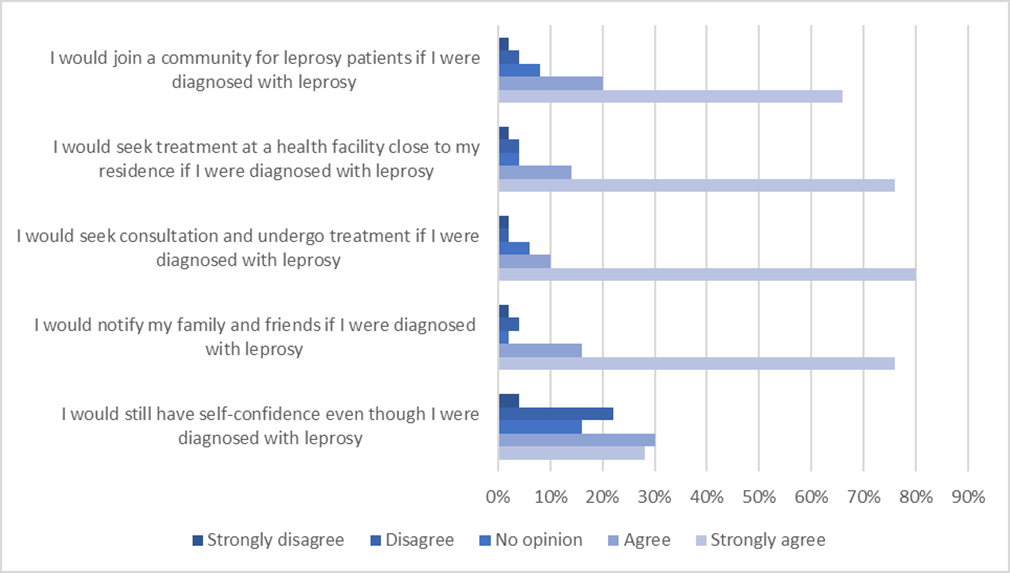
Table 1 shows demographic characteristic of study subjects and Table 2 shows the knowledge and attitude, and practice about leprosy of all 50 nurses, 14 (28%) had high level of knowledge, 31 (62%) had moderate level of knowledge and 5 (10%) had low level of knowledge of leprosy. Table 3 shows subject’s knowledge of causes and transmission of leprosy as well as its clinical manifestations and treatment. In terms of attitude and practice, 28 nurses (56%) had positive attitude and practice, 21 (42%) had neutral attitude and practice, 0 (0%) had negative attitude and practice towards leprosy, and 0 (0%) was undetermined. Table 4 shows their attitude and practice towards leprosy patients and Table 5 shows their attitude and practice towards them, if diagnosed with leprosy (Figures 1-5).
| Sample characteristics | Mean (±SD) or frequency (%), N = 50 |
| Age (years) | 36 (±12.5) |
| Gender | |
| Female | 38 (76%) |
| Male | 12 (24%) |
| Recent Education | |
| Associate Degree of Nursing | 22 (44%) |
| Bachelors of Nursing | 28 (56%) |
Table 1: Demographic characteristics of study.
| Frequency (%) | |
|---|---|
| Level of Knowledge | |
| High | 14 (28%) |
| Moderate | 31 (62%) |
| Low | 5 (10%) |
| Attitude and Practice | |
| Positive | 28 (56%) |
| Neutral | 21 (42%) |
| Negative | 0 (0%) |
| Undetermined | 0 (0%) |
Table 2: Knowledge, attitude, and practice towards leprosy.
| Questionnaire | Frequency (%) |
| What is the cause of leprosy? | |
| Bacteria | 37 (74%) |
| Genetics | 1 (2%) |
| Foul environment | 3 (6%) |
| Poor hygiene | 3 (6%) |
| Food or drink | 2 (4%) |
| Curse | 2 (4%) |
| Don’t know | 2(4%) |
| How is leprosy transmitted? | |
| Inhalation | 10 (20%) |
| Contact with body fluids secretions | 20 (40%) |
| Contact with open wounds | 12 (24%) |
| Direct contact | 5 (10%) |
| Contaminated food or drink | 2 (4%) |
| Not sure | 4 (8%) |
| Can you get leprosy just by having brief interaction, such as shaking hands, with a leprosy patient? | |
| Yes | 46 (92%) |
| No | 2 (4%) |
| Not sure | 2 (4%) |
| Can leprosy patients undergoing treatment transmit the disease? | |
| Yes | 35 (70%) |
| No | 11 (22%) |
| Not sure | 4 (8%) |
| Should leprosy patients undergoing treatment be isolated? | |
| Yes | 28 (56%) |
| No | 19 (38%) |
| Not sure | 3 (6%) |
| If a patient with leprosy has completed treatment but still has symptoms of the disease, can the patient transmit the disease? | |
| Yes | 26 (52%) |
| No | 13 (26%) |
| Not sure | 11 (22%) |
| Which parts of the body are affected by leprosy? | |
| Skin | 20 (40%) |
| Peripheral nerve | 5 (10%) |
| Brain | 3 (6%) |
| Both A and B | 21 (42%) |
| Not sure | 1 (2%) |
| Is leprosy curable? | |
| Yes | 44 (88%) |
| No | 2 (4%) |
| Not sure | 4 (8%) |
| Can leprosy treatment be easily obtained at health facilities? | |
| Yes | 39 (78%) |
| No | 2 (4%) |
| Not sure | 9 (18%) |
Table 3: Knowledge of cause, transmission, clinical manifestation, and treatment of leprosy.
| Questionnaire | Frequency (%) |
|---|---|
| I have no problem shaking hands with someone with leprosy | |
| Strongly agree | 19 (38%) |
| Agree | 24 (48%) |
| No opinion | 3 (6%) |
| Disagree | 2 (4%) |
| Strongly disagree | 2 (4%) |
| I have no problem sitting next to someone with leprosy | |
| Strongly agree | 18 (36%) |
| Agree | 22 (44%) |
| No opinion | 5 (10%) |
| Disagree | 3 (6%) |
| Strongly disagree | 2 (4%) |
| A person with leprosy is allowed to participate in community activities like other people in general | |
| Strongly agree | 43 (86%) |
| Agree | 3 (6%) |
| No opinion | 1 (2%) |
| Disagree | 2 (4%) |
| Strongly disagree | 1 (2%) |
| A person with leprosy should be given the opportunity to work like others | |
| Strongly agree | 14 (28%) |
| Agree | 21 (42%) |
| No opinion | 11 (22%) |
| Disagree | 3 (6%) |
| Strongly disagree | 1 (2%) |
| If I knew someone who might have leprosy, I would encourage them to see a doctor | |
| Strongly agree | 19 (38%) |
| Agree | 24 (48%) |
| No opinion | 3 (6%) |
| Disagree | 2 (4%) |
| Strongly disagree | 2 (4%) |
| I have no problem sharing a workplace with someone with leprosy | |
| Strongly agree | 18 (36%) |
| Agree | 22 (44%) |
| No opinion | 5 (10%) |
| Disagree | 3 (6%) |
| Strongly disagree | 2 (4%) |
| I have no problem living with someone with leprosy | |
| Strongly agree | 13 (26%) |
| Agree | 19 (38%) |
| No opinion | 6 (12%) |
| Disagree | 11 (22%) |
| Strongly disagree | 1 (2%) |
| I have no problem sharing cutleries with someone with leprosy | |
| Strongly agree | 3 (6%) |
| Disagree | 3 (6%) |
| Strongly disagree | 1 (2%) |
| If I knew someone who might have leprosy, I would encourage them to see a doctor | |
| Strongly agree | 19 (38%) |
| Agree | 24 (48%) |
| No opinion | 3 (6%) |
| Disagree | 2 (4%) |
| Strongly disagree | 2 (4%) |
| I have no problem sharing a workplace with someone with leprosy | |
| Strongly agree | 18 (36%) |
| Agree | 22 (44%) |
| No opinion | 5 (10%) |
| Disagree | 3 (6%) |
| Strongly disagree | 2 (4%) |
Table 4: Attitude and practice towards leprosy patients.
I have no problem living with someone with leprosy Strongly agree 13 (26%) Agree 19 (38%) No opinion 6 (12%) Disagree 11 (22%) Strongly disagree 1 (2%) I have no problem sharing cutleries with someone with leprosy Strongly agree 3 (6%) Agree 12 (24%) No opinion 11 (22%) Disagree 22 (44%) No opinion 5 (10%) Disagree 2 (4%) Strongly disagree 1 (2%) If I find out that my partner (husband/wife/lover) had leprosy, our sexual relationship would remain the same Strongly agree 13 (26%) Agree 11 (22%) No opinion 11 (22%) Disagree 12 (24%) Strongly disagree 3 (6%) Table 4: Attitude and practice towards leprosy patients.
| Questionnaire | Frequency (%) |
| I would still have self-confidence even though I were diagnosed with leprosy | |
| Strongly agree | 14 (28%) |
| Agree | 15 (30%) |
| No opinion | 8 (16%) |
| Disagree | 11 (22%) |
| Strongly disagree | 2 (4%) |
| No opinion | 3 (6%) |
| Disagree | 1 (2%) |
| Strongly disagree | 1 (2%) |
| I would seek treatment at a health facility close to my residence if I were diagnosed with leprosy | |
| Strongly agree | 38 (76%) |
| Agree | 7 (14%) |
| No opinion | 2 (4%) |
| Disagree | 2 (4%) |
| I would notify my family and friends if I were diagnosed with leprosy | |
| Strongly agree | 38 (76%) |
| Agree | 8 (16%) |
| No opinion | 1 (2%) |
| Disagree | 2 (4%) |
| Strongly disagree | 1 (2%) |
| I would seek consultation and undergo treatment if I were diagnosed with leprosy | |
| Strongly agree | 40 (80%) |
| Agree | 5 (10%) |
| Strongly disagree | 1 (2%) |
| I would join a community for leprosy patients if I were diagnosed with leprosy | |
| Strongly agree | 33 (66%) |
| Agree | 10 (20%) |
| No opinion | 4 (8%) |
| Disagree | 2 (4%) |
| Strongly disagree | 1 (2%) |
Table 5: Attitude and practice towards oneself if diagnosed with leprosy.
Discussion
Most of the nurse respondents had a moderate level of overall knowledge about leprosy. Fewer nurse respondents had a high level of knowledge, and only a small proportion had a low level of knowledge. This study shows that 74% of subjects understood that bacteria caused leprosy. However, only 2% understood that brief interaction would not cause transmission, and 88% knew leprosy is curable. Our findings may be linked to insufficient efforts to eliminate leprosy- related stigma in both society and healthcare institutions. Health promotion efforts related to leprosy are not uniformly distributed across all levels of society, including healthcare workers, despite the existence of leprosy care groups in Indonesia. This causes the community to be less aware of the disease, transmission, early detection, and management of leprosy is transmitted through inhalation. In contrast, more respondents thought that leprosy was transmitted through body fluids and secretions, as well as open wounds. Moreover, 92% of subjects thought it could be transmitted even by brief interaction (e.g., shaking hands) with leprosy patients. Most subjects did not know that patients undergoing treatment can no longer transmit the disease, isolation is unnecessary, and patients with persistent clinical manifestations, despite complete treatment, will not transmit the disease. However, more than 50% of study subjects had positive attitudes and practices towards leprosy. More than 70% did not mind engaging in daily interactions with leprosy patients and allowed leprosy patients to participate in activities at work, religious places, and in the community. This might be because most of the study subjects were under the impression that washing hands with soap or hand sanitizer and wearing gloves were effective in preventing leprosy transmission [10]. In addition, 38% of the study sample explained that the implementation of infection prevention protocols in the health institutions where they worked was considered capable of overcoming leprosy. Another factor that may influence attitude, practices, and behavior is that 56% of subjects had never been directly involved in treating leprosy patients. However, around 86% of the study sample admitted that they would disclose their condition to family and friends and would seek medical care if they were diagnosed with leprosy.
64% of the study subjects had positive attitudes and practices towards sharing a residence, and 58% were willing to marry someone with leprosy. Although 84% of subjects felt that their relationship with the patient would remain the same if they knew that their partner had leprosy, only 48% of them felt that their sexual relationship would remain the same. Only 30% of subjects would use the same cutleries. Negative attitudes and practices regarding sexual intercourse and sharing utensils with leprosy patients likely stem from the misconception that leprosy is transmitted through bodily fluids such as semen, vaginal secretions, and saliva.
Our findings suggest that most of the subjects had moderate knowledge about leprosy, which caused several misunderstandings and misconceptions about it. This was especially true about its transmission, thus influencing attitudes, practices, and behaviors towards leprosy patients. This could also lead to unnecessary precautions (such as the use of gloves and isolation of patients), reflecting a negative stigma towards leprosy.
Conclusion and Suggestions
Our findings indicate that more than half of the nurse respondents have a moderate level of knowledge and generally positive attitudes and practices toward leprosy. However, several misconceptions and misunderstandings were identified, particularly about leprosy transmission and its prevention, highlighting the need for future improvements. The limitation of this study is that it could not directly assess the attitudes and practices of the research subjects because not all research subjects had experience in providing direct medical care to leprosy patients. In addition, this study did not analyze the influence of various variables on the knowledge, attitude and behavior of the research subjects. Future research will be better if the attitudes and behavior of nurses are linked to the stigma of leprosy. Future research could conduct a focus group study involving nurses and leprosy patients by expressing views on barriers to providing nursing care to leprosy patients.
Ethical Approval
Ethical approval was not obtained.
Conflict of Interest
The authors declare no conflict or interest.
Funding
No specific funding was provided for this article.
Author Contributions
Riyanto Puguh contributed to the conceptualization, methodology, investigation, and original draft preparation. Kurniasih Priskila Dwi, Mayasari Annasia, Putri Dila Muflikhy, Triastuti Lydia Eryana, and Meiliani Pho Denita was responsible for data analysis, visualization, and manuscript editing. Ulfa Nurul Nisa and Agnes Leoni provided critical revisions, and contributed to the final approval of the manuscript. All authors have read and agreed to the published version of the manuscript.
Acknowledgment
This work was supported by Department of Dermatology, Venereology and Aesthetics, Faculty of Medicine, Diponegoro University
References
-
(2023) World Health Organization. Leprosy.
-
(2024) Centers for Disease Control and Prevention. Hansen’s Disease (Leprosy).
-
(2022) Kementerian Kesehatan Republik Indonesia. Pedoman Nasional Pelayanan Kedokteran Tata Laksana Kusta. Jakarta.
-
Bhandari J, Awais M, Robbins BA, Gupta V (2023) Leprosy [Internet]. National Library of Medicine.
-
Esther M, Bairappagari J, Thompson KJ, Daniel E (2015) The Eye in Leprosy.
-
Chen KH, Lin CY, Su Bin, Chen KT (2022) Leprosy: A Review of Epidemiology, Clinical Diagnosis and Management. J Tropical Med.
-
Amal MI, Anggara A, Dwiyanti R (2024) Morbus Hansen Tipe Multibasiler: Laporan Kasus Morbus Hansen Multibasilary Type: Case Report. Jurnal Medical Profession 6.
-
Chavez CP, Lopez MHP, Guia CE, Tapales MJB, Tablizo AA (2022) Knowledge and attitude and practices on leprosy of healthcare workers in a tertiary government hospital in the Philippines. Lepr Rev 93(1): 26-37.
-
Yani D, Agustiani S, Anggraini RB (2024) Faktor – Faktor Yang Berhubungan Dengan Kemampuan Perawat Dalam Penanganan Awal Pasien Cedera Kepala Diruangan Gawat Darurat Rsud Depati Bahrin Sungailiat Tahun 2024. Jurnal Kesehatan Tambusai 5(3): 8226-8239.
-
Srivastava A, Keerthika N, Choudhary S, Ariharasudhan V (2024) Knowledge, Attitude, and Practices Regarding Leprosy Among Nurses Employed at a Tertiary Healthcare Centre in Central India: An Epidemiological Study. Cureus 16(12): e75157.
- Epithelioid Granuloma; 3cases with Different Clinical Features
- Advancing Representation in Dermatology Clinical Trials: Ethical, Scientific, and Regulatory Imperatives for Inclusion Across all Fitzpatrick Skin Types
- A Case of Atopic Dermatitis with Concurrent Psoriasis Vulgaris: Successful Treatment with Upadacitinib
- Innovation Lifting Eyeshadow: A Synthesis of Makeup and Optical Illusion
- Distinguishing Superficial Actinic Porokeratosis from Actinic Keratosis with UVF Dermoscopy: A Case Report
- High Mobility Group Box 1 (HMGB1) in Cutaneous Inflammation: An Immune Modulator Bridging Cellular Stress, Ferroptosis and Danger Signaling