
The Performance of the Thyroid Gland is Affected by the Intellectual and Psychological Pressures that College Students Endure During Exam Time
The thyroid gland is affected by many factors, such as age, gender, and ethnicity. The gland is also influenced by metabolism, stress, and psychological state. In this clinical scenario, establishing a reference period for TSH, T3, and T4 is critical for the diagnosis of thyroid functional disorders before and after screening. The aim of this study is to assess the effect of mental stress on the levels of TSH, T3, and T4 before and after the exam. The study was conducted from December until the end of February 2022 at the Middle Technical College, University of Baghdad. 45 healthy young students, ranging in age from 19 to 23 years, were included in this study. The results found a significant difference between T4 levels in pre- and post-exam in males when compared with females, and there was also a difference between the levels of T3 and TSH in pre- and post-exam.
Introduction
The thyroid gland secretes two hormones, iodine- bound thyroid hormones, from separate amino acids known as 3-5-3’-triiodothyronine (T3) and
3-5-3’-5’-tetraiodothyronine (T4 thyroxine), both of which are also present in fT4 and fT3 formats [1]. These hormones play an essential role in human development and metabolic homeostasis, maintain the level of metabolism in the tissues, regulate calcium levels by secretion of calcitonin, and also stimulate the consumption of oxygen by most of the cells of the body [2]. The thyroid’s function is regulated by thyrotropin (TSH), which is secreted from the pituitary gland. TSH secretion is in turn regulated by two opposing forces, the first being thyrotropin-releasing hormone (TRH) from the hypothalamus, which stimulates TSH secretion and synthesis, whereas the other is controlled by thyroid hormones, which inhibit the TSH secretion mechanism directly and also antagonize the action of TRH. Thus, homeostatic control of TSH secretion is exerted in a negative feedback manner by thyroid hormones, and the threshold for feedback inhibition is apparently set by TRH [3]. The thyroid gland normally works in parallel with the adrenal glands [3, 4]. Stressful situations usually cause the adrenal glands to release cortisol [4]. Cortisol increases body functions and decreases metabolism in the body, but it suppresses the work of the pituitary gland, which is responsible for releasing thyroid hormone [5]. The stress of arithmetic and excessive stress significantly impair mental and physical health [6]. Stress-induced plasma corticosterone levels are not altered by repeated exposure to stress [7]. During stress, the level of active T3 decreases and the production of reverse T3 increases, which may contribute to hypothyroidism as well as weight gain, fatigue, and anxiety [8, 9]. In fact, it is not at all uncommon to find low levels of T3 in chronically ill patients. It can be the mental stress of calculating [10, 11, 12].
The Aim: This study aimed to assess the effect of mental stress on the levels of TSH, T3, and T4 before and after the exam.
Subjects and Methods
This study included 45 randomly selected students—20 female and 25 male—from the Central Technical College, University of Baghdad, ranging in age from 19 to 23 years old. The study was conducted from the beginning of February until the end of March 2022. They were all subjected to a general medical examination and a family health history.
Venous blood was drawn from each study participant twice: once, twenty-four hours before entering the exams, and again, twenty-eight days after the end of the last exam. They were all subjected to a medical examination as well as a family health history. TSH, T4, and T3 hormone levels were measured in two phases at the same time as the blood was drawn by using Elisa kits.
Blood collection has been approved by Scientific Research Ethics Committees of the Iraqi Ministry of Health.
Statistical Analysis
Statistical analyses were performed using SPSS (version 22), and all data were presented as means and standard deviation (SD). Student’s t-test was used to compare differences between values. The acceptable level of significance for differences was equal to or less than 0.05.
Results
The table depicts the anthropometric distribution of the 45 university students (from the first to the fourth stage) who volunteered to enter the study.
| Age years | Female | % | Male | % | Total | Class |
|---|---|---|---|---|---|---|
| Less than19 | 10 | 40% | 10 | 50% | 20 | first |
| 20-23 | 15 | 60% | 10 | 50% | 25 | fourth |
| Total =45 | 25 | 100% | 20 | 100% | 45 |
Table 1: Anthropometric Distribution. TSH levels are shown in Table 2, and there was a significant difference between pre-and pos
| Gender | Post | Pre | Sample |
|---|---|---|---|
| Mean ± SD | Mean ± SD | ||
| Male | 2.02 ± 1.2 | 0.63 ± 0.26 | 20 |
| Female | 2.3 ± 1.61 | 0.66 ± 0.33 | 25 |
| * p-value < 0.000** |
Table 2: Mean serum TSH in pre and post exam.
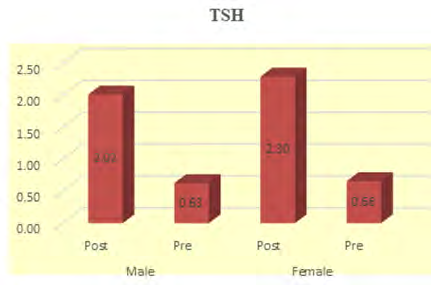
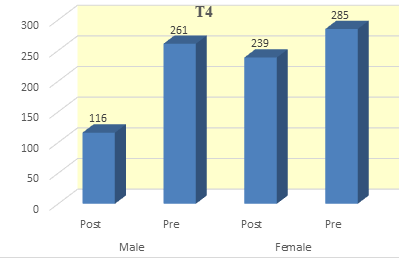
Table 3 showed a significant difference between pre- and post-exam T4 levels (260.98 ± 87.52 pg/mL and 116 ± 33.57 pg/mL, respectively) in males when compared with females (285.07 ± 103.78 pg/mL and 238.56 ± 84.79 pg/mL, respectively) in Figure 2.
| Gender | Post | Pre | Sample |
|---|---|---|---|
| Mean ± SD | Mean ± SD | ||
| Male | 116 ± 33.57 | 260.98 ± 87.52 | 20 |
| Female | 238.56 ± 84.79 | 285.07 ± 103.78 | 25 |
| * p-value < 0.000** |
Table 3: Mean serum T4 in pre and post exam.
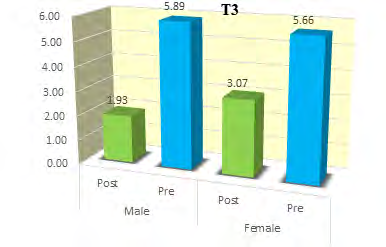
T3 levels were found to differ significantly between pre- and post-exam (5.66 ± 2.31 pg/mL, 3.07 ± 2.3 pg/mL resapactival) in Table 4. Also, in males, there was a significant difference between pre-and post-exam (5.9 ± 2.4 pg/mL and 1.93 ± 0.32 pg/mL, respectively; see Figure 3.
| Gender | Post | Pre | Sample |
|---|---|---|---|
| Mean ± SD | Mean ± SD | ||
| Male | 1.93 ± 0.32 | 5.9 ± 2.4 | 20 |
| Female | 3.07 ± 2.3 | 5.66 ± 2.31 | 25 |
| * p-value < 0.000** |
Table 4: Also, in males, there was a significant difference between pre-and post-exam (5.9 ± 2.4 pg/mL and 1.93 ± 0.32 pg/mL, res
Discussion
Mental stress causes significant psychological and physiological arousal. This response pattern is characterized by marked increases in the thyroid gland, suggesting the involvement of co-adrenergic activation [13, 14]. These results were discussed and compared with the relevant research from this perspective. In this study, we found significant changes in the function of the thyroid gland as a result of psychological stress mixed with stress, which was reflected in significant changes in the level of its hormonal status. The TSH, T3, and T4 have a significant difference between pre-and post-exam values. These changes may well be explained by the action of increased plasma catecholamine concentrations during mental stress. A previous report showed that increases occurred in several areas. After the mental calculation was completed, these increased TSH values returned to their pre-stress levels [14]. Our study showed a significant difference between the value of the TSH (the key hormone) levels before and after the test in both males and females. These differences were highly significant from a statistical point of view [15].
Stress increases the production of the hormone cortisol, which is secreted by the adrenal glands. Cortisol can inhibit pituitary TSH secretion, resulting in partial inhibition of thyroid hormone. Altered cortisol levels may be a result of early stress-induced programming of the HPA axis [16]. All of these studies suggest a physiological feedback loop in which decreased thyroid function leads to increased cortisol, which is then fed back to re-produce This hypothesis is consistent with the hypothesis that cortisol is elevated in primary hypothyroidism (high TSH), but TSH is suppressed in primary cortisol elevation [17, 18]. There was also a significant difference between the T4 levels before and after the exam in males when compared with females. While there was a significant difference in T3 levels before and after the exam in females, these levels significantly increased during mental arithmetic but quickly returned to pre-stress levels after the stressor [19]. The present study partially agrees with previous findings of a T4 increase before testing, and we observed a significant decrease in T4 level after completion of testing; the possible reason for increased thyroid hormone levels may be due to pituitary secretion [19]. A particular outcome of thyroid function may depend on the severity of stress, intellectual focus, and thinking [20, 21]. Additional research into the mechanisms of stress- induced thyroid function deficits is of relevance given the detrimental effects of thyroid deficiency on the body, particularly in cases of subclinical thyroid insufficiency [22].
Conclusion
Mental stress interferes with the central regulation of TSH levels.
References
-
Chiasera JM (2013) Back to the basics: thyroid gland structure, function and pathology. Clinical Laboratory Science 26(2): 112.
-
Elia ZN, AL-Mahdawi, Berwary NJA (2019) Estimation of Anti-thyroglobulin and Anti-Thyroid peroxidase among thalassemia major patients. Annal of Tropical Medicne and Public Health 22: 12.
-
Majeed HM, Mohammed MR, AL-Wandi, Ibrahim FK (2012) Association between chronic renal failure and thyroid hormone. Diyala Journal of Medicine 3(1): 62-66.
-
Curi R, Mendes RDS, Crispin LAD, Norata GD, Sampaio SC, et al. (2017) A past and present overview of macrophage metabolism and functional outcomes. Clinical Science 131(12): 1329-1342.
-
Gigena N, Alamino VA, Montesinos MDM, Nazar M, Louzada RA, et al. (2017) Dissecting thyroid hormone transport and metabolism in dendritic cells. J Endocrinol 232(2): 337-350.
-
Galton VA, Schneider MJ, Clark AS, St Germain DL (2009) Life without thyroxine to 3, 5, 3′-triiodothyronine conversion: studies in mice devoid of the 5′-deiodinases. Endocrinology 150(6): 2957-2963.
-
Angelousi A, Margioris AN, Tsatsanis C (2020) ACTH action on the adrenals. Endotext.
-
Krantz D S, Manuck SB (1984) Acute psychophysiologic reactivity and risk of cardiovascular disease: a review and methodologic critique. Psychological bulletin 96(3): 435-464.
-
Schneiderman N, Ironson G, Siegel SD (2005) Stress and health: psychological, behavioral, and biological determinants. Annual review of clinical psychology 1: 607-628.
-
Yohe LR, Suzuki H, Lucas LR (2012) Aggression is suppressed by acute stress but induced by chronic stress: Immobilization effects on aggression, hormones, and cortical 5-HT1B/striatal dopamine D2 receptor density. Cognitive, Affective, & Behavioral Neuroscience 12(3): 446-459.
-
De Padova S, Urbini M, Schepisi G, Virga A, Meggiolaro E, et al. (2021) Immunosenescence in testicular cancer survivors: potential implications of cancer therapies and psychological distress. Frontiers in Oncology 10: 564346.
-
McLeod S, Berry K, Taylor P, Wearden A (2021) Romantic attachment and support preferences in new mothers: The moderating role of stress. Journal of Social and Personal Relationships 38(5): 1535-1552.
-
Jara EL, Muñoz-Durango N, Llanos C, Fardella C, González PA, et al. (2017) Modulating the function of the immune system by thyroid hormones and thyrotropin. Immunology letters 184: 76-83.
-
Hodkinson CF, Simpson EE, Beattie JH, O’Connor JM, Campbell DJ, et al. (2009) Preliminary evidence of immune function modulation by thyroid hormones in healthy men and women aged 55-70 years. Journal of endocrinology 202(1): 55-63.
-
Hawkins AT, Samuels LR (2021) Use of confidence intervals in interpreting nonstatistically significant results. JAMA 326(20): 2068-2069.
-
Helmreich DL, Tylee D (2011) Thyroid hormone regulation by stress and behavioral differences in adult male rats. Hormones and Behavior 60(3): 284-291.
-
Uddin LQ, Supekar K, Menon V (2013) Reconceptualizing functional brain connectivity in autism from a developmental perspective. Frontiers in Human Neuroscience 7: 458.
-
Deary M, Buckey T, Soldin OP (2012) TSH-clinical aspects of its use in determining thyroid disease in the elderly. How does it impact the practice of medicine in aging?. Advances in Pharmacoepidemiology & Drug Safety 1(119): 9369.
-
Samuels MH (2000) Effects of variations in physiological cortisol levels on thyrotropin secretion in subjects with adrenal insufficiency: a clinical research center study. The Journal of Clinical Endocrinology & Metabolism 85(4): 1388-1393.
-
Ngun TC, Ghahramani N, Sánchez FJ, Bocklandt S, Vilain E (2011) The genetics of sex differences in brain and behavior. Frontiers in Neuroendocrinology 32(2): 227- 246.
-
Aoki Y, Belin RM, Clickner R, Jeffries R, Phillips L, et al. (2007) Serum TSH and total T4 in the United States population and their association with participant characteristics: National Health and Nutrition Examination Survey (NHANES 1999–2002). Thyroid 17(12): 1211-1223.
-
Nadol’nik LI (2010) Stress and the thyroid gland. Biomed Khim 56(4): 443-456.
- Genomic Landscape of Aggressive Penile Squamous Cell Carcinoma including TERT-p and NOTCH1 Mutations – An Institutional Experience
- Establishment of Baseline Haematological Values for Canine Population in North-Central Nigeria: A Cross-Sectional Study in the Federal Capital Territory
- Biochemical Assessment of Uroliths Extracted in Patients with Urolithiasis in a Tertiary Health Institution
- Update on Gastrointestinal Pecomas: Molecular Pathogenesis and Risk Stratification
- A Comparative Study of Serum C-reactive Protein Level Between Pre-eclampsia and Normal Pregnancy in Tertiary Level Hospital
- From Deformity to Alignment: Clinical Outcomes of the Schnepp Osteotomy in Hallux Valgus in 47 Feet