
Fatigue Evaluation in Manual Handling Using Surface EMG and Ergonomic Design of Trolley
Musculoskeletal disorder (MSD) is one of the major health problems that are related to physical labour especially in jobs requiring manual work and the muscle fatigue is considered to be closely related to the muscle-related disorders. In addition to the existing techniques for fatigue assessment, the present research focuses on the use of electromyography for analyzing the fatigue at the workplace. This method calculates the fatigue at the muscular level which helps in evaluating the exact risk for further analysis. Since the spine is the most affected part during manual handling, the present research focuses on the muscle activity of spine for comparison of the risks associated with manual handling as well as using the trolley. The lifting of scrap load obtained from stretch forming machine in an industry is analyzed and an ergonomically designed trolley is suggested for lifting and carrying. The main objective of this research is to design the optimum handle height of the trolley which induces lower compressive stresses on the spine. The experimental values obtained for muscle activity of spine is compared with the data obtained from motion analysis using biomechanical software using 3DSSPP. The percentage reduction of muscle fatigue analysis is compared with Revised NIOSH lifting equation. It infers that the use of trolley for material handling significantly reduced the fatigue than manual material handling.
Introduction
Manual material handling (MMH) is the activity performed without the aid of mechanical devices. MMH includes an activity like lifting, lowering, pushing, pulling, carrying or moving a load with hands or by the body force. Muscle fatigue is defined as “any reduction in the ability to exert force in response to the voluntary effort” and it is believed that the muscle fatigue is one of the potential reasons for musculoskeletal disorders (MSDs). EMG is a commonly used technique to evaluate muscular activity. It is the measure of electrical potential present on the skin in consequence to a muscle contraction that represents the neuromuscular activities [1]. Analysis of EMG recordings is important for assessing the muscle activation, its relationship to the force developed during specific tasks and for evaluating fatigue processes occurring in response to physical activity. Srinivasan and Venkatesh [2] have analyzed the muscle fatigue and low back pain using EMG. Hahn et al. [3] analyzed the factors affecting the muscle activity of young and old people. The people were asked to walk through a particular distance and analyzed their ability to walk. Moreover, the persons are made to cross obstacles of different height just to analyze their muscle activity and concluded that the muscle activity decreases with increase in age. Hoozemans et al. [4] provided a different approach for the evaluation of pushing activities by quantifying the compressive force at low back and net shoulder moment using generalized estimating equations (GEE). Singh and Sunand Kumar [5] conducted a study that demands several factors to be examined to determine an ergonomically correct lifting station. The NIOSH lifting equation was designed to evaluate the risk of lifting tasks with respect to low back injury. Although the NIOSH equation has been available since 1991, very little is known about the practical implication of the Recommended Weight Limit (RWL) under real-life situations. Fethke, et al. [6] analyzed the ware-house manual handling tasks using REBA and NIOSH lifting equation to assess the discomfort. The design of two-step stair and a trolley with flexible height and also changes in working methods were recommended by introducing workers lifting, job rotation and changing plant layout. Halim and Abdul [7] focused on metal stamping factory to examine working posture, oxygen consumption and muscle activity. They conducted a test with workload category and used REBA and surface EMG to evaluate activity. Based on the results they modified the working area to reduce the impact on the physiological performance of the worker. Based on the results of muscular activity and postures, the method that characteristics work time consumption and physical workload was devised. The basic idea is to combine technical and human aspects in designing the workplace ergonomically. From the literature review, it is observed that the most commonly used evaluation methods are lacking in actual determination of fatigue and cause of musculoskeletal disorders. The tools like REBA, RULA are the easiest methods to evaluate the level of discomfort and risk and it is not of great use in the field of ergonomics due to technological advancements and it is best suitable for the academic and industrial application. sEMG, Revised NIOSH lifting equation and calculation are mostly used to find out the muscular activity, risk, and recommended load limit but these tools require some knowledge to use and it needs some mathematical and computer calculations. But these tools are accurate than REBA and RULA in determining the fatigue and muscular risk compared to other tools and helps in the design of ergonomics aspects of the workplace along with suggesting some recommendations which is not much addressed. The objective of this research is to evaluate fatigue using sEMG in a workplace for various postures and to perform a simulation with various ergonomic conditions using biomechanical software which is not carried out.
Methodology
Experiment
The experiment was conducted in the working environment of the stretch forming process as shown in Figure 1, where the scrap load is handled on to the trolley. The surface EMG is used for recording and analyzing the EMG data. Electromyography (EMG) has been around since 1600, is a tool to measure the action potentials of motor units in muscles. The subject’s arm is shaved and the BD Alcohol Swabs of 70 % Isopropyl Alcohol is used in skin preparation cleanser process, then the hand is allowed to dry before it is rubbed with the Signa Gel, the250g tube which is highly conductive multi-purpose and attaching with electrodes (Ag/AgCl, 10 mm diameter).
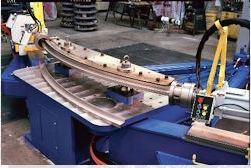
Figure 1: Stretch forming machine. The surface electromyography (sEMG) electrode was placed on the biceps brachii position, longissimus muscle of erector spinae. The electrode was used to collect the muscular activity of the worker. Surface EMG electrodes Balasubramanian KR, et al. Fatigue Evaluation in Manual Handling Using Surface EMG and Ergonomic Design of Trolley. Ergonomics Int J 2018, 2(3): 000145.
attached at the spine as input and reference electrode location. EMG works analysis software is used in the analysis of the signal. The sampling frequency used is 1500 Hz and a low pass filter with the range of 0-500 Hz is used to filter the EMG signal. This window produces the best results for the EMG signal to be analysed. Based on the pattern of the signals, this study can identify the fatigue of the muscles involved in manual lifting. MVC normalization is a technique commonly used for amplitude analysis of EMG signals. This method uses a maximum root mean square (RMS) value from the recording to normalize the subsequent EMG data series. The output is displayed as a percentage of the MVC to easily establish a common ground when comparing data between subjects. EMG signals have a user-dependent nature, causing recordings to differ even when measuring from the same location with the same motion. Therefore, MVC normalization is used in order to eliminate this variance and allow for data comparison between subjects to take place.
Selection of Subject
Significant factors that are considered during the selection of the person (subject) is given below. a) The person should not have a history of bone damage b) The person must be free from pain for minimum of three weeks c) The person should not be a victim of cerebral palsy. d) Persons with age other than the age group 40-50 years should be avoided.
Experiment Procedure
For the analysis, 25 healthy male with age of 22-26 years, height 165-175 cm and body mass of 65-75 kg, who does not have any history of muscle diseases/injuries or bone fractures, are selected. • All the persons are fully aware of the experiments before participating in it.
• All the persons are advised to take rest for a period of
30 minutes before the experiment to avoid errors while taking the measurement.
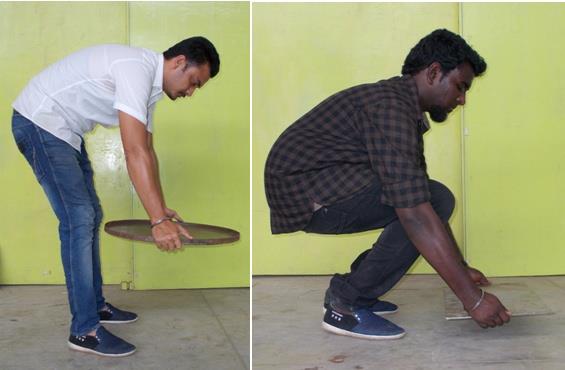
• The protocol consists of manual lifting of 35kg scrap box and placing it on the trolley. Experiments are done during lifting and handling of the box using trolley as well as during manual handling. Figure 2 shows the posture during handling the boxes.
• All the persons are instructed to maintain a comfortable posture throughout the testing session.
• Trolleys of different handle heights in the range of 85-
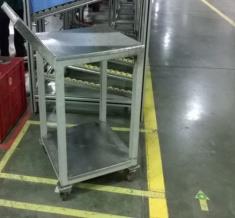
125 cm are chosen for doing the experiment. One such a trolley is given in Figure 3.
• Muscle activity is measured during manual lifting of
35kg scrap box onto the trolley (For both Biceps brachii medial and Erector spine muscle of each participant).
• Muscle activity is measured during lifting and handling of 35kg scrap box using trolleys of three different heights 85cm, 105cm, 125cm (For both Biceps brachii medial and Erector spine muscle of each participant).
• While measuring the muscle activity, the experiment is carried on for both rights and left part of the spinal muscles.
• After each measurement, the subject is rested before doing the next measurement to avoid fatigue.
Balasubramanian KR, et al. Fatigue Evaluation in Manual Handling Using Surface EMG and Ergonomic Design of Trolley. Ergonomics Int J 2018, 2(3): 000145.
Placement of Electrodes
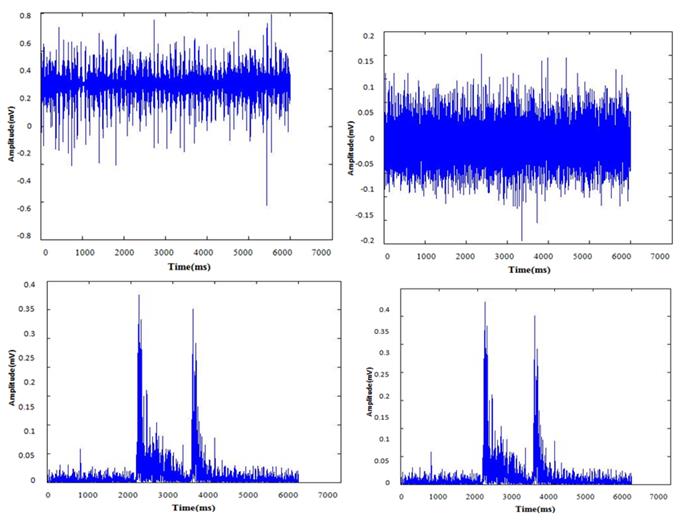
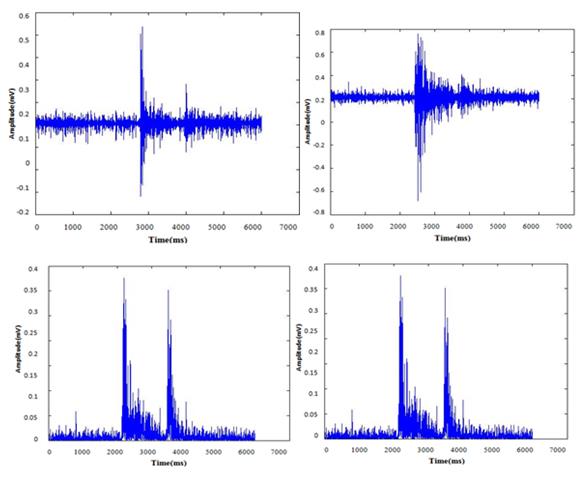
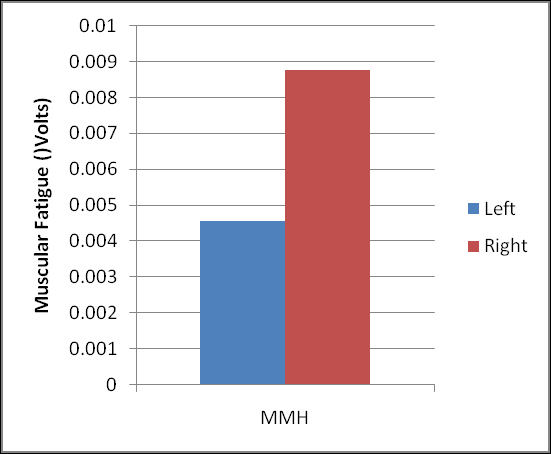
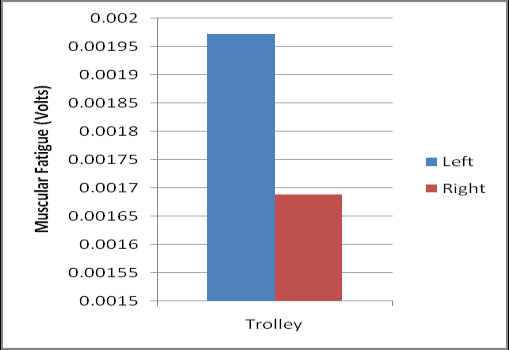
The placement of electrodes is an important factor in the measurement of surface Electromyography. Electrodes are placed across the muscle for which the fatigue is to be determined. Three electrodes are used in the determination of muscle fatigue; a positive, a negative and a ground electrode. All the three electrodes are in the three different colours; red, white and black. The positive and the negative electrodes are placed in the surface where the muscle fatigue is to be determined. The ground electrodes are placed in the bone. • The longissimus and iliocostalis muscle groups are Figure 4 and 5 shows the EMG signal of manual lifting and by using trolley of 85cm height of an employee respectively with amplitude variation showing the spine compression while handling the load and by using the trolley, Figure6 and 7 shows the left and right muscular fatigue of spine of an employee during manual material handling and using trolley respectively. The results conclude that the trolley lifting reduces the muscular fatigue. The percentage of reduction in the left spine is 49.2% and right spine is 78.8%. From the analysis, it is observed that optimal handle height of the trolley should be of 105 cm height as the results conclude that the trolley reduces the muscular fatigue. The percentage of reduction in left and right spine are 67.9% and 79.78%.
chosen since the sagittal lifting task is expected to produce significant muscle activities from these two muscle groups.
- The electrolytic gel was then applied and the electrodes were attached to the skin with double-faced adhesive tape on the cleaned skin surface of the right longissimus and iliocostalis muscle group.
- For the longissimus muscle group, the electrodes were centred 3 cm lateral to the midline at the first lumbar vertebra. For the iliocostalis muscle group, the electrode was centred at 6 cm lateral to the midline at the third lumbar vertebra. Results
EMG data
Balasubramanian KR, et al. Fatigue Evaluation in Manual Handling Using Surface EMG and Ergonomic Design of Trolley. Ergonomics Int J 2018, 2(3): 000145.
NIOSH Lifting Equation Worksheet
The NIOSH lifting equation is a method to assess the risk of low-back disorders in jobs with repeated lifting. It consists of two primary products, the recommended weight limit (RWL) and lifting index (LI). The RWL is defined for a specific set of task condition as the weight of the load nearly all healthy workers could perform over a substantial period of time (up to 8 hrs) without an increased risk of developing lifting-related low pain. It is calculated as a product of the weight that is considered for an ideal lift (i.e. load constant equal to 23 kg) and six weighted task variables, multiplier values got from Revised NIOSH Lifting Equation Manual.
RWL = LC x HM x VM x DM x AM x FM x CM
LC - Load Constant; HM - Horizontal Multiplier; VM - Vertical Multiplier; DM - Distance Multiplier; AM - Asymmetric Multiplier; FM - Frequency Multiplier; CM - Coupling Multiplier, Lifting index (LI); LI = Load Weight / RWL
Using the RWL and LI to Guide Ergonomic Design
The recommended weight limit (RWL) and lifting index (l1) can be used to guide ergonomic design in several ways:
Balasubramanian KR, et al. Fatigue Evaluation in Manual Handling Using Surface EMG and Ergonomic Design of Trolley. Ergonomics Int J 2018, 2(3): 000145.
1. The individual multipliers can be used to identify specific job-related problems. The relative magnitude of each multiplier indicates the relative contribution of each task factor (e.g., horizontal, vertical, frequency, etc.)
2. The RWL can be used to guide the redesign of existing manual lifting jobs or to design new manual lifting jobs. For example, if the task variables are fixed, then the maximum weight of the load could be selected so as not to exceed the RWL; if the weight is fixed, then the task variables could be optimized so as not to exceed the RWL.
3. The LI can be used to estimate the relative magnitude of physical stress for a task or job. The greater the LI, the smaller the fraction of workers will be capable of safely sustaining the level of activity. Thus, two or more job designs could be compared.
4. The LI can be used to prioritize ergonomic redesign.
For example, a series of suspected hazardous jobs could be rank ordered according to the LI and a control strategy could be developed according to the rank ordering (i.e., jobs with lifting indices above 1.0 or higher benefit the most from redesign).
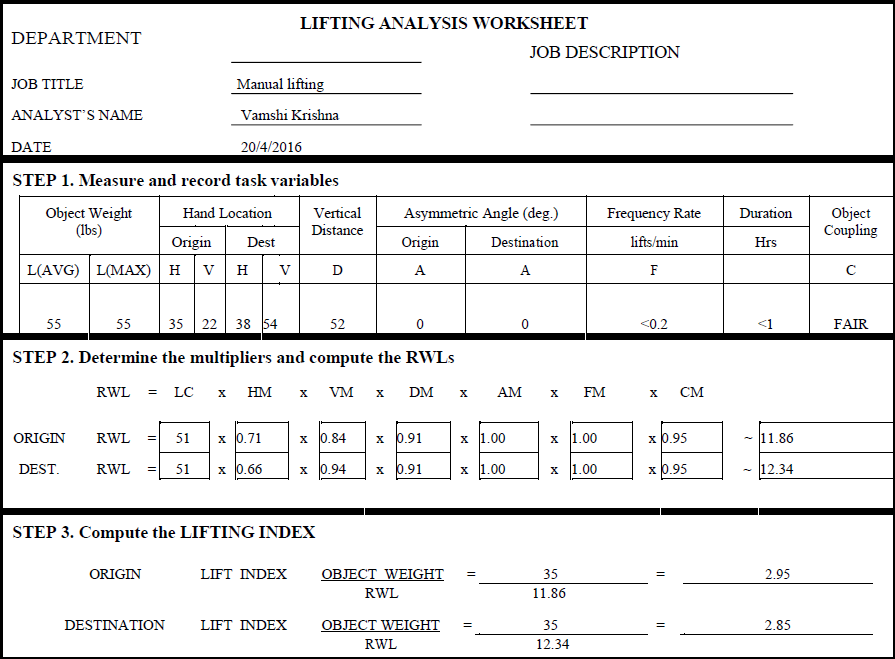
The NIOSH Recommended Weight Limit (RWL) equation and Lifting Index (LI) are based on the concept that the risk of lifting-related low back pain increases as the demands of the lifting task increase. In other words, as the magnitude of the LI increases. (1) The level of the risk for a given worker would be increased, and (2) A greater percentage of the workforce is likely to be at risk of developing lifting-related low back pain. The lifting index (LI) can be used to assess the relative risk of different lifting tasks. When the LI is greater than 1.0, there is an increased risk of lifting-related low back pain and changes should be considered. NIOSH also suggests that when the LI is greater than or equal to 3.0, the risk of lifting-related low back injury is very high and that almost all workers would be at an increased risk. Figure 8 and 9 shows the lifting analysis worksheet for manual lifting and using trolley respectively.
Balasubramanian KR, et al. Fatigue Evaluation in Manual Handling Using Surface EMG and Ergonomic Design of Trolley. Ergonomics Int J 2018, 2(3): 000145.
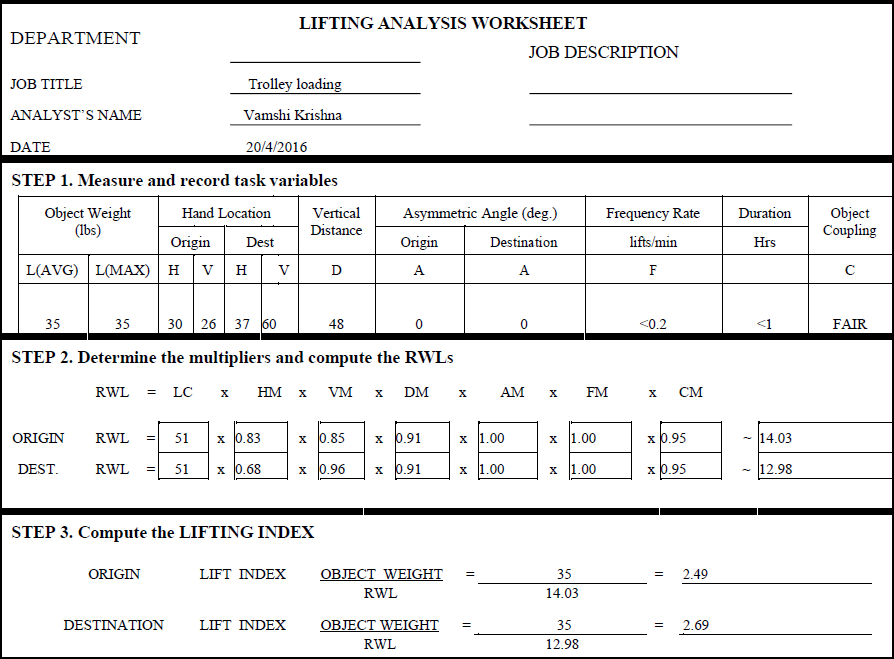
Origin RWL = 51x0.83x0.85x0.91x1x1x0.95 RWL= 14.03; LI = 35/11.86 = 2.49 Destination RWL = 51x0.68x0.96x0.91x1x1x0.95 RWL = 12.98; LI = 35/12.34 = 2.69 Figure 9: Lifting analysis worksheet using trolley.
Hazard and Risk Assessment
The value of lifting index and recommended weight limit indicates that the job is slightly stressful at the origin but moderately stressful at the destination of lift. Biomechanical Approach For the calculation of forces and moments on the joints of body parts, 3DSSPP software is used. In most industrial tasks, such as pushing, pulling, lifting with one hand, and when body twisting is involved, asymmetric loading on the human body occurs quite often. The techniques used to analyze human motion in the sagittal plane are no longer feasible to take care of this more complicated situation. Under such uneven exertions or body movement, it is necessary to utilize three-dimensional analysis techniques to depict and solve the force and moment components of the body. In a three dimensional orthogonal co-ordinate system, the following Newton’s
equilibrated equations must be met when the system is
under static or quasi-static equilibrium situation:
$$ \begin{array}{l} F _ {X} = 0 F _ {Y} = 0 F _ {Z} = 0 \mathrm {a n d} \\ M _ {X} = 0 M _ {Y} = 0 M _ {Z} = 0 \\ \end{array} $$
Where FX, FY, FZ = summation of forces in x, y, z direction
respectively
MX, MY,MZ = summation of moments in x, y, z direction
respectively.
Forces are vector quantities with four characters:
magnitude, direction, line of action and point of
application. There are three types of forces constituting
all the forces acting on the total body system [8]:
• Gravitational forces, acting downward through the centre of mass of each segment, with magnitudes equal to the mass times acceleration due to gravity.
Balasubramanian KR, et al. Fatigue Evaluation in Manual Handling Using Surface EMG and Ergonomic Design of Trolley. Ergonomics Int J 2018, 2(3): 000145.
- Ground reaction or external forces, due to applied work load and body segment weights.
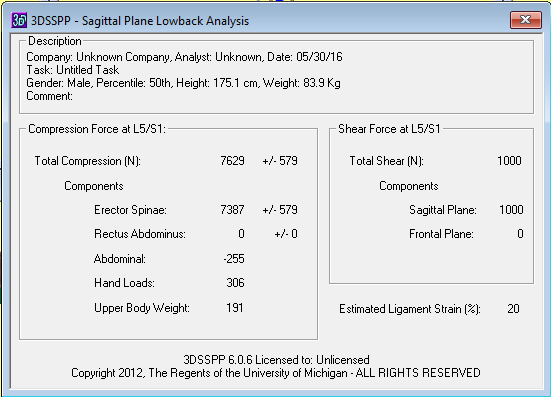
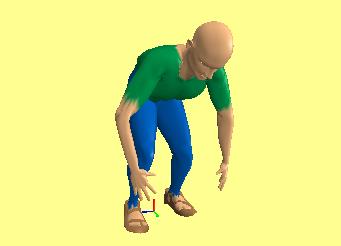
- Muscle forces, expressed in terms of net muscle moment acting at joint. Some other forces such as joint frictions and forces within the muscle cannot be separated from these net values. Two postures are drawn using this software for comparison of body strength capabilities Posture1: Figure 10 shows the manual lifting of 35kg by humans of anthropometric data 50th percentile and body measurements is taken from the photograph taken during that activity.
Case 1: Manual lifting of 35kg As observed in Posture 1 from Figure 12, i.e. during manual lifting compressive force on the erector spinae is 7387N. As it is observed, various body joints like wrist, shoulder, torso, and hip are more affected during manual lifting.
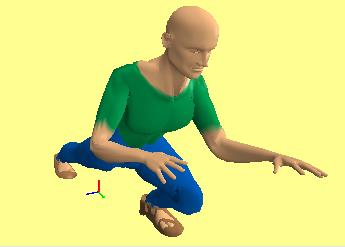
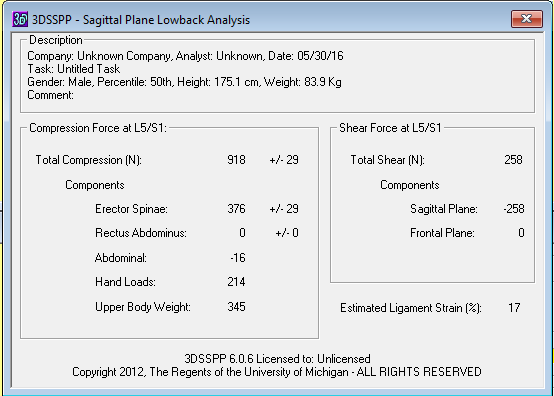
Figure 12: Posture 1 Compressive and shear forces on spine for manual lifting. Case 2: Pushing the trolley device with initial force of 193.12N As observed in posture 2 from Figure 11, i.e. during manual pushing of the trolley forward, compressive force on the erector spinae is 376N which is much below the compressive force on erector spinae of 7387N during manual lifting. Biomechanical software results also stated percentage reduction of muscular fatigue in the spine is 91.9%. As it is observed, various body joints like wrist, shoulder, torso, and hip are less affected compared to manual lifting when lifting trolley is used.
Balasubramanian KR, et al. Fatigue Evaluation in Manual Handling Using Surface EMG and Ergonomic Design of Trolley. Ergonomics Int J 2018, 2(3): 000145.
Conclusion
This research has analyzed the fatigue experienced by the MMH working posture of the operators using sEMG, 3DSSPP software and identified major areas causing long last injury of operators due to poor ergonomics and MMH system. In this study, the muscular fatigue property which is identified as the main reason for poor performance in manual material handling is analyzed for three different workers and the results were compared with the fatigue levels of material handling by the use of trolley by varying the height of the holding handle.
- The analysis tools used are Revised NIOSH Lifting equation, sEMG and Biomechanical software 3DSSPP. Each and every tool is used to analyze manual lifting and lifting by using trolley.
- In the sEMG analysis, the percentage of reduction of fatigue in the left and right spine is 67.9% and 79.78%. Based on the sEMG analysis results, it is clearly concluded that by using the trolley for handling load reduced the muscular fatigue to a greater extent and the optimal handle height of the trolley is decided as 105cm.
- In the REBA posture assessment tool, the results give a LOW category which means the trolley has reduced the risk significantly.
- In the conventional analysis method, it is seen that about 67.17% of the force is reduced by the use of trolley in handling compared to manual handling. Likewise, the other ergonomic analysis tools also gave the similar results of reduction in fatigue levels.
- In NIOSH calculation tool, lifting index comes under the recommended weight lifting (RWL) region under prescribed NIOSH range and percentage of reduction in the lifting index value is 56.14%.
- Biomechanical software results also stated the percentage of reduction of muscular fatigue in the spine as 91.9%.
Ergonomics International Journal
- From the results, it clearly indicates that the use of trolley for material handling significantly reduced the fatigue than manual material handling.
References
-
Merlo A, Isabella C (2010) Technical aspects of surface electromyography for clinicians. The open rehabilitation journal 3(1): 98-109.
-
Srinivasan J, Balasubramanian V (2007) Low back pain and muscle fatigue due to road cycling-An sEMG study. Journal of Bodywork and Movement Therapies 11(3): 260-266.
-
Hahn ME, Lee HJ, Chou LS (2005) Increased muscular challenge in older adults during obstructed gait. Gait & posture 22(4): 356-361.
-
Hoozemans MJ, Kuijer PP, Kingma I, van Dieen JH, de Vries WH, et al. (2004) Mechanical loading of the low back and shoulders during pushing and pulling activities. Ergonomics 47(1): 1-18.
-
Singh Sarbjeet, Sunand Kumar (2012) Factorial analysis of lifting task to determine the effect of different parameters and interactions. Journal of Manufacturing Technology Management 23(7): 947-953.
-
Fethke NB, Gant LC, Gerr F (2011) Comparison of biomechanical loading during use of conventional stud welding equipment and an alternate system. Applied ergonomics 42(5): 725-734.
-
Halim Isa, Abdul Rahman Omar (2011) A review on health effects associated with prolonged standing in the industrial workplaces. IJRRAS 8(1): 14-21.
-
Pierrynowski MR, Winter DA, Norman RW (1980) Transfers of mechanical energy within the total body and mechanical efficiency during treadmill walking. Ergonomics 23(2): 147-156.
- The Expanding Landscape of Road Rage: A Systematic Review of Conflicts Involving Drivers, Pedestrians, and Micromobility
- Validating Cognitive Models of Royal Navy Performance on Control Systems
- Comparing Standard and State-of-the-art Firefighter Coats on Postural Balance and Gait in a Live Burn Environment
- Investigating the Integration of Telemedicine into Clinicians Workflow: A Review of Methods
- Risk Assessment of Ergonomic Factors in a Textile Firm by RULA, REBA and Fine Kinney Methods
- Impact of Self-Esteem Training on Individuals with Disabilities Aged 17-30