
Assessment of Sustainable Development of New Ergonomics Aid for the Betterment of Job Procedure in Ridging Activity in Potato Cultivation among the Farmers of West Bengal, India
The study deals with the assessment of musculoskeletal disorder among the potato farmers in ridging activity and to implement new ergonomic aid for the betterment of job procedure and improvement of productivity, health and safety of the workers. Two hundred sixty two potato farmers were randomly selected from the villages of West Bengal, India, to evaluate musculoskeletal disorder. Modified Nordic questionnaire studies and discomfort level scale along with hand grip strength were assessed among the potato farmers before and after using the ergonomic aid in ridging activity. After implementing the newly designed ergonomic aid, a maximum decrease in discomfort feeling, especially at the wrist, hand and shoulder and at the lower back region of the body, is observed. Thus the application of ergonomic aid in ridging activity in potato cultivation has significantly increased the productivity of the workers by decreasing the absenteeism from work among both the groups of workers.
Introduction
Agriculture is one of the few industries in which farmers as consider as integral component of the work force. They are performing physical demanding jobs that are typically designed for adults [1]. The farmers were suffering from musculoskeletal disorder, especially the Assessment of Sustainable Development of New Ergonomics Aid for the Betterment of Job Procedure in Ridging Activity in Potato Cultivation among the Farmers of West Bengal, India low back pain. Sekimpi [2] also stated that the hand hoe and other hand tools used by the farmers in a stooped posture for a prolonged period in many developing countries were mainly responsible for musculoskeletal disorder, because machinery imported into developing countries is often not ergonomically designed for the local population. According to Sekimpi [2], musculoskeletal Ergonomics Int J
pain especially the back pain in particular most common among the farmers. He also believed that the newly ergonomically design agricultural hand tools and machinery reduce the work load and musculoskeletal disorder among farmers. Occupational agricultural injury is also one of the main problems among the farmers, which may lead to physical disability among them due to working with a not ergonomically designed hand tools [3, 4].
Ergonomics interventions can provide educational, engineering and environmental solutions to help reduce the potential for strains and sprains that decrease a worker’s productivity level and may lead to more serious injuries. Research on ergonomics in agriculture is limited in comparison to manufacturing and other industries. Mitchell, et al. [5] investigated the effectiveness of back supports in reducing back injuries. According to Martin, et al. [6] recommendation for preventing low back pain, the backrest or lumbar support should be adjusted to the subject’s lower back according to the working condition.
The present study deals with ridging activity in potato cultivation. Ridging is a process in which soil was protruded by iron containing two or three columns with iron band wheels (ridger) which mainly rotate freely on the soil to protrude the soil before the potato seed is planted. In irrigated farming system, water is fed into the ditches between the ridges [7]. Ridging activity in potato cultivation was generally done by pulling the device with both hands without back support, which may lead to severe discomfort feeling (pain) to the subjects.
The present study deals with (i) the assessment and identification of the risk factors leading to the development of musculoskeletal disorder during potato cultivation among the potato farmers. (ii) To modify the existing work organization and implement the ergonomics modifications by sustainable development of new ergonomics aid for the betterment of job procedure for the improvement of productivity, health and safety of the workers
Materials and Methods
Selection of Subjects
The study was performed on total 262 farmers (potato cultivators), which was randomly selected from the villages of Tarakeswar of West Bengal comprising 140 male and 122 female. The selected subjects were same farmers, which was surveyed once a year for 6 years. So it is a panel data over 6 years. Prior permission and ethical approval was obtained from local community leaders as well as relevant authorities before commencement of the study.
Questionnaire Study
A detailed longitudinal study based on a modified Nordic questionnaire [8] was performed among these potato cultivators for six years (2011-2016). The questionnaires were performed mainly to assess the discomfort feeling before and after using the newly designed ergonomics aid in ridging activity. The questionnaire comprised a series of objective questions with multiple-choice responses. The questions were grouped into the following major sections, dealing with: individual details, type of work, upper extremities musculoskeletal symptoms, other affected body parts etc. For the symptom survey, the subjects were enquired whether they suffered from tenderness, swelling and warmth in the wrist and from pain numbness and tingling in the hands.
Discomfort Level Scale
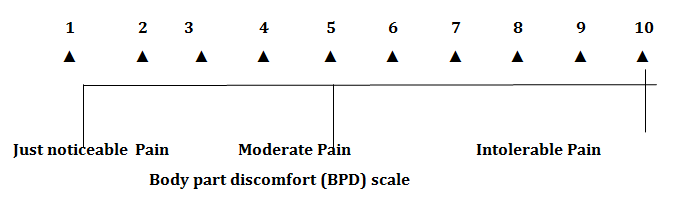
The intensity of pain feeling/discomfort feeling is measured by utilizing the body part discomfort (BPD) scale [9]. The rating of each body part on a scale from 1 to 10 was done to indicate the level of discomfort. In this 1 to 10 point scale for discomfort and pain sensation, where 1 represented just noticeable pain, point 5 scales represented moderate pain or discomfort and point 10 scale represented intolerable pain or discomfort.
Banibrata Das. Assessment of Sustainable Development of New Ergonomics Aid for the Betterment of Job Procedure in Ridging Activity in Potato Cultivation among the Farmers of West Bengal, India. Ergonomics Int J 2019, 3(1): 000189.
Measurement of Hand Grip Strength
Handgrip dynamometer, a hand-held device for measuring maximum static force exerted by the hand. The farmers perform pulling activities (Manual material handling) during activity, by which the strength of the hand muscle alters among the workers, which was measured by hand grip dynamometer. This result was supported by [10]. According to them Hand grip strength has been identified as one limiting factor for manual lifting and carrying loads. A physical examination was performed by hand grip dynamometer (Make: Rolex, India) to measure the handgrip strength of the farmers. The farmers were asked in a straight and standing position without side bending, arms at their side, not touching their body and the dynamometer should be gripped with full force. The measurement of the dynamometer was generally done thrice in a day, prior ridging activity in potato cultivation, just after completion of ridging activity in potato cultivation without using ergonomic aid and just after completion of ridging activity in potato cultivation with using ergonomic aid among the farmers at 90º elbow flexion and 180º elbow flexion as it has been observed that highest and lowest value of grip strengths vary in accordance with the elbow position.
Design of Ergonomics Aid or Back Support
The adjustable ergonomics aid was mainly designed with nylon clothes, straps, plastic fiber & sponge to decrease discomfort feeling of the user. The sponge was placed in between the nylon clothes and plastic fiber for the betterment of back support. Two adjustable straps were made up of nylon clothes and sponge and were fixed at shoulders before use. Another two adjustable straps which were come out from the middle part of the back support and were attached with the handle of two spiked ploughing tool to provide support to the back region of the body during pulling in ridging activity. During ridging activity, the subjects used to pull the iron spike bearing ploughing tool with both the hands and without back support, which may lead to severe discomfort feeling (pain) to the subjects. Comparative study was made among the male and female farmers before and after using of the ergonomics aid in same place in same period of time.
Statistical Analysis
One way ANOVA was performed to determine any significant differences in the discomfort ratings of different body parts throughout the years among the male and female farmers. The F ratio of the ANOVA was used to determine the significant differences in discomfort feelings over the years. Omega square thereby estimates the strength of association between the two variables. ANOVA was also performed to compute the F ratio to find out whether there is any significant difference in between the hand grip strength in resting condition, just after stoppage of work without using ergonomics aid and just after stoppage of work with using ergonomics aid at 90º and 180º elbow flexion to measure the maximum static force exerted by the hand muscle in different working condition. One way ANOVA test was also performed to determine any significant differences in the assessing of body parts discomfort through body part discomfort (BPD) scale and absenteeism of work before and after using the ergonomics aid among the male and female farmers for the chosen level of significance (p<0.05). Linear correlation and regressions were performed to explore the magnitude and direction of association between two variables, viz. after using the ergonomic aid and workdays lost in the both groups of potato farmers. Statistical analysis was performed using the statistical package PRIMER OF BIOSTATISTICS (Primer of Biostatistics 5.0.msi, Msi Version = 1.20.1827.0, Primer for Windows, Mc-Graw-Hill).
Results
Table 1 represents discomfort feeling at different body parts of the male and female potato farmers before and after using of ergonomics aid in ridging activity in potato cultivation. Among all areas of the body, the lower back and wrist is the most affected region among the both group of potato farmers. Table 1 show that 67.9 percent male and 80.3 percent female potato farmers suffered pain in the lower back before using ergonomics aid in ridging activity. Whereas after using the ergonomics aid in ridging activity in potato cultivation the percentage of discomfort feeling in lower back of male and female become significantly less to 55.7 percent and 59.0 percent respectively after six years study. Wrist is another most affected region of the body due to pulling the ridger among the potato farmers. In 2011, 48.6 percent male and 61.5 percent female suffered from pain in the wrist region of the body without using the newly design ergonomics aid in ridging activity. This discomfort feeling (pain) in the wrist region of the body was little bit reduced after using the newly design ergonomics aid in last part of the year .In the year 2016, the percentage of discomfort feeling significantly reduce to 22.1 percent male and 18 percent.
Banibrata Das. Assessment of Sustainable Development of New Ergonomics Aid for the Betterment of Job Procedure in Ridging Activity in Potato Cultivation among the Farmers of West Bengal, India. Ergonomics Int J 2019, 3(1): 000189.
- Body Parts
- Potato Farmers
- Before Using
- Ergonomics Aid
- After Using Ergonomics Aid
- F value P value ω2
- 2011
- 2011
- 2012
- 2013
- 2014
- 2015
- 2016
- Sex
- Male
- (n=140)
- 60 (42.9%)
- 55
- (39.3%)
- 53
- (37.9%)
- 47
- (33.6%)
- 41
- (29.3%)
- 38
- (27.1%)
- 37
- (26.4%) 10.12 0.004 0.043
- Female
- (n=122)
- 68 (55.7%)
- 61
- (50.0%)
- Neck
- 58
- (47.5%)
- 53
- (43.4%)
- 47
- (38.5%)
- 45
- (36.9%)
- 39
- (32.0%)
- Male
- (n=140)
- 66 (47.1%)
- 60
- (42.9%)
- 57
- (40.7%)
- 52
- (37.1%)
- 48
- (34.3%)
- 44
- (31.4%)
- 42
- (30.0%) 8.56 0.006 0.036
- Female
- (n=122)
- 72 (59.0%)
- 65
- (53.3%)
- Shoulder
- 61
- (50.0%)
- 57
- (46.7%)
- 55
- (45.1%)
- 50
- (40.1%)
- 49
- (40.2%)
- Male
- (n=140)
- 63 (45.0%)
- 55
- (39.3%)
- 49
- (35.0%)
- 48
- (34.3%)
- 45
- (32.1%)
- 43
- (30.7%)
- 42
- (30.0%) 25.13
- 0
- 0.107
- Female
- (n=122)
- 65 (53.3%)
- 60
- (49.2%)
- Elbows
- 54
- (44.3%)
- 50
- (40.1%)
- 47
- (38.5%)
- 45
- (36.9%)
- 43
- (35.3%)
- Male
- (n=140)
- 68 (48.6%)
- 57
- (40.7%)
- 48
- (34.3%)
- 43
- (30.7%)
- 38
- (27.1%)
- 35
- (25.0%)
- 31
- (22.1%) 22.78
- 0
- 0.098
- Female
- (n=122)
- 75(61.5%)
- 64
- (52.4%)
- Wrists
- 58
- (47.5%)
- 47
- (38.5%)
- 36
- (29.5%)
- 31
- (25.4%)
- 22
- (18.0%)
- Male
- (n=140)
- 62 (44.3%)
- 58
- (41.4%)
- 50
- (35.7%)
- 45
- (32.1%)
- 40
- (28.6%)
- 38
- (27.1%)
- 37
- (26.4%) 23.43
- 0
- 0.1
- Female
- (n=122)
- 67(54.9%)
- 65(53.3%)
- 52
- (42.6%)
- Hands
- 50
- (40.1%)
- 44
- (36.1%)
- 41
- (33.6%)
- 39
- (32.0%)
- Male
- (n=140)
- 25 (17.9%)
- 24
- (17.1%)
- 23
- (16.4%)
- 23
- (16.4%)
- 23
- (16.4%)
- 22
- (15.7%)
- 20
- (14.3%) 0.77 0.615 1.148
- Female
- (n=122)
- 22 (18.0%)
- 20
- (16.4%)
- Upper back
- 20
- (16.4%)
- 19
- (15.6%)
- 18
- (14.7%)
- 18
- (14.7%)
- 16
- (13.1%)
- Male
- (n=140)
- 95 (67.9%)
- 92
- (65.7%)
- 87
- (62.1%)
- 82
- (58.6%)
- 81
- (57.8%)
- 79
- (56.4%)
- 78
- (55.7%) 14.06 0.001 0.061
- Female
- (n=122)
- 98 (80.3%)
- 97
- (79.5%)
- Lower back
- 94
- (77.0%)
- 85
- (69.7%)
- 81
- (66.4%)
- 75
- (61.5%)
- 72
- (59.0%)
- Male
- (n=140)
- 52 (37.1%)
- 50
- (35.7%)
- 47
- (33.6%)
- 46
- (32.9%)
- 44
- (31.4%)
- 41
- (29.3%)
- 41
- (29.3%) 0.93 0.528 3.498
- Female
- (n=122)
- 63 (51.6%)
- 60
- (49.2%)
- Knees
- 55
- (45.1%)
- 54
- (44.3%)
- 54
- (44.3%)
- 51
- (41.8%)
- 49
- (40.2%)
Table 1: Discomfort Feeling at Different Body Parts of the Male and Female Agricultural Workers Before and after using of
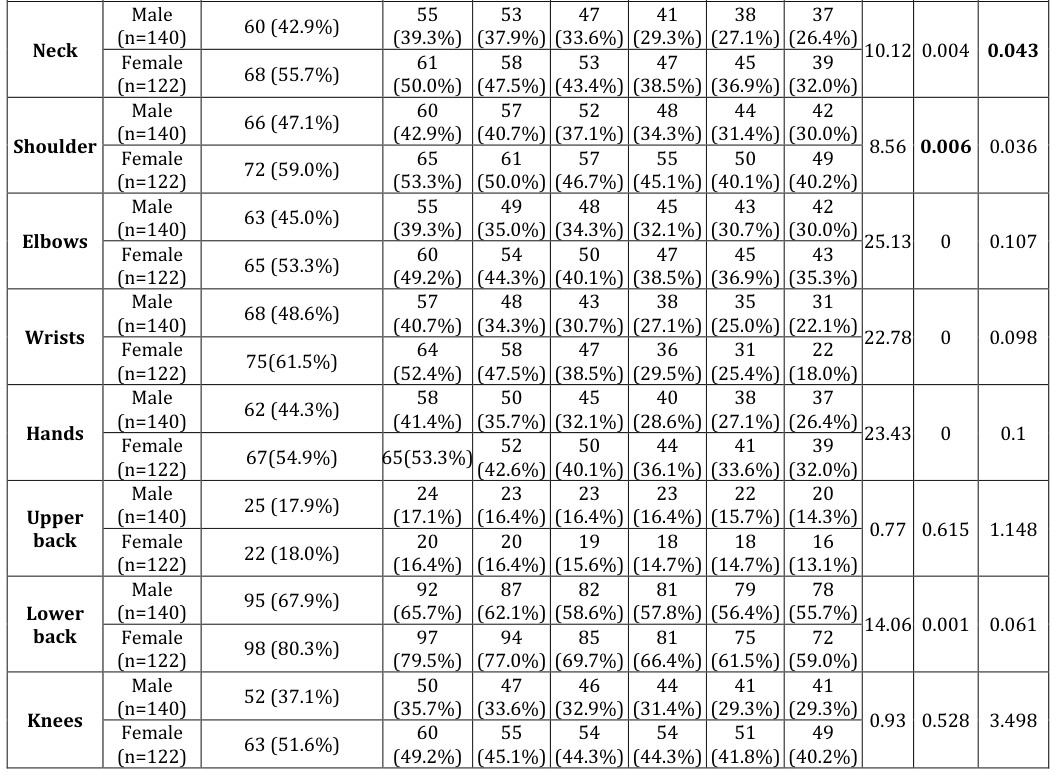
Shoulder and hand was the next two regions which were also affected among the male and female potato farmers before using ergonomics aid in the ridging activity in potato cultivation. The discomfort feeling (pain) has been significantly reduced from 47.1 percent to 30.0 percent in the shoulder region of the body among male potato farmers after using ergonomics aid in the ridging activity in potato cultivation. This result also observed among female potato farmers. Among them, the percentage of discomfort feeling (pain) in shoulder has been significantly reduced from 59.0 percent to 40.2 percent. Hand is also another important part of the body, which is also affected during ridging activity. Using of ergonomics aid has also beneficial effect during ridging activity. The discomfort feeling (pain) in hand has been significantly reduced to 44.3 percent to 26.4 percent in case of male potato farmers, whereas in case of female potato farmers the discomfort feeling (pain) has been significantly reduced to 54.9 percent to 32.0 percent. Elbow pain also significantly reduced to 45.0 percent to 30.0 percent after using ergonomics aid in case of male Banibrata Das. Assessment of Sustainable Development of New Ergonomics Aid for the Betterment of Job Procedure in Ridging Activity in Potato Cultivation among the Farmers of West Bengal, India. Ergonomics Int J 2019, 3(1): 000189.
workers and 53 .3 percent to 35.3 percent in case of female farmers.
just after completion of work condition before and after using ergonomics aid between the male and female potato farmers (Table 2). This result also shows that the hand grip strength of the male and female potato farmers has been significantly increase at 90º elbow flexion and 180º elbow flexion after using the ergonomics aid in ridging activity in potato cultivation in compare to without using ergonomics aid in ridging activity in potato cultivation.
- Just after stoppage of
- Just after stoppage of work after using
- Resting
- Condition Mean work without using
- Subjects
- Hand Grip Strength
- ErgonomicsAid
- Ergonomics Aid
- SD
- Mean±SD
- Mean±SD
- Male farmers
- At 90º Elbow Flexion
- 42.6 ± 4.5
- 36.7 ± 4.2
- 39.2 ±5.1
- 19.58 0.049
- Female farmers
- 38.9 ± 3.2
- 35.1 ± 4.1
- 37.1 ± 3.8
- Male farmers
- At 180º Elbow Flexion
- 42.6 ± 4.5
- 35.2 ± 4.
- 38.6 ± 4.7
- 14.28 0.065
- Female farmers
- 38.9 ± 3.2
- 34.6 ± 4.2
- 36.5 ± 3.5
Table 2: Handgrip strength (in kg) of the male and female potato farmers before and after using ergonomics aid in ridging
using ergonomics aid. The female potato farmers have also a similar result. The average BPD scale result of the female subjects before using ergonomics aid and after using ergonomics aid in longitudinal study (2011-2016) was 6.9 and 4.5 respectively (Table 3), which indicates significantly change after using the ergonomics aid.
- Average results of discomfort feeling (Pain) according to BPD Scale
- Before Using Ergonomics Aid
- After Using Ergonomics Aid
- F value P value ω2
- 2011
- 2011
- 2012
- 2013
- 2014 2015 2016
- Male
- 6.5
- 6.2
- 5.9
- 5.5
- 5.1
- 4.7
- 4.3
- 65.8
- 0
- 0.244
- Female
- 6.9
- 6.1
- 5.8
- 5.5
- 5.2
- 4.9
- 4.5
- Potato farmers
Table 3: Comparative discomfort feeling (pain) according to body parts discomfort (BPD) scale in ridging activity in
Banibrata Das. Assessment of Sustainable Development of New Ergonomics Aid for the Betterment of Job Procedure in Ridging Activity in Potato Cultivation among the Farmers of West Bengal, India. Ergonomics Int J 2019, 3(1): 000189.
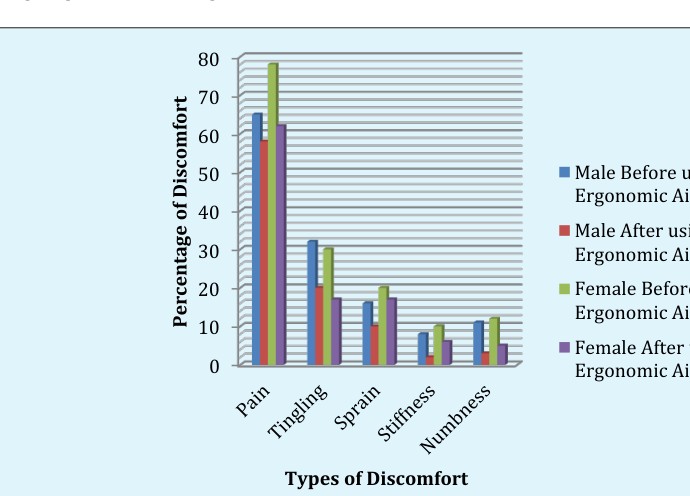
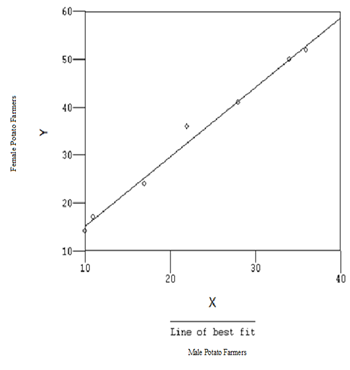
stiffness. This result also shows that after using the ergonomic aid the type of discomfort has been reduced. Figure 3 comparative studies of feelings of discomfort (pain) at different times among the farmers before and after using Ergonomic Aid. Figure 4 shows the linear regression between average number of working days lost by both group of farmers per season before and after using the ergonomics aid in ridging activity in potato cultivation.
Banibrata Das. Assessment of Sustainable Development of New Ergonomics Aid for the Betterment of Job Procedure in Ridging Activity in Potato Cultivation among the Farmers of West Bengal, India. Ergonomics Int J 2019, 3(1): 000189.
Discussion
Musculoskeletal Disorders (MSD) is a major cause of impairment, disability and compensation in farmers. It is found that the entire male and the female potato farmers had some sort of discomfort feeling at different parts of their body. This is because many of the manual tasks performed in potato cultivation involve workers adopting postures, which are highly undesirable according to ergonomics criteria [11, 12].
Agricultural tasks in developing countries in the tropical region are expected to cause musculoskeletal disorders. Improved tools or task-design based solely on researcher’s perceptions of a need of improvements is unlikely to achieve a significant impact. The application of ergonomics has the potential to reduce biomechanical disorders associate with agricultural tasks or tools [13, 14]. The majority of the farmers of India cannot afford heavy or sophisticated machinery, this leads to improvisation of the existing method of work so as to minimize the overall physical demands of their task within allowable limits and to increase the aggregate output of the workers [15, 16].
Pushing and pulling are the most common human activities in several occupations involving manual material handling. Nearly half of all manual material handling activities involve pushing and/ or pulling forces [17, 18]. Most of the agricultural activities such as the operation of manual ridgers, push/pull weeders etc involve pushing and/or pulling in a standing and walking posture [19]. Usage of the ergonomics aid during ridging activity in potato cultivation decreases the discomfort feeling in different parts of the body especially lower back, wrist, hand, shoulder and knee among both the group of the workers due to pushing with newly designed ergonomics aid than pulling by hand the heavy ridger made of iron.
The hand grip strength of the both male and the female potato farmers measured at 90º elbow flexion and 180 º elbow flexion in resting and just after completion of work condition before using the ergonomics aid and just after completion of work condition after using the ergonomics aid. A significant difference in handgrip strength in just after completion of work condition before using and after using the ergonomics aid in ridging activity was observed among the male and the female potato farmers. This result corroborates with the work of Gangopadhyay, et al. [20] and Das [21]. According to him the workers are constantly engaged in hand intensive job which may lead to discomfort in the upper parts of the body and that leads to significant change in handgrip strength in contrast to the subjects using the ergonomics aid not engaged in hand intensive job. Domizio and Keir [22] also stated that due to pulling activity by hand, decreases the grip and muscle activity of the workers which may lead to fatigue among them.
It was revealed from the average BPD scale results that the male and the female potato farmers rated their discomfort as 6.5 and 6.9 respectively before using the ergonomics aid. But this rating has been decreased to 4.3 and 4.5 respectively due to the usage of the ergonomics aid in ridging activity in potato cultivation. So this study indicates that the effectiveness of ergonomics aid which mainly helps to reduce discomfort feeling (pain) by pushing instead of pulling the iron ridger with the ergonomics aid to protrude the soil in potato cultivation. This study corroborates with the work of van Tulder, et al. [23]. According to them Lumbar supports are used in the treatment of patients with low back pain to decrease the impairment and disability. Lumbar supports are also used to prevent the onset of low back pain (primary prevention) or to prevent recurrences of a low back pain episode (secondary prevention). Ergonomics aids not only provide support to the lower back but this newly made Banibrata Das. Assessment of Sustainable Development of New Ergonomics Aid for the Betterment of Job Procedure in Ridging Activity in Potato Cultivation among the Farmers of West Bengal, India. Ergonomics Int J 2019, 3(1): 000189.
ergonomics aid also helps to get rid of pulling the heavy ridger containing iron, due to this the discomfort feeling (pain) of the upper extremities of the body has been reduced.
Ergonomics considers human capacities, needs and limitations in the interaction between a technical and organizational work system. The integrated knowledge of ergonomics is used to develop the contents and the environment of the work through design and redesign of the job, to prevent work related diseases and disability through the integration of ergonomics and with the measures oriented organizationally and individually for the maintenance of working ability and health, and to improve the productivity and quality of work [24, 25]. In this study the application of the ergonomics aid in ridging activity in potato cultivation has markedly and significantly increased the productivity of work by decreasing the absenteeism at work by the workers.
Conclusion
From this study it can be concluded that potato farmers work continuously in an awkward or stressful posture during ridging activity, they suffer from discomfort or pain in different parts of their body, specifically the lower back, neck and knee regions. Consequently they are fatigued after such arduous tasks. This not only hampers normal physical activity but it may also result in the development of a serious musculoskeletal disorder in the near future.
After implementing the newly designed back support (ergonomics aid), there is maximum decrease in discomfort feeling (pain) especially in the region of wrist, hand and lower back region of the body. Thus the application of ergonomics aid in ridging activity in potato cultivation has been markedly and significantly increased in productivity of the workers by decreasing the absenteeism from work of the workers during ridging activity in potato cultivation. In this way in the current study we eliminate the hazards of pulling activities during ridging activities in potato cultivation. By introducing the ergonomics aid which provides back support during work, not only that by applying this newly made ergonomics aid the both group (male and female) of farmers get relief from the wrist pain due to get rid of from pulling activities in ridging activities in potato cultivation.
Acknowledgement
The authors express their sincere gratitude to all those potato farmers for their immense co-operation during this study.
References
-
NIOSH (2004) Conference Proceedings: Prevention of Musculoskeletal Disorders for Children and Adolescents Working in Agriculture. DHHS (NIOSH) Publication &products.
-
Sekimpi DK (1992) Occupational health services for agricultural workers. In: Jeyaratnam J, (Ed.), Occupational Health in Developing Countries, Oxford University, New York, pp: 31-61.
-
Das B, Gangopadhyay S (2018) Occupational agricultural injuries among thepotato workers of West Bengal, India. Int J Ado Med Health.
-
Das B (2014) Agricultural work-related injuries among the farmers of West Bengal, India. Int J Inj Contr Saf Prom 21(3): 205-215.
-
Mitchel LV, Lawler FH, Bowen D, Mote W, Asundi P, et al. (1994) Effectiveness and cost-effectiveness of employer- issued back belts in areas of high risk for back injury. J Occup Med 36(1): 90-94.
-
Martin MM, Ahearn D, Gotcher J, Scott W, Richard L, et al. (2004) An Introduction to Ergonomics: Risk factors, MSDs, Approaches and Interventions. ADA Organization.
-
Campbell JK (1990) Dibble sticks, Donkeys and diesels. Machines in crop production. International Rice Research Institute Philippines.
-
Kuorinka I, Johnson B, Kilbom B, Vinterberg H, Andersson G, et al. (1987) Standardized Nordic questionnaire for the analysis of musculoskeletal Symptoms. Appl Ergon 18(3): 233-237.
-
Reynolds JL, Drury CG, Broderick RL (1994) A field methodology for the control of musculoskeletal injuries. Appl Ergon 25(1): 3-16.
-
Leyk D, Gorges W, Ridder D, Wunderlich M, Rüther T, et al. (2007) Hand-grip strength of young men, Banibrata Das. Assessment of Sustainable Development of New Ergonomics Aid for the Betterment of Job Procedure in Ridging Activity in Potato Cultivation among the Farmers of West Bengal, India. Ergonomics Int J 2019, 3(1): 000189. women and highly trained female athletes. Eur J Appl Physio 99(4): 415-421.
-
Gangopadhyay S, Das B, Das T, Ghoshal G (2005) An Ergonomics Study on Posture Related Discomfort Feeling Among the Preadolescent Agricultural Workers of West Bengal, India. Int J Occup Saf Ergon 11(3): 315-322.
-
Das B, Gangopadhyay S (2015) Prevalence of musculoskeletal disorders and physiological stress among adult, male potato cultivators of West Bengal, India. Asia Pac J Public Health.
-
Rainbird G, Neill DO (1995) Occupational Disorders affecting agricultural workers in tropical developing countries. Appl Ergon 26(3): 187-193.
-
Das B, Gangopadhyay S (2011) An ergonomics evaluation of posture related discomfort and occupational health problems among rice farmers. Occup Ergon 10(1-2): 25-38.
-
Nag PK, Nag A (2004) Drudgery, accidents and injuries in Indian agriculture. Ind Health 42(2): 149- 162.
-
Das B (2015) Gender differences in prevalence of musculoskeletal disorders among the rice farmers of West Bengal, India. Work 50(2): 229-240.
-
Baril-Gingras G, Lortie M (1995) The handling of objects other than boxes: univariate analysis of handling techniques in a large transport company. Ergonomics 38(5): 905-925.
-
Kumar S, Narayan Y, Bacchaus C (1995) Symmetric and asymmetric two -handled pull- push strength of young adults. Human Factors 37(4): 854-865.
-
Tiwari PS, Gite LP, Majumder J, Pharade SC, Singh VV (2010) Push/pull strength of agricultural workers in central India. Int J Ind Ergon 40(1): 1-7.
-
Gangopadhyay S, Ghosh T, Das T, Ghoshal G, Das B (2007) Prevalence of Upper Limb Musculoskeletal Disorders among Brass Metal Workers in West Bengal, India. Ind Health 45(2): 365-370.
-
Das B (2014) Assessment of occupational health problems and physiological stress among the brick field workers of West Bengal, India. Int J Occup Med Environ Health 27: 413-425.
-
Domizio JD, Keir PJ (2010) Forearm posture and grip effects during push and pull tasks. Ergonomics 53(3): 336-343.
-
van Tulder MW, Koes BW, Assendelft WJJ, Bouter LM (1999) The effectiveness of conservative treatment and chronic low back pain. EMGO Institute, Amsterdam.
-
Lee KS, Chaffin DB, Herrin GD, Waikar AM (1991) Effect of Handle Height on lower-back loading in cart pushing and pulling. Appl Ergon 22(2): 117-123.
-
Louhevaara V (1999) Is the physical workload equal for ageing and young blue collars workers. Int J Ind Eng 24: 559-564. Banibrata Das. Assessment of Sustainable Development of New Ergonomics Aid for the Betterment of Job Procedure in Ridging Activity in Potato Cultivation among the Farmers of West Bengal, India. Ergonomics Int J 2019, 3(1): 000189.
- The Expanding Landscape of Road Rage: A Systematic Review of Conflicts Involving Drivers, Pedestrians, and Micromobility
- Validating Cognitive Models of Royal Navy Performance on Control Systems
- Comparing Standard and State-of-the-art Firefighter Coats on Postural Balance and Gait in a Live Burn Environment
- Investigating the Integration of Telemedicine into Clinicians Workflow: A Review of Methods
- Risk Assessment of Ergonomic Factors in a Textile Firm by RULA, REBA and Fine Kinney Methods
- Impact of Self-Esteem Training on Individuals with Disabilities Aged 17-30