
Physiopathological Analysis of MSDs, by Exposure to PDV’s in Oil Production Plant Operators
The innovation in office areas and control rooms with new technologies can generate discomfort in the work environment by the use of display screens (PDV’s), there are several physiopathologies in the appearance of musculoskeletal disorders (MSD); in a study of 100 operators of a production center of crude oil, were analyzed pathological occupational symptoms such as: right wrist pain, lower back pain, elbow inflammation, pain in the thumb and neck pain, caused in many cases by poor posture or repetition in each cycle of work. When applying the ROSE method, I determine the presence of fatigue and stress, observing the relation of clinical occupational alterations; lumbago 26%, carpal tunnel syndrome 23%, olecranon bursitis 18%, radial styloid tenosynovitis 13%, muscular inflammation 11%, and by degenerative discopathy 9%; the presence of these dysergonomic conditions and, with other successes reached by other authors.
Guillermo Neusa Arenas1*, Jeanette del Pilar Ureña Aguirre2, Ramiro Vicente Saraguro3, and María Yajaira Galeano Tocain4
Keywords: Physiopathology; Musculoskeletal Disorder; Pathology; Biometry
Introduction
The term musculoskeletal disorders (MSD), comprises a series of sets of injuries or symptoms that can affect the entire musculoskeletal system and other associated parts of the body anatomy, causing discomfort in joints, tendons, bones, muscles, ligaments, nerves and even blood vessels. These MSDs, related in the field of work to those induced or indisposed by the cycles of exposure to work, cause unfavorable conditions in the health of the worker [1].
MSDs are one of the main causes related to occupational or professional diseases, which affect many workers in all sectors of industry or production, with considerable expenditure on a nation’s economy. Musculoskeletal disorders can have serious short-, medium- and long-term consequences, with damage to the health and quality of life of the worker; thus, permanent pain can lead in many cases to temporary or functional disability [2].
In Spain, according to data from the fifth National Survey on Working Conditions, 4 out of 5 workers show some pain or musculoskeletal discomfort of occupational origin, referring to a pathology or clinical occupational picture, since the frequency of responses may be greater than that corresponding to the lower back, and likewise, the neck and upper part, show a continuous occupational pathological increase in recent years [3].
One of the main objectives of ergonomics is the design of the area and work stations to allow comfort and adapt to the capabilities or limitations of workers, in order to prevent possible deterioration in the health and welfare of the individual. Therefore, for MSDs, the design of the workplace must comply with a series of requirements that protect the worker from the beginning of the workday. These designs are centralized from the normal, with a change both integral or partial according to the area or space of the work place or the task to be performed, taking into account the equipment, machines or tools to be used during the cycles of exposure to the work. In this way, the importance of improvement and adequate training should be emphasized, once the improvements in the conditions favourable to work have been implemented [4].
In the ergonomic evaluation there are several types of methods such as: RULA, LEST, MAPFRE, Check-List OCRA, EWA, OWAS, SNOOK, among others, which allow to determine the needs for both specific conditions by activity that is valued in each worker. However, it is necessary to point out its results at the moment of obtaining the application of the specific method, it is only a question of formulating a point of review at the level of approach. Therefore, when identifying the risk factor to which the worker is exposed, the theory as well as the processes in the production and the methods that are these technicians for their evaluation, will depend on the current working conditions in the worker’s organization so that he/she can develop his/her activity in the best way.
The POS, like any tool, can cause a deterioration in health over time by not taking appropriate control and preventive measures in use. Nevertheless, the own work scenarios for the use of computer or other visualization equipment must be taken into account. In this sense, there are standards and associated techniques for the proper use of POS [5].
For this reason, putting theoretical knowledge into practice involves a series of fields of activity for the worker. Although, the types of actions will depend much on the proposed objectives and the interest of the organization, which, in such a way, are important to generate a conscience and culture of responsibility and understanding, valuing a systematic direction from the theory based on the prevention of MSDs.
In terms of hygiene and occupational health, it is necessary to establish controls of physiopathologies due to MSDs, keeping records of preventive occupational medicine, maintaining a clinical history per worker during periods of exposure by cycles of time of exposure, in order to carry out occupational epidemiological monitoring.
Materials and Methods
In recent decades the rapid spread of new technologies of the 21st century, have achieved growth in all productive sectors in organizations, where operators of CPFs who spend more than six hours a day in front of POS. However, we can consider that they are users with health risk, with possible damages or injuries that can be associated to the acute use of the PDV’s, increasing the occupational clinical pathologies [6].
From the beginning of the research, several methodological aspects are analyzed that allow a subjective analysis in each of the areas and jobs by the operator of the Oil Production Plants, also called Production Centers and Facilities-CPF (Figure 1). Each of the biomechanical movements of the body is evaluated by its exposure.
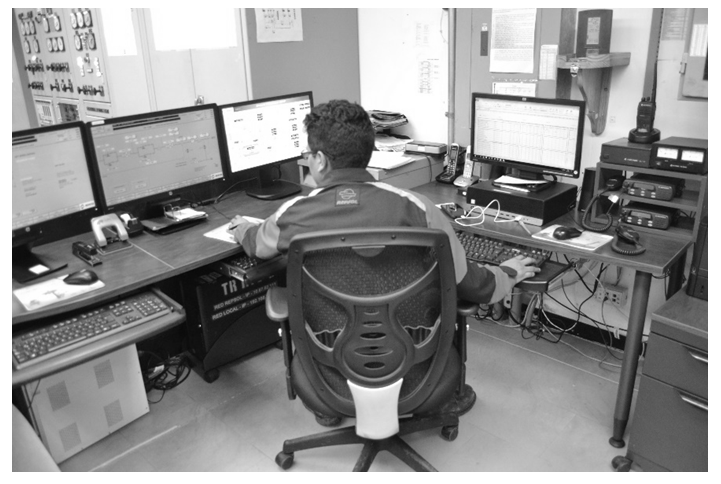
Therefore, the form and nature of work in the organization by task during the cycles and rotation, are observed based on the Nordic questionnaire, videos, photographs, tools for identification, control and postural evaluation through the ROSA (Rapid Office Strain Assessment) Method [7].
By using a survey to identify the main physical discomforts present in the operators, the health risk factors that are so minimal or appear to be non-routine or routine, such as the location of the monitor at a certain distance or the angle that they may be inadequate; “other associated factors in office areas or control centres, is the comfort that can contribute to the risk such as temperature, incorrect environmental relative humidity and lighting, which can generate health effects [8].
Sample and Population
The population of 330 corresponds to operators, integrated in different areas or jobs. The size of the finite research sample was determined for the study. In Table 1, the variables for the application of the sample size formula are established [9].
| Data | |
|---|---|
| Z | 1,96 |
| P | 50% |
| Q | 50% |
| N | 330 |
| D | 8% |
Table 1: Sample variable.
When establishing the sample (330 Oper.), it is necessary to know the equation; the calculation of the finite sample is represented in d N p q Z
2
2 2 * * * N p q n
$$ v = \frac {N ^ {*} Z _ {a} ^ {-} * p ^ {*}}{d ^ {2} * \left(N - 1\right) + Z _ {a} ^ {2}} $$ a ( ) * 1 * * a
$$ n = \frac {3 3 0 * 1 , 9 6 ^ {2} * 0 , 5 * 0 , 5}{0 , 0 8 ^ {2} * \left(3 3 0 - 1\right) + 1 , 9 6 ^ {2} * 0 , 5 * 0 , 5} $$ ( ) $$ n = \frac {3 3 0 * 3 , 8 4 * 0 , 2 5}{0 , 0 0 6 4 * 3 2 9 + 3 . 8 4 * 0 , 2 5} $$ n=103 The sample size of 103 CPF operators is the size of the target group.
Population Observation
The information was collected according to the finite sample size of 103 operators and, through the Nordic Questionnaire survey determining musculoskeletal disorders (MSDs), constituting one of the most frequent and costly health problems in the occupational field worldwide. “Early detection of pathological symptoms by initial EMDs is a priority for epidemiological surveillance programmes” [10].
On the other hand, other aspects should be taken into account, such as: age and sex ranges (Table 2. and in Graph 1, graphic representation by age), which allow the establishment of pathologies by MSDs; Likewise, another point of view, embodied in Table 3, is the identification of work areas and jobs.
| Prom. Age | Men | Women |
|---|---|---|
| 20-25 | 15 | 7 |
| 26-35 | 21 | 4 |
| 36-30 | 29 | 2 |
| 31-49 | 14 | 2 |
| 50-+ | 9 | 0 |
| Subtotal: | 88 | 15 |
| Total: | 103 |
Table 2: Age ranges.
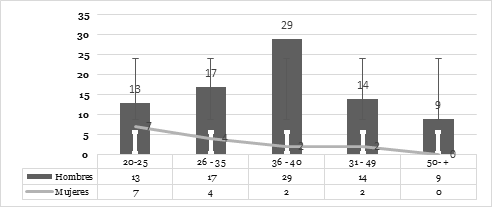
Graph 1: Graphic representation by age.
| Operators | % | |
|---|---|---|
| Warehouses | 2 | 2% |
| Energy | 18 | 17% |
| Maintenance | 47 | 46% |
| Operations | 1 | 1% |
| Production | 23 | 22% |
| P and O | 5 | 5% |
| RRCC | 22% | |
| SMA | 3 | 3% |
| Ti | 2 | 2% |
| Total | 103 | 100% |
Table 3: Area and Distribution of operators is identified, according to the selected sample size.
Relationship between the ROSE Method and the Nordic-CN Questionnaire
Based on the CN the MSD symptoms were applied with the purpose of determining the analogy between the operator’s musculoskeletal symptoms with elements of the workplace with PDV’s. Therefore, the descriptive method of correlation is analysed, using the Excel program and Ergo Soft Pro-5.0 taking scores from the ROSA method and the CN constants. In the scoring of the chair, the biometric part of the upper back, as well as the lower back, shoulders, thighs and hips corresponded; also, the use of the monitor and the phone with neck hook. In the upper back, the mouse and keyboard with shoulder tilt; while, the upper arm and wrist, establish a final score of the CN method; determining the most representative MSDs in each of the operators.
ROSE Evaluation Method
“The POS is a work tool that can cause severe damage to the health of workers over time if adequate preventive measures are not taken in time” [11].
In studies conducted on practices for exposure to PDV’s, the ROSA method (Rapid Office Strain Assessment), published by Sonne and Andrews in Applied Ergonomics [7]; was applied in the research project in the crude oil production plants at CPF, identifying the intervention areas in the offices and control rooms (Control Rum), through the cycles of exposure per minute and postural anthropometric parameters such as:
- Form of sitting posture.
- Technical characteristics of the seat.
- Use and geometric height between the base line (desk) and the height of the monitor, keyboard and telephone.
- Duration of exposure during the working day.
- Rating of scores between 1 and 4, scores above 5, is considered a factor in high risk [12].
Results
Representation of the Population
In the analyses carried out on 103 operators in the CPF of the oil sector in Ecuador and, taking into account the characterization by the operators of: 72.7% men and 27.3% women, with an average age of 36 - 40, an average time in the oil sector between 4 and 17 years, and a size in the operators of 1.64, and, in the operators 1.48.
Analysis and Interpretation
Based on the surveyed NC, it is shown that 49.3% carried out activities involving cargo handling and transport before joining the company and, 50.7% of the operator’s state that they have no relation with other activities of this nature.
Table 4 shows the incidence of the most common MSD physiopathologies in the operators of the different areas during the last 12 months, with occupational medical care.
| Workplace | Risk level | Clinical Pathologies | |
|---|---|---|---|
| Human resources | Manager people and organizations and social work | High | Olecranon bursitis Degenerative Discopathy Lumbago Carpal Tunnel Syndrome Radial styloid tenosynovitis |
| Production | Production engineering | High | Olecranon bursitis Degenerative Discopathy Inflammation of muscles Lumbago Carpal Tunnel Syndrome Radial styloid tenosynovitis |
| Human resources | Administrative assistant | High | Olecranon bursitis Lumbago Carpal Tunnel Syndrome Radial styloid tenosynovitis |
| Energy | Generation operator | Medium | Olecranon bursitis Lumbago Carpal Tunnel Syndrome |
| Production | Production operator | Medium | Olecranon bursitis Inflammation of muscles Carpal Tunnel Syndrome |
| Maintenance | Static maintenance coordinator | Medium | Degenerative Discopathy Inflammation of muscles Lumbago Carpal Tunnel Syndrome |
| TI | Technical support TI | Medium | Inflammation of muscles Lumbago Carpal tunnel syndrome Radial styloid tenosynovitis |
Table 4: Most common MSD physiopathologies.
While Table Nº 5, on identifying the physiopathologies due to MSDs on average and according to CN results and the ROSA Method, in the most infectious ones it was determined that; by dorsolumbar spine 68.4% of the operators have had pain in the dorsolumbar spine, cervical spine, arms or forearms, shoulders, hands or wrists, knees, ankles or feet; on the other hand, 38.7% have not presented occupational clinical pictures (OCC) of any type of ailment in the last six months.
| Have you suffered any problems or pain? | Yes | No |
|---|---|---|
| Cervical Column | 67,7 | 32,3 |
| Dorsolumbar spine | 68,4 | 31,6 |
| Shoulders | 53,8 | 46,2 |
| Arms or forearms | 39,9 | 60,1 |
| Hands or wrists | 49,3 | 50,7 |
| Knees | 33,5 | 66,5 |
| Ankles or feet | 27,3 | 72,7 |
| Average | 48,6 | 51,4 |
Table 5: Identifying the physiopathologies due to MSDs.
Among the most common occupational clinical pictures of MSDs manifested by operators during the work cycles are forced postures with frequent consequences, inducing improvement measures from physical therapy, medication, rest, intervention, occupational medicine and rehabilitation.
Occupational Medical Care
In the occupational medical assessments for periodic MSDs, it was possible to identify osteomuscular pathologies considered as chronic conditions, caused in a direct way by exposure during the work cycles, producing temporary and periodic disability.
Table 6 shows the frequency of occupational health care personnel during the last six months.
| Yes | No | Alternatives | Frequency | Percentage | |
|---|---|---|---|---|---|
| Cervical Column | 67,7 | 32,3 | General practitioner | 43 | 42% |
| Dorsolumbar spine | 68,4 | 31,6 | Others | 31 | 30% |
| Shoulders | 53,8 | 46,2 | 29 | 28% | |
| Arms or forearms | 39,9 | 60,1 | Total | 103 | 100% |
Table 6: Frequency of occupational health care in last six months.
Preventive Medicine Analysis
In Table 7, the analyses of preventive occupational medicine for MSDs, provided to operators, have clinical osteomuscular pictures in relation to the work in the PDV’s such as: dorsalgia, lumbago, shoulder alterations, cervicalgia, carpal tunnel syndrome, epicondylitis and tendinitis. However, in the majority of cases, rotator cuff and bicipital tendonitis such as bursitis, Quervain’s tenosynovitis, carpal tunnel syndrome, lateral and medial epicondylitis, produce a clinical occupational picture due to disc and lumbar hernia pain.
| Frequency | Percentage | |
|---|---|---|
| Musculoskeletal disorders | 26 | 58% |
| Inflammations | 10 | 22% |
| Other conditions | 9 | 20% |
| Total | 45 | 100% |
Table 7: Analyses of preventive occupational medicine.
Occupational Medical Treatment
Table 8 shows the different occupational medical treatments for MSDs carried out on operators, and provides pathological follow-up by ailments or clinical pictures present during the year, related to the frequency of occupational medical care.
| Frequency | Percentage | |
|---|---|---|
| Physiotherapy | 12 | 29% |
| Medication | 14 | 33% |
| Rehabilitation | 16 | 38% |
| Total | 42 | 100% |
Table 8: Different occupational medical treatments.
Conclusion
The physiopathological liking for MSD to PDV exposures in CPF field operators, and as a response to the CCOs present Annex 37: Active Pause Guide in the control room and office area in the population studied, a final score is determined both in the control room and in the offices, between the CN and the scores obtained by the ROSA method, the osteomuscular symptoms in the neck and lower back. These results of the evaluation, showed that a part of the operators, rise to a high risk level, compared to other positions by medium and long time work cycles, qualifying as high or very high risk level.
51.4% of the total number of operators evaluated had a high risk level rating, as determined by the control room analysis and results, while office activities presented 48.6% due to exposure to the dysergonomic risk factor. However, the highest percentage and agreement among the evaluated areas (both 1 and 2 - in situ), given that they did not present the same conditions for the evaluation, as among the evaluators 1 (control room), 2 (offices) and 3 the applicable ROSA method, was demonstrated with the use of the Excel program and ErgoSoft Pro-5.0 (as a reliable and efficient tool) the evaluation of the workstations with PDV’s, reducing the risk factor to improve the comfort of the work area environment as well: seat back, arm advancement zone, precision zone, minimum and maximum reach, right hand grip zone, right and left hand comfort, and the left hand zone for telephone use as shown in the figure 1.
Finally, the intervention by the occupational medicine to be performed, should be of medical control in occupational health and the ergonomist of the company, who will have the need to establish an occupational health program with emphasis on specific examinations of spine x-ray and carpal tunnel syndrome; also, institute training in awareness of bad posture, proper use of furniture and active breaks every 5 minutes according to the cycles of tasks to be performed.
| Active Pause Guide | Versión: 01 | |
|---|---|---|
| Object: | Establish the main characteristics to be considered in the design of the office workstation. | |
| Responsible: Direct: | General Manager & Plant Manager | |
| Methodology: | Photocopy of the general risk assessment and the evaluation by job Procedures for carrying out the activities according to the job | |
| Material Resources: | Laptop or Desktop computer, camera, printer, office supplies (sheets, file cabinets, printer ink) | |
| Legal basis: | Executive Decree 2393 | |
| Recommendation | Indication | Reference Image |
| Head movements | -Stay on your feet. -Place your arms back between your hands, holding your wrist with your right arm. -Tilt your head to the right and then to the left as if touching your shoulder. -Repeat the exercises for 30 seconds. | |
| Arm and wrist movement | -Stay on your feet. - Put your arms down open. - Make a circular motion with your wrists, from the inside to the outside and vice versa. - Repeat the exercises for 30 seconds. | |
| Arm and wrist movement | -Stay on your feet. - Put your arms up. - Join hands and interlock fingers. - Place your arms above your head. - Repeat the exercises for 30 seconds. | |
| Arm movement | -Stay on your feet. - Put your arms up. - With your right arm, press the elbow of your left arm, bending your left forearm toward your back. - Make a small inward pressure three times, then switch arms and repeat the above movements. - Repeat the exercises for 30 seconds. | |
| Movement of hands | -Stay on your feet. - Join the palms of your hands, with your arms bent. - Make movements from the bottom to the top and vice versa. - Repeat the exercises for 30 seconds. | |
| Arm and trunk movement | -Keep in a seated position. - Put your feet up. - Raise your left arm with the palm of your hand open. - Position right arm down with open palm. - Stretch your arms with the support of your trunk. - Change position of arms, and repeat again. - Repeat for 30 seconds. | |
|---|---|---|
| Movement of arms and hands | -Keep in a seated position. - Put your right foot up on the left. - With your left arm, take your left knee and place your right arm around your waist. - Bend your head to the left and perform trunk stretching movements three times. - Repeat the exercises for 15 seconds. | |
| Hand movements | -Keep in a seated position. - Place your hands on the plane of the desk. - Open your hands and fingers. - Close your hands and fingers - Repeat the exercises for 15 seconds. |
References
-
Andalucia JD (2014) Brief Guide to the Prevention of Musculoskeletal Disorders at Work-12 (page 5), Junta de Andalucia, Madrid.
-
Álvarez-Casado E (2009) Risk Assessment Manual for the Prevention of Musculoskeletal Disorders. In: Humans F Ed, Trad E, (Eds.), Factors Humans, Barcelona FC, Spain.
-
Hernández-Soto A (2009) Risk Assessment Manual for the Prevention of Musculoskeletal Disorders. In A. Hernández-Soto, Manual de Evaluación de Riesgos para la Prevención de Disordos Musculosqueléticos (page 21). Factors Humans, Barcelona.
-
INSHT (2017) Prevention of Musculoskeletal Disorders in the Health Sector (p. 4), INSHT, Madrid.
-
Arenas GN (2019) The Data Visualization Screens, Gestión de la Ergonomía Laboral en las MYPIMES (págs. 192-202). UTN, Ibarra-Ecuador.
-
Mondelo PR (2005) Ergonomics 4, Elm Office Work. Working with Data Display Screens (DSPs). Alfaomega, Barcelona, Spain, pp: 33-37.
-
Sonne M (2011) ROSA Methodology. The Rapid Office Strain Assessment (ROSA), Hamilton: Canada, pp: 98- 108.
-
Muñoz JE (2015) Basic Ergonomics, Factores del Entorno y Ambientes. Ediciones de la U, Bogotá, Colombia, pp: 155-156.
-
Morales-Vallejo P (2012) Finite sample size. Applied statistics, pp: 22-39.
-
Martinez MM (2017) Validation of the Standardized Nordic Questionnaire of Musculoskeletal Symptoms for the Chilean Working Population, Adding a Scale of Pain. Public Health Journal 21(2): 41-51.
-
Guillermo N (2019) Gestión de la Ergonomía Laboral en la MIPYMES (Management of labour ergonomics in MSMEs). UTN, Ibarra.
-
Hurtado V, Londoño N, Lozano S (2016) Validation of the ROSA method in a company with computer work in Medellín, University of Antioquia, Medellín, Colombia.
- The Expanding Landscape of Road Rage: A Systematic Review of Conflicts Involving Drivers, Pedestrians, and Micromobility
- Validating Cognitive Models of Royal Navy Performance on Control Systems
- Comparing Standard and State-of-the-art Firefighter Coats on Postural Balance and Gait in a Live Burn Environment
- Investigating the Integration of Telemedicine into Clinicians Workflow: A Review of Methods
- Risk Assessment of Ergonomic Factors in a Textile Firm by RULA, REBA and Fine Kinney Methods
- Impact of Self-Esteem Training on Individuals with Disabilities Aged 17-30