
Is Transfusion Always Necessary?
Within living memory blood as a treatment has generated a mystical feeling and experience. Since ancient times blood has been considered an intriguing, life-saving and supportive life fluid. It has triggered a scientific curiosity stimulating for centuries both a mystical and a scientific thinking to unveil its capacities and potential use to serve mankind. The major obstacles in the early days were the transfusion of blood from one individual to the other and the absence of insight and knowledge of blood cells and plasma constituents, the principle of compatibility. It lasted till mid-19th century before a vague idea of species specificity and blood coagulation started to grow. The basic breakthrough was established by Karl Landsteiner and his team in Vienna, for which he was awarded the Nobel prize in 1930. His discovery of a blood group system on the surface of red cells was the beginning of a long period in which the scientific interest focused on the laboratory bench end the test tube, away from or vaguely connected to the patient and the bedside and in many situations an over transfusion. Today, a trend is noticeable to reduce the amount of blood transfused and observe the normal and reactive physiological processes and phenomena in a variety of abnormal situations like acute and massive bleeding. The lessons learned from history and medical education should be more stringently followed and practiced to the benefit of our patients.
Abbreviations
HIV: Human Immunodeficiency Viruses; AIDS: Acquired Immunodeficiency Syndrome; PBM: Patient Blood Management.
Introduction
Within living memory blood as a treatment has generated a mystical feeling and experience. Since ancient times blood has been considered an intriguing, life-saving and supportive life fluid. It has triggered a scientific curiosity stimulating both mystical and scientific thinking to unveil its capacities and potential use to serve mankind. In ancient Egypt during the reign of the Pharaohs, it was a royal custom to bath the wounded warriors in ox blood to allow an accelerated healing of the battle wounds. The rationale was a belief in the power of the ox that would be transferred through the blood to the wounded warrior and provide its strong and healthy healing capacities to cure the injured skin and muscles [1]. The Roman writer Ovidius describes in his 7th book of Metamorphosis an early ‘exchange transfusion’ approach to rejuvenate the old king Aeson. His son Jason begged Medea to give his father back his youth. Medea granted the desperate request, took her blank knife, cut the throat of the old man, and let the old blood out. Then refilled his old veins with a rich elixir of life. As by magic the old man regained his natural strength and splendid youth. Another Roman writer Plinius reported on the habit in old Rome of men who ran into the arena to drink the blood of dying gladiators in the expectation to acquire some of the braveness and strengths of these victims [1].
Galen advised drinking of blood of a weasel or a dog to cure rabies. The old Vikings drunk the blood of seals and whales as a cure against epilepsy and scurvy, reflecting a primitive scientific thinking of the beneficial and healing use of human and animal blood [1].
An old Hebrew manuscript discloses the use of blood as a fluid with special healing powers. Here it was not so much the oral consumption or external application, but no intravenous application - ´Naäm, supreme commander of the armies of Ben-Ada, king of Syria, consulted his doctors because he was suffering from leprosy.’ To kill him (the disease?) the doctors let his blood out and refilled his veins with blood from someone else, indicating the health effects of normal blood on a diseased person [1].
In the 17th century the Venetian magister scientist Petro de Albano described the evil effects of drinking menstrual or leprous blood: ‘He who drinks such blood will become lunatic, evil and forgetful.’, therefor attributing healthy powers to normal blood and evil powers to blood from diseased or unclean people. At the same year 1692 when Christopher Columbus discovered an entirely new world - the Americas, Pope Innocentius VIII suffering from a chronic renal disease was advised by a mystical doctor from Rome to have administered the blood from 3 young and healthy men. The available old parchment discloses that such practice would save him from dying and give him back his youthful strength. The historiography indicates that 3 ten years old boys were selected who were remunerated as a golden ducat after which the transfusion would have taken place. A few days later the Pope died and the three young donors were also not able to recall the experiment [2]. However, it is not clear whether there really has been a transfusion. Probably there has been an error in translation or interpretation from the original Latin text. It is more likely that the blood was used for the preparation of a special healing potion the Pope would drink. When the Pope got notice of this, he condemned the practice and refused to drink the offered potion. The mystic doctor was punished and the Pope passed away!
Was it Curiosity or Medical Science?
These blood driven practices were largely indicated by mystic and magic, albeit with a definite type of logic in the thinking over the indication and prescription. During the early Renaissance epoch, the scientists Hieronymus Dardanus from Milan (Italy) and Magnus Pegelius from Rostock (Germany) suggested with a certain scientific vision that transfusion of blood from one individual to another should be feasible. However, from the following period of the 16th century no further documents could be retrieved indicating further research and progress to evidence their hypothesis. As early as 1615 Andreas Libavius, a philosopher, PhD in Medicine and naturalist from Halle (Germany), debuted his strong plea for the transfusion of blood and described in detail a method for such transfusion using a silver catheter for an arterio-arterial shunt from donor to recipient. He was remarkably much concerned with the health of the donor – ‘Let the young man (donor) not suffer from weakness, provide him good care and food.’ These events were almost all focused on the transfusion technology [3].
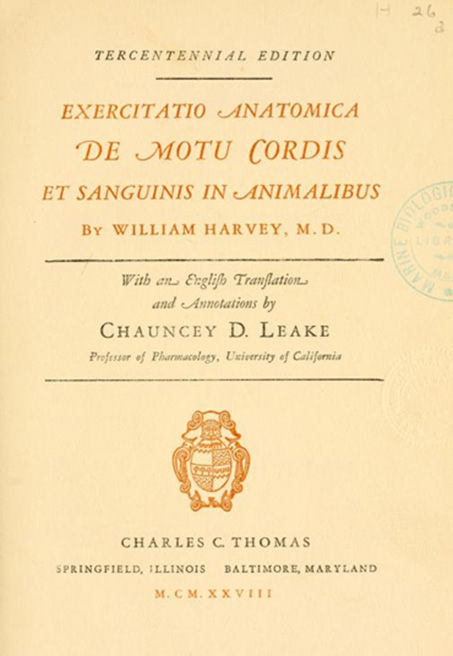
An early though important milestone in the history of transfusion medicine has been the academic experimental study and discovery in 1613, and ultimate documentation in 1628 of the blood circulation by the advanced English court physician and naturalist William Harvey in his famous monography ‘Exercitatio Anatomica de Motu Cordis et Sanguinis in Animalibus’ (Figure 1). The book solicited uncurbed speculations on the possibilities of transfusing blood and infuse medicines [4].
In the same year 1628 Giovanni Colle, a philosopher and physician from Padua (Italy), suggested the idea that transfusion of blood might prolong human life. During the 17th century several scientists contested for the honor to be the first to transfuse blood. Probably the eccentric painter and experimentalist Francis Potter, Fellow of the Royal Society in London, was the first to develop a practical method for the transfusion of blood in humans. The idea was based on the myth of Medea in Ovidius’ Metamorphosis, using a goose quill-feather and a system of tubes. His animal experiments, however, were not really successful [1].
In 1654 Folli claimed to have done successful experiments, but a continuation is not recorded since then. However, in 1658 at a scientific meeting in Paris, the Benedict friar Robert des Gabets published a new method to transfuse blood, based on an invention of the mendicant friar Pichot consisting of 2 silver cannulas connected through a small leather bag. Most likely the first public demonstration was given by the English physician and anatomist Richard Lower in 1665 in Oxford. This experiment was done connecting the venae jugularis of two dogs. Unfortunately, the blood clotted in the cannula. The observation led to a change in the methodology, connecting the coronary artery (arterial blood) of the donor dog with the jugular vein (venous blood) of the recipient dog – the blood did not clot! He was then invited in 1665 by the Royal Society in London to demonstrate his design, which was published in the Philosophical Transactions of the Royal Society, December 1666 [5, 6]. Richard Lower was the first scientist who demonstrated that blood transfusion could be life-saving. In the experiment he first almost exsanguinated a dog and then transfused that dog with blood from a healthy dog, causing complete recovery of the victim. A year later, 23 November 1667, Lower presented the first human experiment in which Authur Coga was hired by the College for the sum of 20 Shillings to undergo within a month two intravenous transfusions with lambs blood, of which the latter did not provide a very cheerful outcome.
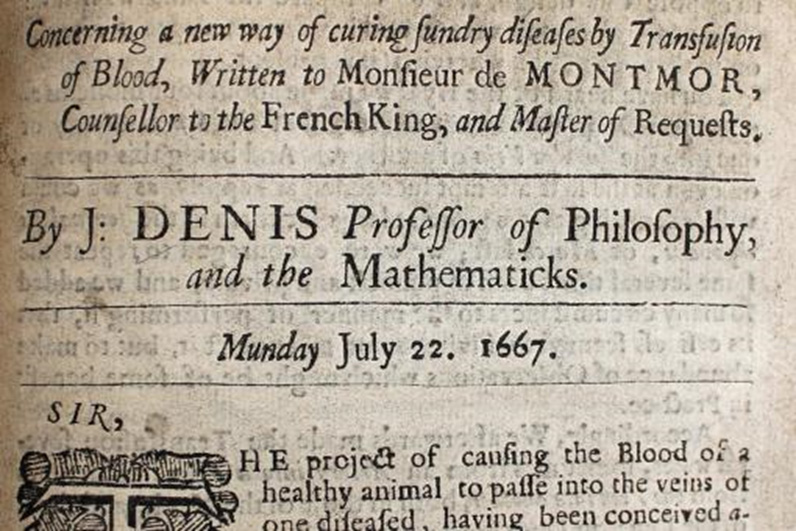
At the same time in France at the court of Louis XIV the young court physician and “most able Cartesian philosopher” Jean Baptiste Denis from Montpellier together with the surgeon Paul Emmerez did quite some dog-to-dog transfusion experiments. When he was presented with a severely ill 15 years old boy with fever and weakness due to the many blood lettings, he decided to transfuse the boy with lambs blood, which resulted in a miraculous curing effect! Shortly after this éclat success a second 45 years old healthy male was successfully transfused, followed by the son of the Minister of Foreign Affairs of the king of Sweden who fell seriously ill while in Paris. Denis decided to treat him with two subsequent transfusions, and with good success. The report was published in the Philosophical Transactions of the Royal Society of July 1667 (Figure 2). The following patient transfused by Denis was a 34 years old man Antoine Mauroy, who suffered from a tragic love affair. He received over a period of a couple of months several calf blood transfusions but started after the second transfusion to react with fever, pain in the lumps, increased pulse rate, sweating, and dyspnea, excreting black urine. Denis has carefully documented the event, thereby uniquely describing for the first time in medical history a classical acute hemolytic transfusion reaction.
Mauroy survived, but when a few months later his mental condition again deteriorated, Denis decide to treat Antoine Mauroy with another transfusion, which unfortunately caused his death due to acute lethal hemolysis [7]. Denis was accused of murder but during the Châtelet trial in Paris plead not guilty. However, the conservative Paris University Sorbonne forbid further blood transfusion experiments. Also, in England further experiments were forbidden, followed by the anathema of the Pope. Almost a century later the French scientist Cantwell from Paris raises his voice for a plea to revive the experiments as he stated that blood transfusion could very well be lifesaving in case of severe trauma and calamities. Unfortunately, he was not well received, and it lasted again more than half a century until in England the Among the diseases and symptomatology for which blood was used with or without success are bat- tle wounds, rejuvenation efforts and transfer of braveness and strength, longevity, rabies, epilep- sy, scurvy, leprosy, chronic renal disease, exsanguination, anemia, mental disease and obstetric bleeding. Replacement fluids like crystalloids and colloids were not yet known.
Step-by-Step Dismantling the Manifold of Problems
In fact, Blundell and Leacock were the founders of modern immunology and the principle of species compatibility presenting scientific evidence for species specificity. The
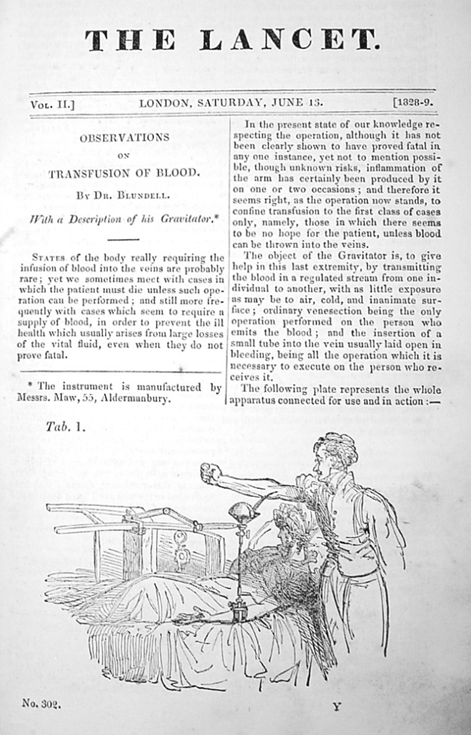
progressive gynecologist and obstetrician James Blundell from London, who did his medical education in Edinburgh, showed a deep interest in the potential of blood transfusion [8]. His interest was not only based on the personal experience with women in labor who postpartum bled to death, but also by the scientific experiments of John Leacock from Barbados [9]. In 1816 John Henry Leacock reported systematic experiments in Edinburgh on dogs and cats and recommended that donors and recipient must be of the same species. He then returned to Barbados and published nothing more [9]. However, James Blundell, who extended Leacock’s experiments and published the results widely, is credited by many with introducing transfusion into clinical use, but he always gave credit to Leacock for his initial work.
scientific and clinical value of these observations became much later understood and practiced. Blundell decided based on his animal experiments to apply the lessons learned in human pathology. A 35-year-old man with a terminal stomach cancer was successfully transfused directly. Most of his work was published in The Lancet (Figure 3).
In an editorial of the 1825 Philadelphia Journal of Medicine, Physics and Science Blundell´s premiere has been debated in a footnote arguing that Dr. Philip Syng Physick did the same already in 1815. However, that practice was never published nor presented. Blundell continued his work and managed to save the lives of dozens of women in labor and was frequently consulted about blood transfusion. He was the first clinical specialist who deserved the classification of ‘Transfusion Medicine Specialist’. Despite the many opponents he continued; from time to time he observed that the transfusion in certain women caused acute hemolysis but was unable to understand the underlying pathophysiology.
The 19th century showed more interest in the transfer technology, but the real breakthrough came at the turn of the 19th century with the work of the Viennese physician, pathologist and scientist Karl Landsteiner, who discovered the presence of specific ‘antigens’ on the surface of red cells, genetically determined [10]. He named them blood groups. Following the alphabet, he distinguished the groups A, B and AB besides individuals who did not express A or B antigens and called those O (actually zero because of the absence of A and/or B). He received in 1930 the Nobel prize for his work that opened the gate to compatibility in blood transfusion [11]. These scientific experiments and documented observations were the overture to the further development of the science and practice of clinical transfusion medicine, first animal experiments and then the human trials! Publishing and presenting the outcomes in the literature and at scientific meetings of the established Societies and Associations of peer groups stimulated an early creation of an evidence base for clinical transfusion medicine. With the breakthrough at the turn of the 19th century by Karl Landsteiner and his research group in Vienna and later in New York (Phillip Levine) and Birger Broman from Sweden [12, 13] the era of blood group serology and immuno-hematology had taken off, would soon be followed by others and pushed and ignored the patient care as a Cinderella to the background [14, 15, 16].
Clinical Transfusion Medicine: What Is Needed?
What history learns is awareness. There has always been an awareness of the supportive and seemingly curative characteristics of blood whether animal or human, expressed as a patient’s demand and a community’s responsibility to supply that need.
The body with its organs and systems produces night and day blood cells, proteins and plasma. These processes do not come to a stand still when for any reason there is major loss. What happens is a response replacing the loss to protect organ function and prevent organ failure. However, that natural response takes time to accellerate and needs a temporary bridging keeping the blood circulating at a lower hematocrit allowing red cells to enter the capillary beds – perfusion [17, 18, 19, 20, 21]. Another essential action is hemostasis, control over bleeding, surgical and through blood coagulation which needs active platelets and fibrin formation to generate clot formation, mitigating fibrinolysis [22, 23].
It has taken centuries to unravel and clarify the phenomena of blood loss, diseases and pathophysiology fundamental to the patient’s need and dependance of the curative and supportive functions of blood. The more one transfuses, the higher the viscosity (hematocrit) of the blood and the more difficult it becomes to perfuse the capillary beds of organs.
For each situation there is a balance and individual width of acceptance for when to infuse perfusate fluid and when red cells (oxygen carrying and release capacity) are needed. In principle, is one compatible donor unit of red cells sufficient to change a thread into a balance. It is then important to observe clinically what happens, how organs react, and decide if a second unit is needed or not [24, 25].
The availability of oxygen has an important impact on the functionality of organs and therefore on the comfort of the patient. This implies that in terminal and advanced disease situations (e.g., hemato-oncology, cancer treatment) sufficient red cells could support comfort. To determine this situation and take the decision to transfuse red cells needs knowledge and experience, the wisdom of what, when and how.
Unfortunately, for long the science of clinical transfusion medicine and prescribing what really is needed (demand) has been dominated by laboratory sciences and practice with a prime interest in the test tube and the laboratory bench, not so much the patient and the bedside. Although the early work was triggered by clinical observations that showed at numerous occasions the power of failure, it deviated into a laboratory defined science, where the connection with the clinical practice was regarded as a ‘milk man’s shop’ business, rather than a truly supportive facilitator of clinical transfusion medicine and patient comfort. The outbreak of the HIV/AIDS pandemic forced the creation of quality awareness and culture in transfusion medicine and centered the scientific attention back to the patient expressed through hemovigilance and patient blood management (PBM) systems [26, 27]. So far in the international world of peer reviewed scientific journals there is only one journal that focuses exclusively on clinical transfusion practice – the International Journal of Clinical Transfusion Medicine [28], bringing blood transfusion back to where it belongs: the bedside in the hospital with the prime and leading Hippocratic adage ‘primum est non nocere’.
With blood group compatibility clinical transfusion became more practiced and the custom of transfusing even numbers of bottles (later bags), starting with two, but hardly ever odd numbers like one or three. The question ‘why’ was seldom ever raised; instead, it became common practice. In education generations of students and doctors accepted this practice as a rule of thumb without any criticism and put it in their transfusion policies and practices. Today a trend is developing to practice a more restricted transfusion rather than liberal, preventing over transfusion and stimulating the (patho-)physiological responses of the patient’s body and demonstrating that blood transfusion is not always necessary.
Conclusion
Transfusion of blood needs a careful and patient oriented decision in the awareness of the pathophysiological wisdom realizing that the human body responses to disturbances of the daily physiological equilibrium increasing the synthesis of what is needed, e.g., blood cells (oxygen) and clotting factors/proteins (fibrin formation). Another important effect is life comfort.
Conflict of Interest
The author declares to have no conflicts of interest.
Funding
No funding was received.
Acknowledgement
The author thanks his respected teachers for the wisdom and knowledge shared and the lessons learned.
References
-
Makuf MFR (1954) History of blood transfusion. J Hist Med 8: 59.
-
Lindeboom GA (1954) The story of blood transfusion to a Pope. J Hist Med 9: 455.
-
Marinozzi S, Gazzaniga V, Ioro S (2018) The eartliest blood transfusions in 17th-century in Italy (1667-1668). Transfus Med Rev 32: 1-8.
-
Harvey W (1928) Excertatio Anatomica de Modu Cordus et Sanguinis in Animalibus. Tercentennial Edition. Charles C. Thomas Spingfield ILL, Baltimore MD.
-
Felts JH (2000) Richard Lower: anatomist and physiologist. Ann Int Med 132: 420-423.
-
Lower R (1666) Philos Trans R Soc London 1: 353.
-
Denis J (1667) Concerning a new way of curing sundry diseases by transfusion of blood. Phil Trans R Soc London 3: 489-504.
-
Blundell J (1828) Observations on transfusion of blood. The Lancet 2: 321-324.
-
Leacock JH (1816) On the transfusion of blood in extreme cases of haemorrhage. Med Chir J & Rev 3: 276.
-
Landsteiner K (1901) Uber Agglutinationserscheinungen normalem menschlichen Blutes. Wiener Klein Wochenschr 14: 1132-1134.
-
(2026) Nobel Prize Laureates.
-
Levine P, Vogel P, Katzin FM, Burnham L (1941) Pathonogenesis of erythroblastosis fetalis; statistical evidence. Science 94: 371-372.
-
Broman B (1944) The blood factor Rh in man. A clinic- serological investigation with special regard to morbus Hemolyticus Neonatorum (erythroblastosis foetalis). Acta Paedr 31.
-
Coombs RRA, Mourant AE, Race RR (1945) A new test for the detection of weak and “incomplete” Rh agglutinins. Br J exp Pathol 26: 255-266.
-
Lewis M, Anstee DJ, Bird GWG, Brodheim E, Cartron JP, et al. (1990) Blood group terminology. ISBT Working Party on Terminology for Red Cell Surface Antigens 58: 152-169.
-
(2012) The discovery and significance of the blood groups. In: Reid M (Eds.), SBB Books, Cambridge, MA.
-
Spoerke N, Michalek J, Schreiber M (2011) Crystalloids resuscitation improves survival in trauma patients receiving low ratios of fresh frozen plasma to packed red cells. J Trauma Injury Infection Crit Care 71(Suppl 3): S380-382.
-
Sisak K, Manolis M, Hardy BN, Enninghorst N, Bendinelli C, et al. (2012) Acute transfusiion practice during trauma resuscitation: Who, when, where and why? Injury 2012.
-
Edwards MJ, Lustik MB, Clark ME, Creamer KM, Tuggle D (2015) The effects of balanced blood component resuscitation and crystalloids administration in pediatric trauma patients requiring transfusion in Afghanistan and Iraq 2002 to 2012. J Trauma Acute Care Surg 78: 330-335.
-
Brakenridge SC, Phelan HA, Henley SS, Golden RM, Eastman AE, et al. (2011) Early blood product and crystalloid volume resuscitation: Risk, association with multiple organ dysfunction after severe blunt traumatic injury. J Trauma Injury Infection Crit Care, pp: 71299-71305.
-
Leal-Noval SR, Munoz M, Asuero M, Contreras E, Garckia- Erce JA, et al. (2013) Spanish consensus statement on alternatives in allogeneic blood transfusion The 2013 update of the “Seville Document”. Blood Transf 13: 1-26.
-
Wohlauer MV, Moore EE, Thomass S, Sauaia A, Evans EE, et al. (2012) Earley platelet dysfunction: An unrecognized role in the acute coagulopathy of trauma. J Am Coll Surg 214: 739-746.
-
Curry N, Stanworth S, Hopewell S, Doree C, Brohi K, et al. (2011) Trauma-induced coagulopathy – A review of the systematic reviews: Is there sufficient evidence to guide clinical transfusion practice. Transf Med Rev 25: 217-231.
-
Schaden E, Kimberger O, Kraincuk P, Baron DM, Metritz PG, et al. (2012) Perioperative treatment algorithms for bleeding burn patients reduce allogeneic blood product requirements. Br J Anaesth 109: 376-381.
-
Callcut RA, Johannigman JA, Kadon KS, Hanseman DJ, Robinson BRH (2011) All massive transfusion criteria are not created equal. Defining the predictive value of individual transfusion triggers to better determine who benefits from blood. J Trauma Injury Infection Crit Care 70: 794-801.
-
Hemovigilance (2012) An effective tool for improving transfusion safety. In: Der Vries RRP, et al. (Eds.), Wiley- Blackwell Chichester UK.
-
(2016) Patient blood management. Frank SM, et al. (Eds.), AABB Press. Bethesda, MD, USA.
-
(2012) International Journal of Clinical Transfusion Medicine. Dove Medical Press LTD, Auckland, New Zealand.
- How to Identify and Overcome Barriers in Developing Blood Systems?
- Why Was Transfusion Medicine Not Recognized as a Clinical Discipline?
- Outcomes of Lenalidomide Relapsed/Refractory Patients
- The Logistics of Production and Use of Blood and Blood Components
- The Challenge for Component Therapies
- Effect of Monoclonal Gammopathy on Risk of Kidney Failure among Patients with Chronic Kidney Disease