
How to Identify and Overcome Barriers in Developing Blood Systems?
The developing world consists of Low- and Middle-Income Countries (LMICs) and is home to around 84% of the global population. According to the WHO Global Status Report on Blood Safety and Availability 2021 compared to the similar report of 2016 there are still the same number of serious challenges. The commitment of a majority of these countries to the recommendations of the World Health Assembly resolutions WHA 63.12 has been low and therefore the expected progress slow. WHO reacted to the recommendation with an Action Framework to advance universal access to safe, effective and quality-assured blood products 2020-2023, but received from various LMICs the notice of problems and barriers with the implementation of the 6 strategic objectives of the Action Framework. The decision was taken to create a guidance to identify the barriers in blood services using a blood self-assessment (BSS) tool created with the support of the Boston Consulting Group (BCG) and United States Agency for International Development (USAID). While composing the Guidance and BSS tool an unexpected political barrier was launched by a number of advanced countries creating a foreign aid cut, both financial and human expertise needed to guide and advise on the elements (strategic objectives) of development as documented and recommended in the WHO Action Framework 2020-2023.
Abbreviations
LMICs: Low- and Middle-Income Countries; BCG: Boston Consulting Group; BSS: Blood Self-assessment; USAID: United States Agency for International Development; WHO: World Health Organization; NHS: National Health Systems; WHA: World Health Assembly; UHC: Universal Health Coverage; GPW: General Programme of Work.
Observation
A National Blood System is to guarantee timely access to quality-assured, safe, effective and sufficient supplies of blood and blood components for all patients duly needing transfusion. A National Blood System should be coordinated at national level to promote uniform ad hoc accepted standards, economies of scale, consistency in the quality and safety of blood and blood products, and best clinical transfusion practices, to achieve the global goal of equitable access to safe blood transfusion for all populations – rich and poor.
Low- and middle-income countries (LMICs) face many challenges in establishing or improving their National Blood Systems. Recently (2020), the World Health Organization (WHO) established the Action Framework to advance universal access to safe, effective and quality-assured blood products 2020–2023 [1]. The aim was to give strategic direction to global efforts to address barriers to a safe, effective and quality-assured blood supply.
However, Low- and Middle-Income Countries (LMICs) still face challenges and barriers in the implementation of the Action Framework 2020-2023 and related Guidance documents [2]. Difficulties include:
- How to assess the local situations and National Health Systems (NHS);
- which challenges should be prioritized to be overcome first;
- how to develop a well-monitored program for implementation at the national or local level.
In response to these difficulties, WHO developed together with the Boston Consulting Group (BCG) and the then United States Agency for International Development (USAID), a Blood System Self-assessment (BSS) tool to help stakeholders assess their Blood Systems through a stepwise questionnaire that identifies its strengths and challenges and barriers [3, 4].
Ultimately, the objective of this questionnaire and associated resources is to help countries understand and act on how to move forward towards a well-functioning and sustainable National Blood System and abandon the existing fragmentation.
Introduction
The World Health Assembly (WHA), in resolution the 2010 WHA 63.12 on Availability, safety and quality of blood products, mandated all Member States to guarantee access to safe, effective and quality-assured blood and blood products [5]. In response to the recommendations of this WHA resolution and the call for action, the World Health Organization (WHO) developed several important guidelines, aides-memoire and other tools to support and guide advancements in accessing safe, effective and quality- assured blood and blood products [6, 7, 8, 9, 10, 11, 12].
WHO has also provided guidance and technical assistance to countries in building and strengthening their National Blood Systems. Countries actively implementing WHO resolutions and guidance on safe blood are making progress in providing access to safe blood and blood products. Unfortunately, the progress in establishing and strengthening National Blood Systems has been slow in many LMICs.
The 2016 and 2021 Global Status Reports on Blood Safety and Availability recognized the same six main challenges faced by blood services, which mainly affect LMICs [13, 14]. These six main challenges are:
- Deficiencies in national policy, governance and financing;
- insufficient supply of safe, effective and quality-assured blood products for transfusion;
- deficiencies in blood product safety, effectiveness and quality;
- insufficient availability of plasma-derived medicinal products (PDMPs);
- suboptimal to poor clinical practices in transfusion of blood components;
- insufficient access to blood during emergency and disaster situations.
Most of these are fundamental, due to insufficient and inadequate policies, regulations, governance, foreign aid financing and too short and time restricted foreign aid projects.
In response to these observations and to stimulate Member States to cope adequately with these challenges, WHO launched in 2020, the Action Framework to advance universal access to safe, effective and quality-assured blood products 2020–2023 [1]. The Action Framework focuses on providing strategic direction to help countries to address barriers to the provision of safe blood and blood components and to respond to the 2010 World Health Assembly resolution WHA 63.12 on Availability, safety and quality of blood products or components.
However, in 2022, 2 years after the launch of the Action Framework in February 2020, many LMICs are still having difficulty implementing the recommendations. This is in part because they lack supportive resources (foreign aid) or are not able to identify the major challenges and barriers in their blood services and hospitals. This causes confusion about prioritizing one or more of the 6 strategic objectives (SOs) of the Action Framework. (1), WHO received requests for guidance or tools from countries urgently wishing to implement the Action Framework. In response to these requests, the United States Agency for International Development (USAID) partnered with WHO to support financially the development of a blood system self- assessment (BSS) tool. The Boston Consulting Group (BCG) supported the BSS tool that would build on the previously created Safe Blood Starter Kit and aimed to help countries to identify and prioritize challenges in their blood services and provide possible solutions.
The BSS tool consists of a questionnaire based on strengths and weaknesses and examines the performance of a Blood System against each of the six strategic objectives of the Action Framework to advance universal access to safe, effective and quality-assured blood products 2020–2023; the self-assessment is ordered according to these six strategic objectives. These are arranged based on their role within the Blood System – either serving to facilitate the enabling environment (legislation, financing, regulatory, governance, etc.) or detailing the operational functions necessary in the donor to patient vein-to-vein value chain (collection, testing, processing, storage and use of blood and blood components). Questions related to strategic objectives 1–5 are arranged by the targeted outcome for that component of the Blood System. For strategic objective 6, questions are arranged according to the three key sets of quality system management processes (Figure 1).
- steering or governance processes;
- supportive or secondary processes;
- the day-to-day routine primary processes applying both to the preparation of blood products or securing the blood supply and to the clinical use of blood and blood components.
They are not standalone processes but are vertically interconnected forming an integrated set – a prerequisite for sustainability [15]. Each of these processes needs a managerial and operational environment and a conducive social climate, as well as established competencies with quality and technical standards as a reference and a well-structured documentation system (monitoring and evaluation, evidence and traceability). The responses are used to identify the challenges and barriers, strengths and weaknesses of blood services and provide a menu of potential solutions to address existing challenges and barriers, changing existing weaknesses into strengths and existing threats into opportunities [4].
Although progress takes time, this 2023 BSS tool is expected to identify the critical needs to achieve impact and accelerate implementation of the Action Framework 2020-2023. In the meantime, WHO is composing a new and updated Action Framework based on identified current challenges, weaknesses and barriers and will possibly be published and made available in the course of 2026.
To ensure sustained availability of blood transfusion every minute, access to whole blood and blood components is vital. In LMICs, blood is mostly used for management of bleeding, e.g., for postpartum hemorrhage (PPH), and severe anemia, for example, in people with sickle cell disease or thalassemia major and in children under 5 years with malaria. For these reasons, it is important to guarantee access to safe, effective and quality assured blood products in all countries [1]. This mandate has been promulgated to all Member States through the 2010 World Health Assembly resolution WHA63.12 on availability, safety and quality of blood products [5].
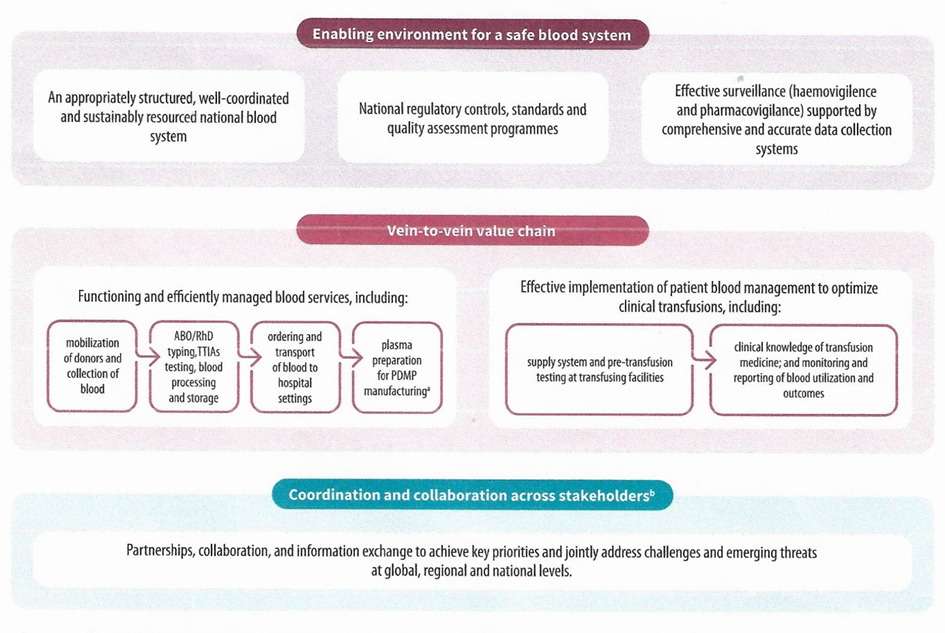
In response to the recommendations of this WHA resolution and the call for action of Member States, WHO has developed important guidelines, aides-memoire and other tools to underpin advancements in access to safe, effective and quality-assured blood and blood products [6, 7, 8, 9, 10, 11, 12]. WHO has also provided guidance and technical assistance to countries in building and strengthening their National Blood Systems [16, 17, 18]. However, the establishing and strengthening of National Blood Systems – policy, legal and regulatory framework, governance, and standards, has been slow in many LMICs. The Global Database on Blood Safety (GDBS) 2015 based Global Status Report on Blood Safety and Availability 2016 and 2021 [13, 14, 19] recognized six major challenges faced by blood services, which mostly affect LMICs:
- deficiencies in national policy, governance and financing;
- insufficient supply of safe, effective and quality-assured blood products for transfusion;
- deficiencies in blood product safety, effectiveness and quality;
- insufficient availability of plasma-derived medicinal products (PDMPs);
- suboptimal clinical practices in transfusion of blood components;
- insufficient access to blood during emergency situations.
Additionally, the US and a few European countries, among which the UK, decided to launch a ‘foreign aid cut’ not only for financial support but also for human guidance and advice projects and many more developmental projects including healthcare and education, microcredits, economic development and infrastructure [20].
What Happened
The approach and contents of the BCG Safe Blood Starter Kit, as well as the lessons learned from its implementation in three LMICs, were leveraged, and aligned with the working mechanism and principles of WHO Geneva and the Action Framework, to develop with the assistance of the BCG a BSS tool with an accompanying user manual [7].
The purpose of these aids, together with this WHO guidance document, is to help countries identify barriers in the provision of sustainable National Blood Systems and implement the recommendations of the Action Framework. The WHO guidance document provides context for these materials, and further directions on how to prioritize and resolve the challenges identified and dismantle the existing barriers through a final chapter on solutions [3].
Assessment of a given developing Blood System and designing potential solutions to overcome the challenges and barriers identified is more than just the analysis of the routine or primary and supportive or secondary functions, processes and procedures. It should include the steering functions, processes and procedures, existing cultures and demographics, and the impact of the societal, economic and political environment, taking into account the existing social climate and any turbulence, such as armed conflicts, political unrest and insurgencies.
When thinking about how to start the BSS activities necessary to strengthen the Blood System, and sequencing and prioritizing the actions and projects, some general principles and factors need to be considered:
- Criticality of the challenges;
- Health system maturity;
- Resources available, whether internal or external (foreign aid) or both;
- Timing;
- Stewardship and ownership.
Potential Solutions: Supportive Actions
Before considering potential ways to implement the strategic objectives of the Action Framework in a country, ensure that three supportive actions have been taken:
- Summarize questionnaire results;
- Review prioritization principles;
- Draft a plan for prioritization of country challenges.
Successful Implementation
When potential solutions have been identified, several key factors should be considered and understood before applying a solution to a local context. The principles and key factors for successful identification and implementation of feasible solutions are outlined below:
- Structure and governance of the blood system and resource availability;
- Demographics, cultures, attitudes and behaviors;
- Underlying infrastructure and environmental conditions; From the outcome of the assessment of strengths and weaknesses based on the • questionnaire in the BSS tool, • expected high-level outcomes of the six strategic objectives, • challenges and barriers identified, actions can be prioritized.
The country profile that emerges from the assessment could roughly be classified either as having “no National Blood System” at all or having a “National Blood System at a certain level of maturity”.
Challenges and Barriers in the LMIC-Blood Systems
The WHO Action Framework to advance universal access to safe, effective and quality-assured blood products 2020– 2023 is based on the identification of six major challenges and 36 barriers that need to be overcome [1].
These 36 barriers are spread over the six major challenges and have not changed over the period of 2015 – 2021, as shown by the Global Status Report on Blood Safety and Availability 2021, which is based on GDBS 2018, does not show significant changes in the data; therefore, the main challenges in Blood Systems are still the same as those reported in 2016 [13, 14].
Per challenge they are: 1. Deficiencies in national policy, governance and financing.
- lack of political commitment and stewardship, and lack of awareness of the essential role of a national blood system in the larger health system;
- failure to appreciate the societal cost of blood insufficiency when compared to the cost of providing an adequate and safe blood supply;
- inadequate and non-updated legal and regulatory frameworks for a National Blood System;
- resource limitations, including financial and infrastructural, and insufficient numbers of qualified and trained personnel, including health workers and national experts, for policy and planning regarding blood product safety and transfusion practice. 2. Insufficient supply of safe, effective and quality- assured blood products for transfusion.
- ineffective donor motivation strategies with low rates of voluntary non-remunerated blood donation;
- cultural resistance or lack of awareness and/or education affecting willingness to donate;
- use of family or replacement and paid blood collection instead of community-based donation to maintain an available and safe inventory;
- lack of support for voluntary non-remunerated blood donation (VNRBD) with repeat donation as the basis of a sustainable system;
- absence of a nationally coordinated blood service;
- logistic complexity of blood collection in non-urban areas (particularly in LMICs);
- lack of government commitment to a nationally coordinated blood service that optimizes resources and minimizes destructive competition among multiple service providers. 3. Deficiencies in blood product safety, effectiveness and quality.
- costs of donor motivation;
- insufficient public education and outreach to promote awareness and to overcome fears and cultural biases;
- inadequate pre-donation screening and risk assessment of donors;
- absence of epidemiological monitoring for transfusion- transmissible infections in the general population and in the blood donor population, hindering public health efforts to identify and motivate low-risk donors;
- insufficient regulatory and professional oversight;
- absence or poor implementation of legislative and regulatory frameworks;
- unreliable management of supplies of reagents and assays (for example, test kits for donation screening and blood grouping reagents);
- little or no control of reagents and assays and related laboratory practices;
- insufficient skills to make use of available laboratory systems;
- lack of or inadequate quality management systems for blood collection and preparation of blood components;
- lack of a hemovigilance system for monitoring and evaluation to identify safety issues and drive improvements. 4. Insufficient availability of PDMPs.
- limited use of blood component preparation to generate recovered plasma;
- failure to meet internationally recognized standards for blood collection and blood component preparation necessary to ensure quality of recovered plasma acceptable to a contract fractionator;
- poor cold chain and supply chain logistics;
- high cost and complexity of apheresis to generate plasma;
- absence of regulatory oversight precluding assurance that appropriate standards are met. 5. Suboptimal clinical practices in transfusion of blood components.
- limited training in and knowledge of transfusion medicine;
- lack of awareness and training in patient blood management (PBM);
- absence of national evidence-based guidelines for transfusion;
- absence of effective transfusion committees in hospitals;
- poor practices in blood component preparation, storage and handling, including maintenance of the cold chain. 6. Insufficient access of patients to blood products during emergency situations.
- damage to the available civil and health care infrastructure system disrupting mobility, transportation and service provision;
- lack of people who come forward to donate blood, due either to fear or illness;
- unreliable means of communication;
- overburdening of the overall health care system.
Despite high demand and large populations, LMICs face significant gaps between the blood supply (establishments) and clinical demand (hospitals). These insufficient blood inventories lead to preventable mortality and morbidity: 26% of deaths from Post Partum Hemorrhage (PPH) worldwide are due to lack of blood [21]. An estimated 1.5 million annual deaths could be prevented in LMICs by making basic surgical procedures accessible, including safe blood. These and many similar issues have persisted due to a combination of factors, such as:
- lack of appropriate and designated funding/resources for blood system improvements (especially given diminishing financial donor funding or foreign aid cuts);
- lack of attention to relevant health areas (for example, HIV, maternal health, neonatology and pediatrics) due to prioritizing other, more addressable and/or innovative areas;
- difficulties in understanding how to holistically assess elements of the National Blood System;
- challenges in determining potential solutions to address key Blood System weaknesses and threats;
- lack of ownership and stewardship of the blood supply, as it is an integrated health system issue that transcends one specific health area, resulting in poor coordination within the health system.
WHO Action Framework to Advance Universal Access to Safe, Effective and Quality-Assured Blood Products 2020–2023
The WHO Action Framework aims to provide strategic directions for addressing the existing barriers to the safety and availability of blood. It aligns with the WHO Thirteenth General Programme of Work (GPW) 2019–2023 [22] and Delivering quality-assured medical products for all 2019– 2023: WHO’s five-year plan to help build effective and efficient regulatory systems [23]. It contains a framework for the implementation of a series of national, regional and resolutions, goals and strategies to ensure availability of safe blood, which is integral to the achievement of the SDGs by 2030 [24]. SDG target 3.8 includes appropriate access to affordable and quality-assured medicines, vaccines and health products, including blood products, which is the main goal of the 2010 Universal Health Coverage (UHC) program [25]. Aligning the WHO Action Framework with the thirteenth WHO GPW 2019–2023 highlights UHC. The objective is to implement appropriate clinical use of blood, including PBM and a hemovigilance system [26, 27, 28] reducing the overall cost of blood services. It will encourage Member States to reduce plasma wastage and to progress towards sufficiency in plasma protein therapies, like albumin, immunoglobulins and coagulation factors. It provides 6 Strategic Objectives with high-level outcomes to achieve:
1. An appropriately structured, well-coordinated and sustainably resourced national blood system Expected high-level outcomes to achieve are:
- The national blood system is appropriately structured, well-coordinated and integrated into the national health system. 1.2 The national blood system is adequately and sustainably costed, financed and budgeted.
- National policies and decisions involving blood products are developed through a formal policy-making process and risk- based decision-making.
- There is an adequate and safe blood supply during emergency situations, such as infectious disease outbreaks, natural disasters and humanitarian emergencies. 2. An appropriate national framework of regulatory controls, national standards and quality assessment programs Expected high-level outcomes to achieve are:
- The national blood regulatory system is in place and functions at an externally assessed maturity level of 3 or 4 evaluated with the Global Benchmarking Tool (current version 6) Plus Blood (28).
- Regulatory mechanisms are in place for comprehensive of blood products, associated substances and medical devices, including in-vitro diagnostic (IVD) devices.
- Quality assessment of blood products, associated substances and medical devices, including IVD devices, is carried out by relevant authorities and national control laboratories.
- Performance of blood products and associated substances and medical devices, including IVD devices, is assured through use of biological reference standards and external quality assessment schemes. 3. Functioning and efficiently managed blood service Expected high-level outcomes to achieve are:
- Achievement of 100% voluntary, non-remunerated blood donation, protection of blood donor health and safety, and promotion of repeat donation.
- A functioning quality system is in place across the entire blood transfusion chain.
- Blood services are efficiently and cost-effectively managed, and donated blood is processed according to clinical need with minimal wastage.
- The volume and quality of plasma available for manufacture into PDMPs has increased. 4. Effective implementation of PBM to optimize clinical practice of transfusion Expected high-level outcomes to achieve are:
- Good PBM is practiced, based on national clinical guidelines and practice standards.
- A quality system is in place in hospitals for all pretransfusion testing and clinical transfusion processes, including hospital blood bank laboratories 5. Effective surveillance (hemovigilance, and pharmacovigilance), supported by comprehensive and accurate data collection systems Expected high-level outcomes to achieve are:
- There is a national system for standardized data collection and reporting, and mechanisms to ensure uniform implementation.
- There are systems for traceability, surveillance, hemovigilance and pharmacovigilance at national and organizational levels.
- The WHO GDBS provides comprehensive and accurate data on the global status of blood product availability, safety and quality which can be used for benchmarking purposes. 6. Partnerships, collaboration and information exchange to achieve key priorities and jointly address challenges and emerging threats at global, regional and national levels Expected high-level outcomes to achieve are:
- Training programs on key functions of the National Blood System are in place.
- Capacity to carry out external assessment and accreditation of national blood establishments is available.
- Capacity to evaluate relevant new technologies and other innovations is incorporated into the national blood system to overcome local impediments and to address urgent situations.
- Regulatory capacity is strengthened through collaborative capability-building and harmonization initiatives.
Activities related to each strategic objective have been described in the log frame of the Action Framework. New guidance documents have been developed to assist countries in implementing the Action Framework [1].
Despite these efforts, developmental progress in LMICs has been slow because many countries seem to have problems in prioritizing their efforts to address the existing challenges and barriers and implementing the relevant actions proposed in the log frame of the strategic objectives of the Action Framework [1]. They all experience the negative aspects of the foreign aid cuts and limitations of ad hoc human guidance and expert advice including the forced reorganization of the WHO and merging of the blood department into a new department, a loss of visibility, reputation and recognition. The BSS has just been made available in time with the aim to identify the challenges, weaknesses and barriers, and provide a menu of potential solutions to address the challenges, transforming existing weaknesses into strengths and dissolving the existing barriers. This self-assessment tool is a starting point for implementing the six strategic objectives of the Action Framework and achieving the respective high-level outcomes in order to: 7. Improve understanding of the organization, governance, management and operations of a country’s Blood System (vein-to-vein):
- increase awareness of what is going well and at what level;
- highlight challenges, weaknesses and potential root causes or barriers. 8. Provide guidance on where to start and what to do next:
- deliver actionable insight to understand which issues to prioritize and explore further;
- offer considerations for prioritization of challenges/ weaknesses and sequencing of solutions;
- understand that each stage or link in the chain (vertical and horizontal) depends on and is important for the two connecting links or processes.
Conclusion
The aim of the development of this self-assessment tool based on the six Strategic Objectives of the 2020-2023 Action Framework is to reduce preventable morbidity and mortality by promoting the availability of safe blood and blood components as essential medicines. Additional benefits of completing the self-assessment and strengthening the Blood System include:
- fostering community engagement, advocacy and trust in the health system;
- strengthening overall health system functions (for example, communication systems across facilities, laboratory performance, systems management, data monitoring and evaluation, stewardship and accountability mechanisms);
- improving clinical competencies (for example, management and provision of blood as a life-saving and supportive for comprehensive emergency, obstetric and newborn care, and the approach of proper and dedicated PBM and hemovigilance.
These benefits will improve the overall quality of health care, which can increase health system utilization, promote care-seeking behaviors, and contribute to patient safety, while eliminating avoidable harm in health care.
The implementation is financially not expensive and might result in cost saving in the health care and substantially reduce morbidity and mortality.
Conflict of Interest
The author has nothing to declare.
Funding
No funding was received. References
1. (2020) Action framework to advance universal access to safe, effective and quality-assured blood products 2020– 2023. Geneva: World Health Organization.
2. Abdella YE, Maryuningsih, YS, Smit Sibinga CTh (2023) Historical Background and Current Global Efforts. In: Smit Sibinga CTh, et al. (Eds.), History, Resolutions, Frameworks; Eichbaum QG editor-in-chief and Section editors. Global Perspectives and Practices in Transfusion Medicine. AABB Press Bethesda, MD, USA, pp: 1-26.
3. (2023) Guidance to identify barriers in blood services using the blood system self-assessment (BSS) tool. Geneva, World Health Organization.
4. (2023) Web annex, Blood system self-assessment In: Guidance to identify barriers in blood services using the blood system self-assessment (BSS) tool. Geneva, World Health Organization.
5. (2010) World Health Assembly resolution WHA63.12. Availability, safety and quality of blood products. In: Sixty-third World Health Assembly, Geneva, 21 May 2010. Geneva: World Health Organization.
6. (2022) Guidance on ensuring a sufficient supply of safe blood and blood components during emergencies. Geneva: World Health Organization.
7. (2021) Guidance on centralization of blood donation testing and processing. Geneva: World Health Organization.
8. (2023) Guidance on quality assessment of blood products and associated substances, and medical devices, including IVD devices. Geneva: World Health Organization.
9. (2021) Guidance on increasing supplies of plasma- derived medicinal products in low- and middle-income countries through fractionation of domestic plasma. Geneva: World Health Organization.
10. (2021) The urgent need to implement patient blood management: policy brief. Geneva: World Health Organization.
11. (2021) Educational modules on clinical use of blood. Geneva: World Health Organization.
12. (2022) WHO User Guide for navigating resources to implement the haemovigilance system. Geneva: World Health Organization.
13. (2016) Global Status Report on Blood Safety and Availability 2016. Geneva. World Health Organization.
14. (2016) Global Status Report on Blood Safety and Availability 2021. Geneva. World Health Organization.
15. Jansen van Galen JP, Smit Sibinga CTh (2013) Process management in the vein-to-vein chain. In: Smit Sibinga CTh (Eds.), Quality management in transfusion medicine. New York (NY): Nova Science, pp: 131-185.
16. (2002) Aide-memoire for national blood programmes: Blood safety. Geneva: World Health Organization.
17. (2008) Aide-memoire for national health policy makers: good policy process for blood safety and availability. Geneva: World Health Organization.
18. (2005) Aide-memoire for national health authorities: safe blood components. Geneva: World Health Organization.
19. (2015) Global Database on Blood Safety (GDBS). Geneva. World Health Organization.
20. (2025) OECD Policy Brief 26 June 2025. Cuts in official development assistance: OECD projections for 2025 and the near term.
21. Bates I, Chapotera GK, McKew S, Broek N (2008) Maternal mortality in sub-Saharan Africa: the contribution of ineffective blood transfusion services. BJOG.
22. (2019) Thirteenth General Programme of Work, 2019– 2023: promote health, keep the world safe, serve the vulnerable. Geneva: World Health Organization.
23. (2019) Delivering quality-assured medical products for all 2019–2023: WHO’s five-year plan to help build effective and efficient regulatory systems. Geneva: World Health Organization.
24. (2025) Sustainable Development Goals. United Nations.
25. (2024) Universal Health Coverage (UHC). WHO.
26. Frank SM, Waters JM (2016) Patient Blood Management: Multidisciplinary Approaches to Optimize Care. Bethesda, MD: AABB Press.
27. De Vries RP, Faber J-C (2012) Hemovigilance. An effective tool for improving transfusion safety. Oxford: Wiley Blackwell.
28. (2019) WHO Global Benchmarking Tool + Blood.
- Why Was Transfusion Medicine Not Recognized as a Clinical Discipline?
- Outcomes of Lenalidomide Relapsed/Refractory Patients
- Is Transfusion Always Necessary?
- The Logistics of Production and Use of Blood and Blood Components
- The Challenge for Component Therapies
- Effect of Monoclonal Gammopathy on Risk of Kidney Failure among Patients with Chronic Kidney Disease