
Epigenetic Sustainability: Modeling the Human Factor as a Natural Resource through Science 4.0 and the NR3C1 Biological Pilot
The Anthropocene demands a paradigm shift in the management of natural resources. This paper introduces the concept of Epigenetic Sustainability, defining the human biological integrity as a finite and vulnerable natural resource. By analyzing the NR3C1 gene through the lens of Science 4.0, we demonstrate how systemic congestion in social and industrial flows leads to an epigenetic "locking" mechanism. We propose an AI-driven "Biological Pilot" framework for predictive maintenance of human resilience. This model transforms the human factor from a passive variable into a steered, sustainable asset, ensuring the long-term viability of complex socio-technical ecosystems.
Introduction
The Ecology of Human Flows
Traditional environmental science focuses on the depletion of external resources (water, minerals, biodiversity). However, the most critical resource within modern high-pressure systems is the Human Factor. Drawing on the SET Theory (Stress-Epigenetic-Transition) established in our previous works (IZAB-16000667, IZAB- 16000669), we argue that social and informational density acts as a “systemic pollutant.” In this context, Sustainability is no longer just about the environment; it is about the capacity of the human operator to maintain genomic integrity under the toxic pressure of saturated flows.
The NR3C1 Sensor: A Biological Barometer
The NR3C1 gene (Nuclear Receptor Subfamily 3 Group C Member 1) is the core regulator of the HPA axis. It acts as a biological sensor of ecosystemic pressure.
• The Locking Process: Environmental over-saturation triggers a non-linear epigenetic response—DNA methylation of the NR3C1 promoter.
• Biological Congestion: This “lock” prevents the feedback regulation of cortisol, leading to a state of permanent biological alert. From an ecological perspective, this represents the “exhaustion” of the human resource (Figure 1).
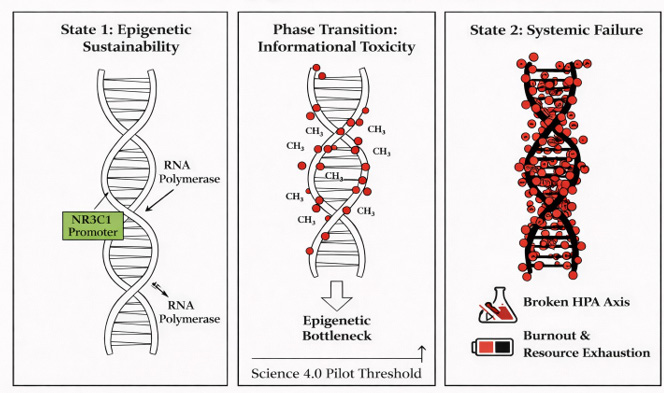
• State 1 (Left): Represents the state of Epigenetic Sustainability. The DNA remains flexible, and the NR3C1 promoter is accessible to RNA Polymerase, ensuring normal stress regulation and high resilience.
• Phase Transition (Center): Shows the impact of Informational Toxicity and systemic pressure. The accumulation of stress triggers the recruitment of methyl groups (CH3), acting as biological “locks” on the gene sequence. This is the critical threshold of the Science 4.0 pilot.
• State 2 (Right): Represents Systemic Failure. The gene is fully methylated (locked), hindering transcription. The feedback loop of the HPA axis is broken, leading to irreversible biological exhaustion and “Burn-out,” marking the depletion of the human factor as a natural resource.
Methodology: Transitioning to Science 4.0
To manage this resource, we transition from descriptive biology to Science 4.0, an operational framework where living systems are managed as logistical flows.
• AI Integration: We utilize Artificial Intelligence to process real-time indicators of systemic stress.
• Predictive Maintenance: The Science 4.0 Pilot identifies the “Early Warning Signals” (EWS) of NR3C1 methylation before the transition to systemic failure (burn-out, collapse) becomes irreversible (Figure 2).
Mathematical Modeling of Resilience Flows
For the management of human natural resources, we introduce the Sustainable Resilience Equation (Rs):
adapt .e s R µ Φ = Φ
(NR3C1) stress Where: • adapt Φ represents the available adaptive capacity.
• stress Φ represents the density of incoming flows.
• (NR3C1) eµ is the exponential factor of epigenetic locking.
• As (NR3C1) µ increases, the sustainability of the system drops toward zero, marking the point of ecological collapse of the human resource.
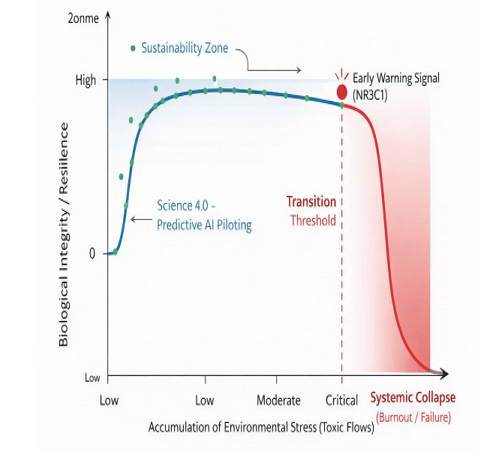
• Sustainability Zone (Blue): Phase of high adaptive capacity where the AI-Driven Pilot optimizes flows to maintain genomic integrity. • Early Warning Signal (EWS): Point of detection corresponding to the initial methylation of the NR3C1 gene. • Transition Threshold: Critical tipping point where the epigenetic lock becomes systemic. • Systemic Collapse (Red): Non-linear drop in integrity leading to burn-out and resource exhaustion.
Results and Discussion: Toxicology of Social Ecosystems
Our analysis shows that “Burn-out” is not an individual pathology but an ecological failure of the resource management. By applying the Science 4.0 Pilot, we can: • Detect the lock before the clinical symptoms appear. • Optimize flow distribution to allow epigenetic “unlocking.” • Ensure the sustainability of the global system (Aviation, Logistics, Research).
This approach provides Joyce Regina and the scientific community with a tool to quantify the “Human Cost” of industrial and social expansion.
Conclusion: The Future of Resource Management
The Journal of Ecology & Natural Resources is the gateway to a new era where biology, ecology, and AI converge. Epigenetic Sustainability is the only vehicle capable of navigating the complexity of the 21st century without exhausting the very actors who drive it.
References
-
Boblique J **(**2026) A Social Epigenetic Theory of Systemic Transitions. Int J Zoo Animal Biol 9(1): 000667.
-
Boblique J (2026) From SET Theory to Science 4.0: An AI-Driven Framework for Epigenetic Integrity and Biological Flow Control. Int J Zoo Animal Biol 9(1): 000669.
- Community Forestry Enterprises as a Model for Sustainable Forest Development: The Case Of The "Baja Tarahumara" in Chihuahua, Mexico
- Ecological and Socio-Economic Impacts of Chromolaena odorata and Mesosphaerum suaveolens, Two Invasive Alien Species in Central and Southern Benin, West Africa
- Growth-at-Risk: A Framework for Assessing Economic Vulnerability
- The Rural Territory as a Socioecological System for the Management of Public Policy for Sustainable Rural Development
- Transition Risks in a Small Open Economy: An EDSGE Model with Blue Firms, Financial Frictions and Macroprudential Policy
- Germination Responses of Araribá (Centrolobium tomentosum - Guillem. ex-Bentham - Fabaceae) when Subjected to Different types of Betterments