
Ecological and Socio-Economic Impacts of Chromolaena odorata and Mesosphaerum suaveolens, Two Invasive Alien Species in Central and Southern Benin, West Africa
Chromolaena odorata and Mesosphaerum suaveolens, two invasive plants originating from tropical America, exert significant pressure on forest ecosystems in West Africa, particularly by disrupting natural regeneration processes. Their expansion in the Lama Classified Forest in southern Benin has raised increasing ecological and socio-economic concerns. This study investigated how C. odorata affects natural regeneration dynamics and examined local perceptions related to both species. Vegetation surveys were conducted in plots situated in invaded and non-invaded zones to assess species composition and seedling density. Complementary interviews with local communities were carried out to document the socio-economic impacts attributed to these invasive plants. Results show a marked decline in seedling abundance and species richness in invaded areas compared to non-invaded zones, indicating strong ecological pressure linked to the presence of the species. Community perceptions consistently highlight the predominantly harmful effects of C. odorata and M. suaveolens on agriculture, forest regeneration, and livelihoods. The study highlights the significant ecological and socio-economic threats posed by these invasive species and emphasizes the need for targeted management to protect ecosystem integrity in affected areas.
Introduction
Biological invasions are a major challenge for biodiversity conservation, ecosystem stability, and food security, particularly in tropical developing regions [1]. These species, often introduced accidentally but sometimes deliberately, can rapidly establish and dominate local plant communities, causing profound changes in ecological dynamics and ecosystem functions [2]. In West Africa, invasive species such as Chromolaena odorata (L.) King RM, et al. [3] and Mesosphaerum suaveolens (L.) Kuntze are raising concerns due to their impact on both agricultural systems and natural habitats.
C. odorata, native to tropical America, is among the most problematic invasive plants in Africa, colonizing fallow land, field margins, secondary forests, and even protected areas [4]. It is characterized by rapid growth, high biomass production, and allelopathic effects that inhibit the germination and growth of native plants, leading to notable losses in local plant diversity [5]. M suaveolens, also native to tropical America, is emerging as a weed of concern in wetlands and food crops such as cassava and maize, where it competes with cultivated plants and reduces productivity [6]. Beyond ecological impacts, plant invasions impose socio-economic burdens, particularly for rural communities dependent on natural and agricultural resources [7]. Reduced yields, higher management costs, and the need to adapt cultural practices can exacerbate farmers’ vulnerability, especially where access to resources and technologies is limited [8]. Despite this, integrated studies combining ecological and socio-economic assessments of C. odorata and M. suaveolens remain scarce in West Africa [9].
This study aims to assess both the ecological and socio- economic impacts of C. odorata and M. suaveolens in rural areas of Benin. By combining surveys of local communities, analyses of management costs, and measurements of natural regeneration of woody species, the research provides evidence to guide sustainable management strategies for these invasive plants.
Materials and Methods
Study Area
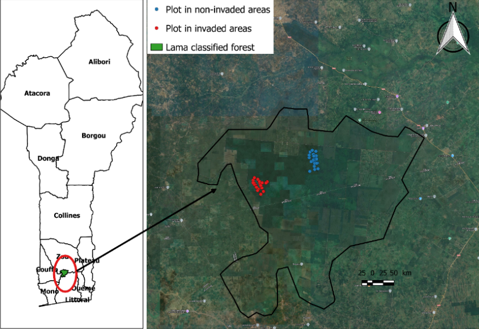
This study was conducted in the Lama Classified Forest in southern Benin, as well as in surrounding municipalities affected by the spread of the two species (Figure 1). This forest constitutes one of the last vestiges of semi-deciduous forests in the Sudano-Guinean zone of the country and represents an ecosystem of major importance. It’s located between 6°55-7°00N and 02°04- 02°12 E, in southern Benin. This forest is the largest natural forest in southern Benin and one of the last relict forests in the Dahomey Gap.
Socio-Economic Survey
To assess how C. odorata and M. suaveolens affect local socio-economic conditions, we conducted a structured survey among rural communities in six municipalities: Zè, Bohicon, Zogbodomè, Dassa-Zoumè, Savè, and Glazoué. The survey aimed to assess local perceptions of the species influencing agricultural productivity, livestock rearing, access to natural resources, and household income.
The number of respondents was determined using the Dagnelie [10] formula:
( ) ( ) 2
2 * 1 * U p p n d − =
where n defines the survey population size, U represents the standardized confidence interval coefficient (1.96 corresponding to 95% certainty), p reflects the anticipated proportion of respondents demonstrating species familiarity, and d constitutes the acceptable sampling error margin, established at 7% precision [11]. Respondents were selected using a stratified random sampling approach to ensure representativeness across different villages and socio- economic groups.
Field Design and Data Collection Methods
A total of 40 quadrats measuring 10 m × 10 m were established, equally distributed between invaded and uninvaded areas. Quadrats were positioned to capture a representative range of local conditions while minimizing topographical and anthropogenic biases. Within each quadrat, all woody regeneration, including seedlings and saplings, was recorded [12]. Plant specimens were collected for identification at the National Herbarium.
Measured Ecological Variables
From the collected data, parameters such as species richness in regeneration and regeneration density were calculated. Shannon’s diversity index (H′), which considers both species richness and relative abundance, and Pielou’s evenness index (J′), which measures the balanced distribution of individuals between species, were also measured [13, 14, 15].
Statistical Analyses
Statistical analyses were performed using R software (version 4.3.2, R Core Team, 2023). Data normality was assessed using the Shapiro-Wilk test, and variance homogeneity was evaluated with Levene’s test. For variables meeting both assumptions, one-way ANOVA was applied. When these assumptions were not met, the Wilcoxon rank- sum test was used as a non-parametric alternative. The significance level was set at α = 0.05 for all tests. Floristic composition between invaded and uninvaded areas was compared using the Jaccard similarity index. Non-metric multidimensional scaling (NMDS) was employed to visualize floristic structure, and PERMANOVA was used to evaluate the effect of invasion on floristic composition using the vegan package [16].
Results
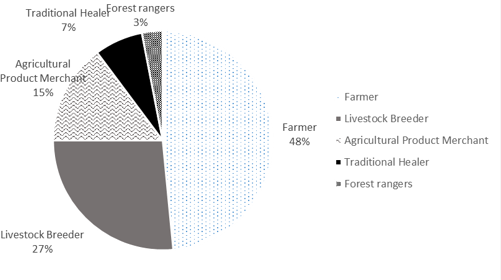
The survey included 196 participants, representing several socio-professional groups. Farmers were the most represented with 95 respondents (48.5%), followed by livestock breeders (26.5%), agricultural product dealers (14.8%), traditional healers (7.1%), and forest rangers (3.1%) (Figure 2).
Socio-Economic Impacts Of C. odorata and M. suaveolens
Most respondents (78.6%) consider these species harmful to their activities due to increased land management costs, reduced pastoral resources, biodiversity loss, and lower yields. Farmers reported that C. odorata rapidly invades fallow land and perennial crops, leading to a marked increase in weeding efforts (Table 1). Producers affected by this species estimate the average annual management cost at 45,200 ± 8,700 FCFA/ha, with higher expenses during the rainy season, when growth is most intense. For M. suaveolens, the average cost is estimated at 31,800 ± 6,400 FCFA/ha/ year, and its impact is considered particularly severe in humid and lowland areas, where it limits the cultivation of cassava (Manihot esculenta) and maize (Zea mays). Regarding productivity, 64.8% of farmers indicated that C. odorata reduces crop yields by more than 25%, compared with 47.3% for M. suaveolens. These losses are commonly linked to reductions in cultivated areas and adjustments to cropping calendars aimed at limiting species expansion. Although C. odorata is largely perceived negatively, 15% of producers associate its presence with improved soil fertility, noting its frequent occurrence on fallow or previously cultivated land and the contribution of its litter to surface organic matter. Some secondary uses were reported, mainly for medicinal purposes, plot demarcation, or mulching. However, these benefits are considered insufficient to offset economic losses and increased labor demands. Consequently, most respondents (83.7%) expressed a desire to eradicate or substantially reduce these species.
| Chromolaena odorata | Mesosphaerum suaveolens | |
|---|---|---|
| Perception of the species | Mainly considered harmful (costs, biodiversity loss, yield reduction) | Mainly considered harmful, especially in humid lowland areas |
| Annual management cost (mean ± SD) | 45,200 ± 8,700 FCFA/ha | 31,800 ± 6,400 FCFA/ha |
| Period of highest cost | Rainy season (vigorous growth) | Rainy season (humid areas) |
| Impact on crops | Rapidly colonizes fallows and perennial crops; increased weeding workload | Particularly problematic for cassava and maize in lowlands |
| Yield loss (> 25%) | Reported by 64.8% of respondents | Reported by 47.3% of respondents |
| Farmers’ strategies | Reduced cultivated area, adjusted crop calendar | Reduced cultivated area, adjusted crop calendar |
Table 1: Reported impacts of C. odorata and M. suaveolens.
Ecological Impact of the Species in the Lama Classified Forest
The analysis of floristic inventories and vegetation structure surveys reveals clear differences between invaded areas by C. odorata and non-invaded areas. This fast-growing, heliophilous species develops dense stands that strongly affect the composition and dynamics of plant communities. In invaded plots, high leaf cover restricts light availability at ground level, thereby limiting the establishment of local herbaceous and woody species. Moreover, substantial biomass and litter accumulation, together with the production of allelochemical compounds, alters soil-related conditions and constrains woody regeneration. The data provide evidence of significant impacts of the invasion on species diversity and regeneration density.
Specific Richness and Regeneration Density
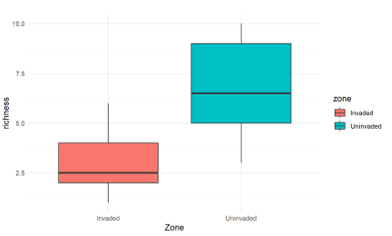
Species richness was calculated to evaluate the effect of invasion by C. odorata on floristic diversity. Differences between invaded and uninvaded areas were assessed using the non-parametric Wilcoxon rank-sum test. A highly significant difference was detected between the two conditions (W ≈ 32, p ≈ 4.9 × 10⁻⁶). Invaded areas exhibited substantially lower species richness (median ≈ 2.5 species) compared to uninvaded areas (median ≈ 6.5 species) (Figure 3).
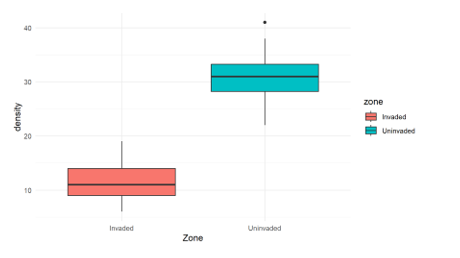
Individual density was assessed to evaluate the effect of C. odorata invasion on natural regeneration abundance. Differences between invaded and uninvaded areas were tested using one-way ANOVA. A highly significant difference was detected between the two conditions (F₁,₃₈ = 186.4, p = 3.13 × 10⁻¹⁶). Invaded areas exhibited substantially lower mean density (mean ≈ 11 individuals) compared to uninvaded areas (mean ≈ 31 individuals) (Figure 4).
Impact of C. odorata Invasion on the Specific Diversity of Natural Regeneration
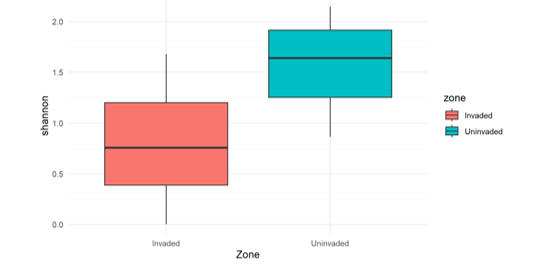
The Shannon diversity index was calculated to evaluate the effect of C. odorata invasion on the diversity of natural regeneration. Differences between invaded and uninvaded areas were tested using a one-way analysis of variance. The ANOVA revealed a highly significant difference between the two conditions (F₁,₃₈ = 32.92, p = 1.3 × 10⁻⁶). Invaded areas exhibited substantially lower mean Shannon index values (mean ≈ 0.75) compared to uninvaded areas (mean ≈ 1.7) (Figure 5). These results align with the reduced species richness observed in invaded areas.
Analysis of Floristic Similarity Between Invaded and Non-Invaded Areas
Floristic similarity between invaded and non-invaded areas was assessed using the Jaccard and Sorensen indices. The Jaccard index ranged from 0.50 to 1.00 (median: 0.90), while the Sorensen index ranged from 0.33 to 1.00 (median: 0.82). High index values indicate that some sites maintain a relatively similar species composition. Lower minimum values, particularly for the Sorensen index, indicate that other sites exhibit notable differences in floristic composition. Invaded areas show greater homogeneity, reflecting local losses of characteristic species.
Differences in Floristic Composition (PERMANOVA) and Ordinal Representation of Plant Communities (NMDS)
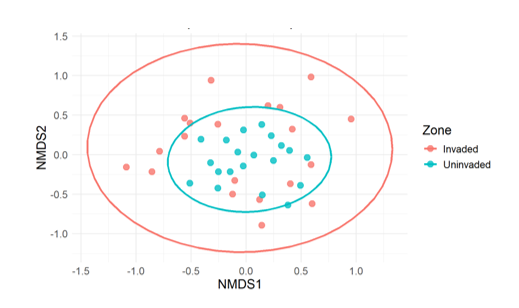
To assess the effect of C. odorata on natural regeneration, floristic composition was compared between invaded and uninvaded areas using PERMANOVA. The analysis indicated a significant difference between the two groups (F = 1.931, R² = 0.048, p = 0.014), suggesting that the species composition of invaded plots differs from that of uninvaded plots. This
finding supports further analyses of community structure using NMDS and similarity indices. NMDS analysis revealed a separation between invaded and non-invaded plots. Invaded plots showed greater dispersion, indicating greater variability in floristic composition, while non-invaded plots were more clustered, indicating more homogeneous communities (Figure 6).
The results show that invaded areas differ markedly from uninvaded areas in terms of floristic composition and regeneration. Invaded areas exhibited lower species richness, lower diversity (Shannon index), and altered community structure compared to uninvaded areas.
Discussion
Socio-Economic Impacts
This study shows that C. odorata and M. suaveolens impose substantial socio-economic pressures on local farming communities. Most respondents perceived these species as pests that contribute to the growing scarcity of pastoral resources, prompting the movement of large herds and exacerbating farmer-herder conflicts, which in some cases have resulted in fatal incidents [17]. These invasive species reduce local biodiversity and greatly increase the occurrence and intensity of vegetation fires in protected areas [18].
Average annual management costs associated with C. odorata exceed those reported for some areas in West Africa [19], likely reflecting its vigorous growth under the influence of the local rainfall regime. M. suaveolens remains particularly problematic in humid zones, where its high density significantly hampers the cultivation of cassava and maize [20]. The yield reductions reported are consistent with ranges observed in other studies, where productivity losses typically vary between 20% and 50% [21]. Adjustments made by farmers, including reducing cultivated areas and modifying cropping calendars, indicate that managing these species requires substantial additional resources [1]. While some benefits are acknowledged, their economic significance remains marginal and does not compensate for cumulative losses in production and labor [22]. Indeed, a minority of producers recognize C. odorata as an indicator of soil fertility, presenting a potential leverage point for integrated management strategies [23].
Ecological Impacts
The results reveal a substantial influence of C. odorata on local plant communities. The high leaf cover of this invasive plant in invaded areas corresponds to descriptions by Nuñez [24], who highlight the ability of this heliophilous species to form monospecific stands, thereby reducing light availability for regeneration of herbaceous and woody species. This is reflected in reduced density of young woody plants in affected areas [25]. The significant contribution of C. odorata litter, combined with allelochemical effects, modifies soil physicochemical properties and hinders germination and growth of local species [26]. These mechanisms partly explain the low species diversity observed in invaded areas, with comparable effects reported for West African forest ecosystems [27].
In the Lama classified forest, C. odorata represents a major disturbance, profoundly modifying forest structure and functioning [27]. Its rapid expansion is explained by effective biological traits for colonizing disturbed environments: rapid growth, abundant production of light wind-dispersed seeds, and regeneration capacity from stem or root fragments [28]. The superficial but extensive root system efficiently captures water and nutrients, depriving local plants of essential elements and increasing seedling mortality [29]. Allelopathic effects through inhibitory compounds released by decomposing leaves further reduce seed germination and seedling growth [30].
The abundant litter produced decomposes quickly, temporarily enriching soil with organic matter but accelerating nutrient cycles, making them less available to other species in the medium term [30]. The simplification of plant structure reduces habitats for many animal species [31], with specialized pollinators losing host plants and frugivorous species struggling to find traditional food [32]. The dominant presence of C. odorata modifies trophic networks, favoring generalist species and contributing to homogenization of forest fauna [33]. During the dry season, accumulated dry biomass exhibits high flammability, elevating fire risk. Such fires occur more frequently in invaded areas, hindering native species regeneration while promoting C. odorata persistence [34].
Implications and Recommendations
Management of C. odorata requires an integrated approach combining mechanical control methods with biological strategies and active restoration through planting competitive local species. Manual weeding effectiveness can be enhanced when combined with careful herbicide application during the wet season, prioritizing farmer training on safe use. Promoting innovative agricultural practices can limit spread. Continuous cultivation should be encouraged to reduce fallow lands favorable for invasion. Introduction of cover crops or legumes may strengthen cropping system resistance while improving soil fertility. Promoting local uses of these species for medicinal, agroecological, or artisanal applications could mitigate economic losses. These strategies require further research on long-term ecological impacts, socio-economic feasibility, and safety. Building technical capacity and raising awareness among local communities are essential for early detection, safe herbicide use, and participatory management. Establishing community monitoring committees could enable effective surveillance and rapid intervention. Finally, creating a regular monitoring system would allow evaluation of management outcomes, adaptation of interventions, and prediction of new invasion events.
Conclusion
The present study highlights the socio-economic and ecological impacts of C. odorata and M. suaveolens. Socio- economically, these species increase land management costs and alter cultivation practices, directly affecting local livelihoods. Ecologically, these species impair woody species regeneration through light competition and soil alteration, posing a threat to biodiversity and forest sustainability. These findings underline the need for integrated management strategies combining targeted control, adapted agricultural practices, and the rational use of local resources to support both conservation and rural well-being. Strengthening awareness and technical capacity among local stakeholders remains key to the long-term effectiveness of such interventions.
Conflict of Interests
The authors report no conflicts of interest.
Acknowledgements
The authors are grateful to the JRS Biodiversity Foundation for its contribution to the Master’s and PhD programs in biodiversity informatics in Benin.
References
-
Pyšek P, Hulme PE, Simberloff D, Bacher S, Blackburn TM, et al. (2020) Scientists’ warning on invasive alien species. Biological Reviews 95(6): 1511-1534.
-
Anton A, Geraldi NR, Lovelock CE, Apostolaki ET, Bennett S, et al. (2019) Global ecological impacts of marine exotic species. Nature Ecology and Evolution 3: 787-800.
-
Blackburn TM, Bellard C, Ricciardi A (2019) Alien versus native species as driver of recent extinction. Frontiers in Ecology and the Environment 17(4): 203-207.
-
Shackleton RT, Shackleton CM, Kull CA (2018) The role of invasive alien species in shaping local livelihoods and human well-being: A review. Journal of Environmental Management 229: 145-157.
-
El Mazi M, Hmamouchi M, Houari A (2021) Impact de l’évolution de l’utilisation des terres sur la dégradation des ressources en sols dans le Rif Central méridional, Maroc. Revue Marocaine des Sciences Agronomiques et Vétérinaires 9(4): 567-572.
-
Gbessemehlan A, Zoundji C, Babatounde N, Gangnon S, Akplo M, et al. (2022) Etude comparative de l’efficacité de deux types de composts organiques sur la performance agroéconomique de l’amarante (Amaranthus cruentus L) dans les jardins familiaux au Bénin. International Journal of Biological and Chemical Sciences 16(3): 1122- 1136.
-
Shackleton RT, Larson BMH, Novoa A, Richardson DM, Kull CA (2019) The human and social dimensions of invasion science and management. Journal of Environmental Management 229: 1-9.
-
Eschen R, Douma JC, Grégoire JC (2023) Biological control of invasive plants in Africa: Challenges and opportunities. CABI Reviews 18(040): 1-15.
-
Soto Á (2023) Monetary impacts should be considered in biological invasion risk assessments. Journal of Applied Ecology 60(11): 2309-2313.
-
Dagnelie P (1998) Statistique théorique et appliquée. Tome 1: Statistique descriptive et bases de l’inférence statistique. De Boeck et Larcier, Belgium 10(3).
-
Singh B, Yadav CM (2009) Effect of soybean straw on voluntary intake, nutrient utilization and rate of passage in sheep and goats. Indian Journal of Small Ruminants 15(2): 262-265.
-
Gbètoho A, Kingbo A, Kiki P, Gnanguènon-Guéssè D, Aoudji A, et al. (2019) Impact de Chromolaena odorata sur la régénération d’arbres natifs dans les forêts secondaires de la Lama, au Bénin. Bois & Forêts des Tropiques.
-
Shannon CE (1948) A mathematical theory of communication. Bell System Technical Journal 27: 379- 423.
-
Pielou EC (1966) The measurement of diversity in different types of biological collections. Journal of Theoretical Biology 13: 131-144.
-
Koné AW, Diakité SA, Konaté Y, Soro TD, N’Dri AB, et al. (2021) Assessing the impacts of Chromolaena odorata invasion on soil properties in West African dry forests. Catena 207: 105619.
-
Oksanen J, Simpson GL, Blanchet FG, Kindt R, Legendre P, et al. (2020) vegan: Community Ecology Package. R package version 2: 5-7.
-
Turbelin AJ, Hudgins EJ, Catford JA, Cuthbert RN, Diagne C, et al. (2024) Biological invasions as burdens to primary economic sectors. Global Environmental Change 87: 102858.
-
Tiralongo F, Mancini E, Gattelli R, di Pasquale C, Rossetti E, et al. (2025) The devasting economic impact of Callinectes sapidus on the clam fishing in the Po Delta (Italy): Striking evidence from novel field data. arXiv.
-
Van Wilgen BW, Fill JM, Govender N, Foxcroft LC (2022) Impacts of invasive alien trees on native ecosystems in South Africa: A synthesis of three decades of research. South African Journal of Botany 151: 102-115.
-
Simberloff D, Keitt B, Will D, Holmes N (2023) Biological invasions as a disruptor of the Anthropocene. Trends in Ecology & Evolution 38(2): 118-130.
-
Shackleton RT, Shackleton CM, Kull CA (2023) Invasive species and poverty in the Global South: A review of interactions and policy responses. World Development 162: 106140.
-
Ouédraogo DY, Nacoulma BMI, Hahn K, Thiombiano A (2023) Spread of invasive plants in West African savannas: A climatic and land-use perspective. Flora 308: 152420.
-
Nuñez MA, Pauchard A, Ricciardi A (2024) Invasive species amplify social inequalities in vulnerable communities. BioScience 74(1): 12-25.
-
Early R, Bradley BA, Dukes JS, Lawler JJ, Olden JD, et al. (2023) Horizon scanning for invasive species threats to biodiversity and ecosystems. NeoBiota 85: 109-128.
-
Kull CA, Shackleton CM, Cunningham PJ, Ducatillon C, Dufour Dror JM, et al. (2021) Invasive plants in African forest landscapes: Drivers, impacts, and management options. Forest Ecology and Management 501: 119668.
-
Diagne C, Leroy B, Vaissière AC, Gozlan RE, Roiz D, et al. (2021) High and rising economic costs of biological invasions worldwide. Nature 592(7855): 571-576.
-
Dassou AG, Odjo T, Tixier P (2022) Invasive species in Benin’s protected areas: Distribution patterns and management challenges. Journal of Environmental Management 324: 116362.
-
Henry M, Leung B, Cuthbert RN, Bodey TW, Ahmed DA, et al. (2023) Unveiling the hidden economic toll of biological invasions in the European Union. Environmental Sciences Europe 35.
-
Bradshaw CJA, Hulme PE, Hudgins EJ, Leung B, Kourantidou M, et al. (2024) Damage costs from invasive species exceed management expenditure in nations experiencing lower economic activity. Ecological Economics 220: 108166.
-
McCulloch-Jones L, van Wilgen BW, Wilson JRU (2024) Estimating the monetary cost of biological invasions to South Africa. Biological Invasions 26: 3191-3203.
-
Cuthbert RN, Bartlett AC, Turbelin AJ, Haubrock PJ, Diagne C, et al. (2021) The economic costs of biological invasions in Africa: A growing but neglected threat? NeoBiota 67: 11-51.
-
Crystal Ornelas R, Hudgins EJ, Leung B (2021) Economic costs of biological invasions within North America. NeoBiota 67: 485-510.
-
Juru B, Kativu S, Mutanga O (2024) Quantifying the impacts of Chromolaena odorata invasion on native tree diversity in tropical forests of Zimbabwe. PLOS ONE 19(6): e0312199.
-
Heringer G, Angulo E, Ballesteros Mejia L, Capinha C, Courchamp F, et al. (2021) The economic costs of biological invasions in Central and South America: A first regional assessment. NeoBiota 67: 401-426.
- Community Forestry Enterprises as a Model for Sustainable Forest Development: The Case Of The "Baja Tarahumara" in Chihuahua, Mexico
- Epigenetic Sustainability: Modeling the Human Factor as a Natural Resource through Science 4.0 and the NR3C1 Biological Pilot
- Growth-at-Risk: A Framework for Assessing Economic Vulnerability
- The Rural Territory as a Socioecological System for the Management of Public Policy for Sustainable Rural Development
- Transition Risks in a Small Open Economy: An EDSGE Model with Blue Firms, Financial Frictions and Macroprudential Policy
- Germination Responses of Araribá (Centrolobium tomentosum - Guillem. ex-Bentham - Fabaceae) when Subjected to Different types of Betterments