
Surgically Important Uncommon Tetrafurcation of Coeliac Trunk
The vascular anatomy of the pancreas is very important for the surgeons to do ligation and to arrest profuse bleeding. So the knowledge about vascular anatomy and its variations for the surgeons is very important. In this case report there was an unusual rare tetrafurcation of coeliac trunk. The usual three branches left gastric, splenic and common hepatic were arising and one more branch dorsal pancreatic artery which arose directly from the coeliac trunk to supply most of the pancreas.
Introduction
The blood supply of pancreas is derived from branches of coeliac trunk, which is the artery of foregut and superior mesenteric artery which is the artery of midgut. The superior pancreaticoduodenal artery which arises from gastroduodenal artery divides into anterior and posterior branches to anastomose with anterior and posterior branches of inferior pancreatico duodenal artery which is the branch of superior mesenteric artery. These anastomotic arteries richly supply entire duodenum, head and uncinate process of the pancreas.
The body and tail of the pancreas is usually supplied by numerous pancreatic branches of splenic artery which directly run into the gland and supply. One of these pancreatic branches is larger and is called as arteria pancreatica magna and the larger branch supplying the tail is called as arteria pancreatica cauda. This knowledge about extensive vascular supply of the pancreas and its variations are important for the surgeon resecting in this region to acquire ligation and haemostasis [1, 2].
During routine Anatomy dissection class of abdominal region at ALL INDIA INSTITUTE OF MEDICAL SCIENCE, MANGALAGIRI, and an uncommon tetra-furcation of coeliac trunk was observed in a 60 year old cadaver.
Origin and course of all the four branches on the contrary to normal three were dissected and then photographed. Observed coeliac trunk was of normal length and bore size, it was traversing horizontally forward after originating from the abdominal aorta at the level of intervertebral disc between T12 and L1 vertebra. Branches of coeliac trunk as observed on further dissection were found to be four, instead of normal three .Observed branches were Common Hepatic Artery(CHA), Left gastric artery(LGA), Splenic Artery(SA) and Dorsal Pancreatic Artery (DPA).
Common hepatic artery passed downwards, forwards towards right and gives gastroduodenal artery further continued as proper hepatic artery. Gastroduodenal artery was running downwards and gave two branches: right gastro-epiploic artery and superior pancreaticoduodenal artery which were supplying greater curvature and head of pancreas respectively. Left gastric artery after coming out of coeliac trunk supplied lesser curvature by gastric branches and lower end of oesophagus by oesophageal branches, then anastomosed with right gastric artery, a branch of proper hepatic artery.
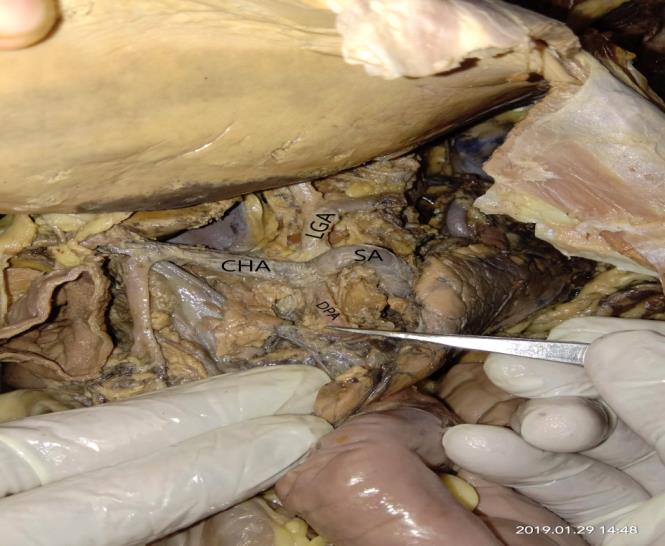
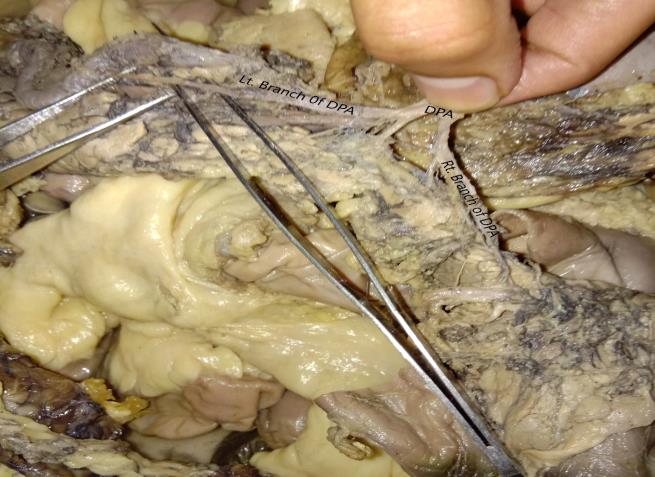
Splenic artery after emergence had taken its usual course horizontally towards left and was supplying neck to tail of pancreas, fundus and greater curvature of stomach through its usual branches before entering into spleen. The DORSAL PANCREATIC ARTERY was running downwards after originating directly from coeliac trunk (Figure 1). The artery was tortuous during its course and enters into pancreas through its dorsal surface dividing into two branches immediately. The branches were going towards right and left (Figure 2). The right branch is small in length and going to right side on superior border of pancreas to supply head and neck of the pancreas and finally anatomosed with superior pancreaticoduodenal artery. The left branch which is longer in length, supplied body and tail of pancreas and finally anatomosed with splenic artery. The head of the pancreas was supplied by superior pancreatico duodenal artery which is a branch of gastroduodenal artery and inferior pancreatico duodenal artery which is the first branch of superior mesenteric artery.
Discussion
In this case report the main variation was in coeliac trunk where the DPA arose from inferior part of celiac trunk. The DPA also can arise from some other arteries like superior mesenteric artery, common hepatic artery or abdominal aorta. The knowledge of this variation is may prevent the vascular damage during any surgeries involving stomach, duodenum, pancreas, and hepatobiliary region, for abdominal aortic aneurism, penetrating injuries of abdomen, in patient undergoing coeliac arteriography for gastrointestinal bleeding, for pancreas transplant and pancreatic tumour [3].
Bergman, et al. [4] had reported variations in the blood supply of pancreas that the dorsal pancreatic artery if present arose from splenic (37%), coeliac (33%), superior mesenteric (21%) and common hepatic artery (8%). Another study had reported a case that dorsal pancreatic artery arose from splenic artery but the inferior pancreaticoduodenal artery was absent [5]. In case of stenosis of coeliac trunk the inferior pancreaticoduodenal artery enlarges and compensate for the pancreatic and duodenal blood supply [6]. Michels' classification [7] divided the variations of celiac trunk into 6 types: Type 1: Normal Type 2: Hepatosplenic trunk and left gastric artery from aorta - Bifurcation Type 3: Hepatosplenomesentric trunk and left gastric from aorta - Bifurcation Type 4: Hepatogastric trunk and splenic artery from superior mesenteric artery - Bifurcation Type 5: Splenogastric type; splenic and left gastric from the coeliac trunk and common hepatic artery from superior mesenteric artery - Bifurcation Type 6: Coeliacomesentric trunk; splenic, left gastric, common hepatic and superior mesenteric arteries arise from a common trunk – Tetrafurcation In this classification the dorsal pancreatic artery variation was not included in any type as in this study it was directly arising from the celiac trunk. Another study showed that the dorsal pancreatic artery arose from common hepatic artery in the pancreatic transplant specimens so the surgeons can be easily overlooked not familiar with this artery [8]. The dorsal pancreatic artery can arise from (a) Splenic artery (70%), (b) common hepatic artery (77%), (c) superior mesenteric artery (2%), (d) coeliac trunk (1%) [9]. Another rare variant of the dorsal pancreatic artery is the anatomotic branch with the middle colic artery which a branch from the superior mesenteric artery [10].
References
-
Williams PL (1995) Gray’s anatomy 40, New York: Churchill Livingstone: pp: 319, 1183-1190.
-
Snell RS (2009) Clinical Anatomy by Regions. 8th (Edn.), New Delhi: Lippincott Williams and Wilkins; pp: 240-243.
-
Murakami G, Hirata K, Takamuro T, Mukaiya M, Hata F, et al. (1999) Vascular anatomy of the pancreaticoduodenal region: A review. J Hepatobiliary Pancreat Surg 6 (1): 55-68.
-
Bergman RA, Thompson SA, Afifi AK, Saadeh FA (1988) Compendium of human anatomic variations. Urban & Schwarzenberg, Baltimore, Munich: 79.
-
Deepthinath R, Nayak S, Vollala VR, Bhat S, Rao M, et al. (2006) Absence of inferior pancreaticoduodenal artery compensated by dorsal pancreatic artery: A case report. Kathmandu Univ Med J 4(2): 256-257.
-
Ohigashi H, Ishikawa O, Eguchi H, Yamada T, Sasaki Y, et al. (2004) Early ligation of the inferior pancreaticoduodenal artery to reduce blood loss during pancreaticoduodenectomy. Hepatogastroenterology 51(55): 4-5.
-
Michels NA (1955) Blood supply and anatomy of the upper abdominal organs with descriptive atlas. Philadelphia: Lippincott.
-
André G, Baranski, Hwai‐Ding L, Andries EB, Alexander F (2016) The dorsal pancreatic artery in pancreas procurement and transplantation: anatomical considerations and potential implication. Clin Transplant 30(10): 1360-1364.
-
Skandalakis JE, Skandalakis LJ, Kingsnorth AN, Colborn GL, Weidman TA, et al. (2004) Pancreas. IN: Skandalakis JE, (Eds.), Surgical Anatomy, International edition, Athens: Paschalidis Medical Publications: 1178-1191.
-
Liu ST (2002) Rare case of left colic flexure is supplied by a branch from splenic artery-a case report. Kaohsi- ung J Med Sci 18(4): 205-207.
- Pattern of Breast Lesions in Ovu Inland, Delta State, South Southern Nigeria
- Morphometric Analysis of the Human Femur: Exploring Platymetric and Robusticity Indices Among the Nigerian Population
- Anatomical Variation of Arteria Lusoria: Clinical Implications for Dysphagia Lusoria and Surgical Risk
- Morphometric Study of the Vertebral Body and Pedicle of Typical Cervical Vertebrae Using Radiological Image
- Epigenetic Mechanisms Driving Human Evolutionary Changes
- Neuroprotective Effects of Ginkgo Biloba Extract on Bilateral Common Carotid Artery Ischaemic Stroke Induced in Wistar Rat