
Ganz’s Anterior Dislocation for Intra-Articular Firearm Projectile Extraction and Fixation of Associated Femoral Head and Neck Fractures: Case Report
Hip fractures involving a firearm projectile are serious and complex injuries that represent a significant challenge for healthcare professionals. These fractures usually result from high-impact injuries caused by gunshots and can lead to extensive damage to tissue and bone structures. This type of injury can cause multiple, comminute fractures as well as damage to nearby blood vessels and nerves. The bullet fragment may remain and lead to poisoning, joint stiffness, pain, and further complications. The Ganz procedure is a surgical approach used in the treatment of femoral neck and head fractures. This method aims to restore the anatomy and biomechanics of the hip, especially in cases of complex or displaced fractures. Unlike traditional techniques, the Ganz procedure uses a less invasive approach, minimizing damage to surrounding tissues and preserving the region's vascularity. Hip fractures associated with gunshot wounds are rarely described in the literature. The objective of the present study is to report the use of the Ganz technique in a femur neck and head fracture associated with a firearm projectile in a 21-year-old male.
Introduction
Fractures due to firearm projectiles (FFP) demand versatility from the surgical team in treating the victim. Fragments lodged in joints can cause infections, metal poisoning and chondral degeneration [1, 2].
Proximal femur fractures represent a potential for osteoarthritis, osteonecrosis of the femoral head (ONCF) and the need for total hip arthroplasty (THA), increasing injury morbidity. Therefore, removing the intra-articular foreign body concomitantly with the definitive stabilization of the bone lesions allows for a faster recovery of the patient, preventing these complications [1, 2].
The surgical dislocation of the hip (SDH) developed by Ganz was initially aimed at the treatment of femoroacetabular impingement [3, 4]. Due to its successful use in intra-articular pathologies, its application for fixation of fractures of the femoral head and for removal of joint foreign bodies has been described [3, 4]. This work aims to report the application of this technique in the removal of firearm projectile fragment lodged in the femoral head followed by osteosynthesis of the femoral head and neck in a single procedure.
Case Report
A 21-year-old male patient presented with a gunshot wound at the right gluteal region. Physical examination showed that the gunshot wound had no signs of exit, while evaluation of the right lower limb with preserved neurovascular function and right hip joint block on dynamic examination. Patient denied musculoskeletal alterations or previous comorbidities. Anteroposterior radiography of the hip showed that the projectile was lodged in the fractured femoral neck. Computerized tomography of the pelvis revealed a comminuted fracture of the femoral head due to foreign body impact and a comminuted fracture of the posterior wall of the acetabulum (Pipkin III and IV.2) (Figure 1).
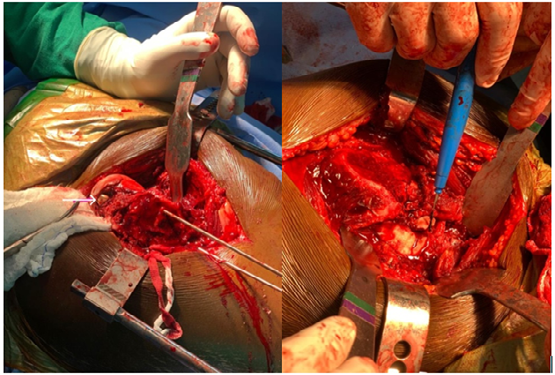
The patient was taken to the operating room and a direct lateral incision was made centered at the apex of the greater trochanter (20 cm long). The fascia lata, the tensor fasciae lata muscle and the gluteus maximus muscles were dissected in order to expose the greater trochanter. After, a manual osteotomy of the greater trochanter was performed with a straight osteotome and the bone fragment was reflected together with the gluteus medius muscle.
In this way, the hip joint capsuled was exposed and anterior capsulotomy with visualization of the femoral neck and its fracture was performed. This was temporarily fixed with two 3.0mm Steinmann wires under fluoroscopy in order to avoid deviation of the fragments during hip mobilization. Then, resection of the round ligament of the femur was performed and the femoral head was exposed. The firearm projectile was located in the head of the femur, generating an impaction fracture on the bone. After its removal, the resulting bone cavity was filled with an autologous graft obtained from the greater trochanter. Then, the cortical fragment detached by the trauma that was trapped in the joint space was anatomically reduced and fixed with a 3.5mm cortical screw number 40. Reduction of the hip joint was performed, followed by capsular repair with vicryl threads.
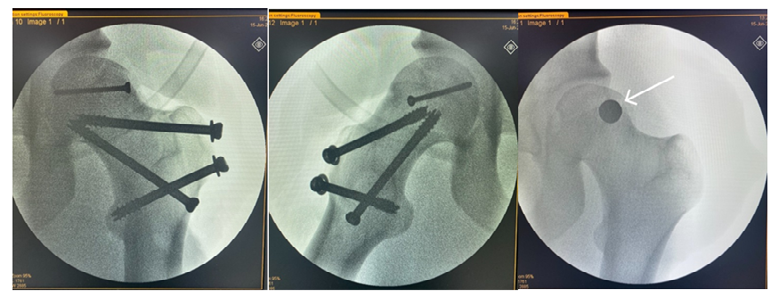
Subsequently, the team removed the Steinmann wires from the femoral neck and fixed it under fluoroscopy with a 7.0mm cannulated screw, number 70. The chosen entry point was at the level of the lesser trochanter towards the neck through the femoral calcar, obtaining a reduction anatomical. Fixation of the greater trochanter was performed using two 7.0mm cannulated screws. The first screw was directed cephalad, transversal to the femoral neck fracture, helping its stabilization. The second screw was guided to the lesser trochanter. The acetabular fracture was not fixed due to the small length of the line, location outside the load area and significant comminution (Figure 2).
With joint reduction, mobility and stability tests were performed satisfactorily. The closure of the muscular and subcutaneous planes was performed with vicryl threads and the skin with nylon threads. The patient was kept hospitalized for venous antibiotic therapy with restriction to the bed under monitoring of the surgical team.
Discussion
The presence of intra-articular gunshot remnants can cause infections, led poisoning and reactive synovitis with possible cartilage damage. Furthermore, it can lead to an increased risk of arthritis and mechanical pain. Gunshot wounds in general account for 2 to 17% of fractures, however, literature regarding gunshot wounds and the hip joint is scarce [5, 6].
Associated with a increased risk for arthritis in gunshot wounds, Pipkin III and IV fracture lines indicate the need for internal fixation, also with a risk of osteoarthritis and avascular necrosis of the femoral head [2, 7]. The Ganz SDH offers a wide view of the proximal region of the femur and acetabulum, being an alternative to anterior or posterolateral approaches. Massè, et al. [8] reported eleven satisfactory results in thirteen patients who underwent osteosynthesis of the femoral head. Among the complications, ONCF, postoperative infection, osteoarthritis and heterotopic ossification were described.
The Ganz approach allows good access to the joint for excision of projectile fragments. Maqungo, et al. [2] reported their positive experience, achieving 100% success in removing intra-articular projectiles using this technique. Thus, this approach also proves to be a good alternative to arthroscopic ballistic exploration and excision [1, 2]. Although acetabular injury in conjunction with femoral head fractures is common, the presence of neck fracture is infrequent. Romeo, et al. [7] reported 2.1% of Pipkin III fractures due to different mechanisms. In the search for fractures similar to the one in this report, mention was found of an occurrence, also due to FAP, of an acetabular injury with the femoral head and neck, however, we did not find documentation of the fracture and treatments used for the patient [1].
A recently published paper showed the association of gunshot wound and femoral neck fracture, which was treated with a total hip arthroplasty. The authors proposed Bell C, et al. [9] this type of treatment due to high rates of nounion and complications in previous reports in the literature, although the case presented herein showed no signs of complications. The Ganz technique is a good option for approaching proximal femur fractures and removing intra-articular foreign bodies in a single surgery. Outpatient follow-up of the patient is necessary to monitor the evolution of bone consolidation, as well as the development of future complications. Due to scarcity in the literature of similar reports, this case may be of significance to surgeons when facing these types of cases.
References
-
Maqungo S, Fegredo D, Brkljac M, Laubscher M (2020) Gunshot Wounds to the Hip. J Orthop 22: 530-534.
-
Maqungo S, Hoppe S, Kauta JN, McCollum GA, Laubscher M, et al. (2016) Surgical hip dislocation for removal of retained intra-articular bullets. Injury 47(10): 2218- 2222.
-
Ganz R, Gill TJ, Gautier E, Ganz K, Krügel N, et al. (2001) Surgical dislocation of the adult hip a technique with full access to the femoral head and acetabulum without the risk of avascular necrosis. J Bone Joint Surg Br 83(8): 1119-1124.
-
Stirma GA, Uliana CS, Valenza WR, Abagge M (2018) Tratamento cirúrgico das fraturas da cabeça femoral através da luxação anterior controlada do quadril – Série de quatro casos e revisão da literatura. Revista Brasileira de Ortopedia 53(3): 337-341.
-
Mullis BH, Figueras J, Trotter MV, Ertl JP (2021) Arthroscopy Should be Used With Caution for Gunshot Wounds to the Hip. Arthrosc Sports Med Rehabil 3(5): e1395-e1400.
-
Pazarci O, Kilinc S, Camurcu Y, Bulut O (2019) Total hip arthroplasty after hip joint gunshot injury. J Orthop Surg (Hong Kong) 27(3): 2309499019873113.
-
Romeo NM, Firoozabadi R (2018) Classifications in Brief: The Pipkin Classification of Femoral Head Fractures. Clin Orthop Relat Res 476(5): 1114-1119.
-
Masse A, Aprato A, Alluto C, Favuto M, Ganz R, et al. (2015) Surgical hip dislocation is a reliable approach for treatment of femoral head fractures. Clin Orthop Relat Res 473(12): 3744-3751.
-
Bell C, Skibicki HE, Post ZD, Ong AC, Ponzio DY, et al. (2022) Gunshot Wound Resulting in Femoral Neck Fracture Treated With Staged Total Hip Arthroplasty. Arthroplast Today 14: 44-47.
- Pattern of Breast Lesions in Ovu Inland, Delta State, South Southern Nigeria
- Morphometric Analysis of the Human Femur: Exploring Platymetric and Robusticity Indices Among the Nigerian Population
- Anatomical Variation of Arteria Lusoria: Clinical Implications for Dysphagia Lusoria and Surgical Risk
- Morphometric Study of the Vertebral Body and Pedicle of Typical Cervical Vertebrae Using Radiological Image
- Epigenetic Mechanisms Driving Human Evolutionary Changes
- Neuroprotective Effects of Ginkgo Biloba Extract on Bilateral Common Carotid Artery Ischaemic Stroke Induced in Wistar Rat