
Prediction of Stature Using Fingers' Lengths
Estimation of stature is of paramount importance in verifying the identity of an individual from the bodily remains, often after any kind of mass disaster, explosion, etc. This study aimed at predicting the stature of students using their finger’s lengths. A total number of 300 students (153 females and 147 males) of Madonna University, Nigeria, was evaluated, age ranging from 18 to 25 years. All the subjects had complete fingers. Stature was measured with stadiometer while Fingers lengths were measured using a straight line ruler, all in centimeters. The data were analyzed using SPSS (Statistical Package for Social Sciences), and the differences were tested using Z-test. The association between stature and Fingers Length was determined using Pearson chi-squared test. The results showed significant difference in the length of the fingers in both right and left hands of males and females respectively (p<0.01). From the result the middle fingers ranked highest for both male and female while the little fingers ranked least. A good correlation was found between the right middle finger and the height in the females and between the left middle finger and height in males. This shows that as the height of females increases, the middle finger of the right hand also increases significantly compared to the left hand middle finger (p<0.01), conversely, as males increase in height, their left hand middle finger tends to increase in length than the right hand middle finger (p<0.01). Linear regression equation was derived to predict stature from the finger’s lengths for male and female respectively. It was observed that amongst all the fingers, the middle fingers right-females and left-males, tend to correlate better with stature than every other finger, and therefore have the possibility of predicting stature than other fingers.
Introduction
The stature or height of an individual is an inherent characteristic that constitutes one of the parameters of personal identification. In addition it is one of the tools used in forensic anthropology. Estimation of stature is of paramount importance in verifying the identity of an individual from the bodily remains, often after any kind of mass disaster, explosion or intentional cuts and dismantling. Scientists, anatomists and anthropologists are focusing their researches on the Dimensional relationship between body segments and the whole body [1], and between stature and measurements of different body parts which are often represented using linear regression equation derived from them. The estimation of stature using different parts of the body is crucial for formulating a biological profile during the process of personal identification, especially when mutilated and amputated limbs or body parts are found [2, 3]. Stature has been shown to steadily increase from infancy to adulthood and remains stable throughout middle age but decrease with old age [4]. Due to the variability in height, various approaches to the study of human growth and development have evolved [5, 6, 7].
Stature can be estimated using two approaches: the anatomical method and the mathematical method. The anatomical method involves measuring the height of each skeletal element contributing to an individual’s stature [8]. However, this method is time-consuming and requires a complete skeleton. The mathematical method, commonly employed, utilizes regression equations based on the measurement of one or two major long bones to estimate living height [9]. While mathematical methods are quicker and applicable to incomplete skeletons, they rely on population averages and may not account for individual variations.
Long bones are commonly used for this purpose of estimating stature, however, the human hand, which is the most used and versatile part of the body presents an alternative approach. The hand length was found to be the most reliable alternative that can be used as a basis for estimating age-related loss in height [10, 11]. The hand length could also be used to predict body weight status and body surface area independent of the sex of the individual [10, 11]. Though, Stature estimation using long bones is more preferable, reliable and accurate, as its’ correlate better than other classes of bones [12, 13]. However, in conditions that the body is being dismembered, it is important to identify a deceased person from remaining body parts, such as head, hands, arms, and feet. Again research had it that lower limb measurements are more strongly associated with stature than upper limb measurements [14] however, there is still a need to assess the correlation of the upper limb measurements with stature because the lower limbs may not always be available. Vaijnathrao, et al. [13] conducted a study on estimation of stature from index and ring finger length. The purpose of the study was to estimate stature using index and ring finger lengths and to predict the accuracy of regression models derived from such parameters. The findings of the study indicate that index finger and ring finger lengths can be used to predict living stature of an individual. Mojaverrostami, et al. [15] investigated the possibility of predicting stature based on Fingers Length in Iranian. The conclusion was that 3rd Finger Length provides a better prediction of stature among the lengths of fingers in both genders.
This study aimed at predicting the stature of Madonna University students using their finger’s lengths. The knowledge gained from this research will contribute to the identification of individuals in situations such as natural disasters, accidents, and other incidents involving dismembered or mutilated bodies.
Materials and Methods
Subjects
This study aimed to investigate the possibility of predicting stature using finger lengths among Madonna University students in the context of fire accidents, domestic accidents, industrial accidents, and natural disasters. A total of 300 students (153 females and 147 males) aged between 18-25 years were randomly selected as the sample for the study. More so, most participants were 20 years (n=71, 23.7%) of age. The least age represented among the participants was twenty five years (n=8, 2.7%). A total of twenty one states were represented among the students from twenty ethnic groups in Nigeria, most participants were from the eastern part of the country, hence the Igbo ethnic group was the highest in population (n=190, 63.3%). Before commencing the work, a consent letter was collected from the Head of Department to begin the work, subjects were selected according to the inclusion criteria and those who volunteered were briefly interviewed on their age, sex, state of origin, ethnicity and nationality before measurement of the height and finger’s length were taken.
Measurements
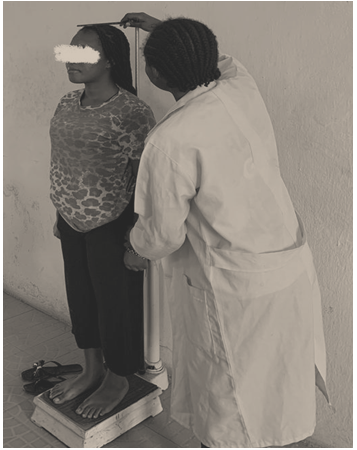
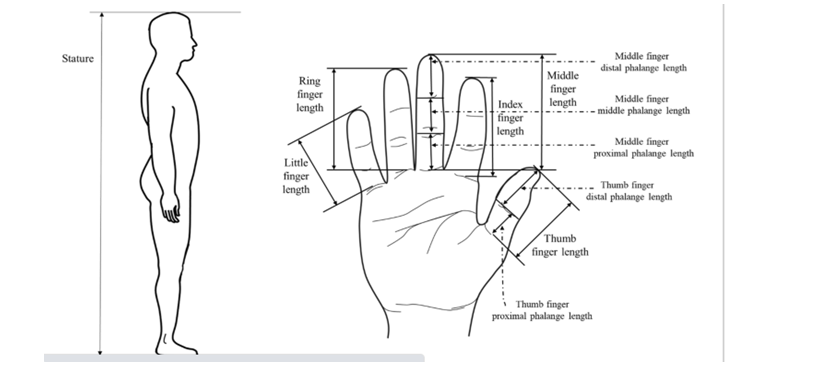
The measurements were conducted at Madonna University, Elele Campus, over a period of three months. Individuals with hand deformities, finger diseases, and vertebral column disorders were excluded from the research. Height was measured using a portable stadiometer, while finger lengths were measured using a straight ruler. Prior to data collection, a pilot study was conducted on 10 subjects to assess the reliability of the instruments, which yielded a correlation coefficient of 0.632.
Statistical Analysis
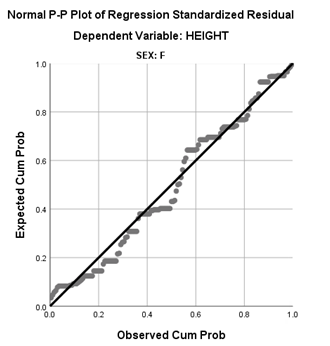
The collected data were analysed using SPSS software. Independent Samples Z-test was employed to determine gender differences, while Pearson chi-squared test was used to evaluate the association between stature and finger lengths. Furthermore, linear regression analysis was conducted to establish equations for predicting stature based on finger length measurements (Figures 1-3).
Results
The results revealed statistically significant gender differences in finger lengths as shown in tables 4 and 5, with different correlations observed between finger lengths and height in males and females of which the middle fingers length appears highest. The correlations done between middle fingers lengths and height suggested that the third finger length estimate stature better than other fingers as shown in tables 6 and 7, for both males and females. In predicting stature from the fingers length, a regression analysis was
Height and Finger’s Lengths
done as shown in table 8, and a regression equation was derived. From the results the regression constants indicate that at 0 cm of the middle finger, the average height of males is 125.07 cm, while for females it is approximately 98.403 cm. The derived regression formulas for males and females were found to be statistically significant. Therefore, these regression equations can be effectively used to predict stature, especially in forensic anthropology and anthropological research involving examination of mutilated remains with all digits available (Tables 1-9 & Figures 4 & 5).
| Gender | MIN (cm) | MAX(cm) | MEAN(cm) | Chi-squared | p-Value | |
|---|---|---|---|---|---|---|
| Female | 157.5 | 186.6 | 169.34±6.4 | 195.27 | 0.00 | |
| Male | 162 | 199.2 | 180.92±7.4 | |||
| Sex | N | Minimum(cm) | Maximum(cm) | Mean | Std. Deviation | |
| Female | LH LITTLE FINGER | 153 | 5 | 7.2 | 6.03725 | 0.542882 |
| LH RING FINGER | 153 | 6.4 | 8.8 | 7.51569 | 0.49326 | |
| LH MIDDLE FINGER | 153 | 7 | 9.3 | 8.17451 | 0.494779 | |
| LH INDEX FINGER | 153 | 6.1 | 8.6 | 7.21569 | 0.533992 | |
| LH THUMB | 153 | 5.2 | 7.5 | 6.53007 | 0.461845 | |
| Male | LH LITTLE FINGER | 147 | 5 | 7.5 | 6.40612 | 0.700804 |
| LH RING FINGER | 147 | 6.9 | 9.4 | 8.09048 | 0.682695 | |
| LH MIDDLE FINGER | 147 | 7.6 | 10.3 | 8.72925 | 0.677547 | |
| LH INDEX FINGER | 147 | 6.6 | 8.9 | 7.70748 | 0.601037 | |
| LH THUMB | 147 | 5.7 | 8 | 6.72381 | 0.570188 |
Table 1: Height Distribution of Students in Madonna University.
| SEX | N | Minimum(cm) | Maximum(cm) | Mean | Std. Deviation | |
|---|---|---|---|---|---|---|
| Female | RH LITTLE FINGER | 153 | 4.9 | 7.5 | 6.03203 | 0.502841 |
| Female | RH RING FINGER | 153 | 6.5 | 9 | 7.55098 | 0.539873 |
| Female | RH MIDDLE FINGER | 153 | 7.1 | 9.6 | 8.2268 | 0.506927 |
| Female | RH INDEX FINGER | 153 | 6.2 | 8.5 | 7.37059 | 0.559003 |
| Female | RH THUMB | 153 | 5.4 | 7.9 | 6.5268 | 0.479035 |
| Female | ||||||
| Male | RH LITTLE FINGER | 147 | 5.5 | 7.3 | 6.26735 | 0.532397 |
| Male | RH RING FINGER | 147 | 6 | 9.2 | 8.04626 | 0.612235 |
| Male | RH MIDDLE FINGER | 147 | 7.7 | 10.2 | 8.71973 | 0.624789 |
| Male | RH INDEX FINGER | 147 | 6.8 | 8.9 | 7.72381 | 0.530228 |
| Male | RH THUMB | 147 | 5.6 | 8.1 | 6.7551 | 0.685883 |
Table 2: Descriptive statistics for Length of Fingers in Right Hand in Males and Females. Key: LF= Little Finger, RF= Ring Finger
Table 3: Descriptive statistics for Length of Fingers in Right Hand in Males and Females. Key: LF= Little Finger, RF= Ring Finger, MF= Middle Finger, IF= Index Finger, T= Thumb Hand Left Hand Right Hand p-Value Finger LF RF MF IF T LF RF MF IF T 0.000* Rank 2.03 6.89 9.35 5.56 3.2 1.9 7.19 9.56 6.32 3.01 Table 4: Differential Statistics of the Ranking of the different Fingers length in Males. Key: LF= Little Finger, RF= Ring Finger, MF= Middle Finger, IF= Index Finger, T= Thumb * Means Significant Difference
- Hand
- Left Hand
- Right Hand p-Value
- Finger
- LF
- RF
- MF
- IF
- T
- LF
- RF
- MF
- IF
- T
- 0.000*
- Rank
- 2.21
- 7.38
- 9.49
- 5.63
- 2.94
- 1.76
- 7.25
- 9.47
- 5.75
- 3.12
Table 3: Differential Statistics of the Ranking of the different Fingers length in Females.
Correlation between Finger Length and Height in Males and Females
| Mean finger length (cm) | Mean Height (cm) | Pearson‘r’ value | p-value | |
|---|---|---|---|---|
| Left hand middle finger | 8.17 | 169.34±6.4 | 0.636 | 0.00** |
| Right hand middle finger | 8.23 | 0.681 | 0.00** |
Table 4: Correlation between the Middle finger of females and their Height. ** Correlation is significant at the 0.01 level (2-ta
| Finger | Mean finger length (cm) | Mean Height (cm) | Pearson ‘r’ value | p-value |
|---|---|---|---|---|
| Left hand middle finger | 8.73 | 180.92±7.4 | 0.557 | 0.00** |
| Right hand middle finger | 8.71 | 0.525 | 0.00** |
Table 5: Correlation between the Middle finger of Males and their Height. ** Correlation is significant at the 0.01 level (2-tail
Prediction of Height from Length of Finger in Males and Females
Sex Hand & finger R R2 Regression Coefficient Regression Constant p-Value Male Left hand, Middle Finger 0.557 0.31 6.398 125.07 0.00 Female Right hand, middle finger 0.681 0.463 8.625 98.403 0.00 Table 8: Regression Table for height and Middle finger length in males and females. Key: R= Pearson Correlation factor, R2=Pearson correlation square.
| Sex | Regression Equation |
|---|---|
| MALE | Y=6.398x+125.070 |
| FEMALE | Y=8.625x+98.403 |
Table 6: Regression (Prediction Equation) for predicting height from finger length in males and females. Where Y= Height (cm) X=
Table 9: Regression (Prediction Equation) for predicting height from finger length in males and females. Where Y= Height (cm) X= finger Length (cm) Plotting this data obtained from the regression plot into the linear equation Y =mx+c where Y=height of individual measured in cm (independent variable) m=slope of plot x=measured length of middle finger (left for males and Right for Females) in cm c=intercept on Y axis This results in the equations seen in Table 9 above.
![Figure 3: Schematic representation of the measurement of the finger Source [16].](/fulltextimages/11235/fig_3.png)
Discussion
From the study, it can be observed that the average height of the males was higher than the average height of females. The mean height for females in centimeter was 169.34 while that for males was 180.92. There was a statistically significant difference in the height of the males when compared to the females in the population. In line with this study, Ilsun and Wonjoon [16] showed a significantly higher stature for males than females. However, a descriptive statistics across the fingers length was seen to be significant and the middle fingers right hand and left hand for males, and right hand and left hand for females were observed to have the highest values when compared to other fingers. Similarly, Ilsum and Wonjoon [16], observed significant differences in the middle fingers of males and females. However, Kachan, et al. [17] observed that the length of ring finger in males is significantly longer than the females. Krishan, et al. [18] also observed similar finding that the length of the index and ring fingers of adolescent males in North Indian are significantly longer than the females. The differences observed could be as a result of the gender differences in growth rate during adolescent where the male grow faster than the female. In Nigeria Oladipo, et al. [19] observed a significant difference in the length of right ring finger and right index finger between male and female. Many studies have established positive correlations between stature and hand dimensions in different populations [20, 21] and regression equations. From this study, it can be observed that there was a more favorable correlation between the left middle finger and height in males (left hand R=0.557; right hand R=0.525) and a better correlation between the right middle finger and the height in females (right hand R=0.681; left hand R=0.636). This finding is in line with the findings of Mojaverrostami [16] in whose study the regression equations derived for the estimation of stature from measured variables are the third Fingers Lengths (R2=0.338) and was the highest determining factor in the regression equation. Accordingly, the 3rd and 4th Fingers Lengths (R2=0.253 and R2=0.157, respectively) demonstrated the highest accuracy among the female group. Also, this study was in agreement to Shivakumar, et al. [22] who also found good correlation and statistically highly significant correlation coefficient between middle finger length and stature among the South Indian population of Karnataka region however, the regression equations obtained in the present study are different from their study. Again, Gloria, et al. [12] also found a positive correlation between the middle finger and stature among the students of Gujarat Forensic Sciences University, Gandhinagar, which is located in the western region of India. From all indication the 3rd Finger length seem to be an appropriate parameter for estimating stature, this could be as a result of its length amongst other fingers, it is the longest finger. This agrees with the findings that said that long bones predict stature better than other bones [12, 13].
From this study, the regression constant as observed for males shows that at 0cm in the middle finger, the height of males in average will be 125.07cm while the Regression coefficient in females was 98.403cm meaning at 0cm of the right middle finger in females, the height of the female will be approximately 98.403 which is in agreement with the work of Gayathri and Ranganath [7]. The regression formulae for females and males have been derived separately. Oladipo, et al. [19] worked on the ring and index fingers in relation to the stature. They found out a relationship between right index finger and stature and between right ring finger and stature The regression equations derived in this study can be effectively used to predict stature, therefore, it can be concluded that the equation may be helpful to obtain approximate stature in situations where mutilated remains are to be examined and all digits are not available. This equation could be useful in forensic anthropology and any anthropological research.
Conclusion
This study demonstrated a significant correlation between height and finger’s length, suggesting that fingers lengths measurements can be used to determine stature particularly the middle fingers length. Therefore, from this study, it is deduced that, amongst all the fingers, the middle fingers (right and left) have the possibility of predicting stature better than every other finger.
Conflict of Interest
Authors declared no conflict of interest.
Acknowledgements
The Authors appreciate all the people involved in this research.
References
-
Pinar D, Sibel K, Cagatay B (2014) Morphological and functional aspects of hand in relation to age, gender and sports playing condition. Acta Medica International 1(2): 67-74.
-
Ilayperuma I, Nanayakkara G, Palahepitiya NA (2009) Prediction of personal stature based on the hand length. Galle Medical Journal 14(1): 15-18.
-
Zeybek G, Ergur I, Demiroglu Z (2008) Stature and gender estimation using foot measurements. Forensic SciInt 181(1-3): 54.e1-54.e5.
-
Palanikumar B, Indirapriya DA (2023) Human Growth and Development. StatPearls Publishing, Treasure Island.
-
Krishan K, Sharma A (2007) Estimation of stature from dimensions of hands and feet in a North Indian population. Journal of Forensic Legal Medicine 14(6): 327-332.
-
Danborno B, Adebisi S, Adelaiye A, Ojo S (2008) Estimation of Height and weight from the Lengths of Second and Fourth Digits in Nigerians. The Internet Journal of Forensic Science 3(2): 1-4.
-
Gayathri M, Ranganath V (2014) Digit Length Displays A Significant Fraction In Stature Estimation: A Study From Coastal Region of South India. International Journal of Anatomy and Research 2(2): 336-339.
-
Munoz SK, Krenz SK, Tiesman HM (2001) The importance of complete and accurate skeletonization in recovery and interpretation of evidence from human skeletal remains. Journal of Forensic Sciences 46(4): 937-940.
-
Chan H (2000) Estimation of stature from long bone lengths. Journal of Forensic Sciences 45(2): 254-259.
-
Ibegbu AO, David ET, Hamman WO, Umana UE, Musa SA (2013) Association of hand length with height in Nigerian school children. J Biol Life Sci 4(2): 83.
-
Ibegbu AO, David ET, Hamman WO, Umana UE, Musa SA (2015) Hand Length as a Determinant of Height in School Children. Advances in Life Sciences 5(1): 12-17.
-
Gloria C, Prajakta M, Pooja A, Dahiya MS (2018) Estimation of Stature from Finger Length. J Forensic Sci & Criminal Invest 7(2): 1-4
-
Vaijnathrao S, Mishra P, Birodkar A, Belekar V (2013) Estimation of stature using finger length. Journal of Forensic Dental Sciences 5(2): 130-134.
-
Mohanty NK (1998) Prediction of height from percutaneous tibial length amongst Oriya population. Forensic Science International 98(3): 137-141.
-
Mojaverrostami S, Mokhtari T, Malekzadeh M, Noori L, Kazemzadeh S, et al. (2019) Stature Estimation Based on Fingers Anthropometry in Iranian Population. ASJ 16 (2): 87-92.
-
Ilsun R, Wonjoon K (2019) Estimation of stature from finger and phalange lengths in a Korean adolescent. Journal of Physiological Anthropology 38(1): 1-8.
-
Kanchan T, Kumar GP, Menezes RG, Rastogi P, Rao PPJ, et al. (2010) Sexual dimorphism of the index to ring finger ratio in south Indian adolescents. J Forensic Legal Med 17(5): 243-246.
-
Krishan K, Kanchan T, Asha N (2012) Estimation of stature from index and ring finger length in a north Indian adolescent population. J Forensic Legal Med 19(5): 285-90.
-
Oladipo GS, Gloria E, Okoh PD, Abidoye AO (2015) Stature estimation in a Nigerian population. Annals of Index and ring finger lengths and their correlation with stature in a Nigerian population 3(1): 18-21
-
Hossain S, Begum JA, Banu MLA, Rahman F, Akhter Z (2010) Prediction of stature from hand length and breadth - An Anthropometric study on Christian Gara tribal Bangladeshi females. Bangladesh Journal of Anatomy 8(1): 21-27.
-
Anas IY, Esomonu UG, Zagga AD (2010) Prediction of stature of Hausa ethnic group using hand length and breath”. Journal of medicine in the tropics 12 (1): 30-32.
-
Shivkumar AH, Raju GM, Vijaynath V (2013) Prediction of stature by right middle finger length of males among south Indian population. Journal of Pharmaceutical and Scientific Innovation 11(4): 90-93.
- Pattern of Breast Lesions in Ovu Inland, Delta State, South Southern Nigeria
- Morphometric Analysis of the Human Femur: Exploring Platymetric and Robusticity Indices Among the Nigerian Population
- Anatomical Variation of Arteria Lusoria: Clinical Implications for Dysphagia Lusoria and Surgical Risk
- Morphometric Study of the Vertebral Body and Pedicle of Typical Cervical Vertebrae Using Radiological Image
- Epigenetic Mechanisms Driving Human Evolutionary Changes
- Neuroprotective Effects of Ginkgo Biloba Extract on Bilateral Common Carotid Artery Ischaemic Stroke Induced in Wistar Rat