
Oral Rehabilitation with Removable Partial Denture in a Patient with a Maxillary Defect Caused by a Firearm
The use of Removable Partial Denture (RPD) for the oral rehabilitation of patients who have suffered facial trauma and consequent tooth loss of several elements, serves as an alternative for replacing hard and soft tissues, as well as providing aesthetic and functional support. Facial trauma related to firearm injuries is a challenge for the surgical team, both in planning and during surgery, due to the destruction of anatomical planes and the multifragmentation of soft tissues and bone. The aim of this study is to report on the oral rehabilitation using removable prostheses of a patient who had suffered firearm trauma. Patient F. B. C., 30 years old, male, normosystemic, attended the postgraduate dental prosthesis clinic at Unichristus with the aim of rehabilitation after a firearm trauma. During the clinical assessment, a bone defect was observed in the anterior region of the maxilla, with the loss of several teeth and part of the alveolar bone structure. The plan was designed to rehabilitate the extensive bone loss caused by the trauma, through the use of an RPD, to promote the return of masticatory function, the patient's facial aesthetics and soft tissue support. The prosthesis was designed to use the remaining posterior teeth as a support and means of retention, aided by full coverage of the palate in order to bring more stability and comfort to the patient. At the end of the treatment, the aesthetic and functional aspects were restored, showing that this type of prosthesis is an alternative for rehabilitation in this type of case.
Introduction
Bone injuries in the maxilla and mandible, in the majority of cases, are the result of traumatic accidents that result in extensive lesions, causing esthetic and even functional irregularities. Firearm injuries have a high potential for destruction, causing multifragmentation of soft tissue and bone, which makes the planning and rehabilitation process challenging for both the professional and the patient [1].
The approach of surgical and later prosthetic reconstructive techniques to rehabilitate extensive bone defects, mainly caused by firearm trauma, depends on the quality and quantity of remaining tissue, loss of mandibular continuity, feasibility, costs, professional skill as well as the morbidity of the donor area, so that the bone graft procedure is satisfactory [1].
In treatment planning and diagnosis, the general impacts that have been caused to the individual are delimited and objectified, both functionally and in terms of modified aesthetic characteristics, and this assessment is carried out in a multidisciplinary manner, in which way it is possible to promote better results for the patient [1, 2].
Removable partial dentures (RPD) can be used to restore aesthetics and function in a conservative and cost-effective way compared to surgical procedures, which in many cases are complex and require more time. The RPD, on the other hand, requires minimal intervention and wear on other dental structures, making it easier to maintain and faster to treat [3].
The basic principles of a removable partial prosthesis (RPD) include support, stability and adequate retention, while maintaining an infrastructure that does not cover the gingival margins and that the patient can properly clean. Several factors influence the adaptation and acceptance of the prosthesis by the patient: biological, mechanical, esthetic and psychological factors, which can be consequently related to the success of the prosthetic treatment [1].
The aim of this study was to report on the oral rehabilitation using removable prostheses of a patient who had suffered trauma from a firearm, where a satisfactory solution was found to restore favorable aesthetic and functional characteristics after the loss of several dental elements and bone structure.
Case Reports
Patient F.B.C., 30 years old, male, normosystemic, attended the graduate dental prosthesis clinic at Unichristus with the aim of oral rehabilitation due to extensive loss of dental elements, as well as soft tissue due to an accident involving a firearm during his commute to work.
The patient was referred to the Dr. José Frota Institute after his upper airway had been re-established for rehabilitation of the lost dental tissue. The patient had a concave facial profile with loss of the vertical dimension of occlusion due to extensive tooth loss, as well as loss of upper lip volume and the presence of an inverted smile which promotes an ageing appearance, revealing facial and skeletal disharmony (Figures 1a-1d).
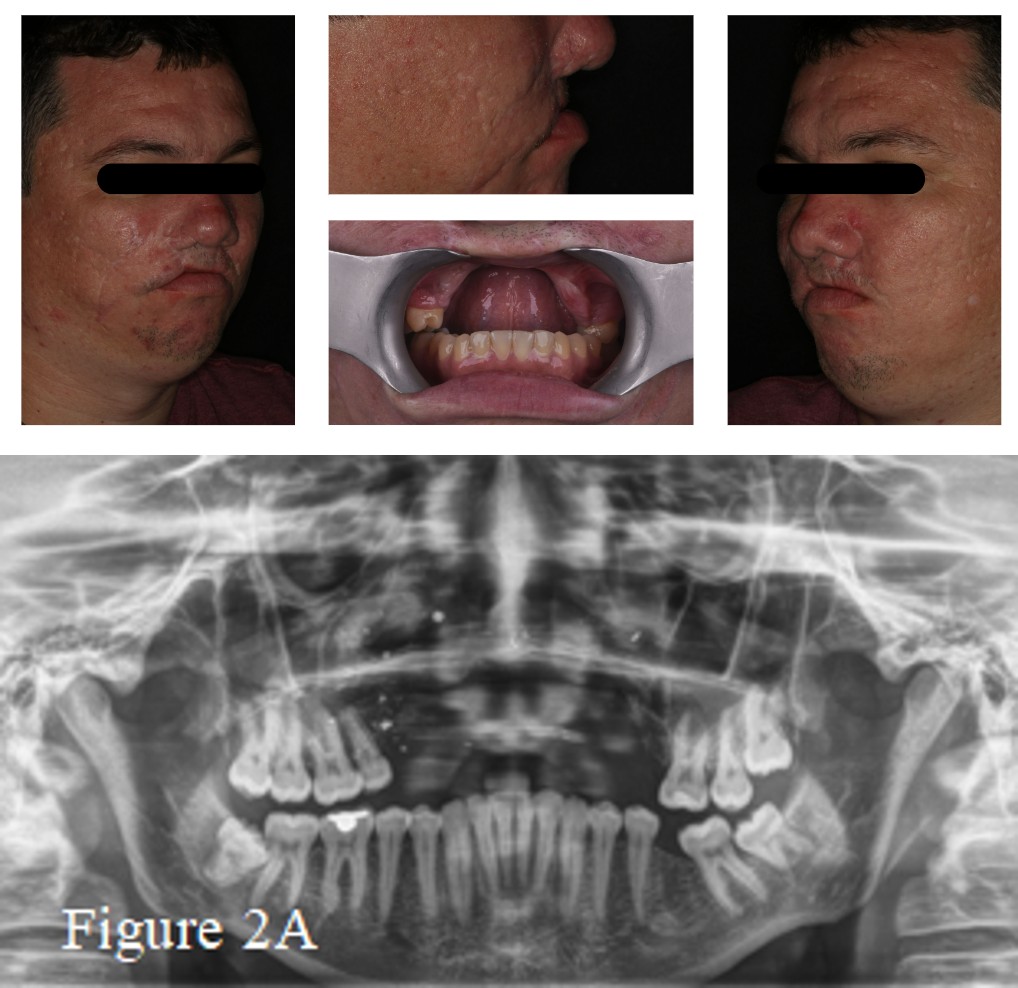
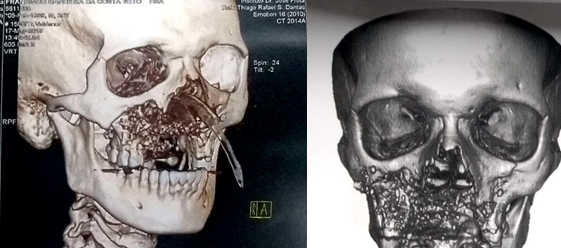
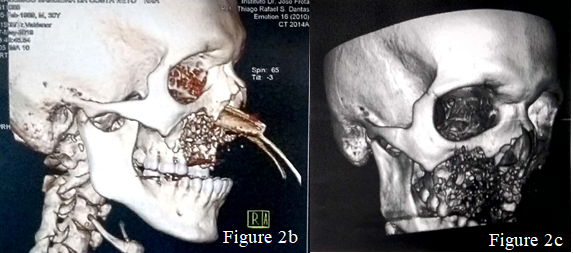
Images radiologic and clinical examination revealed an extensive bone defect in the anterior region of the maxilla, with the loss of several teeth and part of the alveolar bone structure (loss of approximately 12 mm of buccal and palatal bone), resulting in difficulty chewing and aesthetic complaints for the patient (Figures 2a-2d). In addition to these limitations, after plastic surgery to restore the upper lip, the medical team recommended the use of a prosthesis to relax the lip muscles, using a prosthesis with a deeper acrylic base.
After all this analysis, due to the extensive loss of bone and soft tissue and the distribution of dental elements in the arch, it was unfeasible to carry out prostheses on implants, which require the use of grafts that are not very favorable due to the lack of blood and nutritional support in the area, as well as the high cost for the patient.
As a result, the decision was made to make a removable partial denture with support for the remaining dental elements, and the patient was told about the treatment and its advantages and limitations. As the treatment progressed, an upper removable partial prosthesis was made using tip- action clips at the ends for better retention and stability, and a larger connector covered in acrylic resin was used, providing better aesthetics and comfort for the patient (Figures 3-10). After the procedure, the patient presented satisfactory facial aesthetics, with a more youthful appearance, as well as restoring adequate function to the patient.
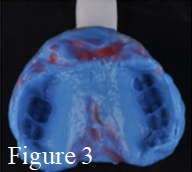
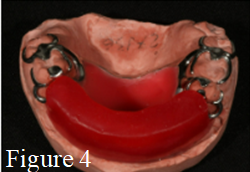
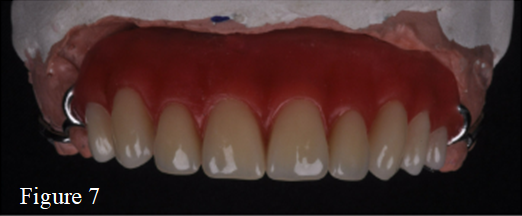
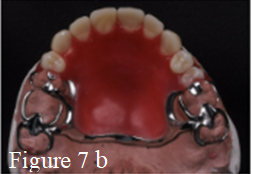
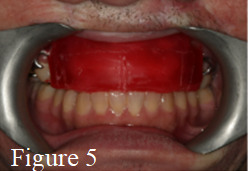
Figure 7a: Front view of the tooth assembly on the upper plaster model.
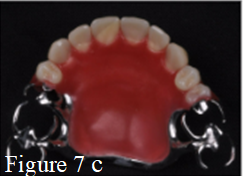
Figure 7b: Occlusal view of the tooth assembly on the upper plaster model.
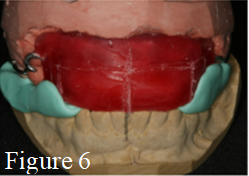
Figure 7c: Occlusal view of the tooth assembly.

Figure 8a: Tooth assembly test in the mouth.
Figure 8b: Test fitting the tooth in the mouth with a “c” type lip retractor.
Figure 9a: Lateral view of the acrylic removable partial denture.
Figure 9b: Front view of the acrylicized removable partial denture inserted in the upper plaster model.
Figure 10a: Frontal view of the patient with acrylic removable partial dentures in the mouth after occlusal adjustments.
Figure 10b: Lateral view of the patient with acrylic removable partial dentures in the mouth after occlusal adjustments.
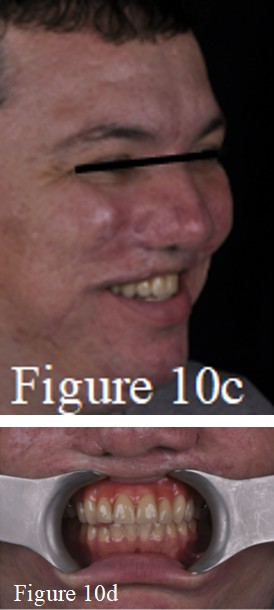
Figure 10c: Frontal view of the patient with acrylic removable partial dentures in the mouth after occlusal adjustments.
Figure 10d: Acrylic removable partial denture after occlusion adjustments in the mouth with a type “c” lip retractor.
Discussion
Accidents resulting from firearm projectiles have an alarming epidemiological picture, and many studies have shown a high rate of hospitalization and mortality. In addition, the general factors that result from this type of instrument corroborate the development of various psychosocial impacts, as well as generating a greater degree of complexity for the treatment and subsequent rehabilitation of these patients. In many cases, the facial region generates a greater risk of permanent sequelae, which can be exclusive to soft tissue or, more frequently, cause multiple bone fractures and the loss or fracture of dental structures [1, 2, 4, 5].
The rehabilitation of complex injuries must be carried out in a multidisciplinary manner due to the extensive area and possible damage caused to the patient, such as altered appearance, paralysis, temporomandibular dysfunction, tooth loss and various other associated sequelae, which require a health team for a better and complete therapeutic approach [1, 6, 7, 8].
Traditionally, fixed dental prostheses are considered the gold standard for treating cases of partial tooth loss. They are not indicated when there is no abutment tooth distal to the edentulous space, nor in large edentulous areas. In the past, these patients only had removable partial dentures (RPDs) as a second alternative; however, today we have dental implants as a possibility for fixed treatment, but the issue of financial cost, treatment time and factors that make the installation of dental implants unfeasible make RPDs the most viable treatment option [9].
Unlike the implant approach, RPDs treatment stands out for its minimally invasive nature, providing a cost-effective and timely solution for partially edentulous patients, where they act by replacing both lost hard and soft tissues, providing aesthetic and functional support, being considered the best practice therapy in many clinical scenarios, characterizing it as a crucial treatment alternative and a viable option for a significant portion of the partially edentulous population [9].
When planning for partially edentulous patients, masticatory function and aesthetics must be taken into account, as this will directly affect the patient’s motivation and acceptance. To achieve ideal aesthetics, the metal components should be barely visible and the artificial teeth, especially the anterior ones, should be placed in the most natural position possible and the alignment of the surfaces should follow the parallelism observed during the planning of the RPD. As well as seeking to restore function and phonetics, it is essential to pay greater attention to aesthetics, which requires meticulous attention during the process of making the prosthesis [9, 10].
Conclusion
In this case of complex oral rehabilitation, the use of a removable partial denture achieved a favorable result. Aesthetic and functional aspects were restored to the patient, with appropriate indication and execution. It can be seen that this type of prosthesis can be an alternative for more cost-effective results for the patient compared to other surgical oral rehabilitation treatments.
References
-
Coelho LERF, Pimentel RM, Nogueira J (2022) Dental approach to patient victim of injury caused by firearm projectile - literature review. Fluminense Dentistry Magazine 3(59): 14-21.
-
Bezerra Da Silva Junior ML, Vanderson Da Silva M, Ismaeley De Andrade T, Vasconcelos Cavalcante MDL (2023) Oral and maxillofacial prosthetic rehabilitation: difficulties in recovering the function and aesthetics of the patient after facial trauma. Brazilian Journal of Surgery & Clinical Research 44(2): 56-60.
-
Farias Neto A, Carreiro ADFP, Rizzatti-Barbosa CM (2011) Removable partial dentures in the context of current dentistry. Odontol. Clín.-Cient 10(2): 125-128.
-
Maia ABP, Assis SG, Ribeiro FML, Pinto LW (2021) The marks of firearm violence on the face. Brazilian Journal of Otorhinolaryngology 87(2): 145-151.
-
Miller T, Downing J, Wheeler L, Fischer K (2024) The medical costs of firearm injuries in the United States: a systematic review. The Journal of Emergency Medicine 66(2): 109-132.
-
Fernandes ACF, Griza GL, Garbian Junior EÁ, Ernica NM, Conci RA, et al. (2021) Rehabilitative treatment with jaw reconstruction due to sequelae of gunshot wound – Case report. Research, Society and Development 10(2): e26810212435-e26810212435.
-
Powers DB, Holmes J (2022) Maxillofacial Firearm Injuries. In Peterson’s Principles of Oral and Maxillofacial Surgery, Springer International Publishing, pp: 785-812.
-
Silva J (2023) Oral and maxillo-facial injuries in victims of political repression during the Chilean dictatorship. Torture Journal 33(1): 23-31.
-
Shah R, Aras M (2013) Esthetics in removable partial denture-a review. Kathmandu University Medical Journal 11(4): 344-348.
-
Guariza-Filho O, Miranda de Araujo C, Deliga Schroder AG, Tanaka OM , Kern R, et al. (2018) Prosthetic, orthodontic and implant-supported rehabilitation of five maxillary anterior teeth with alveolar bone loss. Dental Press J Orthod 23(1): 87-96.
- Ramsay Hunt Syndrome Presenting as Gait Imbalance without Facial Paralysis: A Case Report
- Unveiling Hidden Culprits: An Observational Study of Upper Gastrointestinal Endoscopy Findings in Symptomatic Cholelithiasis Patients
- Assessing Health Care Providers’ Proficiency in International Patient Safety Goals: A Study to Assess the Knowledge &Practice on Patient Safety in a Tertiary Care Teaching Hospital in Gujarat
- Challenges in Diagnosing Child Language Disorders
- Stunting Service Management Model in the South-Central Timor Region, East Nusa Tenggara, Indonesia
- Acute Small Bowel Obstruction Presenting as Gangrenous Jejunal Loop Secondary to Intestinal Endometriosis – A Rare Case Report