
Enhancing Lifelong Vaccination: Insights from Spain, France and Italy
Vaccinations are not limited to children and teenagers, as recently reiterated in the Council Conclusions on Vaccination. With the European Union's population continuing to age, there is a growing need to prioritize adult vaccination alongside pediatric vaccinations. In April 2023, the Italian NGO Cittadinanzattiva, through its European branch Active Citizenship Network, launched a new project called 'Civil Society promoting vaccination across the life-course' during the European Immunization Week. The goal was to enhance collaboration and dialogue with all relevant health stakeholders, engaging citizens' and patients' associations across Europe to better understand and implement vaccination policies. This article presents the outcomes of three national focus groups held in the second half of 2023 across Spain, France and Italy. The methodology involved discussions in native languages to gain qualitative insights into life-course immunization, barriers, and strategies. Engaging leaders from civic and patients' associations, healthcare professionals, and policymakers, the collaborative effort explored lessons learned and identified pathways for improving vaccination rates. Positive shifts in stakeholders' perspectives underscore the pivotal role of preventive measures, prompting increased policymakers' awareness. However, challenges arise, including a polarized approach to vaccination and issues in communication causing confusion and distrust, amplified by media influence. Presently, there is an overall stagnation in vaccination rates, with a slight decline, particularly in influenza vaccinations, signaling vaccination “fatigue”. Common suggestions include advocating for effective and personalized communication, leveraging digital tools, endorsing patient and civic organizations as strong vaccine advocates, and recognizing the increased role of different healthcare professionals (pharmacists, nurses, etc.) as invaluable support resources. Additionally, the importance of vaccination campaign evaluation is emphasized.
Introduction
In the European Union, implementing routine lifelong immunization could safeguard the population against a total of 20 life-threatening infectious diseases [1]. In 2022, approximately 84% of the EU adult population agreed that vaccines are important, safe, and effective. Yet, vaccine confidence rates continue to decline, posing a thre(a)t to achieving the optimal coverage target. In most countries, for instance, COVID-19 booster uptake rates remain well below levels of primary vaccination and below targets set by the World Health Organization (WHO) [2]. For older adults, ensuring COVID-19 coverage rates reach target levels is paramount to avoid the social exclusion and loneliness experienced during the emergency phase of the pandemic [3]. Vaccinations are not limited to children and teenagers, as recently reiterated in the Council Conclusions on Vaccination from December 2022 [4]. As the European Union’s population continues to age, there is a growing need to prioritize adult vaccination on par with pediatric one. Older adults face a higher risk of vaccine-preventable diseases due to age- related declines in their immune systems and the presence of chronic conditions. It is crucial to cultivate and maintain an appropriate level of confidence in vaccines among all populations. The WHO has emphasized the importance of rebuilding trust in institutions, leadership, and science, addressing the “trust crisis” that has emerged during the pandemic [5].
Methodology
The EU project “Civil Society promoting vaccination across the life-course” [6], primarily executed in an online format, was strategically designed to address the imperative of reinforcing adult vaccination efforts in Europe [7]. The initiative placed a pivotal emphasis on community empowerment and confidence-building regarding vaccine choices, while fostering collaboration with diverse healthcare stakeholders. With a central focus on a citizens’ and healthcare stakeholders’ perspective, the project aimed to make a substantial contribution to the ongoing discourse on adult vaccination in Europe.
The overarching goal for the activities in 2023 was to enhance collaboration and dialogue among various health stakeholders. The strategy involved active engagement with citizens’ and patients’ associations across Europe, fostering a deeper understanding of vaccination policies and facilitating their effective implementation.
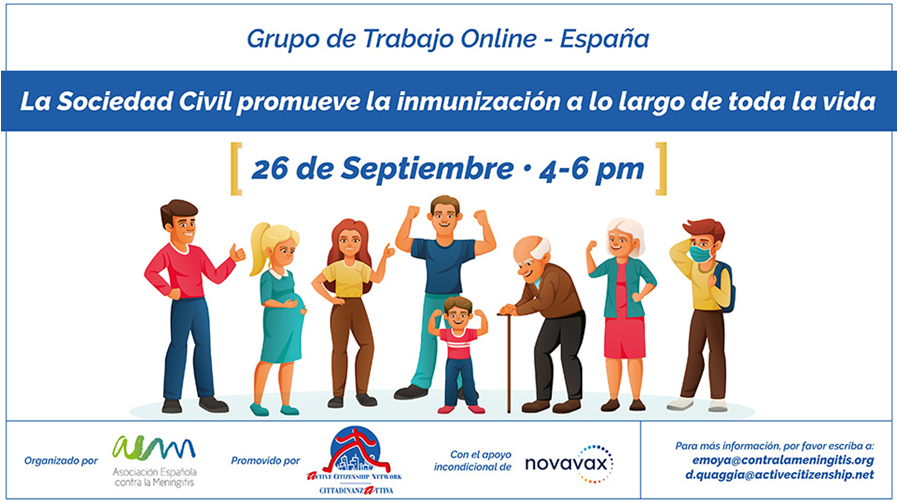
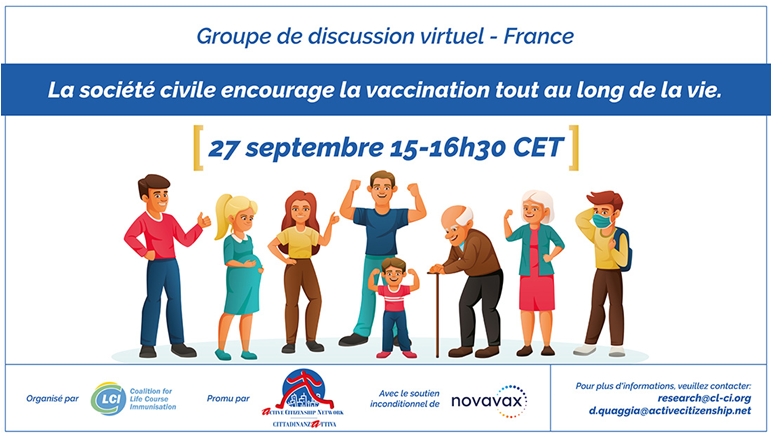
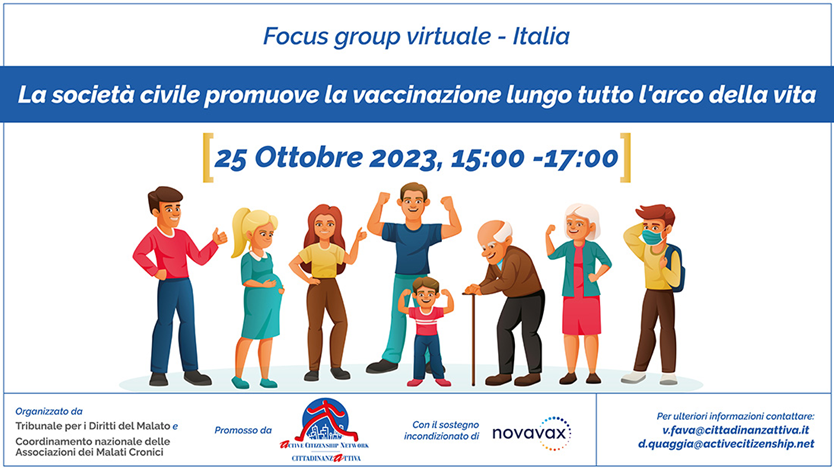
The online focus groups transpired in the latter half of the year, with collaboration from Active Citizenship Network’s local partners [8] in each country ensuring effective organization and participation of national stakeholders. To ensure a uniform format for the European initiative implemented simultaneously in three Member States, the local partners of Active Citizenship Network received a common communication template, along with guidelines and a “questions grid for the moderator.” The first online focus group took place on September 26, 2023, in Spanish, organized by La Asociación Española contra la Meningitis [9] The second session, conducted in French, was organized by the Coalition for Life Course Immunisation [10]. Lastly, the third focus group, conducted in Italian, was organized by Cittadinanzattiva [11] through - Tribunale per i Diritti del Malato e Coordinamento nazionale delle Associazioni dei Malati Cronici [12].
These activities – realized with the support of Active Citizenship Network [13] - facilitated a robust exchange of ideas and perspectives among diverse stakeholders.
The Participants
In France, a diverse array of perspectives enriched the discussions, with representatives from prominent organizations contributing valuable insights. Among these contributors were experts from Health Policy, a Hospital- based adults’ Doctor at CH Annecy, the Vaccine Confidence Project, mesvaccins.net, Université de Lyon, the French Chamber of Pharmacists, the URPS Pharmacists Auvergne Rhône-Alpes, Grenoble Alpes University Hospital, and the Société de Pathologie Infectieuse de Langue Française - SPILF, among others [14].
Italy experienced dynamic and informed participation, featuring representatives from influential organizations such as the Federation of Italian Pharmacists Orders - FOFI, the National Councillor Italian Society of Paediatrics SIP, Italian Federation of General Practitioners FIMMG, the National Federation of Nursing Professions FNOPI, Complex Operative Units UOC Vaccinations ASL Roma 1, the Italian Diabetic Association FAND, the Italian COPD Association, and the Cuore Nostro Association [15].
In Spain [16], a robust and diverse engagement was witnessed, with active participation from key organizations representatives: Foro Espanol de Paciente (Fep), the Ministerio De Comunicación, Ministerio De Sanidad
Direccion General Vacunas, the Universidad Rey Juan Carlos - Medicina Preventiva, Agencia De Comunicacion Comsalud, the Asociación de Enfermería (Adenfermero), the Instituto de Investigación Sanitaria Valdecilla (IDIVAL), and the Asociación Nacional de Enfermería y Vacunas (ANENVAC).
Each representative brought a unique perspective, contributing to the depth and breadth of the discussions.
Results and Discussion
Eight main areas were identified, revealing commonalities and local peculiarities in each country.
| Summary of the Main Results | |
|---|---|
| Lessons Learned | Increased awareness of the pivotal role of preventive measures |
| Barriers to Vaccination | Financial constraints, bureaucratic inertia, and knowledge gaps |
| Personalized Communication | Recognized importance of tailored communication |
| Collaboration | Significant involvement of patient associations |
| Healthcare Professionals | Key advocates for vaccination & need for continuous training |
| Pharmacy and Nurses | Essential for vaccination-related activities |
| Evaluation Challenges | Need for explicit targets for vaccination coverage and monitoring |
| Vaccines availability | Recognized importance of diverse vaccine choices |
Lessons Learned from COVID-19 Vaccination Campaigns
Commonalities: All three countries recognized the pivotal role of preventive measures following the COVID-19 pandemic. Positive shifts in awareness were observed among stakeholders, leading policymakers to acknowledge the importance of vaccinations throughout life.
Distinct Observations Spain: The necessity for extensive legal reforms in vaccination policies became evident. Education and training, coupled with technological improvements, were identified as crucial elements for success. The emphasis was on improving access, disseminating information effectively, and recognizing the influential role of healthcare professionals. France: The pandemic underscored the economic and health implications of vaccinations, emphasizing the importance of easy access and addressing fear to drive coverage. Challenges included balancing obligation with public trust, necessitating a careful evaluation of mandatory vaccination strategies. Italy: Proximity vaccination strategies and digital platforms for booking COVID vaccinations proved effective. However, challenges surfaced regarding compulsory vaccination, varying organizational models, and the need for tailored information campaigns.
Barriers to Vaccination Across the Three Countries
Shared Challenges: Financial constraints, bureaucratic inertia, and knowledge gaps emerged as shared challenges. Coordinating vaccination efforts and addressing public doubts remained key hurdles.
Country-Specific Barriers: Spain: Financial challenges and a lack of proactive health system hindered vaccination efforts. Scheduling and coordination issues, knowledge gaps, and difficulties in access presented formidable barriers [17]. France: Insufficient evaluation of strategies, inadequate logistical support, and training for healthcare professionals were identified as barriers. Public doubts about vaccination’s overall value persisted, exacerbated by bureaucratic inertia affecting policy adaptations. Italy: Diverse organizational models and bureaucratic inertia posed challenges. Insufficient deployment of reminder services and digital tools impacted accessibility, emphasizing the need for harmonizing communication approaches.
Personalized Communication Strategies
Unified Approach: All three countries recognized the importance of tailored communication. In Spain, tailored messages recognizing the role of Advanced Nurses were crucial. France emphasized personalized conversations using electronic vaccination calendars, while Italy stressed the importance of age-specific and culturally sensitive customizations.
Collaborative Efforts with Patient Associations
Common Ground: Patient associations played a significant role in all three countries, gaining credibility and influencing vaccination communication positively. Spain encouraged giving a voice to patient associations, recognizing their significant impact. France highlighted the valuable role of patient associations and community influencers in vaccination communication. Italy acknowledged the credibility gained by patient associations, emphasizing collaboration.
Healthcare Professional Training
Consistent Message: The need for continuous training for healthcare professionals was highlighted universally. Engaged healthcare professionals were identified as key advocates for vaccination [18].
Spain highlighted the role of engaged healthcare professionals, emphasizing their impact on vaccination acceptance. France called for harmonizing medical curricula to present a united front, while Italy stressed the importance of continuous training for health workers.
Pharmacy and Nurses Engagement
Unified Recognition: All three countries acknowledged the pivotal role of different healthcare professionals, in particular nurses (in Spain) and pharmacies, with a notable shift in their responsibilities. They emerged as essential hubs for vaccination-related activities.
In Spain, the decentralized healthcare system underscored the role of nurses in vaccination. France noted a significant shift in pharmacy roles, emphasizing personalized vaccination consultations. Italy recognized pharmacies as essential hubs for health activities [19], emphasizing their potential in increasing vaccination coverage [20].
Evaluation Challenges
Shared Concerns: Comprehensive evaluation challenges were recognized across the board. Establishing explicit targets for vaccination coverage and addressing hurdles in monitoring were deemed indispensable.
France pointed out the lack of comprehensive evaluation, especially regarding combined vaccination campaigns. Italy highlighted challenges in monitoring vaccination coverage, advocating for the establishment of explicit targets for vaccination coverage.
Vaccine Choices and Availability
Common Ground: all three countries acknowledged the importance of diverse vaccine choices. Italy stressed the importance of age-appropriate vaccines and informed citizen choices, emphasizing the customizability of prevention. France highlighted the benefits of a variety of vaccine options catering to diverse preferences. Spain cautioned against overwhelming information.
Conclusion
Collaboration, streamlined communication, and evaluation are deemed vital for enhancing vaccination rates across all life stages. Challenges notwithstanding, insights gleaned from the COVID-19 vaccination drive provide a roadmap for improvement. The envisioned journey demands sustained dialogue, collective action, and investment in research, policy review, awareness campaigns, digital tools, comprehensive training, and information dissemination. Healthcare professionals are urged to collaborate for a clear message, targeting hesitant, vulnerable, and elderly populations. Monitoring data for better adherence necessitates a unified effort across institutions. Strengthened communication, innovation, and updated vaccination calendars are pivotal, with common digital tools facilitating collaboration and data retrieval from the COVID-19 experience. The collective effort aims to fortify vaccination management capacity, particularly in adults, ensuring the safeguarding of public health and well-being.
Timely and valuable recommendations for decision- makers at both the national and European levels, especially considering the recent adoption of the EU4Health 2024 work program [21] by the European Commission. Within this framework of the European Health Union, vaccination policies seem noticeably absent. However, a notable innovation is the recognition of the crucial role played by civil society in engaging with citizens.
Declarations
Each of the authors confirms that this manuscript has not been previously published by another international peer-review journal and is not under consideration by any other journal. Additionally, all the authors have approved the contents of this paper and have agreed to the submission policies of the journal.
Authors’ Contribution and Conflict of Interest
Each named author has substantially contributed to conducting the underlying research and drafting this manuscript. Additionally, to the best of our knowledge, the authors listed on the first page declare that they do not have no conflict of interest, financial or otherwise.
Acknowledgements
The EU project “Civil Society promoting vaccination across the life-course” has been led by Active Citizenship Network, with the unconditional support of Novavax.
References
-
Ethgen O, Rémy V, Wargo K (2018) Vaccination budget in Europe: an update. Hum Vaccin Immunother (12): 2911- 2915.
-
(2023) European Centre for Disease Prevention and Control: COVID-19 Vaccine Tracker.
-
Su Y, Rao W, Li M, Caron G, D’Arcy C, et al. (2023) Prevalence of loneliness and social isolation among older adults during the COVID-19 pandemic: A systematic review and meta-analysis. Int Psychogeriatr 35(5): 229- 241.
-
(2022) Conclusions on vaccination as one of the most effective tools for preventing disease and improving public health. Council of the European Union.
-
(2022) Strategic Preparedness, Readiness and Response Plan to end the global covid-19 emergency in 2022. World Health Organization.
-
(2023) Civil Society promoting vaccination across the life-course. Active Citizenship Network.
-
Tate J, Aguado T, Belie JD, Holt D, Karafillakis E, et al. (2019) The life-course approach to vaccination: Harnessing the benefits of vaccination throughout life. Vaccine 37(44): 6581-6583.
-
Active Citizenship Network.
-
(2024) Spanish Association against Meningitis (Aem). Advocacy for Vaccination.
-
(2022) Coalition for Life-course Immunisation. Enhancing Lifelong Vaccination Strategies.
-
(2022) Cittadinanzattiva & Active Citizenship Network. Active Citizenship Network.
-
(2013) National Coalition of Associations for Patients suffering Chronic Diseases (CnAMC). Who we are.
-
(2022) The Engagement of Cittadinanzattiva on Vaccination. Active Citizenship Network.
-
(2023) France: Civil Society promoting vaccination across the life-course. Active Citizenship Network.
-
(2023) Italy: Civil Society promoting vaccination across the life-course. Active Citizenship Network.
-
(2023) Spain: Civil Society promoting vaccination across the life-course. Active Citizenship Network.
-
(2020) Addressing the Life-Course Approach in Vaccination Policy across Europe: The Case History of Spain. Journal of Biomedical Research & Environmental Sciences 1(7): 313-319.
-
(2023) Policy Recommendations for Empowering Healthcare Professionals for Everyone’s Protection. EUFLUDAY.
-
Votta M, Vitale M, Cardillo M, Papavero M (2021) The role of the pharmacies and their relationship with citizens during the Covid-19 emergency: The Italian Case History. Suntext Review of Case Reports & Images.
-
Votta M, Vitale M, Papavero M (2021) Enlarging access to vaccination in Italy according to the citizens and the pharmacists’ perspective. Journal of Vaccines Research & Vaccination 7: 017.
-
(2024) EU4Health Programme to strengthen European Health Union with EUR 752.4 million. Ministry of Social Affairs and Health.
- Ramsay Hunt Syndrome Presenting as Gait Imbalance without Facial Paralysis: A Case Report
- Unveiling Hidden Culprits: An Observational Study of Upper Gastrointestinal Endoscopy Findings in Symptomatic Cholelithiasis Patients
- Assessing Health Care Providers’ Proficiency in International Patient Safety Goals: A Study to Assess the Knowledge &Practice on Patient Safety in a Tertiary Care Teaching Hospital in Gujarat
- Challenges in Diagnosing Child Language Disorders
- Stunting Service Management Model in the South-Central Timor Region, East Nusa Tenggara, Indonesia
- Acute Small Bowel Obstruction Presenting as Gangrenous Jejunal Loop Secondary to Intestinal Endometriosis – A Rare Case Report