
Syntactic Judgment in Non-Fluent (Broca’s) Aphasia and Neuro- Typical Participants: A Comparison
Earlier research on persons with non- fluent aphasia especially concentrated on the expression related difficulties, agrammatism component etc. Eventually researchers focused on the comprehension related difficulties in these persons with no- fluent aphasia especially persons with Broca’s aphasia. These persons will have milder comprehension deficits which would reflect as poor performance on meta-linguistic judgment tasks especially syntactic judgment task. The other view in the same line of research attributes poor performance on syntactic judgment to the agrammatic component associated with non-fluent aphasia claiming that the syntactic comprehension difficulty is parallel with agrammatism component associated. The present study aimed at testing grammatical judgment abilities in persons with Broca’s aphasia. 5 persons with Broca’s aphasia and 20 neuro-typical participants were recruited for the study. Syntactic judgment task was carried out on all these participants by using 15 correct, 15 grammatically incorrect and 10 semantically incorrect sentences were used. Persons with Broca’s performed poorly compared to neuro-typical group. The performance of neuro typical participants did not vary much with respect to the three types of stimuli used. While persons with Broca’s aphasia showed more difficulty in judging grammatically incorrect sentences followed by semantically correct sentences.
Introduction
Aphasia is associated with deficit in comprehension and/or expression domain associated with a brain damage. Persons with aphasia may have cognitive linguistic deficit and exhibit difficulties in one or more of the cognitive aspects. Many classification systems such as anatomical and linguistic classifications have been proposed. Combining these two classification systems, the classic division proposes two large groups anterior aphasia and posterior aphasia.
Persons with anterior aphasia may have marked deficits on expression domain while persons with posterior aphasia can have significant difficulties on comprehension domain [1].
Until the late 1970’s, it was believed that persons with non fluent aphasia (Broca’s aphasia) exhibit only speech- production problem and mild comprehension problems such as understanding complex verbal messages and sentences, following which controlled experiments on comprehension begin.. They stated that persons with Broca’s aphasia have problem with semantically reversible sentences (where the object relative clauses) were interchanged. This finding further provoked researchers in aphasiology to carry out studies on comprehension in persons with Broca’s aphasia especially at syntactic level. Persons with Broca’s aphasia are known to have the following syntactic comprehension deficits.
- They have difficulties in understanding sentences with graded complexity.
- Difficulties in comprehending intra-sentential dependency relations such as passive sentences [2].
- Difficulties in detecting sentences with violation in phrase structure rules. Difficulty in comprehending sentences with violations in sub categorisations in semantic category.
- Difficulty in understanding sentences with false and pseudo true thematic structures Difficulty in comprehending sentences with variations in the agent, goal and source [3].
- They may also exhibit difficulty in judging sentences with variation in the noun phrases.
- It is well known fact that persons with Broca’s aphasia have difficulty in understanding sentences with semantic anomaly [4].
Persons with anterior aphasia are known to produce agrammatic utterances, this fact is well known and is been studied by many researchers. They are known to produce syntactically deficient speech with only content words. Broca’s aphasia is type of non-fluent type of aphasia characterised with effortful and non-fluent speech output. They have difficulty in constructing sentences with longer phrase length and the phrase length is confined to one or two words most of the time. Persons with Broca’s type of aphasia may find it difficult to produce verbs more than nouns [2]. Persons with Broca’s aphasia usually flaunt agrammatism. Agrammatism refers to tendency of constructing sentences with incorrect inflectional forms. They may produce errors in producing sentences with correct tenses, person, number and gender markers. They also find it difficult to access the correct phonemes from the phonological output lexicon and form words and the utterances is filled with phonemic disruptions and is often unintelligible. Grammaticality judgment deficit in persons with Broca’s aphasia is often linked to the agrammatism component. A hypothesis namely structural deficit hypothesis has been proposed in this direction. The proponents of this hypothesis believe that difficulty in judging sentences in persons with Broca’s aphasia is because they have grammatical deficits in their productions [5]. In other words the deficits in spoken language and comprehension deficits are parallel with respect to each other. However this hypothesis has been criticised as the two deficits (agrammatism and grammaticality judgment deficits) may not be present to the same extent. Agrammatism component may be severe and grammaticality judgment deficits may be mild in nature. Another explanation for defective grammaticality judgment in persons with Broca’s aphasia is explained through processing limitation hypothesis. This deficit on other hand attributes the grammaticality judgment deficits in persons with Broca’s aphasia to the comprehension deficits. It is universally believed that persons with Broca’s aphasia have mild deficits in comprehension and the same is believed to intrude the grammaticality judgment. In other words the poor grammaticality judgment is directly attributed to poor syntactic comprehension [5]. Many studies have verified these hypotheses mainly and the findings of these studies are often contradicting. The processing limitation hypothesis is a relatively well accepted hypothesises compared to structural deficit hypothesis. Poor performance on syntactic judgment is attributed to the comprehension deficits.
Need-The present study aims to study grammaticality judgment abilities in persons with Broca’s aphasia. Though many studies have been carried out in this direction the results of the studies are contradicting to one another. While some researchers claim that persons with Broca’s aphasia have mild deficits in grammatical judgment others claim it to be severe to verify this, the present study was carried out. Studies on grammaticality judgment are often sensitive to the language being spoken. Only a handful number of studies have been carried out in Indian context to decipher details about grammaticality judgment in persons with Broca’s aphasia. This is the other reason for carrying out the study.
Method
Total of 8 males participants with agrammatism component in the age range of 45-65 years were recruited for the study. The six participants with cerebro vascular accident were diagnosed by a neurologist, Western Aphasia Battery [6] was administered on the participants and these participants were confirmed to have Broca’s type of aphasia on WAB (Table 1). In order to compare the performance 20 neuro-typical individuals were also recruited. The neuro- typical participants were screened through the WHO ten checklist. This checklist is a self-assessment tool where the participant would fill information on communication (2 items), sensory 4 items) and cognitive skills (4 items) and screens for the deficits in aforementioned domains.
| Sl No | Age/Sex | Pre morbid duration | Therapy duration |
|---|---|---|---|
| 1 | 47/M | 6 months | 3 months |
| 2 | 53/M | 8 months | 1 month |
| 3 | 45/M | 9 months | 6 months |
| 4 | 51/M | 9 months | 9 months |
| 5 | 65/M | 1 year | 5 months |
| 6 | 46/M | 8 months | 3 months |
| 7 | 49/M | 9 months | 7 months |
| 8 | 41/M | 10 months | 8 months |
Table 1: Details of Participants.
The stimulus for the study was 40 newly constructed sentences. Out of 40 sentences, 15 sentences were grammatically correct sentences and 15 sentences were grammatically incorrect sentences. The sentences were changed into incorrect sentences by varying the subject, verb agreement and by altering the PNG markers. The remaining 10 sentences had a semantic anomaly i.e. the sentences were syntactically correct but semantically incorrect. These sentences were deliberately used in the study to verify if persons with Broca’s aphasia find it difficult to judge such sentences also or if the problem is confined in judging grammatical deficits. The sentences were presented in auditory mode and the participant had to say if the sentences were correct either by nodding the head or verbalising, the correct and incorrect sentences were randomised and presented to the participant. A score of 1 was given for each correct judgment and 0 was given for an incorrect judgment.
Results -The maximum score was 40. The neuro typical individuals obtained a mean score of 38 and persons with Broca’s aphasia secured a mean score of 24. In order to verify if the difference between the two groups was statistically significant, Mann Whitney U test was carried. Mann Whitney U test was carried out as the data did not abide by the properties of normal distribution. The Z score was 5.22 and corresponding p value (p< 0.05) showed that there was a statistically significant difference between the two groups.
Further the scores elicited for correct sentences (out of 15), grammatically correct sentences (out of 15) and semantically incorrect responses (out of 10) were calculated for neuro-typical individuals and persons with Broca’s aphasia. Neuro-typical individuals secured scores of 14, 14 and 9 for correct, grammatically incorrect and semantically incorrect sentences. While persons with Broca’s aphasia secured mean scores of 10, 4 and 8 for these sentences (in the above mentioned order see Figure 1).
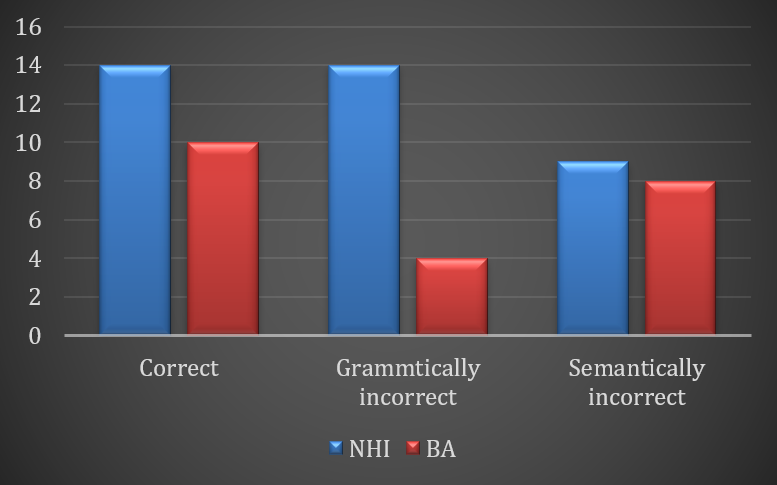
Further in order to verify if there was any significant difference within the groups, on the three sets of sentences appropriate statistical tests were used. Kruskal-Wallis test was administered to check if the distribution is normal or non-normal. The p value obtained was less than 0.05 indicating that the data was non-parametric. Friedman’s test was carried out as the comparison focused on within group difference for each of the sentence type and the Z scores for neuro-typical group was 1.14 and the corresponding p value (p<0.05) indicated no within group difference. The Z score obtained for persons with Broca’s aphasia was 5.16 and corresponding p value (p<0.05) showed significant difference. In order to verify which two stimuli sets varied Wilcoxon’s signed rank test was employed. Z scores for correct versus grammatically in correct and grammatically in correct versus semantically incorrect was 4.82 and 5.14 respectively and the corresponding p values (p<0.05) showed significant difference. Z scores for correct and semantically incorrect sentences was 3.22 and the p value (p<0.05) showed no significant difference. From the findings it was evident that persons with Broca’s aphasia found it difficult to judge sentences which were grammatically incorrect.
Discussion
It is a well-established fact that persons with Broca’s aphasia have issues with respect to comprehension. The performance of these participants with Broca’s aphasia on tasks like syntactic judgment is often probed. The results of these studies vary, while some proponents state the performance of Broca’s aphasia varies marginally from the performance of neurologically healthy participants while some argue that the syntactic judgment ability is markedly affected [5]. From the results it is evident that persons with Broca’s aphasia have difficulty in judging syntactically incorrect sentences. This deficit in syntactic judgment can be attributed to mild comprehension deficits seen in persons with Broca’s aphasia [6]. The results is in par with the processing limitation hypothesis however, the syntactic judgment ability in these participants was not compared with expression domain in the present study to address the structural deficit hypothesis.
Conclusion
The study was carried with the aim of testing grammatical judgment abilities in persons with Broca’s aphasia. 8 persons with Broca’s aphasia and 20 neuro-typical participants were recruited for the study. Judgment task was carried on all participants. 15 correct, 15 grammatically incorrect and 10 semantically incorrect sentences were used. Persons with Broca’s aphasia secured less mean scores compared to neuro-typical group and the difference in the performance was significant statically. Individual mean scores on the three stimulus set was calculated, no much difference was seen in neuro-typical individuals while persons with Broca’s aphasia showed more difficulty in judging grammatically incorrect sentences.
References
-
Caramazza A, Zurif EB (1976) Dissociation of algorithmic and heuristic processes in sentence comprehension: Evidence from aphasia. Brain and Language 3(4): 572- 582.
-
Drai D, Grodzinsky Y (1999) Comprehension Regularity in Broca’s Aphasia? There’s More of It Than You Ever Imagined. Brain & Language 70(1): 139-143.
-
Grodzinsky Y (1988) Syntactic representations in agrammatism: The case of prepositions. Language & Speech 31(2): 115-134.
-
Caplan D, Alpert N, Waters G, Olivieri A (2000) Activation of Broca’s area by syntactic processing under conditions of concurrent articulation. Human Brain Mapping 9(2): 65-71.
-
Al-Adam H (2011) Comprehension and Production of Prepositions by Palestinian- Speaking Broca’s Aphasics. JAIISH 30: 125-129.
-
Chengappa SK, Kumar R (2008) Normative & Clinical Data on the Kannada Version of Western Aphasia Battery (WAB-K). Language in India 8(6).
- Ramsay Hunt Syndrome Presenting as Gait Imbalance without Facial Paralysis: A Case Report
- Unveiling Hidden Culprits: An Observational Study of Upper Gastrointestinal Endoscopy Findings in Symptomatic Cholelithiasis Patients
- Assessing Health Care Providers’ Proficiency in International Patient Safety Goals: A Study to Assess the Knowledge &Practice on Patient Safety in a Tertiary Care Teaching Hospital in Gujarat
- Challenges in Diagnosing Child Language Disorders
- Stunting Service Management Model in the South-Central Timor Region, East Nusa Tenggara, Indonesia
- Acute Small Bowel Obstruction Presenting as Gangrenous Jejunal Loop Secondary to Intestinal Endometriosis – A Rare Case Report