
Performance Evaluation of Advanced Bread Wheat Genotypes for Yield Stability Using the AMMI Stability Model
Bread wheat (Triticum aestivum L.) is one of the staple foods for large proportion of the Ethiopian population. Ethiopia is the largest wheat producer in Sub-Saharan Africa, The country cultivates a total of more than 1.6 million hectares, and yet imports about 1/3 of the national requirement to make up for annual deficits. To increase wheat production in the country, adaptive breeding has been in progress to develop promising lines for broad adaptation or to develop wheat varieties that perform well over diverse agricultural environments. In this study a total of fifteen genotypes, eight advanced lines from CIMMYT/ICARDA source, five Ethiopian crosses, and two checks, were tested across six locations during 2017 and 2018 seasons. Yield stability index (YSI) was calculated by ranking the mean grain yield of genotypes (RY) across environments and by ranking the AMMI stability values (RASV). The smallest YSI value of 5 was exhibited by variety Hidass and entries ETBW8084, ETBW9037, ETBW9470 and ETBW8459 had YSI values of 6, 7, 12, and 12, respectively, and indicated stability across locations with comparatively higher yields. The highest YSI (30) was recorded by genotype ETBW8075 which is characterized as unstable and low yielder. ETBW 8084 was high yielder and with bi
Introduction
Bread wheat (Triticum aestivum L.), is the staple food for a large proportion of the Ethiopian population. The country is the largest wheat producer in sub- Saharan Africa, next to South Africa [1]. Wheat is found at altitudes ranging from 1700 to 2900 masl. Rainfall In these areas is bimodal and varies from 600 to 2000 mm. Most wheat is produced during the main rainy season, June to September, although some is produced during the light rain season, March to May. Virtually all wheat is produced under rain fed conditions. Central and south eastern highlands of the countries are major wheat producing areas. Therefore, Arsi, Bale and part of Shoa are considered wheat growing belt. Although Ethiopia is largest wheat producing country, the average productivity of the country is 2.5 t/ ha which is lower than world wheat productivity, 3.09 qt/ha (https://www.statista.com/statistics/237705/global- wheat-production/) and 6-7 t/h of potential farmers in the country (personal observation) [2]. Biotic stress, abiotic stress and conventional management practices are among major constraints for wheat production. In particular the breakout out of new races of wheat rusts, like Ug 99 and Digelu races throughout time made popular and wider adapted varieties out of production. Wheat producers in developing countries, like Ethiopia which use restricted inputs and grow wheat under harsh and unpredictable environments require stable wheat varieties. The development of varieties which can be adapted to a wide range of environments with high grain yield is the final goal of any plant breeders in a crop improvement program. High yield stability usually refers to a genotype’s ability to perform consistently across a wide range of environments [3]. In order to ensure consistent stability and high yields, new lines are A total of fifteen genotypes: eight advanced genotypes initially introduced from CIMMYT and ICARDA and then evaluated and selected for four consecutive years, five Ethiopian crosses, and two checks Hidasse and Lemu were evaluated in six location: Kulumsa, Arsi robe, Assasa, Bokoji, Holota and Ofla during 2016 and 2017 cropping season. Details of each location are shown in table. A randomized complete block design with three replication was used.
developed, and tested for their yield performances in different environments [4]. Genotype × environment interactions are of major importance, because they provide information about the effect of different environments on genotype performance and have a key role in assessment of stability of the breeding materials [5]. Quantitative trait like yield mainly dependent on G×E interaction as it obscures the interpretation of genetic experiments and makes predictions difficult. In such circumstances it is difficult to select and suggest one better genotype across various locations. A wider adapted Genotype performs consistently over a wider range of environment. To ensure valid genotype recommendation and to identify promising genotypes, a breeder should conduct multi location yield trials across different environments.
Materials and Methods
| Entry | Genotype | Pedigree | Selection history | ||||||||
| 1 | Lemu | WAXWING*2/HEILO | |||||||||
| 2 | ETBW8070 | Line 1 Singh/ETBW4919 | KU07-01-0KU-0KU-0KU-0BK2-22KU | ||||||||
| 3 | ETBW8078 | Line 1 Singh/(Cham6/WW1402) | KU07-04-0KU-0KU-0KU-0BK1-4KU | ||||||||
| 4 | ETBW8084 | Line 3 Singh/(Cham6/WW1402) | KU07-07-0KU-0KU-0KU-0BK1-3KU | ||||||||
| 5 | ETBW8311 | ND643/2*WBLL1/3/KIRITATI//PRL/2*PASTOR/4/KIRITA TI//PBW65/2*SERI.1B | CMSS07B00823T-099TOPY-099M- 099Y-099M-7WGY-0B | ||||||||
| 6 | ETBW8065 | Line 1 Singh/ETBW4919 | KU07-01-0KU-0KU-0KU-0BK1-5KU | ||||||||
| 7 | ETBW8427 | SERI.1B//KAUZ/HEVO/3/AMAD/4/PYN/BAU//MILAN/5/I CARDA-SRRL-1 | ICW06-50208-5AP-0AP-0AP -02 SD | ||||||||
| 8 | ETBW8459 | CHIL-1//VEE'S'/SAKER'S' | ICW99-0026-7AP-0AP-0AP-9AP-0AP- 0DZ/0AP-0DZ/0KUL/0SIN/0AP- 0NJ/0AP-0ALK/0AP | ||||||||
| 9 | ETBW9037 | SWSR22T.B./2*BLOUK #1//WBLL1*2/KURUKU | CMSS08Y01116T-099M-099Y-099M- 099NJ-099NJ-23WGY-0B | ||||||||
| 10 | ETBW9045 | KINDE/4/CMH75A.66//H567.71/5*PVN/3/SERI | CMSS09Y00603S-099Y-17M-0WGY-6B- 0Y |
Table 1: Pedigree and history of fifteen genotypes tested for yield performance and wheat rust resistance.
| 11 | ETBW8075 | Line 1 Singh/(Cham6/WW1402) | KU07-04-0KU-0KU-0KU-0BK1-1KU |
|---|---|---|---|
| 12 | ETBW9464 | MARCHOUCH*4/SAADA/3/2*FRET2/KUKUNA//FRET2*2/4 /TRCH/SRTU//KACHU | CMSS10B00928T-099TOPY-099M- 099NJ-099NJ-13WGY-0B |
| 13 | ETBW9466 | ATTILA/3*BCN//BAV92/3/TILHI/5/BAV92/3/PRL/SARA/ /TSI/VEE#5/4/CROC_1/AE.SQUARROSA (224)//2*OPATA*2/6/HUW234+LR34/PRINIA//UP2338*2 /VIVITSI | CMSS10B01047T-099TOPY-099M- 099NJ-099NJ-2WGY-0B |
| 14 | ETBW9470 | BAVIS #1/5/W15.92/4/PASTOR//HXL7573/2*BAU/3/WBLL1 | CMSA10M00485S-099ZTM-099NJ- 099NJ-6WGY-0B |
| 15 | Hidasse | YANAC/3/PRL/SARA//TSI/VEE#5/4/CROC- 1/AE.SQUAROSA(224)//OPATTA |
Table 2: Pedigree and history of fifteen genotypes tested for yield performance and wheat rust resistance.
| Temp | ||||||||||||||||||||
| Location | Altitude (m) | Representing Agroecology | Soil type | Rainfall | ||||||||||||||||
| max | Min | |||||||||||||||||||
| Kulumsa | 2200 | Mid-altitude | Clay soil (luisols) | 820mm | 22.8 | 10.5 | ||||||||||||||
| Arsi robe | 2420 | Water logged vertisoil | Heavy clay soil (vertisiol) | 890mm | 22.1 | 6 | ||||||||||||||
| Assasa | 2340 | Terminal drought prone | Clay loam soil(gleysols) | 620mm | 23.6 | 5.8 | ||||||||||||||
| Bokoji | 2780 | Highland/haigh rainfall | Clay siol(nitosols) | 1020mm | 18.6 | 7.9 | ||||||||||||||
| Holota | 2400 | M2-5 | Nitosols | 1144 | 22 | 6 | ||||||||||||||
| Ofla | 2490 | - | clay | - | 22.2 | 7.7 |
Table 3: Information on Altitude, Soil, rainfall and temperature of tested location.
Statistical Analysis
Four internal rows were harvested and grain yield per plot was converted to ton per hectare. Analysis of Variance was computed to determine the effects of genotype, environment, and GE interactions on grain yield. The stability of yield performance for each genotype was calculated by regressing the mean grain yield of individual genotypes on environ-mental index and calculating the deviation from regression as suggested by Eberhart and Russell as [6]:
$$ Y _ {i j} = \mu_ {i} + \beta_ {i} I _ {j} + \delta_ {i j} $$
where: Yij is the variety mean of the ith environment, µi is the mean of ith variety over all environments, βi is the regression coefficient that measures the responseof the ith variety to varying environments, δij is the deviation from regression of the ith variety at the jth environment, and Ij is the environmental index obtained as the mean of all varieties at the jth environment minus the grand mean. regression coefficient (bi) close to unity and deviation from regression (S2di) near to zero, was defined as a stable cultivar [6].
AMMI Stability Value (ASV is the distance from the coordinate point to the origin in a two-dimensional plot of IPCA1 scores against IPCA2 scores in the AMMI model [7]. Because the IPCA1 score contributes more to the GXE interaction sum of squares, a weighted value is needed. This weighted value was calculated for each genotype and each environment according to the relative contribution of IPCA1 to IPCA2 to the interaction sum of squares as follows:
( )( ) ( ) 2
$$ \mathrm {A S V} = \sqrt {\left[ \left(S S _ {I P C A 1} \div S S _ {I P C A 2}\right) \left(I P C A 1 s c o r e\right) ^ {2} + \left(I P C A 2 s c o r e\right) ^ {2} \right]} $$
where, SSIPCA1/SSIPCA2 is the weight given to the IPCA1-
value by dividing the IPCA1 sum of squares by the IPCA2
sum of squares. Either the larger negative ASV value or
positive, the more specifically adapted a genotype is to
certain environments. Smaller ASV values indicate more
stable genotypes across environments [7].
Yield stability index (YSI), is calculated by ranking the
mean grain yield of genotypes (RY) across environments
and rank of AMMI stability value (ASV). The YSI
- incorporates both mean yield and stability in a single criterion as follows: YSI = RASV + RY [8,9]. Ecovalnce
- (Wi2) and stability variance (σi2) were computed as suggested by
- Wricks’s and
- Shukla’s
- [10,11].
- Result and Discussion
- GEN
- Mean
- ASV
- YSI
- RASV
- RYI
- Wi2 σi2 si2 bij
- Sd2i
- Lemu
- 5.17
- 0.6834
- 14
- 5
- 9
- 17.26
- 3.662091 ns
- 1.818214 ns
- 0.408
- 0.21
- ETBW8070
- 5.61
- 1.3542
- 20
- 14
- 6
- 30.56
- 6.731099 ns
- 4.355622 ns
- 0.286
- 0.008
- ETBW8078
- 4.19
- 0.8852
- 21
- 8
- 13
- 14.46
- 3.016039 ns
- 3.570220 ns
- 0.807
- 0.006
- ETBW8084
- 6.04
- 0.4525
- 6
- 4
- 2
- 5.68
- 0.991338 ns
- 0.892331 ns
- 1.236
- 0.434
- ETBW8311
- 4.04
- 0.9258
- 24
- 10
- 14
- 22.6
- 4.890277 ns
- 5.565642 ns
- 1.283
- 0.123
- ETBW8065
- 5.05
- 1.3461
- 23
- 13
- 10
- 31.39
- 6.923159 ns
- 7.167105 ns
- 0.559
- 0.491
- ETBW8427
- 5.66
- 0.8858
- 14
- 9
- 5
- 12.89
- 2.652924 ns
- 2.987167 ns
- 0.77
- 0.042
- ETBW8459
- 5.02
- 0.093
- 12
- 1
- 11
- 7.91
- 1.505092 ns
- 1.909821 ns
- 1.097
- 0.192
- ETBW9037
- 5.74
- 0.3589
- 7
- 3
- 4
- 4.36
- 0.684794 ns
- 0.950139 ns
- 0.962
- 0.418
- ETBW9045
- 5.41
- 0.7073
- 13
- 6
- 7
- 12.3
- 2.517762 ns
- 3.215418 ns
- 1.068
- 0.024
- ETBW8075
- 2.35
- 1.6888
- 30
- 15
- 15
- 55.26
- 12.430907 **
- 14.024556 **
- 0.555
- 4.779
- ETBW9464
- 4.5
- 1.2541
- 24
- 12
- 12
- 31.54
- 6.959196 ns
- 5.583620 ns
- 1.623
- 0.128
- ETBW9466
- 5.24
- 0.7975
- 15
- 7
- 8
- 14.44
- 3.013000 ns
- 1.164301 ns
- 1.576
- 0.36
- ETBW9470
- 7.13
- 1.1078
- 12
- 11
- 1
- 25.87
- 5.649403 ns
- 3.096933 ns
- 1.706
- 0.033
- Hidasse
- 6
- 0.2096
- 5
- 2
- 3
- 5.06
- 0.847359 ns
- 1.133583 ns
- 1.062
- 0.368
Table 4: Results of AMMI stability values.
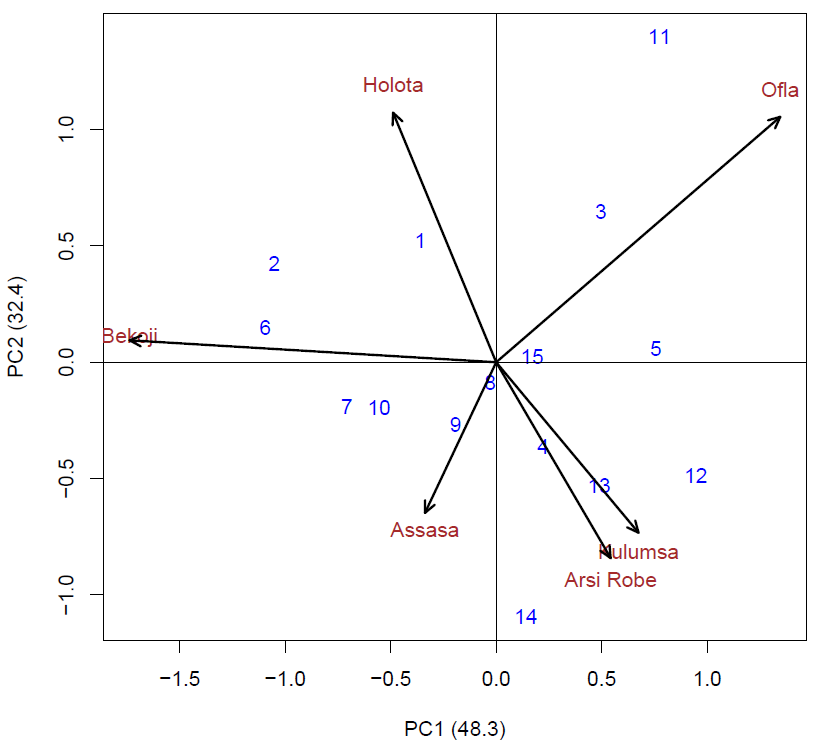
adapted to high yielding environments or optimum areas. A cultivar Hidase, genotypes: ETBW9045, ETBW8084 and ETBW8427 were high yielder and bi close to unity and Si2 near to zero. And therefore, they were widely adapted genotypes. ETBW 8084 was high yielder and bi<1, indicted that the genotype well perform to environmental changes and low yielding areas [14]. ETBW8075 with high deviation from regression Si2= 4.779 (table.) delivered the lowest yield and poor performance across tested location.
| Genotypes | Arsirobe | Assasa | Bokoji | Holota | Kulumsa | Ofla | ||||||||||||||
| Lemu | 4.6 | 5.2875 | 4.8125 | 4.9625 | 6.675 | 4.685714 | ||||||||||||||
| ETBW8070 | 4.9125 | 6.85 | 6.7 | 4.7625 | 5.625 | 4.785714 | ||||||||||||||
| ETBW8078 | 3.8375 | 4.5125 | 2.575 | 3.0625 | 5.6375 | 5.514286 | ||||||||||||||
| ETBW8084 | 6.8375 | 6.7 | 5.1625 | 3.55 | 7.9875 | 5.985714 | ||||||||||||||
| ETBW8311 | 4.4375 | 5.9 | 1.4375 | 2.1125 | 5.2 | 5.171429 | ||||||||||||||
| ETBW8065 | 3.9 | 6.8625 | 5.925 | 4.1125 | 5.8 | 3.685714 | ||||||||||||||
| ETBW8427 | 5.725 | 6.975 | 6.1375 | 3.9875 | 6.625 | 4.5 | ||||||||||||||
| ETBW8459 | 5.375 | 6.3625 | 4.8 | 2.2625 | 5.775 | 5.557143 | ||||||||||||||
| ETBW9037 | 6.2375 | 6.575 | 5.2625 | 4 | 7.4125 | 4.942857 | ||||||||||||||
| ETBW9045 | 4.8375 | 7.4875 | 5.6625 | 3.1875 | 6.475 | 4.828571 | ||||||||||||||
| ETBW8075 | 1.5125 | 2.0375 | 0.8625 | 1.2 | 3 | 5.485714 | ||||||||||||||
| ETBW9464 | 5.3625 | 6.05 | 1.425 | 2.3125 | 7.025 | 4.814286 | ||||||||||||||
| ETBW9466 | 5.65 | 6.1125 | 3.775 | 2.5375 | 8.15 | 5.242857 | ||||||||||||||
| ETBW9470 | 8.4 | 8.725 | 6.5286 | 3.4375 | 9.325 | 6.371429 | ||||||||||||||
| Hidasse | 6.0625 | 6.2 | 5.4 | 3.925 | 8.1 | 6.328571 |
Table 5: Mean grain yield of fifteen genotypes across six location for two years.
Conclusion and Recommendation
To develop varieties for different environments, very essential for breeders to evaluate their genotypes based on many years and several locations. Environmental variations are important in determining performance of elite materials. Genotype ranks consistently across different tested location has less response for highly unstable environment. Genotype 8084 is high yielder than the two checks and stable across tested location. Therefore this genotypes recommended as candidate variety for next year to release as a variety for wider environment. Genotype 9470 with highest mean grain yield and best performance at potential environments recommended as candidate variety for optimum areas.
Acknowledgement
This work would not have been possible without the financial support EIAR, Collaborating regional and federal research centers and wheat breeding teams of Kulumsa Agricultural Research Center (KARC). I am grateful to all of those with whom I have had the pleasure to work during this and other related projects.
References
-
White JW, Tanner DG, Corbett JD (2011) An agro- climatological characterization of bread wheat production areas in Ethiopia. CIMMYT, México, US.
-
CSA (2010) Agricultural sample survey report on area, production and yields of major crops. Central statistical Authority, Addis Ababa, Ethiopia.
-
Annicchiarico P (1997) Additive main effects and multiplicative interaction (AMMI) analysis of genotype location interaction in variety trials repeated over years. Theoretical and Applied Genetics 94(8): 1072-1077.
-
Mehmet A, Telat Y (2006) Adaptability performance of some bread wheat (_Triticum aestivum_ L.) genotypes in the Eastern region of Turkey. Turk Int J Sci & Technol 1(2): 82-89.
-
Moldovan V, Moldovan M, Kadar R (2000) Item from Romania. S:C:A Agricultural Research Station.
-
Eberhart SA, Russell WA (1966) Stability parameters for comparing varieties. Crop Sci 6(1): 36-40.
-
Purchase JL, Hatting H, Vandeventer CS (2000) Genotype × environment interaction of winter wheat (_Triticum aestivum_ L.) in South Africa: Stability analysis of yield performance. South African Journal of Plant and Soil 17(3): 101-107.
-
Bose LK, Jambhulkar NN, Pande K, Sing ON (2014) Use of AMMI and other stability statistics in the simultaneous selection of rice genotypes for yield and stability under direct-seeded conditions. Chilean Journal of Agricultural Research 74(1).
-
Bavandpori F, Ahmadi J, Hossaini SM (2015) Yield Stability Analysis of Bread Wheat Lines using AMMI Model. Agricultural Communications 3(1): 8-15.
-
Wricke G (1962) On a method of understanding the biological diversity in field research. Z Pflanzenzucht 47: 92-96.
-
Shukla GK (1972) Some statistical aspects of partitioning G x E components of variability. Heredity 29(2): 237-245.
-
Becker HC, Leon J (1988) Stability analysis in plant breeding, Plant Breed 101: 1-23.
-
Kılıç H (2012) Assessment of Parametric and Non parametric methods for Selecting Stable and Adapted Spring Bread Wheat Genotype in Multi-Environments. Journal of Animal & Plant Sciences 22(2): 390-398.
-
Singh RP, Hodson DP, Huerta-Espino J, Jin Y, Bhavani S, et al. (2011) The Emergence of Ug99 Races of the Stem Rust Fungus is a Threat to World Wheat Production. Annu Rev Phytopathol 49(1): 465-481.
-
Ahmed J, Choudhery MH, Salah-ud-Din S, Ali MA (1996) Stability for grain yield in wheat. Pak. J Bot. 28(1): 61-65.
-
Akcura M, Kaya Y, Taner S, Ayranci R (2006) Parametric stability analyses for grain yield of durum wheat. Plant Soil Environ 52(6): 254-261.
-
Allard RW, Bradshaw AD (1964) Implication of genotype x environmental interaction in applied plant breeding. Crop Sci 5: 503-508.
-
Food and Agriculture Organization of the United Nations FAO. Rome, Italy pp: 519-564.
-
Ceccarelli S, Grando S, Booth RH (2006) International breeding programmes and resource-poor farmers: crop improvement in difficult environments. The International Center for Agricultural Research in the Dry Areas (ICARDA), Aleppo, Syria pp: 189-199.
-
Freeman GH (1990) Modern statistical methods for analyzing genotype-environment interactions. In: Kang MS (Ed.), Genotype × Environment Interaction and Plant Breeding pp: 118-125.
-
Gauch HG, Piepho HP, Annicchiaricoc P (2008) Statistical analysis of yield trials by AMMI and GGE: Further considerations. Crop Sci 48(3): 866-889.
-
Kang MS (1992) Simultaneous selection for yield and stability: Consequences for growers. Agron J 85(3): 754-757.
-
Khan AJ, Azam F, Ali A, Tariq M, Amin M, et al. (2007) Wide and specific adaptation of bread wheat inbred lines for yield under rainfed conditions. Pak J Bot 39(1): 67-71.
-
Lillimo M, van Ginkel M, Trethowan RM, Hernandez E, Rajaram S (2003) Associations among international CIMMYT bread wheat yield testing locations in high rainfall areas and their implications for wheat breeding. Crop Sci 44(4): 1163-1169.
-
Mohammadi R, Abdulahi A, Haghparast R, Armion M (2007) Interpreting genotype X environment interactions for durum wheat grain yields using non- parametric methods. Euphytica 157(1-2): 239-251.
-
Nachit MM, Nachit G, Ketata H, Gauch HG, Zobel RW (1992) Use of AMMI and linear regression models to analyse genotype environment interaction in durum wheat. Theor Appl Gene 83(5): 597-601.
-
Naghavi A, Sofalian O**,** Asghari A, Sedghi M (2010) Relation between freezing tolerance and seed storage proteins in winter bread wheat (_Triticum aestivum_ L.). Turk J Fld Cr 15(2): 154-158.
-
R Development Core Team (2008) R: A language and environment for statistical computing. R Foundation for Statistical Computing, Vienna, Austria.
-
Singh RK, Chaudhary BD (1985) Biometrical methods in quantitative genetics. Kalyani Publishers, New Dehli, India.
-
Steel RGD, Torrie JH, Deekey DA (1997) Principles and Procedures of Statistics: A Biometrical Approach. 3rd Edition. McGraw Hill book Co Inc pp: 666.
-
Yan W, Rajcan I (2002) Biplot analysis of test sites and trait relations of Soybean in Ontario. Crop Sci 42(1): 11-20.
- Enhancement of Vegetative Growth and Fruit Yield in Cucumber (Cucumis sativus L.) via Spiritual Blessing (Biofield) Energy Intervention
- Production of Açaí (Euterpe oleracea Mart.) under Different Agroforestry System Management Intensities in Amazonian Floodplain (Varzea) Forests
- Coffee and the Production Region: What is the Secret to the Expression "Quality"?
- Experiential Agripreneurship Training in Sub-Saharan Africa: Integrating a Business Incubator into Postgraduate Livestock Education at the University of Buea
- Advances in Agricultural High-Quality Development
- Linking Compost Residue to ABAGE in Plants - a Short Note