
The Contest Between the Roles of Local Understanding and Scientific Knowledge in Cacao Cultivation
This study aims to describe the apparent contest between local knowledge and scientific knowledge in Cacao farming. This research was conducted from June 2016 to December 2016 in Penanggosi village, Lambandia sub-district of East Kolaka regency, Southeast Sulawesi Province. In-depth interviews regarding cacao cultivation practices were carried out in order to collect various reasons that farmers accept or refuse to implement scientific knowledge which was recommended through government extension officers. The research results which pointed out the pattern of contest between local knowledge and scientific knowledge on cacao cultivation has given birth to the three patterns of contest; Zero Sum Game, Coexistence and Hybridization pattern. The Zero Sum Game pattern can be found in land preparation, shade planting, spacing and size of planting hole as well as control of pest / disease. The pattern of Coexistence took place regarding aspects of planting material and nursery, pruning and maintaining good garden health. Hybridization pattern occurs in planting, fertilizing and harvesting. Farmers tend to retain some of the local knowledge practices due to the various limitations. Some farmers do not have proper equipment or materials which they need to carry out recommendations of scientific knowledge. Other farmers claim that scientific knowledge requires additional cost to implement. In addition, the reason farmers maintain and retain local knowledge is they consider it more appropriate to the environment of their hilly garden. The government needs to prepare comprehensive information which can be useful for farmers. In addition, government should provide additional equipment such as tools for pruning in a way which entices farmers. Truly close collaboration between scientists and farmers should mean that strengths and weaknesses of both sources of knowledge become a thing of the past.
Introduction
Many studies and policies developed in the field of agriculture have argued that scientific knowledge should replace traditional knowledge in agricultural practice in order to increase productivity. Nevertheless, this opinion has been challenged by the emerging of a new paradigm which suggests that local knowledge should be considered very important in discussions on the use of sustainable and balanced development of resources [1].
Discourse between local knowledge and scientific knowledge become prominent in agricultural development particularly in plantation plants such as cacao. Considering that cacao plantation undertaken by people, private companies and government have contributed significantly to local (gross domestic product) and national (gross national product). In addition, cacao plantations also have a strategic role in employment, feed for animal husbandry, supplying raw materials for industry and as a source of people’s income [2].
Cacao is a strategic commodity for at least two reasons. Firstly, Indonesia is the third largest cacao producer in the world after Ivory Coast and Ghana, with production of 809,586 tons [3]. As such, this commodity has contributed US $ 1.1 billion to the national economy which is the third largest foreign exchange gain after palm oil and rubber (Ministry of Trade). Secondly, 95% of the cacao farming is small scale involving people with land holdings of 0.5-2 ha. Thus, the development of a cacao business directly or indirectly will affect the populist economy.
The second largest area of cacao plantation in Southeast Sulawesi province is in East Kolaka District. The majority of population in East Kolaka regency cultivate cacao farm as they main source of livelihood. In addition, many of the farmers in this regency are also plant food crops such as rice field, pepper and coconut but not as widely as cacao. The number of cacao farmers in East Kolaka is 26,348 households; if it is assumed that on average each family has four members (father, mother and two children), then the total number of farmers is ±105.392 persons [4]. On the average, the largest of cacao farm owned by farmers is 2.5 Ha. The total land used for cacao cultivation until 2013 reaches 66,757 ha.
At the farm level, in terms of cacao cultivation, many farmers have not fully followed the introduction of technology according to the government programs (scientific knowledge). Among the departure of government programs are: a) land preparation, b) planting and seeding materials, c) cultivation of shade, d) determining the distance and planting hole size, e) pruning, f) planting, g) fertilization, h) environmental hygiene, i) pest / disease control and harvesting. These habits form part of local knowledge that has long been shared from family or fellow of cacao farmers.
Associated with the linkage of two kinds of or sources of knowledge between local and external introduction technologies, Salman argues that when information derived from local knowledge interacts with outside knowledge, the knowledge which is applied becomes an uneasy marriage between that which is already held and that which has come from the outside [5]. In such situations, cooperation, mutual reconciliation, competition and conflict from bearers of knowledge takes place. The whole phenomenon is referred to as the contestation of knowledge as part of the culture of the practices of cacao cultivation.
The pattern of contestation between local knowledge that is constructed on the basis of daily experience of community and the external knowledge that is scientifically constructed in the cacao cultivation is very complex. The complexity gives rise to the three alternatives of patterned knowledge reconstruction.
1. Zero Sum Game, which takes place when there is mutual negation/domination in the contestation between the narratives,
2. Hybridization, which takes place when mixing and then gives birth to a new feature of knowledge in contestation between narratives; patterned reconstruction
3. Coexistence, which takes place when there, is a common presence without mutual influence in contestation between narratives [6].
According to Fujisaka, Pretty in Sunaryo and Joshi there are several reasons why new technology and information offered are rejected by farmers because of [7]:
a) The recommended technology often does not address the problems facing by the farmer.
b) The technology offered is difficult for farmers to implement and may not be better than existing local technologies.
c) Technological innovation creates a new problem for farmers because it is less suited to local social, economic, and cultural conditions.
d) The application of technology requires additional cost while the benefits are insufficient.
e) Extension systems and strategies are still weak, so it does not delivered the message properly.
f) Farmers' ignorance the offer of new technology, often due to a poor experience in the past.
g) There is uncertainty in the control of resources such as land.
This condition creates a gap between the limited ability of farmers and the high input needs of technological introductions born from scientific knowledge. Based on that, it is necessary to establish wise and prudent action to be more effective and creative in the contact between local knowledge and scientific knowledge. The strengths and weaknesses of both sources of knowledge should lead to close collaboration between scientists and farmers for future cacao plantation development.
Research Methods
This study uses a case study approach on cacao farmers in Penanggosi Village, Lambandia Sub-district, East Kolaka District, and Southeast Sulawesi Province. On the one hand, many farmers still maintain local knowledge-based on cultivation techniques, but on the other hand there are quite a lot of outsiders, government, donor and private sector programs introducing and intervening the cacao cultivation pattern of the people on the basis of scientific knowledge. The unit of analysis of this study is the household of smallholder cacao farmers. The study took place from June 2016 to December 2016.
Data were obtained from cacao farmers through semi- structured in-depth interviews and surveys. In addition to direct data from farmers, information was also collected from other sources of relevance to the research from related institutions/agencies, ie Plantation and Horticulture Agency of Southeast Sulawesi Province, Estate Crops Office of East Kolaka District, Statistical Office of East Kolaka District, Sub-District Office and Village Head Office.
Data Processing Technique
Data from in-depth interviews, field notes and other documents were analyzed qualitatively by compiling local knowledge and scientific knowledge. Both types of knowledge are furthermore examined the pattern of contestation in the cultivation of cacao, either in the form of zero-sum game patterns, coexistence patterns and hybridization patterns. The pattern of contestation of local knowledge and scientific knowledge is examined in the aspects of cacao cultivation of the people. According to Asrul aspects of cacao cultivation include: a) land preparation, b) planting and seeding materials, c) shade planting, d) determination of spacing and size of planting hole, e) planting, f) fertilization, g) pruning, h) environmental hygiene, i) pest / disease control and j) harvesting [8].
Results
The results of this study indicate that the process of contestation of local knowledge and scientific knowledge that took place on cacao cultivation of the people has occurred either through zero sum game patterns, coexistence patterns and hybridization patterns. Forms of contestation pattern can be explained as follows.
Zero Sum Game Pattern
This pattern is a form of knowledge that can only occur because the knowledge has advantages and predominates over others. Subjectivity and interest are factors that contribute to a form or pattern of knowledge embraced and becomes dominant.
Local knowledge’s has become a hereditary habit, cacao farmers undertake a slash-and-burn method when clearing land, both in primary forest or secondary forest. This is a specific local knowledge appropriate to the conditions, understanding and capabilities of farmers with limited manpower cost and time. The workforce involves only the head of the household assisted by his brother and other relatives, e.g. an adult child. They find this method almost impossible to abandon, because knowledge which supports this practice has been held for generations, and the entry of new knowledge about practices of land-clearing holds little appeal.
Government and other parties ‘intervene through counseling and assistance, disseminating knowledge of land clearance without burning which aims to avoid damage to the environment and surrounding ecosystem as well as issues of smoke production and contribution to global warming. Moreover, through the introduction of this knowledge it is expected that the growing trees are not felled because they will serve as temporary shelter before the permanent shading grows well.
Technically and economically, the suggestion of an unburned land clearance system is unacceptable to farmers, as it requires more labor, time and cost, which farmers cannot provide. Farmers still believe that the ashes of burned wood can increase soil fertility. It is this understanding which causes the opening of land by burning more to be widely practiced. Farmers usually use ash from burning to plant short-term crops such as corn, paddy fields and vegetables for additional daily living needs.
The pattern of zero sum game or dominance is also seen in the aspect of shade planting. Prior to the inclusion of guidance from extension workers or other experts, farmers planted bananas as the shade for their cacao plants. After the cacao bear fruit or produces the bananas are cut down entirely. According to farmers, the purpose of planting bananas is for an additional income not for permanent shade. While the introduction of permanent shading technology, among others, with Gliricidia sepium (gamal) is aimed to protect cacao plants from direct sunlight permanently. According to scientific knowledge, cacao requires rather cool conditions and will dry out and decrease production when exposed to 100% sun continuously. Introduction of new technology in the form of permanent shade around cacao plantation can be well received by farmers, because Gliricidia sepium is also used as a climbing pole for pepper plants that generally intercropped with cacao. In addition, at any time the shade tree can be trimmed and the wood used as household firewood. Therefore, the provision of permanent shading of gamal plants as scientific knowledge can be well received.
The overall pattern of zero sum games that took place in cacao cultivation shows that, although scientific knowledge has begun to dominate, but in some aspects farmers’ local knowledge comes to the fore. In detail the pattern of zero sum game that takes place in the cultivation of cacao is presented in the following table.
In terms of determining spacing and planting holes, farmers apply a spacing of 4 x 4 meters with the hole size is 40 x 40 cm. While introduction of knowledge from outside suggest spacing 3 x 3 meters with planting the hole size is 60 x 60 cm. For farmers this new knowledge cannot be followed because with the size of planting distance 3 x 3 m, is too close, so overlapping boughs or twigs between cacao with each other can quickly occur. In addition, the resulting fruit size is smaller and the diameter of cacao stems is also somewhat small due to nutrient competition in the soil. Likewise with the planting the hole size is 60 x 60 cm, according to farmer is too broad. For farmers, according to local knowledge, size 40 x 40 cm provides enough room for rooting cacao plants. Therefore, local knowledge still dominates on the aspect of spacing and planting holes.
With regard to pest and disease control, local knowledge of farmers involved fumigation and maintenance of red ants; this practice has been abandoned by farmers. Instead, in order to control cacao fruit borer attack, fruit rot disease and VSD (Vascular Streak Dieback), farmers adopt new knowledge submitted by the government, using chemical methods with various types of insecticides and fungicides. In terms of biological approach, ie stem crop borer control, the government advocated the use of biological agents, through the maintenance of black ant and the utilization of the bassiana beauveria fungus. This recommendation cannot be implemented on an ongoing basis, since black ant and fungus are still very difficult for the farmers to breed, so that practice still depends on government assistance. However, in general the introduction of technology from the government and other concerned parties has dominated and now replaces the local knowledge of farmers. The use of red ants in pest control on cacao crops is abandoned because it is very disturbing when harvest time. Likewise, with the way of fumigation, interfere with the growth of flowers and cacao fruits, generally cause the resulting cacao fruit is small. Thus, the dominance of scientific knowledge in the aspects of pest and disease control occurs and is well received by farmers.
- No Aspects of cacao
- The practices of local
- The practices of scientific cultivation knowledge knowledge
- 1
- Land preparation
- Traditional (slash-and-burn)
- Modern (without burning)
- Zero Sum Game (local
- Plant bananas as productive plant which will be totally cut
- Planting of Gliricidia sepium
- Zero Sum Game(scientific
- 2
- Shading planting
- Down after 3 years.
- -
- Size spacing : 4m x 4m
- The size of planting hole is
- 3
- Distance and planting hole
- Size spacing: 3m x 3m.
- Size of planting hole: 60cm x 60cm uncertain
- 4
- Pest and disease
- Fumigation and maintaining
- Integrated pest management (IPM); mechanical, chemical and biological control red ants
Table 1: Zero Sum Game Patterns between Local Knowledge and Scientific Knowledge in Cacao Cultivation.
Coexistence Patterns
This pattern occurs if both entities, local knowledge and scientific knowledge, respectively maintain their existence. Although local and scientific knowledge are recognized by cacao farmers but in the process will result in marginalization of one of them. This is because that particular knowledge is more developed and recognized by the local community.
One form of coexistence occurs in determining aspects of seeds and nurseries. Generally, planting materials in the form of cacao seeds taken from farmers’ gardens and neighboring gardens that are not certified. It is recognized as farmers' local knowledge. In its development there has been coexistence with scientific knowledge delivered by extension workers/counselors. Seeds from farmers' gardens should no longer be seed sources because they are not guaranteed to be free from pests and diseases, but must be taken from the seed sources that the government recommends. It is to ensure that the seeds are pest-free, disease-free and superior. Government-introduced cacao seeds, Sulawesi-1 and 2 clones are the most widely- accepted cacao seeds used in the research sites. Nevertheless, on an individual basis, due to the limitation of the seeds from the government, most of farmers still take the seeds from their own garden by choosing the fruits that are physically better than others.
In the case of nursery media, farmers have not followed the government's recommendation to use mixing of organic fertilizer and sand for nursery media. Many farmers complain that to prepare organic fertilizer and sand as a nursery media requires additional cost, energy and time. So, the use of planting media as recommended by the government still is not being implemented. Therefore, in the aspect of seeds selection and preparation of planting media, there is a pattern of coexistence between local knowledge and scientific knowledge.
The coexistence of local knowledge and scientific knowledge is also seen in cacao pruning. Treatment of pruning according to the farmer's habit is to tidy the plants that grow thick without considering the risk of damage and injury to the stem due to irregular pruning by using a machete farmers also prune at any time.
On the other hand, the government provides new knowledge through extension workers / counselors about good and correct cacao pruning procedures. The recommended trimming includes form trimming, production cuts and maintenance trimming by using a cropping tool and pruning shears. This scientific knowledge can be well received by farmers because it benefits plant growth and increases productivity. However, irregular pruning based on local knowledge continues to be done by some farmers. The reason is that the government's recommendation regarding pruning are sometimes difficult to implement during the rainy season because new shoots are fast growing, so sometimes to speed up the time of pruning, farmers carry out pruning using machetes according to their previous habit. Therefore, scientific knowledge and local knowledge in the practice of pruning still goes side by side.
In addition, the pattern of coexistence also takes place on the aspects of garden maintaining good garden health. Based on local knowledge, means that farmers clear weeds that grow wild and disrupt the growth of cacao. They are not taking into account the positive aspects of leaves and dry wood around the cacao garden. If the condition is left continuously it can be a source of pests and diseases that can lead to decreased productivity. Seeing this situation the government through counselors introduced a new knowledge in the form of a well- maintained cacao garden with the making of a ditch (rorak) and drainage around cacao plantation. Trench serves as a shelter for all existing garden litter of such as leaves, branches and cacao shells it is no longer scattered around the garden but can be a source of organic fertilizer. The recommendation of this dead-end ditch as well as drainage in cacao farms can be accepted by some farmers. Others still use the old ways because they do not have enough labour and cannot afford to make rorak. Much of their focus is on finding ways to overcome cacao borer disease and vascular streak dieback.
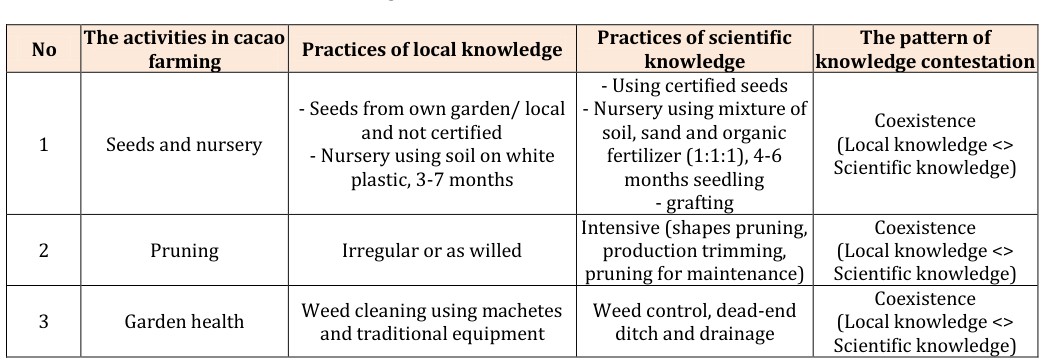
- No
- The activities in cacao farming
- Practices of local knowledge
- Practices of scientific knowledge
- - Using certified seeds
- - Nursery using mixture of
- - Seeds from own garden/ local and not certified
- - Nursery using soil on white soil, sand and organic
- 1
- Seeds and nursery fertilizer (1:1:1), 4-6 plastic, 3-7 months months seedling
- - grafting
- Intensive (shapes pruning,
- 2
- Pruning
- Irregular or as willed production trimming, pruning for maintenance)
- 3
- Garden health
- Weed cleaning using machetes
- Weed control, dead-end and traditional equipment ditch and drainage
Table 2: Coexistence pattern between local knowledge and scientific knowledge in the cacao cultivation of the people in
Hybridization pattern is the occurrence of mixing / fusion between local knowledge and scientific knowledge so that there is a birth of new features of knowledge in contestation between narratives. Both knowledge’s in contest will provide an opportunity for the formation of a new knowledge that can be offered as a new knowledge.
Knowledge to determine the timing of planting either local knowledge of farmer or scientific knowledge introduced from the government basically the same that is carried out at the beginning of the rainy season. This is undertaken to reduce the death rate of cacao seeds when planted in the garden. In addition, planting during the rainy season can reduce watering costs and other costs. The knowledge about the practices to determine the exact time of planting cacao is in the early part of the rainy season has been implemented by cacao farmers from generation to generation (commonsense).
Hybridization of knowledge also appears in terms of fertilization. In accordance with farmer’s experience, fertilizing is undertaken by agglomerating the leaves, twigs, branches and cacao husks from around the garden, burning these and then scattering the residue around the cacao plant. Local knowledge regarding fertilization has been melding with scientific knowledge in the form of introduction of technology of the use of inorganic fertilizers i.e. nitrogen, phosphorus, potassium and compound by immersed in the soil around the garden side by side with organic from the utilization of litter leaves, twigs, branches and corn husk composting in the ground at the time of making hole around the garden (rorak). Although the fertilizer used is not yet complete, but the use of inorganic fertilizer i.e. nitrogen, phosphorus, potassium and compound, has been generally implemented by the farmers.
Furthermore, hybridization patterns are also seen in the practice of harvesting / picking cacao fruits. The timing of the harvest is made by visual examination of the physical signs of the fruit and based on the age of harvest which is scientific knowledge has undergone a smelting, including harvesting equipment in the form of traditional picker tools made by farmers is also used in conjunction with the use of scissors and pruning shears that are scientific knowledge. Introduction of technology advocates the use of cropping tools such as pruning shears as a substitute for a machete to pick fruit. Using both equipment scissors and machete mainly aims to ensure that the next flowering is not damaged. The use of pole shears allows for the picking of cacao fruit that is at the top and thus cannot be reached by hand. However, cacao farmers also have their own way in the practice of harvesting / picking cacao fruit by using hook to reach cacao fruit which cannot be reached by hand. Farmers maintain the use of traditional picking tools, since most farmers assume that traditional picking tools also do not damage the fruit and flower, as well as they are more easily used skillfully and they are cheap. Governmental- approved tools are used only for cutting branches of cacao, not to pick fruit, because according to many farmers it can damage the young fruit that is around the fruit to be harvested [9, 10, 11, 12, 13, 14, 15, 16, 17, 18, 19, 20, 21, 22, 23, 24]. So there was a fusion of cacao harvesting tools called harvesting knowledge hybridization.
- No The activities in cacao farming
- Practices of local knowledge
- Practices of scientific knowledge
- The pattern of knowledge contestation
- 1
- Planting
- Early in rainy season
- Early in rainy season
- -Inorganic fertilizers (Urea, TSP, KCl,
- Stacking and burning of leaves, twigs, branches and cacao shells
- NPK Compound, immersed in the ground in a straight line and circular as
- 2
- Fertilization around the garden. The rest of the burning result is spread on deep as + 20 cm.
- -Organic fertilizers (animal / industry soil surface cattle
- Visually, the fruit of cacao is yellow or orange, harvesting
- Age 5-6 months after flowering, cropping tools and pruning shears
- 3
- Harvesting equipment: machetes and homemade picker.
Table 3: Hybridization pattern between local knowledge and scientific knowledge in the cacao cultivation of the people in
Conclusion
Contestation between local knowledge and scientific knowledge on the cultivation of cacao crops gave birth to three patterns of relationship namely zero sum game, coexistence and hybridization. The zero sum game pattern in cacao cultivation takes place on land preparation aspect, planting shading, spacing and planting hole as well as pest and plant disease control. While the pattern of coexistence takes place on aspects of planting materials and nurseries, pruning and sanitation. While the hybridization pattern takes place on aspects of planting, fertilizing and harvesting.
The results of this study indicate the contestation of local knowledge and scientific knowledge is still relatively balanced running in the cultivation of cacao plants. Although empirically science-based practice is more likely to increase production, based on the rationality of farmers’ local knowledge-based practice is more likely to run according to the ability possessed. The persistence of local knowledge practices on the one hand has a dimension of environmental sustainability, but in some aspects on the other hand, it causes of declining productivity of cacao people.
References
-
Arun A (1995) Indigenous and Scientific Knowledge: Some Critical Comments. IK Monitor 3(3): 3-33.
-
Ahimsa-Putra HS (2008) Ilmuwan Budaya dan Revitalisasi Kearifan Lokal Tantang Teoritis dan Metodologis.
-
Ali M, Saleh S (2000) Pengetahuan Lokal dan Pembangunan Pertanian Berkelanjutan: Perspektifdari Kaum Marjinal.
-
Ardhian D (2009) Pengetahuan Pertanian: Dialog Pengetahuan Lokal dan Ilmiah.
-
Asrul La Ode (2013) Agribisnis Kakao (Edn1) Penerbit Media Bangsa. Jakarta.
-
Bureau of Plantation Statistics of Southeast Sulawesi (2013) Statistik Perkebunan dan Hortikultura Provinsi Sulawesi Tenggara.
-
Darmawan S (2012) Sosiologi Desa: Revolusi Senyapdan Tarian Kompleksitas. Penerbit: Ininnawa- Makassar.
-
DeWalt BR (1994) Using Indigenous Knowledge to Improve Agriculture and Natural Resource Management. Human Organization 53(2): 123-131.
-
Devenport TH, Prusak L (1998) Working Knowledge. How Organizations Manage What They Know. Harvard Busines School Press.
-
Directorate General of Plantations (2013) Report of the National Movement of Cocoa Production and Quality Improvement from 2009 to 2012. Ministry of Agriculture. Jakarta.
-
Forsyth T (2004) Training Manual: Building on Gender, Agrobiodiversity and Local Knowledge_._ FAO.
-
Foucault M (2012) Arkeologi Pengetahuan. IRCiSoD, Jogyakarta.
-
Fitria Yuliasmara (2015) Manajemen Pembibitan Tanaman Kakao. Dalam Buku Kakao. Sejarah, Botani, Proses Produksi, Pengolahan, dan Perdagangan. Penerbit Gadjah Mada Press. Cet-I 2015. _14._ Geertz C (1983) Local Knowledge, Further Essays in Interpretative_._ Anthropology. Basic Book, United State of America.
-
Hidayat T, Pandjaitan NK, Dharmawan AH (2010) Kontestasi Sains dengan Pengetahuan Lokal Petani dalam Pengelolaan Lahan Rawa Pasang Surut. Jurnal Sosiologi Pedesaan 4(1).
-
Ministry of Agricultural (2012) Pedoman Umum Gerakan Nasional Peningkatan Produksi dan Produktivitas Kakao. Direktur Jenderal Kementerian Pertanian RI.
-
Muyungi, Tillya AF (2003) Appropriate Institutional Framework for Coordination of Indigenous Knowledge. Links Project Gender, biodiversity and Local Knowledge System for Food Security.
-
Nurdiah Husnah (2015) Kontestasi Pengetahuan Berbasis Pengalamandan BerbasisIlmiah. Universitas Hasanuddin, Makassar.
-
Qandhi FF (2012) Pentingnya Kearifan Lokal Masyarakat Dalam Pengelolaan Sumberdaya Alam dan lingkungan di Pedesaan.
-
Ridwan NA (2007) Landasan Keilmuan Kearifan Lokal. Jurnal Studi Islam dan Budaya 5(1).
-
Salman D (2012) Belajar dari Konsep Kearifan Lokal Dalam Pengelolaan Lingkungan. Makalah, Dipresentasikan dalam seminar nasional "Tinjauan Hukum, Kajian Ekologi Ekonomi dan Pemberdayaan Masyarakat (_Community_ _Development)_ dalam Pengelolaan Lingkungan Hidup Republik Indonesia, Makassar.
-
Salman D (2012) Sosiologi Desa: Revolusi Senyap dan Tarian Kompleksitas. Ininnawa Press, Makassar.
-
Sunaryo D, Joshi L (2003) Peranan Pengetahuan Ekologi Lokal dalam Sistem Agroforestry. World Agroforestry Centre.
-
Talami LD, Sahaka A, Ihsan Nurdan Marwiah. Kearifan Lokaldalam Budaya Masyarakat Mekongga. PT. Dinamika Press. Jakarta 2010.
- Enhancement of Vegetative Growth and Fruit Yield in Cucumber (Cucumis sativus L.) via Spiritual Blessing (Biofield) Energy Intervention
- Production of Açaí (Euterpe oleracea Mart.) under Different Agroforestry System Management Intensities in Amazonian Floodplain (Varzea) Forests
- Coffee and the Production Region: What is the Secret to the Expression "Quality"?
- Experiential Agripreneurship Training in Sub-Saharan Africa: Integrating a Business Incubator into Postgraduate Livestock Education at the University of Buea
- Advances in Agricultural High-Quality Development
- Linking Compost Residue to ABAGE in Plants - a Short Note