
An Overview on Ring Closing Metathesis Reaction and its Applications
Carbon-carbon bond forming reactions are the most important class of reactions in organic synthesis. Among them, in recent years, ring-closing metathesis (RCM) has gained much of attention due to its success for the synthesis of macro lactones. In many cases, ring closing metathesis has been used as the key step, owing to its fundamentally convergent character
Introduction
Carbon-carbon bond forming reactions are the most important class of reactions in organic synthesis. Among them, in recent years, ring-closing metathesis (RCM) has gained much of attention due to its success for the synthesis of macro lactones. In many cases, ring closing metathesis has been used as the key step, owing to its fundamentally convergent character [1]. Therefore, RCM reaction is documented as one of the most straight- forward and reliable method for the formation of large ring systems and compares favorably to all current synthetic alternatives. In this review, a brief description of ring-closing metathesis (RCM) reaction has been discussed.
Olefin metathesis is an organic reaction that entails the union of fragments of alkenes (olefins) by the scission and regeneration of carbon-carbon double bonds [1]. Olefin metathesis has become a strong and potent synthetic technique and is a powerful method for the clean construction of innumerable classes of chemical architectures [1, 2, 3, 4, 5, 6, 7, 8]. The successful applicability of the reaction in the total synthesis of natural products and in commercial scale led to the awarding of Nobel Prize in Chemistry to the pioneers in olefin metathesis: Prof. Yves Chauvin, Prof. Robert H. Grubbs, and Prof. Richard R. Schrock. The salient features of the these catalyst are functional group tolerance, shelf stable and their ability to be handled without inert atmosphere, have propelled this synthetic methodology in to the front runner of carbon- carbon bond forming methods. Therefore herein, we willdiscusse briefly about the ruthenium alkylidenes participation in olefin metathesis reaction [2, 3, 4, 5, 6, 7, 8].
Metathesis reaction represents a bimolecular process involving the exchange of bonds between the two reacting chemical species and the olefin metathesis is a reaction which involves the redistribution of olefin bond. The term metathesis was first introduced by Colderon in 1967 although this reaction was initially observed in 1950 during the study on Ziegler-Natta polymerization process. The first report of the process involving olefin metathesis was reported by Eleuterio. Traditional catalysts are prepared by a reaction of the metal halides with alkylatiing agents. Historically, olefin metathesis has been studied both from a mechanistic viewpoint and in the context of polymer synthesis [9, 10, 11].
Modification of Catalyst
Modern catalysts are well-defined organometallic compounds that come in to two main categories, commonly known as Schrock catalysts and Grubbs' catalysts. Schrock catalysts are molybdenum (VI) and tungsten(VI) based alkylidenes. Schrock entered the olefin metathesis field in 1979 as an extension of work on tantalum alkylidenes [12]. Schrock in 1990, prepared the alkylidenes for olefin metathesis and in 1993, prepared the asymmetric catalyst in which the saturated part was replaced with a binol ligand (Figure 1) [13].
Utilization of the so called catalyst in different type of metathesis reactions, resulted several types of olefin metathesis processes. Some important classes of olefin metathesis include:
- Cross Metathesis (CM)
- Ring-Opening Metathesis (ROM)
- Ring-Closing Metathesis (RCM) Cross-metathesis (CM) and Ring closing metathesis (RCM) reactions are widely used in total synthesis of many complex bioactive natural products. Herein, a brief discussion about CM and RCM reactions has been given.
- Ring opening metathesis polymerisation (ROMP)
- Acyclic diene metathesis (ADMET)
- Ethenolysis
![Figure 1: Metal alkylidene catalysts. [Cy=cyclohexyl, Mes=2,4,6-trimethylphenyl].](/fulltextimages/2889/fig_1.png)
Cross-Metathesis (CM)
Carbon-carbon bond construction is an interesting part of organic chemistry. Number of protocols are reported for the construct C-C bond. Olefin metathesis has come to the fore in recent years owing to the wide range of transformations that are possible with commercially available and easily accessible catalysts. Consequently, olefin metathesis is now widely considered as one of the most powerful synthetic tool in organic chemistry. Until recently the intermolecular variant of this reaction, cross- metathesis, has been neglected despite its potential. With the evolution of new catalysts, the selectivity, efficiency, and functional-group compatibility of this reaction has improved to a level that was unimaginable just a few years ago. These advances, together with a better understanding of the mechanism and catalyst–substrate interactions, have brought to a stage where more and more researchers are employing cross-metathesis reactions in multistep procedures and in the synthesis of natural products. The recent inclusion of alkynes and hindered bi-cyclic olefins as viable substrates for bimolecular metathesis coupling, the discovery of enantioselective cross-metathesis and cross-metathesis in water was also reported. Progress in the development of the metathesis reaction has been directly correlated to improvements in the functional group compatibility and the reactivity of the catalysts. Cross metathesis reactions have numerous advantages, typical of modern olefin- metathesis reactions i.e. to carry out this reaction 1–5 mol% of catalyst required and high yields can obtain under mild conditions in relatively short reaction times, a wide range of functional groups are tolerated, with minimal substrate protection necessary, this is a well adoptable process for industrial applications due to its reversibility character and relatively atom-economic and ethylene is usually the only by product which is a gas, the olefin substrates are generally easier and less expensive to prepare than those associated with other common catalytic C-C bond-forming reactions (e.g. unsaturated boranes, stannanes, halides, triflates), the olefinic products are suitable for further structural elaboration (e.g. hydrogenation, epoxidation, halogenation, cycloaddition), high levels of chemo, regio and stereoselectivity can be attained.
Cross-metathesis between two acyclic olefins offers interesting possibilities for synthesizing higher- substituted alkenes. The use of highly substituted asymmetric olefins is not practical because of the expected complex spectrum of products. Use of terminal olefins in the formation of volatile ethylene as a byproduct provides the driving force for the reaction. The volume of work reported in the areas of RCM, ROMP, and novel combinations thereof has dramatically over shadowed that reported for olefin cross-metathesis (CM). This unique method for the intermolecular formation of carbon-carbon double bonds has not yet found wide spread application in organic synthesis because general reaction conditions that give high product and trans/cis selectivity have not been developed. The simplified CM reaction between two terminal olefins is depicted below.
Mechanism of Cross-Metathesis
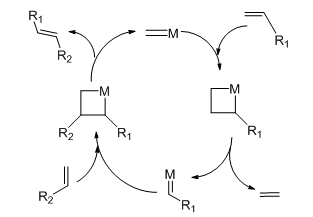
Hérisson and Chauvin first proposed the widely accepted mechanism of transition metal alkene metathesis. The direct [2+2] cycloaddition of two alkenes is formally symmetry forbidden and thus has high activation energy. The Chauvin mechanism involves the [2+2] cycloaddition of an alkene double bond to a transition metal alkylidene to form a metal-cyclobutane intermediate. The metal-cyclobutane produced then cyclorevert to give either the original species or a new alkene and alkylidene (Figure 2). Interaction with the d- orbitals on the metal catalyst lowers the activation energy enough that the reaction can proceed rapidly at modest temperatures.
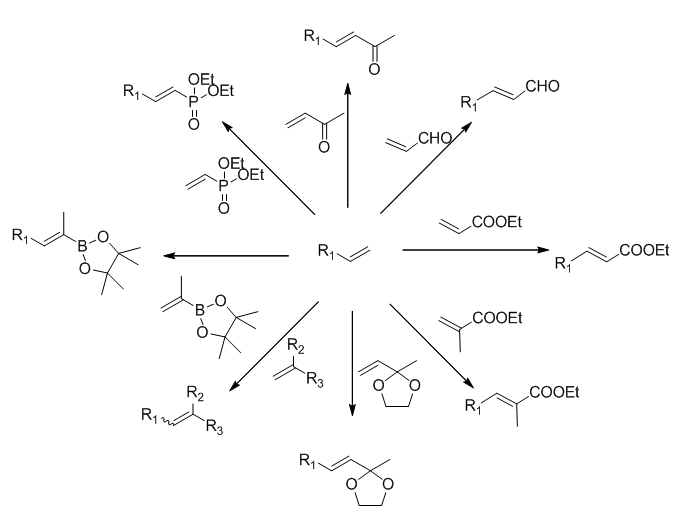
Cross-metathesis is a powerful method for the rapid synthesis of simple and complex olefinic building blocks. Grubbs catalyst and Hoveyda-Grubbs catalyst are generally used for this reaction to lead high yield of desired product. Some examples by using Grubbs II generation catalyst were shown figure 3.
Ring-Closing Metathesis (RCM)
The olefin metathesis reaction has been known since the 1960s, but it was not until the early 1990s that this transformation became an important tool in synthetic organic chemistry. It was thus in 1992 that Grubbs and Fu published two seminal papers describing the application of ring-closing metathesis (RCM) to the synthesis of simple five, six, and seven memebered monocyclic systems containing oxygen and nitrogen atoms using a molybdenum catalyst that has been first prepared by Schrock [14, 15]. RCM became an interesting and exciting protocol for total synthesis of number of natural products after its discovery. Ruthenium and the molybdenum catalysts are very reactive and well tolerance behavior towards all types of functional groups, but the Mo-based complexes suffer the potential disadvantage of being more air and moisture sensitive. Therefore ruthenium- based catalysts were treated as ideal catalyst worldwide.
The high selectivity and reactivity of all ruthenium catalyst for carbon-carbon π-bonds reduces protecting group manipulations while enabling the use of RCM as an excellent alternative to other ring-forming reactions for the efficient construction of complex cyclic targets having a variety of ring sizes. The ring-closing metathesis allows synthesis of 5- to 30-membered cyclic alkenes. The E/Z- selectivity depends on the ring strain.
Chauvin's Mechanism for RCM
Chauvin suggested the following mechanism, which was universally accepted.

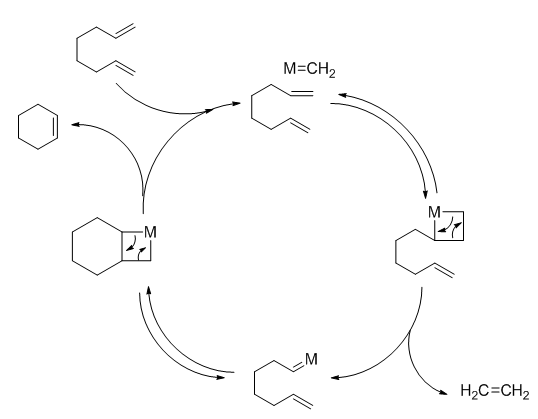
It is now generally accepted that the mechanism of both cyclic and acyclic olefin metathesis proceeds through a series of metallacyclobutanes and carbene complexes. Although the relative stabilities of the carbenes and metallacyclo butanes can change with (Diagram for most commonly employed different types of alkene metathesis reactions.)reaction conditions, catalyst composition and alkene substitution, the mechanism of olefin metathesis appears to be the same for all catalysts (Figure 4) [14, 15]. The key intermediate is a metallacyclobutane, which can undergo cycloreversion either towards products or back to starting materials.
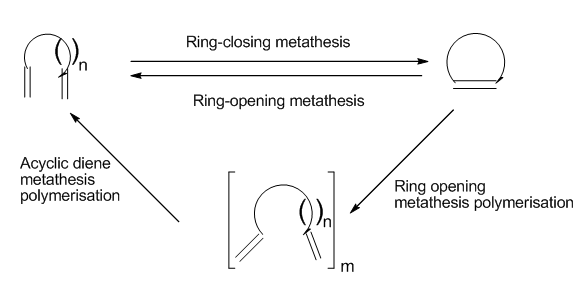
As with any other cyclization method, the synthetic efficiency of RCM is limited by the competition between intramolecular ring-closing and intermolecular oligomerization reactions. Olefin metathesis is represented as a fully reversible set of [2 + 2] cyclo- addition-cycloreversion equilibria, employing a thermodynamic distribution of “living” metathesis products [16]. The emergence of metathesis reactions in chemical synthesis over the last few years has been dramatic. It has been delightful to review the field and highlight some of its most exciting applications in total synthesis. Some excellent use of ring closing metathesis has been demonstrated bellow.
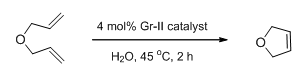
Olefin ring closing metathesis and hydrosilylation reaction in aqueous medium by Grubbs second generation ruthenium catalyst was demonstrated by Verma, et al. (Scheme 3) [17].
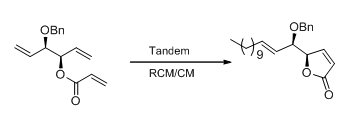
The total synthesis of (−)-muricatacin has been achieved via highly regioselective and stereoselective tandem ring-closing/cross metathesis reaction in which both lactone formation and chain extension was accomplished (Scheme 4) [18].
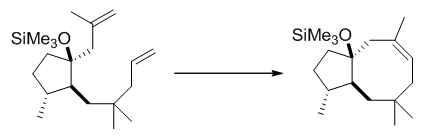
A straightforward total synthesis of the cyclooctenoidsesquiterpenedactylol has been achieved _via_ring-closing metathesis (RCM) of the resulting dienes to form the cyclooctene ring using Schrocks molybdenum carbene as a precatalyst (Scheme 5) [18].
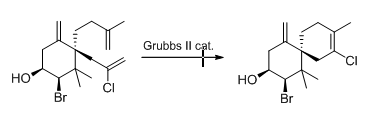
The first total synthesis of elatol which is a halogenated sesquiterpene in the chamigrene natural product family has been achieved a ring-closing olefin metathesis to concomitantly form the spirocyclic core as well as the fully substituted chlorinated olefin (Scheme 6) [19].
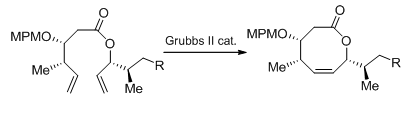
The total synthesis of the novel lactone natural product octalactin A was done. The key step involves the facile construction of the eight-membered lactone core via ring-closing metathesis (RCM) (Scheme 7) [19].
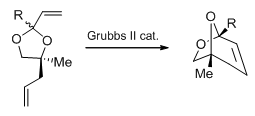
Racemic and enantiopure targets containing the 6,8- dioxabicyclo [3.2.1] octaine skeleton, was conveniently synthesized from monocyclic diene precursors using an intramolecular ruthenium-catalyzed ring-closing metathesis reaction as the key step (Scheme 8) [20].
The ring closing reaction was widely demonstrated in 10 membered lactones. In this context, we are going to discuss about some similar lactones. The total syntheses of stagonolide B and its 4-epimer were carried out to probe into how the relative stereochemistry of allylic hydroxy groups and their protecting groups influence the efficiency of the ring closing metathesis (Scheme 9) [21].
Ring-closing metathesis to form a diene system in the total synthesis of pochonin C was completed by Winssinger and co-workers in 2004 (Scheme 10) [22].
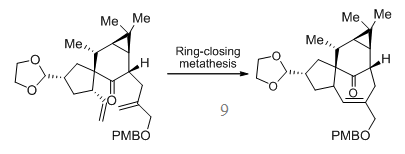
Wood and co-workers in 2004 had reported the total synthesis of Ingenol via ring-closing-metathesis reaction (Scheme 11) [23].
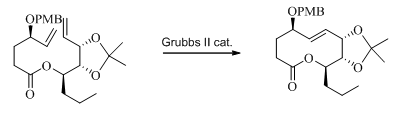
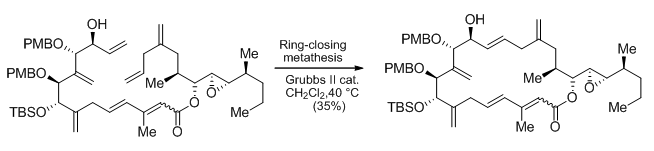
Ring-closing-metathesis reactions in the total synthesis of amphidinolide A and its stereoisomers was successfully demonstrated by Maleczka and co-workers (Scheme 12) [24].
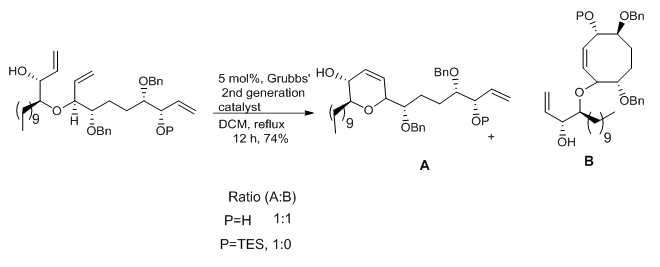
Raghavan and Ganapathy Subramanian demonstrated the power of protecting groups in the product distribution using ring closing metathesis to obtain a key fragment of (-)-mucocin(Scheme 13) [25].
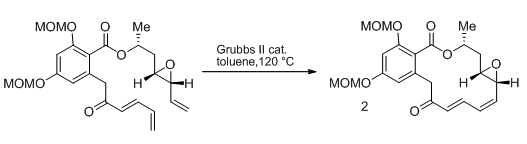
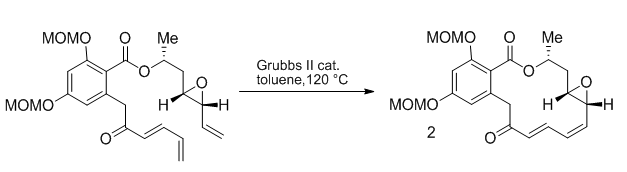
In 2016, Raghavan and coworkers reported the synthesis of (+) and (-)-cyclophellitol, Conduritol and conduramine from a common intermediate obtained using stereoselective alkylation followed by ring closing metathesis approach (Scheme 14) [26].
Conclusion
The ring closing metathesis approach has emerged as a powerful tool for organic chemists to achieve their targets in an elegant way. Using this technique in synergy with creativity and mechanistic understandings have helped them in accomplishing many total synthesis, advanced intermediates in drug discovery. More discoveries in natural product synthesis can be realized and will be reported in future using this approach by chemists from all over the world.
References
-
Astruc D (2005) The metathesis reactions: from a historical perspective to recent developments. New J Chem 1: 42-56.
-
Schrodi Y, Pederson RL (2007) Evolution and Applications of Second-Generation Ruthenium Olefin Metathesis Catalysts. Aldrichimica Acta 40(2): 45.
-
(2007) Adv Synth Catal 349: 1-268 (Olefin Metathesis Special Issue).
-
Grubbs RH (2004) Olefin metathesis. Tetrahedron 60: 7117-7140.
-
Grubbs RH (2003) Handbook of Metathesis. Wiley pp: 1-3.
-
Trnka TM, Grubbs RH (2001) The Development of L2X2RuCHR Olefin Metathesis Catalysts: An Organometallic Success Story. Acc Chem Res 34(1): 18-29.
-
Fürstner A (2000) Olefin Metathesis and Beyond. Chem Int 39(17): 3012-3043.
-
Schuster M, Blechert S (1997) Olefin Metathesis in Organic Chemistry. Chem Int 36(19): 2036-2056.
-
Herrison JL, Chauvin Y (1971) Catalyse de transformation des oléfines par les complexes du tungstène. II. Télomérisation des oléfines cycliques en présence d'oléfines acycliques. Makromol Chem 141(1): 161-176.
-
Feldman J, Schrock RR (1991) Recent Advances in the Chemistry of "d0" Alkylidene and Metallacyclobutane Complexes. Prog Inorg Chem 39: 1.
-
Grubbs RH, Tumas W (1989) Polymer synthesis and organotransition metal chemistry. Science 243(4893): 907-915.
-
Schrock RR, Meakin P (1974) Pentamethyl complexes of niobium and tantalum. J Am Chem Soc 96 (16): 5288-5290.
-
McConville DH, Wolf JR, Schrock RR (1993) Synthesis of chiral molybdenum ROMP initiators and all-cis highly tactic poly(2,3-(R)2norbornadiene) (R = CF3 or CO2Me) J Am Chem Soc 115(10): 4413-4414.
-
Fu GC, Grubbs RHJ (1992) The application of catalytic ring-closing olefin metathesis to the synthesis of unsaturated oxygen heterocycles. Am Chem Soc 114(13): 5426-5427.
-
Fu GC, Nguyen ST, Grubbs RH (1993) Catalytic ring- closing metathesis of functionalized dienes by a ruthenium carbene complex. J Am Chem Soc 115(21): 9856-9857.
-
Piers WE (1997) Olefin Metathesis and Metathesis Polymerization. JACS 119(35): 8396-8396.
-
Polshettiwar V, Varma RS (2008) Olefin Ring Closing Metathesis and Hydrosilylation Reaction in Aqueous Medium by Grubbs Second Generation Ruthenium Catalyst. J Org Chem 73(18): 7417-7419.
-
Fürstner A, Langemann K (1996) Conformationally Unbiased Macrocyclization Reactions by Ring Closing Metathesis. J Org Chem 61(12): 3942-3943.
-
White DE, Stewart IC, Grubbs RH, Stoltz BM (2008) The catalytic asymmetric total synthesis of elatol. J Am Chem Soc 130(3): 810-811.
-
Buszek KR, Sato N, Jeong Y (2002) Total synthesis of octalactin A via ring-closing metathesis reaction. Tetrahedron Lett 43(2): 181-184.
-
Scholl M, Grubbs RH (1999) Total synthesis of (−)- and (±)-frontalin via ring-closing metathesis. Tetrahedron Lett 40(8): 1425-1428.
-
Giri AG, Mondal MA, Puranik VG, Ramana CV (2010) Effect of the allylic substituents on ring closing metathesis: the total synthesis of stagonolide B and 4- epi-stagonolide B. Org Biomol Chem 8(2): 398.
-
Barluenga S, Lopez P, Moulin E, Winssinger N (2004) Modular asymmetric synthesis of pochonin C. Angew Chem Int Ed Engl 43(26): 3467-3470.
-
Nickel A, Maruyama T, Tang H, Murphy PD, Greene B, et al. (2004) Total synthesis of ingenol. J Am Chem Soc 126(50): 16300-16301.
-
Raghavan S, Subramanian SG (2011) Tetrahedron 67: 7529.
-
Raghavan S, Chiluveru RK, Subramanian SG (2016) Stereoselective Formal Synthesis of (+)- and (−)- Cyclophellitol and (−)-Conduritol-B and Synthesis of (−)-Conduramine-B Derivative Using a Sulfinyl Moiety for C–O Bond Formation and α-Chloro Sulfide for C–C Bond Formation. J Org Chem 81(10): 4252-4261.
- Enhancement of Vegetative Growth and Fruit Yield in Cucumber (Cucumis sativus L.) via Spiritual Blessing (Biofield) Energy Intervention
- Production of Açaí (Euterpe oleracea Mart.) under Different Agroforestry System Management Intensities in Amazonian Floodplain (Varzea) Forests
- Coffee and the Production Region: What is the Secret to the Expression "Quality"?
- Experiential Agripreneurship Training in Sub-Saharan Africa: Integrating a Business Incubator into Postgraduate Livestock Education at the University of Buea
- Advances in Agricultural High-Quality Development
- Linking Compost Residue to ABAGE in Plants - a Short Note