
Effect of Different Rates of Compound C- Extra on Potato (Solanum Tuberosum L.) Productivity
Low levels of calcium and magnesium has been the prime challenge impeding farmers to attain high potato productivity in sandy soils. The actual tuber yield in Zimbabwe ranges between 8 to 35 t/ha. A yield gap of 77 percent has been experienced although efforts have been made in breeding high yielding potato varieties. The current study was conducted to evaluate the effect of different rates of Compound C extra fertilizer (5N:15P2O5:12K2O:6S:0.1B:6%Ca+3%Mg) compared to the traditional Compound C (5N:15P2O5:12K2O:6S:0.1B) on potato (Solanum tuberosum L.) productivity. The results obtained showed that tuber yield had a significant difference between treatments (p<0.05). Compound C at 2000 kg/ha recorded the highest tuber yield of 29.3 t/ha compared to Compound C extra at the same rate with 17.1 t/ha. Compound C at 500 kg/ha had a yield of 12.8 t/ha compared to Compound C extra at a similar rate with 16 t/ha. Compound C extra and Compound C at 1300 kg/ha recorded tuber yields (t/ha) of 15 and 20.3 respectively. It was concluded that Compound C extra at 1300 kg/ha was effective to increase plant height and number of leaves/plant. The traditional Compound C basal fertilizer gives a higher potato productivity at high rates of 1300 and 2000 kg/ha when compared to the improved Compound C extra at similar rates. Compound C extra at a low rate of 500 kg/ha proved to produce a considerably better yield compared to the traditional Compound C at the same rate. Farmers are recommended to apply the traditional Compound C fertilizer at a rate of 2000 kg/ha to increase total tuber yield.
Introduction
Globally, approximately two hundred million tonnes of potatoes are being cultivated annually on 20 million hectares of land [1]. The potato crop is fourth after maize, wheat, and rice as the world’s vital staple crop [2], Asserts that the crop is intensively grown due to its varied uses which consist of chips, crisps, vegetable dishes or salad, canning and cattle feed. In Zimbabwe, potatoes are one of the most consistent tuber crops in terms of market price for both the formal and informal markets. Low quantities of calcium and magnesium is the prime challenge of farmers in progressing toward sustainable crop production in sandy soils [3]. Zimbabwe sandy soils are low in nitrogen, phosphorous and sulphur and in cation exchange capacity (CEC). This is due to low clay and organic matter contents and that magnesium deficiency is highly pronounced where sandy soils are cropped using nitrogen (N) phosphorus (P) and potassium (K) fertilizers only (Food and Agriculture Organization, 2006). Chemical fertilizers that include NPK, calcium (Ca) and sulphur (S) but not magnesium (Mg), are regularly used and it has been cited that deficiency in magnesium is now common to potato production [4]. Rosen (2013) [5] reported that many sandy soils used for potato production also turn out to be low in calcium and magnesium because lime applications are not common. The reason for not liming is that the pathogenicity of the common scab pathogen (Streptomyces scabies) increases when the soil pH is above 5.2. Ladha, et al. (2005) [6], asserts that the demand of calcium and magnesium at vegetative stage make potatoes respond well to calcium and magnesium applied at planting or at early vegetative stage. Therefore, as sandy soils are inherently deficient in nutrients, the calcium and magnesium, which is needed at vegetative growth, tuber initiation and tuber development stages, cannot be readily available for plant uptake. In Zimbabwe, there are several basal compound fertilizers for potatoes such as the ZFC Potato Blend, ZFC Vegetable Blend, Compound C and Super C that are being produced by the Zimbabwe Fertilizer Company and Windmill (Pvt) Ltd. Zimbabwe Fertilizer Company (2015) [7], reported that the ZFC Potato Blend (10 N:19 P2O5:25 K2O 9 S +0.15 B) a basal fertilizer offers a high level of potassium ensuring a consistent supply of the adequate potash critical for yield throughout the potato crop’s life. The blend is applied at a rate of 1500 kg/ha. It supplies other nutrients such as boron and sulphur except calcium and magnesium. Zimbabwe Fertilizer Company (2014) [8], reported that the ZFC Vegetable Blend (9 N: 24 P2O5: 20 K2O +9 S+1 Zn+0.15 B) applied at a rate of 500 to 1000 kg/ha has been formulated for horticultural crops such as potatoes. The blend meets the zinc, sulphur and boron requirements but contains no calcium and magnesium. Compound C (5 N:15 P2O5:12 K2O+ 11 S 0.1 B) and Super C (6 N:24 P2O5:20 K2O+ 8 S 0.1 B) applied at 1500 kg/ha and 1000 kg/ha respectively provides sulphur and boron like the other mentioned basal compound fertilizers but lack calcium and magnesium.
A research conducted showed that, with the current fertilizers on the market there has been a huge yield gap in potato production. Svubure (2015) [9] stipulated that the actual tuber yield in Zimbabwe ranged between 8 to 35 t/ha representing a yield gap of 77 percent although efforts have been made in breeding high yielding varieties. The common smallholder production level is at 7 t/ha in comparison to the potential farm yield level of 14 t/ha and those from experiment stations of 25 to 35 t/ha [10]. This shows that the current basal NPK fertilizers’ effect on improving yields of potatoes has been experiencing a short fall further increasing the yield gap. As a measure to address these challenges, being faced in the potato production sector Windmill (Pvt) Ltd introduced Compound C extra. This was done to alleviate the deficiencies of calcium and magnesium especially in sandy soils and to increase potato yields in the country. Therefore, the research was conducted on the calcium and magnesium containing basal fertilizer (5N:15P2O5:12K2O:6S:0.1B:6%Ca+ 3% Mg) to evaluate its agronomic potential to alleviate calcium and magnesium deficiencies and to boost potato yields under proper application rates.
Materials and Methods
The experiment was conducted at the Horticultural Research Institute located within the Grasslands Research Station Farm. The Horticultural Research Institute is in the Highveld according to local geographical classification, and its latitude 18º 11’, longitude 31º 28’ E, and an altitude of 1630 m. The average day-length is 13.2 hours in summer to 11.1 hours in winter. Rainfall averages 873 mm per year, temperature mean maximum is from 19.5ºC (July) to 24.6ºC (January). Hot summer is between September and December with October being the hottest month of the year with maximum temperatures above 30 ºC. The soils range from clay loams to sandy loam soils of granitic origin. A 2×3+1 factorial treatment structure in a Randomized Complete Block Design (RCBD) with two factors was used. Factor A was fertilizer type (Compound C: Fertilizer type 1 and Compound C extra: Fertilizer type 2) and Factor B was fertilizer rates (Rate 1:500 kg/ha, Rate 2:1300 kg/ha and Rate 3:2000 kg/ha). Three rates of fertilizer were applied for both the improved (Compound C extra) and traditional fertilizer types (Compound C). A control treatment with no fertilizer was included. Blocking was done according to the general slope of the land. All treatments were completely randomized within a block to constitute a replicate. Applying the full factorial treatment structure, the experiment had seven treatments with three replicates (that is three blocks) per treatment. Each of the three blocks had seven plots each measuring 3 m × 2.7 m. The treatments used are given in Table 1.
| Fertilizer type | Fertilizer Rate (kg/ha) |
|---|---|
| Compound C (NPK) (5N:15P O :12K O:6S: 0.1B) 2 5 2 | 500 |
| 1300 | |
| 2000 | |
| Compound C extra (5N:15P O :12K O:6S: 0.1B: 2 5 2 6% Ca+ 3% Mg) | 500 |
| 1300 | |
| 2000 | |
| Control (no fertilizer) |
Table 1: The fertilizer type and rates used in the experiment.
Soil sampling was done using a diagonal sampling method on a 21 m × 8.1 m main plot from 0 - 15 cm depth. A shovel was used to collect soil samples at a 15cm depth. Ten sampling points were sampled to make one composite sample after thorough mixing of all the samples. To determine the pH and the level of nutrition in the soil, a representative sample (1kg) was taken from a composite sample and pH and nutrient analysis (mainly for calcium and magnesium levels) were conducted. Soil analysis was conducted at the Windmill Private Limited laboratory. The soil was crushed, air dried then passed through a 2-mm sieve and stored at ambient temperature after homogenization. The methods used in nutrient analysis are Kjeldhal method and Mehlich number 3 for mineral nitrogen determination and available phosphorus, potassium, calcium and magnesium levels respectively. Calcium, potassium and magnesium concentrations were measured using an Atomic Absorption Spectrophotometer (AAS). The Calcium chloride buffer method (0.01M) was used to determine the pH status of the soil. A 10 g soil sample was weighed and then transferred into a container.
Calcium chloride (0.01M) at 50 ml was added and the mixture agitated intermittently for 30 minutes. Soil pH was measured potentiometrically using a 1:5 soil/calcium chloride suspension after shaking. The pH was then measured using an already calibrated pH meter. The Kjeldhal method was used to determine the mineral nitrogen concentration. A 5 g soil sample was weighed using an analytical balance and then transferred to an 800 ml Kjeldhal flask. Concentrated sulphuric acid (0.1M) at 25 ml was added together with one tablet of the catalyst (CuSO4). The contents were heated for 45 minutes in the fume hood. The contents were cooled for 10 minutes away from one’s face. Twenty milliliters (20 ml) of water was then added. A pinch of acid washed sand was added to clear way the bubbles. Boric acid (50 ml) was added together with a few drops of bromocresol green indicator into a 250 ml Erlenmeyer flask. One mossy zinc granule was slide into the Erlenmeyer flask and 100 ml of 40 % NaOH was slowly added into the Kjeldhal flask. The flask was then immediately attached to the macro Kjeldhal distillation apparatus. The contents were gently mixed with the stopper on to break ammonium sulphate into free ammonia. The flask was heated to boiling point until 175 ml of solution was collected in the receiving conical flask. Ammonia was then back titrated with 0.025M HCl to determine the concentration of mineral nitrogen present. Mehlich number 3 was used to determine the available phosphorus, potassium, calcium and magnesium concentration in the soil sample. A 5 g soil sample was weighed and added to a 250 ml polyethylene flask.
Mehlich number 3 extraction reagent (50 ml) was then added. The soil-extraction reagent was shaken for 5 minutes. The solution was then filtered using a Whattman number 42 filter paper and filtrate collected into a conical flask. Available phosphorous levels were analyzed using a UV visible Spectrophotometer at 660 nm. Potassium, calcium, and magnesium levels were then analyzed using an Atomic Absorption Spectrophotometer after calibration with the standards. Table 2 shows the soil analysis results.
| Soil sample | pH (CaCl ) 2 | % Sand | % Silt | % Clay | Texture | Mineral Nitrogen (ppm) | Available phosphorus (ppm) | K+ meq/100g | Ca2+ meq/100g | Mg2+ meq/100g |
|---|---|---|---|---|---|---|---|---|---|---|
| 4.6 | 59 | 22 | 19 | Sandy Loam | 45.16 | 162.06 | 0.79 | 6.12 | 1.00 |
Table 2: Soil analysis results The potato seed tubers were immersed for 3 to 4 minutes in a solution containing 1.6 ml of gibb
Source: Windmill Private Limited Table 2: Soil analysis results The potato seed tubers were immersed for 3 to 4 minutes in a solution containing 1.6 ml of gibberellic acid (GA3) per 10 liters of borehole water in order to break the seed dormancy and stimulate the sprouting of potato seed. The treated tubers were then removed from the water and placed on a clean surface to dry. After drying, the potato seed tubers were then placed in chitting trays and then placed in a well-ventilated semi-dark room at room temperature. Malathion dust was applied to control the potato tuber moth. The sprouting process took 2 weeks for all the tubers so that they are ready for planting. Rotten tubers were removed together with potato seed with very few sprouts. Sprouts were checked regularly and potato seed with 3 to 5 sprouts per tuber was ideal for planting. Diffuse light was used to green and strengthen the tubers. The land was ploughed on 14 December 2016 using a tractor drawn disc plough. This was followed by a light discing operation to ensure a fine tilth for a good seed-to-soil contact.
Planting of the potato seed commenced on 27 January 2017. A pre-marked wire cable was used to mark the planting stations. The inter-row and in-row spacing of 0.90 m by 0.30 m respectively was used. The potato variety planted was Diamond, which is an early maturing variety (14-15 weeks) which is grown by both commercial and small-scale farmers and has a yield potential of 30 t/ha. Furrows were opened using hoes in order to plant the potato seed. The pre-sprouted potato tubers of grade ‘AA’ were planted one tuber per planting station to achieve an approximate plant population of 37000 plants per ha. A border was placed at the margins of the plot to protect the main treatments. Compound C and Compound C extra basal fertilizers were applied at planting as per treatment (Table 2). Potassium nitrate (13N:0P2O5:46K2O) was applied in two split applications at 4 and 8 weeks after emergence uniformly as a top-dressing fertilizer at 3 and 6 g/plant respectively to achieve a rate of 300 kgha-1. The first ridge and second ridge was then applied immediately after application of the first and second split applications respectively. The trial was rain- fed and supplementary irrigation was applied at planting and throughout the growth stages to establish a good plant stand.
The trial was kept weed free throughout the growing season by using chemical and mechanical weed control methods. Most of the weeds were killed before planting by the land preparation procedures. Dual/ Metolachlor (1 litre/ ha) a pre-emergence herbicide for control of annual grasses and some broadleaf weeds and suppresses yellow nutsedge (Cynodon dactylon) was applied. Late weeds were pulled by hand from week four onwards, the fields were kept weed free through the first ridge at 4 weeks after emergence. Monitoring for the potato tuber moth Phthorimaea operculella, was conducted to ensure the population is within the economic threshold level. Oxamyl 310SL (8 litres/ ha) an insecticide and nematicides was applied to control the root knot nematodes (Meloidogne javanica) and aphids. A preventative fungicide Copper Oxychloride 85 WP (2.5 kg ha-
1) was applied soon after emergence to prevent early and late blight caused by fungi Alternaria solani and Phytophthora infestans respectively.
The plots were harvested when 90 % of the tops had dried or changed colour to pale yellow. Irrigation of the crop was stopped. The haulms were cut and removed (when haulms are completely dry they are then burnt to control diseases). The tubers were left in the ground to cure for 10 to
14 days. A garden fork was used to unearth the tubers from the ground. Tubers randomly selected from each plot were weighed using a mass balance and their weight recorded in grams per plot for each replicate. Total tuber number was counted as per treatment and then averaged for every replicate of each of the treatments.
Data was collected before and after harvesting. Measurements recorded before harvesting include number of leaves/plant collected during the vegetative growth stage to the peak reproductive stage of the crop from 21, 35 and 49 days after planting (DAP). The leaves were counted from the each of the randomly selected ten plants per each plot. Plant height (cm) was measured using a meter rule at two week intervals from week 3 onwards to week 11 after planting (WAP). Total tuber yield (t/ha) was recorded by weighing 10 tubers as per treatment (Table 1). Data was entered into Microsoft Excel of 2016 and verified before analysis. Analysis of variance (ANOVA) was done using Genstat® version 14. Fischer’s Protected Least Significant Difference at 5 % significant level separated all significant means. Graphs were constructed using Microsoft excel.
Results and Discussion
Plant height
Compound C extra at 1300 kg/ha had the highest plant height of 42.8 cm compared with control (18.07 cm) as from week 9 to 11 WAP (Figure 1).
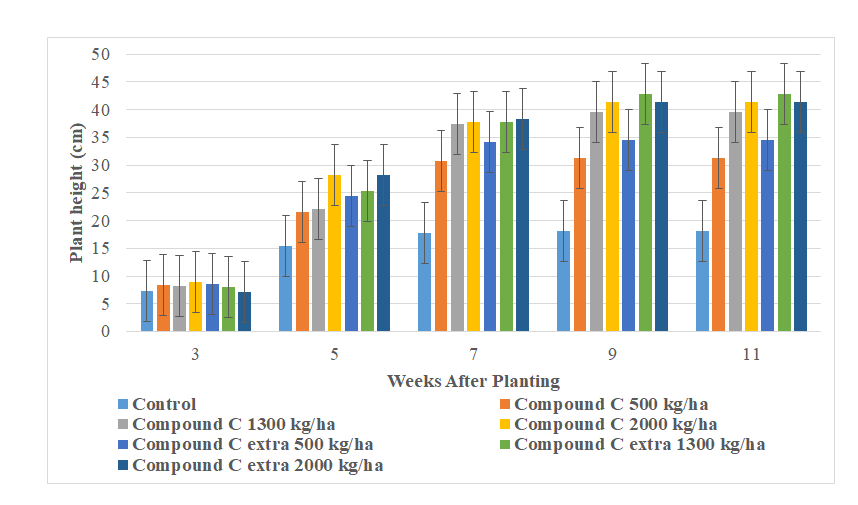
The increase in plant height observed with Compound C extra at 1300 kg/ha was in agreement with Ehret, et al. (2005) [11] who reported that increasing calcium led to an increase in plant height. According to Windmill (2015), plant height is a function of the nutrient status of the soil. Van der Zaag (1981) [12] reported that calcium and magnesium are related to protein synthesis, cell division, and growth. Calcium is important for cell division and elongation [13]. Therefore, the increase in plant height was due to the high rates of calcium and magnesium in Compound C extra. However, Talukder et al (2009) [14] found that plant height, shoots per hill as well as tubers per hill did not differ significantly when different magnesium rates were applied.
Number of leaves per plant
Compound C extra at 1300 kg/ha recorded the highest number of leaves/plant between treatments at 49 DAP. Compound C extra at 500 kg/ha had the lowest number of leaves/plant between treatments (Table 3). The high number of leaves/plant by Compound C extra at 1300 kg/ ha was due to the effect of calcium and magnesium on the synthesis of new leaves during the vegetative stage and phase of the potato crop. According to Tisdale, et al_._ (1993) [13] calcium is important for cell division and elongation. In agreement to the above notion, Van der Zaag (1981) [12] reported that calcium is related to protein synthesis, cell division, and growth. Calcium moves into the plant with the uptake of water therefore, it generally accumulates into the older leaves [15]. Schwarzkopf (1972) [16] also showed that magnesium is mobile in the plant where it moves from the older parts (leaves) to the younger as the plant grows. In addition to that, magnesium is involved in protein synthesis in the plant although it accumulates more in the tubers than in the leaves when compared to calcium [17]. However, Van Straaten (2002) [4] argues that an increase in the number of leaves per plant is a function of genetics, hence the higher number of leaves per plant at 49 days after planting might have been a function genetics and not due to plant nutrition.
| Days after planting | 21 | 35 | 49 |
|---|---|---|---|
| Control | 8.37a | 12.30a | 13.87a |
| Compound C 500kg/ha | 9.30a | 17.27b | 24.97b |
| Compound C 1300 kg/ha | 9.13a | 16.90b | 33.13c |
| Compound C 2000 kg/ha | 9.93a | 24.13d | 35.17c |
| Compound C extra 500 kg/ha | 9.53a | 20.50c | 27.67b |
| Compound C extra 1300 kg/ha | 8.83a | 21.23cd | 36.53c |
| Compound C extra 2000 kg/ha | 8.03a | 23.63d | 34.77c |
Table 3: Effect of Compound C extra on the number of leaves/plant at 21, 35, and 49 days after planting (DAP).
Means sharing the different superscripts are significantly different from each other (p>0.05) Table 3: Effect of Compound C extra on the number of leaves/plant at 21, 35, and 49 days after planting (DAP).
Tuber yield
The lower yield recorded by Compound C extra fertilizer at 2000 and 1300 kg/ha when compared to the traditional Compound C at the same rates was because calcium and magnesium were unable to significantly affect tuber yield. The results were consistent with previous studies reported by Clough (1994) [18] who observed that potato yield was not significantly affected by calcium treatments. This was also in agreement with Ozgen and Palta (2005) [19] who reported that total tuber yield was not affected by soil calcium applications. Allison, et al. (2002) [20] observed that magnesium fertilizer had no significant effect on total tuber fresh weight. Ozgen, et al. (2003) [21] in their research also reported that there were no significant differences in total tuber yield of potato applied with calcium treatments. Bull (2014) [15] in a study showed that calcium applications had no consistent effect on tuber yield. However, Haifa (2011) and YARA (2016) [22] argued that yield increases of up to 10 percent in potatoes have been acquired in trials in which magnesium fertilizers was applied. In a study conducted by Talukder, et al. (2009) [14] showed that yield increased significantly with increasing rate of magnesium. Tuber yields were increased from 29.8 to 31.6 t/ha with an increase from 0 to 450 kg/ha Ca [23]. In addition to that, Forsman, et al. (2002) [24] reported that a better tendency of yield was achieved when calcium sulphate was applied in low exchangeable calcium soil. Therefore [25, 26], this suggests that there are inconsistences on whether calcium and magnesium addition to potato increases tuber yield of potato.
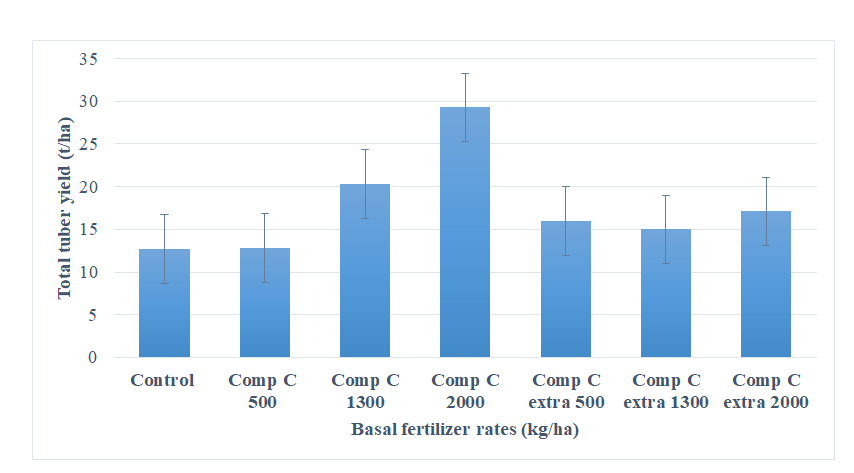
In this study, the results (Figure 2) showed that the traditional Compound C fertilizer at 2000 kg/ha produced the highest yield of 29.3 t/ha when compared to the improved Compound C extra fertilizer at 2000 kg/ha with a yield of 17.1 t/ha. Compound C extra at 1300 kg/ha had a tuber yield of 15 t/ha when compared to Compound C
at 1300 kg/ha with 20.3 t/ha. This suggest an increase in calcium and magnesium levels with increase in Compound C extra basal fertilizer rates from 1300 to 2000 kg/ha on tuber yield was insignificant. However, at 500 kg/ha Compound C extra proved to produce a considerable yield of 16 t/ha when compared to the traditional Compound C at the same rate which produced a yield of 12.8 t/ha.
Conclusions
Compound C extra applied at 1300 kg/ha was effective in increasing plant height and number of leaves/plant. The traditional Compound C basal fertilizer gives a higher potato tuber yield at high rates of 1300 and 2000 kg/ha when compared to the improved Compound C extra at similar rates. Compound C extra at a low rate of 500 kg/ha proved to produce a considerably better yield compared to the traditional Compound C at the same rate.
Acknowledgements
The author would like to thank the input of Professor Paul Mapfumo and Mrs Doris Ndebele from Windmill Pvt Ltd.
References
-
Cromme, N, Prakash AB, Ezeta F (2010) Strengthening potato value chains. Technical and Policy options for developing countries, Food and Agriculture Organization and the Common Fund for Commodities, Rome, pp; 1-150.
-
Manzira C (2010) Potato production handbook. Potato Seed Association Zimbabwe.
-
Nyamangara J, Mugwira LM, Mpofu SE (2000) Soil Fertility Status in the Communal Areas of Zimbabwe in Relation to Sustainable Crop Production. Journal of Sustainable Agriculture 16: 17-18.
-
Van Strateen P (2002) Rocks for crops. Agro minerals for Sub-Saharan Africa, pp: 338.
-
Rosen JC (2013) Nutrient management for potato production_._ Department of Soil, Water, and Climate. University of Minnesota. St. Paul, Canada, pp: 3.
-
Ladha JKH, Pathak H, Krupnik TJ, Six J, Van Kessel C (2005) Efficiency of fertilizer nitrogen in cereal production: Retrospect and prospects. Advanced in Agronomy 87: 86-156.
-
Zimbabwe Fertilizer Company (2015) ZFC Potato Fertilizer Program.
-
Zimbabwe Fertilizer Company (2014) ZFC Fact sheet.
-
Svubure O (2015) Agronomic and Environmental studies of potato (Solanum tuberosum L.) and analysis of its value chain in Zimbabwe. Wageningen University.
-
Makoni E, Tsikirai CM, Urombo J, Mandisodza F (2014) The impact of value chain constraints on potato farmers: A survey of Nyanga District Smallholder Irish potato farmers (2008-2013). Prime Journal of Business Administration 4(3): 1397-1409.
-
Ehret DL, Menzies JG, Helmer T (2005) Production and quality of greenhouse roses in recirculating nutrient systems. Science Horticulture 106(1-3): 103-113.
-
Van der Zaag P (1981) Soil fertility requirements for potato production, Technical Information Bulletin, International Potato Center (CPI).
-
Tisdale SL, Nelson WL, Beaton JL (1993) Soil Fertility and Fertilizers. 5th (Edn.), New Jersey, USA: Pearson Education.
-
Talukder MAH, Islam MB, Kamal SMAHM, Mannaf MA, Uddin MM (2009) Effects of magnesium on the performance of potato in the Tista Meander floodplain soil. Bangladesh J Agril Res 34(2): 255-256.
-
Bull B (2014) Calcium in potato production. YARA International; pp: 4.
-
Schwartzkopf C (1972) Potassium, Calcium, Magnesium- How They Relate to Plant Growth. USGA section.
-
Craighead MD (2001) Magnesium deficiency in crops and its relevance to arable farming in New Zealand - a review. Agronomy New Zealand
-
Clough GH (1994) Potato tuber yield, mineral concentration, and quality after calcium fertilization, Journal of American Society of Horticultural Science 119(2): 175-179.
-
Ozgen S, Palta JP (2005) Supplemental Calcium Application Influences Potato Tuber Number and Size, American Society for Horticultural Science 40(1): 102-
-
Allison MF, Fowler JH, Allen EJ (2002) Factors affecting the magnesium nutrition of potatoes _(Solanum tuberosum)_, Journal of Agricultural Science 137(4): 397-409.
-
Ozgen S, Palta JP, Kleinhenz MD (2003) Influence of supplemental calcium fertilization on potato tuber size and number, Cant International Development Agency (CIDA), pp: 329-336.
-
Haifa (2011) Nutritional recommendations for potato. Haifa Chemicals (Pvt) Ltd, pp:17-19.
-
Locascio SJ, Bartz JA, Weingartner DP, Calcium and potassium fertilization of potatoes grown in North Florida I. Effects on potato yield and tissue Ca and K concentrations (1992) American Potato Journal 69: 95- 104.
-
Forsman JT, Seppänen JT, Mönkkönen M (2002) Positive fitness consequences of interspecific interaction with a potential competitor. Proc R Soc Lond B Biol Sci 269(1500): 1619-1623.
-
Ifarn UH (2005) Management of potato (Solanum tuberosum L.) fungal, viral and bacterial diseases in northern areas, FSC and RD, MINFAL, MINKANAA and Agri. Dptt. Northern Areas, Gilgit. pp. 30-35.
-
Waterer D (2009) Calcium Nutrition of Potatoes Problems and Potential Solutions, Department of Plant Sciences, University of Saskatchewan, Agriculture Development Fund.
- Enhancement of Vegetative Growth and Fruit Yield in Cucumber (Cucumis sativus L.) via Spiritual Blessing (Biofield) Energy Intervention
- Production of Açaí (Euterpe oleracea Mart.) under Different Agroforestry System Management Intensities in Amazonian Floodplain (Varzea) Forests
- Coffee and the Production Region: What is the Secret to the Expression "Quality"?
- Experiential Agripreneurship Training in Sub-Saharan Africa: Integrating a Business Incubator into Postgraduate Livestock Education at the University of Buea
- Advances in Agricultural High-Quality Development
- Linking Compost Residue to ABAGE in Plants - a Short Note