
A Short Note of the Causes behind Price Increases in Rice
This review paper aimed to provide a short note of the causes behind price increases in rice. Several causes might be intricately linked. The following are some typical causes of price increases for rice. With strong literature support, these causes include a) climate and weather conditions, b) customer demand, c) fertilization, d) diseases and pests, e) costs associated with transportation and distribution, and other factors. In order to keep rice prices stable and ensure that the populace has access to food, government regulations and actions might be extremely important.
Introduction
Recent Trends in Rice Prices
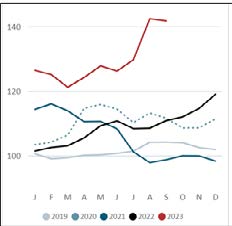
The fact that increasing population size is undeniable in many different countries Ritchie H, et al. [1] when it is just judged from 1950 to 2021 timeline. This is followed by the increment of rice yield (tons per hectare) from 1961 to 2021, almost, globally [2]. However, recent price increases for rice have been reported by the Food Agriculture Organization of the United Nations (FAO) [3]. This is expected to affect numerous countries in Asia (Figures 1-3).
In response to worries about shortages following the onset of the El Nio phenomenon, rice futures traded at $16 per hundredweight. The supply of rice, a basic meal for more than half of the world’s population, is in jeopardy due to unpredictable weather patterns in Asian countries, which cultivate and consume 90% of the world’s rice.
![Figure 1: Population growth from 1950 to 2021. Data published by United Nations, Department of Economic and Social Affairs, Population Division (2022). World Population Prospects 2022, Online Edition (https:// population.un.org/wpp/) [1].](/fulltextimages/11275/fig_1.jpeg)
Because El Nino has been extending the dry season, Indonesia is already feeling its repercussions. Thailand’s Agriculture and Cooperatives Ministry’s Agricultural Economics Office has predicted a decrease in rice output for the country’s harvest season of 2023–2024, mostly as a result of the effects of the El Nio weather phenomena (Figure 4).
![Figure 2: Increment of rice yield (tons per hectare) from 1961-2021. Data published by Food and Agriculture Organization of the United Nations. https://www.fao.org/ faostat/en/#data/QCL. [2].](/fulltextimages/11275/fig_2.jpeg)
![Figure 3: FAO all Price Index from 2019 to 2023. Retrieved from Food Agriculture Organization of the United Nations (FAO), 2023 [3].](/fulltextimages/11275/fig_3.jpeg)
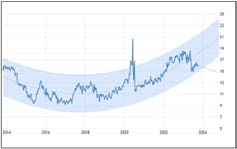
Source: https://tradingeconomics.com/commodity/rice (Assessed on 11 October 2022). Figure 4: Variation of Rice Price (USD/Cwt (Hundredweight) from 2014 to 2023.
By the conclusion of this quarter, experts and Trading Economics’ global macro models predict that the price of rice will be 15.71 USD/CWT. Looking forward, we predict it will trade at 14.76 in a year (Figure 5).
Source: https://tradingeconomics.com/commodity/rice (Assessed on 11 October 2023). Figure 5: Forecast of Rice Price (USD/Cwt (Hundredweight) to 2025.
Several causes might be to blame for this. These elements may be intricately linked. The following are some typical causes of price increases for rice: • Climate and Weather Conditions: Rice production may be greatly impacted by unfavourable meteorological circumstances including floods, droughts, or unpredictable rainfall [4, 5, 6]. If these circumstances cause the crop to be less plentiful, it may result in less rice being available and higher costs [7, 8].
The results of Firdaus RR, et al. [4] indicated that paddy production is severely threatened by climate change, which would eventually have an impact on food security because of their close ties. Therefore, it is imperative that Malaysia update its paddy and rice intervention plans while paying careful attention to improving the paddy farmers’ capacity to adapt to climate change. According to De Silva, et al. [6] average rainfall reduces by 17% (A2) and 9% (B2) during the rainy season, showers cease sooner, and potential evapotranspiration rises by 3.5% (A2) and 3% (B2). As a result, the average amount of water needed for paddy irrigation rises by 23% (A2) and 13% (B2).
Basak R [7] looked into the advantages and disadvantages of alternating wetting and drying (AWD), a method that can help reduce greenhouse gas (GHG) emissions, in the paddy rice production in Bangladesh and Vietnam. Basak R [7] investigated the possible costs and advantages of adopting AWD at the national levels in Vietnam and Bangladesh. Despite compiling a lot of data on the agronomic advantages of AWD, he found less evidence of its economic effects, particularly when considered in the context of its effects on GHG emissions. It should be emphasized that there is only one research on the costs of producing AWD in Vietnam, therefore more comprehensive cost information is needed.
• Customer Demand: As manufacturers adapt their output to satisfy demand, changes in customer preferences or greater demand for rice-based items may result in higher costs [9, 10, 11].
Yaacob et al. [9] contended that rather than being seen as two distinct segments within a supply chain model, the cultivation of paddy and the delivery of rice to customers should be seen as a series of linked segments. A competitive production and effective distribution of paddy and rice from farmers to ultimate customers may be ensured by a strong relationship between players at every level of the supply chain [9]. The practical challenges that arise in the supply chain for rice were addressed by Sharma, et al. [10]. They talked on a variety of topics including demand consolidation, inventory reduction, inventory management, and collaboration at the downstream end of the supply chain.
Using block chain technology, Kumar MV, et al. [11] developed a rice supply chain system that ensures the safety of rice throughout supply chain management procedures. This is because, as a staple food, its integrity across supply chain operations is constantly a top priority for society [11]. The decentralized, distributed, and non-centralized block chain technology is the answer to the issues that have arisen in the rice supply chain system [11].
• Fertilization: Fertilization applications Khema S, et al. [12], Zhang ZS, et al. [13], Atnoorkar AA [14] that impact rice harvests might result in lower yields of paddy, which can raise costs.
In 14 provinces with a variety of soil types, Khema S, et al. [12] research compared the grain yield, gross return above fertilizer cost (GRAFC: (paddy sales)-(fertilizer cost)), and various parameters relating to the quality of white rice grown with various soil-specific nutrient management strategies. The grain yield tended to rise as the amount of fertilizer used rose, however, in regions where clay soil predominates, the connection between fertilization rate and yield was nonlinear. The carbohydrate concentration and the carbohydrate/protein ratio, which are considered to be favourable factors for rice quality, were inversely correlated with the fertilizer rate, but the nitrogen concentration, which is known to be a negative factor for rice quality, tended to increase with an increase in fertilization rate. The combined impacts of N fertilization and tillage techniques on the global warming potential (GWP) and net ecosystem economic budget (NEEB) in paddy fields were investigated by Zhang ZS, et al. [13]. NEEB and greenhouse gas intensity (GHGI) in central Chinese paddy fields. Both GWP and greenhouse gas intensity (GHGI) were dramatically raised by the usage of N fertilizers. Among all treatments, the combination of 50% N from organic fertilizer and 50% N from chemical fertilizer (OFIF) with no-tillage (NT) produced the biggest NEEB and the second-highest GWP and GHGI. To maximize the financial and environmental advantages of paddy fields in central China, they recommended combining OFIF with NT. The government should pay enough ecological compensation for this practice, which has minimal GHG emissions and a high yield of rice, according to their findings.
The constant use of chemical fertilizers in agricultural agriculture is extremely hazardous to the environment. The price of chemical fertilizers is high, which reduces agricultural output [14]. In place of artificial fertilizers, Atnoorkar AA [14] suggested using cyanobacteria in paddy fields. This is due to the fact that cyanobacteria are common in paddy fields and provide a significant contribution to the production of the rice crop. In addition to fixing atmospheric nitrogen and improving phosphorus availability, it also generates a huge number of substances that encourage plant development. As a result, it has great potential as a bio fertilizer and reduces the need for fuel in the manufacture of chemical fertilizers. Additionally, cyanobacterial bio fertilizers are cheap, easy to use, and environmentally friendly [14].
• Diseases and Pests: Lower paddy yields might arise from pest or disease outbreaks that affect rice harvests [15, 16, 17], which could increase prices.
The pattern of pesticide usage in rice production was investigated by Singh A, et al. [15], who also evaluated the financial and environmental effects of using IPM techniques when growing paddy in Haryana. They discovered that even at this level, technology has the ability to reduce pesticide risk risks to several environmental categories by 20–30%. Farmers are risk cautious despite having adequate awareness of the environmental risks associated with pesticides. In order to increase IPM adoption, it is therefore essential to increase farmers’ understanding of pest control by giving them in-depth, comprehensive information and training as well as teaching them about its economic usefulness.
Deep convolutional neural networks (DCNN) were utilized by Malathi V, et al. [16] to identify 10 different types of pests that were present in the rice crop. The neural model was constructed using several types of DCNN architecture, and interpretation of the models was done based on their performance and accuracy rate. The derived outcome value represents the model’s successful performance in classifying pest diseases. According to Kumar S, et al. [17] analysis of rice insect-pest infestation and yield, integrated pest control (IPM) outperformed farmers’ practices. Compared to farmers’ practices, the IPM module had the lowest incidence of yellow stem borer (6.57% and 5.85%) and leaf folder (5.12% and 4.72%). In IPM plots, there were also fewer brown plant hopper and green leaf hopper populations. IPM demonstration plots had a yield that was 13.05% higher than control plots, and using advised practices also led to the highest net return and benefit-cost ratio.
• Costs Associated with Transportation and Distribution: Getting rice from farmers to markets might become more expensive due to rising fuel prices and network problems. Prices might rise as a result of these added expenses being passed on to customers [18, 19, 20].
In order to examine the degree of market integration at three different spatial scales—sub regional, regional, and national—as well as to ascertain whether non-integration is brought on by high transfer costs or a lack of competition, Moser C, et al. [18] used rice price data from four quarters of 2000-2001 along with information on transportation costs and infrastructure accessibility for nearly 1,400 communes in Madagascar. The findings suggest that markets are rather well linked at the sub regional level and that issues restricting competitiveness include transportation costs and a lack of information.
With cross-section data gathered from four districts, Jhapa, Morang, Chitwan, and Rupandehi in 2008, Shrestha RB [19] used the Relative Price Spread (RPS) model to analyze factors impacting the retail-price spread of rice in Nepal. They discovered that the marketing expense, rice’s wholesale price, retail price, and the farmer’s access to market knowledge all had a big impact on the marketing margin. Reducing the marketing margin is made possible by lowering the cost of transportation, enhancing the market information system, and strengthening the role of the farmer in setting prices. The findings showed that the marketing expense, rice wholesale and retail prices, and market information to the farmer all had a substantial impact on the marketing margin. Reducing the marketing margin is made possible by lowering the cost of transportation, enhancing the market information system, and strengthening the role of the farmer in setting prices.
Other Factors
Other Factors Include: Trends in the world market: The dynamics of the world market may have an impact on rice prices. Local rice prices can be impacted by changes in domestic supply and demand, export limitations by major rice-producing nations, and shifts in world commodities prices [21].
Changes in currency rates; these changes can alter the price of imported rice, which can have an impact on domestic pricing. Imports of rice may become more expensive due to a weaker local currency, raising consumer costs [22, 23].
Government policies; Governmental actions like price controls, import quotas, and subsidies can have a direct impact on rice prices. The rice market may be significantly impacted by changes to these rules [24].
Speculation and market attitude; Price volatility can be caused by speculation in the commodities markets and shifts in market attitude. Based on their projections for future pricing, traders and investors can purchase or sell contracts for rice futures [25]
Concluding Remarks
It’s crucial to remember that a combination of the aforementioned factors may affect changes in rice prices, and their effects may change over time. In order to keep rice prices stable and ensure that the populace has access to food, government regulations and actions might be extremely important. In addition, the implementation of environmental governance when looking at the climate change factor should be addressed at the forefront discussion topic.
References
-
Ritchie H, Rodés-Guirao L, Mathieu E, Gerber M, Ortiz- Ospina E, et al. (2023) Population Growth. Our World in Data.
-
Ritchie H, Rosado P, Roser M (2022) Crop Yields. Our World in Data.
-
Food Agriculture Organization of the United Nations (FAO) (2023) FAO Rice Price Update.
-
Firdaus RR, Leong Tan M, Rahmat SR, Senevi Gunaratne M (2020) Paddy, rice and food security in Malaysia: A review of climate change impacts. Cogent Social Sciences 6(1): 1818373.
-
Kim HY, Ko J, Kang S, Tenhunen J (2013) Impacts of climate change on paddy rice yield in a temperate climate. Global Change Biology 19(2): 548-562.
-
De Silva CS, Weatherhead EK, Knox JW, Rodriguez-Diaz JA (2007) Predicting the impacts of climate change—A case study of paddy irrigation water requirements in Sri Lanka. Agricultural water management 93(1-2): 19-29.
-
Basak R (2016) Benefits and costs of climate change mitigation technologies in paddy rice: Focus on Bangladesh and Vietnam. CGIAR Research Program on Climate Change, Agriculture and Food Security Working Paper.
-
Alam MM, Siwar C, Jaafar AH, Talib B, Salleh K (2013) Agricultural vulnerability and adaptation to climatic changes in Malaysia: Review on paddy sector. pp: 14.
-
Yaacob A, Yusop Z, Malek SA, Malek A (2019) Paddy Supply Chain: A Case of Paddy Industry in Kelantan. Advances in business research international journal 5(3): 17-22.
-
Sharma V, Giri S, Rai SS (2013) Supply chain management of rice in India: a rice processing companys perspective. International Journal of Managing Value and Supply Chains 4(1): 25.
-
Kumar MV, Iyengar NCS (2017) A framework for Blockchain technology in rice supply chain management. Adv Sci Technol Lett 146: 125-130.
-
Khema S, Rin S, Fujita A, Kong K, Ngin C, et al. (2022) Grain Yield and Gross Return above Fertilizer Cost with Parameters Relating to the Quality of White Rice Cultivated in Rainfed Paddy Fields in Cambodia. Sustainability 14(17): 10708.
-
Zhang ZS, Chen J, Liu TQ, Cao CG, Li CF (2016) Effects of nitrogen fertilizer sources and tillage practices on greenhouse gas emissions in paddy fields of central China. Atmospheric Environment 144: 274-281.
-
Atnoorkar AA (2021) Cyanobacterial biofertilizers as an alternative to chemical fertilizers in paddy fields: a review. The Applied Biology & Chemistry Journal 2(2): 49-52.
-
Singh A, Kumar R, Das DK, Jain PK (2004) Economic and environmental impact of integrated pest management in paddy a case study of Haryana. Agricultural Economics Research Review 17: 69-84.
-
Malathi V, Gopinath MP (2021) Classification of pest detection in paddy crop based on transfer learning approach. Acta Agriculturae Scandinavica, Section B-Soil & Plant Science 71(7): 552-559.
-
Kumar S, Nath S, Kannaujia SK, Gautam AD, Singh BP (2020) Assessment of the integrated pest management against insect pests of paddy in Eastern Uttar Pradesh. Journal of Krishi Vigyan 8(2): 8-11.
-
Moser C, Barrett C, Minten B (2009) Spatial integration at multiple scales: rice markets in Madagascar. Agricultural Economics 40(3): 281-294.
-
Shrestha RB (2012) Factors affecting price spread of rice in Nepal. Journal of Agriculture and Environment 13: 47- 52.
-
David CC, Huang J (1996) Political economy of rice price protection in Asia. Economic Development and Cultural Change 44(3): 463-483.
-
Dawe D (2002) The changing structure of the world rice market, 1950–2000. Food Policy 27(4): 355-370.
-
Adam P, Saidi LO, Tondi L, Sani LOA (2018) The causal relationship between crude oil price, exchange rate and rice price. International Journal of Energy Economics and Policy 8(1): 90-94.
-
Hermawan W, Maipita I (2017) Factors affecting the domestic price of rice in Indonesia. Jurnal Ekonomi dan Kebijakan 10(1): 155-171.
-
Silalahi NH, Yudha RO, Dwiyanti EI, Zulvianita D, Feranti SN, et al. (2019) Government policy statements related to rice problems in Indonesia. Journal of Biological Science, Technology, and Management 1(1): 35-41.
-
Tomlins K, Manful J, Gayin J, Kudjawu B, Tamakloe I (2007) Study of sensory evaluation, consumer acceptability, affordability and market price of rice. Journal of the Science of Food and Agriculture 87(8): 1564-1575.
- Enhancement of Vegetative Growth and Fruit Yield in Cucumber (Cucumis sativus L.) via Spiritual Blessing (Biofield) Energy Intervention
- Production of Açaí (Euterpe oleracea Mart.) under Different Agroforestry System Management Intensities in Amazonian Floodplain (Varzea) Forests
- Coffee and the Production Region: What is the Secret to the Expression "Quality"?
- Experiential Agripreneurship Training in Sub-Saharan Africa: Integrating a Business Incubator into Postgraduate Livestock Education at the University of Buea
- Advances in Agricultural High-Quality Development
- Linking Compost Residue to ABAGE in Plants - a Short Note