
Eastern Region Holds the Key to Future Increase in Rice Production in India
Rice is the main staple food of India and supply of adequate amounts of rice to the consumers is essential to ensure food security. However, rice production in recent years has been threatened by unsustainable use of groundwater and yield plateauing in irrigated areas. The objective of this paper is to find out the regions that face such problems and recommend strategies to overcome them. Data for this study was gathered from various ministries of the Government of India. Analyses of data reveal that the eastern region accounts for 50% of India’s rice production, and holds 56% of the total rice area. The region receives more rainfall than the northern, southern, and western regions states. The groundwater exploitation is below 50% in the region. The demonstrations carried out by two mega schemes of the government of India show potential for increasing rice productivity in the eastern region. It was observed that the groundwater has been overexploited in northern and southern region states viz. Punjab, Haryana, and Tamil Nadu. Yield plateauing was also observed in five irrigated states in recent years. Various strategies are discussed to overcome the problems, adoption of yield-enhancing and water-saving technologies, and the promotion of rice cultivation in eastern states.
Abbreviations
MSP: Minimum Support Price; DES: Directorate of Economics and Statistics; NFSM: National Food Security Mission; BGREI: Bringing Green Revolution to Eastern India.
Introduction
Rice is the staple food of more than two-thirds of Indians and therefore, the supply of adequate amounts of rice to the consumers holds the key to food security. India is the second largest rice producer in the world next to China and exports more than 20 million tons of rice which accounts for about 40% of global rice exports. This crop is grown in an area of about 45.2 million ha covering all the states with an average production of 124.2 million tons. However, the productivity of rice is 2.75 t/ha, which is below the global average of 3.14 t/ha. India has about 156 million of its population below the poverty line. There is a high degree of correlation between the yield of food grains and the incidence of poverty across Indian states Hossain M [1]. Farmers in many states did not realize the minimum support price (MSP) of rice announced by the government Samal P, et al. [2, 3]. Hence, a remunerative price for producers to the adoption of improved technologies will lead to improved productivity. At the national level, an important political objective is to achieve self-sufficiency in rice production and to maintain stable prices for rice consumers. It is estimated that by the year 2050, the Indian rice demand will be 197 million tons Mondal B, et al. [4] and the global demand will be 584 million tonnes of milled rice Samal P, et al. [5]. However, the rice production sector is threatened by stagnant yield and declining groundwater table in irrigated areas. Evidence of yield decline in long- term yield trials due to unsustainable use of production inputs in intensive rice production systems casts doubts on the achievement of future rice production targets Dawe D, et al. [6]. Further, climate change has increased the uncertainty on the achievement of production targets for the year 2050 Wassman R, et al. [7]. Therefore, planning to increase sustainable production and yield of rice in different regions of India is important from the viewpoint of national cum global food security and poverty alleviation. The objective of the paper is to find out the potential regions of India and recommend strategies for rice development in the country.
Data and Methods
India has been divided into five regions viz. East, Northeast, North, South, and West by combining individual state and union territories (UTs) located in that region. The Eastern region includes states, viz. Bihar, Chhattisgarh, Jharkhand, Madhya Pradesh, Odisha, Uttar Pradesh, and West Bengal; the Southern region includes states and UTs, viz. Andaman & Nicobar Islands, Andhra Pradesh, Karnataka, Kerala, Puducherry, Telangana, and Tamil Nadu; the Northern region includes states and UTs, viz. Chandigarh, Delhi, Haryana, Himachal Pradesh, Jammu & Kashmir, Punjab, and Uttarakhand; the Northeastern region includes states, viz. Arunachal Pradesh, Assam, Manipur, Meghalaya, Mizoram, Nagaland, Sikkim, and Tripura; and the Western region covers states and UTs, viz. Daman & Diu, Dadra & Nagar Haveli, Goa, Gujarat, Maharashtra, and Rajasthan. The state and union territory-wise secondary data on area, production, yield, and irrigated area of rice for the study was collected from various issues of the publication ‘Agricultural Statistics at a Glance’ published by the Directorate of Economics and Statistics of the Ministry of Agriculture and Farmers’ Welfare, Government of India (DES). The regional figures for area, production, and yield were computed using those data. Tabular and graphical analyses of data were done to reach the conclusions.
The information on groundwater exploitation was collected from the Central Ground Water Board, Ministry of Jal Shakti, Government of India, and the state-wise normal rainfall data was collected from the Indian Meteorological Department, Ministry of Earth Sciences, Government of India, and used in this paper. The terms yield and productivity were used interchangeably throughout the paper. The production and yield data reported are in terms of milled rice.
Results and Discussion
Decade-wise increase in Area, Production and Yield
The production of rice in India has increased more than five times since 1950-51 and made India self-reliant on rice from the early 1980s (Figure 1). The sources of growth in the past were an increase in area and yield, which has increased by 1.5 and 3.8 times, respectively since 1950-51. Though during the Green Revolution period (1966-1989), the production growth has accelerated, during the 2000s, the growth has decelerated. It is observed that the average additional production during the 2000s has decreased (Table 1).
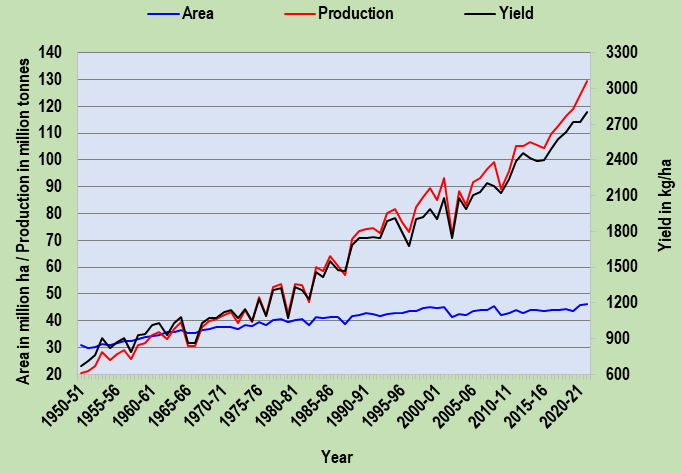
More precisely, additional production during the 1990s over the 1980s was 20.3 million tons, which was reduced to 9.15 million tons during the 2000s. However, the production increase has recovered during the 2010s and the recent period (2019-21). The additional yield has also reduced from 387 kg/ha during the 1990s to 200 kg/ha during the 2000s. However, some signs of improvement in yield were noticed during the recent period (2010-11 to 2021-22). The additional average yield has increased from 200 kg/ha during the 2000s to 421 kg/ha during the 2010s.
| Period | Production (million tons) | Yield (kg/ha) | Area (million ha) | |||
|---|---|---|---|---|---|---|
| Average production | Additional production over the previous period | Average yield | Additional yield over the previous period | Average area | Additional areas over the previous period | |
| India | ||||||
| 1970s | 45.26 | 1173 | 38.61 | |||
| 1980s | 59.74 | 14.48 | 1465 | 292 | 40.69 | 2.08 |
| 1990s | 80.04 | 20.3 | 1852 | 387 | 43.19 | 2.5 |
| 2000s | 89.19 | 9.15 | 2052 | 200 | 43.41 | 0.22 |
| 2010s | 108.09 | 18.9 | 2473 | 421 | 43.7 | 0.28 |
| 2019-21 | 124.24 | 16.15 | 2746 | 273 | 45.24 | 1.55 |
Table 1: Increase in Average Production, Yield, and Area, of Rice in India (1970-71 to 2021-22).
Note: 1970s refers to the average of data for the period 1970-71 to 1979-80 (ten years) and so on. The year 2019-21 refers to the average of data for the period 2019-20 to 2021-22 agricultural years. Table 1: Increase in Average Production, Yield, and Area, of Rice in India (1970-71 to 2021-22).
Region-Wise Scenarios
The area, production, and yield of five regions of India are presented in Table 2. Eastern states account for about 56% of the total rice area and 50% of the total rice production of India. Southern and Northern regions cover 20 and 11 percent of the total area, respectively and contribute 24 and 15 percent of the total production, respectively when data for the recent period (2019-21) was considered. However, the average yield realization is only 2.45 t/ha in eastern states in comparison to 3.79 t/ha in northern and 3.41 t/ ha in southern states. In the northern and southern states, more than 90% of the rice area is grown under irrigated conditions while the irrigated area in the eastern region is 54%. The yield is higher in northern and southern states due to more irrigated areas and better crop management practices adopted by farmers. Therefore, there is scope to boost average yields in eastern states by expanding irrigated areas, use of drought-tolerant and flood-tolerant varieties, and better management practices.
The government of India has been implementing two mega programs to increase the production and productivity of rice throughout the country. The National Food Security Mission (NFSM) was introduced during the year 2007 while the Bringing Green Revolution to Eastern India (BGREI) was implemented from the year 2010. Various incentives like improved seeds, micronutrients, farm implements, machines, irrigation devices, plant protection chemicals, biopesticides for promoting integrated pest management, soil ameliorants, training to farmers, etc. were provided to farmers under the two mega programs. Other supporting services like credit, insurance, marketing facilities, etc. were also provided through various schemes. It has been demonstrated through NFSM and BGREI that a significant yield increase can be achieved in eastern states with the available technologies Pathak H, et al. [8, 9]. The effects of the programs in terms of increase in production and productivity in the five regions are listed in Table 2. The increase in yield was greater in the Eastern and Northeastern regions than in the other three regions during the two periods under comparison. The yield has increased by 38% and 40% in the eastern and northeastern regions, respectively in comparison to 13, 9 to 18 percent in the southern, northern, and western regions, respectively during the last 14 years (2008-09 to 2021-22). Despite the decrease in the area, the production has increased by 15.78 million tons in the eastern region accounting for a 34% increase over the pre-NFSM period. The other four regions together added less (14.49 million tons during the same period. The southern region’s contribution was 7.26 million tons mainly due to an increase in area in the state of Telangana.
| Region | Period | Additional area/production/yield | Percent change | |
|---|---|---|---|---|
| 2005-06 to 2007-08 | 2019-20 to 2021-22 | |||
| AREA (MILLION HA) | ||||
| Eastern | 26.23 | 25.46 -56.28 | -0.77 | -2.9 |
| Southern | 7.63 | 8.86 -19.58 | 1.23 | 16.1 |
| Northern | 4.32 | 4.89 -10.81 | 0.57 | 13.2 |
| Northeastern | 3.18 | 3.27 -7.23 | 0.09 | 2.8 |
| Western | 2.44 | 2.76 -6.09 | 0.32 | 13.1 |
| India | 43.8 | 45.24 -100 | 1.44 | 3.3 |
| PRODUCTION (MILLION TONS) | ||||
| Eastern | 46.66 | 62.44 -50.26 | 15.78 | 33.8 |
| Southern | 22.91 | 30.17 -24.28 | 7.26 | 31.7 |
| Northern | 14.96 | 18.52 -14.91 | 3.56 | 23.8 |
| Northeastern | 4.93 | 7.1 -5.72 | 2.17 | 44 |
| Western | 4.5 | 6 -4.83 | 1.5 | 33.3 |
| India | 93.95 | 124.24 -100 | 30.29 | 32.2 |
| YIELD (KG/HA) | ||||
| Eastern | 1779 | 2453 | 674 | 37.9 |
| Southern | 3004 | 3405 | 401 | 13.3 |
| Northern | 3466 | 3787 | 321 | 9.3 |
| Northeastern | 1550 | 2172 | 622 | 40.1 |
| Western | 1841 | 2176 | 335 | 18.2 |
| India | 2145 | 2746 | 601 | 28 |
Table 2: Changes in Average Area, Production, and Yield of Rice between the Triennium Ending 2007-08 and 2021-22.
Figures in parentheses indicate percent. Table 2: Changes in Average Area, Production, and Yield of Rice between the Triennium Ending 2007-08 and 2021-22.
Concerns to Future Increase in Production
Agricultural intensification has resulted in detrimental environmental impacts such as deterioration of soil fertility resulting in yield decline or plateauing, shrinking groundwater levels, pollution of soil, air, water, and biodiversity loss. In the Green Revolution belts of India, though rice productivity is high, the present cropping patterns (rice-wheat and rice-rice) are inefficient in terms of sustainable use of natural resources like land and water Dutta S, et al. [10, 11, 12]. Due to the intensification, the micronutrients and carbon contents of the soils have gone down.
Yield Decline
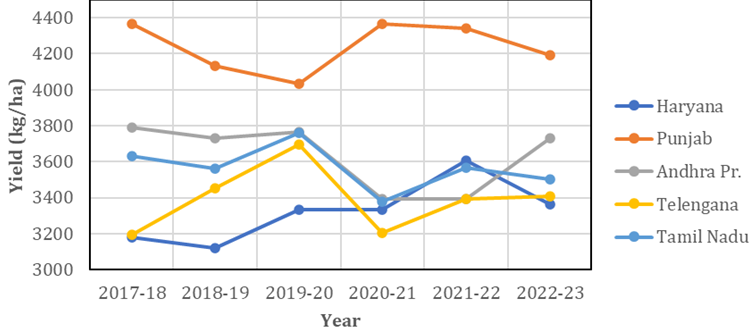
In the last five years, there has been a sign of yield plateauing in major irrigated states (Figure 2). The rice yields fluctuated between 4.0 to 4.4 t/ha in Punjab and 3.1 to 3.8 t/ha in the other four irrigated states during the period 2017-18 to 2021-22. There is now growing concern that other non-price factors, such as deteriorating soils, reducing groundwater table, and reduced public investment in research have contributed to poor performance in recent years in irrigated areas and must be addressed through research efforts and other public policies. The immediate need is to break the yield ceilings in the irrigated ecosystem by developing super varieties that have a yield advantage of 20% or more.
Groundwater Overdraft
The level of groundwater has been exploited by more than 100 percent in states like Punjab and Haryana. Groundwater extraction has reached critical levels or over-exploited in many states (Table 3) and is widespread in states like Haryana, Punjab, and Tamil Nadu. Punjab and Haryana have among the lowest irrigation-water productivity (0.22 kg/m3) in comparison to eastern states Sharma BR, et al. [12]. One of the reasons for the over-exploitation of groundwater is the supply of free or excessive subsidized power to the farmers in these states. Therefore, there is a need for the rationalization of power subsidies. Unless policy decisions are taken to halt the overexploitation, the areas will be unproductive after some years. The adoption of water-saving rice technologies, improved water management practices, changes in cropping patterns, and improved nutrient management will bring efficiency to rice production in those areas Dhiman J, et al. [13, 14, 15].
| Region/State | Total numbers assessed* | Critical# | Over-exploited$ | Level of exploitation (Percent) | Normal Annual Rainfall (mm) | ||
|---|---|---|---|---|---|---|---|
| Numbers | Percent | Numbers | Percent | ||||
| Eastern (54.4) | |||||||
| Bihar | 534 | 5 | 0.94 | 7 | 1.31 | 51 | 1136 |
| Chhatisgarh | 146 | 9 | 6.16 | - | - | 46 | 1292 |
| Jharkhand | 259 | 2 | 0.77 | 3 | 1.16 | 29 | 1255 |
| MP | 317 | 8 | 2.52 | 26 | 8.21 | 57 | 1338 |
| Odisha | 314 | - | - | - | - | 44 | 1445 |
| WB | 268 | 1 | 0.37 | - | - | 45 | 1439 |
| Southern (94.5) | |||||||
| Andhra Pr. | 667 | 15 | 2.25 | 23 | 3.45 | 33 | 1094 |
| Karnataka | 227 | 10 | 4.41 | 52 | 22.91 | 65 | 1126 |
| Tamil Nadu | 1166 | 63 | 5.4 | 435 | 37.31 | 83 | 998 |
| Telangana | 589 | 44 | 7.47 | - | - | 53 | 961 |
| Northern (99.7) | |||||||
| Haryana | 141 | 12 | 8.57 | 85 | 60.28 | 135 | 617 |
| Punjab | 150 | 6 | 4 | 117 | 78 | 164 | 619 |
| North-eastern (18.1) | |||||||
| Assam | 28 | - | - | - | - | 12 | 2818 |
| Western (43.1) | |||||||
| Gujarat | 248 | 4 | 1.61 | 25 | 10.08 | 53 | 840 |
| Maharashtra | 353 | 8 | 2.27 | 10 | 2.83 | 55 | 1034 |
| India (65.0) | 6965 | 270 | 3.88 | 1114 | 15.99 | 62 | 1083 |
Table 3: Groundwater Exploitation Levels and Concerns (Critical / Over-Exploited) in Major Rice-Growing States of India (2020)
*Units of Assessment: Blocks/Mandals/Taluks/ Firkas. # Indicates the stage of groundwater extraction is between 90-100% of their availability. $ Indicates the groundwater extraction exceeded the annual extractable groundwater resources (availability). Figures in parentheses indicate the percent rice area under irrigation in the region. Table 3: Groundwater Exploitation Levels and Concerns (Critical / Over-Exploited) in Major Rice-Growing States of India (2020).
Deterioration in Soil Quality
A significant reduction in manure use in rice cultivation has been observed in irrigated states threatening the soil quality and sustainability of rice production in these areas Samal P, et al. [3]. Though farmers apply some of the macronutrients like N, P, and K, they usually neglect the application of micronutrients (Iron, Zinc, Sulphur, Manganese, Boron, and Molybdenum). Moreover, the soil quality is deteriorating from the loss of organic carbon, erosion, soil compaction, salinization, and heavy metal introgression into the soil from industries and pesticides. Even the N, P, and K fertilizers are not applied proportionately. A study using panel data for selected states revealed that there was excessive use of Nitrogen in the irrigated areas of Indo-Gangetic Plains Praveen KV, et al. [16]. The analysis suggested that the crop response has decreased considerably in the green revolution states of Punjab, Haryana, Uttar Pradesh, and Andhra Pradesh. The percentage of farmers overusing nitrogen in these states is comparatively higher. While 78 percent of farmers from Punjab considered in the analysis overused nitrogen, the values were 74, and 68 percent, in the states of Haryana, and Andhra Pradesh, respectively. In the long run, this causes an imbalance in soil and plant nutrition resulting in yield decline. Balanced use of fertilizers, application of compost, green manuring, change in cropping pattern, application of micronutrients, etc. will help in ameliorating the situation in many areas.
Management of Green House Gases: Agricultural soils contribute to the greenhouse effect primarily through the emission of greenhouse gases (GHGs) such as methane, nitrous oxide (N2O), and carbon dioxide (CO2). In the agricultural sector, rice cultivation is considered one of the major contributors to GHG emissions Pathak H, et al. [15]. The irrigated, waterlogged, and flood-prone rice fields contribute more towards methane emissions. Upland rice fields are potential sources of N2O. Generally, an increase in N2O emission is observed from rice fields following irrigation and precipitation. The main source of CO2 from agriculture is through soil management such as tillage which triggers CO2 emission through the biological decomposition of soil organic matter. Rice crop residue burning in the fields in many Indian states, particularly in Punjab, Haryana, and western Uttar Pradesh adds to CO2 concentration in the atmosphere. Several mitigation technologies and strategies viz. change in cropping pattern, irrigation scheduling, use of straw compost, application of industrial wastes like basic slag and phosphogypsum as soil amendments, cultivation of rice cultivars having low GHG emission potential, etc. are recommended to reduce the GHG emissions from rice fields Bhattacharyya P, et al. [17].
Promotion of Mechanization: With the process of development, the non-farm sector is growing and young people are attracted to non-farm jobs due to higher wage rates in that sector and higher drudgery involved in agricultural operations. Therefore, the growing labour shortage is observed throughout the country during the peak periods of different agricultural operations like transplanting, weeding, and harvesting leading to higher agricultural wages year after year. As more than 86% of farmers’ holdings in India are marginal (< 1 ha) and small (< 2 ha), custom hiring centres should be strengthened/promoted by the government to mechanize farm operations, which not only reduce the cost of cultivation but also drudgery in farm operations. The mechanization of rice farming is low in the eastern region in comparison to the northern, southern, and western region states Samal P, et al. [3]. Therefore, mechanization has to be promoted aggressively in the eastern region to bring efficiency in rice production.
India receives about 1200 mm of rainfall out of which 75% is received during the monsoon season (June- September) and 10.5% during the post-monsoon season (October-December). During pre-monsoon season (Mar- May) about 11% of rainfall is received. Rainfall in the eastern and north-eastern region states is high compared to other regions (Table 3) and replenishes the groundwater level more quickly Pathak H, et al. [14]. However, the region faces droughts and floods due to erratic rainfall. Varieties tolerant to drought and submergence are required for the region. Though some submergence-tolerant varieties are available they are not suitable for turbid water conditions. Further, the farmers of the eastern region do not realize MSP due to poor infrastructure development Samal P, et al. [2, 3]. Therefore, it is prudent to incentivize farmers of eastern and northeastern regions in the form of improved varieties and management practices, marketing-storage cum insurance facilities, irrigation development, etc. to improve rice productivity.
Conclusions and Policy Implications
The foregoing analysis concluded that rice cultivation is not sustainable in the long run in all the regions of India unless the right policies are followed. Nevertheless, rice production and productivity have to be increased under an increasing scarcity of land, water, and labour resources due to increasing population pressure leading to increasing demand. The rice area is maximum in the eastern region, the region receives a good amount of rainfall and the sustainability issues are less. However, the region has more rainfed areas and faces natural calamities like drought and flood affecting the yield levels. Therefore, efforts should be made to expand more area under irrigation to bring not only resiliency in rice production but also increase productivity. Submergence tolerance varieties that tolerate turbid water for a longer duration are needed for flood-prone areas. For northern and southern regions, the issues of yield plateauing and groundwater overdraft are more. Research efforts to break the yield barriers and balanced nutrient management are the priority in irrigated states. More research funds need to be made to achieve this goal. The promotion of rice farming needs to be discouraged in areas where groundwater exploitation has been over- exploited or reached critical levels. The energy subsidy to the agricultural sector in those areas needs to be reviewed and rationalized in those states. Less water-consuming crops should be promoted in such areas by adopting micro- irrigation techniques. Climate-resilient rice varieties need to be developed for all the states to bring resiliency to rice production. Mechanization of farm operations needs to be promoted in those regions/states where human and animal labour use is more to bring further efficiency to rice production. Green manuring and soil incorporation of crop residues and other organic wastes need to be promoted in all states to improve soil quality. Public and private agencies need greater concerted efforts to achieve this so that not only income of farmers will increase but also rice production in India will sustain in the years to come.
Conflicts of Interest
The author declares no conflict of interest.
References
-
Hossain M (1995) Sustaining food security for fragile environments in Asia: Achievements, challenges, and implications for rice research. In**:** Proceedings of the International Rice Research Conference, 13-17 Feb 1995, Fragile lives in fragile ecosystems, International Rice Research Institute, Los Baños, Philippines, pp: 3-25.
-
Government of India (2023) Price policy for Kharif crops: The marketing season 2023-24, New Delhi India.
-
Samal P, Rout C, Repalli SK, Jambhulkar NN (2018) State- wise analysis of growth in production and profitability of rice in India. Indian Journal of Economics and Development 14(3): 399-499.
-
Mondal B, Bisen J, Jambhulkar NN, Tripathi R (2022) Rice supply, demand and exportable surplus in India: Present vis-à-vis thirty years ahead. Oryza 59(4): 504-511.
-
Samal P, Babu SC, Mondal B, Mishra SN (2022) The global rice agriculture towards 2050: An inter-continental perspective. Outlook on Agriculture 51(2): 164-172.
-
Dawe D, Dobermann A, Moya P, Abdulrahman S, Singh B, et al. (2000) How widespread are yield declines in long- term rice experiments in Asia? Field Crops Research 66: 175-193.
-
Wassman R, Jagadish SVK, Heuer S, Ismail A, et al. (2009) Climate change affecting rice production: The physiological and agronomic basis for possible adaptation strategies. Advances in Agronomy 101: 59- 122.
-
Pathak H, Panda BB, Nayak AK (2019) Eds., Bringing Green Revolution to Eastern India: Experiences and Expectations. ICAR-National Rice Research Institute, Cuttack, India, pp: 62.
-
Government of India (2020) Evaluation of centrally sponsored schemes in agriculture, animal husbandry, and fisheries sector. NITI Aayog, New Delhi, India.
-
Dutta S, Dhillon SS (2020) Structural transformation of Punjab agriculture and its environmental implications. Indian Journal of Economics and Development 16: 533- 546.
-
Kumar P, Mittal S (2006) Agricultural productivity trends in India: Sustainability issues. Agricultural Economics Research Review 19: 71-88.
-
Sharma BR, Gulati A, Mohan G, Manchanda S, Ray I, et al. (2018) Water productivity mapping of major Indian crops. National Bank for Agriculture and Rural Development, Mumbai and Indian Council for Research on International Economic Relations, New Delhi, India, pp: 213.
-
Dhiman J, Dhiman JS, Aggarwal R, Dhiman M (2015) Water management for sustainability of irrigated agriculture: An Indian perspective. Indian Journal of Economics and Development 11: 601-622.
-
Pathak H, Tripathy R, Jambhulkar NN, Bisen JP, Panda BB (2020) Eco-regional-based rice farming for enhancing productivity, profitability and sustainability. NRRI Research Bulletin No. 22, ICAR-National Rice Research Institute, Cuttack, India, pp: 30.
-
Pathak H, Bhatia A, Jain N, Aggarwal PK (2010) Greenhouse gas emission and mitigation in Indian agriculture – A review, In ING Bulletins on Regional Assessment of Reactive Nitrogen, Bulletin No. 19, (Ed. Bijay Singh), SCON-ING, New Delhi, India, pp. 1-34.
-
Praveen KV, Singh A, Jha GK (2024) Moving towards sustainable production through access to extension services: Evidence from rice growing states. Indian Journal of Agricultural Economics 79 (1): 148-157.
-
Bhattacharyya P, Padhy SR, Dash PK (2022) Greenhouse gases emissions from rice production systems and mitigation strategies. In: Bhattacharyya P, Chakraborty K, Molla KA, et al. (Eds.) Climate Resilient Technologies for Rice-based Production Systems in Eastern India. ICAR-National Rice Research Institute, Cuttack, India, pp: 186-198.
- Enhancement of Vegetative Growth and Fruit Yield in Cucumber (Cucumis sativus L.) via Spiritual Blessing (Biofield) Energy Intervention
- Production of Açaí (Euterpe oleracea Mart.) under Different Agroforestry System Management Intensities in Amazonian Floodplain (Varzea) Forests
- Coffee and the Production Region: What is the Secret to the Expression "Quality"?
- Experiential Agripreneurship Training in Sub-Saharan Africa: Integrating a Business Incubator into Postgraduate Livestock Education at the University of Buea
- Advances in Agricultural High-Quality Development
- Linking Compost Residue to ABAGE in Plants - a Short Note