
New Approaches of Root Stocks in Fruit Production: A Review
Rootstocks play an essential role to determining orchard performance of fruit trees. Pyrus communis and Cydonia oblonga are widely used rootstocks for European pear cultivars. The lack of rootstocks adapted to different soil conditions and different grafted cultivars is widely acknowledged in pear culture. Cydonia rootstocks (clonal) and Pyrus rootstocks (seedling or clonal) have their advantages and disadvantages. Selecting the right combination of the rootstock and cultivar is important for optimizing fruit quality parameters. Dwarfing is an important agricultural trait for intensive cultivation and effective orchard management in modern fruit orchards. Commercial citrus production relies on grafting with rootstocks that reduce tree vigour to control plant height. Citrus growers all over the world have been attracted to dwarfing trees because of their potential for higher planting density, increased productivity, easy harvest, pruning, and efficient spraying. Dwarfing rootstocks can be used to achieve high density. Citrus rootstocks with dwarfing potential have been investigated regarding physiological aspects, hormonal communication, mineral uptake capacity, and horticultural performance. This study lays the foundation for future research into the genetic and molecular mechanisms underlying citrus dwarfing. Many of the rootstocks now available to growers of apples, pears, peaches, nectarines, apricots, cherries and plums are listed and described briefly. Future rootstock needs for these and other crops are anticipated. Alternatives to rootstocks are considered, in particular the opportunities for scion cultivar improvement which may be offered by the developing techniques of molecular biology. Finally, the need for a better understanding of the physiology of the effects of rootstock on scion growth and cropping is emphasized.
Introduction
Rootstocks are a key element of any commercial apple orchard. Today’s commercial apple trees are not grown on their own roots (Seedlings), but are propagated on rootstocks that can impart important characteristics to the tree, improving the uniformity, economics and profitability of growing apples.
Seedlings have increased genetic variability, therefore decreased orchard uniformity, and produce the largest trees, which is not the goal of current commercial apple orchards. The number of rootstocks available commercially has been steadily increasing since the 1970s due to the presence of active breeding programs all around the world. If you are interested in growing apple trees, you need to know about the varieties of rootstocks on the market. Since there is a not a one-size-fits-all rootstock, it is essential to select the rootstock that best satisfies your needs and that performs best under your soil and environmental conditions. This factsheet summarizes important information about currently-available rootstocks and their characteristics, and is targeted mainly towards commercial apple growers.
Rootstocks are playing an increasingly crucial role in determining orchard efficiency and sustainability in fruit crops. Combining the desirable attributes of two or three different individuals by budding or grafting can produce dramatic effects on growth and productivity [1]. The effect of rootstocks on fruit quality in terms of physical traits and internal chemical compositions is well known in several fruit crops. Rootstocks can influence precocity/juvenility, yield, tree size control, biotic and abiotic stress resistance or tolerance, fruit respiratory behavior, crop load and canopy management techniques [2]. There has been major progress made by rootstock breeders in the second half of the last century and the beginning of the present century. The increased breeding activity of rootstock breeders is the reason why a wide range of new rootstocks are available to fruit growers. However, breeding rootstocks for fruit crops is much slower than scion breeding within the same species [3]. This is due to the long testing requirements of rootstocks that reduce the opportunity for comprehensive first stage tests on individual plants compounded by expanding selection criteria for new rootstocks. It is much easier to re- graft a scion than replant an orchard.
The current global agricultural challenges imply the need to generate new technologies and farming systems to cope with the need for sustainability and to face up to climate change. In this context, rootstocks are an essential component for fruit crops in modern agriculture. Currently most rootstocks used are clonally propagated and there are several ongoing efforts to develop these plant materials [4].
The aim of this Research Topic was to present the latest results of new rootstocks developed using classic and modern selection techniques and forecast novel applications. In this context, Rufato, et al. examined productive performance of apple cultivars grafted on selected Geneva® series rootstocks under extreme conditions of apple replant disease (ARD) areas in southern Brazil, including “Gala Select” and “Fuji Suprema” apples (Malus domestica [Suckow] Borkh.) grafted on “G.202,” “G.210,” “G.213,” and “G.814” rootstocks. It was found that the non-fallow condition does not alter the relative differences in vigor and apple fruit quality among the rootstocks, and the G.210 semi-dwarfing rootstock is an alternative for the immediate conversion of “Gala Select” and “Fuji Suprema” apple orchards under these conditions. Within the same species and topic, Mao et al. explored the potential ARD resistance of “12-2” elite rootstock selection and compared it with “M.9-T337” and “M.26” rootstocks, which are commonly grown in China. Authors found that “12-2” elite rootstock can be used as an important genetic source material for breeding of ARD-resistant apple rootstocks, which will be essential for fundamentally solving the rampant problem of ARD in China.
Moving toward another important tree crop species, i.e., citrus (Citrus sinensis L.), Bowman et al. described the USDA’s citrus breeding program novel, multi-pronged, strategy termed “SuperSour,” for rootstock breeding and presented its key components and methodologies, along with reference to the historical favorite rootstock sour orange (Citrus aurantium), and previous methods employed in citrus rootstock breeding. One of characteristics of this strategy is the rootstock propagation by cuttings and or in-vitro methods which avoid the need for nucellar seeds (and the associated juvenility period), increases testing replication and eliminates a 6- to 15-year delay in testing while waiting for new hybrids to fruit.
As a result, many of the new “SuperSour” hybrid rootstocks exhibited greatly superior fruit yield, yield efficiency, canopy health, and fruit quality, as compared with the standard rootstocks. Within the same species, Carvalho, et al. investigated the effects of fruit maturity on seed quality and seedling performance of “US-802,” “US-897,” and “US- 942” citrus rootstocks in Florida, US, including the evaluation of seed germination and nursery performance of the seedlings. Authors found that fruit from all three rootstock varieties can be harvested as early as August without losing any germination potential. In another trial, Cruz, et al. evaluated the influence of five rootstocks on the vegetative growth, yield performance, fruit quality, and HLB tolerance of “Emperor” mandarin (Citrus reticulata Blanco) under the Southern Brazilian humid subtropical climate. Based on their findings “Cleopatra” mandarin, “Sunki” mandarin, “Swingle” citrumelo, and “Fepagro C-13” citrange were considered more suitable rootstocks for “Emperor” mandarin under such conditions.
Some interesting aspects of grapevine (Vitis spp.) rootstocks regarding their tolerance to fungal grapevine trunk diseases (GTDs) were investigated by Ramsing et al. in Spain. Twenty-five rootstocks were screened for xylem characteristics and tolerance to main associated fungi. Authors found differences in all the analyzed xylem traits, and also in DNA concentration for both of the main associated fungi among the tested rootstocks. This finding is an important tool to support future rootstock breeding programs to reduce the detrimental impact of GTDs worldwide. The rootstock-mediated genetic contributions in recombinant juvenile cacao (Theobroma cacao L.) across target traits, specifically cadmium (Cd) uptake, and its correlation with growth and physiological traits, were addressed by Férnandez-Paz et al., in which 320 progenies were used as rootstocks in grafts with two commercial clones (ICS95 and CCN51) commonly grown in Colombia. Authors found that differences in the specific combining ability for Cd uptake were mostly detected in ungrafted rootstocks, or 2 months after grafting with the clonal CCN51 scion. These findings will harness early breeding schemes of cacao rootstock genotypes compatible with commercial clonal scions and adapted to soils enriched with toxic levels of Cd.
Also in Colombia, Cañas, et al. assessed how elite “crioulo” “plus trees” of avocado rootstocks (Persea americana Mill.) inherit trait variation to their seedling progenies, and whether such family superiority may be transferred after grafting to the clonal scion. The results revealed that that elite “criollo” “plus trees” may serve as promissory donors of seedling rootstocks for avocado cv. Hass due to the inheritance of their outstanding trait values. Finally, Xiong, et al. evaluated in China the graft compatibility of melon cv. Akekekouqi (Cucumis melo) grafted onto eight Cucurbitaceae species including cucumber, pumpkin, melon, luffa, wax gourd, bottle gourd, bitter gourd, and watermelon. The starch–iodine staining technique was used to predict graft compatibility. Authors found that cucumber and pumpkin are graft compatible with melon, while luffa, wax gourd, bottle gourd, bitter gourd, and watermelon are graft incompatible. Also, it was demonstrated that graft compatibility can be evaluated earlier by the starch–iodine staining technique, supporting breeding programs. Citrus fruits are one of the most popular tree fruits and are widely grown in tropical and subtropical regions around the world on a commercial scale. Citrus fruits belong to the family Rutaceae, which consists of 140 different genera and 1300 different species, including oranges, mandarins, lemons, limes, pummelos, grapefruits, and several others. In Brazil, high-density citrus orchards have 600–1250 plants ha−1, with 4–6 m distance between the rows and 2–3 m between the plants. Long-term experiments in Japan have been conducted in the ‘Wase’ satsuma mandarin to assess orchards with higher densities of up to 10,000 plants ha−1. Taken together, this evidence suggests that high-density plantations are particularly important because this help improve the amount of fruit- bearing volume per hectare. The use of size-controlling rootstocks seems to be the primary option that enables the development of modern orchards under high-density planting systems. This paper aims to address the planting of high-density citrus trees using dwarfing rootstocks. The causes of dwarfism and mechanisms mediated by citrus rootstocks are also discussed.
What is Rootstock?
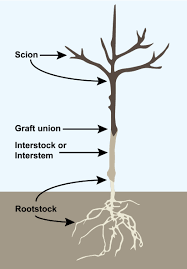
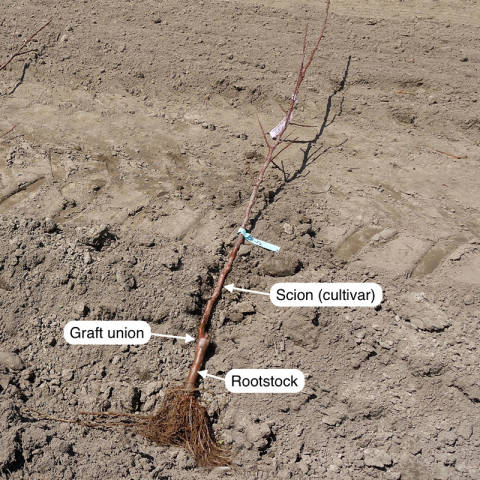
Rootstock is the base and root portion of a grafted plant. It’s grafted onto the scion, which is the flowering or fruiting part of the plant, in order to create a new plant with superior qualities.
How are Rootstock Plants Chosen?
Rootstock plants must have a close relation to the scion in order for the graft to be successful. An apple rootstock cannot be grafted with a pit fruit like cherry, for example. Grafters look for naturally growing trees, a naturally occurring plant mutation, or a genetically bred plant to use as rootstock. And once a successful rootstock plant is identified, there is much rejoicing, as there are many more scion varieties available than rootstock ones.
Why do we use Rootstock?
Mostly to create very specific plant traits. Rootstock plants determine the longevity of the plant, resistance to pests and diseases, cold hardiness, fruit yield, and the size of the tree and its root system. Also, fruit trees grown from rootstock tend to produce trees that immediately fruit, rather than the 3-8 years it takes to get fruit from a tree grown from seed. Take a larger fruit tree, for example — when it’s grafted onto the rootstock of a dwarf fruit tree, the result will be smaller trees that home gardeners can grow in containers, and with an immediate fruit harvest.
What Kinds of Plants are used?
In the grafting world, it’s the fruit crops (citrus, apples, etc.) that pay close attention to rootstock, but other plants like roses and ornamental trees also use rootstock to produce new variations. Have you seen those Knockout rose plants that look like standard trees with a single trunk? That’s a result of grafting, not painstaking pruning. Citrus Dwarfing Rootstocks: Citrus growers worldwide are attracted to dwarfing citrus rootstocks because they are ideal for high-density plantations and are suitable for mechanized farming [5]. Dwarfing citrus rootstocks are well represented in research reports (Table 1). Higher plant densities promote greater productivity; generally, lower densities permit the harvest of larger fruits, which raises the price of fresh fruit on the market [6]. Dwarf trees have several advantages, such as a better yield, high density, and photosynthetic efficiency, which raises potential production. In this system, plants will be trained in the assigned space, facilitating numerous practices such as harvesting, scouting, and spraying. Additionally, high tree densities, in combination with adapted varieties, enable high-efficiency production techniques in many fruits [7]. It has long been believed that the ‘Flying Dragon’ trifoliate orange is the only true dwarfing rootstock in the citrus industry. Its commercial feasibility in tropical conditions has been established, particularly for more vigorous scion cultivars such as Persian lime and lemons. Mature ‘Flying Dragon’ trees are typically about 2.5 m tall in most scion varieties. Conversely, this tree grows slowly when grafted to navel oranges, requiring several years to produce a commercial harvest. Hence, employing a dwarfing rootstock that grows faster and produces more fruit than scions grafted to ‘Flying Dragon’ is needed. However, the extensive use of Flying Dragon with sweet orange scion has not acquired commercial importance in the major producing areas, where farmers generally prefer more vigorous rootstocks. As a result, most citrus breeding programs have developed new, alternative dwarfing rootstocks, and conventional cross- breeding has produced some promising genotypes and genetic transformation. Dwarfing by Chemical Treatments: Plant growth inhibitors are substances that slow down plant growth without altering developmental stages. Many species are regularly treated with chemicals to control their height. Plant growth regulators (PGRs), such as gibberellic acid (GA) biosynthesis inhibitors, are often used to limit excessive vegetative growth in various fruit crops, including apples, cashews, pomegranates, and citrus. In the 19th century, Aron treated ‘Minneola’ tangelos (Citrus paradisi Macf.) with 1 g·L −1 of paclobutrazol before summer growth; the average shoot length decreased by nearly 50%. Dwarfing by Using Interstocks: Interstock grafting is utilized in many fruit trees , including citrus trees, as a sustainable approach to controlling plant height, dwarfing traits, and fruit quality. According to previous studies, interstock and rootstock could be utilized jointly to overcome compatibility issues between the scion cultivar and rootstock. When the ‘Flying Dragon’ rootstock is used as an interstock, it causes a considerable reduction of scion growth with both ‘Troyer’ citrange and ‘P. trifoliata’ as rootstocks. Furthermore, compared to plants without interstock, the average size reduction is approximately 37%. However, using ‘Flying Dragon’ as a rootstock resulted in a 66% reduction in canopy growth compared with P. trifoliata and ‘Troyer citrange’ rootstocks. Moreover, similar findings have been documented that lemon trees grafted with interstocks have smaller size, peel, and albedo thicknesses. Furthermore, interstocks affect the growth morphology and photosynthetic characteristics of ‘Yuanxiaochun’ grafted plants. In addition, when Kumquat and ‘Ponkan’ mandarin were employed as interstocks, the ‘Yuanxiaochun’ scion cultivar displayed greater photosynthetic activities and higher rates of light and CO2 utilization. Interstocks influence the transport of water, nutrient uptake capacity, hormonal communication, and some other factors, and these interstocks influence overall plant growth, blooming, and fruiting. In addition, methods such as strangling, inarching, girdling, and grafting by budding are frequently employed throughout the interstocked-seedling production stages. Through stomatal and non-stomatal effects (girdling), these techniques can restrict photosynthetic carbon uptake and reduce transpiration. Dwarfing by Using Tetraploid Rootstocks: In citrus, tetraploid trees can be used for the diversification of rootstocks because they have more genetic variability because of new recombination possibilities and their capability to serve as dwarf rootstock. Tetraploids (4×), which result from incomplete mitosis of somatic embryos, might occur naturally or artificially in seedlings with diploid (2×) apomictic genotypes. Tetraploid rootstocks are characterized by shorter and thicker roots, which results in slower growth. Furthermore, tetraploidy affects phenotypic features such as leaf and root morphology, fruit quality, stomatal size, and density. These alterations may disrupt normal physiological processes. Tetraploid trifoliate orange rootstocks lowered scion canopy development and fruit yield; however, clementine’s sugar content, acidity, juiciness, and carotenoid content remained unaffected; hesperidin concentration increased, and this was only true for clementine scions grafted onto tetraploid rootstocks evaluated diploid and tetraploid plants derived from the same seed (‘Rangpur’ lime; C. limonia Osbeck), and found that polyploid seedlings were smaller than diploid plants. According to Syvertsen J, et al., the lowest growth rates reported in citrus seedlings obtained from tetraploid rootstocks are attributed to decreased transpiration rates due to a lower number of stomata. Variation concerning plant height was oticed, and the diploid plants presented higher growth than tetraploid plants. Moreover, tetraploid plants were smaller and grew more slowly. Dwarfing Mechanism of Scion Reduction: Grafting is an ancient horticultural practice that joins the aerial part (scion) with another segment (rootstock) to produce a new plant. Scion cultivars grafted with rootstock are the foundation of modern fruit orchards. Rootstocks influence the morphological, biochemical, and physiological characteristics of the scion portion [6]. Several studies have been conducted to investigate the rootstock-induced dwarfing effect; however, the associated mechanisms in citrus plants have not been fully explained. Scion vigor is known to be influenced by multiple factors, such as the transport of minerals, level of hormones, hydraulic conductance and anatomical studies. Therefore, it can be concluded from the literature that the impact of citrus rootstocks on scion growth and dwarfing mechanisms are mediated by numerous factors, including mineral uptake capacity, hormonal alterations, hydraulic conductance, and anatomical features. Dwarfing by Using Tetraploid Rootstocks In citrus, tetraploid trees can be used for the diversification of rootstocks because they have more genetic variability because of new recombination possibilities and their capability to serve as dwarf rootstock. Tetraploids (4×), which result from incomplete mitosis of somatic embryos, might occur naturally or artificially in seedlings with diploid (2×) apomictic genotypes. Tetraploid rootstocks are characterized by shorter and thicker roots, which results in slower growth [8]. Furthermore, tetraploidy affects phenotypic features such as leaf and root morphology, fruit quality, stomatal size, and density. These alterations may disrupt normal physiological processes. Tetraploid trifoliate orange rootstocks lowered scion canopy development and fruit yield; however, clementine’s sugar content, acidity, juiciness, and carotenoid content remained unaffected; hesperidin concentration increased, and this was only true for clementine scions grafted onto tetraploid rootstocks. Allario, et al. [9] evaluated diploid and tetraploid plants derived from the same seed (‘Rangpur’ lime; C. limonia Osbeck), and found that polyploid seedlings were smaller than diploid plants. According to Syvertsen, the lowest growth rates reported in citrus seedlings obtained from tetraploid rootstocks are attributed to decreased transpiration rates due to a lower number of stomata. Variation concerning plant height was noticed, and the diploid plants presented higher growth than tetraploid plants. Moreover, tetraploid plants were smaller and grew more slowly. Type of Dwarf Rootstock: Dwarfing rootstocks produce a mature tree with a height of no more than 2.5 m, in combination with any scion cultivar, regardless of environmental influences. The vigor of citrus trees (Citrus spp.) is affected by the canopy/rootstock combination, soil, and phytosanitary conditions. Bitters W, et al. proposed a classification in which a tree taller than 6.0 m was used as the standard. Sub-standard, semi-dwarf, and dwarf plants had a reduction of 25%, 50%, and 75%, respectively, regarding the standard. Another classification was proposed by Castle and Phillips based on plant height or volume of scions into four different categories, such as standard plants: dwarf, semi-dwarf, semi-standard, and standard plants. Dwarf and semi-dwarf plants are 40% and 40–60% of the standard size, respectively. Semi-standard plants have 60–80% of the size of standard plants. On the other side, the term standard refers to plants having 80–100% of the standard size. Tree Size and Vigor: Rootstocks significantly impact the physiological, biochemical, and molecular characteristics of the scion cultivar. The reduction of scion growth due to rootstock is a fascinating phenomenon in studying fruit trees. Previous studies have demonstrated that the Salustiana scion cultivar grafted on ‘Rough lemon’ rootstock had the most extended primary shoot length, greater scion trunk diameter, and vigorous root morphology compared with less vigorous rootstocks. Additionally, plants grafted onto vigorous rootstocks have better nutritional properties. The ‘Shatangju’ mandarin scion cultivar grafted onto the ‘Fragrant orange’ and ‘Red tangerine’ rootstocks displayed dwarfing traits with the shortest shoot length, lowest trunk diameter, and shortest internodal length. In another study, the root system of ‘Rough lemon’ rootstock was shown to be vigorous with increased root projected area, root volume, surface area, and the number of forks and points; however, the ‘Carrizo’ rootstock displayed lower values of root morphological traits. Recent experiments reported that the ‘Shatangju’ scion cultivar grafted onto the ‘Flying Dragon’ rootstock encouraged short-stature trees. In contrast, trees grafted with other rootstocks, such as ‘Shatang mandarin’, ‘Goutou sour orange’ and ‘Sour orange’, grew taller and wider and had more vigorous plant growth. According to the research mentioned above, the vegetative growth of scion cultivars is significantly influenced by citrus rootstocks. Additionally, using dwarfing rootstocks permits high-density planting, which boosts yield and leads to optimal use of water and nutrients.
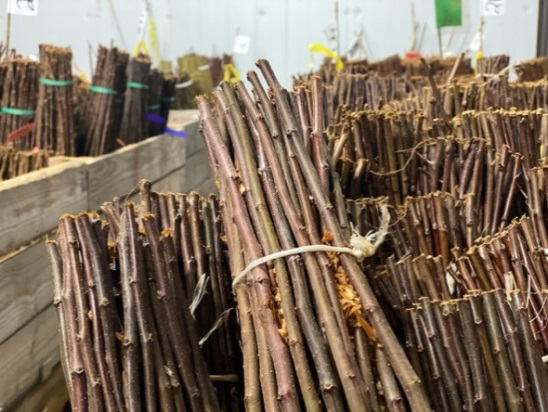
Precocity: Prominent features imparted by dwarfing citrus rootstocks are a decrease in tree size and precocity (early flowering and fruiting). Dwarfing rootstocks are typically connected with precocity, while vigorous rootstocks delay fruiting. Conversely, the performance of the fruit trees is linked to a proper balance between fruiting and vegetative growth because excessive vegetative growth lowers the total yield and fruiting. Rootstocks that encourage scion precocity are needed for early crop production. For instance, dwarfing citrus rootstocks limit tree size and increase yield production and precocity. ‘Mandared’ trees grafted onto C22, C57, and C35 rootstocks bear fruit one year earlier than other tested rootstocks. Furthermore, ‘Mandared’ trees grafted with C22 rootstock demonstrated yield precocity and higher yield efficiency than C22 rootstock. A lowered canopy volume of trees grafted on C22 rootstocks has been shown in previous studies, and could be an advantage for new plantings with higher densities. 5. Planting Density for Citrus Rootstocks A high-density planting system is an innovative agrotechnology that enhances yield by managing more plants in a given area. In addition, the appropriate plant density should be maintained for maximum yield and good-quality fruit. Citrus trees in a grove compete for resources such as water, nutrients, and light. As the distance between trees decreases and resources become more limiting, competition increases, and there are notable tree responses. A distance of 5–7 ft (1.52–2.13 m) is recommended between plants grafted onto Flying Dragon rootstock despite its limited commercial use in Florida. In Southeast Brazil, 4–5 m row spacing and 1.5–2.5 m plant spacing are advised for the Flying Dragon rootstock. In Japan, orchards of Wase satsuma mandarin with a density of up to 10,000 plants ha−1 were evaluated via long-term tests. Recent research conducted in India with Nagpur mandarin on Rangpur lime rootstock determined that a high-density planting was regarded as one that included between 555 and 625 plants ha−1 and that an ultra-high-density planting was considered as one that contained between 1250 and 2500 plants ha−1. Therefore, long-term experiments will be needed to examine commercial citrus cultivars with dwarfing rootstocks to determine optimal plant density under modern production circumstances.
Use of Rootstock in Fruit Crops
A grafted or budded plant can produce usual patterns which may be different from what would have occupied if each component part of graft age viz. root stock and scion were grown separately or when it is grafted or budded in other types of rootstock. Some of these have major horticulture valve. This very inspect of rootstock in the performance of a scion cultivator or vice versa is known as stock scion relationships.
Effect of Stock on Scion Cultivates: • Size and Growth Habit: In apple, rootstock can be classified as dwarf, semi dwarf vigorous and very vigorous rootstock based on their effect on a scion cultivator. If a scion is drafted on dwarf rootstock the graft combination will be dwarf while he same cultivar grafted on very rootstock would grow very vigorously. In citrus, trifoliate oranges. On the other hans, in mango all plants of a given variety are known to have the same characteristic canopy shape of the variety despite the rootstocks being of seedling origin. But recently, rootstock of kakarady, olour have been found to impart dwarfness in the scion cultivators. Guava cultivars grafted on psidium puminum are found to be dwarf in statue.
• Precocity in Flowering and Fruiting: The time taken from plating to fruiting precocity) is influenced by rootstocks. Generally fructing is influenced by rootstocks. Generally fruiting precocity is is associated with dwarfing rootstocks and slowness to start fruiting with vigorous rootstocks. Mandarins, when grafted on Jamberi rootstock are precious than those grafted on sweet orange or sour orange or acid lime rootstock.
• Fruit Set and Yield: The rootstock directly influence on the production of flowers and setting fruit in oriental persimmon (diospyrous kakij cv. Hichiya). When it is grafted on D. Lotus I products more flowers but few only mature but when D. Kakij is used as the rootstock, the set is more. The influenced of rootstock on the yield performance or cultivar has been well documented in many fruit crops. Acid limes budded on rough lemon register nearly 70 percent increased yield than those budded on troyer citrange, Rampur lime or its own rootstock. Sweet orange var. satngdi budded on kichili rootstock rootstock gave higher yield than on Jamberi or on its own seeding (South India).
• Fruit Size and Quality: Sathgudi sweet oranges grafted on gjanimma rootstock produced large but poor quality fruit, while on its own roots they produced fruit with high juice content and quality. The physiological disorder ‘granulation’ in sweet orange is very low of grafted on Cleopatra mandarin seedling, on their hand rough lemon seedling, stocks induced maximum granulation. The physiological disorder ‘black end ‘in Barlett Pear did not appear if Pyrus communis was used as the rootstock Ehen P. pyrisfolia was used as the rootstock. This disorder appeared, affecting fruit quality.
• Nutrient Status of Scion: Rootstocks do influence the nutrient status of scion also. Sathgudi sweet oranges trees have a better nutrient in the leaves when on its budded on C. volkarminriana rootstock than on its own rootstock or Cleopatra mandarin stocks.
• Winter Hardiness: Young grape fruit tree on Rangpur lime withstand winter injury better than on rough lemon or sour on orange. Sweet orange and Mandarins on trifoliate were more cold hardy.
• Diseases Resistance: In citrus considerable variability exists among the rootstock in their response to diseases and nematodes. For instance, rough lemon rootstock is tolerate to tristeasa, xyloprosis and exocorita is tolerant to gummosis but susceptible to exocorita virus disease. Similarly guava varieties grafted on chinse Guava, resist wilt diseases and nematodes.
Ability to Resist Soil Adverse Conditions: Among the citrus rootstocks trifoliate orange exhibits poor ability to resist excess soil moisture or excess boron in the soil. Myroblam plum rootstock generally viz, peach, appreciator almond.
Effect of Scion on Root Stock:
- Effect on Root System of Stock: In apple it has been found that if apple seedling were budded with the "Red Astrochan" apple the rootstock produced a very fibrous root system with few top roots. On the other hand, if scion cultivar is less vigorous than the rootstock cultivar the rate growth and the dry ultimate size of the tree is more determinate by the scion rather the rootstock.
- Cold Hardiness of the Rootstock: Cold hardiness of citrus roots is affected by the scion cultivar. Sour orange seedling budded to 'Eureka' lemon suffered much more from winter injury than the unbudded seedlings.
- Age of Root Stock Seedling: Young mango rootstock seedling (6 month to one year old) were found to put forth inflorescence when the branches from old trees are inarched which will be attributed to the influence of scion on the rootstock.
- Incompatibility: Certain rootstock and scions are incompatible; therefore, the graft union between these two will not normally take place.
- Kind of Plant: Some species like oats are difficult to graft but apple and pears are very easy in predicting a successful graft union.
- Environmental Factor During and Following Grafting: There are certain environmental requirements which must be met for callus tissue to develop and heal the graft union.
- **Temperature has a pronounced effect on the production of callus tissues. An optimum temperature as essential for the production of callus tissue. In most of the temperature fruit crops callus production is retarded after 1000 F.
- **Relative humidity must be high or maintaining a film of water against the callusing surface is essential to prevent these delicate thin walled parenchymatous calls from drying.
- Presence of high Oxygen content near this surface is essential.
- Growth Activity of Stock Plants: Some propagation methods such as "T" budding and bark grafting depend upon the bark grafting depend upon the bark 'spipping' which means the cambila cells activity dividing and producing young thin walled cells on the side of the cambium. These newly formed cells separating readily from one another as the book slips.
- Propagation Techniques: Sometimes the technique used in grafting is so poor that only a small portion of the causal regions of the stock and scion are brought together. This measurement in its failure of the graft union.
- Importance of Rootstocks in Fruit Crops: The choice of rootstock is very important as it determines the suitability of the tree for the position and the form in which one intend to grow it.
- As part of the tree, the rootstock influences many factors in addition to tree size, particularly productivity, fruit quality, pest resistance, stress tolerance, and ultimately profitability.
- A rootstock primarily provides a reduction in juvenility and tree vigor, thus, trees propagated with a rootstock combined with a pathogen-free scion bring a much improved degree of uniformity and consistency to an orchard.
- Rootstocks have also many characteristics that contribute in positive ways to the performance of a fruit tree.
- Further, the rootstocks influence various horticultural traits and provide tolerance to pests and diseases and certain soil and site conditions that contribute significantly to orchard profitability.
- A successful rootstock should have compatibility with the scion cultivar onto it.
- Rootstocks provide growers with useful tools to manipulate the vigor and production of orchard trees.
- Effects on tree size, fruit quality, precocity, fruit production and maturity are achieved through complex interrelationships between roots and canopy of the plants.
- Rootstocks directly affect the ability of plants to take up water and nutrients and significantly alter the pattern of canopy development and photosynthesis.
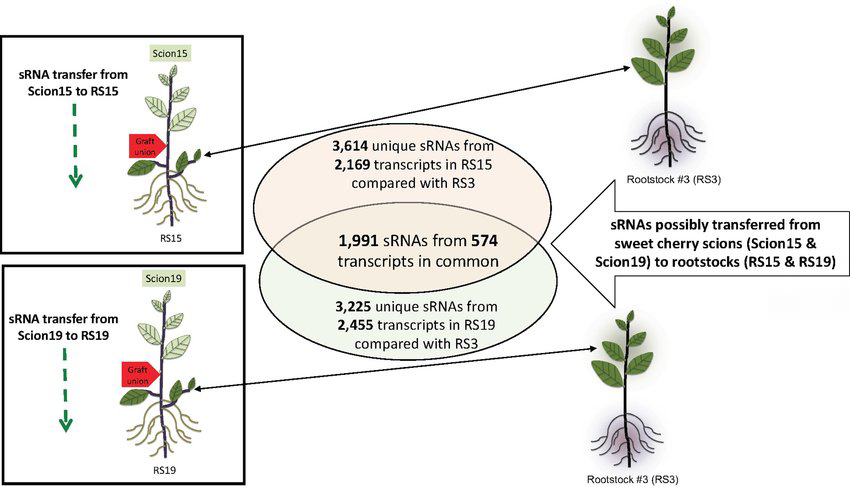
Figure 2: A diagram showing the Pipeline of Determining Scion-to-Rootstock Transferred sRNAs Transgenic breeding CASE STUDIES Mango Dayal, et al. studied the effect of rootstocks on growth, yield and physiology of mango cultivars. Rootstock K-5 inhibited canopy volume (CV) of Pusa Arunima, Pusa Surya and Dushehari, while Olour had an inhibitory effect on CV of Amrapali and Mallika. Kurakkan rootstock promoted highest yield in Amrapali and Pusa Surya, while both Kurakkan and Olour for PusaArunima; and K-5 and Kurakkan for Mallika seem to be more productive. Pandey, et al. observed effect of salinity stress on growth and nutrient uptake in polyembryonic mango rootstocks. Based on overall performance and leaf scorching, it could be said that salinity tolerance increased in the following order Chandrakaran<Moovandan<Bappakai<Nekkare<Kurukkan<T erpentine
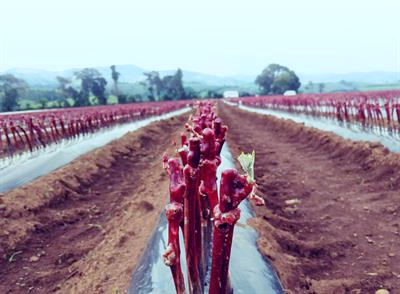
• Different Rootstocks of Stone Fruits: Different rootstocks have been reported for different problems in stone fruits. Additionally, many “problem” sites have more than one limitation and require that a new rootstock incorporate resistance to multiple problems for successful adaptation. In many cases, new rootstocks are probably best suited for regional or prescription/ niche planting rather than broad use over a large industry. Regional testing is the only way to determine each rootstock’s best adaptation. Priorities vary from one stone fruit crop to another. Several studies have shown that the rootstock requirement for apricots (P. armeniaca) and plum (P. domestica, P. salicina) are similar to the rootstock requirement of peach. For sweet cherry (P. avium), the first and foremost need in rootstocks is for size reduction followed by increased scion precocity and compatibility so sour cherry (P. cerasus), which has low inherent vigor (compared to sweet cherry) can be used as a rootstock for sweet chery. Fortunately, many stone fruit species can be budded onto other Prunus species. As a result, peaches, plums, apricots and almonds (P. amygdalus) often can be budded onto rootstocks developed for each other. In this way, progress made in developing water-logging tolerant rootstocks for plum also can be used advantageously as a rootstock for peaches, apricots or almonds. Not all stone fruit scions are compatible with available Prunus rootstocks namely: P. cerasifera, P. cerasiferax P. munsoniana, P. domestica, P. insititia, P. americana, P. pumila, P. besseyi, P. spinosa, P. dulcis, P. amygdalusx P. persica, P. insititiax P. domestica, P. armeniaca, P. salicina, P. persica x P. davidiana and P. amygdalusx P. neared (P. persica x P. davidiana) used as rootstocks for peach, plum, apricot and almond in different countries. Wild forms of peach, apricot, plum and almonds are also used as rootstock in India depending on varietal graft compatibility and soil types. Almond as rootstock shows better resistance to limestone and drought conditions, and peach induces tree vigour and nematode resistance, whereas, different plum species as rootstock are more resistant to water- logging and various diseases. Peach almond Titan Hybrids (Titan almond x Nemaguard hybrid seedling) namely: Red and Green Leaf Titan are extremely vigorous, resistant to nematode, tolerant to calcareous soil and cold. Guardian is another peach rootstock which exhibits nematode and peach tree short leaf resistance and moderatly cold hardy. Bailey is another hardy peach rootstock. Studies have suggested that a wide range of Prunus rootstocks resistant to nematode which includes Argot, P.S. Series Cadaman, Ishatara, Marianna 2624 and Garnem. In other countries, wild apricot selections namely: INRA Manihot and North African wild apricot are commonly used as rootstock. Apart from wild biotypes, seedlings or clonal selections of different species which are used as root stocks are Royal, Higgith, Siberian C, Rubira, Harrow Blood, GF 677, Marianna series, Myrobalan series, Damas GF 1869, Rutger’s Red Leaf, St. Julien series, Myram, Nemaguard, Nemared, Lovell, Pixy, Citation, Brompton, Pershore, Julior, Flordaguard etc. Seeds of P. cerasoides easily germinate and commonly used as seedling rootstock for sweet cherry in India. P. cornutais a very good rootstock for cherry and has been found to be compatible. Mazzard seedlings and F/12 produce larger tree as rootstock having longer life span. Mahaleb induces precocious bearing on scion cultivars and gives very good performance on light textured sandy to sandy loam or calcareous soil and even under water stress condition. Trees on these rootstocks are better in hardiness, survival and yield in comparison to Mazzard and Stockton Morello. In some countries, Mahaleb seedlings such as CEMA (C500) and Korponay seedling are commercially used. A new series under P. cerasus was raised from seeds of ‘Weiroot 11’ namely: 53, 72 and 158. Many rootstocks are in use in different countries evolved from P. cerasus namely: Edabriz, Weiroot 10, Weiroot 13, Weiroot 53, Weiroot 72 and Weiroot 158. Some other rootstocks are Gisela 5 (P. cerasusx P. canescens), Giesela 6 (P. cerasusx P. canescens), LC-52 [P.cerasusx (P.cerasusx P. maackii)], Colt (P.avium x P. psedocerasus) and OCR and CAB series. Graft union success is evaluated by the vigor, productivity and longevity of the scion. Some rootstocks might have undesirable influences on the scion including reduced fruit size, delayed leaf growth, and delayed ripening. Typically, several years after peach scions are grafted onto plum rootstocks the graft union develops a “shoulder” and trees topple over in high winds. Other signs of incompatibility include low scion vigor, shoot dieback, premature leaf drop, or excessive root suckering. Major portion of the total stone fruits production in Himachal Pradesh is confined mainly to the mid hill region falling in the altitude range of 1000–1700 meters above mean sea level where the summer are moderately hot (31.8 to 34.80C) during May-June and winters are cold (2.4 to 3.70C) during December– January. The average annual rainfall ranges from 100-130 cm, 90% of which is limited to two months of the monsoon (July– August) and during the rest of the year plants remain under water stress. Most of the orchards are on sloppy land where irrigation is difficult to practice and due to scarcity of water and uneven distribution of rainfall throughout the growing season drought conditions are commonly prevalent, which results in poor fruit set, heavy fruit drop and sometimes even cause the death of the plants. Like majority of fruit crops, stone fruits are also multiplied clonally by grafting the scion cultivar on the desired rootstock and beneficial effects of rootstock on the grafted plant. Wild relatives of the stone fruits e.g. wild peach (Kateru), wild apricot (Chulli) and Behmi have remained the first choice as rootstock in case of stone fruits on commercial level and have adapted in this region for ages. Thus, in India the productivity of peach, plum and apricot is 8.10 tonnes/hac, 5.7tonnes/hac and 4.17 tonnes/hac respectively which is considerably low as compared to other countries where these fruits are grown commercially. Non-availability of good rootstocks suitable for the local climatic conditions for mid hills of Himachal Pradesh is one of the major reasons for the low productivity of these crops. Since there is huge variations available in form of wild peach (kateru), wild apricot (Chulli) and Behmi from which suitable clonal rootstock could be evolved which are suitable for the local climatic conditions and benefit the orcharding enterprise to a larger extent.
Apple Rootstock
Growers often ask which the ‘best’ apple rootstock is. The replant tolerant Geneva rootstocks (G.11, G.41, G.214, G.935, G.210, G.969, and G.890) are much better than the available standards of Bud 9, Mark, M.9 clones, M.26 and the semi-dwarf rootstocks. But, which rootstock you use depends on your site, goals and scion. Years of experience will show us which scions will do better on which rootstocks in a given site. Try multiple rootstocks in your site to see which combination is better in your particular location. Here are some considerations from the Washington State Tree Fruit Research Commission trials and recent tour.
Rootstock & Scion relationship: England’s East Malling Research station gathered selections and determined trueness to name. Finding many misnamed collections of plant materials Dr. R. Hatton properly divided the 24 selections found and assigned them a Roman numeral. These numerals were not in order by tree size and thus M.9 is smaller than M.2. Of this group M.9, M.7, M.2, M.8 and M.13 have been commercially important in the US. In succeeding years M.26 and M.27 were developed from controlled crosses. In 1917 the John Innes Institute of Merton England joined with East Malling Research Station with an effort toward developing woolly apple aphid resistant rootstocks. Of these Malling-Merton rootstocks, the MM.106 and M.111 are still widely used. In the 1960’s East Malling and Long Ashton research stations in England worked to remove viruses and the resulting incompatibility problems from rootstocks. The resulting ‘cleaned up’ rootstocks are the EMLA group. Since this time most modern rootstocks have had viruses removed. New rootstocks are being developed the first of which was the Budagovsky series designated Bud or B. The newest rootstocks being developed and released are the Geneva series from Cornell University’s breeding program.
Washington Tree Fruit Research Commission Trial
The Washington Tree Fruit Research Commission (WSTFRC) installed Geneva rootstocks trials in three locations with multiple scions in order to evaluate rootstocks in multiple soil types and growing conditions. Trees are managed by growers to approximate their normal growing practices. Trees are now in their third leaf. This fall, fruit evaluations will be conducted, allowing for observations on fruit yield and quality. This trial is meant to complement the national NC140 rootstock trials.
Brief comments on rootstocks in TFRC trial listed from smallest to largest:
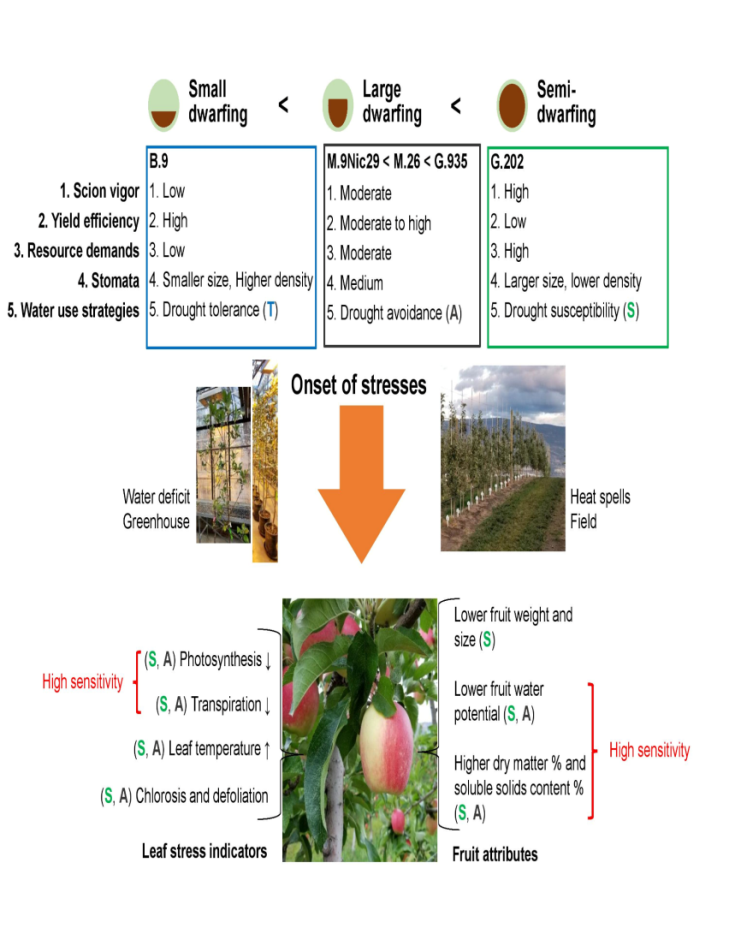
Smallest size: Bud.9 is a newer dwarfing rootstock bred in the Soviet Union from the cross of M.8 x Red Standard (Krasnij Standart). Trees in this series are 15-25% smaller than M.9 depending on the cultivar and site. B.9 appears to be resistant to collar rot and very cold hardy.
Small size: Malling 9 (M.9) is the industry standard for dwarfing rootstocks. Numerous clones of M.9 are available from nurseries including the M.9.337 clone used in this trial. Size/vigor: In trials, M9.337 is considered to be 30% of seedling with the same scion and site. Pest/disease resistance: M.9 337 has low replant resistance, no fire blight resistance, no wooly apple aphid resistance and high crown/ root rot resistance.
G.11 has the most history of the Geneva rootstocks. For example, McDougall and Son’s Legacy Orchard has 8th leaf trees on G.11 that are performing better than M9.337. Size/ vigor: Geneva 11 is considered an excellent M.9 replacement. It does well in loam and clay-loam soils. In sandy soils, it must be planted closer together in order to fill space. Disease/pest resistance: G.11 is not woolly apple aphid resistant. Replant resistant. Crown and root rot resistant. Moderately resistant to fire blight1. Nursery performance: Stable. Disadvantages: Less tolerant to growing in sandy soil.
G.935 is the most precocious of the Geneva series in these trials. It is a 1935 cross of Ottawa 3 and Robusta 5. Size/ vigor: Semi-dwarf reported to be slightly larger than M.26. Production efficiency rated equal to M.9. Disease/pest resistance: It is not resistant to woolly apple aphid. It has fire blight and crown rot resistance. Nursery performance: Very good. Disadvantages: Some new plantings have experienced decline. There is no confirmed evidence of hypersensitivity to viruses. Currently researchers are investigating the cause of the decline. Viruses are under suspicion in the decline of G.935 trees based on some association between declining trees and the presence of viruses. In New York both apple chlorotic leaf spot virus and apple stem pitting virus were present in declining trees on G.935. However, in Washington some declining trees tested have tested positive to one or the other virus and others have not. Apple chlorotic leaf spot virus and apple stem pitting virus are extremely common in Washington and often cause few symptoms. A new luteovirus is also being tested. Remember, association is not causation and until further research is conclusive we cannot say what is causing the decline. Research trials are underway at both Cornell and Washington State University to address the decline. Growers should be extremely cautious with G.935 until this issue is further understood.
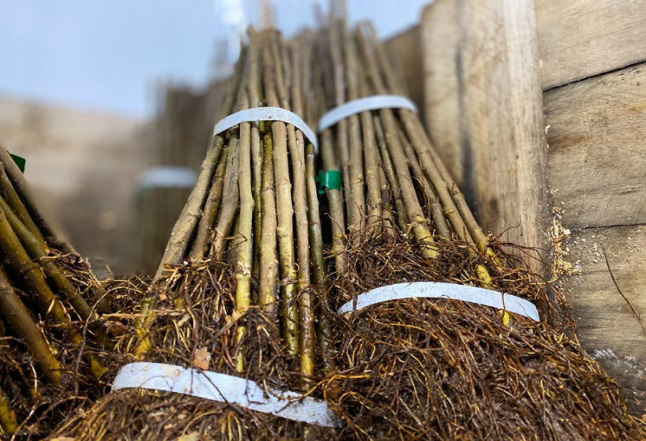
Figure 5: A semi-standard, rugged apple rootstock. Also known as Malling-Merton 111, MM.111 EMLA, and EMLA 111.( MM.111/MM.111 EMLA is a semi-standard rootstock, a cross of Malling 2 and Northern Spy that produces trees about 85% of full size. Its major strengths are pest and disease tolerance (collar rot, fireblight, and WAA), and its tolerance for heavy, wetter soils. It produces upright and vigorous trees that are cold hardy and self-supporting. Unfortunately, MM.111 is slow to come into production and it is not productive. It is quite prone to burr knots. We have had consistently good results using MM.111 as the base for a 3-piece tree–the classic interstem. Anchorage remains good in this scenario and productivity issues are resolved. Spur-type Delicious trees have performed well, and Tomato Ringspot Virus has not been a problem).
G.214 is in the M.9 337 size class with fireblight and wooly apple resistance. Size/vigor: G.214 is similar in size to G.11 and G.41 in the M9.337 size class. In TFREC trials it had reasonable croploads in 2nd and 3rd leaf trees indicating potential for precocity. In all three blocks, trees were above the top wire. It filled canopy and grew well. Disease/ pest resistance: Replant and fire blight resistant. Wooly apple aphid resistant. Nursery performance: It is nearing commercial availability. Disadvantages: Availability is low due to prior problems with mislabeling of foundation material shipped to tissue culture companies.
Medium Full Dwarf Rootstocks
M.9 Nic 29® is 20-25% larger than M.9 337 (25 to 40% of seedling). Nic 29® is a Malling 9 type rootstock. Size/vigor: It usually exhibits a better root system than M.9 337 or M.9 EMLA. Of the various types of Malling 9, Nic 29® exhibits stronger vigor, yet is still a full dwarf. The rootstock is both precocious and productive, usually fruiting in second or third leaf. Disease/pest resistance: Highly susceptible to fire blight. No wooly apple aphid or replant resistance documented. Disadvantages: Root death from fire blight infections before scion symptoms are present.
G.969 is in the large M.9 group of dwarfing rootstocks in Washington trials. Size/vigor: It is classified as having growth between M.7 and MM.106 in prior Cornell trials. More recent trials from Terrence Robinson at NYSAES Geneva, have transitioned the G.969 classification to significantly smaller. In TFRC trials it was in the size class of Nic 29. Disease/ pest resistance: Fire blight, crown rot, and woolly apple aphid resistance. Nursery performance: Excellent, best of the Geneva family. Disadvantages: Lack of experience with scions, sites, and growers.
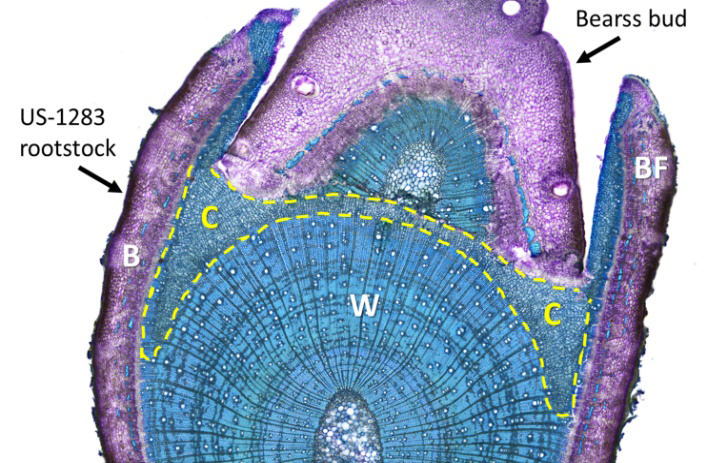
G.935 is the most precocious of the Geneva series in these trials. However, some new plantings have had problems that might be virus sensitivity and it should only be planted with fully virus screened scions until the issue is further understood. It is a 1935 cross of Ottawa 3 and Robusta 5. Size/vigor: Semi-dwarf reported to be slightly larger than M.26. Production efficiency rated equal to M.9. Disease/pest resistance: It is not resistant to woolly apple aphid. It has fire blight and crown rot resistance. Nursery performance: Very good. Disadvantages: Virus sensitivity was not demonstrated in known virus trials. Should be planted with virus-free scions or scions with several years of good results on G.935.
Largest: G.890 is a larger rootstock. It seems able to scavenge for water and nutrients making it a successful replacement tree rootstock. It is considerably more precocious than Malling stocks of similar vigor. Size/vigor: G.890 and G.210 are the most vigorous of the Genevas. Size is similar to an M.7 but with higher and earlier production. In the TFRC trial, G.890 with fruit was bigger than G.210 without fruit. Resistance: Resistant to fire blight, crown rot, and wooly apple aphid. Nursery performance: Very good. Disadvantages: It is vigorous.
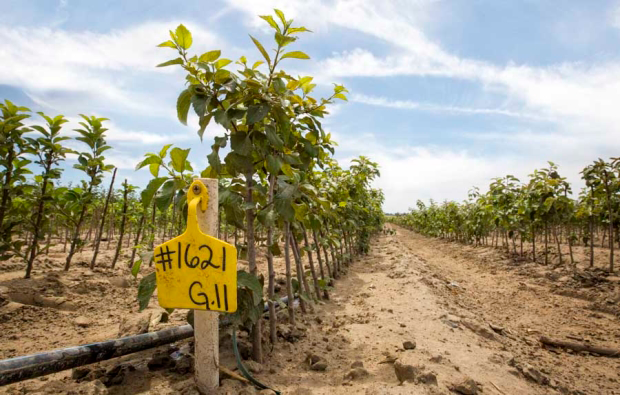
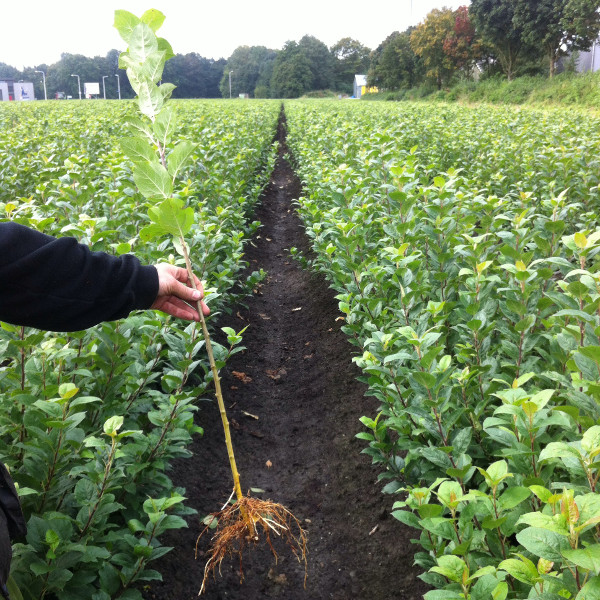
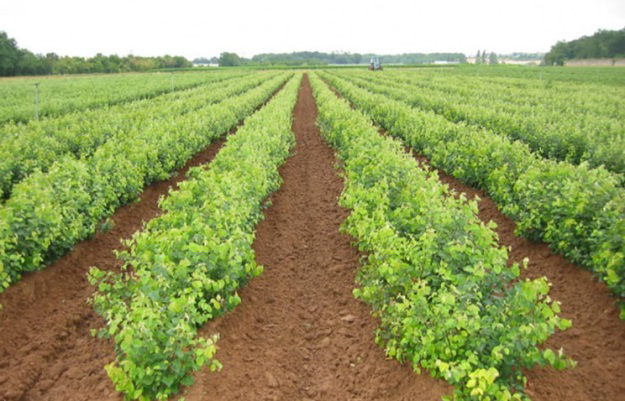
The majority of the rootstock production from Fruit tree nursery J. Morren are represented by the M9T337 rootstocks. Also most of the trees grown in the nursery, are made on M9 rootstocks. The M9 is available as one year old rootstock, from own stoolbed (mother garden), and as two year old rootstock. The M9 rootstock is weak to moderate vigorous. The malus M9 are widely used rootstocks for high density orchards on fertile grounds. Trees grown on this very important dwarf apple rootstock are relatively small in height. A support system, stakes, are required. First apple production from fruit trees on M9 can be expected in the second year after planting. The rootstocks are usually graded in size categories (in mm) 4/6, 6/8, 8/10, 10/12 and 12+. On client request we can do specific grading, for example 8/12.).
• Tips for working with G.41: G.41 has had some problems with trees breaking at the union of the scion and the root. This brittleness is associated with high rigidity. Most of this injury happens in the nursery but at the field day, Auvil explained some ways to prevent injury at planting. First, “Don’t buy big trees.” Bigger trees are more susceptible to breakage. “Buy ½ inch whips if you can.” “½” whips have very few problems and can be planted mechanically,” Auvil explained. If you do buy larger caliper trees it is important to handle them gently. Build your trellis before you plant. Clip your trees to the trellis as you go and be gentle as you handle the bundle. “Instruct your crew to lift trees with two hands,” Auvil reminded the group. Damage can occur as they untangle the trees. The NC-140 group has also found that BA applications directly to the graft union increased break strength2. Apogee also increased strength but reduced scion growth.
• Freestanding Trees: Participants asked which rootstocks could be freestanding trees. Auvil reminded them that free standing is a cultural practice, not a rootstock trait. Any rootstock in the trial would have to be headed back multiple times to create a free standing tree. Rootstocks that have good anchorage can be cultivated into free standing. Pruning, especially to develop free standing trees, will significantly delay fruiting.
• Availability: G.11, G.41, and G.935 are widely available, however demand is larger than supply. Other Genevas are available in smaller quantities and by pre-arranged contractual agreements. At the present time most of all the dwarfing rootstocks have pre-arranged contractual agreements in place. It is best to reserve your rootstock for the future as soon as possible and then determine the variety you want on it prior to budding. G.41, G.935 and G.11 have the most plant material available of the Geneva’s .So, here’s a rundown of the latest news on rootstock choices for Washington from a couple of experts: Tom Auvil, research horticulturist with the Washington Tree Fruit Research Commission in Wenatchee, Washington, and Dr. Gennaro Fazio, plant geneticist with the U.S. Department of Agriculture in Geneva, New York.
• Mark: The Mark rootstock starts growth uniformly and shows excellent horticultural traits in propagation, and growers who have their own nurseries have found it to be a very high-performing rootstock, Auvil said. Like other dwarf rootstocks, Mark is not drought tolerant, especially in the arid West, and tends to have more problems when planted as a finished tree when compared to bench grafts or sleeping eyes.
• Budagovsky 9: In recent years, Bud 9 or B.9 has grown in popularity, largely due to its winter hardiness and compatibility with most cultivars. It’s shown to be more dwarfing than M.9 varieties. B.9 doesn’t like sandy soils and has not been a very reliable replant partner, but that can be overcome if more trees are planted, “as close as 18 inches,” Auvil said. B.9 is an excellent choice for scions that grow large fruit or have high vigor, but be warned: If you graft them, they will sucker.
• Geneva 65: A cold-hardy rootstock that is very resistant to fire blight and tolerant of crown and root rot, G.65 remains under review for its susceptibility to latent viruses and replant disorders. Fazio compares G.65 to a Malling 27 as a super-dwarfing rootstock suitable largely for vigorous varieties or a pedestrian orchard, though G.65 has some disease benefits over M.27. It’s not generally available in volume.
• Malling 27: M.27 is another rootstock that doesn’t have large volumes of commercial availability, and it hasn’t been used much in Washington. It’s less advantageous for commercial production and more likely to be utilized for very special uses, Fazio said, such as a pedestrian orchard or containerized trees.
• Geneva 41: G.41 tends to be associated with very large- caliper finished trees — it’s one of the high-performing Geneva rootstocks — but half-inch trees seem to have fewer problems than 5/8-inch or larger. Why? Because G.41 has had challenges with union breakage and needs to be handled with care, more so than other cultivars. Fazio said G.41 has this problem only with certain varieties, but researchers are working to improve graft- union development. “The smaller you graft or bud the tree, the better the chance at getting homeostatic communication between the two,” he said.
• Malling 9 T-337: M9.337 is the global standard for rootstock and is the most widely planted cultivar in Washington. M9.337 shows tremendous compatibility with most scions, but its susceptibility to fire blight makes it a rootstock to avoid in areas where fire blight is a concern, Auvil said. Also worth avoiding: pairing M9.337 with fire blight susceptible scions that bloom early and for a long time, such as Cripps Pink and Jazz.
• Geneva 11: G.11 can be disappointing in its vigor, particularly in sandy or light soils. In good soils, G.11 grows very vigorously on nonbearing trees and grows large fruit. The rootstock seems to do well in nurseries, and some plantings back East have reached 25 years old and are still going strong, Fazio said. G.11 is not resistant to all the strains of fire blight, but compared to M.9, it’s resistant. “You’ll lose maybe a tree as opposed to a whole orchard,” he said.
• Geneva 16: Two words: virus sensitive. Even with certified wood. “We’ve had blocks that have had sustained tree losses over time. It’s relatively slow, but even a half a percent adds up over time,” Auvil said. “It can take three to four years from first symptom to final end,” he said. Fazio called G.16 one of the wonders that made beautiful, productive trees in the nursery. It’s still being used in the Southeast U.S. and in Minnesota’s breeding program, he said, but clean wood is essential.
• Malling 9 Nic29: This is the largest M.9 used in the West, but some nurseries have removed it from production due to its susceptibility to fire blight and replant disease. The rootstock tends to remain very vigorous, but works well with slow-growing scions. However, that vigor can create a late bloom, adding to those fire blight concerns.
• Malling 9 Pajam2: More vigorous than M.9, Pajam2 is productive with large fruit. Replant may be a bit of a problem, and fire blight is also an issue. A clone of the original M.9, this rootstock has similar characteristics of M.9 Nic29.
• Malling 9 EMLA: EMLA 9 tolerates most soil types, except dry, light soils in low rainfall areas. Its root systems tend to be a little more fragile, so take care when digging up or planting this cultivar, and it’s susceptible to fire blight. It also has similar characteristics to M.9 Nic29, but it’s been cleared of viruses.
• Geneva 935: Another high-performing Geneva rootstock, G.935 is a good rootstock for weaker varieties, such as Honeycrisp, with good fruit production. It’s tolerant of replant disease, but not woolly aphid resistant, and is commercially available.
• Geneva 969: G.969 has not been evaluated in the Northwest, though it’s the easiest to grow in a nursery of the entire Geneva family. In the East, it’s rated a very large tree and a high-performing tree. G.969 is the only cultivar in the Geneva family that stands up when it grows, rather than bend over like a raspberry bush. Fazio said G.969 will make weaker varieties shine. It is commercially available in limited quantities.
• Geneva 214: One of the high-performing Geneva
rootstocks, G.214 is the first of the Genevas known for being very replant tolerant. There have been a number of issues getting it into production — specifically, identity mistakes in propagation — but G.214 is finally headed to the stool beds. Washington trials have shown great stands with good transplant. The first group of 214 is available at some nurseries this year in limited quantity. Fazio said the new Washington variety WA 38, known as Cosmic Crisp, would do well on G.214.
• Geneva 210: Another high-performing Geneva clone, G.210 has done the best at an unfumigated research replant site in Wapato, Washington. “It’s been an excellent performer,” Auvil said. “It’s coming out of tissue culture, stool beds are starting to show some production, and availability will dramatically increase over the next two to three years.” Some limited availability now.
• Geneva 222: A good M.9-type cultivar that is somewhat commercially available, G.222 is a good choice in areas where fire blight is a concern. However, it’s not very replant tolerant. Fresh ground is good. There are limited quantities available.
• Geneva 814: G.814 has been shown to be virus sensitive and must be paired with clean scion wood. In a couple of trials with Gala in Washington, the rootstock has grown a box-size bigger fruit than G.214. It’s a rootstock that has a good balance of calcium, potassium and phosphorous, Fazio said, but the causal effects of large fruit size on bitter pit with this rootstock is not yet known.
• Budagovsky 10: A very cold hardy rootstock that is resistant to fire blight and easy to propagate with few side shoots, Bud 10 has not yet been widely used in Washington. Bud 10 is highly susceptible to replant disease, which means it doesn’t provide much improvement over bigger M.9 clones, Fazio said. It’s a rootstock researchers are still learning about in the Northwest.
- Malling 26: M.26 produces a significantly lower crop than M.9. In some locations, M.26 has shown very high susceptibility to crown rot, has relatively high susceptibility to fire blight and is among the worst rootstocks in terms of susceptibility to replant disease. “Don’t use it,” Fazio said. “It’s been a productive stock for certain things, but it’s done its job.”
- Geneva 30: A very hard cultivar to propagate, G.30 production is declining. Only one or two liner nurseries are producing G.30, Auvil said, and the rootstock has not proven itself horticulturally to be an extremely productive, large fruit rootstock. “But if you were a Gala grower, you’d love to grow Gala on G.30,” he said. “It’s just very hard to get.” Watch the graft unions in the first two years.
• Geneva 890: A commercially available rootstock that has wider distribution, G.890 will probably be competitive with G.41 in terms of tree availability and volume, Auvil said. Bitter pit is a concern, due to its high vigor, but G.890 seems to be an excellent replacement tree in difficult soils. Fazio also noted that the rootstock has shined in extremely harsh replant areas.
• Geneva 202: G.202 is a rootstock Auvil has removed from his lists because it produces one of the biggest trees, failing to “calm down” over time, yet is among the least productive rootstocks. The cultivar has been widely planted in New Zealand and is being sold in Mexico, but is not as well adapted to the Northwest.
• Malling 7 EMLA: This rootstock offers significant crop density issues, Auvil said, and blind wood is made much more severe. Fazio noted the rootstock is easy to propagate, but suckers a lot, is not fire blight resistant and not particularly productive.
• Malling 106 EMLA: A very difficult combination with vigorous scions like Granny Smith or Fuji, M.106 EMLA can show a lack of productivity. In addition, it’s the “canary in the mine” for crown rot, Auvil said, meaning it’s highly susceptible.
• Budagovsky 118: A very vigorous rootstock that values dry, sandy orchard sites but is adaptable to various soil types, Bud 118 is extremely winter hardy but is not replant tolerant. Productivity is an issue, as it tends to grow smaller fruit every other year and suffers annual bearing challenges, Auvil said. There also has been some bitter pit in fruit in Washington.
Pear Rootstocks
The majority of commercial pear trees are grown on rootstocks. Pear rootstocks impart characteristics such as vigor, precocity, disease resistance, and cold hardiness. The most commonly used rootstock worldwide is some selection of a Bartlett seedling, making it the “standard” rootstock. In rootstock trials, rootstock test scores are often expressed as a comparison to Bartlett characteristics. For example, the test rootstock may impart dwarf characteristics as 70% height compared to a Bartlett seedling tree. In North America, the most common Bartlett-type rootstock is OHxF. OH stands for “Old Home”, a name given to a seedling selection discovered in Illinois by Prof. F.E. Reimer of OSU. It was found to be resistant to fireblight, but was self-infertile. The “F” stands for Farmingdale, the town in Illinois that Reimer discovered the second Bartlett selection. Like OH, it had fireblight resistance, although not quite as good, but it was self-fertile. Old Home and Farmingdale were crossed by L. Brooks of Oregon and the resulting offspring were fireblight resistant, self-fertile, vigorous and had good cold hardiness, making it desirable as a rootstock and receiving a patent in 1960. Pear varieties growing on OHxF or any Bartlett seedling rootstock tend to be large, non-porous trees. In order to get trees that are more suited to high-density plantings, rootstocks with dwarfing traits and precocity need to be used. In many parts of the world, Quince selections are used as rootstocks. This combination will result in dwarfed growth and precocity. However, Quince is not compatible as a rootstock for many varieties of pear such as Bartlett, Bosc, Forelle, Packham, Triumph, Winter Nellis and Eldorado. For these varieties, the use of an interstock (intermediate graft section) must be used. Another problem with using Quince is that most varieties are not winter hardy making it a poor choice for the Pacific Northwest. However, there are ongoing trials at OSU testing potential Quince selections exhibiting good winter hardiness (Einhorn’s work).
| Advantages | Disadvantages | |
|---|---|---|
| CORNERSTONE (PP#21,248) Use with almonds and stone fruits. | Deep rooting red leaf hybrid. Better Phytopthora and drought tolerance than Hansen Good in high pH and resistance to iron induced chlorosis Good for heavy soils | Very vigorous clone. Will make a large tree. Still experimental with most peaches and nectarines Hasn’t been tested with all varieties. |
| GUARDIAN® (BY520-9) Use with stone fruits. | Resistant to ring nematode, a leading cause of Peach Tree Short Life (PTSL). Resistant to root knot nematodes. Fairly vigorous. | Used mainly in the Southeast United States. Unknown adaptability in other regions. |
| FLORDAGUARD Prunus persica peach seedling. Use with peaches. nectarines, plums, and apricots. | A low chill peach rootstock that causes early bud break of 3-5 days in some years. Resistant to root knot nematodes | Does not tolerate high pH soils |
| M-40 (PP#11,404) | A Marianna 26-24 selection that roots deeper and has less suckers. Good in wet soils. | Not compatible with all almond varieties Same as Marianna 26-24 |
| VLACH PARADOX NCB X English walnut hybrid seedling (grown from tissue culture). Use with walnuts. | A vigorous paradox cloned from a surviving tree planted in 1904. Chosen for its longevity, vigor and overall health Trees on this rootstock will be comparable to trees on paradox seedings. Vlach has shown less susceptibility to lesion nematode and slightly more resistance to crown gall and Phytopthora | |
| VX211 PARADOX (PP#21,179) | VX211 paradox is considered lesion nematode “tolerant” as it survives and grows vigorously in soils with high lesion nematode populations. The variety also shows average or superior vigor in nursery and preliminary field tests. | Variety has shown considerable promise in greenhouse and/or field test for reduced susceptibility to Phytophthora citricola |
| RX1 PARADOX (PP#20,649) | RX1 paradox is moderately resistant to Phytophthora and is currently being tested for response to nematodes. The variety also shows average or superior vigor in nursery and preliminary field tests. | Resistance to crown gall unknown |
| Controller 5* (CV K146-43) (PP#15,228) | A dwarfing rootstock that will reduce the size of the scion cultivar to bewteen 50 and 60% of the size of trees growing on Nemaguard rootstock | Moderately susceptible to root knot nematodes and probably not inherently resistant to numerous soil pathogens. |
| Controller 9* (CV P30-135) (PP#15,225) | A dwarfing rootstock that will reduce the size of the scion cultivar to between 90% of the size of trees growing on Nemaguard rootstock | Moderately susceptible to root knot nematodes and probably not inherently resistant to numerous soil pathogens. |
| GISELA® 5 (PP#9522) GISELA® 6 (PP#8054) GISELA® 12 (PP#9531) | Refer to Gisela Rootstocks for Cherries chart. | |
| M-9 EMLA-26 EMLA-7 EMLA-111 (apple layered cutting) | Refer to Apple Rootstocks chart |
Table 1: Rootstocks with their Advantages and Disadvantages.
| Rootstock | Root-Knot Nematode | Root Lesion Nematode Partylenchus Vulnus | Ring Nematode | Verticillium Wilt | Comments | |
|---|---|---|---|---|---|---|
| M. Incognita | M. Javinica | |||||
| Lovell (Peach) | Susceptible | Susceptible | Susceptible | Susceptible | Susceptible | Most commonly used where nematodes are not problem |
| Nemaguard (Peach) | Most are immune, some resistant | Resistant | Susceptible | Susceptible | Susceptible | Most common rootstock for peaches and almonds. |
| Guardian (BY520-9) | Resistant | Resistant | Moderate tolerance | Resistant | Unknown | A good choice of rootstock when planting back an old orchard site Used mainly in the Southeast United States. |
| Flordaguard | Resistant | Resistant | Susceptible | Susceptible | Unknown | Low-chill rootstock Does not tolerate high pH soils. |
| Nemared | Possibly more resistant than Nemaguard | Susceptible similar to Nemaguard | Very susceptible | Unknown | Very similar to Nemaguard More vigorous than Nemaguard | |
| Cornerstone (PP#21,248) | Resistant | Resistant | Moderate tolerance | Susceptible | Unknown | Increases in fruit size |
| Hansen 536 (Peach/ Almond Hybrid) | Immune | Immune | Unknown presumed susceptible | Unknown | Susceptible more than peach | Very vigorous, drought tolerant, may promote larger trees Will not tolerate excess water. |
| Controller 5* (PP#15,228) | Moderately susceptible | Moderately susceptible | Unknown | Moderately susceptible | Unknown | A dwarfing rootstock that will reduce the size of the scion cultivar to 50-60% of the size of trees on Nemaguard rootstock |
| CONTROLLER 9* (PP#15,225) | Moderately susceptible | Moderately susceptible | Unknown | Moderately susceptible | Unknown | A dwarfing rootstock that will reduce the size of the scion cultivar to 90% of the size of trees on Nemaguard rootstock |
| PLUM (Myrobalan 29C Cuttings) | Immune | Immune | Susceptible | Susceptible | Moderately susceptible | Common rootstock for heavy soils that tend to be wet |
| PLUM (Marianna 26-24 Cuttings) | Immune | Immune | Susceptible | Susceptible | Moderately susceptible | Common rootstock for heavy soils that tend to be wet |
| CITATION | Somewhat resistant | Somewhat resistant | Unknown | Unknown | Susceptible | Somewhat dwarfing |
| M40* PLUM | Susceptible | Susceptible | Susceptible | Susceptible | Unknown | Reduced sucker production Not compatible with all almond varieties. |
| MAZZARD (Cherry) | Immune | Immune | Susceptible | Unknown | Susceptible | Preferred rootstock in soils too heavy for Mahaleb |
| MAHALEB (Cherry) | Resistant | Susceptible but more tolerant than peach | Moderately resistant | Unknown | Susceptible | Trees may be slightly smaller Come into bearing sooner and have heavier fruit set than Mazzard |
| COLT (Cherry) | Unknown | Unknown | Unknown | Unknown | Unknown | Very vigorous |
| Northern California BLACK WALNUT (Seedlings) | Somewhat resistant | Somewhat resistant | Highly susceptible | Susceptible | Resistant | Common walnut rootstock in California. |
| PARADOX (Hybrid Walnut) | Unknown | Unknown | Variable average more resistant than Black | Susceptible | Resistant | Tend to be more vigarous than Black Common rootstock for heavy soils that tend to be wet |
| VLACH | Susceptible and tree is intolerant of nematode presence. | Unknown | Very vigorous deep- rooting. | |||
| VX211* (PP#21,179) | Some tolerance to nematode presence. | Unknown | Very vigorous | |||
| RX1* (PP#20,649) | Susceptible and tree is intolerant of nematode presence. | Unknown | Good vigor | |||
| WIP3* (clonal) | Susceptible and tree is intolerant of nematode presence. | Unknown | Tolerant of Black Line |
Table 2: Rostock’s resistant for Root knot Nematodes, Root lesion nematodes, Ring spots and Verticillium wilt.
| Cold Hardy | Soil Type Compatibility | Resistance | Replace- ment trees | Nursery friendly | Challenges | ||||||
|---|---|---|---|---|---|---|---|---|---|---|---|
| Smallest | Loams/ clay | sandy | Fire Blight | Re-plant | Crown/ root rot | Woolly apple aphid | |||||
| Bud 9 | Mod | High | None | High | Very Good | ||||||
| Small | M.9 337 | Good | |||||||||
| G.11 | Mod | High | Good | High | Sandy soil | ||||||
| G.41 | High | High | High | High | High | Fair | Breakage | ||||
| G.214 | High | TBD | TBD | High | High | High | High | Good | |||
| Med | Nic 29 | Low | Low | High | Good | ||||||
| G.969 | TBD | TBD | TBD | High | High | High | High | Excellent | |||
| G.935 | High | TBD | TBD | High | High | High | Good | Virus sensitivity | |||
| Largest | G.890 | High | TBD | TBD | High | High | High | High | Very Good |
Table 3: Cornell Trials G.11 Plants Inoculated with Fire Blight Developed 25% Infection under High Inoculation Pressure with One
Present Status of Rootstock in Fruit Crops
Rootstock for Tropical and Sub-tropical Fruits:
- Mango: In India, seed propagation, though not suitable for commercial orcharding, is still the chief method of multiplication of rootstocks. Use of non-descriptive mango stones for multiplication of rootstocks has led to enormous variation in the performance of mango clones in the orchards. Some attempts have been made to standardize the rootstocks for various scion varieties including the use of polyembryonic varieties. Most of the Indian varieties are monoembryonic but some varieties from South India are polyembryonic, namely, Olour, Bappakai, Muvandan, Chandrakaran, Mylepelian, Kitchner, Nekkare, Prior, Vellaikulumban, Peach, Starch and Kurukan which give true to type seedlings from nucellar embryos. However, large scale utilization of polyembryonic varieties has not been made so far and there availability in northern India is very poor. Efforts have been made to standardize rootstocks for different scion varieties. The results obtained with monoembryonic and polyembryonic rootstocks are inconsistent.
- Citrus: Citrus fruits are grown under varying agro- climatic conditions in all the states except in high altitude temperate regions. Rootstocks role in citrus industry is well known for its tolerance towards biotic and abiotic stress as well for increasing yield and quality. A wide variety of citrus rootstock are available, each having desirable attributes. A rootstock for citrus must be adopted to alkalinity, salinity and calcareous soils, should be resistant to Phytopthora, provide some measures of cold tolerance and produce good yield of high quality fruits. The rootstocks known to impart disease tolerance, high productivity and long tree life have also been identified. Seeds of most citrus species are polyembryonic and thus nucellar seedlings are used both for raising uniform rootstocks as well as for direct planting in acid lime and mandarins and also helps to raise healthy plants as most of the citrus viruses are not transmitted through seeds.
| Rootstock | Characteristics |
|---|---|
| Rough lemon | Large tree, high yield, deep rooted, susceptible to blight, tristeza tolerant, suitable for oranges and grape fruit; Fruit: Large, low quality |
| Trifoliate orange | Small tree, high yield, resistant to footrot, tristeza; suitable for mandarins; Fruit: Good quality. |
| Troyer Citrange | Standard tree, high yield, tolerant to foot rot, tristeza, suitable for oranges, grape fruit, lemons; Fruit: Large, good quality |
| Carrizo Citrange | Standard tree, high yield, tolerant to foot rot, tristeza, suitable for oranges, grape fruit, lemons, nematode resistant; Fruit: Large, good quality |
| Rangpur lime | Large tree, high yield, foot rot susceptible and suitable for orange, grape fruit; Fruit medium quality |
| Cleopatra mandarin | Large tree, slow growth, suitable for tangelos orange and grape fruit Fruit small with high quality |
Table 4: Commonly used Citrus Rootstocks.
In India, Rangpur lime is the most promising for mandarin and sweet orange in central and south India [10] however in Punjab, Jatti Khatti (C. jambhiri) and Rangpur lime for kinnow, Rangpur lime and Cleopatra mandarin for Blood Red and Jatti Khatti and Cleoptra Mandarin for Jaffa have shown promise [11]. Feronia limonia proved to be highly dwarfing and precocious and suitable for high density planting. In IARI, New Delhi ‘Troyer Citrange’, ‘Karna Khatta’ and ‘Sohsarkar’ were identified as dwarf, semi dwarf and vigorous rootstocks for Kinnow rootstocks. At Bangalore, the tree volume of Sathgudi and Mosambi was maximum on Rangpur lime and Rough lemon followed by Kodakittuli and Cleopatra mandarin [12]. Citrus volkameriana found superior rootstocks for Navel orange, Valencia orange, Ruby Red and Marsh Grapefruit trees compared with the other rootstocks.
- Guava: Rootstocks for guava can either be grown from open pollinated seeds or clonally propagated. [13] found a compatible wilt resistant Chinese guava rootstock (Psidium friedrichsthalianum) and had small bushes. Shankar [14] reported that P. molle, P. guineense, P. cattleianum, and Phillippines guava were found suitable as rootstocks. Pusa Srajan (aneuploid 82) found to be promising dwarf rootstock and had effect on growth and yield of Allahabad Safeda at IARI, New Delhi. The overall yield/unit volume of the plants was highest in Pusa Srajan and there is a strong potentiality of its being used as a dwarfing rootstock on commercial scale for increasing the production and profitability of guava orchards. At CISH, Lucknow, interspecific hybrid between P. molle and P. guajava found resistant to guava wilt and graft compatible with commercial varieties of P. guajava.
- Grape: The important rootstocks for grape viz., Dog
Ridge, 110-R, Salt creek, Temple, St. George, Ripario & Gloria, US17 and US 41, Harmony, 1613, Freedom etc, plays important role for imparting dwarfness and tolerance against biotic and abiotic stresses. Resistance of Rootstocks to Phylloxera: Rootstocks with resistance to phylloxera are ‘Riparia Gloire’, ‘1104-14 Mgt’, SO4’ (Selection Oppenheim 4), ‘K5BB’ (Kober 5BB), and ‘St. George. Resistance of Rootstocks to Root Nematodes: The rootstocks exhibited resistance to root nematodes, namely, ‘Barnes’ (V. champini), ‘Joly’ (V. champini), ‘Monticola x Rupestris ’, ‘Ramsey’ (V rupestris x V. candicans), ‘Riparia x berlandieri 161-49’, and ‘Rupestris St. George’. Some other rootstocks considered to be resistant to nematodes are ‘Ramsey’, ‘Dog Ridge’, ‘Harmony’, ‘1613 C’ and ‘SO4’. Tolerance of Rootstocks to Salinity: More recently, rootstock effects on salt tolerance of ‘Sultana’ were reported by Walker, et al. the best performing rootstocks were ‘Ramsey’, ‘1103P’ and ‘R2’, which could impart most vigour to the scions. Tolerance of Rootstocks to Drought: Rootstocks from V. berlandieri x V. rupestris were considered to be drought tolerant. Drought resistant rootstocks ‘110R’, ‘140Ru’ and ‘1103P’ [15]. Effect of Rootstocks on Vine Growth and Production: Effect of rootstocks on scion vigor and yield is specific to scion/rootstock combinations.
- Sapota: The most commonly used rootstock for sapota is Rayan or Khirni (Mimusops hexandra). In rootstock trials conducted in Gujarat, Kerala and Andhra Pradesh, Khirni was found to be most vigorous and productive rootstock compared to sapota seedlings and Bassia latifolia [16]. Chrysophyllum lanceolatum, an indigenous species has also found suitable as it have abundant fruiting with seed fertility over 95% and has well established root system as well as wide adoptability.
- Minor Fruit Crops: In ber, Zizyphus nummularia (dwarfing due to inverted bottle neck at graft union) and Zizyphus rotundifolia, in Bael Aegle fraeglegaboensis, in Fig, Ficus glomerata- a nematode resistant rootstock, in custard apple, Annona glabra which is suitable for various soil condition, in Jamun, Syzigium fruticosum (termite resistent) and Syzigium densiflora, in Olive, Olea huspidata can be used as a potential rootstocks.
- Rootstocks for Temperate Fruits Root Stocks for Temperate Fruit Crops: In India, all the major temperate fruits such as apple, pears, peaches, plums, apricot, cherries, almond, walnuts, pecan etc. previously raised on seedling rootstocks but now new promising clonal rootstocks for various temperate fruits have been developed in different parts of the world keeping the specific local needs such as cold hardiness, tolerance to salt, resistance to certain pests and diseases and adoptability to climate and soil conditions in consideration. The evaluation of rootstocks of important temperate fruit crops based on resistance, yield, and other quality parameters Apple rootstocks Among all the temperate fruit crops, apple is most important and proved as a cash crop for the temperate fruit growers. Several rootstocks have been selected and bred so far by the apple rootstock breeding program at HRI, East Malling but they are not always satisfying the needs of the modern apple growers and are not adaptable for every region [17]. Therefore, the need for developing and identifying potential rootstocks is always there. Quamme, et al. [18] conducted three studies to identify the rootstocks with cold hardiness and observed the minimum survival temperature (MST) of the rootstocks in terms of browning of xylem and phloem. The roots of the plants were frozen with 1˚C temperature/hour to check the cold resistance. In the first study, the MST of M26 (-10.0˚C) was observed lower followed by MM106 (- 7.2˚C) and M7 (-6.7˚C) budded with Golden Delicious and Heyer12. In the second study, Summerland McIntosh variety was used as scion and the average MST of P.2 (-13.3˚C) and Ottawa 3I (-13.2˚C) was significantly lower followed by B9 (12.3˚C), Jork 9 (- 11.8˚C), Alnorp 2 (-11.2˚C) than the M9 (- 9.6˚C) and M7 (-7.6˚C). In another study, Robusta 5 exhibits great hardiness than M7, M26, and B9 on the Summerland McIntosh variety. Comparing the cold hardiness among the Malling series, (M7, 9.26,104 and 106), M26 reported more tolerant against cold temperature under snow cover whereas, M7 was least tolerant (-7.6) and get killed [19]. Among the Geneva series [20], the cold hardiness of root tissues in Geneva 935 is reported more, whereas the G11, G30, G41 are equal hardy to M26. The selection of new dwarfing rootstocks with high tolerance to cold temperature has been made by various rootstock breeding programs in the USA [21], Poland [22], Sweden [23], and Canada [24]. Tolerance against drought condition is a desirable trait, imparted by the gene MdDREB76 which encodes a functional transcription factor. Drought tolerance in the rootstock is determined by the root dry mass [25]. Out of all M and MM series rootstocks, M9 was found to have higher numbers of coarse roots. Whereas, among the new selection from HRIEast Malling (AR69-7, AR295-6, AR360-19, AR486-1, and AR628-2), dwarfing rootstock AR295-6 produces the most course roots which are three times or more than that of the M9. Similarly, the large numbers of fine roots are also found in dwarfing clone AR295-6. Because of the higher root mass, the plant can absorb more water and can withstand the drought conditions. Tolerance to salt in apple is also controlled by the same gene MdDRE76. Motosugi, et al. [26] compared the salt tolerance between 9 rootstocks of apple (Malusprunifolia, M4, M7, M9, M11, M16, M26, M27, and MM106), out of which M4 and M11 were severely affected by salt injury whereas, M26 was least affected. Between two In-vitro cultured rootstocks MM106 and Omara [27], MM106 was found most tolerant to salinity condition. Since wooly apple aphid infestation is a major problem in apple, all the rootstocks of Malling series of apple are susceptible to the wooly apple aphid whereas, all the MM series are resistant to it but MM 106 is very sensitive for the phytophthora infestation which causes the collar rot. Dwarfing rootstocks [28] Geneva® 935, G41, G11, and B.9 are resistant to fire blight and phytophthora root rot with increased yield efficiency. Similarly, rootstocks M9, EMLA, Mark, Bud 118, and Bud 9 are also reported resistant to Phytophthoracactorum. Pear rootstocks unlike apple, rootstocks for pear have not been developed in numbers because of the less adaptability. It is still grafted on the rootstocks (Bartlett, Anjou, etc.), which are of seedling origin resulting in extreme vigor, long juvenile phase, and variable yields. There are several other species of Pyrus which are used as rootstocks such as Pyruspyrifolia, Pyruspashia, P. betulifolia, P. calleryana, P. ussuriensis [29] but they impart in vigorous growth on scion variety, therefore, are not very popular. Among the seedling rootstocks, P. betulifolia is tolerant to salinity [30] and can grow better even in the soils with a higher concentration of NaCl (50 mM). A clonal rootstock Quince (Cydonia oblonga Mill.) is the popular rootstock for pear which imparts the dwarfness and precocity but there is the problem of poor graft compatibility. To overcome this problem, some interstocks which are graft compatible (e.g. Beurrè Hardy) should be used. Also, Quince is very sensitive to cold & alkaline pH and has very poor anchorage with soil as compared to the seedling rootstocks. Various dwarfing clones of Quince rootstocks have been developed such as Quince A, Quince C (HRI, East Malling), BA29, Sydo (INRA, France), Adams 332 (Belgium), and CtS.212, (Pisa, Italy). Quince C is more dwarfing (10-20%) than Quince A. In the nurseries as well as orchards, Sedo performs better than the Quince A whereas, Adams 332 is preferred more by the nurserymen. Rootstock CtS.212 has found more tolerant of the soils with high pH [31]. A new dwarfing rootstock 193-16 selected from East Malling, in combination with scion gives rise to fruits with large size and also imparts the precocity [32]. The rootstocks of the OHF series are most popular [33] but the problem lies with them is large tree vigor, due to which they are not preferred for high-density orcharding. However, OHF 333 and OHF 59 are less vigorous than the other clonal rootstocks of the OHF series. OHF 87 is reported high yielding and is resistant to fire blight (Erwinia amylovora) and tolerant to pear decline. Peach and Nectarine Rootstocks Traditionally, Peaches and nectarines were mostly grafted on their seedlings but these rootstocks have several problems like late bearing, variability, vigorous growth, etc. Peaches are very prone to nematode attacks and are severely affected by several soil nematodes such as Meloidogyne spp., Pratylenchus spp., Xiphinema americanum, and many soil-borne pathogens like Phytophthora spp., Armillaria spp., Verticillium spp., Agrobacterium tumefaciens, etc. So, the major focus is on producing the rootstocks which are resistant to these pests. Rootstocks such as Nemaguard, Nemared, Flordaguard, and Guardian have been reported resistant to most of the species of root-knot nematode. Similarly, the tolerant rootstocks [34] to lesion nematode (Pratylenchus penetrans and P. vulnus) and Xiphinema americanum have also been reported from different countries namely Rubira (French), Penta, Tetra (Italian), and Torinel (Spanish). Apart from sensitivity to nematodes, peaches are also non-adaptable to heavy soils with poor drainage and the calcareous soils. Therefore, the hybrid rootstocks from various places have been developed and proved tolerant of calcareous soils. These hybrid rootstocks are namely Barrier 1, Sirio (Italian), Julier, Paramount, Jasper, Cadaman (French), T 16 (Romanian), and Spanish rootstocks Montizo, Adarcias, and Adesoto 101 [35]. Hybrids between the peach and almond (P. dulcis) such as Monegro, Pema, Paramount, Garnem, and peach × P. davidiana namely Barrier 1, PeDa, and Cadman have been reported drought tolerant. Similarly, Everica 99, VVA-1, Kuban 86, and VSV-1 (Krymsk Fruit Research Station, Western Russia) are the 4 new rootstocks that have been found cold hardy. Besides these, Tetra, Rubira, P.S. A5, Everica, and Junior are mildly dwarfing rootstocks. Plum rootstocks Unlike other fruit crops, a few clonal rootstocks have been developed for plum and most of the plum varieties are grown on the seedlings of Myrobalan (P. cerasifera), whereas the clonal selections from St. Julien are most popular in UK, Scandinavia, and Holland. Plum pox virus is a serious disease in plum which results in great yield loss. Hybrid Myrobalan 29C (Almond x peach) and L2 cherry are reported resistant to plum pox virus and do not show any symptoms of virus infection [36]. Rootstock Mr. S. 2/5 has found tolerant to waterlogging condition and alkaline soils, whereas the clonal rootstock ISG 1/5 has reported tolerant to lime induced chlorosis [37]. Some new selections such as Mariana GF 8/2, Mariana 8-6 (Maridon), Mariana 2624, Myrabi, Adara, Myrobalan 29C, etc. are however vigorous but show resistance against some specific soil problems. Whereas, Pixy, Maridon, and Ferlenain are dwarfing rootstocks and are suitable for HDP [38]. Apricot Rootstocks Apricot (Prunus armeniaca L.) is grown worldwide and grafted mostly on the seedling rootstocks. Most of the seedling rootstocks used for apricot belongs to the same species. Seedlings of peach are also used as rootstocks for apricots but are not much popular. Many apricot varieties are also grafted on Myrobalan seedling rootstock and its clones (Myrobalan B, Myrobalan 29C) throughout the apricot producing areas. Rootstocks such as Mariana GF 8-1, Greengage CD-4 and Damas1869 are reported to give higher yields in combination with scion varieties [39]. The rootstock Mariana GF 8-1 also contributes to increasing the longevity of the tree. A Spanish rootstock Pollizo prune (Prunusinstitia L.) has been found resistant to the flooding condition on the Mediterranean coast of Spain [40]. Viruela is a serious viral disease of apricot in Spain
which is caused by the Apple Chlorotic Leaf Spot Virus (ACLSV). Studies have been reported that two rootstock selections namely GF305 peach and Real Fino apricot seedlings are resistant to ACLSV and did not show any symptom of disease on the leaves [41]. Cherry rootstocks There are two species of cultivated cherries i.e. sweet cherry (Prunus avium) and sour cherry (Prunus cerasus) which are grown all over the world. Sweet cherries are mostly used for fresh consumption, whereas the tart or sour cherries are utilized mainly for processing purposes. Sweet cherries are grafted on the rootstocks of their species but impart vigorous growth therefore, are not suitable for high-density planting. Two rootstocks Mazzard (wild sweet cherry) and P. mahaleb (St Lucie) are the most popular rootstocks of cherry but they also don’t contribute to size control. Four clonal rootstocks Z1, PN, P3, and P7 [42] for sweet cherry (Vytenu rozine) were evaluated for yield and other field parameters at the Lithuanian Institute of Horticulture.
Among all 4 rootstocks, P3 resulted in highest productivity, whereas the lowest was recovered from the Z1 and P7. However, PN rootstock gave average productivity but did not produce suckers, whereas the P3 showed profuse suckering. Colt is a very popular and old rootstock originated in Kent, England, and is a hybrid between P. avium F 299/2 x P. pseudocerasus L. It is semi vigorous, resistant to Phytophthora root rot, field stem pitting, and is compatible with almost all the varieties of sweet and sour cherry. Among Colt, Stockton Morello (SM), and SL-64 [43], SM is reported to give higher yield and produces small trees and the lower yield is recovered from SL-64. Semi-dwarf rootstocks of cherry (e.g. Maxma-14, Colt) induce the precocity but their branches form the blind wood very easily. A large number of dwarfing rootstocks have also been identified, including mainly the Edabriz and Weiroot series which are mostly the selections from the species of sour cherries or some closely related species. It is concluded from the above study that most of the varieties of fruit crops are grafted on the seedling rootstocks except apple which is largely propagated through the clonal rootstocks. Being the members of a singlefamily, similar rootstocks are also used for some stone fruits. Every rootstock consists of specific traits and has certain advantages and disadvantages. It has been noted that every rootstock is not adaptable to all the temperate areas because of the variability in soil. Therefore, there is further need for developing such potential rootstocks which could be adapted in almost all the temperate fruit growing belts to sustain the quality of fruits.
There is insufficient space in this brief review to describe all the rootstocks available for the principal temperate fruit species. The rootstock used as industry standards in the main area of production are listed, as are many rootstock types currently undergoing orchard evaluations. In temperate fruits following rootstocks have been found promising:
| Crop | Rootstock | Remarks |
|---|---|---|
| Apple | ||
| A. Most dwarfing | M-27 (M 13 x M 9) | Most suited to triploid cultivars, Most dwarfing, 4’ tall, slightly reduced fruit size, can also be used as interstock, resistant to fire blight, |
| P 59 and P 64 | Developed in Poland | |
| B 146 | Developed in Russia | |
| J-TE-G | Developed in Czech Republic | |
| B. Very dwarfing (inter- mediate between M-27 and M-9 EMLA) | P.2, P.16, P 22, P.62, P.63, P. 65, P.66 | Resistant to Powdery Mildew, |
| J-TE-E | Developed in Czech Republic | |
| M 20 | Developed in UK | |
| C. Dwarfing | M-9 (chance seedling) | Resistant to phytophthora root rot (crown rot), 9’ tall, |
| M-26 (M-16 x M-9) | Propagated by soft wood cuttings, Better anchored and larger then M-9, | |
| Jork (J) 9 | Developed in Germany | |
| Bemali | Developed In Swedon | |
| Supporter 1 and supporter 2 | Developed in Germany | |
| J-TE-F and J-OH-A | Developed in Czech Republic | |
| G 16 and G 41 | Developed in USA | |
| Ottawa 3 | Developed in Canada |
D. Semi Dwarfing M 7 Deeper root system, stronger, precocious, tolerant to excessive soil moisture, larger than M 26, MM 106 (Northern spy x M-1) Very sensitive to collar rot B-9 Developed in Russia M-2 Precocious, fruits are smaller than the seedling roots, fruit full E. Vigorous F.Very vigorous G. Others Robusta-5 Important winter hardy and vigorous rootstocks Different apple rootstocks can manipulate tree size, plant architecture, productivity, fruit quality and to a certain degree disease resistance of the scions. Intensive and high density planting systems is a major trend of the current apple industry and depends on the use of dwarfing rootstocks. Pear Cydonia (Quince) MM 111 (Northern spy x M-1) Resistant to wooly aphid, best suitable to heavy soils, drought tolerant MM-104 Well anchorage, drought resistant, M-16 Adopted to wide range of soil temperature MM-109 M 25 High yielding Merton 793 Developed in UK Marubakaido Developed in Japan Northern Spy A source of resistant to wooly aphid Apomictic seedlings such asM. sikkimensis, M. hupehensis, M. sargentii and M. toringoides Apomictic seedlings also used as clonal rootstocks.
BA 29 Semi vigorous to vigorous, popular to poorer soils where increased vigour is desirable, Also suitable for hot dry soil.
EMA (Quince A) Intermediate to vigorous, good for week growing cultivars Quince B Semi-vigrous Quince C Dwarf, easy to propagate, incompatible with many Asian pears, susceptible to fire blight Sydo Similar vigour to QA, less susceptible to viruses and increased production effficiecy Adams 332 Semi dwarfing, EMH Semi dwarfing, EMC Dwarfing S 1 and S3 Improved winter cold tolerance Pear (Pyrus communis) Pyrodwarf Dwarfing P. ussuriensis Maxim Invigorating rootstocks P. longipipes Coss and Dur., and P. betuleafolia Bge OHF Series Vigorous, popular rootstocks are OHF 333 (old Brokmal),OHF 87 and OHF 51 Brossier series Range of vigour from very dwarfing to invigorating,
| Fox 11 and Fox 16 | Semi vigorous to vigorous | |
|---|---|---|
| Peach (Prunus persica) | ||
| GF 305 | Very vigorous, susceptible to Agrobacterium | |
| and Phytophthora | ||
| Rubira | Vigorous, red foliage, uniform germination, slightly sensitive to Pratylenchus vulnus | |
| Montelor | Resistant to Fe and Mg deficiency and chlorosis | |
| Higama | Vigorous, resistant to Fe deficiency and replant disease. | |
| PS series | Very vigorous to vigorous, good productivity, good seed germination. | |
| Siberian C | Cold resistant | |
| Harrow Blood | Cold resistant, poor induction to precocity | |
| Rutgers Red leaf | Cold resistant | |
| Nemared | Nematode resistant | |
| ApricotMyrobalan GF 31 | Vigorous, productive, good compatibility and tolerant to high soil moisture | |
| Myrobalan GF 8/1 | Vigorous, wide adoptability to soil and resistant to wet soil, salt and crown gall | |
| P. besseyi hybrid | Dwarfing | |
| CherryColt (P. avium x | (P. pseudocerasus) | Semi dwarfing, induce better growth control with traditional cultivar, induce good fruit size |
| Mahaleb (P. mahaleb) | Hardier and more drought resistant than Mazzard | |
| Mazzard (P. avium) | Standard rootstock for both sour and sweet cherries | |
| Paja (P. cerasoids) | Show delayed incompatibility | |
| AlmondHansen 2168 | Vigorous, tolerant to root knot nematode and relatively low chilling | |
| Peach Almond Hybrid GF 677 | Vigorous tolerant to wet and dry soil, salt | |
| WalnutParadox | Vigorous, disease resistant and tolerant to salt and drought | |
| Pecan nutCarya acquia | ticaWide adoptability especially to wet soil |
Table 6: Temperate Rootstocks and their Characteristics.
Several surveys have been undertaken to determine the relative importance of the various “problems” facing stone fruit industries around the world. The peach (Prunus persica) industry has received the most attention, if only because of its large size, hence economic importance, relative to other stone fruit crop industries. Results of two of these surveys are summarized in Table. Relative order of importance changed little between 1982 and 1997. At this time it would appear that the need for waterlogging tolerance has been alleviated somewhat by recent releases. This factor was the only one that moved down significantly in importance since the earlier survey. Given the number of rootstock releases that offer some relative promise for most of the problem areas listed, this might seem surprising at first. However, given that orchard life expectations for stone fruits range from 15 to 25 years or longer, adoption is an inherently slow process. This may also be due in part to the fact that many interspecific rootstocks change other “non-target” Characteristics of the finished tree, for example, vigor or bloom date which require changes in management that growers may not wish to change. Additionally, many “problem” sites have more than one limitation and require that a new rootstock incorporate resistance to multiple problems for successful adaptation. In many cases, new rootstocks are probably best suited for regional or prescription/niche planting rather than broad use over a large industry. Regional testing is the only way to determine each rootstock’s best adaptation. Priorities vary from one stone fruit crop to another. Rom RC [44] has summarized priorities for apricots (P. armeniaca) which generally agreed with those cited for peach. Nematodes were of less importance and one particularly vexing issue with apricot was that of scion/rootstock graft compatibility. However, Rom noted that priorities also varied widely between growing regions. Ramming DW, et al. [45] noted that priorities for plum (P. domestica, P. salicina) rootstocks were generally similar to those for peach. Perry RL [46] noted priorities for cherry varied considerably depending on scion type. For sweet cherry (P. avium), the first and foremost need in rootstocks was for size reduction followed by increased scion precocity and compatibility. For sour cherry (P. cerasus), size control was a low priority due to its much lower inherent vigor (compared to sweet cherry). Fortunately, many stone fruit species can be budded onto other Prunus species. As a result peaches, plums, apricots and almonds (P. amygdalus) often can be budded onto rootstocks developed for each other. In this way, progress made in developing waterlogging tolerant rootstocks for plum cultivars, e.g., Ishtara, also can be used advantageously as a rootstock for peaches, apricots or almonds. Unlike scion cultivar development, for which evaluation of each generation can take as little as 2–3 years to complete, evaluation cycles for rootstock programs, especially those addressing traits affecting longevity, may require 7–10 years to complete. However, improved methodologies and new technologies have provided significant improvements in evaluation efficiency for some problems and crops. If only because of space constraints, this presentation must be limited in its scope and depth; therefore, the reader is encouraged to consult other resources pertinent to breeding objectives, progress and available germplasm for stone fruit rootstock development, including Cummins JN, et al., Janick et al., Moore et al., Rom et al., [47, 48, 49, 50, 51].
Nematodes Resistant Rootstocks: One of the most intensely active areas of stone fruit rootstock breeding has been for nematode resistance. Most production areas around the world have significant problems with one or more species of nematode.
Root-knot (Meloidogyne spp): Thanks in part to the importance of this pest in many production areas and also to the relatively straightforward inheritance of resistance, many new rootstocks (mostly for peach or plum) have been developed with resistance to one or more species of Meloidogyne and released in the last 10 years. While not all production areas are infested with the same species, several are commonly found worldwide, including M. incognita, M. javanica, and M. arenaria. Other less common species are significant problems in certain locales, such as M. hapla, M. hispanica, and an incompletely identified Meloidogyne species that at present is known only in Florida in the United States (A. Nyczepir, pers. commun.). Resistance to the most common Meloidogyne species has been identified in peach and plum germplasm [52, 53, 54, 55] and will not be discussed further here. Resistance to the as yet unidentified Meloidogyne species in Florida has also been identified [56, 57]. Screening methodologies are somewhat laborious, involving either field, tank or greenhouse assays. Recent improvements in methodology offer greater efficiency and reliability [58, 59]. Progress in the determination of the inheritance of resistance to this pest [57, 59, 60, 61] and the identification of markers [62, 63] represent significant progress. This is one of the more mature areas in stone fruit rootstock development and many programs are making significant progress in developing broadly resistant rootstocks for the industries they serve. Ring (Mesocriconema xenoplax): The Ring nematode is a primary factor predisposing peach trees to peach tree short life (PTSL) [64, 65]. Attempts to identify resistant Prunus germplasm have met with little success [66, 67]. Interestingly, peach trees on Guardian (BY520-9) rootstock display markedly greater resistance to PTSL than when budded onto Lovell even though Guardian and Lovell support similar populations of ring nematodes [68].
Lesion (Pratylenchus spp): Two species dominate most research interests, Pratylenchus vulnus and P. penetrans. Although a recognized problem in many stone fruit production areas worldwide, there is still much work to be done in the development of commercial rootstock materials with significant levels of resistance. Evaluation methodologies for many stone fruits have been developed [52, 69, 70, 71, 72, 73, 74, 75]. However, only a few commercial materials have been released to date. Screening for resistance is laborious and mode of inheritance is still unknown.
Dagger (Xiphinema spp): Xiphinema americanum and X. rivesi are the principal species involved in the transmission of Tomato Ringspot Virus (TmRSV), the causal agent of Prunus stem pitting and Prunus brown line disease. Little progress has been made in the identification of sources of resistance to these nematodes.
Disease Resistance Rootstocks: Considerable progress has been made in the identification of sources of resistance to various diseases. More importantly, several rootstocks have been released for commercial use.
- Fungi (Armillaria, Phytophthora and others): Several species are known to attack stone fruits, chief among these in importance are Armillaria mellea, A. tabescens, and A. ostoyae. Various sources of resistance to Armillaria species have been identified [76, 77, 78, 79, 80, 81, 82], and some progress has been made in the development of rootstocks with resistance to Armillaria mellea. ‘Ishtara’ and ‘Myran’, both complex plum × peach hybrids, reportedly are significantly more resistant to A. mellea than are peach seedlings [83, 84]. Unfortunately, this resistance does not appear to extend to A. tabescens, another important species [85]. Therefore, regional development may be needed to provide suitable improvements. In general, plum species native to the production region appear to provide the most usable resistance to this organism, and most programs attempting to develop resistant stocks for use with peach, plum, apricot and almond have utilized such germplasm. Currently, resistant stocks for cherry are less promising, with the search for suitable sources of resistance continuing (A. Jones, pers. commun.) to expand upon the marginal resistance of P. avium found by Proffer, et al. [79]. Until recently, field screening on Armillaria-infected sites was the most utilized technique for evaluation, but the use of infected plant tissues in conjunction with natural inoculum on field sites [85] or under artificial conditions Proffer, et al. [79] has been shown to accelerate infection and mortality markedly, reducing screening time. Nevertheless, screens typically take years to complete and more progress in evaluation methodology is needed. Ultimately, markers for resistance would be a profound advancement. Considerable groundwork has been laid in the development of Armillaria-resistant rootstocks, and new materials should be forthcoming to augment the few materials currently available. Phytophthora often is involved in tree decline and death on waterlogged sites. Invariably, damage is worse when both factors are present and when the problem occurs during the growing, rather than dormant, season. Several species of Phytophthora have been demonstrated to be pathogenic on Prunus. Screening methodologies have been developed and some progress made in identifying useful differences in germplasm [83, 84, 86, 87, 88, 89, 90, 91, 92, 93, 94]. Screening of Phytophthora resistant or tolerant Prunus mahaleb rootstocks for Cherries is currently underway at University of California-Davis (T. DeJong, pers. commun.). Somewhat less progress has been made with other important soilborne diseases including Fusarium, Phymatotrichum, Pythium, Rhizoctonia, Rosellinia, and Verticillium. In some cases, these are significant problems in established industries, while in others they prevent the establishment of an industry in climates otherwise conducive to fruit production.
- Bacteria and MLO’s (Crown Gall, Bacterial Canker, X-disease): Germplasm sources have been identified with resistance to crown gall (Agrobacterium tumefaciens) [71, 81, 95, 96, 97]. Differences in susceptibility have generally been small in current commercial material [52, 98]. Recent work Bliss, et al. [99] has identified germplasm with potentially useful levels of resistance that should be helpful in the development of rootstocks for peach, plum, cherry and almond. Given the progress in screening methodology and the identification of useful variability, the prospects for development of crown gall resistant rootstocks appear bright. Bacterial canker incited by Pseudomonas syringae is a significant problem on all stone fruits. In most stone fruits, rootstock selection is a primary management tool for dealing with this problem. Peach tree short life (PTSL) specifically refers to the manifestation of this disease, often in conjunction with winter injury, in the southeastern United States. However, it also afflicts peach trees in California (Bacterial Canker Complex), South Africa, Brazil, and Australia. Similar symptoms have been observed on most, if not all, of the Prunus species tested on a PTSL site in the southeastern United States (T. Beckman, unpubl. data). Many of the species afflicted were not commercially utilized materials. Considerable progress has been made in identifying rootstock selections with resistance to PTSL and bacterial canker [51, 81, 100]. The recently introduced ‘Guardian’ (BY520-9) has demonstrated significantly greater resistance than existing commercial stocks and is now dominating the southeastern US peach industry where PTSL has been a significant cause of premature tree mortality for several decades [101]. PTSL resistance screening still relies primarily on field tests, which can take up to 7 years to complete [66, 102, 103]. Hence, there is considerable interest in the development of markers to accelerate breeding progress. Selection of cherry rootstocks with less susceptibility to bacterial canker is of interest worldwide, but has been, as yet, rarely practiced, presumably due to few good choices. While ‘F.12/1’, ‘Colt’, and the MxM series have been reported to have somewhat reduced susceptibility, only ‘Charger’ (P. avium) has been noted to be “resistant” [104, 105, 106]. The development of lab screening tests by Krzesinska, et al., Bedford, et al. [107, 108] should help speed identification of further sources of resistance in cherry. Cherry rootstock tolerance of Western X disease, caused by a mycoplasma-like organism (MLO), remains an elusive goal. Mahaleb, ‘MxM 2’ and ‘MxM 46’ (presumably hybrids of P. mahaleb × P. avium) are considered to be “resistant” [109]; however, in a grafted tree, this resistance is manifested at the graft union by blockage of MLO movement (and, unfortunately, necessary plant nutrients) from the scion into the rootstock, causing rapid scion death. The susceptible rootstocks Mazzard, ‘Colt’ (P. avium × P. pseudocerasus), all Gisela interspecific rootstocks tested thus far, and ‘Damil’ (P. × dawykensis) exhibit a slow decline following X-disease infection.
- Viruses (TmRSV, PNRSV, Prune Dwarf): Tomato Ringspot Virus (TmRSV) is a serious problem for Prunus species in that it causes Prunus stem pitting and brownline disease. Trees infected with this pathogen decline and ultimately die in most cases. The virus is transmitted by the dagger nematode, and control procedures usually have centered on control of the nematode and the alternate weed hosts for the virus.
Resistance to the virus has been demonstrated in plum, i.e. Marianna 2624, but has yet to be identified in other Prunus species. An assay for evaluating plant resistance to the virus has been demonstrated and could be used in a breeding program [89, 110, 111]. Mild strains of two common ilarviruses, prunus necrotic ringspot (PNRSV) and prune dwarf (PDV), commonly infect mature sweet cherries worldwide, with little or no negative impact for cherries grown on Mazzard or Mahaleb rootstocks. However, when these viruses move from the point of pollen-borne infection (young flowering shoots) to the graft union of a hypersensitive or sensitive rootstock, rapid or gradual mortality may result [112, 113]. This sensitivity appears to be carried strongly by the P. fruticosa parent used in many of the crosses from the Giessen rootstock breeding program, as well as more variably by one of the P. cerasus (‘Leitzkauer’ or ‘Schattenmorelle’) or P. canescens parents. However, the strong susceptibility carried by the Giessen P. fruticosa is not species-wide, as the MSU cherry rootstock breeding program has several selections with P. fruticosa parentage that have tested as tolerant to ilarviruses (A. Iezzoni and W. Howell, pers. commun.). Insect Resistance Peach tree borers are one of the most important insect pests attacking fruit tree rootstocks. Recommendations for their control are a standard part of grower management in virtually all stone fruit industries. This area would seem to be of burgeoning importance, given the possibility of future withdrawal of important pesticides needed for control of borers (Synanthedon spp. and Capnodis spp.) and root weevils (Pachnaeus spp.) [114]. Reports of resistance to peach tree borer (Synanthedon spp.) in peach have yet to be confirmed and utilized [115, 116, 117, 118]. The identification of resistance to Capnodis spp. in almond germplasm [119] is promising, particularly given the possibility that it appears to be correlated with prunasin content, which may provide a more convenient screening procedure than artificial infestation of candidate rootstock lines. Although the development of alternative control procedures and resistance breeding will be difficult and require close collaboration with entomologists, it appears to be an almost certain necessity given the likelihood that key pesticides soon may be lost. There are alternatives to conventional breeding approaches. Genetic modification of stone fruit rootstocks with genes encoding the BT (Bacillus thuringiensis) toxin for the control of Lepidopteran pests is one possible avenue. The incorporation and isolation of this trait in the rootstock would presumably be a less controversial issue than its presence in the scion variety and, thus, the consumable fruit. Moreover, if incorporated into an interspecific hybrid that was both resistant to suckering and infertile, the possibility of accidental transfer of the trait into wild Prunus would be minimized.
Edaphic Adaptation
Calcareous Soils: Peach × almond hybrids have been a great success for coping with calcareous soils for peach production. Their use in southern Europe, in particular, represents one of the few stone fruit industries dominated by clonal stocks (principally GF677) rather than seedlings. The susceptibility of GF677 to nematodes and crown gall has left room for recent introductions that address these deficiencies. Plum and peach germplasm has been identified which may offer alternatives to almond germplasm for breeding calcareous soil-adapted rootstocks, both for almonds and other stone fruits [120, 121, 122, 123]. Differences in calcareous soil adaptation of cherry rootstocks have been reported as well [46, 124, 125, 126]. Current field and greenhouse rootstock screening procedures for both calcareous and acidic soil conditions suffice, but could be improved upon.
Salt Tolerance: Saline conditions are generally a localized problem, but one which may increase in importance as agricultural water resources shrink due to demands placed on them by human populations. Screening methodology has been developed and used to identify variability in a limited amount of peach, plum and almond germplasm [127, 128, 129, 130].
Waterlogging Tolerance: Considerable progress has been made in the development of waterlogging tolerant rootstocks, principally from plum germplasm for use beneath peach, plum, apricot and almond varieties; these will not be covered here. This progress can clearly be seen in the decreased importance of this problem between 1982 and 1997. Progress also has been made in discerning useful variability in newer cherry germplasm [131]. Given the progress in the Identification and development of germplasm, along with necessary methodologies [132, 133, 134, 135, 136, 137, 138], waterlogging tolerance appears to be a mature area that is now an ongoing priority of several programs.
Drought Tolerance: Water stress is a problem not only in areas with limited rainfall, which are irrigated but may face water shortages as greater demands are made on water resources, but also in areas of significant annual rainfall that increasingly face highly variable periods of unusual drought due to global climatic changes. Several rootstocks, principally almond, peach × almond and peach × P. davidiana hybrids, have been reported to tolerate drought better than peach seedlings [139]. In cherry, it generally is observed that at least some clonal rootstocks, e.g., Colt, and those with P. cerasus parentage (e.g., Tabel Edabriz, Gisela 5, and Gisela 6), appear to exhibit water stress more quickly than the seedling rootstocks Mazzard and Mahaleb presumably due to more shallow, less extensive root systems. Others, such as the MxM series, have extensive root systems [46, 140] and are considered to be drought- tolerant [94]. Rieger, et al. [141]
concluded that, in greenhouse tests, peach scion variety characteristics had more influence on tree tolerance than did the physiological characteristics of the rootstock. Hence, it may be that progress may come more rapidly by breeding for drought avoidance, via mechanisms such as root system architecture, than by attempting to breed for physiological tolerance.
Nutrition and Low Fertility: Numerous studies have demonstrated that rootstocks influence foliar nutrient content of stone fruit scion varieties [29, 124, 142, 143, 144, 145, 146, 147, 148, 149, 150]. The impact of these relationships on tree performance and/or fruit quality has yet to be demonstrated clearly. Nevertheless, this suggests that it might be possible to correct nutrient deficiencies/excesses, resulting from low/high soil content or availability (e.g. due to soil pH), by a judicious rootstock selection. Low soil fertility has become or is becoming an issue in many traditional stone fruit growing areas throughout the world, particularly in Europe where peach sites are re-used repeatedly, and/or in organic production systems. Initially, the use of high vigor peach × almond hybrids, such as GF677, gave vigor sufficient for satisfactory peach production in these situations. However, after a generation or two, even greater vigor is needed. At this time, peach × P. davidiana hybrids appear to be promising alternatives for this problem. In cherry, evaluations of the physiological efficiency of nitrogen uptake and/or use by standard and new hybrid rootstocks are currently underway [151]. For specific (and probably modest) purposes, this objective might be a feasible component of a rootstock development program.
Cold Hardiness: Low temperature stress involves two issues: first, the hardiness of the rootstock itself. In extreme northern latitudes with adequate snow pack, this is generally not a problem. However, in locations where winter snowfall is inadequate or comes after the occurrence of extreme low temperatures, rootstock damage can be a threat to tree survival. Layne [152] has documented significant differences in cold hardiness of peach stocks. The second issue is the influence of the rootstock on the hardiness of the scion. A number of rootstocks have been identified which enhance the cold hardiness of peach, plum, apricot and cherry varieties [46, 52, 71, 121, 153, 154]. Breeding for this character can be complicated by the interaction of secondary factors, such as various bark and wood diseases that enter cold-damaged areas of cherry and other stone fruits in the northern latitudes of the USA and elsewhere. Cold hardiness evaluation methodology is a significant limitation to progress, as reliance on ‘test’ winters is particularly slow and highly variable. Alternative lab-based methods [155] offer greater efficiency, though difficulties of their own [156]. Markers would be very helpful in this area. Horticultural Influence No rootstock will succeed in the stonefruit industries without promoting superior horticultural performance of the scion. Challenging economic conditions, including increased material, labor, and land costs, market competition and overproduction has increased the importance of production efficiency issues. High, reliable, uniform production of premium quality fruit is essential for economic survival. Again, rootstocks can have significant influence on a variety of these important characteristics.
Vigor: Several new stone fruit production systems have been introduced in recent years, including palmette, fusetta, perpendicular-V, spindle, solaxe, Spanish bush, and others [157, 158]. On high fertility sites with vigorous scion cultivars, some reduction in vigor is highly desirable if only for reduced pruning, thinning and picking costs. As an added benefit, vigor reductions are often accompanied by improved fruit quality, in particular red blush, and increased size and sweetness due to reduced shading. New rootstocks, too numerous to list here, have been introduced with varying levels of dwarfing for peach, plum, apricot, cherry, and almond, some imparting scion vigor that is 50% or less than current industry standards. Many more are in development & of these materials released for commercial trial, probably none have enjoyed a more enthusiastic reception than the new interspecific hybrid rootstocks for sweet cherries, as typified by the Giessen/Gisela and Gembloux clonal series [159]. When used with sweet cherries, formerly the largest and most difficult of the stone fruit species to manage, these new rootstocks offer significant possibilities to tame these former giants, and vastly improve labor efficiencies for pruning, training, and harvesting. In general, the greatest levels of vigor control are with rootstocks having significant P. cerasus or P. fruticosa parentage. Dwarfing, however, is not the only industry need for vigor manipulation. At the other end of the spectrum are rootstocks which induce higher vigor in scion varieties on low fertility sites, as noted above under “Nutrition and Low Fertility.” Furthermore, stone fruits that are harvested mechanically, such as sour cherries, favor rootstocks that will quickly achieve a size suitable for mechanical harvest, providing precocity and productivity are also enhanced.
Bloom Time: The potential for a rootstock to either promote or delay bloom probably deserves more attention than it receives. While these effects typically are subtle for scion cultivars grafted onto rootstocks of the same species, such as peach on peach or sweet cherry on sweet cherry, the use of other rootstock species (e.g., peach on interspecific hybrids or sweet cherry on sour cherry) can produce more significant shifts in bloom time [160, 161, 162, 163]. Such bloom date alterations can translate into proportional harvest date alterations, and/or can be important for spring frost susceptibility or avoidance [112].
Spring Shock Syndrome: This is a recently reported
phenomenon [164], the cause of which is still understood incompletely. During atypically cool springs in low-chill areas of Australia when soils are slow to warm, peaches on high-chill rootstocks (e.g. ‘Golden Queen’) lag well behind those on low-chill rootstocks (e.g. ‘Okinawa’). This does not appear to be a simple case of delayed bloom, as foliation and tree development lag profoundly through the entire growing season, resulting in delayed ripening and significant reductions in total crop and fruit size. This is of particular concern since much of the recent growth in stone fruit production, principally peach, has been in low to moderate chilling climatic zones [165], which often have unique combinations of disease and edaphic limitations, i.e., coastal regions having sandier soils, root-knot nematodes, and/ or nutritional and soil water-holding limitations. Winter hardiness typically is less of a concern. The Spring Shock Syndrome appears to be uniquely tied to such climates and may require a shift in rootstock development priorities for these areas, which have typically relied on adoption of rootstocks from higher chill industries. Focused breeding efforts to develop rootstocks as well-adapted as scion cultivars may be critical for reliable annual production in such areas.
Precocity and Productivity: Perhaps just as important as vigor control, many of these new rootstocks, particularly in cherry, induce profound increases in precocity and productivity, which have challenged researchers and growers to develop appropriate crop load management strategies to prevent excessive cropping, reduced fruit size, and insufficient annual growth [166, 167, 168]. However, with certain light-bearing cherry cultivars (e.g. ‘Tieton’, ‘Cavalier’), the ability of some new rootstocks to increase flowering spur formation can be the difference between commercial success and failure [159]. These important fruiting characteristics are evaluated routinely in large scale regional trials, such as the NC-140 Regional Trials for peach, plum and cherry in the United States, the Working Group on Rootstocks for peach, plum, apricot, almond and cherry in Italy, and the International Cherry Rootstock Trials in Europe. A better understanding of the physiology of these effects (see Molecular Analysis of Key Rootstock Traits below) should lead to a more efficient selection protocol.
Graft Compatibility: Grafting is a traditional horticultural technique that manipulates plant wound healing mechanisms to join together two genotypes to form a composite plant. Grafting is used for different reasons: for example, to control vegetative multiplication, reduce the time to obtain the fruits, change cultivars quickly, increase or decrease the size, or provide tolerance to biotic or abiotic stresses [169]. Grafting is frequently used in the production of woody fruit crops such as citrus, figs, apples, pears, quince, and grapevine and various vegetable crops such as tomatoes, watermelons, and cucumbers. Today, thanks to the large panel of rootstocks available in many grafted plants, the scion/rootstock combination can be adapted to a type of soil, climate or production objective (for example for a certain vigor and yield). We can differentiate several stages of development for the formation of a successful graft. Presumably, the first stage of graft union formation is the initial mechanical injury response (i.e., cellular damage and the disruption of the protective layers), which requires rapid wound closure to prevent water loss and pathogen entry. Polymerized phenolic compounds such as suberin and lignin accumulate to act as a physical and antimicrobial barrier at the site of wounds. Wounding triggers an oxidative stress burst, changes to metabolism, wound-related hormone signaling and the initiation of defense responses such as the induction of pathogenesis-related proteins. During graft union formation, there is a proliferation of parenchymal cells, to form the callus which will serve as a bridge between the two tissues. Then, there is the differentiation of the cambial cells into vascular vessels, which begins with the formation of phloem vessels in some herbaceous plants [from 3 days after grafting (DAG)] and then xylem vessels [170, 171] and allows the connection between scion and rootstock (Figure 1C). Scion/rootstock graft compatibility is a critical issue for orchard performance and longevity. It is perhaps more of a problem in cherry, almond, and especially apricot, than in peach or plum. It has been such a particularly vexing issue in apricot that Duquesne [172] suggested it might be easier to breed apricot varieties with less specific rootstock needs, than rootstocks having compatibility with a wide selection of apricot varieties. Rapid industry adoption of new sweet cherry cultivar releases, before widespread rootstock graft compatibilities have been tested, has increased the prevalence of reports (e.g. ‘Lapins’, ‘Chelan’, ‘Tieton’) of graft incompatibility, particularly with ‘Mahaleb’ seedling rootstocks. While these appear to be genetic, it is likely that the ilarvirus sensitivity of some of the interspecific cherry rootstocks (discussed above) may explain several of the reports of “delayed graft incompatibility” in European rootstock trials. As all stone fruit rootstock development tends more toward the creation of interspecific hybrids, these compatibility issues will likely take on greater importance. Field trials and direct examination of excised unions are the mainstay of many programs, but these tedious methodologies need to give way to a better physiological understanding of the mechanisms involved so that more efficient evaluation methodologies can be developed, possibly in conjunction with marker assisted selection (MAS). Graft compatibility between scion and rootstock materials of the same species is often taken for granted, although in some species (e.g. apricot), this is not necessarily a safe assumption.
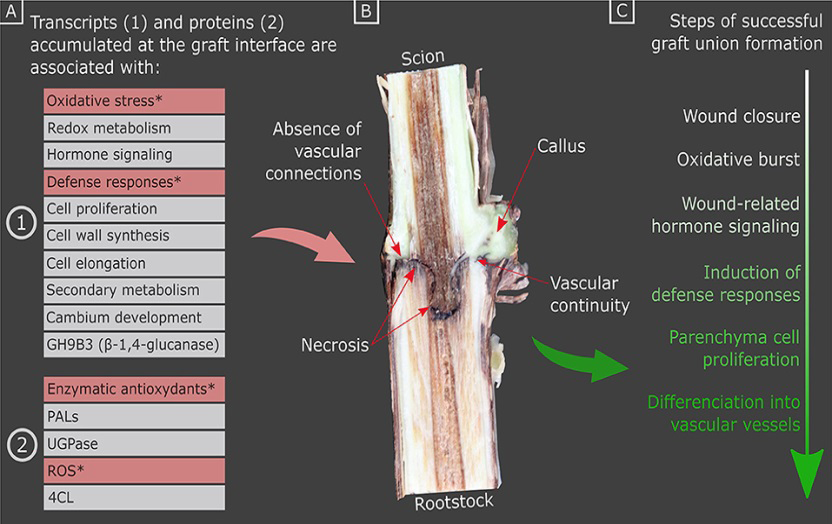
Figure 14: Summary of (A) the transcripts and proteins accumulated at the graft interface during graft union formation (stars indicate the transcripts and proteins which are more highly accumulated in hetero-grafts vs. homo-grafts, and/or incompatible vs. compatible combinations), (B) a photograph of a cross section of a homo-graft interface, 4 months after grafting, illustrating the appearance of necrosis, callus and vascular continuity, and (C) the sequence of events underlying graft union formation. PALs, PHENYLALANINE AMMONIA LYASEs; UGPase, UDP-glucose pyro phosphorylase; 4CL, 4-COUMARATE: COA LIGASE; ROS, reactive oxygen species.
Surprisingly, in several peach rootstock trials reported from the US and Canada and a cherry trial from Poland, the most efficient performer was the own-rooted scion cultivar (Table 3), which often displayed lower vigor, both desirable characteristics. Whether this is an indication of incompatibility in the traditional sense, or more an expression of mechanical interference due to imperfect joining of tissues, remains to be seen. This might seem more an intellectual curiosity, but as markers are developed for important traits, it may become feasible to incorporate important rootstock traits into scion cultivars for use as own-rooted cuttings. Even with current breeding and screening techniques, it should be possible to incorporate resistance to root-knot nematodes into scion cultivars at this time. Not having to bud or graft finished trees offers both cost and time savings to offset part of the cost of clonal propagation. Efficient protocols have been developed for peach [173, 174] and should be feasible for the relatively easy to root plums, though cherries remain quite difficult (W. Proebsting, pers. commun.). Own-rooted trees of ‘Stanley’ plum have been recommended for avoidance of stem- pitting, which develops in grafted ‘Stanley’ trees that are infected subsequently with TmRSV [175]. Own-rooted trees of several peach varieties appeared to be less susceptible to stem-pitting than conventional grafted trees [176] and have exhibited higher levels of nutrients [142]. However, own- rooted trees were shown to be more susceptible to PTSL [177].
Fruit Quality: Rootstocks capable of improving the fruit quality attributes of the scion variety would be of great interest.
There appear to be some possibilities in this area, though many of the effects reported to date have been relatively subtle, negative, or inconsistent, particularly for fruit size. It is often difficult to separate apparently negative effects on fruit size from the combination of the positive traits of reduced vigor and increased productivity that can lead to imbalanced crop loads if not managed properly. Potentially useful rootstock influences on fruit maturity have been described for some stone fruits. The development of an understanding of the physiological basis of these effects will be important. Interstems some mention of interstems is appropriate here. While obviously incapable of directly affecting below ground issues such as soilborne diseases, insects, waterlogging, low fertility, etc., interstems have been shown to provide hardier trunks [121, 178], control vigor [178, 179, 180], delay bloom and fruit maturation of peach [181]; improve fruit quality, vigor control and yield for sweet cherry [182, 183, 184], and influence foliar nutrient content in cherry [146]. However, an unavoidable yet significant limitation to their utilization is the added time and cost associated with their production. Furthermore, issues such as graft incompatibility and virus.
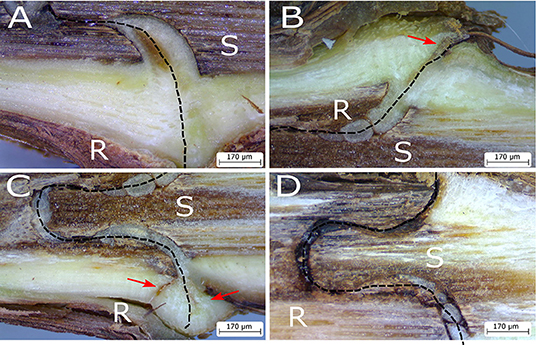
Figure 15: Photographs of the graft interface of homo-grafts of grapevine 4 months after grafting showing decreasing levels of tissue continuity between the scion (S) and rootstock (R). Necrosis in the callus tissue is absent in (A), small amounts of necrosis are indicated in by red arrows in (B) and (C), and poor tissue continuity in (D). Graft interface indicated by a dashed line Sensitivity/hypersensitivity remain the same for inderstock as for rootstocks.
Future Work’s Needs
Preservation and Exchange of Germplasm: All breeding programs need germplasm as foundational, raw materials. Many recently introduced rootstocks are interspecific hybrids of conventional rootstock species with “exotic” unimproved species that often have no precedent in rootstock usage. A case in point is the USDA rootstock program in Georgia. Many of this program’s Armillaria-resistant rootstock selections are hybrids with native North American plum species, which as a rule are woefully under-represented in the US Germplasm Repository system. Much of the “available” diversity in these native species is currently stored solely in the breeding collections of the stone fruit breeding programs outside the relative safety of the repository system. At the turn of the century, several hundred fresh market plum cultivars were available that were either selections or hybrids with native North American species [185]. However, these were rapidly displaced by the introduction of improved plum cultivars utilizing introduced P. salicina materials. Today, barely a handful of the native species-based materials still exist, yet these and the native species from which they were developed have tremendous potential for utilization in solutions for many of our modern problems [186]. Moreover, much of the wild diversity has disappeared, either because of intentional eradication efforts to reduce wild reservoirs of diseases and insect pests, or because of land development. This is a worldwide problem and a troubling one.
As regionally-oriented stone fruit production industries grow and begin to provide product to national and international markets, a profound shift in germplasm usage also typically occurs as growers change varieties to suit these larger and often more lucrative markets. Such a shift has been seen in the Mexican.
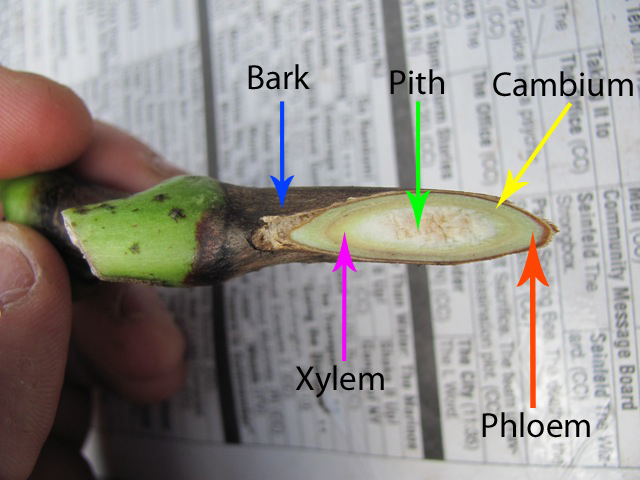
Peach industries, which utilized seedling land races or local cultivars grafted on locally-adapted seedling rootstocks. More dramatic shifts were seen as Spain’s peach industry grew into a major supplier of stone fruit to European Union (EU) markets. Typically, no concerted effort has been made to preserve this potentially valuable germplasm since it is often viewed as “obsolete” and worthless. Nevertheless, some of the most significant advances in rootstock adaptation were made with obscure germplasm, such as hardy peach accessions from northern China that produced clearly superior performers under harsh winter conditions in Canada. Germplasm exploration needs our continued support and involvement, but So does the preservation of native and naturalized materials in our own backyards that may be slowly disappearing right out from under our noses. Efforts have been undertaken to evaluate and describe the variability and possible breeding value of some germplasm, such as the ‘Vineyard’ peaches in Yugoslavia [187, 188], Spanish peach seedling populations [189], and Mexican peach seedling populations [190]. With the exception of the ‘Vineyard’ peaches, only scion characteristics were evaluated. Some material has been collected and is being retained, if only on a regional basis at this time. We also see an emerging problem as many breeding and development programs move forward in the production of complex interspecific hybrids.
These materials often display varying levels of sterility, ranging from reduced flower density and set to complete infertility. In hybrids of both native North American plum species and complex plum hybrids with peach germplasm in the USDA program in Georgia, most interspecific hybrids have been completely infertile, producing non-germinating pollen (if any) and setting no fruit (T.G. Beckman, pers. obser.). This is a problem not only within a breeding program, but also for any external program hoping to build on another’s releases. Hence, unlike variety breeding programs, which by definition must release materials capable of being intercrossed, many rootstock programs release materials that functionally are genetic dead-ends. A realization of the consequences of this should engender more, rather than less, cooperation and germplasm sharing between programs. However, the ever-expanding issues of intellectual property rights and their ownership may prove to be an increasingly difficult hurdle. Indeed, many programs already exchange and market material only with severe limitations on the use of that material in breeding programs. It is not unusual for non-propagation agreements to include “reach through” clauses giving the “donor” full rights to any hybrids made in the receiving program, be they F1or F2, clearly a step above the traditional “essentially derived” definition of ownership. Constraints on the exchange of materials will work against the progress and even survival of small and moderate breeding programs, unless they are part of a “group” of (most likely non-competing) programs that exchange germplasm and ideas freely among themselves. Corporate breeding programs, particularly vertically integrated ones that do not offer their cultivars for sale to the public (leasing them only to licensed growers), will end up becoming more or less ‘one- way sinks’ for germplasm and technology.
Seedling V/S Clonal Types: Despite the clear shift from seedling to clonal types over the last 10–20 years, seedling types still rule in most stone fruit industries. Obvious exceptions would be the use of peach × almond hybrids on calcareous soils, i.e., ‘GF677’ in southern Europe, and the likely large-scale shift to the new interspecific cherry hybrid selections where size control and precocity have been needed so badly. The reasons for the continued dominance of seedling types are obvious: low cost (pennies per plant vs. dollars in some cases) and convenience. The ease with which seedling types can be incorporated into the nursery production scheme should not be overlooked either. In those industries situated in suitable climates, the comparative ease of direct fall planting of a relatively hard to injure seed is a valuable asset compared to the management- intensive process of transplanting and caring for rooted cuttings or tissue-cultured plantlets. In many industries, the predominant production areas suffer from relatively few limitations and for those problems which seedling types have offered solutions, i.e. root-knot nematodes and PTSL, a clonally propagated alternative may be seen as overpriced. Niche planting is likely to be the most common use for many of the clonal materials produced to date, though this will not be true in some industries. The extensive need for tolerance to calcareous soils and adequate vigor on low fertility sites in many production regions of Europe will continue to drive the use of clonal peach × almond and peach × davidiana materials, since no comparable seedling counterpart has been developed. One significant limitation to the future use of seedling types is the issue of uniformity. Outcrossing in seed production orchards no doubt varies widely but in peach appears to be typically between 2–6% [191, 192]. The impact of these events goes largely unnoticed if only because of our inability to detect such events. The frustrating variability in delayed tree mortality due to graft incompatibility, as with certain seedling cherry and apricot rootstocks, is a clear example of the potential negative ramifications of this genetic variability. Also, as orchard management becomes more intensive in a highly competitive global market, increased uniformity of rootstock performance across various scion varieties will be more important for achieving efficient profitability. Virtually all of the dominant seedling stone fruit rootstocks lack any morphological feature, such as red leaves, to allow visual detection of outcrosses in the nursery setting. If good control of outcrossing, or at least efficient rogueing techniques, could be devised, then even interspecific hybrid seedlings could be made practical. Several potentially useful lines have been proposed and developed [193, 194, 195, 196, 197, 198], but have not enjoyed adoption due, in part, to problems with nursery production efficiency and uncontrolled outcrossing with resulting variability. This area is worthy of more attention. The use of doubled haploids is another avenue that deserves consideration. In the absence of an outcrossing event, this allows the production of a “seedling clone” of the mother plant [199]. Such seedlings could then be handled like any conventionally produced sexual seedling, with the attendant lower production and management costs compared to conventional clones produced via cuttage or tissue culture. A major obstacle is the relative rarity of haploids [200] estimated their rate of occurrence at about 1:1250. Molecular Analysis of Key Rootstocks Traits: This is a promising research area, with molecular analyses becoming more routine, automated (such as DNA microarrays), and genetically powerful (with tools such as the Arabidopsis
genomic library). While such work pertinent to stone fruit rootstock breeding is increasing, little has yet to be found in the scientific literature. In cherry, DNA microarrays have been created to examine rootstock and rootstock-induced scion gene expression, with particular emphasis on genes associated with dwarfing and perhaps graft incompatibility (K-H. Han and G. Lang, pers. commun.). Similarly, a homolog to the Arabidopsis flowering-associated gene, LFY, has been identified in sweet cherry, and is being used to probe rootstock induction of scion precocity and flower spur formation (G. Lang, pers. commun.). The molecular analysis of such traits is expected to lead to more efficient capabilities for developing and/or evaluating the improved expression of key horticultural or pathological traits in stone fruit rootstocks and grafted scions. Rootstock Evaluation Methodology: Current testing programs such as the NC-140 in the United States [201], the Working Group on Rootstocks in Italy and the International Cherry Rootstock Trials in Europe [202], among others, are laudable in both their aims and progress to date, and will likely continue to grow in their sophistication and usefulness. Most new rootstocks were developed at least in part with some improved resistance to a disease, pest or edaphic limitation. With the possible exception of climatic adaptation, these characteristics are difficult to evaluate accurately in the current regional and international testing trials. Indeed, it would not be practical to evaluate characteristics pertinent to longevity in conjunction with a horticultural trial typically utilizing as few as 8–10 single tree replications, as is the case of the NC-140 trials. Even minimal tree losses during the course of the trial would seriously compromise the collection of meaningful horticultural data. Nevertheless, in the absence of an organized effort to provide meaningful, broad evaluation of the non-horticultural characteristics of these new materials, they will likely be introduced into distant marketplaces with only tentative recommendations for their use in dealing with the very diseases and problems they were developed to address. We propose that some effort needs to be made to provide uniform testing of disease, pest and edaphic performance under realistic field conditions as a counterpart to the horticultural trials currently performed. Necessarily, these will have to be limited in number, as probably only regional trials will be practical and affordable, especially given the larger replication needed to evaluate problems that can result in the death of non-resistant materials. For the evaluation of rootstock impact on fruit quality issues, an economic analysis would be a useful addition to typical horticultural testing. In many markets, there is currently no economic incentive to provide improved quality characteristics beyond some minimal base level, for example % soluble solids. However, in virtually all markets there is a premium paid for larger size fruit, in which case some trade-offs (e.g., reduced total yield) can be more than made up with the premium paid for larger fruit. Appropriate application of pricing structures at each trial location would help growers and extension personnel sort out which rootstock may maximize economic return. Additionally, the type of long-term production data typically generated in large scale performance trials lends itself to a variety of statistical analyses to reveal genotype × environmental interactions and performance stability [203], as well as relative production risk [204]. Such analyses would provide valuable feedback to breeding programs and better inform growers and extension personnel. Impact of Marker Assisted Selection (MAS): Although MAS holds promise for all areas of rootstock breeding through reduced cost and increased efficiency (and speed) of evaluations, it has the best potential for profound impact on those characteristics that are particularly difficult to evaluate. This is because the testing procedure itself relies on a currently expensive methodology, and/or the opportunity to score populations is infrequent. Either problem can severely slow progress. Field evaluation of cold hardiness or dwarfing are examples. Diseases that cause tree mortality well after establishment would also be prime candidates for the development of markers. Field evaluation for resistance to both PTSL and Armillaria root rot is difficult not only because of the lack of uniformly infected field sites, but also because field screens typically require at least 5–7 years to achieve sufficient mortality to allow differentiation of the resistant lines from the susceptible. Efforts are underway to develop markers for many important traits, including graft compatibility, precocity, and resistance to root-knot nematodes, PTSL and Armillaria root rot. Those traits controlled by only a few genes are more likely to provide usable markers than are those controlled by many genes. The investment in effort to produce and accurately score a suitable segregating population to generate the initial marker trait associations, will doubtlessly require substantial effort in many cases. Molecular markers having few alleles per locus such as RAPDs and AFLPs are likely to have low transferability rates between pedigrees and may require mapping in each segregating population. Microsatellite (SSR) based markers which are typically codominant and have multiple alleles per locus are likely to be much more informative in inbred species such as peach. Another application of this technology is the use of markers for the purpose of identifying rootstock cultivars [205]. This has utility not only for the protection of intellectual property rights, but also for the field verification of rootstock identity [206], which is often difficult (if not impossible) in nursery or orchard situations, yet would be extremely helpful when diagnosing performance problems.
Conclusions
Considerable progress has been made in recent years in the development of better-adapted rootstocks for stone fruits. Indeed, in a few cases, such as waterlogging tolerance for peach, progress has been such that there has been a significant reduction in the perceived importance of the problem. Progress has been made in the development of more efficient screening procedures, which in turn leads to the identification of useful variability, both of which by necessity precede the development of commercially useful materials. Modern genetic engineering technology is starting to realize much of its promise in the identification of markers that will reduce reliance on tedious, expensive, long-term field trials and thus accelerate progress. Much good scientific work and challenges remain.
Author Contributions
Ashok Kumar, B.D. Bhuj, and Shri Dhar: writing—review and editing. All authors contributed to the article and approved the submitted version.
Conflict of Interest: The authors declare that the research was conducted in the absence of any commercial or financial relationships that could be construed as a potential conflict of interest.
Publisher’s Note
All claims expressed in this article are solely those of the authors and do not necessarily represent those of their affiliated organizations, or those of the publisher, the editors and the reviewers. Any product that may be evaluated in this article, or claim that may be made by its manufacturer, is not guaranteed or endorsed by the publisher.
References
-
Bowman KD, McCollum G (2015) Five new citrus rootstocks with improved tolerance to huanglongbing. Hort Science 50(11): 1731-1734.
-
Domingues AR, Marcolini CDM, Gonçalves CH, Resende JTV, Roberto SR, et al. (2021) Rootstocks genotypes impact on tree development and industrial properties of ‘Valencia’ sweet orange juice. Horticulturae 7(6): 141.
-
Cousins P (2005) Rootstocks breeding: an analysis of intractability. Hort Science 40: 1945-1946.
-
Gainza F, Opazo I, Guajardo V, Meza P, Ortiz M, et al. (2015) Rootstock breeding in Prunus species: ongoing efforts and new challenges. Chilean J Agric Res 75: 6-16.
-
Craddock LI, Dang T, Comstock S, Osman F, Bodaghi S, et al. (2022) Transcriptome Analysis of Citrus Dwarfing Viroid Induced Dwarfing Phenotype of Sweet Orange on Trifoliate Orange Rootstock. Microorganisms 10(6): 1144.
-
Haque MA, Sakimin SZ (2014) Planting Arrangement and Effects of Planting Density on Tropical Fruit Crops—A Review. Horticulturae 8(6): 485.
-
Khan MN, Hayat F, Asim M, Iqbal S, Ashraf T, et al. (2020) Influence of citrus rootstocks on growth performance and leaf mineral nutrition of Salustiana sweet orange [Citrus sinensis (L.). obsek]. J Pure Appl Agric 5: 2617- 8680.
-
Ruiz M, Quinones A, Martínez Alcántara B, Aleza P, Morillon R, et al. (2016) Tetraploidy enhances the ability to exclude chloride from leaves in carrizo citrange seedlings. J Plant Physiol 205: 1-10.
-
Allario T, Brumos J, Colmenero-Flores JM, Iglesias DJ, Pina JA, et al. (2011) Tetraploid Rangpur lime rootstock increases drought tolerance via enhanced constitutive root abscisic acid production. PC&E 36(4): 856-868.
-
Reddy YTN, Gorakh Singh (1993) Effect of rootstock on growth and yield of Alphonso Mango (_Mangifera indica_ _L._). Indian J Agric Sci 63(4): 208-210.
-
Dhatt AS, Singh Z (1993) Propagation and rootstocks of Citrus. In: Chadha KL, Pareek OP (Eds.), Malhotra Publishing House, New Delhi, India, pp: 523-550.
-
Haleem SA (1984) Influence of rootstock on the pre- bearing performance of sweet orange. South Indian Hort. 32: 57-60.
-
Edward JC, Shankar G (1994) Rootstock trial for guava. Allahabad farmer, 38: 249-250.
-
Shankar G (1967) Rootstock trial in guava. Allahabad Farmer 12: 259-264.
-
Ezzahouani A, Williams LE (1995) Influence of rootstock on leaf water potential, yield, and berry composition of Ruby Seedless grapevines. Amer J Enol Viticult 46: 559- 563.
-
Chadha KL (1991) Strategy for optimization of productivity and utilization of sapota in India. National seminar on optimization of productivity and utilization of sapota held at GAU, Navsari, Gijarat, india, 49(2): 1-17.
-
Webster AD (1992) New dwarfing rootstocks for apple, pear plum and sweet cherry-a brief review. In V International Symposium on Orchard and Plantation Systems 349: 145-154.
-
Quamme HA, Brownlee RT (1996) Cold Hardiness Evaluation of Apple Rootstocks. VI International Symposium of Integrated Canopy, Rootstock, Environmental Physiology in Orchard System, ActaHorticulturae 451: 187-194.
-
Wildung DK, Weiser CJ, Pellett HM (1973) Cold Hardiness of Malling Clonal Apple Rootstocks Under Different Conditions of Winter Soil Cover. Canadian Journal of Plant Science 53(2): 323-329.
-
MoranRE, Sun Y, Geng F, Zhang D, Fazio G (2011) Cold temperature tolerance of trunk and root tissues in one- or two-year-old apple rootstocks. Hort Science 46(11): 1460-1464.
-
Cummins JN, Aldwinckle HS (1983) Rootstock breeding. In: Janick J, Moore JN (Eds.), Methods in Fruit Breeding Purdue Univ Press, West Lafayette, IN, USA, pp: 294-327.
-
Zagaja SW (1980) Performance of two apple cultivars on P series dwarf rootstocks. Symposium on Research and Development on Orchard and Plantation Systems 114: 162-169.
-
Trajkovski V, Andersson G (1988) Stone fruit breeding. Verksamhetsberattelse Report SLU – Balsgard pp: 16-23.
-
Granger RL, Rouselle GL, Meheriuk M, Khanizadeh S (1992) Performance of ‘Cortland’ and ‘McIntosh’ on fourteen rootstocks in Quebec. Fruit Varieties Journal 46: 114-118.
-
Atkinson CJ, Policarpo M, Webster AD, Arboree AM (1999) Drought Tolerance of Apple Rootstocks: production and partitioning of dry matter. Plant and Soil 206: 223-235.
-
Motosugi H, Sugiura A, Tomana T (1987) Salt Tolerance of Various Apple Rootstock Cultivars. Jpn Soc Hort Sci 56(2): 135-141.
-
Abdel hussein MAA (2006) Evaluation of MM106 and Omara apple rootstocks for salt tolerance _in vitro_. Journal of Kerbala University, 4(1): 178-185.
-
Russo N L, Robinson TL, Fazio G, Aldwinckle HS (2007) Field evaluation of 64 apple rootstocks for orchard performance and fire blight resistance. Hort Science 42(7): 1517-1525.
-
Webster AD (1998) A Brief Review of Pear Rootstock Development. Horticulture Research International, East Malling, West Malling, Kent, ME196BJ, UK, 475.
-
Okubo M, Furukawa Y, Sakuratani T (2000) Growth, flowering and leaf properties of pear cultivars grafted on two Asian pear rootstock seedlings under NaCl irrigation. Scientia horticulturae 85(1-2): 91-101.
-
Loreti S, Faggioli F, Barba M (1997) Identification and characterization of an Italian isolate of pear blister canker viroid. Journal of Phytopathology 145(11‐12): 541-544.
-
Browning G, Watkins R (1991) Preliminary Evaluation of New Quince (_Cydonia oblonga_ Miller) hybrid Rootstocks for Pears. Journal of Horticultural Science 66 (1): 35-42.
-
Brooks LA (1984) History of the Old Home X Farmingdale pear rootstocks. Fruit Varieties Journal 38: 126-128.
-
Alcaniz E, Pinochet J, Fernandez C, Esmenjaud D, Felipe A (1996) Evaluation of Prunus rootstocks for root-lesion nematode resistance. Hort Science 31(6): 1013-1016.
-
Moreno MA, Tabuenca MC, Cambra R (1995) Adesoto 101, a plum rootstock for peaches and other stone fruits. Hort Science 30(6): 1314-1315.
-
Rubio M, Martínez Gómez P, Pinochet J, Dicenta F (2005) Evaluation of resistance to sharka (Plum pox virus) of several Prunus rootstocks. Plant Breeding 124(1): 67- 70.
-
Cinelli F, Loreti F (2002) Evaluation of Some Plum Rootstocks concerning Lime Induced Chlorosis by Hydroponic Culture. Acta Horticulturae 658(658): 421- 427.
-
Webster AD, Wertheim SJ (1993) Comparisons of species and hybrid rootstocks for European plum cultivars. Journal of Horticultural Science 68(6): 861-869.
-
Dimitrova M (2001) Evaluation of some plum rootstocks as rootstock for apricot in the orchard. Acta Hortic 577: 311-314.
-
Domingo R, Pérez-Pastor A, Ruiz-Sánchez MC (2002) Physiological responses of apricot plants grafted on two different rootstocks to flooding conditions. Journal of Plant Physiology 159(7): 725-732.
-
Ibarra AG, Rubio M, Dicenta F, Gomez PM (2010) Evaluation of Resistance to Apple Chlorotic Leaf Spot Virus (ACLSV) in Controlled Greenhouse Conditions in Apricot Breeding Programme of CEBASCSIC in Murcia (Spain). Acta Horticulturae 862(862): 487-490.
-
Lanauskas J, Kviklys D, Uselis N (2004) Evaluation of Rootstocks for Sweet Cherry cv. ‘Vytenu Rozine’. Acta Hortic 732: 335-339.
-
Toribio F, Moreno J, Manzano MA (1997) Evaluation of Rootstocks for Cherry Trees. Acta Horticulturae 468: 339-344.
-
Rom RC (1991) Apricot rootstocks: Perspective, utilization and outlook. Acta Hortic 293: 345-354.
-
Ramming DW, Cociu V (1991) Plums. Acta Hort 290: 235-287.
-
Perry RL (1987) Cherry rootstocks. In: Rom RC, Carlson RF (Eds.), Rootstocks for Fruit Crops. Wiley, New York, USA, pp: 217-264.
-
Cummins JN, Aldwinckle HS (1983) Breeding apple rootstocks. Plant breeding reviews pp: 294-394.
-
Janick J, Moore JN (1996) Tree and tropical fruits, Fruit Breeding. Wiley, USA 1: 632.
-
Janick J, Moore JN (1996) Nuts, Fruit Breeding. Wiley, USA, 3: 288.
-
Moore JN, Ballington JR, (1991) Genetic Resources of Temperate Fruit and Nut Crops 1. Acta Hort pp: 290.
-
Rom RC, Carlson RF (1987) Rootstocks for Fruit Crops. Wiley, New York.
-
Layne REC (1987) Peach rootstocks. In: Rom RC, Carlson RF (Eds.), Rootstocks for Fruit Crops. Wiley, New York, pp: 185-216.
-
Esmenjaud D, Minot JC, Voisin R, Pinochet J, Salesses G (1994) Inter- and intra-specific resistance variability in myrobalan plum, peach and peach-almond rootstocks using 22 root-knot nematode populations. J Amer Soc Hort Sci 119(1): 94-100.
-
Fernandez C, Pinochet J, Esmenjaud D, Salesses G, Felipe A (1994) Resistance among new Prunus rootstocks and selections to root-knot nematodes in Spain and France. Hort Science 29(9): 1064-1067.
-
Pinochet J, Calvet C, Hernandez-Dorrego A, Bonet A, Felipe A, et al. (1999) Resistance of peach and plum rootstocks from Spain, France and Italy to root- knot nematode _Meloidogyne javanica._ Hort Science 34(7): 1259-1262.
-
Sherman WB, Lyrene PM, Sharpe RH (1991) Flordaguard peach rootstock. Hort Science 26(4): 427-428.
-
Rubio-Cabetas MJ, Lecouls AX, Esmenjaud D, Salesses G (2000) Genetic control of resistance to root-knot nematodes in Prunus rootstocks. Acta Horticulturae 522(522): 155-163.
-
Esmenjaud D, Minot JC, Voisin R (1996) Effects of durable inoculum pressure and high temperature on root galling, nematode numbers and survival of Myrobalan plum genotypes (_Prunus cerasifera_ Ehr.) highly resistant to Meloidogyne spp. Fund Appl Nematol 19(1): 85-90.
-
Xiang ZL, Reighard GL, Nyczepir AP, Beckman TG, Ramming DW (2000) Inheritance of resistance to root- knot nematodes (Meloidogyne sp.) in Prunus rootstocks. Hort Science 35(7): 1344-1346.
-
Esmenjaud D, Minot JC, Voisin R, Bonnet A, Salesses G (1996) Inheritance of resistance to the root-knot nematode Meloidogyne arenaria in Myrobalan plum. Theor Appl Genet 92(7): 873-879.
-
Lecouls AC, Salesses G, Minot JC, Voisin R, Bonnet A, et al. (1997) Spectrum of the Ma genes for resistance to Meloidogyne spp. in Myrobalan plum. Theor Appl Genet 95: 1325-1334.
-
Xiang ZL, Sosinski B, Reighard GL, Baird WV, Abbott AG (1998) Construction of a genetic linkage map and identification of AFLP markers for resistance to root- knot nematodes in peach rootstocks. Genome 41(2): 199-207.
-
Lecouls AC, Rubio-Cabetas MJ, Minot JC, Voisin R, Bonnet A, et al. (1999) RAPD and SCAR markers linked to the Ma1 root-knot nematode resistance gene in Myrobalan plum (_Prunus cerasifera_ Ehr.) Theor. Appl Genet 99: 328- 335.
-
Nyczepir AP, Zehr EI, Lewis SA, Harshman DC (1983) Short life of peach trees induced by _Criconemella_ _xenoplax_. Plant Dis 67: 507-508.
-
Nyczepir AP (1990) Influence of _Criconemella xenoplax_ and pruning on short life of peach trees. J. Nematol 22(1): 97-100.
-
Nyczepir AP, Okie WR (1996) Occurrence of peach tree short life on a field site with no history of peach production. Hort Science 31(1): 163.
-
Westcott SW III, Zehr EI, Newall WC, Cain DW (1994) Suitability of Prunus selections as hosts for the ring nematode (Criconemella xenoplax). J Amer Soc Hort Sci 119(5): 920-924.
-
Nyczepir AP, Okie WR, Beckman TG (1996) Evaluating Prunus genotypes for resistance/tolerance to Criconemella xenoplax. In: Proc. 5th Stone Fruit Tree Decline Workshop, pp: 37-42.
-
Potter JW, Dirks VA, Johnson PW, Olthof THA, Layne REC, et al. (1984) Response of peach seedlings to infection by the root lesion nematode _Pratylenchus penetrans_ under controlled conditions. J Nematol 16(3): 317-322.
-
Culver DJ, Ramming DW, McKenry MV (1989) Procedures for field and greenhouse screening of Prunus genotypes for resistance and tolerance to root lesion nematode. J Amer Soc Hort Sci 114(1): 30-35.
-
Iezzoni A, Schmidt H, Albertini A (1991) Cherries. In: Moore JN, JR Ballington (Eds.), Genetic Resources of Temperate Fruit and Nut Crops, Acta Hort, pp: 111-173.
-
Ledbetter CA (1994) Techniques for screening Prunus rootstocks for resistance to Pratylenchus vulnus. In: Proc. Stone Fruit Tree Decline Workshop, Fort Valley, Georgia, United States, pp: 34-36.
-
Melakeberhan H, Bird GW, Gore R (1997) Impact of _Pratylenchus penetrans_ infection on Prunus avium rootstocks. J Nematol 29(3): 381-388.
-
McFadden-Smith W, Miles NW, Potter JW (1998) Greenhouse evaluation of Prunus rootstocks for resistance or tolerance to the root-lesion nematode (_Pratylenchus penetrans_). Acta Hort 465(91): 723-730.
-
Pinochet J, Fernandez C, Calvet C, Hernandez-Dorrego A, Felipe A (2000) Selection against _Pratylenchus vulnus_ populations attacking Prunus rootstocks. HortScience 35(7): 1333-1337.
-
Thomas HE, Thomas E, Roberts C, Amstutz A (1948) Rootstock susceptibility to _Armillaria_ _mellea._ Phytopathology 38: 152-154.
-
Duquesne J, Gall H, Delmas JM (1977) New observations made on susceptibility to root fungus disease (Armillaria) of some apricot rootstocks (in French). Pomologie Francaise 19: 95-98.
-
Raabe RD (1979) Resistance or susceptibility of certain plants to Armillaria root rot. Univ Cal Leaf 2591.
-
Proffer TJ, Jones AL, Perry RL (1988) Testing of cherry rootstocks for resistance to infection by species of Armillaria. Plant Dis 72: 488-490.
-
Guillaumin JJ, Pierson J, Grasselly C (1991) The susceptibility to _Armillaria mellea_ of different Prunus species used as stone fruit rootstocks. Scientia Hort 46: 43-54.
-
Loreti F (1997) Bioagronomic evaluation of the main fruit tree rootstocks in Italy. Acta Hort 451(21): 201-216.
-
Beckman TG (1988) Flooding tolerance of sour cherries. Horticulture pp: 156.
-
Beckman TG, Cummins JN (1991) Rootstocks for peaches. In: Register of new fruit and nut varieties (Edn.), Brooks and Olmo List 35. Hort Science 26: 951-986.
-
Beckman TG, Cummins JN (1991). Rootstocks for plums and prunes. In: Cummins JN (Ed.), register of new fruit and nut varieties, Brooks and Olmo List Hort Science 26: 951-986.
-
Beckman TG, Pusey PL (2001) Field testing peach rootstocks for resistance to Armillaria root rot. Hort Science 36(1): 101-103.
-
Mircetich SM, Matheron ME (1981) Differential resistance of various cherry rootstocks to Phytophthora species. Phytopathology 71: 243.
-
Wilcox WF, Mircetich SM (1985) Pathogenicity and relative virulence of seven Phytophthora spp. Mahaleb and Mazzard cherry. Phytopathology 75: 221-226.
-
Wicks T, Lee TC (1985) Effects of flooding, rootstocks and fungicides on Phytophthora crown rot of almonds. Austral J Expt Agri 25(3): 705-710.
-
Cummins JN, Gonsalves D (1986) Constriction and decline of ‘Stanley’ prune associated with Tomato Ringspot Virus. J Amer Soc Hort Sci 111(2): 315-318.
-
Mircetich JSM, Browne GT (1989) Phytophthora root and crown rot of deciduous fruit trees: The influence of different rootstocks and soil moisture conditions on severity of the disease. Compact Fruit Tree 22: 115-123.
-
Cummins JN, Beckman TG (1991) Rootstock for Almonds. In: Register of new fruit and nut varieties (Edn.), Brooks and Olmo List 35. Hort Science 26(8): 951-986.
-
Jacobs KA, Johnson GR (1996) Ornamental cherry tolerance of flooding and Phytophthora root rot. Hort Science 31(6): 988-991.
-
Beckman TG (1997) Almond rootstocks. In: Okie WR (Ed.), Register of new fruit and nut varieties, Brooks and Olmo List 38. Hort Science 32: 785-805.
-
Wertheim SJ (1998) Rootstock guide: Apple, pear, cherry, European plum. Fruit Research Station Publ 85-114.
-
Smith CO (1925) Crown gall studies of resistant stocks for Prunus. J Agri Res 31: 957-971.
-
DeCleene M, DeLey J (1976) The host range of crown gall. Bot Rev 42: 390-456.
-
Stylianidis EM, Pallidas PG, Grasselly C, Isaakidis A (1992) Peach (_Prunus persica_ (L.) Batsch) rootstocks resistance to crown gall (_Agrobacterium tumefaciens_) pp: 265-270.
-
Peirronnet A, Salesses G (1996) Behaviour of Prunus cultivars and hybrids towards Agrobacterium tumefaciens estimated from hardwood cuttings. Agronomie 16(4): 247-256.
-
Bliss FA, Almehdi AA, Dandekar AM, Schuerman PL, Bellaloui N (1999) Crown gall resistance in accessions of 20 Prunus species. Hort Science 34(2): 326-330.
-
Cummins JN (1995) Plum rootstocks. In: Cummins JN (Ed.), register of new fruit and nut varieties, Brooks and Olmo List 37. Hort Science 30(6): 1135-1150.
-
Okie WR, Beckman TG, Nyczepir AP, Reighard GL, Newall Jr WC, et al. (1994) BY520-9, a peach rootstock for the southeastern United States that increases scion longevity. HortScience 29(6): 705-706.
-
Beckman TG, Okie WR, Nyczepir AP (1993) Use of clonally replicated seedlings in field screening for resistance to peach short life. J Amer Soc Hort Sci 118(1): 115-118.
-
Okie WR, Reighard GL, Beckman TG, Nyczepir A, Reilly CC, et al. (1994b) Field-screening Prunus for longevity in the southeastern United States. Hort Science 29(6): 673-677.
-
Webster AD (1996) Rootstocks for sweet and sour cherries. In: Webster AD, NE Looney (Eds.), Cherries: Crop Physiology, Productions and Uses, CAB Intl, Oxon, UK, pp: 127-163.
-
(1997) The Brooks and Olmo register of fruit and nut varieties. ASHS Press, Alexandria, Virginia. pp: 213-216.
-
Wertheim SJ, Balkhoven JMT, Callesen O, Claverie J, Vercammen, et al. (1998) Results of two international cherry rootstock trials. Acta Hort 468: 249-264.
-
Krzesinska EZ, Azarenko ANM (1992) Excised twig assay to evaluate cherry rootstocks for tolerance to _Pseudomonas syringae_ pv. syringae. Hort Science 27(2): 153-155.
-
Bedford KE, Scholberg PL, Kappel F (2002) Use of a detached leaf bioassay for screening sweet cherry cultivars for bacterial canker resistance. XXVIth Intl Hort Congr pp: 335.
-
Uyemoto JK, Kirkpatrick BC, Cummins JN (1991) Susceptibility of selected cherry clones and related species to Western X-disease. Hort Science 26(12): 1510-1511.
-
Hoy JW, Mircetich SM (1984) Prune brownline disease: Susceptibility of prune rootstocks and tomato ringspot virus detection. Phytopathology 74: 272-276.
-
Halbrendt JM, Podleckis EV, Hadidi A, Scorza R, Welliver R (1994) A rapid protocol for evaluating Prunus germplasm for Tomato Ringspot Virus resistance. Hort Science 29(9): 1068-1070.
-
Lang G, Howell W, Ophardt D, Mink G (1997) Biotic and abiotic stress responses of interspecific hybrid cherry rootstocks. Acta Hort 451: 217-224.
-
Howell WE, Lang GA (2001) Virus sensitivity of new sweet cherry rootstocks. Compact Fruit Tree 34: 78-80.
-
Sherman WB, Mizell RF (1995) Pachnaeus root weevils in peach at Gainesville. Proc Fla State Hort Soc 108: 348- 349.
-
Weaver GM, Boyce HR (1965) Preliminary evidence of host resistance to the peach tree borer, _Sanninoidea_ _exitiosa_. Can J Plant Sci 45(3): 293-294.
-
Chaplin CE, Schneider GW, Martin DC (1974) Rootstock effect on peach tree survival on a poorly drained soil. Hort Science 9(1): 28-29.
-
Chaplin CE, Schneider GW (1975) Resistance to the common peach tree borer (Sanninoidea exitiosa Say) in seedling of ‘Rutgers Redleaf’ peach. Hort Science 10(4): 400.
-
Puterka GJ, Scorza R, Brown MW (1993) Reduced incidence and lesser peachtree borer and Leucostoma canker in peach-almond hybrids. J Amer Soc Hort Sci 118(6): 864-867.
-
Mulas M (1994) Almond genetic resources and resistance to _Capnodis tenebrionis_. Acta Hort 373(4): 41-48.
-
Reeves DW, Edwards JH, Thompson M, Horton BD (1985) Influence of Ca concentration on micronutrient imbalances in in vitro propagated. Prunus rootstock J Plant Nutr 8(4): 289-302.
-
Crossa-Raynaud P, Audergon JM (1987) Apricot rootstocks. In: Rom RC, Carlson RF (Eds.), Rootstocks for fruit crops, Wiley, New York, USA, pp: 295-320.
-
Byrne DH, Bacon T, Egilla JN (1989) Developing peach rootstocks for calcareous soils. Compact Fruit Tree 22: 87-90.
-
Shi Y, Byrne D (1995) Tolerance of Prunus rootstocks to potassium carbonate- induced chlorosis. J Amer Soc Hort Sci 120(2): 283-285.
-
Callesen O (1998) Recent developments in cherry rootstock research. Acta Hort 468(27): 219-228.
-
Melakeberhan H, Jones AL, Hanson E, Bird GW (1995) Effect of low soil pH on aluminum availability and on mortality of cherry seedlings. Plant Dis 79(9): 886-892.
-
Melakeberhan H, Bird GW, Jones AL (2001) Soil pH affects nutrient balance in cherry rootstock leaves. Hort Science 36(5): 916-917.
-
El Motaium R, Hu H, Brown PH (1994) The relative tolerance of six Prunus rootstocks to boron and salinity. J Amer Soc Hort Sci 119(6): 1169-1175.
-
Massai R, Gucci R, Tattini M (1998) Salinity tolerance in four different rootstocks for peach. Acta Hort 465(45): 363-369.
-
Ottman Y, Byrne DH (1988) Screening rootstocks of Prunus for relative salt tolerance. HortScience 23(2): 375-378.
-
Rieger M (2001) Salt stress resistance of peach and four North American Prunus species. Acta Hort 557(24): 181-187.
-
Roth M, Gruppe W (1985) The effects of water logging on root and shoot growth of three clonal cherry rootstocks. Acta Hort. 169(41): 295-302.
-
Rowe RN, Catlin PB (1971) Differential sensitivity to waterlogging and cyano- genesis by peach, apricot and plum roots. J Amer Soc Hort Sci 96(3): 305-308.
-
Mizutani F, Yamada M, Tomana T (1982) Differential water tolerance and ethanol accumulation in Prunus species under flooded conditions. J Japan Soc Hort Sci 51(1): 29-34.
-
Stassen PJC, Van Zyl HJ (1982) Sensitivity of stone fruit rootstocks to water- logging. Decid Fruit Grower 32: 270-275.
-
Andersen PC, Lombard PB, Westwood MN (1984) Leaf conductance, growth, and survival of willow and deciduous fruit tree species under flooded soil conditions. J Amer Soc Hort Sci 109(2): 132-138.
-
Hassan MM, Salem AT, Fayek MA (1986) Response of apricot seedling lines to waterlogging. Scientia Hort 29(1-2): 125-130.
-
Alvino A, Zerbi G (1989) Effect of different levels of shallow water table on death rate, growth and productivity of peach grafted on different rootstocks. Acta Hort 254(51): 307-312.
-
Ranney TG (1994) Differential tolerance of eleven Prunus taxa to root zone flooding. J Environ Hort. 12(3): 138-141.
-
Wang Y (1985) Peach growing and germplasm in China. Acta Hort 173(6): 51-56.
-
Longstroth M, Perry RL (1996) Selecting the orchard site, orchard planning and establishment. In: Webster AD, Looney NE (Eds.), Cherries: Crop Physiology, Production, and Uses (Edn.), CAB Intl, Oxon, UK, pp: 203-222.
-
Rieger M, Dummel MJ (1992) Comparison of drought resistance among Prunus species from divergent habitats. Tree Physiol 11(4): 369-380.
-
Couvillon GA (1982) Leaf elemental content comparisons of own-rooted peach cultivars to the same cultivars on several peach seedling rootstocks. J Amer Soc Hort Sci 107(4): 555-558.
-
Werner DJ, Young E (1987) Effect of ‘Siberian C’ rootstock, interstem, and scion on foliar calcium content in peach. Fruit Var J 41(4): 140-141.
-
Hanson EJ, Perry RL (1989) Rootstocks influence mineral nutrition of ‘Mont- morency’ sour cherry. Hort Science 24(6): 916-918.
-
Brown SK, Cummins JN (1989) Rootstock effect on foliar nutrient concentrations of ‘Redhaven’ peach trees. HortScience 24(5): 769-771.
-
Rozpara E, Grzyb ZS, Olszewski T (1990) The mineral nutrient content in the leaves of two sweet cherry cvs. with interstem. Acta Hort 274: 405-411.
-
Ugolik M, Holubowicz T (1990) The influence of rootstock and cultivar on the leaf content of nutrient elements, growth and yield of three sour cherry cultivars. Acta Hort 274: 491-499.
-
Caruso T, Giovannini D, Liverani A (1996) Rootstock influences the fruit mineral, sugar and organic acid content of a very early ripening peach cultivar. J Hort Sci 71(6): 931-937.
-
Neilsen G, Kappel F (1996) ‘Bing’ sweet cherry leaf nutrition is affected by rootstock. HortScience 31(7): 1169-1172.
-
Boyhan GE, Norton JD, Pitts JA, Himelrick DG (1998) Growth, yield, survival, and leaf nutrient concentrations of plums on various rootstocks. Fruit Var J 52(2): 71-79.
-
Zavalloni C, Flore J (2002) Nitrogen- and water-use efficiency of sweet cherry (_Prunus avium_ L.) cv. Rainier grown on Mazzard and on Gisela dwarfing rootstocks. Prog XXVIth Intl Hort Congr pp: 346.
-
Layne REC (1974) Breeding peach rootstocks for Canada and the northern United States. HortScience 9: 364-366.
-
Layne REC, Jackson HO, Stroud FD (1977) Influence of peach seedling rootstocks on defoliation and cold hardiness of peach cultivars. J Amer Soc Hort Sci 102: 89-92.
-
Layn REC, Ward GM (1978) Rootstock and seasonal influences on carbohydrate levels and cold hardiness of ‘Redhaven’ peach. J Amer Soc Hort Sci 103: 408-413.
-
Strauch H, Gruppe W (1985) Results of laboratory tests for winterhardiness of P. avium cultivars and interspecific cherry hybrids (Prunus × spp). Acta Hort 169: 281-287.
-
Palonen P, Buszard D (1996) Current state of cold hardiness research on fruit crops. Can J Plant Sci 77: 399-420.
-
Balmer M (2001) Sweet cherry tree densities and tree training. Compact Fruit Tree 34: 74-77.
-
Long L (2001) Sweet cherry training systems. Compact Fruit Tree 34: 66-69.
-
Lang GA (2000) Precocious, dwarfing, and productive—how will new cherry rootstocks impact the sweet cherry industry. Hort Technology 10(4): 719-725.
-
Young E, Reid OB (1979) Siberian C rootstock delays bloom of peach. J Amer Soc Hort Sci 104(2): 178-181.
-
Young E, Houser J (1980) Influence of Siberian C rootstock on peach bloom delay, water potential, and pollen meiosis. J Amer Soc Hort Sci 105(2): 242-245.
-
Beckman TG, Okie WR, Myers SC (1992) Rootstocks affect bloom date and fruit maturation of Redhaven peach. J Amer Soc Sci 117(3): 377-379.
-
Reighard GL (2001) Five-year performance of 19 peach rootstocks at 20 sites in North America. Acta Hort 557: 97-102.
-
Malcolm P, Holford B, McGlasson B, Newman S, Richards G, et al. (1999) Growing low chill peaches and nectarines on high chill rootstocks causes spring shock syndrome. Austral Fresh Stone Fruit Quart 1(1): 11-12.
-
Fideghelli C, Della Strada G, Grassi F, Morico G (1998) The peach industry in the world: Present situation and trend. Acta Hort 465: 29-40.
-
Choi C, Andersen RL (2001) Hedelfingen sweet cherry fruit and tree growth responses to thinning and five rootstocks. J Amer Pomol Soc 55(2): 114-119.
-
Lang GA (2001) Sweet cherry training systems. Compact Fruit Tree 34(3): 70-73.
-
Lang GA, Ophardt D (2000) Intensive crop regulation strategies in sweet cherries. Acta Hort 514: 227-334.
-
Mudge K, Janick J, Scofield S, Goldschmidt EE (2009) A history of grafting. Hortic Rev 35: 437-493.
-
Parad GA, Zarafshar M, Striker GG, Sattarian A (2013) Some physiological and morphological responses of Pyrusboissieriana to flooding. Trees 27(5): 1387-1393.
-
Melnyk CW, Schuster C, Leyser O, Meyerowitz EM (2015) A developmental framework for graft formation and vascular reconnection in Arabidopsis thaliana. Curr Biol 25(10): 1306-1318.
-
Duquesne J (1969) Studies of the compatibility of some cultivars of _Prunus armeniaca_ (Koch) on several types of Prunus. Ann Amelior Pl 19: 419-441.
-
Couvillon GA, Erez A (1980) Rooting, survival, and development of several peach cultivars propagated from semihardwood cuttings. Hort Science 15: 41-43.
-
Coston DC, Krewer GW, Owings RC, Denny EG (1983) Air rooting of peach semihardwood cuttings. Hort Science 18: 323-324.
-
Cummins JN, Wilcox WF, Forsline PL (1986) Tolerance of some new cherry rootstocks to December freezing and to Phytophthora root rots. Compact Fruit Tree 19: 90-93.
-
Byers RE, Yoder KS (1994) Incidence of stem pitting of Lovell rootstock and own-rooted ‘Redhaven’ and ‘Cresthaven’ peach trees. Hort Science 29: 1269-1270.
-
Reighard GL, Watson WA, Coston DC, Ridley JD (1990) Survival of own-rooted and budded ‘Redhaven’ trees on a peach tree short life site. Hort Science 25: 359.
-
Gryzb ZS, Roxpara E (1994) The influence of different interstems on the growth and yield of Ruth Gerstetter plum CV Trees. Acta Hort 359: 256-259.
-
Roberts AN, Westwood MN (1981) Rootstock studies with peach and _Prunus subcordata_ Benth. Fruit Var J 35: 12-20.
-
Rozpara E, Grzyb ZS, Zdyb H (1998) Growth and fruiting of two sweet cherry cultivars with different interstems. Acta Hort 468: 345-352.
-
Reighard GL (1998) Manipulation of peach phenology, growth, and fruit maturity using interstems. Acta Hort 465: 567-572.
-
Larsen FE (1970) A sweet cherry scion/interstock rootstock experiment. Fruit Var Hort Dig 24(2): 40-44.
-
Larsen FE, Patterson ME (1981) Interstock/ rootstock effect on Bing cherry fruit quality. Fruit Var J 35: 23-25.
-
Larsen FE, Higgins SS, Fritts R (1987) Scion/ interstock/rootstock effect on sweet cherry yield, tree size and yield efficiency. Scientia Hort 33(3-4): 237-247.
-
Wight WF (1915) The varieties of plums derived from native American species. US Dept Agri Bul 172: 44.
-
Beckman TG, Okie WR (1994) Native North American plum species-Potential for variety and rootstock development. Acta Hort 359: 41-48.
-
Vujanic-Varga D, Ognjanov V, Balaz J, Macet K, Krstic M (1994) Genetic resources in apple, pear and vineyard peach populations in former Yugoslavia. Euphytica 77: 155-159.
-
Paunovic SA, Paunovic AS (1996) Investigation of peach germplasm (_Prunus persica_ ssp. vulgaris = Vineyard peach) in situ in Yugoslavia. Acta Hort 374: 201-207.
-
Badenes ML, Werner DJ, Martinez-Calvo J, Llacer G (1998) A description of peach native populations from Spain. Fruit Var J 52: 80-86.
-
Perez S, Montes S, Mejia C (1993) Analysis of peach germplasm in Mexico. J Amer Soc Hort Sci 118: 519-524.
-
Hesse CO (1975) Peaches. In: Janick J, JN Moore (Eds.), Advances in Fruit Breeding. Purdue Univ Press, West Lafayette, Indiana, USA, pp: 285-335.
-
Beckman TG (1998) Outcrossing in a diverse peach rootstock seed block. Fruit Var J 52(2): 100-103.
-
Riggoti R (1942) A new peach stock? _Prunus persica_ × _P. davidiana_. Ital Agri 21: 664-667.
-
Bernhard R (1965) The propagation of peach varieties, and of useful rootstocks. Proc Int Peach Congr Verona pp: 365-378.
-
Kester DE, Hansen CJ (1966) Rootstock potentialities of F1 hybrids between peach (Prunus persica L.) and almond (_Prunus amygdalus_ Batsch.). Proc Amer Soc Hort Sci 89: 100-109.
-
Kester DE, Hansen CJ, Lownsbery BF (1970) Selection of F1hybrids of peach and almond resistant and immune to root-knot nematodes. HortScience 5: 349.
-
Jones RW (1969) Selections of intercompatible almond and root knot nematode resistant peach rootstocks as parents for production of hybrid rootstock seed. J Amer Soc Hort Sci 94(2): 89-91.
-
Jones RW (1972) Titan, a seed source for F1 almond × Nemaguard peach hybrids. Fruit Var Hort Dig 26: 18- 20.
-
Scorza R, Pooler M (1999) Growth and yield of F1 hybrid peaches developed from doubled haploids. Hort Science 34(5): 928-931.
-
Toyama TK (1974) Haploidy in peach. Hort Science 9: 187-188.
-
Perry R, Reighard G, Ferree D, Barden J, Beckman T, et al. (2000) Performance of the 1984 NC-140 cooperative peach rootstock planting. J Amer Pom Soc 54(1): 6-10.
-
Kemp H, Wertheim SJ (1996) First results of two international cherry rootstock trials. Acta Hort 410(25): 167-176.
-
Olien WC, Ferree DC, Bishop BL (1991) Long- term performance potential and stability across 10 environments for nine apple rootstocks tested in the 1980-81 NC-140 trial. Fruit Var J 45: 208-212.
-
Harper JK, Greene GM (1998) Impact of production risk on the selection of peach rootstocks. Fruit Var J 52(1): 41-46.
-
Cantini C, Iezzoni AF, Lamboy WF, Boritzki M, Struss D (2001) DNA fingerprinting of tetraploid cherry germplasm using simple sequence repeats. J Amer Soc Hort Sci 126(2): 205-209.
-
Struss D, Boritzki M, Iezzoni AF (2002) Microsatellite markers differentiate eight Giessen cherry rootstocks. Hort Science 37(1): 191-193.
-
Chohan GS, Kumar H, VK Vij (1982) Effect of different rootstock on vigour, yield and fruit quality of Blood Red orange. J Res PAU 19: 107-112.
-
Coombe B (1999) Grafting. In: Robinson J (Eds.), The oxford Compinion to Wine (Edn.), The Oxford University Press Inc, USA, 2.
-
Zuazo DVH, Pleguezuelo RCR, Tarifa DF (2006) Fruit yield, growth, and leaf nutrient status of mangoes grafted on two rootstocks in a marginal growing area (South-East Spain). Fruits Paris 61(3): 163-170
-
Mukherjee SK, Das D (1980) Anatomical screening of mango seedling for use as dwarfing rootstock. Sci & Cult 46: 333-336.
-
Phillip J, Menon MK (1984) Effect of different rootstocks on quantitative attributes of citrus fruits var Coorg mandarin. Agric Res J Kerala 22(2): 173-176.
-
Reddy BMC, Ranjan S (2008) In: Chadha KL, Singh AK, Patel VB (Eds.), Recent initiative in Horticulture (Edn.). The horticultural society of India pp: 172-181.
-
Samddar HN (1990) Jackfruit, in Fruits: Tropical and Subtropical. In: T.K. Bose and S.K. Mitra (Eds.). Naya Prokash, India, pp: 638-649.
-
Cummins JN (1991) Register of new fruit and nut varieties. Hort Science 26(8): 951-986.
-
Beckman TG, Okie WR, Nyczepir AP, Pusey PL, Reilly CC (1998) Relative susceptibility of peach and plum germplasm to Armillaria root rot. Hort Science 33(6): 1062-1065.
-
Frecon JL (1987) Propagation and performance of own-rooted peach cultivars. Compact Fruit Tree 20: 165- 177.
-
Loupit G, Cookson SJ, (2020) Identifying Molecular Markers of Successful Graft Union Formation and Compatibility, Front. Plant Sci 11: 610352.
-
Jadczuk E, Sadowski A (1998) Growth and productivity of self-rooted ‘Schatten- orelle’ cherry trees, compared with trees on seedling rootstocks. Acta Hortic 468: 377-383.
-
Kester DE, Grasselly C (1987) Almond rootstocks. In: Rom RC, Carlson RF (Eds.), Rootstocks for Fruit Crops. Wiley, USA, pp: 265-293.
-
Okie WR (1997) Register of new fruit and nut varieties, Brooks and Olmo List 38. Hort Science 32(5): 785-805.
-
Okie WR (1999) Register of new fruit and nut varieties, List 39. Hort Science 34(2): 181-205.
-
Okie WR (2002) Register of new fruit and nut varieties, List 41. Hort Science 37(2): 251-272.
-
Reighard GL, Newall WC, Zehr EI, Beckman TG, Okie WR, et al. (1997) Field performance of Prunus rootstock cultivars and selections on replant soils in South Carolina. Acta Hort 451: 243-249.
-
Rom RC (1984) A new generation of peach rootstocks. Natl. Peach Council Convention, pp: 59-68,
-
Rozpara E, Grzyb ZS, Zdyb H (1998) Growth and fruiting of two sweet cherry cultivars with different interstems. Acta Hort 468: 345-352.
-
Debbagh NEI (2016) Analyse de la diversité de processus de dévelopementracinaire chez les Prunus: aptitude au bouturage et réponses à la contrainte hydrique.
-
Romera FJ, Alcantara E, Guardia MDDL (1991) Characterization of Drought Tolerance to Iron Chlorosis in Different Peach Rootstocks Grown in Nutrient Solution. Iron Nutrition and Interactions in Plants, pp: 145-149.
-
Francescatto P, Pazzin D, GazollaNeto A, Fachinello JC, Giacobbo CL (2010) Evaluation of graft compatibility between quince rootstocks and pear scions. Actahorticulturae 872: 253-260.
-
Sottile F, Signore MBD, Massai R, Capocasa F, Mezzetti B (2012) Rootstock Evaluation for European and Japanese Plums in Italy. Acta Hort 968.
-
Browne GT, Mircetich SM (1993) Relative Resistance of Thirteen Apple Rootstocks to Three species of Phytophthora. Phytopathology 83: 744-749.
-
Granger RL, Rouselle GL, Meheriuk M, Khanizadeh S (1992) Performance of ‘Cortland’ and ‘McIntosh’ on fourteen rootstocks in Quebec. Fruit Varieties Journal 46: 114-118.
-
Reighard GL (2002) Current Directions of Peach Rootstock Programs Worldwide. Acta Hort 592.
-
Gyevivi M, Bujdoso G, and Hrotko K (2008) Results of Cherry Rootstock Evaluation in Hungary. International Journal of Horticulture Science 14(4): 11-14.
-
Moreno MA (2002) Breeding and Selection of Prunus Rootstocks at Aula Dei Experimental Station, Zaragoza, Spain. Fruit 658: 519-528.
-
McAfee JD, Rom CR (2003) Evaluation of size- controlling apple rootstocks for high-density ‘Gala’apple orchards in Arkansas: final year results of the 1994 NC140 uniform apple rootstock trial. Hort Studies, pp: 21-23.
-
Sharma V, Goel P, Kumar S, Singh AK (2019) An apple transcription factor, MdDREB76, confers salt and drought tolerance in transgenic tobacco by activating the expression of stress responsive genes. Plant cell reports 38(2): 221-241.
-
Vachun Z (1993) Rootstocks for apricot-the current situation and main problems. In X International Symposium on Apricot Culture 384: 459-466.
-
Warschefsky EJ, Klein LL, Frank MH, Chitwood DH, Londo JP, et al. (2016) Rootstocks: diversity, domestication, and impacts on shoot phenotypes. Trends in plant science 21(5): 418-437.
-
Webster AD (1998) A Brief Review of Pear Rootstock Development. Horticulture Research International, UK.
-
Webster T, Tobutt K, Evans K (2000) Breeding and Evaluation of New Rootstocks for Apple, Pear, and Sweet Cherry. Compact Fruit Tree 33(4): 100-104.
-
Zagaja SW (1980) Performance of two apple cultivars on P series dwarf rootstocks. In Symposium on Research and Development on Orchard and Plantation Systems 114: 162-169.
-
Sharma JB, Chauhan N, Rana K, Bakshi M (2020) Evaluation of Rootstocks for Temperate Fruit Crops-A Review. Int J Curr Microbiol App Sci 9(11): 3533-3539.
-
Adams S, Black BL, Fazio G, Roberts N (2017) The Effect of Plant Growth Regulators on Apple Graft Union Flexural Strength and Flexibility. Journal of the American Pomological Society 71(1): 8-18.
-
Hayat F, Li J, Liu W, Li C, Song W, et l. (2022) Influence of Citrus Rootstocks on Scion Growth, Hormone Levels, and Metabolites Profile of ‘Shatangju’ Mandarin (Citrus reticulata Blanco). Horticulturae 8(7): 608.
-
Sharma JB, Chauhan N, Rana K, Bakshi M (2020) Evaluation of Rootstocks for Temperate Fruit Crops-A Review. Int J Curr Microbiol App Sci 9(11): 3533-3539.
- Evaluation of Comparative Morphological and Phytochemical Studies on the Seeds Extracts of Cocos nucifera (L.) and Elaeis guineensis Jacq. (Arecaceae)
- Aborted Spores in Argentine Ferns
- Ficus middletonii Chantaras. – A New Distributional Record For Central India
- A Study on the Phytochemical, Antioxidant and Antimicrobial Activities of Ficus glumosa Delile (Moraceae)
- Paclobutrazol (PBZ) and its Metabolic Function in Agriculture: A Review
- Decalepis arayalpathra: Ethnobotany, Scientific Interventions and Prospects