
Diagnosis of Breast Cancer Using a Single Hair
It is now twenty years since this test was first published in Nature and still women are suffering through mammograms. I ask why? In this time over four thousand tests have been run. No false negatives were found. False positives have been proved not false only much too early. Surely that is enough
Introduction
These results were originally published in Nature in 1999 James V, et al. [1], no experimental details were given in accordance with the journal’s policy resulting in an avalanche of papers showing negative results from similar experiments [2, 3, 4, 5]. Our results had culminated
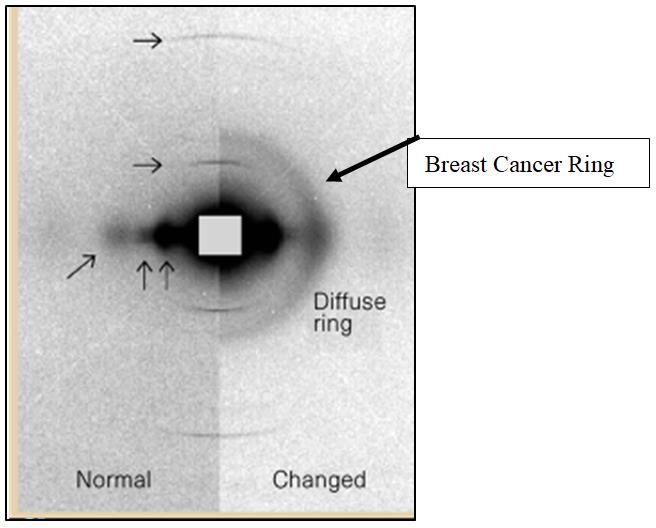
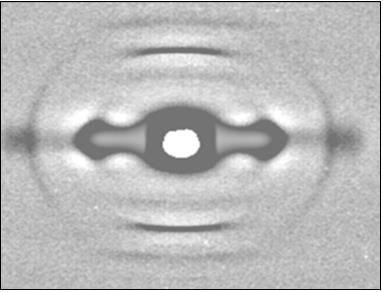
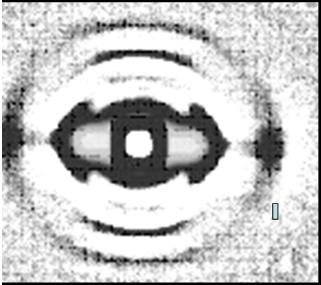
Every breast cancer patients has had the breast cancer ring of change stamped on the low angle diffraction pattern of their hair, clearly separating them from the normal samples, Figure 1. There have been no false negatives amongst the 4500+ samples completed so far. A number of false positives have subsequently been shown to be correct. One of these was marked as false positive, two years in a row. She died in the next year from breast cancer, finally diagnosed by mammography.
Method
An assessment of the papers that contradicted my results shows two major experimental problems viz. mounting techniques and experimental methodology. The fact that hair stretches with humidity changes is totally ignored. Samples in Denmark and Japan stretched visibly when moved from room to room necessitating loading samples in the X-ray room immediately before the experiment. Far from using 5cm long hairs as other scientists did, our samples were usually pubic hair cut as near the skin as possible. The section of hair used went from the cut end approximately 5 mm along the hair. This optimum length was obtained from a mouse study. Experimental proof that the ring observed in the X-ray diffraction pattern is related to the breast cancer was obtained from the mice studies. These showed that the breast cancer change in the hair pattern appears when the breast cancer starts. The cancer itself adds a molecule which bonds to the helical tail at that point of the hair, Figure 3. All subsequent helical tails will be so marked as the hair grows, until the cancer is removed.
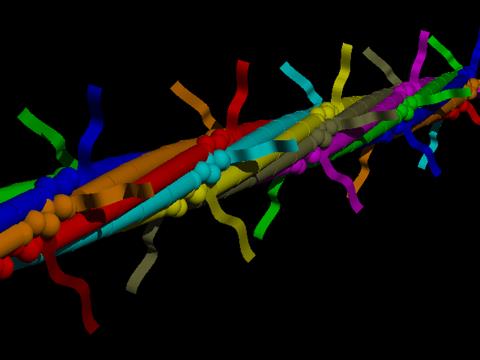
As the hair grows the cancer marker bonds to all subsequent helical tails. If the cancer is removed the change disappears, in the hair, from that point, Figure 4.
The hair for the mouse studies was supplied from 2 universities in Perth, Australia, Toronto (Canada) and Washington. Human breast cancers were implanted on the backs of 8 nude mice by scientists at the Perth University. Three whiskers were taken from each mouse before and about a month after the cancers were implanted successfully to allow time for whiskers to grow out. The results obtained are shown in Figure 5.
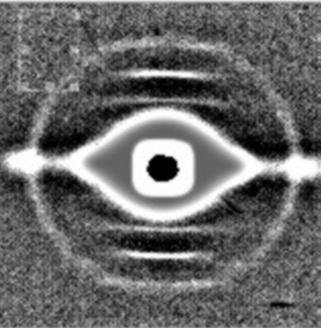
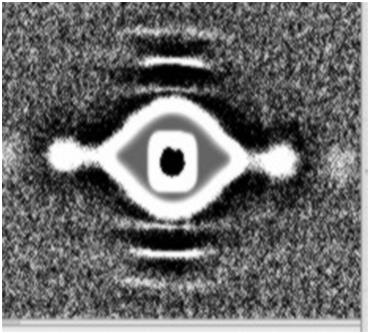
(A) (B) Figure 5: Whiskers patterns (a) before and (b) after.
The method of mounting hair was to attach a piece “parcel” paper tape to each end of the 0.5cm hair sample. A length of cotton is then attached to each paper tape strip and then lengths of cotton are tied to the paper tapes. These lengths of cotton are used for mounting the samples. The mounting of the samples should be done just prior to the diffraction experiment and in a room with the same humidity as the machine.
Mouse Studies
Experimental proof that the additional ring in the X- ray patterns of the hair of breast cancer patients is directly related to the breast cancer itself was obtained from a series of mouse studies. Firstly, human breast cancers were implanted on the backs of 8 nude mice by scientists at the Perth University, WA. Keeping in mind that the whiskers are curved, not straight, each whisker was approximately 15.0mm long. Diffraction patterns were taken with the beam centered near the tip of the first sample. There was no BC ring, Figure 4a. The X-ray beam was then centered 1.2mm approx. from the tip. No ring appeared, Figure 4b. The centre of the beam was then moved mm by mm along the whisker until finally the breast cancer ring appeared when the beam was centred 0.2mm approximately from the root,
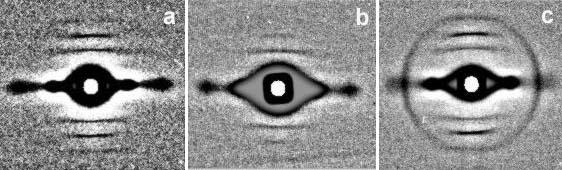
These results indicated that the BC ring does not move along the hair but travels with the hair as it grows. To verify this Perth scientists shaved the whiskers of a mouse and verified that they re-grew at approximately the same rate as the breast cancer change moved along the hair. This shows the necessity to cut the hair as close to the skin as possible and to use the section as close to the skin as possible to ensure the breast cancer is picked up as early as possible.
This test gives highly accurate results as the cancer itself produces the change. It causes no pain for the patient, not like a mammogram which the Ashkenazi Jewish women like in slamming their breasts in a refrigerator. This test can diagnose the cancer from the very beginning, unlike mammography which needs the cancer to be the size of a pea, i.e. two years later. A laboratory Small Angle X-ray Machine is all that is needed to bring this test into use.
Acknowledgement
The author acknowledges the generous support of the BioCAT facility (Advanced Photon Source), Argonne National Laboratory and for the assistance provided by the beam-line staff of this facility. The Advanced Photon Source is supported by the US Department of Energy, Basic Energy Sciences, and Office of Science under Contract No.W-31-109-ENG-38 -31-109-Eng-38. BioCAT is a National Institute of Health-supported Research Centre RR-08630.The author acknowledges the generous support of the Australian Synchrotron for beam-time on their low angle beam-line.
References
-
James V, Kearsley J, Irving T, Amemiya Y, Cookson D (1999) Using hair to screen for breast cancer Nature. Scientific Correspondence 398: 33-34.
-
Amenitsch H, Rappolt M, Laggner P, Bernstorff S, Moslinger R, et al. (1999) Synchrotron x-ray study at Trieste: no correlation between breast cancer and hair structure. Synchrotron Radiat News 12 (5): 32- 34.
-
Chu B, Fang D, Hsiao BS (1999) Hair test results at the advanced polymer beamline (X27C) at the NSLS. Synchrotron Radiat News 12(5): 36.
-
Howell A, Grossman JG, Cheung KC, Kanbi L, Evans DG, et al. (2000) Can hair be used to screen for breast cancer? J Med Genet 37(4): 297-298.
-
Laaziri K, Sutton M, Ghadirian P, Scott AS, Paradis AJ, et at. (2002) Is there a correlation between the structure of hair and breast cancer or BRCA1_/_2 mutations? Phys Med Biol 47(10): 1623-1632.
-
Feughelman M, James VJ (1998) Hexagonal Packing of Intermediate Filaments in a-keratin fibres. Textile Research Journal 68(2): 110-114.
- Cancer Diagnosis from RNA Sequence of Blood Cells by Using AI
- Field Cancerization in Oral Cavity, Case Report and Review of Literature. Oncologic Program Salud Integral Hospital, Managua, Nicaragua
- Identification of B Lymphocytes in Cancer Patient’s Blood
- A Case Report of a Breast Cancer Patient Developing Pneumonitis as a Result of Abemaciclib Therapy
- Immune Checkpoint Therapeutics for Today’s Fight and Beyond
- The Amalgamated Sophomore-Gonadoblastoma