
Relationship between Gait Speed and Balance Among Older Adults Residing in Long Term Care Settings
Studies have documented that a decrease in gait speed is linked to an increased risk of falling among older adults residing in the community. However, there is a lack of research examining the correlation between gait speed and balance in older adults who reside in long-term care settings (LTCS). Objective: To determine the relationship between balance using a four-square step test (FSST) and gait speed using a 10-m walk test among older adults residing in LTCS in and around Udupi-Manipal. Methods: A cross-sectional study was conducted among older adults residing in six LTCS. The residents above 60 years, either gender, able to follow commands, with functional vision and duration of stay > 6 months were included, and those who were bed or wheelchair-bound, use assistive devices for mobility, any acute cardiovascular events in the past 3 months, any orthopaedic or neurological conditions that affect mobility, and with benign paroxysmal positional vertigo were excluded. The participants were asked to perform the FSST and gait speed test. The demographic characteristics were summarized using descriptive statistics. Linear regression analysis was carried out keeping balance as the outcome variable and gait speed as the independent variable. Results: A total of ninety-four residents were screened, and thirty-five (n=35) were included in the study. The mean age of participants was 74.94 ± 7.54 years, with an average duration of stay in LTCS being 5.37 years. The participant's average gait speed was 0.994 ± 0.325 m/s, and the average time taken to complete the balance test was 12.75 ± 4.41 sec. The regression analysis revealed that for every second decline in gait speed, the dynamic balance assessed by the FSST reduced by 0.036 seconds (r2 =0.443; p = 0.008; 95% CI: -.062, -.010). Conclusion: This study showed that with an increase in gait speed, the time taken to complete the balance test decreased. This suggests older adults have better balance abilities when they can walk at a faster speed.
Introduction
Gait speed considered a sixth vital sign [1], is an important functional indicator of health among older adults [2]. The
literature suggests that a walking speed above 0.8 m/s has been associated with a range of positive health outcomes [2, 3]. Slowing down of gait due to the process of ageing is also well documented and is highly predictive of important outcomes relating to health such as physical, cognitive, functional decline, falls, hospitalization, poor quality of life and mortality [4]. Another factor significantly impacting older adult’s health and functioning is their balance [5].
Age-related anatomical and physiological changes impair the individual’s ability to generate motor responses to control body movements concerning their environment, thus affecting the balance among older adults. Dynamic balance as seen during gait is described as the body’s ability to react to external stimuli while in motion and older adults do it by reducing their gait speed to enhance their stability [6]. A study has reported a decline in gait speed over 12 months is associated with an increased likelihood of falls among community-dwelling older adults [7]. The place of living also poses a unique challenge, with better quality of life being observed in community-dwelling older adults than residing in long-term care settings (LTCS) [8].
Older adults residing in LTCS, particularly, are at higher risk of multiple chronic health conditions, functional limitations, and cognitive impairments due to lack of autonomy, boredom, loneliness and social isolation [9]. Hence compared to community dwellers, older adults residing in LTCS are more likely to fall and sustain injuries [10]. These factors can further exacerbate the decline in an individual’s physical and mental functions which may affect their gait speed and balance. However, little is known about the relationship between gait speed and balance among older adults. Hence, this study aimed to determine the relationship between gait speed and balance among adults residing in LTCS in and around Udupi-Manipal, Karnataka, India.
Materials and Methods
Study Design
To find out the relationship between gait speed and balance among older adults, an observational cross-sectional study was carried out. This study was initiated after obtaining the ethical clearances and approvals (Mpl/IRC/ UG/2023/009). This study adhered with the Declaration of Helsinki and strengthened the reporting of observational studies in epidemiology (STROBE) requirements [11].
Study Setting
The study was carried out between September 2023 and January 2024 in six LTCS in and around Udupi-Manipal, Karnataka, India. The convenience method of sampling was used by the investigators who were the students pursuing the Bachelor of Physiotherapy.
Inclusion and Exclusion Criteria
The residents above 60 years, either gender, able to follow commands, with functional vision and a duration of stay > 6 months were included, and those who were bed or wheelchair-bound, used assistive devices for mobility, any acute cardiovascular events in the past 3 months, any orthopaedic or neurological conditions that affect mobility, and with benign paroxysmal positional vertigo were excluded.
Study Participants
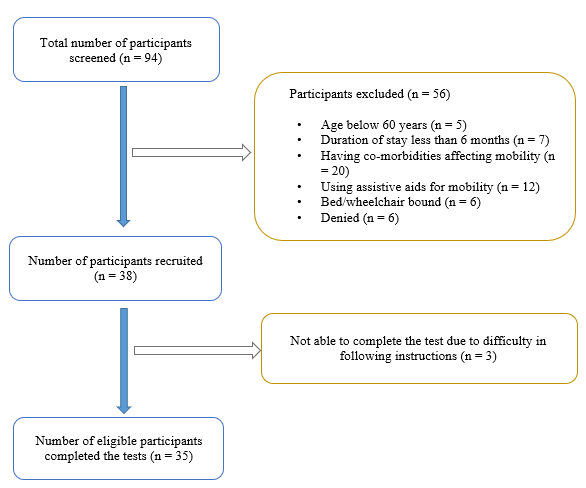
A total of ninety-four (n = 94) participants from six LTCS were screened, and thirty-five (n=35) eligible participants completed the test (Figure 1).
Outcome Measures and Procedure
Participants were screened according to the selection criteria. Those who met the criteria and wished to participate were given a detailed explanation of the study by providing them with a participant information sheet and informed consent was obtained. Participants were given detailed instructions about the tests. First, gait speed was assessed using a 10m walk test followed by a four-square step test after a brief rest period during the same visit.
Gait speed was determined using a 10m walk test. A clear pathway free of obstruction was identified, followed by measuring 10 meters and placing the cones at either end. 2-meter marks were made from each cone to allow for acceleration and deceleration phases. Only the central 6 meter was used to calculate the speed. During the study, each participant was provided with specific instructions to walk the distance between the initial and final cones at their regular walking pace. The timing of each individual’s walk was initiated when the toe of their leading foot crossed the initial 2-meter mark and concluded when the same foot’s toe crossed the final 2-meter mark. To determine the gait speed, the researchers divided the distance of 6 meters by the time taken to complete the course. Each participant was given two opportunities to complete the course, and the average of the two attempts was calculated and utilized as their final gait speed in meters per second [12].
Balance was assessed using a four-square step test (FSST). Canes were set up in cross configuration on the ground to form four squares and they were numbered 1,2,3,4 respectively. The participants were asked to stand in square-1 facing the square-2. Facing only one direction throughout the sequence was encouraged to ensure the participant steps forward, backward and sideways to right & left. The participants were required to step as fast as possible into each square in the following sequence 1-> 2-> 3-> 4-> 1-> 4-> 3-> 2-> 1. Demonstration of the sequence was done, and participants were given a familiarization trial. The timer was started when the first foot contacted the floor of square 2 and stopped when the last foot contacted square 1 after both clockwise and anti-clockwise directions were completed. They were encouraged to contact both feet in each square. The test was repeated when the participant missed the sequence, lost balance or touched the cane. Two FSSTs were performed with the best time taken as the score [13].
Statistical Method
The data was analyzed using Statistical Package for the Social Sciences 16 version (IBM SPSS Modeler 16.0) software. Descriptive analysis was used to examine demographic data. Linear regression analysis was carried out keeping balance as the outcome variable and gait speed as the independent variable.
Results
Demographic Characteristics of the Participants
Among the n=35 participants, there were n=15 men (42.9%) and n=20 women (57.1%). The mean age of participants was 74.94 ± 7.54 years with the average duration of stay in LTCS being 5.37 years. Further, demographic details of the study participants can be found in Table 1.
| Variables | Mean | Standard deviation |
|---|---|---|
| Age (Years) | 74.94 | 7.542 |
| Height (m) | 1.57 | 0.10145 |
| Weight (Kg) | 60.97 | 12.538 |
| Body mass index (Kg/m2) | 24.44 | 4.61639 |
| Duration of stay (Years) | 5.37 | 5.1 |
Table 1: Demographic Characteristics of Participants (n=35).
The mean gait speed of the participants was 0.994 m/s with a standard deviation of 0.325 ranging from a minimal value of 0.49 to a maximum of 2.00 m/s. The mean time taken to complete the balance test was 12.75 sec with a standard deviation of 4.41, ranging from the fastest time of 7.34 sec to the slowest time of 24.83 sec. The regression analysis revealed that for every second decline in gait speed, the dynamic balance assessed by the FSST was reduced by 0.036 seconds (r2 =0.443; p = 0.008; 95% CI: -.062, -.010) (Table 2).
- Mean (SD) r r2 p value (95%
- CI)
- Gait Speed (m/s)
- 0.994
- (0.325)
- -0.479
- 0.443
- 0.008
- Balance (seconds)
- 12.75
- (4.412)
- (-.062, -.010)
Table 2: Relationship between Gait Speed and Balance
Discussion
This study intended to determine the relationship between gait speed and balance among older adults residing in long-term care settings. Our study findings reveal that for every second decline in gait speed, the dynamic balance assessed by the FSST was reduced by 0.036 seconds.
With ageing changes in multiple systems are common, resulting in reduced physical performance. To evaluate the functional status, an assessment of the gait speed is a valuable resource [14, 15]. The assessment of gait speed considered as the sixth vital sign Fritz S, et al. [1] is quite common in geriatric research and clinical settings. Gait speed is a clinically feasible measure, as it is quick, inexpensive, and requires minimal equipment to administer [16].
Accurate quantification of balance deficits allows clinicians to determine if their patient is at risk of a fall, as well as guide intervention. Evidence demonstrates that clinical measures can capture balance impairments that signify increased fall risk in community-dwelling older patients [17]. Foot clearance is an important function required in everyday life. The ability to do this in different directions is essential when reacting to stimuli such as navigating crowds on a busy street or walking on uneven pavement. Compared to straight path walking, walking a curved path and changing direction further challenges balance and requires increased motor planning [18]. The FSST was developed by Dite and Temple and incorporates rapid stepping whilst changing direction. The test requires a person to step forward, backwards and sideways over obstacles in a specified sequence [19].
The determinants of falling are multifactorial, with important determinants of are performance of physical abilities such as gait speed and balance [4]. The study has shown that higher performance in gait speed and balance reduces the risk of falling by up to 0.34 and 0.44 times, respectively [4]. On a similar line, our study among older adults residing in LTCS has found a negative correlation between gait speed and balance. The result signifies that with an increase in gait speed, the time to complete the balance test decreases, which would ultimately result in the reduction of falls. Another study done among community-dwelling older adults has concluded that fast gait speed showed stronger associations and better predictive capabilities compared with usual gait speed with physical performance measures and balance confidence in older adults [5]. The results from the meta-analysis suggest a reduction in gait speed among long term care facility residents compared to their community dwelling counterparts [20].
Limitations
This study was carried out in LTCS belonging to a particular geographical location where rehabilitation interventions are done regularly. Hence, the results from this study cannot be generalized to all the older adults residing in LTCS, which may or may not have rehabilitation facilities.
Conclusion
This study showed that with an increase in gait speed, the time taken to complete the balance test decreased. This suggests older adults residing in LTCS have better balance abilities when they can walk at a faster speed.
References
-
Fritz S, Lusardi M (2009) White paper:“walking speed: the sixth vital sign”. J Geriatr Phys Ther 32(2): 46-49.
-
Studenski S, Perera S, Patel K, Rosano C, Faulkner K, et al. (2011) Gait speed and survival in older adults. Jama 305(1): 50-58.
-
Studenski SA, Peters KW, Alley DE, Cawthon PM, McLean RR, et al. (2014) The FNIH sarcopenia project: rationale, study description, conference recommendations, and final estimates. J Gerontol Ser Biomed Sci Med Sci 69(5): 547-558.
-
Nascimento M de M, Gouveia ÉR, Gouveia BR, Marques A, Martins F, et al. (2022) Associations of gait speed, cadence, gait stability ratio, and body balance with falls in older adults. Int J Environ Res Public Health 19(21): 13926.
-
Tiernan C, Schwarz DJ, Goldberg A (2023) Associations of Usual and Fast Gait Speed With Physical Performance and Balance Confidence in Community-Dwelling Older Adults: Implications for Assessment. J Geriatr Phys Ther.
-
Menz HB, Lord SR, Fitzpatrick RC (2003) Age‐related differences in walking stability. Age Ageing 32(2): 137- 142.
-
Adam CE, Fitzpatrick AL, Leary CS, Hajat A, Ilango SD, et al. (2023) Change in gait speed and fall risk among community-dwelling older adults with and without mild cognitive impairment: a retrospective cohort analysis. BMC Geriatr 23(1): 328.
-
Olsen C, Pedersen I, Bergland A, Enders-Slegers MJ, Jøranson N, et al. (2016) Differences in quality of life in home-dwelling persons and nursing home residents with dementia – a cross-sectional study. BMC Geriatr 16(1): 137.
-
Boamah SA, Weldrick R, Lee TSJ, Taylor N (2021) Social isolation among older adults in long-term care: A scoping review. J Aging Health 33(7-8): 618-632.
-
Rubenstein LZ (2006) Falls in older people: epidemiology, risk factors and strategies for prevention. Age Ageing 35(2): 37-41.
-
Von Elm E, Altman DG, Egger M, Pocock SJ, Gøtzsche PC, et al. (2007) The Strengthening the Reporting of Observational Studies in Epidemiology (STROBE) statement: guidelines for reporting observational studies. Ann Intern Med 147(8): 573-577.
-
Graham JE, Ostir GV, Fisher SR, Ottenbacher KJ (2008) Assessing walking speed in clinical research: a systematic review. J Eval Clin Pract 14(4): 552-562.
-
Moore M, Barker K (2017) The validity and reliability of the four square step test in different adult populations: a systematic review. Syst Rev 6(1): 1-9.
-
Verghese J, Wang C, Holtzer R (2011) Relationship of clinic-based gait speed measurement to limitations in community-based activities in older adults. Arch Phys Med Rehabil 92(5): 844-846.
-
Purser JL, Weinberger M, Cohen HJ, Pieper CF, Morey MC, et al. (2005) Walking speed predicts health status and hospital costs for frail elderly male veterans. J Rehabil Res Dev 42(4): 535-546.
-
Middleton A, Fritz SL (2013) Assessment of gait, balance, and mobility in older adults: considerations for clinicians. Curr Transl Geriatr Exp Gerontol Rep 2(4): 205-214.
-
Muir SW, Berg K, Chesworth B, Klar N, Speechley M (2010) Quantifying the magnitude of risk for balance impairment on falls in community-dwelling older adults: a systematic review and meta-analysis. J Clin Epidemiol 63(4): 389-406.
-
Courtine G, Schieppati M (2003) Human walking along a curved path. I. Body trajectory, segment orientation and the effect of vision. Eur J Neurosci 18(1): 177-190.
-
Dite W, Temple VA (2002) A clinical test of stepping and change of direction to identify multiple falling older adults. Arch Phys Med Rehabil 83(11): 1566-1571.
-
Kuys SS, Peel NM, Klein K, Slater A, Hubbard RE (2014) Gait speed in ambulant older people in long term care: a systematic review and meta-analysis. J Am Med Dir Assoc 15(3): 194-200.