
Diclofenac Sodium Loaded Nanosized Ethosomes: An Investigation on Z-Average, Polydispersity and Stability
Diclofenac sodium is a non-steroidal anti-inflammatory drug (NSAID). Oral therapy with NSAID is always associated with several side effects such as gastric bleeding, and ulceration. The purpose of this work was to explore the feasibility of power ultrasound in designing a noval ethosomal carrier based on Phosphatidyl choline (PC) and ethanol for topical application of Diclofenac sodium, and further to investigate Z-Average (nm), polydispersity index (PDI) and zeta potential (mV). The designed drug loaded ethosomes had Z-Average of 440.3nm, PDI of 0.56, and zeta potential of -35.2 mV. The obtained results demonstrated feasibility of power ultrasound in achieving nanosized drug loaded ethosomes though PDI value (above 0.5) was clearly indicative of broad distribution of particles. The zeta potential value of -35.2 mV substantiated stability of Diclofenac sodium loaded ethosomes
Introduction
Ethosomes are sophisticated vesicular delivery carriers that are capable of delivering various pharmaceutical actives [1, 2, 3]. These novel delivery systems contain soft phospholipid vesicles in the presence of high concentrations of ethanol [4, 5]. Diclofenac sodium is a non-steroidal anti-inflammatory drug (NSAID) [6]. NSAIDs are the most common and extensively used drugs for the management of pain, inflammation, and arthritis [7]. They inhibit Cyclooxygenase-2 (Cox-2) and thereby prostaglandin biosynthesis which is responsible for inflammation. The oral administration of NSAIDs is frequently associated with adverse effects such as gastric ulceration, bleeding and irritation [8]. Thus, ethosomal topical delivery of Diclofenac sodium was thought significant to overcome aforementioned adverse effect. Besides, other toxicities such as nausea, vomiting and diarrhea due to the high concentration of NSAIDs in the alimentary canal can also be circumvented. Also, dose related adverse effects such as acute renal insufficiency can be avoided through topical application.
Experimental
Materials
Diclofenac sodium was a gift sample from Dr. Reddy’s Laboratories (Hyderabad, India), Soya lecithin was obtained from Lipoid (Germany) while ethanol was purchased from Merck Ltd (India). Distilled water was used throughout the experiment.
Methods
Preparation of Diclofenac sodium ethosomes: To prepare ethosomes, initially Diclofenac sodium and soya lecithin was dissolved in ethanol (5mL). To this distilled water was added slowly with constant stirring and the resultant mixture was probe sonicated (PCI Analytics, Mumbai) at an optimized conditions of 5min and 60W.
Z-average, PDI, and zeta potential measurement: Size and PDI (polydispersity index) were determined by dynamic light scattering (DLS) using Malvern Zetasizer Nano ZS (Malvern Instruments, UK). Zeta potential was measured using the same instrument based on the electrophoretic mobility.
Result and Discussion
The obtained results for diclofenac sodium loaded ethosomes are depicted in Figures 1-3.
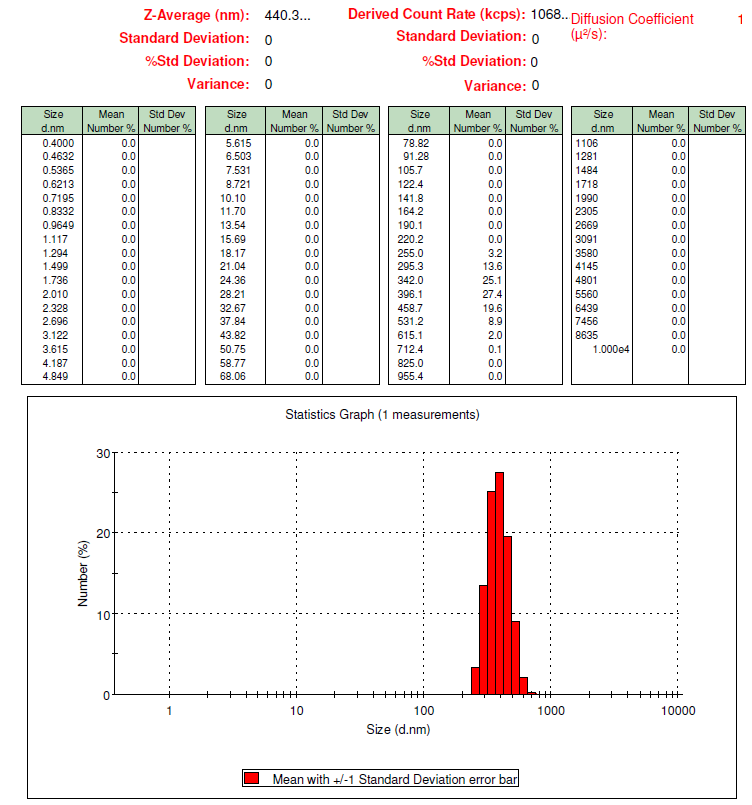
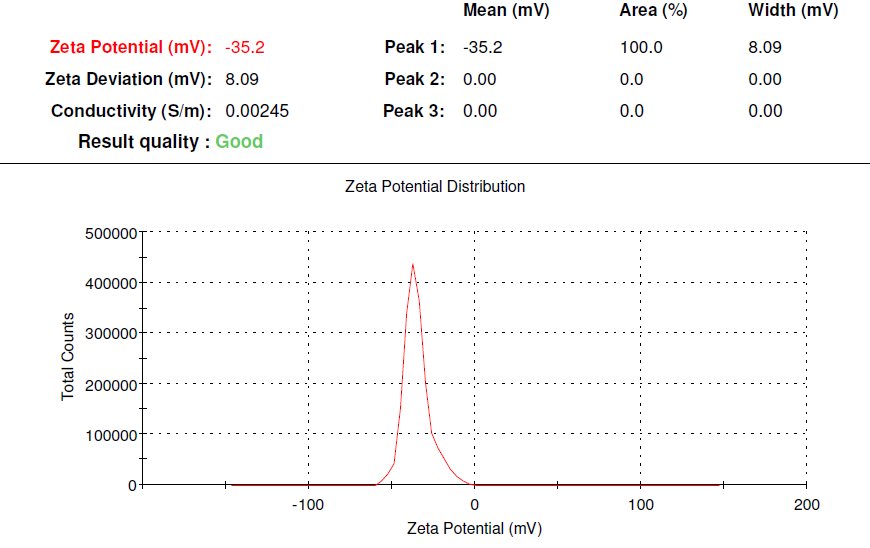
High power ultrasound was found to be useful method to produce Diclofenac sodium loaded ethosomes based on soya lecithin (Phospholipon 90G). Distinctive applications of dynamic light scattering (DLS) are the characterization of particles, emulsions or molecules, which have been dispersed or dissolved in a liquid [9]. Here, it is necessary to realize that the brownian motion of particles or molecules within suspension results in scattering of laser light with different intensities. Investigation of these intensity variations yields the velocity of the Brownian motion and henceforth the particle size by the Stokes- Einstein relationship. As can be seen from Figure 1, 27.4 (% Mean number) particles had size of 396.1 nm, followed by 25.1(% Mean number) corresponding to 342 nm, 19.6 (% Mean number) particles of 458.7nm. Figure 2 depicts size distribution of diclofenac sodium ethosomes by intensity. Note that Z-Average is an intensity-based calculated value and also known as the cumulants mean. As defined in ISO 13321 and more recently ISO 22412, Z- Average is the best value to report when used in a quality control setting [9]. The designed Diclofenac sodium ethosomes had Z-Average of 440.3nm. Polydispersity index (PDI) is a dimensionless parameter indicative of particle size distribution. In general, PDI value within 0.03-0.06 is indicative of monodisperse system, while PDI within 0.10-0.20 suggest narrow size distribution [10]. Also, to note that PDI value within 0.25-0.50 and above 0.50 is considered to have broad size distribution. Diclofenac sodium loaded ethosomes had PDI of 0.56 indicative of broad distribution of particles. Zeta potential is a prime factor predicting the stability of colloidal dispersion. In general, particles with zeta potentials values more than +30 mV or -30 mV are normally considered stable [11]. As shown in Figure 3, diclofenac sodium loaded ethosomes had zeta potential of -35.2 mV. Significant negative surface charges could be attributed to adsorption of hydroxyl ions of lipid at the interface [12].
Conclusion
Based on the obtained results it can be concluded that with power ultrasound it is feasible to produce nanosized Diclofenac sodium ethosomes with substantial stability as reflected through zeta potential value of -35.2 mV.
References
-
Touitou E, Dayan N, Bergelson L, Godin B, Eliaz M (2000) Ethosomes novel vesicular carriers for enhanced delivery: characterization and skin penetration properties. J Control Rel 65(3): 403- 418.
-
Pandey V, Golhani D, Shukla R (2015) Ethosomes: versatile vesicular carriers for efficient transdermal delivery of therapeutic agents. Drug Deliv 22(8): 988-1002.
-
Pirvu DC, Hlevca C, Ortan A, Prisada R (2010) Elastic vesicles as drugs carriers through the skin. Farmacia 58(2): 128-135.
-
Mbah CC, Builders PF, Attama AA (2014) Nanovesicular carriers as alternative drug delivery systems: ethosomes in focus. Expert Opin Drug Deliv 11(1): 45-59.
-
Elsayed MM, Abdallah OY, Naggar VF, Khalafallah NM (2007) Deformable liposomes and ethosomes as carriers for skin delivery of ketotifen. Pharmazie 62(2): 133-137.
-
Caddeo C, Sales OD, Valenti D, Sauri AR, Fadda AM, et al. (2013) Inhibition of skin inflammation in mice by diclofenac in vesicular carriers: Liposomes, ethosomes and PEVs. Int J Pharm 443(1-2): 128-136.
-
Heyneman CA, Lawless Liday C, Wall GC (2000) Oral versus topical NSAIDs in rheumatic diseases: A comparison. Drugs 60(3): 555-574.
-
Dhikav V, Singh S, Pande S, Chawla A, Anand KS. 2003. Non-steroidal drug induced gastrointestinal toxicity: Mechanisms and management. JIACM 4(4): 315-322.
-
(2011) Dynamic light scattering common terms defined, Malvern Instruments Limited MRK1764- 01.
-
Pardeike J (2008) Nano-suspenions and nano structrured lipid carriers for dermal application, PhD Thesis, Free University Berlin, Berlin, Germany: 65-66.
-
Zeta potential an introduction in 30 minutes, Zetasizer Nano series technical note, Malvern Instruments. MRK 654-01.
-
Kumbhar DD, Pokharkar VB (2013) Physicochemical investigations on an engineered lipid–polymer hybrid nanoparticle containing a model hydrophilic active, zidovudine, Colloids and Surfaces A: Physicochem Eng Aspects 436: 714-725.
- Acido Labile or Gastro Irritant Apis and Enteric Release in Galenic Practice: An Overview
- A Study on Knowledge, Attitude and Practice of Hand Hygiene among Healthcare Professionals at a Tertiary Care Hospital, India
- Influence of Inoculum Concentration on In Vivo Incubation Period of Emmia lacerata, Pathogenesis and Management of Wilt in Pepper (Capsicum annuum L.)
- Vanilla’s Chemistry
- Marine Anti-Cancer Compounds and Adverse Effects of Global Warming on Oceans: An Overview
- Serological Investigation of Chikungunya Virus Antibody among Malaria-Suspected Febrile Patients in Some Healthcare Facilities in Rivers State