
Simultaneous Determination of Ranitidine Hydrochloride and Ondansetron Hydrochloride in Bulk Drug and Tablet Dosage Form by UV Spectrophotometry
A simple, accurate and economic UV Spectrophotometric method was developed for simultaneous estimation of Ranitidine Hydrochloride (RNH) and Ondansetron Hydrochloride (ODH) in bulk drug and tablet dosage form. Distilled water was used as solvent for analysis. The wavelengths selected for determination of Ranitidine was found to be 227.8 nm and for Ondansetron was found to be 248.7 nm. The linearity was found to be satisfactory in the concentration range of 2-10 µg/ml for both RNH and ODH. Regression analysis reveals that the correlation coefficient was found to be 0.9976 for RNH and 0.9979 for ODH. The %RSD values for intra-day precision and inter-day precision for Ranitidine were found to be 0.58% and 0.96% and for Ondansetron were found to be 0.44% and 0.54% respectively. The mean recovery of the drugs RNH and ODH was 99.36% and 99.51% respectively. The proposed method was validated as per ICH guidelines and the results are in accordance with acceptance criteria. Hence the present described method can be identically used for analysis of Ranitidine Hydrochloride and Ondansetron Hydrochloride in commercial formulation.
Introduction
Ranitidine Hydrochloride (Figure 1) is a histamine H2- receptor antagonist indicated for the treatment of peptic ulcers [1, 2]. The chemical name for Ranitidine Hydrochloride N[2-[[[5-[(dimethylamino)methyl]- 2furanyl]methyl]thio]ethyl]-N'-methyl-2-nitro-1,1- ethenediamine hydrochloride [3, 4]. Ranitidine is a competitive, reversible inhibitor of the action of histamine. Ranitidine blocks the production of acid by acid-producing cells in the stomach. Histamine is a naturally-occurring chemical that stimulates cells in the stomach to produce acid. H2-blockers inhibit the action of histamine on the cells, thus reducing the production of acid by the stomach. They accomplish this by two mechanisms: histamine released by enterochromaffin-like (ECL) cells in the stomach is blocked from binding on parietal cell H2 receptors which stimulate acid secretion, and other substances that promote acid secretion have a reduced effect on parietal cells when the H2 receptors are blocked.
![Figure 1: Molecular structure of Ranitidine Hydrochloride. Ondansetron Hydrochloride (Figure 2) is a selective, competetive serotonin (5-HT3) receptor antagonist [5]. The chemical name was (±) 1,2,3,9-tetrahydro-9- methyl-3-[(2-methyl-1_H_-imidazol-1-yl)methyl]-4_H_- carbazol-4-one, monohydrochloride [6,7]. It is effective in the treatment of nausea and vomiting. The antiemetic activity of the drug is brought about through the inhibition of 5-HT3 receptors present both centrally (medullary chemoreceptor zone) and peripherally (GI tract) [8]. This in turn inhibits the visceral afferent stimulation of the vomiting center, likely indirectly at the level of the area postrema through direct inhibition of serotonin activity within the area postrema and the chemoreceptor trigger zone. On literature survey it was found that few analytical methods were available for simultaneous estimation of Ranitidine Hydrochloride and Ondansetron Hydrochloride by using UV Spectrophotometry and RP- HPLC [9-15]. Hence an effort has been made to develop a simple, sensitive, economic and precise UV Spectrophotometric method for simultaneous analysis of RNH and ODH and validated as per ICH guidelines.](/fulltextimages/1044/fig_1.png)
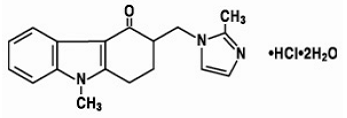
Figure 1: Molecular structure of Ranitidine Hydrochloride. Ondansetron Hydrochloride (Figure 2) is a selective, competetive serotonin (5-HT3) receptor antagonist [5]. The chemical name was (±) 1,2,3,9-tetrahydro-9- methyl-3-[(2-methyl-1_H_-imidazol-1-yl)methyl]-4_H_- carbazol-4-one, monohydrochloride [6, 7]. It is effective in the treatment of nausea and vomiting. The antiemetic activity of the drug is brought about through the inhibition of 5-HT3 receptors present both centrally (medullary chemoreceptor zone) and peripherally (GI tract) [8]. This in turn inhibits the visceral afferent stimulation of the vomiting center, likely indirectly at the level of the area postrema through direct inhibition of serotonin activity within the area postrema and the chemoreceptor trigger zone. On literature survey it was found that few analytical methods were available for simultaneous estimation of Ranitidine Hydrochloride and Ondansetron Hydrochloride by using UV Spectrophotometry and RP- HPLC [9, 10, 11, 12, 13, 14, 15]. Hence an effort has been made to develop a simple, sensitive, economic and precise UV Spectrophotometric method for simultaneous analysis of RNH and ODH and validated as per ICH guidelines.
Method and Materials
Materials
Instrument: Shimadzu UV1800 Double Beam Spectrophotometer was used for analysis. Drugs and formulations: The pure drug samples of Ranitidine Hydrochloride (API) and Ondansetron Hydrochloride (API) were provided as gift samples from Spectrum Labs, Hyderabad, India. The commercial formulations (tablets) (DORAN-O tablets containing 150 mg of Ranitidine Hydrochloride and 4 mg of Ondansetron Hydrochloride) were procured from the local market. Chemicals and solvents: Distilled water was used as solvent and was used throughout the experiment.
Methodology
Selection of suitable solvent: Both the drugs RNH and ODH were soluble in distilled water hence the distilled water was used as a solvent for estimation of these drugs. Preparation of standard stock solution: Accurately weighed 10 mg of Ranitidine and 10 mg of Ondansetron and transferred into a 100 ml clean dry volumetric flask containing 70 ml of distilled water. The solution was sonicated for 5 min and the drug was dissolved completely. The volume was made up to the mark with a further quantity of the water to get a stock concentration of Ranitidine and Ondansetron. Determination of analytical wavelength: Standard dilution containing 10 µg/ml of each RNH and ODH was prepared separately from stock solution and spectra were recorded in the wavelength region of 200-400 nm. The λmax was found to be 227.8 nm for RNH and 248.7 nm for ODH.
Validation
Linearity
Linear response was observed in the concentration range of 2-10 µg/ml for both RNH and ONH. The standard solutions in the range of 2-10 µg/ml were prepared and the absorbances were measured at 227.8 nm for Ranitidine and 248.7 nm for Ondansetron. A calibration curve by taking concentration on X-axis and absorbance on Y-axis were plotted. The results were represented in Table 1.
| S. No. | Concentration (µg/ml) | Absorbance (RNH) | Absorbance (ODH) | ||||||||
| 1 | 2 | 0.146 | 0.231 | ||||||||
| 2 | 4 | 0.223 | 0.389 | ||||||||
| 3 | 6 | 0.287 | 0.48 | ||||||||
| 4 | 8 | 0.344 | 0.66 | ||||||||
| 5 | 10 | 0.412 | 0.808 | ||||||||
| Slope | 0.0327 | 0.0713 | |||||||||
| Intercept | 0.0865 | 0.0983 | |||||||||
| Regression Equation (y) | 0.0327x+0.0865 | 0.0713x+0.0983 | |||||||||
| Correlation Coefficient | 0.9976 | 0.9979 |
Table 1: Linearity results for RNH and ODH.
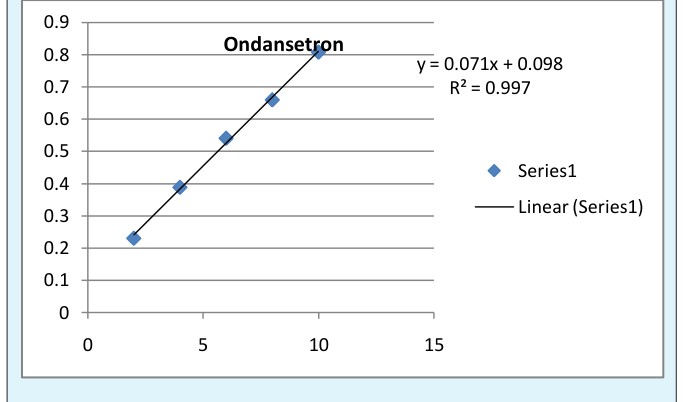
six times in a day (Intra-day) and six different days (Inter- day). %RSD values are calculated and compared with acceptance criteria. The data was presented in Tables 2 and 3.
Precision
Precision was determined by measuring the absorbance of standard solution of same concentration
| S. No. | Time (Hours) | Absorbance (RNH) | Absorbance (ODH) | ||||||
| 1 | 0 | 0.26 | 0.34 | ||||||
| 2 | 1 | 0.265 | 0.333 | ||||||
| 3 | 2 | 0.261 | 0.34 | ||||||
| 4 | 3 | 0.266 | 0.342 | ||||||
| 5 | 4 | 0.248 | 0.335 | ||||||
| 6 | 5 | 0.271 | 0.341 | ||||||
| Mean | 0.261 | 0.338 | |||||||
| SD | 0.00583 | 0.00149 | |||||||
| %RSD | 0.58 | 0.44 |
Table 2: Intra-day Precision results.
| S. No. | Time (Days) | Absorbance (RNH) | Absorbance (ODH) | ||||||
| 1 | 1 | 0.278 | 0.38 | ||||||
| 2 | 2 | 0.268 | 0.382 | ||||||
| 3 | 3 | 0.266 | 0.381 | ||||||
| 4 | 4 | 0.263 | 0.379 | ||||||
| 5 | 5 | 0.262 | 0.375 | ||||||
| 6 | 6 | 0.261 | 0.371 | ||||||
| Mean | 0.266 | 0.378 | |||||||
| SD | 0.00256 | 0.00207 | |||||||
| %RSD | 0.96 | 0.54 |
Table 3: Inter-day Precision results.
Accuracy
Accuracy was determined by performing recovery studies. Recovery studies were conducted by preparing standard solutions of all the two drugs were added equivalent to 50, 100 and 150% of its drug content. These solutions were prepared in triplicate and % mean recovery was calculated. The results were tabulated in Table 4.
| Standard conc. (µg/ml) | Conc. added | Conc. found | % Mean Recovery | ||||||||||||||
| Level | Drugs | % Recovery | |||||||||||||||
| (µg/ml) | (µg/ml) | ||||||||||||||||
| 50% | RNH | 10 | 3 | 2.98 | 99.33 | 99.36 | |||||||||||
| 100% | 6 | 5.94 | 99 | ||||||||||||||
| 150% | 9 | 8.98 | 99.77 | ||||||||||||||
| 50% | ODH | 10 | 3 | 2.96 | 98.66 | 99.51 | |||||||||||
| 100% | 6 | 6.02 | 100.33 | ||||||||||||||
| 150% | 9 | 8.96 | 99.55 |
Table 4: Recovery studies.
Robustness
The robustness study was performed by slight modification in method parameters of Ranitidine and Ondansetron. Samples of RNH and ODH at 100 µg/ml concentration were analyzed under these changed experimental conditions. It was observed that there were no marked changes in absorbances, which demonstrated that the developed method was robust in nature.
Ruggedness
Ruggedness of the method was confirmed by the analysis of samples was done by different analysts. Samples of Ranitidine and Ondansetron at 100 µg/ml concentration were analyzed by different analysts. It was observed that there were no marked changes in absorbances, which demonstrated that the developed method was rugged in nature.
Limit of detection and Limit of quantification
Limit of detection (LOD) and Limit of quantification (LOQ) values were calculated based on standard deviation of response and slope of calibration curve. Standard deviation of response can be obtained from y- intercepts of regression line. The LOD and LOQ of Ranitidine and Ondansetron are given in Table 5.
| Measured valu | e | Measured value | ||||||
| Parameter | ||||||||
| RNH (µg/ml) | ODH (µg/ml) | |||||||
| Limit of detection | 0.588 | 0.068 | ||||||
| Limit of quantification | 1.764 | 0.204 |
Table 7: LOD and LOQ values for RNH and ODH.
Analysis of marketed formulation
Assay was carried out by taking an accurately weighed portion of tablet powder sample equivalent to 10 mg of Ranitidine and 10 mg of Ondansetron was transferred into a 100 ml clean dry volumetric flask containing distilled water and the solution was sonicated for 5 min. 0.2 ml of the above stock solution were transferred into a 10 ml volumetric flask and the volume was made up to the mark with the water. The assay results were presented in Table 6.
| c | Labe | l | Amount | |||||||||
|---|---|---|---|---|---|---|---|---|---|---|---|---|
| Formulation | % Assay | |||||||||||
| laim | found | |||||||||||
| DORAN-O | Ranitidine HCl | 5 mg | 4.98 mg | 99.60% | ||||||||
| Ondansetron HCl | 5 mg | 5.02 mg | 100.40% |
Table 5: Assay of marketed formulation.
Summary and Conclusion
The present method involves development of a method for simultaneous estimation of Ranitidine Hydrochloride and Ondansetron Hydrochloride by using distilled water as a solvent and the peaks of maximum absorbance was measured at 227.8 nm for Ranitidine Hydrochloride and 248.7 nm for Ondansetron Hydrochloride. The results of validation parameters were summarized in Table 7.
| Parameter | RNH | ODH | ||||||
|---|---|---|---|---|---|---|---|---|
| Linearity (µg/ml) | 2-10 | 2-10 | ||||||
| Intra-day Precision (%RSD) | 0.58 | 0.44 | ||||||
| Inter-day Precision (%RSD) | 0.96 | 0.54 | ||||||
| Accuracy (% recovery) | 99.36 | 99.51 | ||||||
| Limit of detection (µg/ml) | 0.588 | 0.068 | ||||||
| Limit of quantification (µg/ml) | 1.764 | 0.204 |
Table 6: Validation Summary. Based on above results the developed method was simple, precise, robust and accurate for quantificat
Table 7: Validation Summary. Based on above results the developed method was simple, precise, robust and accurate for quantification of Ranitidine Hydrochloride and Ondansetron Hydrochloride in pure and tablet dosage form. %RSD values for intra-day and inter-day precision were below 1 revealed that the method was precise. Satisfactory recovery results shown that the established method was free from interference of excipients. Low LOD and LOQ values makes the method was suitable for routine quality control analysis. So, the proposed method can be utilized for simultaneous analysis of Ranitidine Hydrochloride and Ondansetron Hydrochloride.
References
-
Brogden RN, Carmine AA, Heel RC, Speight TM, Avery GS (1982) Ranitidine: a review of its pharmacology and therapeutic use in peptic ulcer disease and other allied diseases. Drugs 24(4): 267-303.
-
Wormsley KG (1993) Safety profile of Ranitidine-a review. Drugs 46(6): 976-985.
-
(2014) Indian Pharmacopoeia, Volume III, The Indian Pharmacopoeia Commission, Ghaziabad, India. p 2643(RNH) & 2376(ODH).
-
The Merck Index (2006), 14th edition, Merck Research Laboratories, Merck & Co., Whitehouse Station, NJ, USA. p. 1396(RNH) & 1180(ODH).
-
Cooke CE, Mehra IV (1994) Oral Ondansetron for preventing nausea and vomiting. Am J Hosp Pharm 51(6): 762-771.
-
Gan LS, Hsyu PH, Pritchard JF, Thakker D (1993) Mechanism of intestinal absorption of Ranitidine and Ondansetron: transport across Caco-2 cell monolayers. Pharm Res 10(12): 1722-1725.
-
(2009) British Pharmacopoeia, Volume II, British Pharmacopoeia Commission Office, London, UK. p 1765(RAT) & 1506(OST).
-
U.S. Pharmacopoeia 37 National Formulary 32, Volume III, The Unites States Pharmacopoeial Convention, Rockville, MD, USA. 2014; p. 4537(RNH) & 4070(ODH).
-
Pillai S, Singhvi I (2007) Spectrophotometric simultaneous estimation of Ranitidine Hydrochloride and Ondansetron Hydrochloride from tablet formulation. Indian J Pharma Sci 69(4): 601-604.
-
Vaibhav RM, Palekar SS, Prakash TS, Tauqueer K, Atul SS, et al. (2015) Development and validation of UV spectrophotometric method for the simultaneous estimation of Ranitidine and Ondansetron in bulk and pharmaceutical formulation. WJPR 4(2): 1093-1101.
-
Patel NM, Fursule RA, Shirkhedkar AA, Talele GS (2006) Simultaneous estimation of Ranitidine Hydrochloride and Ondansetron Hydrochloride by RP-HPLC. Asian Journal of Chemistry 18(4): 2691- 2694.
-
Meyyanathan SN, Venkatesh DN, Krishnaveni N, Babu B, Jeyaprakash MR, et al. (2012) A RP-HPLC method for simultaneous estimation of Ondansetron and Ranitidine in pharmaceutical formulation. IJHAS 1(2): 129-132.
-
Priyanka K, Vennela K, Reddy MM (2014) A new RP- HPLC method development and validation for simultaneous estimation of Ranitidine and Ondansetron in pharmaceutical dosage form. IJIPSR 2(12): 2971-2979.
-
Vaibhav RM, Palekar SS, Patel MV, Borkar NA, Tekade AR, et al. (2015) Development and validation of RP- HPLC method for simultaneous estimation of Ranitidine and Ondansetron in pharmaceutical formulations. WJPR 4(1): 1872-1881.
-
Abdel Hamid ME, Sharma D (2004) Simultaneous quantification of Doxorubicin, Lorazepam, Metoclopramide, Ondansetron and Ranitidine in mixtures by Liquid Chromatography-Tandem Mass Spectrometry. Journal of Liquid Chromatography & Related Technologies 27(4): 641-660.
- Acido Labile or Gastro Irritant Apis and Enteric Release in Galenic Practice: An Overview
- A Study on Knowledge, Attitude and Practice of Hand Hygiene among Healthcare Professionals at a Tertiary Care Hospital, India
- Influence of Inoculum Concentration on In Vivo Incubation Period of Emmia lacerata, Pathogenesis and Management of Wilt in Pepper (Capsicum annuum L.)
- Vanilla’s Chemistry
- Marine Anti-Cancer Compounds and Adverse Effects of Global Warming on Oceans: An Overview
- Serological Investigation of Chikungunya Virus Antibody among Malaria-Suspected Febrile Patients in Some Healthcare Facilities in Rivers State