
Development and Validation of RP-HPLC Method for Simultaneous Estimation of Moexipril and Hydrochlorothiazide in Bulk and Tablet Dosage Form
A simple, fast, precise reverse phase and isocratic HPLC method was developed for the separation and quantification of Moexipril (MXP) and Hydrochlorothiazide (HCT) in pharmaceutical dosage form. The quantification was carried out using Kromasil C18 (250 x 4.6 mm, 5 µm) enhanced polar selectivity column and mobile phase comprised of orthophosphoric acid buffer and acetonitrile in proportion of ratio 70:30v/v and degassed under ultra sonication. The flow rate was 1.0mL/min and the effluent was monitored at 230nm. The retention time of Moexipril and Hydrochlorothiazide were 2.4 and 3.2min respectively. The method was validated in terms of linearity, precision, accuracy, specificity, limit of detection and limit of quantitation. Linearity of Moexipril and Hydrochlorothiazide were in the range of 37.5 to 225µg/mL and 62.5 to 375µg/mL respectively. The percentage recoveries of both the drugs were 98.44% and 98.80% for Moexipril and Hydrochlorothiazide respectively from the tablet formulation. The proposed method is suitable for simultaneous determination of Moexipril and Hydrochlorothiazide in pharmaceutical dosage form
Introduction
Moexipril [1] is chemically (3_S_)-2-[(2_S_)-2-{[(2_S_)-1- ethoxy-1-oxo-4-phenylbutan-2-yl] amino} propanoyl]-
6,7-dimethoxy-1,2,3,4-tetrahydroisoquinoline-3- carboxylic acid (Figure 1). It is a non-sulfhydryl containing precursor of the active angiotensin-converting enzyme (ACE) inhibitor moexiprilat. It is used to treat high blood pressure (hypertension). The mechanism through which Moexiprilat lowers blood pressure is believed to be primarily inhibition of Angiotensin Converting Enzyme (ACE) activity. Although the principal mechanism of Moexipril in blood pressure reduction is believed to be through the renin-angiotensin-aldosterone system, ACE inhibitors have some effect on blood pressure even in apparent low-renin hypertension.
Figure 1: Structure of Moexipril. Hydrochlorothiazide (HCT) [2, 3] is chemically described as 6-chloro-3,4-dihydro-2_H_-1,2,4- benzothiadiazine-7-sulfonamide 1,1-dioxide (Figure 2). Hydrochlorothiazide is a thiazide diuretic, inhibits water reabsorption in the nephron by inhibiting the sodium- chloride symporter (SLC12A3) in the distal convoluted tubule. It reduces the reabsorption of electrolytes from the renal tubules. This results in increased excretion of water and electrolytes, including sodium, potassium, chloride, and magnesium. The combination of MXP and HCT is available as tablet dosage form.
Figure 2: Structure of Hydrochlorothiazide. Several analytical methods have been reported for the determination of MXP and HCT alone in biological fluids and in pharmaceutical formulations. Literature survey revealed several analytical methods have been reported for individual estimation [4, 5, 6, 7] of MXP and HCT and in combination with other drugs [8, 9, 10, 11, 12] but only two HPLC methods [13, 14] were reported for simultaneous estimation of MXP and HCT. Hence an attempt has been made to develop a simple, precise, reliable, sensitive and selective HPLC method for the analysis of MXP and HCT in bulk samples and in combined tablet dosage form. The proposed method was validated according to ICH guidelines [15].
Materials and Methods
Materials
Moexipril and Hydrochlorothiazide were obtained as gift samples from Spectrum Labs, Hyderabad. Moexipril and Hydrochlorothiazide combined dosage form tablets were purchased from local market. HPLC grade acetonitrile, methanol and analytical grade, orthophosphoric acid was obtained from Merck Chemicals Ltd, Mumbai. Milli-Q water was used throughout the experiment dispensed through 0.22µ filter of the Milli-Q water purification system from Merck Millipore.
Chromatographic Conditions
Waters Alliance HPLC, integrated with Auto Sampler and UV detector was used. The output of signal was monitored and integrated using waters Empower 2 software. Kromasil C18, 250 x 4.6mm, 5µm particle size enhanced polar selectivity column was used as stationary phase. Mobile phase was comprised of 0.1%ortho phosphoric acid and acetonitrile in proportion of ratio 70:30v/v. The mobile phase was mixed, filtered through 0.45µ membrane filter and degassed under ultrasonication. Water: acetonitrile (50:50v/v) was used as diluent. Injection volume was 10μL and flow rate was 1mL/min and run time was 7min.The column was maintained at ambient temperature and the eluent was monitored at 230nm.
Preparation of Standard Solution
Standard stock solutions of Moexipril and Hydrochlorothiazide (µg/mL) were prepared by dissolving 15mg of Moexipril and 25mg of Hydrochlorothiazide dissolved in sufficient mobile phase. After that filtered the solution using 0.45micron syringe filter and sonicated for 5min and dilute to 100mL with mobile phase. Further dilutions made by adding 1mL of stock solution to 10mL of mobile phase. Standard stock solution was diluted in mobile phase to contain a mixture of Moexipril and Hydrochlorothiazide in over the linearity range from 37.5 to 220µg/mL and 62.5 to 375µg/mL respectively.
Preparation of Sample Solution
20 tablets (each tablet contains 15mg of Moexipril and 25mg of Hydrochlorothiazide) were weighed and taken into a mortar and crushed to fine powder and uniformly mixed. Tablet stock solutions of Moexipril and Hydrochlorothiazide (μg/mL) were prepared by dissolving weight equivalent to 15mg of Moexipril and 25mg of Hydrochlorothiazide and dissolved in sufficient mobile phase. After that filtered the solution using 0.45μ syringe filter and Sonicated for 5 min and dilute to 100mL with mobile phase. Further dilutions are made by adding 1mL of stock solution to 10mL of mobile phase. 10µL of the sample solution was injected in to the HPLC system.
Results and Discussion
Method Development
To develop a simple and robust method for the simultaneous determination of MXP and HCT in combined tablet dosage form using HPLC. Solubility of standard drug was checked and based on solubility different mobile phase compositions were pumped in binary mode to achieve the resolution of drug peaks, initial experimental conditions were column with C18 stationery phase, water System Suitability: System suitability test was performed on each day prior to initiation of the validation run. The system suitability results of the method are presented in (Tables 1 & 2).
and acetonitrile as organic solvent at a flow rate of 1.0mL/min was chosen and respective injections shown considerable resolution of drug peaks with a run time of 10min. For better resolution the water was replaced by 0.1% ortho phosphoric acid (OPA) and finally a premixed composition (70:30, v/v) of 0.1% OPA and acetonitrile was chosen as mobile phase, and the Kromasil stationary phase with enhanced polar selectivity of particle size 5µm, 250X4.6mm was used and the runtime of the method was got minimized to 7min with better resolution, better peak shape was found with mobile phase as diluent in samples injected into chromatographic system. Injections with UV detection at a wavelength of 230nm for both drug peaks in the trail results were observed to be specific, precise and fast.
Validation of the Proposed Method
| Injection | Retention time (min) | Peak area | Theoretical plates | Tailing factor | ||||||||
| 1 | 2.401 | 785185 | 4978 | 1.25 | ||||||||
| 2 | 2.402 | 781793 | 4595 | 1.23 | ||||||||
| 3 | 2.403 | 783322 | 4921 | 1.28 | ||||||||
| 4 | 2.403 | 782952 | 4844 | 1.28 | ||||||||
| 5 | 2.404 | 784703 | 4949 | 1.27 | ||||||||
| 6 | 2.404 | 786933 | 4864 | 1.28 | ||||||||
| Mean | - | 784148 | - | - | ||||||||
| SD | - | 1833.1 | - | - | ||||||||
| %RSD | - | 0.2 | - | - |
Table 1: Results for system suitability of Moexipril.
| Injection | Retention time (min) | Peak area | Theoretical plates | Tailing factor | ||||||||
| 1 | 3.295 | 2173551 | 8535 | 1.17 | ||||||||
| 2 | 3.296 | 2181287 | 8502 | 1.13 | ||||||||
| 3 | 3.298 | 2178698 | 8515 | 1.15 | ||||||||
| 4 | 3.299 | 2181255 | 8406 | 1.15 | ||||||||
| 5 | 3.3 | 2188768 | 8598 | 1.16 | ||||||||
| 6 | 3.304 | 2174555 | 8653 | 1.17 | ||||||||
| Mean | 2179685 | - | - | |||||||||
| SD | 5521.9 | - | - | |||||||||
| %RSD | 0.3 | - | - |
Table 2: Results for system suitability of Hydrochlorothiazide.
Specificity: A study was conducted to establish specificity of the proposed method involved injecting diluent and placebo using the chromatographic conditions defined for the proposed method. The blank chromatogram showed no interference peaks at the retention time of Moexipril and Hydrochlorothiazide respectively. This indicates that diluent solution used in sample preparation do not interfere in the estimation of Moexipril and Hydrochlorothiazide. Similarly the placebo sample chromatogram showed no interference peaks at the retention time of Moexipril and Hydrochlorothiazide respectively. Additional peaks were observed in the channel may be due to excipients present in the formulations. These peaks however did not interfere with the standard peak indicating that the placebo used in sample preparation do not interfere in estimation of Moexipril and Hydrochlorothiazide in combination tablet, which demonstrates the specificity of the proposed method. The chromatogram of the blank and placebo using the proposed method for Moexipril and Hydrochlorothiazide is shown in Figures 3 & 4. The typical chromatogram of the sample using the proposed method for Moexipril and Hydrochlorothiazide is shown in Figure 5.
![Figure 1: Structure of Moexipril. Hydrochlorothiazide (HCT) [2,3] is chemically described as 6-chloro-3,4-dihydro-2_H_-1,2,4- benzothiadiazine-7-sulfonamide 1,1-dioxide (Figure 2). Hydrochlorothiazide is a thiazide diuretic, inhibits water reabsorption in the nephron by inhibiting the sodium- chloride symporter (SLC12A3) in the distal convoluted tubule. It reduces the reabsorption of electrolytes from the renal tubules. This results in increased excretion of water and electrolytes, including sodium, potassium, chloride, and magnesium. The combination of MXP and HCT is available as tablet dosage form.](/fulltextimages/1405/fig_1.png)
![Figure 2: Structure of Hydrochlorothiazide. Several analytical methods have been reported for the determination of MXP and HCT alone in biological fluids and in pharmaceutical formulations. Literature survey revealed several analytical methods have been reported for individual estimation [4-7] of MXP and HCT and in combination with other drugs [8-12] but only two HPLC methods [13,14] were reported for simultaneous estimation of MXP and HCT. Hence an attempt has been made to develop a simple, precise, reliable, sensitive and selective HPLC method for the analysis of MXP and HCT in bulk samples and in combined tablet dosage form. The proposed method was validated according to ICH guidelines [15].](/fulltextimages/1405/fig_2.png)
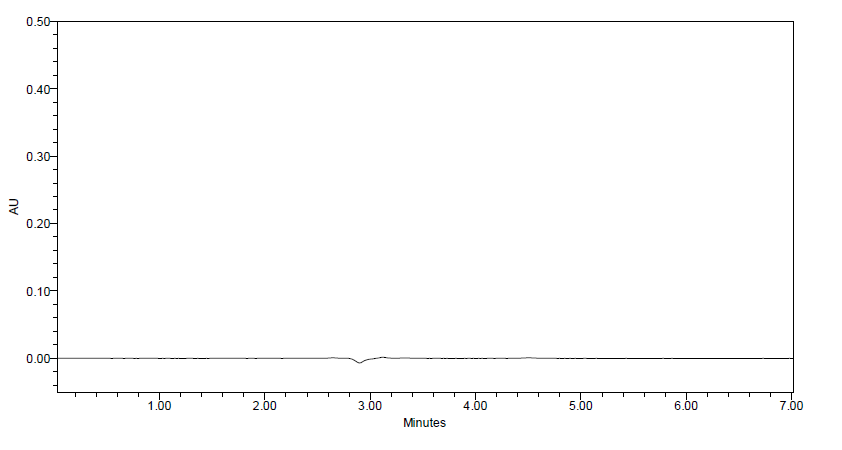
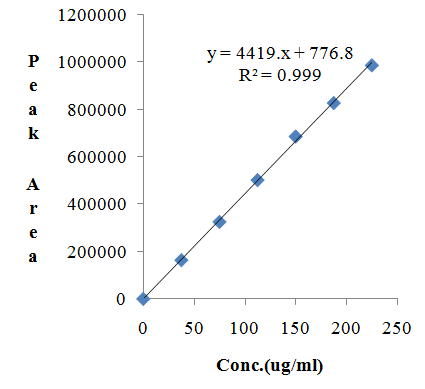
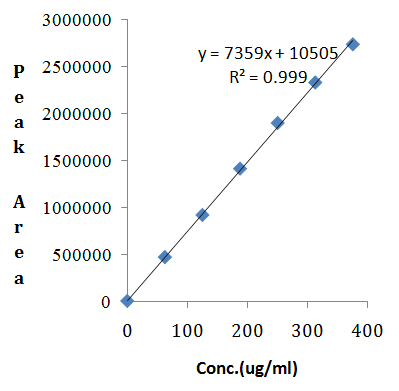
Figure 5: Optimised Chromatogram. Linearity: Detector response for the proposed method determined to be linear over the range of five concentration levels prepared and injected, 37.5 to 220µg/mL for Moexipril and 62.5 to 375µg/mL for Hydrochlorothiazide. The calibration curve was plotted as concentration of the respective drug versus the obtained peak area at each concentration level. The linearity of the method was evaluated by linear regression analysis. The linear regression equation of proposed method representing slope and intercept for Moexipril and Hydrochlorothiazide were given in (Figures 6 & 7). The statistical data calculated for Moexipril and Hydrochlorothiazide found to be accurate and was given in Table 3.
| MXP | HCT | |||||||||||||
|---|---|---|---|---|---|---|---|---|---|---|---|---|---|---|
| S. No. | ||||||||||||||
| Conc. (µg/mL) | Peak area | Conc. (µg/mL) | Peak area | |||||||||||
| 1 | 0 | 0 | 0 | 0 | ||||||||||
| 2 | 37.5 | 163560 | 62.5 | 466283 | ||||||||||
| 3 | 75 | 324926 | 125 | 914065 | ||||||||||
| 4 | 112.5 | 501268 | 187.5 | 1407465 | ||||||||||
| 5 | 150 | 684763 | 250 | 1892699 | ||||||||||
| 6 | 187.5 | 826162 | 312.5 | 2322923 | ||||||||||
| 7 | 225 | 985168 | 375 | 2728770 | ||||||||||
| Slope | 4419.6 | 7359 | ||||||||||||
| Intercept | 776.8 | 10505 | ||||||||||||
| Regression Equation(y) | y = 4419.6x + 776.89 | y = 7359x + 10505 | ||||||||||||
| Correlation Coefficient | 0.999 | 0.999 |
Table 3: Linearity results.
the proposed method. The percentage recoveries found are in the range of 98.31 to 98.54 and 98.39 to 99.54 for Moexipril and Hydrochlorothiazide respectively. From the data obtained, the proposed method found to be accurate. The results are summarized in Tables 4 & 5.
| l | Amount taken | Amount recovered | Recovery (%) | Mean Recovery | ||||||||||||||
|---|---|---|---|---|---|---|---|---|---|---|---|---|---|---|---|---|---|---|
| R | ecovery lev | e | Area | Average area | ||||||||||||||
| (µg/mL) | (µg/mL) | |||||||||||||||||
| 50% | 75 | 989071 | 989440 | 73.73 | 98.31 | 98.44 | ||||||||||||
| 75 | 989006 | |||||||||||||||||
| 75 | 990245 | |||||||||||||||||
| 100% | 150 | 1315379 | 1316779 | 147.81 | 98.54 | |||||||||||||
| 150 | 1318161 | |||||||||||||||||
| 150 | 1316799 | |||||||||||||||||
| 150% | 225 | 1614810 | 1632761 | 221.57 | 98.48 | |||||||||||||
| 225 | 1643207 | |||||||||||||||||
| 225 | 1640266 |
Table 4: Recovery results for Moexipril.
| Recovery | Amount taken | Amount recovered | Mean Recovery | |||||||||||||||
|---|---|---|---|---|---|---|---|---|---|---|---|---|---|---|---|---|---|---|
| Area | A | verage are | a | Recovery (%) | ||||||||||||||
| level | (µg/mL) | (µg/mL) | ||||||||||||||||
| 50% | 125 | 2759120 | 2764976 | 124.3 | 99.44 | 98.8 | ||||||||||||
| 125 | 2761114 | |||||||||||||||||
| 125 | 2774695 | |||||||||||||||||
| 100% | 250 | 3657620 | 3664070 | 246.48 | 98.59 | |||||||||||||
| 250 | 3662926 | |||||||||||||||||
| 250 | 3671665 | |||||||||||||||||
| 150% | 375 | 4555748 | 4565502 | 368.97 | 98.39 | |||||||||||||
| 375 | 4567343 | |||||||||||||||||
| 375 | 4573414 |
Table 5: Recovery results for Hydrochlorothiazide.
Precision: The method precision study for six sample preparations in marketed samples showed a RSD of 0.2% and 0.4%, respectively for MXP and HCT. For the intermediate precision, a study carried out by the same analyst working on different day. The results calculated as inter-day RSD (For Standard) corresponded to 0.5% for both MXP and HCT respectively. Both results together with the individual results are showing that the proposed analytical technique has a good intermediate precision. Results are summarized in Table 6.
| Intra-day Precision | Inter-day Precision | |||||||||||||||||||
|---|---|---|---|---|---|---|---|---|---|---|---|---|---|---|---|---|---|---|---|---|
| S. No. | MXP | HCT | ||||||||||||||||||
| MXP | HCT | |||||||||||||||||||
| Rt (min) | Area | Rt (min) | Area | |||||||||||||||||
| 1 | 2.404 | 784137 | 3.297 | 2185754 | 625342 | 1728154 | ||||||||||||||
| 2 | 2.405 | 781418 | 3.297 | 2181804 | 630727 | 1732848 | ||||||||||||||
| 3 | 2.406 | 782581 | 3.299 | 2170011 | 623411 | 1741627 | ||||||||||||||
| 4 | 2.406 | 785162 | 3.3 | 2188986 | 626086 | 1723147 | ||||||||||||||
| 5 | 2.407 | 781331 | 3.3 | 2193655 | 621878 | 1747213 | ||||||||||||||
| 6 | 2.408 | 785639 | 3.3 | 2172442 | 627735 | 1741166 | ||||||||||||||
| Mean | - | 783378 | - | 2182109 | 625863 | 1735693 | ||||||||||||||
| S.D | - | 1872.9 | - | 9314.4 | 3142.5 | 9167.4 | ||||||||||||||
| %RSD | - | 0.2 | - | 0.4 | 0.5 | 0.5 |
Table 6: Precision results. Detection and Quantification limit: The LOD is the lowest concentration of the analyte that can be de
Table 6: Precision results. Detection and Quantification limit: The LOD is the lowest concentration of the analyte that can be detected and LOQ is the lowest concentration that can be quantified with acceptable precision and accuracy. The limit of detection (LOD) and limit of quantification (LOQ) for Moexipril were 0.04µg/mL and 0.19µg/mL respectively and for hydrochlorothiazide were 0.13µg/mL and 0.59µg/mL respectively by the proposed method. Robustness: Small deliberate changes in method like flow rate, mobile phase ratio, and temperature are made but there were no recognized change in the result and are within range as per ICH Guide lines. The data was presented in Table 7.
| S. No. | Robustness condition | MXP %RSD | HCT %RSD | ||||||||
|---|---|---|---|---|---|---|---|---|---|---|---|
| 1 | Flow minus (0.9 mL/min) | 1.1 | 0.6 | ||||||||
| 2 | Flow plus (1.1 mL) | 0.5 | 0.4 | ||||||||
| 3 | Mobile phase minus (65:35) | 0.3 | 0.4 | ||||||||
| 4 | Mobile phase plus (75:25) | 0.5 | 0.4 | ||||||||
| 5 | Temperature minus (250C) | 0.5 | 0.5 | ||||||||
| 6 | Temperature plus (300C) | 0.9 | 0.7 |
Table 7: Robustness Results.
Conclusion
Thus the proposed stability indicating RP-HPLC method for the simultaneous determination of Moexipril and Hydrochlorothiazide in tablet dosage form was accurate, precise, linear, reliable, simple, economic and robust. The method has several advantages, including simple mobile phase, rapid analysis, simple sample preparation and improved selectivity as well as sensitivity. The method can be used for routine analysis of marketed products of Moexipril and Hydrochlorothiazide in combined tablet formulation.
References
-
Chrysant SG (2004) Pharmacological and clinical profile of Moexipril: a concise review. J Clin Pharmacol 44(8): 827-836.
-
Indian Pharmacopoeia (2014), Volume II, The Indian Pharmacopoeia Commission, Ghaziabad, India. pp: 2305.
-
Savaj BV, Raj HA, Rajanit S, and Harshita S (2015) Analytical techniques for determination of Hydrochlorothiazide and its combinations: a Review. IJASR 1(3): 114-128.
-
Stanisz B, Regulska K, Ratajczak T (2012) First order Derivative Spectrophotometric and HPLC methods for determination of Moexipril Hydrochloride in the pure form, pharmeceutical formulations and evaluation of its stability. Acta Pol Pharm 69(3): 389-395.
-
Bhagwate S, Gaikwad NJ (2013) Stability indicating HPLC method for the determination of Hydrochlorothiazide in pharmaceutical dosage form. JAPS 3(2): 88-92.
-
Mohammed NS, Mohammad AJ (2016) Development and validation of RP-HPLC method for the determination of Hydrochlorothiazide in bulk drug and pharmaceutical dosage form. Chromatography Research International 2(3): 152-156.
-
Mastiholimath VS, Gupte PP, Mannur VS, Dandagi PM, Gadad AP (2012) Development and validation of a UV Spectrophotometric and a RP-HPLC methods for Moexipril Hydrochloride in pure form and pharmaceutical dosage form. MJAS 16(3): 202-212.
-
Sahoo S, Panda PK, Mishra SK, Sabuj S (2012) HPLC method development for simultaneous estimation of Hydrochlorothiazide and Perindropril in tablet dosage form. Asian J Pharm Clin Res 5(S2): 136-138.
-
Nagavi JB, Anantharaju PG (2017) Analytical RP-HPLC method development and validation for the simultaneous estimation of Ramipril and Hydrochlorothiazide in tablet dosage form. AJPTR 7(3): 349-364.
-
Wankhede SB, Raka KC, Wadkar SB, Chitlange SS (2010) Spectrophotometric and HPLC methods for simultaneous estimation of Amlodipine Besilate, Losartan Potassium and Hydrochlorothiazide in Tablets. Indian J Pharm Sci 72(1): 136-140.
-
Rane VP, Patil KR, Sangshetti JN, Yeole RD, Shinde DB (2010) Stability indicating LC method for simultaneous determination of Irbesartan and Hydrochlorothiazide in pharmaceutical preparation. Journal of Chromatography Sciences 48(7): 595-600.
-
Bankey S, Tapadiya GG, Saboo SS, Bindaiya S, Deepti J, et al. (2009) Simultaneous determination of Ramipril, Hydrochlorothizide and Telmisartan by Spectrophotometry. Int J Chem Tech Res 1(2): 183- 188.
-
Erturks, Cetin SM, Atmacas S (2003) Simultaneous determination of Moexipril Hydrochloride and Hydrochlorothiazide in tablets by Derivative Spectrophotometric and High-Performance Liquid Chromatographic Methods. J Pharm Biomed Anal 33(3): 505-511.
-
Raju VB, Rao AL (2012) Simultaneous estimation of Moexipril and Hydrochlorothiazide in tablet dosage form by RP-HPLC method. Asian J Chem 24(11): 5026-5028.
-
ICH Harmonised Tripartite Guideline (2005) Validation of Analytical Procedures: Text and Methodology. ICH, Geneva Q2 (R1): 1-13.
- Acido Labile or Gastro Irritant Apis and Enteric Release in Galenic Practice: An Overview
- A Study on Knowledge, Attitude and Practice of Hand Hygiene among Healthcare Professionals at a Tertiary Care Hospital, India
- Influence of Inoculum Concentration on In Vivo Incubation Period of Emmia lacerata, Pathogenesis and Management of Wilt in Pepper (Capsicum annuum L.)
- Vanilla’s Chemistry
- Marine Anti-Cancer Compounds and Adverse Effects of Global Warming on Oceans: An Overview
- Serological Investigation of Chikungunya Virus Antibody among Malaria-Suspected Febrile Patients in Some Healthcare Facilities in Rivers State