
Recent Advances in Process Development of Antiviral Agents Targeting the Influenza Virus: Amantadine-RemantadineDerived Pharmaceutical Agents
This short review summarizes our work on the process development for the synthesis of amontidine remantadine. The M2 proton channel of the influenza A virus is the target of the anti-influenza drugs amantadine and rimantadine. The effectiveness of these drugs has been dramatically limited by the rapid spread of drug resistant mutations, mainly at sites S31N, V27A and L26F in the pore of the channel. Despite progress in designing inhibitors of V27A and L26F M2, there are currently no drugs targeting these mutated channels in clinical trials. The article traces the evolution of various synthesis approaches and provides a comparison for overall yield efficiency. Amantadine hydrochloride is an antiviral drug used in prevention and treatment of influenza a infections. It has also been used for alleviating early symptoms of Parkinson’s disease. Several methods for the preparations of Amantadine hydrochloride have been reported. Overall yields ranging from 50 to 52%. In this article, we describe procedure for the synthesis of Amantadine hydrochloride from via N-(1- adamantyl) acetamide with an improved yield of 60% the procedure was also optimized to reduce the use of toxic solvents and reagents, rendering it more environment-friendly. The procedure can be considered as suitable for largescale production of amantadine hydrochloride.
Introduction
It is estimated that over 40 million people perished during the 1918 Spanish influenza pandemic, and nearly 35% of the global population was infected with the disease [1]. From Europe to America and even reaching as far as the wilderness of Alaska and remote Pacific islands, this virus was exceptionally widespread during a time when global travel was not very prominent. This pandemic has been regarded as one of the single most devastating infectious disease events in recorded history [1]. It is currently believed that the influenza strain responsible for the 1918 Spanish flu is genetically linked to the N1H1 influenza that emerged in 2009 and threatened another pandemic [1, 2]. With the advent of modern vaccinations, the death toll from the flu virus has been substantially lowered, but there still remains the possibility for a recurrent epidemic. Should the virus mutate in such a way that a new variant circulates, there would be little defense against the spread of the disease and a global outbreak would be almost inevitable.
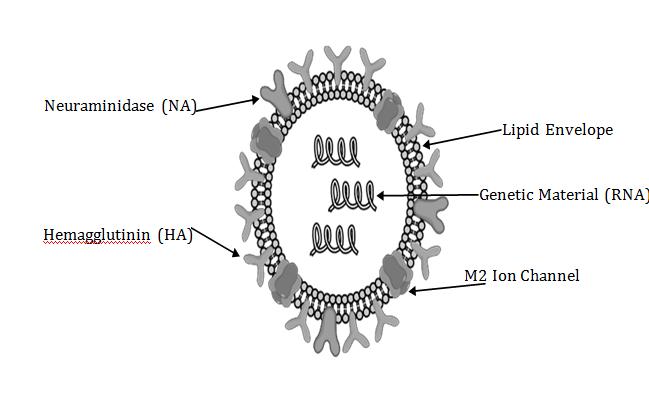
Since its identification in the 1930’s, the influenza virus has been extensively studied and characterized, yet many aspects of its mechanism of infection still remain unclear. To date, only four antiviral drugs have been approved by the Food and Drug Administration (FDA) to treat influenza illness (Table 1). Of those four drugs, two have developed resistance among the most common influenza a strains in circulation and are rarely used today. Although every year new developments in prophylactic vaccinations are made, few options for post-infection treatment are available. For this reason, there is a vast opportunity in this area for continued drug development. The development of new antiviral drugs is hindered because of the relatively simple structure of the influenza virus [1] (Figure 1) and the fact that few known areas in the viral life cycle can be targeted for inhibition. The two current drug inhibition targets in the influenza virus are the M2 proton channel, which aids in releasing virus particles from an infected host cell, and the neuraminidase (NA) enzyme, which is required for viral recognition and entry into a host cell (Figure 1). The neuraminidase
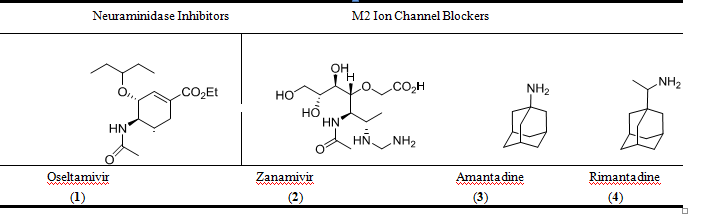
highly conserved among all influenza A and B viruses. Both oseltamivir and zanamivir [3] function by acting as stable transition state analogs of the sialosyl cation, which is a highly unstable transitionstate complex in the enzymatic mechanism of viral sialidase (Scheme 1) [3, 4, 5]. The NA inhibitor drugs 1 and 2 are similar enough in structure to the sialosyl cation transition state complex, allowing them the ability to bind tightly to the sialic acid active site and prevent viral budding.
Pathy KS. Recent Advances in Process Development of Antiviral Agents Targeting the Influenza Virus: Amantadine-Remantadine-Derived Pharmaceutical Agents. Pharm Res 2018, 2(2): 000155.
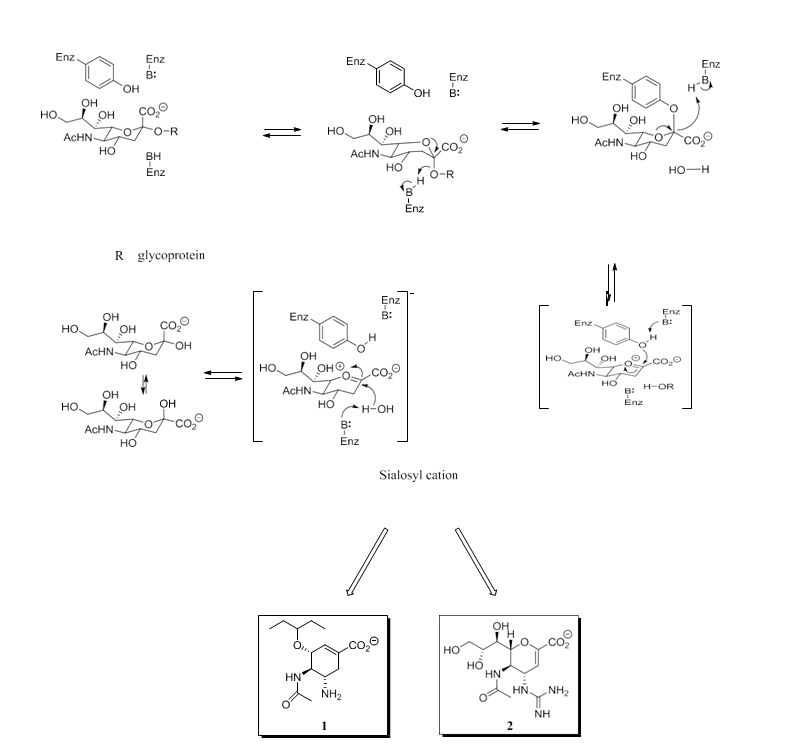
Scheme 1: Enzymatic mechanism of influenza a sialidase.
Particular interest to this work is the structure and function of the M2 ion channel. This channel is the target for the adamantane family of antiviral drugs and has recently become a popular topic for research in this area [6, 7, 8]. The two current FDA- approved M2 ion channel blocker drugs are the adamantanes: amantadine (3, Symmetrel, Endo Health solutions) and rimantadine (4, Flumadine, Impax Laboratories) (Figure 2). These drugs specifically target and inhibit the ion channel function of the M2 protein, which aids in the viral uncoating process after the virions undergo endocytosis and gain entry into a host cell. However, due to a single amino acid substitution occurring in the transmembrane portion of the M2 protein, these drugs no longer have therapeutic effects [1]. Speculation surrounding the exact resistance mechanism acquired by the virus continues, however [9]. The resistance could be due to the ion channel not binding the blocker at all, or the blocker is bound but with no or minimal inhibition, still allowing the flux of protons. Also, particularly for amantadine, there have been documented cases of CNS side effects [7, 8, 9, 10, 11, 12] from the use of this drug [10]. Regardless, this group of compounds still has potential as future antiviral chemotherapeutics, and this topic will be further examined in the next section of this work. Both antiviral drugs rimantadine and amantadine have similar damantane-based structures, but differ only by the amine head-group present on the adamantyl moiety [12]. Because this dissertation outlines similar syntheses as those developed for these molecules, the different routes and their development will be examined in the following section. Amantadine was first shown to have antiviral activity in 1964 and was initially used as a preventative medicine for the influenza A virus when the H2N2 subtype first surfaced around 1966 [1]. The original preparation was published by Stetter, et al in 1960 and eventually patented in 1967 by Paulshock and Watts [11, 12]. The synthesis is based on the reaction of adamantane with bromine to give 1-bromoadamantane. A subsequent Ritter-type reaction with acetonitrile and sulfuric acid give the 1-acetylaminoadamantane Pathy KS. Recent Advances in Process Development of Antiviral Agents Targeting the Influenza Virus: Amantadine-Remantadine-Derived Pharmaceutical Agents. Pharm Res 2018, 2(2): 000155.
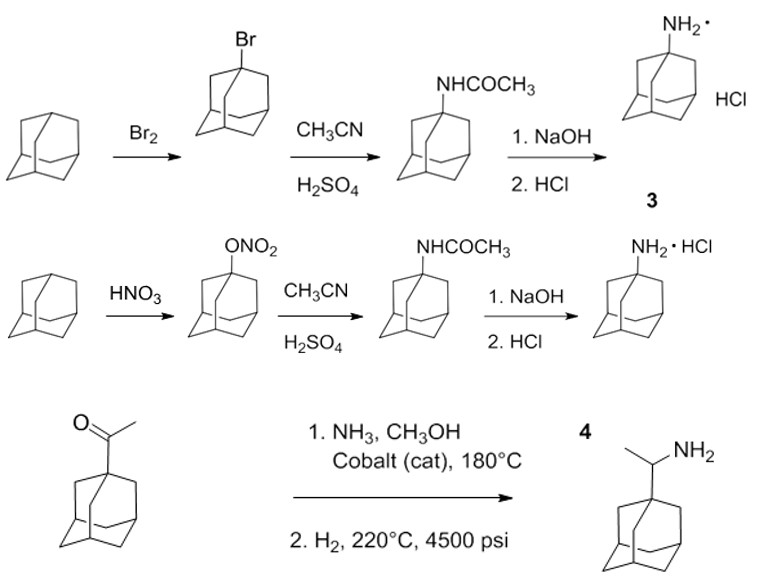
temperature to yield the nitrate intermediate. From this point, the reaction proceeds similarly to the previous method with the formation of a carboxamide species followed by treatment with an aqueous base to give the primary amine. The benefit of this reaction was the ability to have other sensitive functional groups present on the adamantane moiety that may otherwise be destroyed by employing Stetter’s method.
lithium aluminum hydride (LAH) [14, 15, 16, 17, 18, 19, 20, 21]. In this preparation, the ketone from which the ketoxime is derived can be made via reaction of dimethylcadmium with 1- adamantanecarbonyl chloride. The alkyl ketoxime can then be reduced to the amine using LAH [14] naturally; the use of dimethylcadmium is problematic due to its toxicity and sensitivity to air, moisture and light. So, to address this issue, an alternative
Scheme 4: Original synthesis of rimantadine (4) [15].
Pathy KS. Recent Advances in Process Development of Antiviral Agents Targeting the Influenza Virus: Amantadine-Remantadine-Derived Pharmaceutical Agents. Pharm Res 2018, 2(2): 000155.
Preparation was developed in 1970 by Brake [15]. This synthesis does not require organocadmium compounds, but instead consists of the reductive amination of 1- acetyladamantane to give rimantadine (4). In this preparation, the acetyl compound, hydrogen, ammonia, and metal catalyst (Co, Ru, Ni) are reacted at high temperatures (~250°C) and pressures up to 15,000 psi (Scheme 4) [15]. Although more appealing than the previous synthesis, this process is still highly unfavorable for a commercial scale operation, requiring specialized equipment to handle such high pressures and temperatures. In 1985, a new synthetic approach to rimantadine was patented by Liu, again out of the DuPont Company [16]. This new preparation addressed the high temperature, high pressure requirements, and utilized 1-adamantyl methyl ketoxime as the starting compound. The reduction of the ketoxime with hydrogen gas and a metal catalyst (Pt on carbon) could be carried out using lower temperatures (10-60°C) and lower pressures (25-215 psi) as described in Scheme 5 [16]. This procedure proved to be more commercially accessible than previous routes. Several other reports of rimantadine preparation can be found, with one of the more interesting pathways being a synthesis by Liu starting from 1- adamantanecarbonitrile [17, 18, 19, 20, 21].
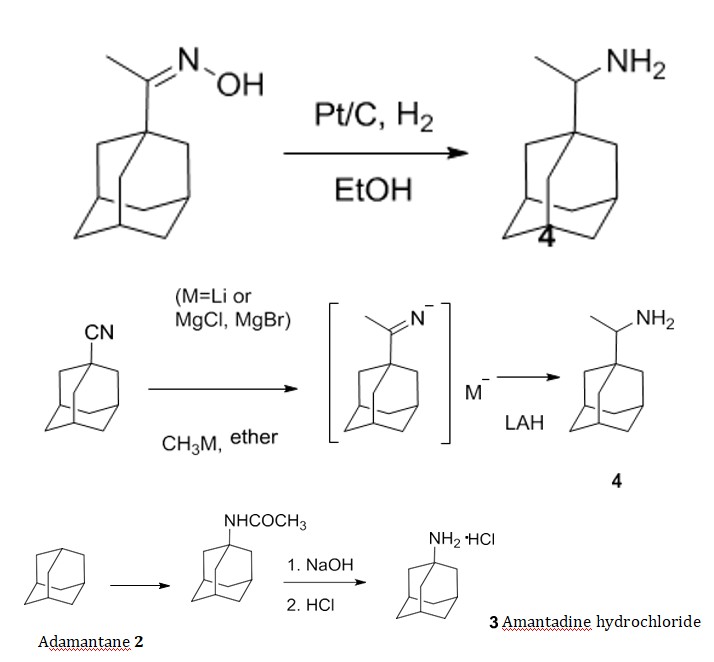
Scheme 5: A lower pressure and temperature synthesis of rimantadine (4). In this process, the nitrile moiety is alkylated using either methyllithium (CH3Li) or a methyl Grignard reagent (CH3MgX, X=Cl, Br), followed by reduction with LAH or catalytic hydrogenation of the imino intermediate (Scheme 6) [21, 22]. This versatile procedure easily allows for the introduction of various alkyl groups, which could be useful in creating a set of analogs for testing antiviral activity.
examines unique routes to prepare 2, 4, 9- trithiaadamantane derivatives, some of these routes are related to the previous work just discussed.
Synthesis of amantadine (3) [13].
Pathy KS. Recent Advances in Process Development of Antiviral Agents Targeting the Influenza Virus: Amantadine-Remantadine-Derived Pharmaceutical Agents. Pharm Res 2018, 2(2): 000155.
Reagents and conditions: (a) 98% H2SO4, 99.5% CH3CN, 55-65°C, 4.5 h; (b) (i) 82% KOH or KOH, water, PG, 125- 130oC, 7.5 h, CH2Cl2 extraction, (ii) 5N aq. HCl. N-(1-adamantyl) acetamide [22, 23, 24, 25, 26, 27, 28, 29, 30, 31, 32, 33, 34, 35, 36, 37, 38, 39, 40, 41]. To a mixture of 99.5% acetonitrile (400 mL, 7.66 mol) and 98% adamantane 2 (277g, 2.0 mol) was added dropwise 98% sulfuric acid (1.56 L, 28.4 mol) with stirring at 25-30°C for 2 h. The reaction mixture was stirred at 60-65°C for an additional 2.5 h. At the end of the reaction, ice water (5.00 L) was added to the reaction mixture and stirred for 1.0 h at 0-5°C. The resulting mixture was then extracted with dichloromethane (8.00 L); the separated organic layer was washed with cold water (0-5°C) and dried over Na2SO4. The solvent was removed under vacuum to yield N-(1-adamantyl) acetamide as a white solid. Yield: 314 g (82%). Purity (GC): 99.20%, tR 15.90 min mp 147-149°C Amantadine hydrochloride (3) [22, 25]. A mixture of 82% potassium hydroxide (600 g, 8.74 mol), water (100 mL) and propylene glycol (750 mL) was stirred at room temperature for 1 h, to which was added 4 (290 g, 1.5 mol). The mixture was maintained at 125°C-130°C for 8.5 h, then cooled to room temperature and followed by the addition of ice-cold water (2.00 L). The reaction mixture was extracted with dichloromethane (3 x 2.00 L). The separated organic layer was concentrated by threefold. To the concentrate was added 5N aq. HCl (1.40 L), stirred at 55-60°C for 1 h, and then cooled to room temperature. The resulting aqueous layer was evaporated under vacuum to give a white solid, to which was added acetone (200 mL), stirred at 50°C for 1 h, and then at 0- 5°C for additional 1 h. The obtained colorless precipitate was filtered off and dried under vacuum to give 1. Yield: 232 g (82%). Rf = 0.5 (CHCl3/MeOH/25% aqueous NH3= 6:1:1). Purity (GC): 99.22%, mp 360°C.
Conclusion
Finalised the synthesis for amantadine hydrochloride 1 has been provided. It produces a total yield of 60% over two steps and a purity of 99%. The synthesis of 4 from 2 was successfully accomplished in one step via the Ritter reaction. This method does not require liquid bromine or fuming nitric acid as reactants. The subsequent conversion of 4 to 5, and then 5 to 1, was carried out under milder reaction conditions without using hazardous solvents. These advantages facilitate the efficient, cost-effective and industrially convenient production of amantadine hydrochloride Synthesis and antiviral activity of metabolites of rimantadine.
References
-
Zoidis G, Kolocouris N, Naesens L, De Clercq E (2009) Design and synthesis of 1,2-annulated adamantane piperidines with anti-influenza virus activity. Bioorg Med Chem 17(4): 1534-1541.
-
Kawaoka, Yoshihiro (2006) Influenza Virology: Current Topics. England: Caister Academic Press.
-
Neumann G, Noda T, Kawaoka Y (2009) Emergence and pandemic potential of swine-origin H1N1 influenza virus. Nature 459(7249): 931-939.
-
Von Itzstein M (2007) The war against influenza: discovery and development of sialidase inhibitors. Nat Rev Drug Discov 6(12): 967-974.
-
Chan J, Lewis AR, Gilbert M, Karwaski M, Bennet AJ (2010) A direct NMR method for the measurement of competitive kinetic isotope effects. Nature Chem Biol 6: 405-407.
-
Stouffer AL, Acharya R, Salom D, Levine AS, Di Costanzo L, et al. (2008) Structural basis for the function and inhibition of an influenza virus proton channel. Nature 451(7178): 596-599.
-
Schnell JR, Chou JJ (2008) Structure and mechanism of the M2 proton channel of influenza A virus. Nature 451(7178): 591-595.
-
Cady SD, Schmidt-Rohr K, Wang J, Soto CS, Degrado WF, et al. (2010) Structure of the amantadine binding site of influenza M2 proton channels in lipid bilayers. Nature 463(7281): 689-692.
-
imonsen L, Viboud C, Grenfell BT, Dushoff J, Jennings L, et al. (2007) The genesis and spread of reassortment human influenza A/H3N2 viruses conferring adamantane resistance. Mol Biol Evol 24(8): 1811-1820.
-
Lindgren G (1976) Chem Scrip 9: 220-226.
-
Stetter H, Mayer J, Schwarz M, Wulff K(1960) Über Verbindungen mit Urotropin‐Struktur, XVI. Beiträge zur Chemie der Adamantyl‐(1)‐Derivate. Chem Ber 93(1): 226-230
-
Paulshock M, Watts JC (1967) Pharmaceutical compositions and methods utilizing 1- aminoadamantane and its derivatives. E.I. Du Pont de Pathy KS. Recent Advances in Process Development of Antiviral Agents Targeting the Influenza Virus: Amantadine-Remantadine-Derived Pharmaceutical Agents. Pharm Res 2018, 2(2): 000155. Nemours and Company (Wilmington, DE) United States Patent 3,310,469, Pp: 11.
-
Prichard WW (1967) Adamantanes and tricyclo[4.3.1.13.8] undecanes. E.I. Du Pont de Nemours and Company (Wilmington, DE) United States Patent 3,352,912, Pp: 3.
-
Prichard WW (1971) Pharmaceutical compositions and methods of controlling influenza a virus infection utilizing substituted adamantanes and tricyclo[4.3.1.13.8] undecanes. E.I. Du Pont de Nemours and Company (Wilmington, DE) United States Patent 3,592,934, Pp: 7.
-
Brake LD (1970) Preparations of α-methyl- adamantane-methylamine and α,4-dimethyl-1- bicyclo[2.2.2]octane methylamine. E.I. Du Pont de Nemours and Company (Wilmington, DE) United States Patent 3,489,802, Pp: 5.
-
Liu JJ (1985) Process for preparing rimantadine. E I Du Pont de Nemours and Company (Wilmington, DE) United States Patent 4,551,552, Pp: 3.
-
Liu JJ (1985) Process for preparing rimantadine. E I Du Pont de Nemours and Company (Wilmington, DE) European Patent Application 178668.
-
Bright RA, Medina M, Xu X, Perez-Oronoz G, Wallis TR, et al. (2005) Incidence of adamantane resistance among influenza A (H3N2) viruses isolated worldwide from 1994 to 2005: a cause for concern. Lancet 366(9492): 1175-1181.
-
Astrahan P, Kass I, Cooper MA, Arkin IT (2004) A novel method of resistance for influenza against a channel-blocking antiviral drug. Proteins 55(2): 251- 257.
-
Leonov H, Astrahan P, Krugliak M, Arkin IT (2011) How Do Aminoadamantanes Block the Influenza M2 Channel, and How Does Resistance Develop?. J Am Chem Soc 133(25): 9903-9911.
-
Stamatiou G, Foscolos GB, Fytas G, Kolocouris A, Kolocouris N, et al. (2003) Heterocyclic rimantadine analogues with antiviral activity. Bioorg Med Chem 11(24): 5485-5492.
-
Nicolas Kolocouris, Antonios Kolocouris, George B. Foscolos, George Fytas, Johan Neyts. Et al. (1996) Synthesis and antiviral activity evaluation of some new aminoadamantane derivatives. 2. J Med Chem 39 (17): 3307-3318.
-
Gongye Zazhi (2013).
-
Yuenan Q, Orchids L, Jianrong W, Huaqiang W, Zhen L (2013) CN Patent 102875387A. 44: 1-3.
-
Li LW, Bin L, Hui C, Chungui L, Ruilin Y, et al. (2016) CN 105523942A.
-
Li LW, Bin L, Hui C, Chungui L, Ruilin Y, et al. (2016) CN Patent 105461570A.
-
Wolfgang (1964) H U.S. patent 3,152,180 A.
-
Moiseev IK, Doroshenko RI, Ivanova VI, Khim Farm Zh (1976) 10(4): 32-33.
-
Leonova MV, Skomorokhov MY, Moiseev IK, Klimochkin YN (2015) One-pot amination of cage hydrocarbons. Russ J Org Chem 51(12): 1703-1709.
-
Marvin P, Watts JC (1967) Pharmaceutical compositions and methods utilizing 1- aminoadamantane and its derivatives. U.S. patent. 3,310,469, Pp: 1-20.
-
Kraus GA (1997) Method for the synthesis of Adamantane Amines. U.S. patent 5,599,998, Pp: 1-8.
-
Jack M, Eriks K (1968) Adamantyel Secondary Amenes. U.S. Patent 3,391,142, Pp: 1-8.
-
Vincent CW, Bruce AR (1968) Method of preparing 1- adamantanamine U.S. patent 3,388,164, Pp: 1-2.
-
Jirgensons A, Kauss V, Kalvinsh I, Gold MR (2000) A practical synthesis of tert-alkylamines via the Ritter reaction with chloroacetonitrile. Synthesis 12: 1709- 1712.
-
Schickaneder CP (2009) Process for the Preparation of Adamantanamines U.S. patent 20090082596A1, Pp: 1-8.
-
Tsutsui Hironori, Ichikawa Tomoko, Narasaka Koichi (1999) Preparation of Primary Amines by the Alkylation of O-Sulfonyloximes of Benzophenone Derivatives with Grignard Reagents. Bulletin of the Chemical Society of Japan 72(8): 1869-1878.
-
Kitamura Mitsuru, Chib Shunsuke, Narasaka Koichi (2003) Synthesis of Primary Amines and N- Pathy KS. Recent Advances in Process Development of Antiviral Agents Targeting the Influenza Virus: Amantadine-Remantadine-Derived Pharmaceutical Agents. Pharm Res 2018, 2(2): 000155. Methylamines by the Electrophilic Amination of Grignard Reagents with 2-Imidazolidinone O- Sulfonyloxime. Bulletin of the Chemical Society of Japan 76(5): 1063-1070.
-
Kitamura Mitsuru, Suga Takahiro, Chiba Shunsuke, Narasaka Koichi (2004) Synthesis of Primary Amines by the Electrophilic Amination of Grignard Reagents with 1,3-Dioxolan-2-one O-Sulfonyloxime. Org Lett 6(24): 4619-4621.
-
Zhang Zhiting (2011) A method for synthesizing amantadine hydrochloride Chinese Patent No. 102050744B.
-
Manchand PS, Cerruti RL, Martin JA, Hill CH, Merrett JH, et al. (1990) Synthesis and antiviral activity of metabolites of rimantadine. J Med Chem 33(7): 1992- 1995.
-
Tataridis D, Fytas G, Kolocouris A, Fytas C, Kolocouris N, et al. (2007) Influence of an additional 2-amino substituent of the 1-aminoethyl pharmacophore group on the potency of rimantadine against influenza virus A. Bioorg Med Chem Lett 17(3): 692- 696. Pathy KS. Recent Advances in Process Development of Antiviral Agents Targeting the Influenza Virus: Amantadine-Remantadine-Derived Pharmaceutical Agents. Pharm Res 2018, 2(2): 000155.
- Acido Labile or Gastro Irritant Apis and Enteric Release in Galenic Practice: An Overview
- A Study on Knowledge, Attitude and Practice of Hand Hygiene among Healthcare Professionals at a Tertiary Care Hospital, India
- Influence of Inoculum Concentration on In Vivo Incubation Period of Emmia lacerata, Pathogenesis and Management of Wilt in Pepper (Capsicum annuum L.)
- Vanilla’s Chemistry
- Marine Anti-Cancer Compounds and Adverse Effects of Global Warming on Oceans: An Overview
- Serological Investigation of Chikungunya Virus Antibody among Malaria-Suspected Febrile Patients in Some Healthcare Facilities in Rivers State