
Enhancement of Hair Growth through Stimulation of Dermal Papilla Cells in Human Follicular Dermal
Hair gives one of the most memorable images of a person’s identity. Hair loss has an enormous impact on quality of life. Although various treatment strategies are available to prevent hair loss, unfortunately not adequate. Hence, in this context authors performed this study to evaluate the impact of Consciousness Energy Healing (The Trivedi Effect®) Treatment on the test item (DMEM) in human follicular dermal papilla culture cells for the assessment of hair cell growth and development in vitro. The test item, DMEM was divided into three parts. First part did not receive any sort of treatment and defined as the untreated DMEM group. The second and third parts were treated with the one-time and two-times Biofield Energy Treatment by a renowned Biofield Energy Healer, Mahendra Kumar Trivedi and coded as the one-time Biofield Energy Treated DMEM (BT-I) and two-times Biofield Energy Treated DMEM (BT-II) groups, respectively. Results showed that BT-I group exhibited 14.8%, however BT-II group was significantly (p≤0.001) increased cellular proliferation of dermal papilla cells by 124.3% compared to the untreated DMEM group. The results demonstrated that the Biofield Energy Healing Treatment significantly increased the proliferation of human hair follicle dermal papilla cells. Therefore, the Consciousness Energy Healing (The Trivedi Effect®) Treatment could be useful as a hair growth enhancer against different skin injuries like actinic keratosis, necrotizing fasciitis, sebaceous cysts, diaper rash, decubitus ulcer and hair-related disorders like androgenetic alopecia (male and female pattern baldness), alopecia totalis or alopecia universalis, traction alopecia, telogen effluvium, trichodystrophy, scarring alopecias, alopecia areata, etc.
Introduction
Hair plays many vital biological activities, which includes protection from the elements and distribution of sweat-gland products. In addition, it has an important psychosocial role in society. Hair life-cycle may be subject to abnormal changes due to seasons, fatigue, stress, hormonal imbalance, hair treatment, treatment of medication, and pollution or aging [1]. Hair loss has a great negative impact on Quality of Life. Traditional plant remedies have been used for centuries in the treatment of hair loss, but only a few have been scientifically evaluated [2]. The huge numbers of population (male and female) are suffering from baldness and also increasing day-by- day due to various factors like stress, pollution, smoking, drinking, changes of lifestyle, fast globalization, indiscriminate grow of industrialization, and advance medical therapies. Hence, it is very essential to establish new therapies that inhibit baldness or increase hair proliferation [3, 4]. Alternative medical systems are the systems of theory and practice that are different from conventional therapy, both in Western cultures (e.g., homeopathy, naturopathy) and in non-Western cultures (e.g., Ayurvedic medicine, traditional Chinese medicine). Due to lack of scientific data and information mechanism these systems have not yet been incorporated in the conventional medical practice [5]. A lot of scientific work of literature including United State - Food and Drug Administration (US-FDA) indicated that minoxidil has potent hair growth promotion activity both animal studies as well as cell-based assay [6, 7, 8].
In recent years, several scientific reports and clinical trials have revealed the useful effects of Biofield Energy Treatment, which have shown to enhance the immune function in cases of cervical cancer patients via therapeutic touch [9], massage therapy [10], etc. Complementary and Alternative Medicine (CAM) therapies are now rising as preferred models of treatment, among which Biofield Therapy (or Healing Modalities) is one approach that has been reported to have several benefits to enhance physical, mental, and emotional human wellness. However, as per the data of 2012 from the National Health Interview Survey (NHIS), which indicated that the highest percentage (~18%) of the Americans used dietary supplements as a complementary health approach as compared with other practices in past years. The National Center of Complementary and Integrative Health (NCCIH) has recognized and accepted Biofield Energy Healing as a CAM health care approach in addition to other therapies, medicines and practices such as natural products, deep breathing, yoga, Tai Chi, Qi Gong, chiropractic/osteopathic manipulation, meditation, massage, special diets, homeopathy, progressive relaxation, guided imagery, acupressure, acupuncture, relaxation techniques, hypnotherapy, healing touch, movement therapy, pilates, rolfing structural integration, mindfulness, Ayurvedic medicine, traditional Chinese herbs and medicines, naturopathy, essential oils, aromatherapy, Reiki, and cranial sacral therapy. Human Biofield Energy has subtle energy that can work effectively [11]. CAM therapies have been practiced worldwide with reported clinical benefits in different health disease profiles [12]. This energy can be harnessed and transmitted by the practitioners into both living and non-living objects via the process of Conscious Energy Healing Treatment. The Trivedi Effect®- Consciousness Energy Healing Treatment has been reported with a significant revolution in the physicochemical properties of metals, chemicals, ceramics, and polymers [13, 14, 15], an improved agricultural crop yield, productivity, and quality [16, 17], transformed antimicrobial characteristics [18, 19, 20], biotechnology [21, 22], an improved bioavailability [23, 24, 25], skin health [26, 27], nutraceuticals [28, 29], cancer research [30, 31], bone health [32, 33, 34], human health and wellness. Considering the promising importance of alternative natural therapies-based literature information and importance of Biofield Energy Healing Treatment on various fields, the authors sought to evaluate the impact of the Biofield Energy Treatment (The Trivedi Effect®) on the test item (DMEM) for hair cells growth activity using standard assay in human follicular dermal papilla cells (HFDPC).
Materials and Methods
Chemicals and Reagents
Dulbecco's Modified Eagle Medium (DMEM) and fetal bovine serum (FBS) were obtained from Gibco, India. 3- (4,5-Dimethylthiazol-2-yl)-2,5-Diphenyltetrazolium Bromide (MTT) and ethylenediaminetetraacetic acid (EDTA) were obtained from Sigma Chemical Co. (St. Louis, MO). Minoxidil sulphate (positive control) was purchased from Clearsynth Labs Ltd., Mumbai. Antibiotics solution (penicillin-streptomycin) was procured from HiMedia, India. Other chemicals used in this study were analytical grade obtained from India.
BrdU Incorporation Cell Proliferation Assay in HFDPCs
The human follicular dermal papilla cells (HFDPCs) in DMEM supplemented with 10% FBS were counted using an hemocytometer and a single cell suspension was prepared. The single cell suspension was seeded at a density of 800 cells/well in a fresh DMEM supplemented with 10% FBS in 96-well plates. Then, the cells were incubated in a CO2 incubator for 24 hours at 37°C, 5%CO2, and 95% humidity. After 24 hours of incubation, the medium was replaced with a fresh DMEM supplemented with 0.1% FBS. Further, after 24 hours, cells were treated with the test items and positive control (minoxidil sulphate). After incubation for 48 hours, the effect of the test items on cell proliferation was assessed by bromodeoxyuridine (BrdU) incorporation using colorimetric ELISA kit. For that, 10 µL of BrdU solution was added per well and the cells were incubated for 90 minutes at 37°C. After incubation, the medium was removed from each well by gentle pipetting. About 200 µL of a FixDenat solution was added to each well. After incubation, cells were incubated for 30 minutes at room temperature (RT) (15-25ºC). The FixDenat solution was removed by gentle pipetting. After incubation, 100 µL of anti-BrdU-POD (peroxidase) solution was added to each well. Then, the cells were incubated for 90 minutes at RT (15-25°C). After incubation, the anti-BrdU-POD solution was removed by gentle pipetting. Each well was washed 3 times using 200 µL of washing solution. About 100 µL of substrate solution was added to each well. Cells were incubated for 30 minutes at RT (15-25°C). After incubation, the absorbance of each well was measured at 370 nm. Cellular proliferation was determined as following Equation (1):
(1) Where, A = OD of Untreated DMEM wells B = OD of cells treated with the test items/positive control
Experimental Design
The experimental groups composed of group 1 (G-I) with DMEM medium defined as the untreated DMEM group. Group 2 (G-II) contained positive control (minoxidil sulphate) at various concentrations. Further, group 3 (G-III) included one-time Biofield Energy Treated DMEM and denoted as BT-I, while group 4 (G-IV) included the two-times Biofield Energy Treated DMEM and denoted as BT-II.
Biofield Energy Healing Strategy
The test item, DMEM was divided into three parts. First part did not receive any sort of treatment and defined as the untreated DMEM group. The second and third parts were treated with the one-time and two-times Biofield Energy Treatment by a renowned Biofield Energy Healer (The Trivedi Effect®), Mahendra Kumar Trivedi remotely for ~3 minutes under laboratory conditions and coded as the one-time Biofield Energy Treated DMEM (BT-I) and two-times Biofield Energy Treated DMEM (BT- II) groups, respectively. Biofield Energy Healer was located in the USA, while the test items were located in the research laboratory of Dabur Research Foundation, New Delhi, India. Healer in this study never visited the laboratory in person, nor had any contact with the test items (DMEM medium). Further, the untreated DMEM group was treated with a “sham” healer for comparative purposes. The “sham” healer did not have any knowledge about the Biofield Energy Treatment. After that, the Biofield Energy Treated and untreated test items were kept in similar sealed conditions for experimental study.
Statistical Analysis
All the values were represented as Mean ± SEM (standard error of mean) of three independent experiments. The statistical analysis was performed using SigmaPlot statistical software (v11.0). For two groups comparison student’s t-test was used. For multiple group comparison, one-way analysis of variance (ANOVA) was used followed by post-hoc analysis by Dunnett’s test. Statistically significant values were set at the level of p≤0.05.
Results and Discussion
BrdU Incorporated Cell Proliferation of Dermal Papilla Cells
The effect of the test items after treatment with the Biofield Energy and the results in terms of percent change in the proliferation of DPCs is shown in Figure 1. Based on the literature information the hair follicles start to form during the embryonic and matured in postnatal phase. The hair follicles are undergoing various periodic growths over lifetime. The hair cycle consists of three stages viz. anagen, catagen and telogen [35]. Androgens can control the proliferation of human hair based on secretion of hormone in different location. Androgen target cells are very important for the assessment of hair growth in terms of proliferation of Dermal papilla cells (DPCs) in various location such as beard, armpit, and scalp, etc. [36]. The human follicular dermal papilla cells suspension were treated with the positive control and test item (DMEM). Topical application of minoxidil is a well-established therapeutic for various types of hair growth-related disorders like alopecia [37]. The untreated DMEM group showed 100% proliferation of DPCs. Additionally, the positive control, minoxidil showed 68.57%, 187.14%, and 230.95% increased the proliferation of DPCs at 0.001, 0.01, and 0.1 µM, respectively in a concentration- dependent manner compared to the untreated DMEM group. Moreover, the one-time Biofield Energy Treated DMEM group (BT-I) showed 14.8% and two-times Biofield Energy Treated DMEM group (BT-II) showed significantly (p≤0.001) increase the percent proliferation of DPCs by 124.3% with respect to the untreated DMEM group (Figure 1). Here, the study outcomes clearly signify that Biofield Energy Treatment significantly enhanced the percent proliferation of DPCs. The dermal papilla (DP) is a unique mesenchymal component of the hair follicle (HF) responsible for morphogenesis and regeneration of HF [38]. Hair loss (alopecia) is a general and distressing problem for both men and women. The ability of the differentiated and highly specialized fibroblasts of the DP to induce neighboring epidermal cells is a suitable approach to treat alopecia [39]. Hair follicles undergo different cycles of growth (anagen), regression (catagen), quiescence (telogen), and regeneration [40]. The hair follicle consisted of two types of cells like DP and dermal sheath (DS) that can regenerate vis-a-vis and possess a high level of plasticity [41]. The current experimental results revealed that Biofield Energy Treatment significantly increased the proliferation of dermal papilla cells (DPCs). From the literature point of view, it is reported that thrombin can stimulate phosphoinositide 3- kinase (PI3K)-Akt pathway-dependent acquisition of DS- like properties by DP cells in vitro, responsible for an increased proliferation rate [42]. Based on the literature and findings of this study, it is concluded that the high growth of DPCs is due to the impact of The Trivedi Effect® and which could be due to activation of thrombin- mediated (PI3K)-Akt pathway signaling pathway and regulation of keratinocytes during hair growth and development.
![Figure 1: Based on the literature information the hair follicles start to form during the embryonic and matured in postnatal phase. The hair follicles are undergoing various periodic growths over lifetime. The hair cycle consists of three stages viz. anagen, catagen and telogen [35]. Androgens can control the proliferation of human hair based on secretion of hormone in different location. Androgen target cells are very important for the assessment of hair growth in terms of proliferation of Dermal papilla cells (DPCs) in various location such as beard, armpit, and scalp, etc. [36]. The human follicular dermal papilla cells suspension were treated with the positive control and test item (DMEM). Topical application of minoxidil is a well-established therapeutic for various types of hair growth-related disorders like alopecia [37]. The untreated DMEM group showed 100% proliferation of DPCs. Additionally, the positive control, minoxidil showed 68.57%, 187.14%, and 230.95% increased the proliferation of DPCs at 0.001, 0.01, and 0.1 µM, respectively in a concentration- dependent manner compared to the untreated DMEM group. Moreover, the one-time Biofield Energy Treated DMEM group (BT-I) showed 14.8% and two-times Biofield Energy Treated DMEM group (BT-II) showed significantly (p≤0.001) increase the percent proliferation of DPCs by 124.3% with respect to the untreated DMEM group (Figure 1). Here, the study outcomes clearly signify that Biofield Energy Treatment significantly enhanced the percent proliferation of DPCs. The dermal papilla (DP) is a unique mesenchymal component of the hair follicle (HF) responsible for morphogenesis and regeneration of HF [38]. Hair loss (alopecia) is a general and distressing problem for both men and women. The ability of the differentiated and highly specialized fibroblasts of the DP to induce neighboring epidermal cells is a suitable approach to treat alopecia [39]. Hair follicles undergo different cycles of growth (anagen), regression (catagen), quiescence (telogen), and regeneration [40]. The hair follicle consisted of two types of cells like DP and dermal sheath (DS) that can regenerate vis-a-vis and possess a high level of plasticity [41]. The current experimental results revealed that Biofield Energy Treatment significantly increased the proliferation of dermal papilla cells (DPCs). From the literature point of view, it is reported that thrombin can stimulate phosphoinositide 3- kinase (PI3K)-Akt pathway-dependent acquisition of DS- like properties by DP cells in vitro, responsible for an increased proliferation rate [42]. Based on the literature and findings of this study, it is concluded that the high growth of DPCs is due to the impact of The Trivedi Effect® and which could be due to activation of thrombin- mediated (PI3K)-Akt pathway signaling pathway and regulation of keratinocytes during hair growth and development.](/fulltextimages/3105/fig_1.png)
Figure 1: Effect of the test samples on hair growth regarding dermal papilla cells (DPCs) proliferation after 48 hours of treatment in immortalized human follicular dermal papilla cell line (HFDPC). BT-I: One- time Biofield Energy Treated DMEM; BT-II: Two-times Biofield Energy Treated DMEM. All the values are represented as mean ± SEM of three independent experiments. ***p≤0.001 vs. untreated DMEM group.
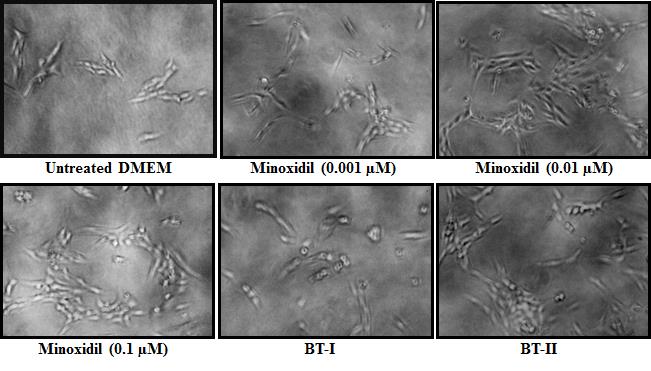
The representative images are indicating the intensity of proliferative DPCs after treatment with the test item (DMEM) in HFDPC (Figure 2). Overall, data suggested that two-times Biofield Energy Treated DMEM significantly improved the growth and proliferation of human dermal papilla cells compared to the one-time Biofield Energy Treated DMEM reflected in the photograph, which might be due to the Biofield Energy Healing (The Trivedi Effect®) and the Consciousness Energy Therapy could be helpful in proliferation of hair follicles.
Conclusions
The study results showed that the percent of dermal papilla cells (DPCs) was significantly elevated by 14.8% and 124.3% in the one-time Biofield Treated DMEM (BT- I) and two-times Biofield Energy Treated DMEM (BT-II) groups, respectively compared to the untreated DMEM group in human follicular dermal papilla cells (HFDPC). Overall, the Biofield Energy Treated test items significantly increased the DPCs. In conclusion, The Trivedi Effect® - Consciousness Energy Healing Treatment might act as a hair growth promoter, and it can be used as a complementary and alternative treatment for the prevention of various types of skin and hair-related disorders viz. necrotizing fasciitis, actinic keratosis, sebaceous cysts, diaper rash, decubitus ulcer, androgenetic alopecia, telogen effluvium, trichodystrophy, alopecia areata, etc. Besides, it could be useful to improve cell-to-cell communication, normal cell growth, cell differentiation, neurotransmission, cell cycling and proliferation, hormonal balance, skin health, immune and cardiovascular functions. Moreover, it can also be utilized in organ transplants (i.e., kidney transplants, liver transplants and heart transplants), hormonal imbalance, aging, and various immune-related disease conditions such as Ulcerative Colitis (UC), Alzheimer’s Disease (AD), Dermatitis, Irritable Bowel Syndrome (IBS), Asthma, Hashimoto Thyroiditis, Pernicious Anemia, Sjogren Syndrome, Multiple Sclerosis, Aplastic Anemia, Hepatitis, Diverticulitis, Graves’ Disease, Dermatomyositis, Diabetes, Myasthenia Gravis, Parkinson’s Disease, Atherosclerosis, Systemic Lupus Erythematosus (SLE), Stress, etc. with a safe therapeutic index to improve overall health and the Quality of Life.
Acknowledgement
Authors would like to express appreciation to Trivedi Global, Inc., Trivedi Science, Trivedi testimonials and Trivedi master wellness for their support. Also, authors are thankful for the support of Dabur Research Foundation for conducting this study.
References
-
Nutbrown M, MacDonald Hull SP, Baker TG, Cunliffe WJ, Randall VA (1996) Ultrastructural abnormalities in the dermal papillae of both lesional and clinically normal follicles from alopecia areata scalps. Br J Dermatol 135(2): 204-210.
-
Obrigkeit DH, Oepen T, Jugert FK, Merk HF, Kubicki J (2008) Xenobiotics in vitro: The influence of L-cystine, pantothenat, and miliacin on metabolic and proliferative capacity of keratinocytes. Cutan Ocul Toxicol 25(1): 13-22.
-
Bhaumik S, Jyothi MD, Khar A (2000) Differential modulation of nitric oxide production by curcumin in host macrophages and NK cells. FEBS Lett 483(1): 78- 82.
-
Stenn KS, Paus R (2001) Controls of hair follicle cycling. Physiol Rev 81(1): 449-494.
-
Wolraich ML, Drotar DD, Perrin EC (2007) Developmental-behavioral pediatrics evidence and practice, 1st (Edn.). Elsevier.
-
Choi N, Shin S, Song SU, Sung JH (2018) Minoxidil promotes hair growth through stimulation of growth factor release from adipose-derived stem cells. Int J Mol Sci 19(3): 691.
-
Rumsfield JA, West DP, Fiedler-Weiss VC (1987) Topical minoxidil therapy for hair regrowth. Clin Pharm 6(5): 386-392.
-
Messenger AG, Rundegren J (2004) Minoxidil: Mechanisms of action on hair growth. Br J Dermatol 150(2): 186-194.
-
Lutgendorf SK, Mullen-Houser E, Russell D, Degeest K, Jacobson G, et al. (2010) Preservation of immune function in cervical cancer patients during chemoradiation using a novel integrative approach. Brain Behav Immun 24(8): 1231-1240.
-
Ironson G, Field T, Scafidi F, Hashimoto M, Kumar M, et al. (1996) Massage therapy is associated with enhancement of the immune system's cytotoxic capacity. Int J Neurosci 84(1-4): 205-217.
-
Jain S, Hammerschlag R, Mills P, Cohen L, Krieger R, et al. (2015) Clinical studies of biofield therapies: Summary, methodological challenges, and recommendations. Glob Adv Health Med 4: 58-66.
-
Rubik B (2002) The biofield hypothesis: Its biophysical basis and role in medicine. J Altern Complement Med 8(6): 703-717.
-
Trivedi MK, Tallapragada RM (2008) A transcendental to changing metal powder characteristics. Met Powder Rep 63(9): 22-28,31.
-
Trivedi MK, Nayak G, Patil S, Tallapragada RM, Latiyal O (2015) Studies of the atomic and crystalline characteristics of ceramic oxide nano powders after bio field treatment. Ind Eng Manage 4: 161-166.
-
Trivedi MK, Nayak G, Patil S, Tallapragada RM, Latiyal O, et al. (2015) Effect of biofield energy treatment on physical and structural properties of calcium carbide and praseodymium oxide. International Journal of Materials Science and Applications 4(6): 390-395.
-
Trivedi MK, Branton A, Trivedi D, Nayak G, Mondal SC, et al. (2015) Morphological characterization, quality, yield and DNA fingerprinting of biofield energy treated alphonso mango (Mangifera indica L.). Journal of Food and Nutrition Sciences 3(6): 245-250.
-
Trivedi MK, Branton A, Trivedi D, Nayak G, Mondal SC, et al. (2015) Evaluation of biochemical marker - Glutathione and DNA fingerprinting of biofield energy treated Oryza sativa. American Journal of BioScience 3: 243-248.
-
Trivedi MK, Branton A, Trivedi D, Nayak G, Charan S, et al. (2015) Phenotyping and 16S rDNA analysis after biofield treatment on Citrobacter braakii: A urinary pathogen. J Clin Med Genom 3: 129.
-
Trivedi MK, Patil S, Shettigar H, Mondal SC, Jana S (2015) Evaluation of biofield modality on viral load of Hepatitis B and C viruses. J Antivir Antiretrovir 7(3): 83-88.
-
Trivedi MK, Patil S, Shettigar H, Mondal SC, Jana S (2015) An impact of biofield treatment: Antimycobacterial susceptibility potential using BACTEC 460/MGIT-TB System. Mycobact Dis 5: 189.
-
Trivedi MK, Patil S, Shettigar H, Bairwa K, Jana S (2015) Phenotypic and biotypic characterization of Klebsiella oxytoca: An impact of biofield treatment. J Microb Biochem Technol 7: 202-205.
-
Nayak G, Altekar N (2015) Effect of biofield treatment on plant growth and adaptation. J Environ Health Sci 1: 1-9.
-
Branton A, Jana S (2017) The influence of energy of consciousness healing treatment on low bioavailable resveratrol in male Sprague Dawley rats. International Journal of Clinical and Developmental Anatomy 3: 9- 15.
-
Branton A, Jana S (2017) The use of novel and unique biofield energy healing treatment for the improvement of poorly bioavailable compound, berberine in male Sprague Dawley rats. American Journal of Clinical and Experimental Medicine 5: 138- 144.
-
Branton A, Jana S (2017) Effect of The biofield energy healing treatment on the pharmacokinetics of 25- hydroxyvitamin D3 [25(OH)D3] in rats after a single oral dose of vitamin D3. American Journal of Pharmacology and Phytotherapy 2(1): 11-18.
-
Kinney JP, Trivedi MK, Branton A, Trivedi D, Nayak G, et al. (2017) Overall skin health potential of the biofield energy healing based herbomineral formulation using various skin parameters. American Journal of Life Sciences 5(2): 65-74.
-
Singh J, Trivedi MK, Branton A, Trivedi D, Nayak G, et al. (2017) Consciousness energy healing treatment based herbomineral formulation: A safe and effective approach for skin health. American Journal of Pharmacology and Phytotherapy 2(1): 1-10.
-
Trivedi MK, Branton A, Trivedi D, Nayak G, Plikerd WD, et al. (2017) A Systematic study of the biofield energy healing treatment on physicochemical, thermal, structural, and behavioral properties of magnesium gluconate. International Journal of Bioorganic Chemistry 2(3): 135-145.
-
Trivedi MK, Branton A, Trivedi D, Nayak G, Plikerd WD, et al. (2017) Chromatographic and spectroscopic characterization of the consciousness energy healing treated Withania somnifera (ashwagandha) root extract. European Journal of Biophysics 5(2): 38-47.
-
Trivedi MK, Patil S, Shettigar H, Mondal SC, Jana S (2015) The potential impact of biofield treatment on human brain tumor cells: A time-lapse video microscopy. J Integr Oncol 4: 141.
-
Trivedi MK, Patil S, Shettigar H, Gangwar M, Jana S (2015) In vitro evaluation of biofield treatment on cancer biomarkers involved in endometrial and prostate cancer cell lines. J Cancer Sci Ther 7: 253- 257.
-
Anagnos D, Trivedi K, Branton A, Trivedi D, Nayak G, et al. (2018) Influence of biofield treated vitamin D3 on proliferation, differentiation, and maturation of bone-related parameters in MG-63 cell-line. International Journal of Biomedical Engineering and Clinical Science 4(1): 6-14.
-
Lee AC, Trivedi K, Branton A, Trivedi D, Nayak G, et al. (2018) The potential benefits of biofield energy treated vitamin D3 on bone mineralization in human bone osteosarcoma cells (MG-63). International Journal of Nutrition and Food Sciences 7(1): 30-38.
-
Stutheit ME, Trivedi K, Branton A, Trivedi D, Nayak G, et al. (2018) Biofield energy treated vitamin D3: Therapeutic implication on bone health using osteoblasts cells. American Journal of Life Sciences 6(1): 13-21.
-
Alonso L, Fuchs E (2006) The hair cycle. J Cell Sci 119(3): 391-393.
-
Randall VA (2007) Hormonal regulation of hair follicles exhibits a biological paradox. Semin Cell Dev Biol 18(2): 274-285.
-
Bang CY, Byun JW, Kang MJ, Yang BH, Song HJ, et al. (2013) Successful treatment of temporal triangular alopecia with topical minoxidil. Ann Dermatol 25(3): 387-388.
-
Mikkola ML, Millar SE (2006) The mammary bud as a skin appendage: Unique and shared aspects of development. J Mammary Gland Biol Neoplasia 11(3- 4): 187-203.
-
Inui S, Fukuzato Y, Nakajima T, Yoshikawa K, Itami S (2003) Identification of androgen-inducible TGF- beta1 derived from dermal papilla cells as a key mediator in androgenetic alopecia. J Investig Dermatol Symp Proc 8(1): 69-71.
-
Enshell-Seijffers D, Lindon C, Kashiwagi M, Morgan BA (2010) β-catenin activity in the dermal papilla regulates morphogenesis and regeneration of hair. Dev Cell 18(4): 633-642.
-
Paus R, Cotsarelis G (1999) The biology of hair follicles. N Engl J Med 341(7): 491-497.
-
Feutz AC, Barrandon Y, Monard D (2008) Control of thrombin signaling through PI3K is a mechanism underlying plasticity between hair follicle dermal sheath and papilla cells. J Cell Sci 121(9): 1435-1443.
- Acido Labile or Gastro Irritant Apis and Enteric Release in Galenic Practice: An Overview
- A Study on Knowledge, Attitude and Practice of Hand Hygiene among Healthcare Professionals at a Tertiary Care Hospital, India
- Influence of Inoculum Concentration on In Vivo Incubation Period of Emmia lacerata, Pathogenesis and Management of Wilt in Pepper (Capsicum annuum L.)
- Vanilla’s Chemistry
- Marine Anti-Cancer Compounds and Adverse Effects of Global Warming on Oceans: An Overview
- Serological Investigation of Chikungunya Virus Antibody among Malaria-Suspected Febrile Patients in Some Healthcare Facilities in Rivers State