
HPLC Method Development and Validation: For Simultaneous Determination of Flibanserin and Caffeine
A simple and rapid HPLC method is developed and validated for the simultaneous determination of Flibanserin and Caffeine. This is the first single reported method for these two drugs. The good separation was achieved by HPLC technique using 0.1% ammonium acetate buffer (pH 3) and ACN as the mobile phase, a C18 column and wavelength set at 254nm. The retention time for Caffeine and Flibanserin is 2.0 min and 4.9 min respectively. The method was validated as per ICH guidelines for linearity, precision, accuracy, LOD, LOQ, robustness and solution stability. The method shows good accuracy and precision with RSD value of less than 2%. The Flibanserin shows good linearity in range 50.0μg-150.0μg/mL and Caffeine in range 10.0μg-30.0μg/ mL.
Introduction
Flibanserin is 1-[2-(1,3-dihydro-2-oxobenzimidazol-1- yl)ethyl]piperazine approved by US FDA in the year 2015 for the treatment of hypoactive sexual desire disorder(HSDD) in women. Hypoactive sexual desire disorder expounds as a state of perpetual or recurrent deficiency or deprivation of sexual desire and fantasies, which leads to marked distress or interpersonal difficulties [1, 2, 3]. The HSDD etiology may include multiple psychological and biologic factors [4, 5, 6]. The serotonergic drug Flibanserin acts as an agonist for 5-HT1A and antagonist for the 5-HT2A receptor [1, 7]. Since 1930 the treatment of low sexual desire was done with the help of testosterone patch until the discovery of Flibanserin [8]. However, testosterone patch was not widely used as a treatment in women due to certain safety concern. Flibanserin shows high plasma protein binding (98% to albumin). Its molecular mass is 390.4g/mol (C20H21F3N4O) and freely soluble in ACN sparingly soluble in methanol and in acidic pH however, it is slightly soluble in water, ethanol and formic acid. Metabolites of the drug are primarily excreted in urine and feces [9]. Surprisingly, it has been found that it is possible to combine Flibanserin with Caffeine in order to significantly reduce the described side effects to a minimum and at the same time enhance the efficacy of the treatment.
A central nervous system stimulant Caffeine is 1,3,7-trimethylpurine-2,6-dione widely used as a psychoactive stimulant in the world. Scientific literature review reveals that Caffeine shows immense importance as an ingredient in wide range of food products [10]. Its molecular weight 194.19g/mol (C8H10N4O2) and freely soluble in water, ACN, chloroform and ammonium acetate, sparingly soluble in ethanol, however it is slightly soluble in ether [11]. Primarily it acts on adenosine receptor in brain, resulting in antagonism of all four subtypes of adenosine receptors. Precisely, it antagonizes A2a receptor which is responsible for wakefulness effect of Caffeine. It is also used as a medicating agent [12].
Literature review reveals that separate methods have been reported for analysis of Caffeine and Flibanserin. HPLC method for determination of Caffeine in combination with other drugs is also reported [13]. Till date, there are no published reports about the simultaneous quantitation of Flibanserin and Caffeine by HPLC. This is the first report simultaneous quantitation of Flibanserin and Caffeine by HPLC. The analytical technique is highly selective and sensitive which analyse the quality aspects of pharmaceuticals [14]. This analytical technique shows wide range of application in number of fields like food, environment, pharmaceuticals and biochemical analysis, etc [15, 16, 17, 18]. The proposed method is validated as per International Conference on Harmonisation (ICH) guidelines.
Experimental Section
Instrumentation/Chromatographic System
Chromatography is the most widely accepted technique for the analytical method development. The separation of components is based on the different migration rate of number of components to be separated [19]. In HPLC technique sample is dissolve in selected mobile phase. The mobile phase is then forced through the stationary phase (column) for separation [20, 21]. In this experiment we have used Waters 2996 alliance which consist of intelligent pump with auto sampler programmed at 10µL injection capacity. The detector PDA was operated at 254nm. Data was integrated using a Empower™3 software. The column used during entire process was waters symmetry® C18 5µm 4.6×150mm.
Material
A gift sample of Flibanserin and IPRS of Caffeine were received from Symed Labs Limited Hyderabad and Indian Pharmacopoeia Commission Ghaziabad respectively. Analytical grade ammonium acetate, o-phosphoric acid and ACN provided by Sisco Research Laboratories Private Limited, Fisher Scientific and Merck Life Science Private Limited respectively for analysis. Glassware used in entire process were thoroughly cleaned and rinsed with teepol and milli Q respectively.
Preparation of Standard Stock Solution
Approximately 25.00mg of Flibansein and 20.00mg of Caffeine was weighed accurately and transfer into 25ml and 100ml volumetric flask respectively. Add small volume ammonium acetate buffer (pH 3) and ACN in ratio 70:30v/v [22, 23, 24, 25]. The solution was sonicated for 7 min and 5 min for Flibanserin and Caffeine respectively. After sonication the volume was made to mark with ammonium acetate buffer (pH 3) and ACN in ratio 70:30v/v. Which possess the concentration of standard stock solution of Flibanserin 1.0mg/mL and Caffeine 0.2mg/mL.
Preparation of Mixed Test Solution
Take 5.00ml from each stock solution and transfer into 50.00ml volumetric flask. Add small volume of ammonium acetate buffer (pH 3) and ACN in ratio 70:30v/v. The solution was sonicated for 3min. After sonication the volume was made to mark with ammonium acetate buffer (pH 3) and ACN in ratio 70:30v/v. The prepared solution was stored at room temperature.
Preparation of Buffer Solution
Prepare 1000mL of 0.1% w/v ammonium acetate buffer solution with milli Q water. The buffer was sonicated for 5 min. Add drop by drop o-phosphoric acid to maintain the pH of the solution at 3 and then filtered with 0.45µm filter membrane using Millipore Filtration unit.
HPLC Method Optimization
The optimization of HPLC method was carried out for simultaneous determination of Flibanserin and Caffeine respectively. The previously prepared stock solutions and mixed test solution of Flibanserin and Caffeine of was injected in HPLC. The optimization of the method was carried out at a different ratio like 50:50, 60:40 and 70:30 of buffer and water. It was found that buffer: ACN in the ratio 73:27v/v, at flow rate 1.0mL/min produced acceptable results which included retention time, tailing factor, number of plates and good resolution for Flibanserin and Caffeine. The chromatogram of a blank sample (no peak at retention time of Flibanserin and Caffeine) is shown in Figure 1, and chromatogram of the developed HPLC method is shown in Figure 2. The given figure indicates the retention time for Caffeine and Flibanserin is 2.00 and 4.90 min respectively.
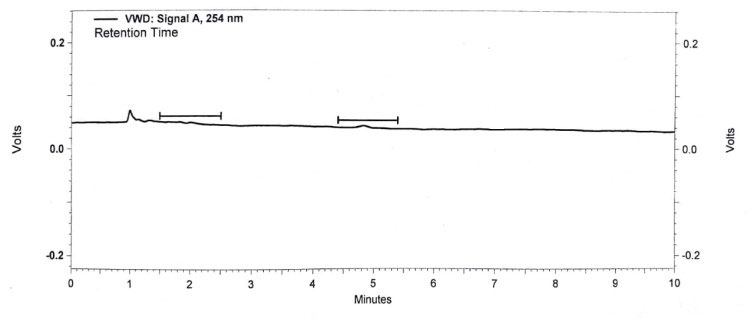
Figure1: Chromatogram of Blank.
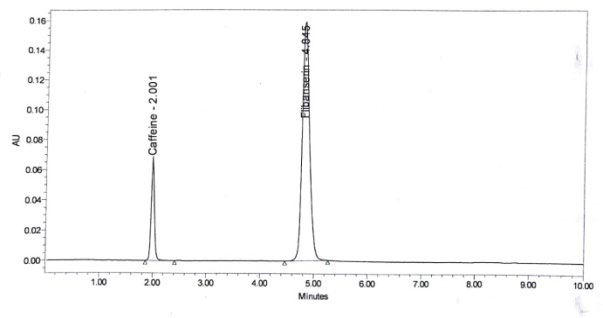
Figure2: Chromatogram of Developed Method.
Validation of Developed HPLC Method
The validation of HPLC method for Flibanserin and Caffeine was carried out according to ICH guidelines with respect to the following parameters:
Linearity and Range
Linearity of the developed method demonstrates the ability of method to produce a result which are directly proportional to concentration of analyte in the sample. The Five different concentrations of Flibanserin and Caffeine were prepared for linearity in the range of 50%-150%. The amount of Flibanserin and Caffeine in five different concentration are 50% (50µg/mL and 10µg/mL), 80% (80.0µg/mL and 16.0µg/mL), 100% (100.0µg/mL and 20.0µg/mL), 120% (120.0µg/ml and 24.0µg/mL) and 150% (150.0µg/mL and 30.0µg/mL) respectively. For regression analysis each solution was injected only one time. The graph was plotted between concentrations versus area of peak. The Flibanserin and Caffeine shows good correlation coefficient (r2 =0.997 and 0.998 respectively Figures 3 & 4 in concentration range 50%, 80%,100%, 120% and 150%.
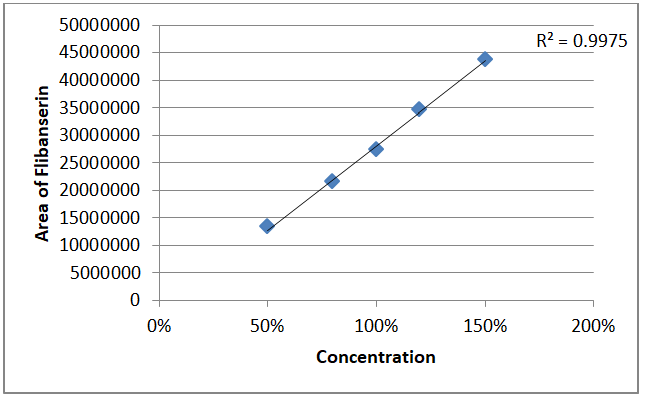
Figure3: Flibanserin linearity Curve.
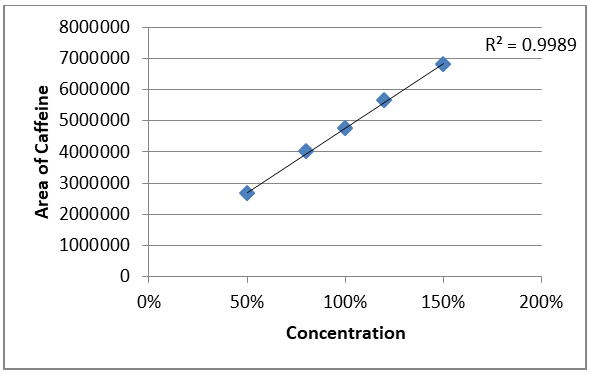
Accuracy
It is also termed as trueness or recovery. Accuracy expresses the closeness between the reference value or true value and the value found. The method was carried out at 80%, 100% and 120% for Flibanserin and Caffeine. It is usually demonstrate in the form of SD and RSD. The recovery studies show good results for Flibanserin and Caffeine in three concentration range 80% (80.0µg/mL and 16.0µg/mL), 100% (100.0µg/mL and 20.0µg/mL) and 120% (120.0µg/mL and 24.0µg/mL). The results reveal that the value of %RSD is less than 2%. The percent recovery results are shown Table 1.
| Concentration | %RSD | % Recovery | |
|---|---|---|---|
| Caffeine | 80% | 0.25 | 99.09 |
| Caffeine | 100% | 0.24 | 98.97 |
| Caffeine | 120% | 0.59 | 95.42 |
| Flibanserin | 80% | 0.21 | 98.66 |
| Flibanserin | 100% | 0.32 | 98.56 |
| Flibanserin | 120% | 0.65 | 99.84 |
Table 2: % Recovery of Flibanserin and Caffeine.
Precision
It reveals the data regarding closeness between the series of measurements. The precision of the developed method was verified by system precision, method precision and intermediate precision (raggedness). A homogenous mixed sample 100µg/mL and 20µg/mL of Flibanserin and Caffeine was prepared under prescribed conditions and estimation was carried out. The results are expressed in the form of standard deviation and RSD value. Table 2 shows the result of system precision, method precision and intermediate precision respectively. The developed method is highly precise as % RSD is less than 2%.
| Drug | %RSD | |
|---|---|---|
| System precision | Caffeine | 0.22 |
| System precision | Flibanserin | 0.21 |
| Method precision | Caffeine | 0.80 |
| Method precision | Flibanserin | 0.74 |
| Intermediate precision (raggedness) | Caffeine | 0.81 |
| Intermediate precision (raggedness) | Flibanserin | 1.03 |
Table 1: System precision, Method precision and Intermediate precision (raggedness).
Limit of Detection and limit of Quantification
Limit of detection (LOD) and limit of quantification (LOQ) reveal information regarding concentration of analyte that yields signal-to-noise ratio around 3 and 10 respectively. Serial dilutions are made from mixed solution of Flibanserin and Caffeine for determination of LOD and LOD. The mixed sample were injected in HPLC system and compare the signals of mixed sample and blank sample of LOD and LOQ. According to earlier mentioned parameters, LOD and LOQ were estimated for Flibansein 0.24µg/mL and 0.8µg/mL, for Caffeine it is 0.3µg/mL and 1µg/mL respectively.
Robustness
The robustness of developed HPLC method was carried out by making small deliberate changes in HPLC process parameters. This parameter includes variation in wavelength, flow rate of mobile phase and change in proportion of buffer and ACN. The method was performed on single concentration of mixed sample of Flibanserin and Caffeine (100µg/mL and 20µg/mL respectively). The alternation of parameters may leads to some significant changes in peak area and RSD. Robustness studies conclude that the method is robust under ±2 wavelength, ± 10% flow rate and plus 10% increase in organic phase (Note: method is sensitive for minus organic phase). There is no significant effect observed in recovery of Flibanserin and Caffeine. The per cent recovery is shown in Table 3 Negligible changes were observed in resolution, number of theoretical plates and retention time during robust condition. So, we can say that developed method is robust.
| Parameters | % Recovery | |
|---|---|---|
| Caffeine | Wavelength plus | 86.85 |
| Caffeine | Wavelength minus | 86.80 |
| Caffeine | Flow plus | 97.40 |
| Caffeine | Flow minus | 97.03 |
| Caffeine | Organic plus | 96.76 |
| Flibanserin | Wavelength plus | 86.03 |
| Flibanserin | Wavelength minus | 86.08 |
| Flibanserin | Flow plus | 97.65 |
| Flibanserin | Flow minus | 97.28 |
| Flibanserin | Organic plus | 97.02 |
Table 3: Robustness Studies.
Specificity and Selectivity
The developed method was found to be selective for Flibanserin and Caffeine since the injection of the blank solution confirmed the absence of interfering peaks at the retention times of the two examined substances at 254 nm wavelength. The results obtained from studies demonstrate that there was no interference from other materials in the developed method and therefore confirm the specificity of the method.
Solution Stability Studies
Solution stability studies are performed for 24 hours and % relative area is calculated. This study is conducted with a mixture of Flibanserin and Caffeine (100 and 20ppm respectively). Per cent relative difference in area during 24 hours for Flibanserin and Caffeine is shown in Table 4 which shows that the solution is stable during 24 hours study.
| Drug | Hour | Area | % Relative Difference |
|---|---|---|---|
| Caffeine | Initial | 4752843 | - |
| Caffeine | 01 hr. | 4758113 | 0.11 |
| Caffeine | 02 hr. | 4754491 | 0.03 |
| Caffeine | 03 hr. | 4761771 | 0.19 |
| Caffeine | 04 hr. | 4796106 | 0.91 |
| Caffeine | 05 hr. | 4763055 | 0.21 |
| Caffeine | 06 hr. | 4777275 | 0.51 |
| Caffeine | 07 hr. | 4793792 | 0.86 |
| Caffeine | 08 hr. | 4783497 | 0.64 |
| Caffeine | 09 hr. | 4780560 | 0.58 |
| Caffeine | 10 hr. | 4781809 | 0.61 |
| Caffeine | 12 hr. | 4758554 | 0.12 |
| Caffeine | 14 hr. | 4764389 | 0.24 |
| Caffeine | 16 hr. | 4761944 | 0.19 |
| Caffeine | 18 hr | 4766864 | 0.3 |
| Caffeine | 20 hr. | 4749330 | 0.07 |
| 22 hr. | 4765243 | 0.26 | |
| 24 hr. | 4759606 | 0.14 |
Table 4: Solution Stability Studies.
| Flibanserin | Initial | 26973449 | - |
|---|---|---|---|
| 01 hr. | 26996881 | 0.09 | |
| 02 hr. | 26988587 | 0.06 | |
| 03 hr. | 27063338 | 0.33 | |
| 04 hr. | 27287356 | 1.16 | |
| 05 hr. | 27137831 | 0.61 | |
| 06 hr. | 27216441 | 0.9 | |
| 07 hr. | 27348689 | 1.39 | |
| 08 hr. | 27281415 | 1.14 | |
| 09 hr. | 27283292 | 1.15 | |
| 10 hr. | 27356845 | 1.42 | |
| 12 hr. | 27166519 | 0.72 | |
| 14 hr. | 27210544 | 0.88 | |
| 16 hr. | 27206834 | 0.87 | |
| 18 hr | 27215035 | 0.9 | |
| 20 hr. | 27132517 | 0.59 | |
| 22 hr. | 27300561 | 1.21 | |
| 24 hr. | 27176039 | 0.75 |
Table 5: Solution Stability Studies.
Conclusion
The HPLC method was successfully developed and validated on a Waters 2996 alliance for simultaneous determination of Flibanserin and Caffeine. The method for simultaneous determination has not been reported before. This present method is novel for the determination of two drugs at a single wavelength, 10µL injection capacity and waters symmetry® C18 5µm 4.6×150mm column. It was found that the method is sufficiently simple, rapid and sensitive as well as precise, accurate, linear, robust, LOD, LOQ and solution stability which compiles the ICH guidelines. The entire experimentation procedures proved that the developed HPLC method shows good resolution, separation of peaks, linearity and RSD values (less than 2%). Which indicate that method is suitable for the determination of Flibanserin and Caffeine?
Acknowledgement
No external funding
References
-
Borsini F, Evans K, Jason K, Rohde F, Alexander B, et al. (2002) Pharmacology of Flibanserin. CNS Drug Reviews 8(2): 117-142.
-
Borsini F, Brambilla A, Ceci A, Cesana R., Giraldo E, et al. (1998) Flibanserin. Drugs Fut 23: 9-16.
-
Simon JA (2011) Implementing a successful clinical development program for female sexual dysfunctions (how to navigate a regulatory minefield). Maturitas 69(2): 97-98.
-
Stahl SM (2015) Mechanism of action of Flibanserin, a multifunctional serotonin agonist and antagonist(MSSA), in hypoactive sexual desire disorder. CNS Spectr 20(1): 1-6.
-
Jayne C, Simon JA, Taylor LV, Kimura T (2012) Open-label extension study of flibanserin in women with hypoactive sexual desire disorder. J Sex Med 9(12): 3180-3188.
-
Jordan R, Hallam TJ, Molinoff P, Spana C (20111) Developing treatments for female sexual dysfunction. J Clin Pharmacol Ther 89(1): 137-141.
-
Scandroglio A, Monferini E, Borsini F, (2001) Ex vivo binding of flibanserin to serotonin 5-HT1A and 5-HT2A receptors. Pharmacol Res 43(2): 179-183.
-
Brotto LA, Bitzer, J, Laan E, Leiblum S, Luria M (2010) Women’s sexual desire and arousal disorders. J Sex Med 7(2): 586-614.
-
Clayton AH, Dennerstein L, Pyke R, Sand M (2010) Flibanserin: a potential treatment for Hypoactive Sexual Desire Disorder in premenopausal women. Women’s Health 6(5): 639-653.
-
Barone JJ, Roberts HR (1996) Caffeine Consumption. Food Chem Toxicol 34(1): 119-129.
-
Shrestha S, Rijal SK, Pokhrel P, Prasad RK (2016) A Simple HPLC Method for Determination of Caffeine Content in Tea and Coffee. J Food Sci Techol 9: 74-78.
-
Nawrot P, Jordan S, Eastwood J, Rotstein J, Hugenholtz A, et al. (2003) Effects of caffeine on human health. Food Additives and Contaminants 20(1): 1-30.
-
Franeta JT, Agbaba D, Eric S, Pavkov S, Aleksic M, et al. (2002) HPLC assay of acetylsalicylic acid, paracetamol, caffeine and Phenobarbital in tablets. Farmac 57(9): 709-713.
-
Paraskevas D, Tzanavarasa DG, Themelis B (2007) Validated high-throughput HPLC assay for nimesulide using a short monolithic column. Journal of Pharmaceutical and Biomedical Analysis 43(4): 1483- 1487.
-
Cabrera K (2004) Applications of silica-based monolithic HPLC columns. J sep sci 27(10-11): 843-852.
-
Rieux L, Niederlander H, Verpoorte E, Bischoff R (2005) silica monolithic columns:synthesis, characterisation and applications to the analysis of biological molecules. J Sep Sci28(14): 1628-1641.
-
Tanak Tanak N, Nobuo K, Hiroshi I, Minakuchi N, Hiroyoshi N, et al. (2002) Monolithic silica for high-efficiency chromatographic separations. J chromatography A 965(1-2): 35-49.
-
Siouffi AM (2003) silica gel- based monoliths prepared by the sol-gel method: Facts and Figures. Journal of Chromatography A 1000(1-2): 801-818.
-
Hearn MTW (1980) Ion-pair chromatography on normal and reversed-phase systems. Adv Chromatography 18: 59-100.
-
Martin M, Guiochon G (2005) Effects of high pressures in liquid chromatography. J Chromatography A 7: 16-38.
-
Abidi SL (1991) High-performance liquid chromatography of phosphatidic acids and related polar lipids. J Chromatography 587: 193-203.
-
Poplawskaa M, Blazewicz A, Zolek P, Fijaleka Z (2014) Determination of flibanserin and tadalafil in supplements for women sexual desire enhancement using high-performance liquid chromatography with tandem mass spectrometer, diode array detector and charged aerosol detector. Journal of Pharmaceutical and Biomedical Analysis 94: 45-53.
-
Zamia Z, Saisho K, Maruyama T, Gouda Y (2013) LC-PDA- MS analysis of dapoxetine and Flibanserin. Jpn J Food Chem Safety 20(2): 119-123.
-
Wang R, Zhou M, Cheng Q (2017) Detection of Avanafil and Flibanserin in Health Food by HPLC-MS/MS. Herald of Medicine 36(7): 783-785.
-
Becker R (2009) US Patent. US 2009/0239881 A1.
- Acido Labile or Gastro Irritant Apis and Enteric Release in Galenic Practice: An Overview
- A Study on Knowledge, Attitude and Practice of Hand Hygiene among Healthcare Professionals at a Tertiary Care Hospital, India
- Influence of Inoculum Concentration on In Vivo Incubation Period of Emmia lacerata, Pathogenesis and Management of Wilt in Pepper (Capsicum annuum L.)
- Vanilla’s Chemistry
- Marine Anti-Cancer Compounds and Adverse Effects of Global Warming on Oceans: An Overview
- Serological Investigation of Chikungunya Virus Antibody among Malaria-Suspected Febrile Patients in Some Healthcare Facilities in Rivers State