
Consumption of Wild Tulsi Leaves May Protect Against Methicillin-Resistant Staphylococcus Aurous (MRSA) Infection!
Nosocomial infections are caused by the evolution of methicillin-resistant Staphylococcus aureus (MRSA) and vancomycinresistant Staphylococcus aureus (VRSA). It is concerning because the prevalence of fluoroquinolone and carbapenem resistance in commensal gut bacteria like E. coli is steadily increasing. The emergence of resistant bacterial strains is a natural incidence that happens when microorganisms replicate themselves incorrectly or when resistance features are transferred across strains via horizontal gene transfer pathways. This research demonstrates that leaf juice of Ocimum gratissimum contains a large quantity of flavanoids and phenolic compounds i.e., 315.96 mg rutin equivalent/g dry weight and 0.19 mg GA equivalent/g dry wt. Furthermore, despite its minimal concentration of juice, a notable antibacterial activity found against MRSA stains in comparison to another gram positive and gram-negative bacteria. According to the findings, the zones of inhibition against E. coli, Streptococcus aureus, and MRSA were 2.52 mm, 2.82 mm, and 3.45 mm, respectively.
Introduction
Antibiotic drug resistance (ADR) development is a typical natural incidence. But several human practices accelerate the onset and development of ADR. The emergence and development of resistant strains is encouraged by the inappropriate therapeutic use of antimicrobial drugs, as well as their usage in agricultural, fish, poultry, and animal farming. Additionally, inadequate prevention and control measures can contribute to the emergence and spread of ADR.
A more harmful strain of staphylococcus has evolved in recent decades. Methicillin-resistant Staphylococcus aureus is the name of this kind, and it is frequently abbreviated as MRSA. The fact that MRSA is immune to the complete family of antibiotics known as beta-lactams distinguishes it from other bacteria. Methicillin is a member of this class of antibiotics, along with others like the more often prescribed penicillin, amoxicillin, and oxacillin. Most frequently, MRSA causes skin infections and some extents diseases such as pneumonia (lung infection). MRSA infections can become serious and result in sepsis if left untreated. Community-associated MRSA (CA-MRSA) frequently starts as an excruciating skin boil and spreads throughout a community through contact with infected individuals or objects. Additionally, exchanging personal objects like towels or razors that have come into contact with diseased skin or coming into contact with a contaminated wound are other ways to spread the infection. The majority of MRSA infections affect patients who have visited hospitals or other healthcare facilities, such nursing homes and dialysis facilities known as Health care-associated MRSA (HA-MRSA).
We are revealing multidrug resistance among bacteria as a result of the bulk of pathogenic microorganisms developing resistance to contemporary antibiotics. Antibiotics are becoming limited, and over the past thirty years, no new antibiotic groups have been introduced. In the meanwhile, no new antibiotic is scheduled for release relatively soon. The use of herbal medicines to treat infections is one approach that has encouraged study in alternative medicine. Herbs and their essential oils have been prized for their various levels of antibacterial activity since the dawn of time. India has a rich store of medicinal plants that are employed in conventional medical treatments because of its incredible biodiversity [1]. Hence this study was undertaken to explore the antibacterial potentials of fresh Ocimum gratissimum leaves against MRSA bacterial strains which was never explored prior may highlight the repurposing of this plant use. Ocimum gratissimum commonly known as Vana Tulsi or Wild Leaf Basil is a perennial, woody bush basil grows up to 2m high with highly aromatic, slightly hairy green leaves with a strong clove scent and spicy flavor. It is native to India, Sri Lanka, Java and the northern and eastern parts of Africa. It has a wide range of bioactive compounds such as flavonoids and polyphenols [2, 3] and essential oils. Various phytochemicals such as Sinapic acid, Rosmarinic acid, Luteolin, Apigenin, Nepetoidin, Xanthomicrol, Salvigenin, Oleanolic acid, Gallic acid, Chlorogenic acid, Quercetin, Kaempferol etc. [4, 5] were isolated from this plant Figure 1.
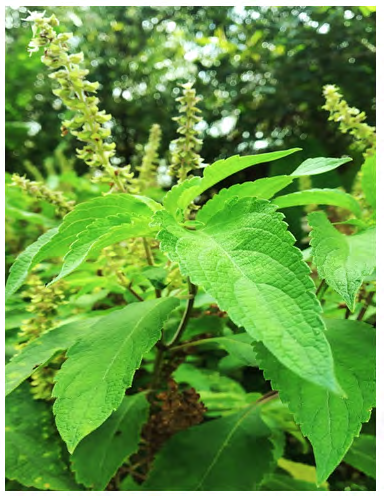
Ethnopharmacologically Ocimum gratissimum revealed its potentials such as improves immunity and contributes to a general sense of well-being. The strong antioxidant activity [6] slows the aging process and helps prevent and treat cancer [7], heart disease, arthritis [8], diabetes [9] and dementia [10]. It normalizes both blood pressure [11] and cholesterol levels and will help to overcome coughs colds, flu and fever [12]. Vana Tulsi is warming, has antiseptic qualities, clears bacterial infections [13] and is considered to be a tonic and apoptogenic.
Materials and Methodology
Collection and Authentication of Plant Materials
Plant leaves were collected from the medicinal garden of Sri Adichunchanagiri College of Pharmacy in a quantity sufficient to carry out all experiments. The process of authentication of plant samples were done by comparing with authentic plant materials and their botanical characteristics.
Extraction of Plant Materials
Fresh leaves were pounded in Mortar and pestle with little distilled water and fresh juice prepared after squeezing by Muslin Cloth. The freshly prepared juice kept in cool temperature for further experimental use.
Phytochemical Investigations
Determination of Total Phenolic Content: Phenolic content was calculated using the folin-Ciocalteu reagent (FC reagent). The reducing ability determined by the folin-Ciocalteu technique, an assay based on electron transfer, is represented as phenolic content. Sample stock preparation was done with 50% methanol in 100ml volumetric flask. Add 50 mg of plant extract was dissolved in 50% of 50 ml of methanol. After the preparation of sample 100 µl of plant extract was taken and added 400 µl distilled water, and was shaken properly. After 2 min, added 150 µl of FC reagent the solution mixture was spinned for 5-10 min at room temperature, bluish colour was formed. After the rotation solution mixture was further added with 500 µl of 20% Na 2 CO 3 (W/W) and incubated for 1h, the reaction mixture was agitated and keeps in dark place at room temperature, the absorbance was measured at 765nm in UV spectrophotometer against the blank. Standard gallic acid stock sample also prepared with methanol (100 µl /ml) and various dilution concentration were prepared such 1, 2, 2.5, 3, 3.5, 4, 4.5, 5 µl /ml and standard gallic acid curve also been plotted against the absorbance at 765nm by UV spectrophotometer against the blank [14]. Determination of Total Flavanoid Content: Standard rutin stock solution was prepared (100µg/ml) using 80% methanol and various dilute concentrations such as 10, 20, 40,80 and100 µl /ml had been prepared, each 0.5ml of standard Rutin dilution was added with 1.5ml 95% methanol, 0.1ml of 10% aluminium chloride, 0.1ml 1M potassium acetate and 2.8ml of distilled water and incubated for 30 min at room temperature. Absorbance, measured at 415 nm using UV spectrophotometer against the blank [15].
Determination of Antimicrobial Activity
The agar diffusion method was employed for determination of antibacterial activities. All bacteria were suspended in sterile water. The suspension was spread onto the surface of NA medium. The antimicrobial properties of fresh plant leaf extracts were tested against Gram- positive bacteria [Staphylococcus aureus (SA), Methicillin- resistant Staphylococcus aureus (MRSA)], Gram-negative bacteria [Escherichia coli (EC)]. Sterile discs were dipped into the plant extract and use as test sample and placed on the Nutrient agar media. The artificial Streptomycin and Amoxicillin disk (15mcg and 25mcg) were used as positive reference standards to determine the sensitivity of each microbial species tested and to compare the relative percent of antibacterial activity. The inoculated plates were incubated at 37°C for 24-48 h. Antibacterial activity was evaluated by measuring the diameter of inhibition zone (DIZ) of the tested bacteria. DIZ was expressed in millimeter [16, 17].
Results and Discussions
The results of this study revealed that, Ocimum gratissimum fresh leaves juice contains a significant amount of Phenolics and Flavanoids i.e., 315.96 mg Rutin Eq. /g dry weight and 0.19mg GA Eq. /g dry wt.) respectively (Table 1).
| Total Flavanoid content | Total phenolic content | |
|---|---|---|
| (mg GAE/g dry wt.) | (mg Rutin E/g dry wt.) | |
| Ocimum gratissium fresh leaf juice | 0.192 | 315.96 |
Table 1: Determination of Antimicrobial Activity.
Table1: Determination total flavonoids and Phenolics.
More over the antimicrobial activity of plant leaves juice showed a remarkable inhibition effect against MRSA stains as compared to other gram positive and gram-negative bacterial strains despite of its low concentration. As results found that the zone of inhibition was 2.52mm, 2.82mm and 3.45mm against E-Coli, Streptococcus aureus and MRSA respectively Table 2.
| Microorganism/ sample | Zone of inhibition (mm) | ||
|---|---|---|---|
| E-Coli | Streptococcus aureus | MRSA | |
| Streptomycin (20 mcg) | 3.76 | 6.28 | 2.52 |
| Amoxicillin (15 mcg) | - | 5.65 | 2.67 |
| Ocimum gratissimum fresh leaf juice (15 mcg) | 2.52 | 2.82 | 3.45 |
Table 2: Determination of Antimicrobial Activity.
The antibacterial activity mainly focused on various inhibitory cellular mechanisms. The inhibition of bacterial protein synthesis is one of the prominent ways among them. The plant constituents might have impact on bacterial elongation process of protein synthesis. By hindering translation, plant compounds, in particular plant phenolics, can prevent the creation of bacterial proteins. These substances impede the production of a functional 70S initiation complex by attaching to a location on the 50S subunit of the bacterial 23S ribosomal RNA. In essence, this function suppresses the synthesis of proteins and hinders bacterial growth. O. gratissimum essential oils primarily contains eugenol, also revealed strong antibacterial activity against Klebsiella pneumoniae, Serratia marcescens and E. coli as found by Matias, et al. [18]. Hence, this leaf juice definitely leads the way forward to find the solo active constituents of synergistic Phyto molecular action in counter the problem of MRSA infection. Further scope of investigations is on to isolate and identify the active therapeutic agent/ agents to explore further possibilities in this area of antimicrobial resistance. This study might provide the scientific community with a chance to learn and explore more about this current topic as well as about how these sophisticated microorganisms can coexist in our environment.
Acknowledgement
Authors are grateful to the Principal, Sri Adichunchanagiri College of Pharmacy, Adichunchanagiri University for providing necessary facilities for successful completion of this research work. We sincerely thank to Dr Annagowda, Professor, Department of Pharmacognosy, for his support and encouragements through over the turner of this research.
References
-
Chopra RN, Nayar SL, Chopra CI, Asolkar LV, Kakkar KK, et al. (1956) Glossary of Indian Medicinal Plants. CSIR New Delhi.
-
Venuprasad MP, Kandikattu HK, Razack S, Khanum F (2014) Phytochemical analysis of _Ocimum gratissimum_ by LC-ESI-MS/MS and its antioxidant and anxiolytic effects. South Afr J Bot Le 92: 151-158.
-
Irondi EA, Agboola SO, Oboh G, Boligon AA (2016) Inhibitory effect of leaves extracts of _Ocimum basilicum_ and _Ocimum gratissimum_ on two key enzymes involved in obesity and hypertension in vitro J Intercult Ethnopharmacol 5(4): 396-402.
-
Benitez NP, Leon EMM, Stashenko EE (2009) Eugenol and methyl eugenol chemotypes of essential oil of species _Ocimum gratissimum_ L. and Ocimum campechianum Mill. from Colombia. J Chromatogr Sci 47(9): 800-803.
-
Melo RS, Azevedo AMA, Pereira AMG, Rocha RR, Cavalcante RMB, et al. (2019) Chemical composition and antimicrobial effectiveness of _Ocimum gratissimum_ L. Essential oil against multidrug-resistant isolates of Staphylococcus aureus and Escherichia coli. Molecules 24(21): 3864.
-
Yan X, Qi M, Li P, Zhan Y, Shao H (2017) Apigenin in cancer therapy: anti-cancer effects and mechanisms of action. Cell Biosci 7: 50.
-
Abbaszadeh H, Ebrahimi SA, Akhavan MM (2014) Antiangiogenic activity of xanthomicrol and calycopterin, two polymethoxylated hydroxyflavones in both in vitro and ex vivo models. Phytother Res 28(11): 1661-1670.
-
Naveed M, Hejazi V, Abbas M, Kamboh AA, Khan GJ, et al. (2018) Chlorogenic acid (CGA): a pharmacological review and call for further research. Biomed Pharmacother 97: 67-74.
-
Sen A (2020) Prophylactic and therapeutic roles of oleanolic acid and its derivatives in several diseases. World J Clin Cases 80(10): 1767-1792.
-
Salehi B, Upadhyay S, Erdogan Orhan I, Kumar Jugran A, LD Jayaweera S, et al. (2019) Therapeutic potential of α- and β-pinene: a miracle gift of nature. Biomolecules 9(11): 738.
-
Musial C, Kuban Jankowska A, Gorska Ponikowska M (2020) Beneficial properties of green tea catechins. Int J Mol Sci 21(5): 1744.
-
Juergens UR (2014) Anti-inflammatory properties of the monoterpene 1.8-cineole: current evidence for co- medication in inflammatory airway diseases. Drug Res 64(12): 638-646.
-
Li L, Shi C, Yin Z, Jia R, Peng L, et al. (2015) Antibacterial activity of α-terpineol may induce morphostructural alterations in Escherichia coli. Braz J Microbiol 45(4): 1409-1413.
-
Fuentes E, Baez ME, Bravo M, Cid C, Labra F (2012) Determination of Total Phenolic Content in Olive Oil Samples by UV-visible Spectrometry and Multivariate Calibration. Food Anal Methods 5: 1311-1319.
-
Zhishen J, Mengcheng T, Jianming W (1999) The determination of flavonoid contents in mulberry and their scavenging effects on superoxide radicals. Food Chemistry 64(4): 555-559.
-
Agarwal P, Nagesh L (2010) Evaluation of the antimicrobial activity of various concentrations of Tulsi (Ocimum sanctum) extract against Streptococcus mutans: An in vitro study. Indian Journal of Dental Research 21(3): 357-359.
-
El Awady MA, Hassan MM, Abdel Hameed ES, Gaber A (2015) Comparison of the antimicrobial activities of the leaves-crude extracts of Moringa peregrina and Moringa oleifera in Saudi Arabia. Int J Curr Microbiol App Sci 4(12): 1-9.
-
Matias EFF, Santos KKA, Almeida TS, Costa JGM, Coutinho HDM (2011) Phytochemical Screening and modulation of antibiotic activity by _Ocimum gratissimum_ L. Biomed Prev Nutr (1)1: 57-60.
- Acido Labile or Gastro Irritant Apis and Enteric Release in Galenic Practice: An Overview
- A Study on Knowledge, Attitude and Practice of Hand Hygiene among Healthcare Professionals at a Tertiary Care Hospital, India
- Influence of Inoculum Concentration on In Vivo Incubation Period of Emmia lacerata, Pathogenesis and Management of Wilt in Pepper (Capsicum annuum L.)
- Vanilla’s Chemistry
- Marine Anti-Cancer Compounds and Adverse Effects of Global Warming on Oceans: An Overview
- Serological Investigation of Chikungunya Virus Antibody among Malaria-Suspected Febrile Patients in Some Healthcare Facilities in Rivers State