
Pharmaceutical Applications of White Button Mushroom (Agaricus Bisporus)
In this review paper, characteristics of Agaricus bisporus and its applications medicine were described. Agaricus bisporus is targeted by humans foraging for food and have many usages in human dietary followed by pharmaceutical fields due to its composition of essential chemical and nutritional composition. Modern pharmacological research confirms large parts of traditional knowledge regarding the medicinal effects of Agaricus bisporus due to its antifungal, antibacterial, antioxidant and antiviral properties, besides being used as functional food. Nanoparticles like silver nanoparticle that can be synthesized from A. bisporus are used to treat cancer, viral, bacterial and fungal diseases. In general, Agaricus bisporus is an essential edible mushroom that play role in health as therapeutic character.
Introduction
Fungi are vital organisms of fundamental importance to life on earth and they are epigeous fruiting bodies of fungi, visible to the naked eye [1]. Mushrooms are a very large and diversified group of macrofungi belonging to basidiomycetes and ascomycetes, which have two phases of growth: the reproductive phase (fruit bodies) and the vegetative phase (mycelia) [2]. Agaricus bisporus are mainly mushroom-forming basidiomycetes of the subphylum Agaricomycotina, class Agaricomycetes, order Agaricales, and the primary common decomposers of residual plant material in forests and grasslands [3]. Agaricus bisporus belongs to Basidiomycetes family and the most important commercially cultivated mushroom in the world and have many usages in human dietary and pharmaceutical fields due to its composition of essential amino acids, fatty acids, carbohydrates, low calories, crude fibers, trace elements and vitamins. Recently synthesized nanoparticles from A. bisporus were used to treat cancer, viral, bacterial and fungal diseases [4, 5].
Application of Agaricus Bisporus as Medicine
Medicinal mushrooms have been used in traditional medicine and human diet for thousands of years. Nowadays, medicinal mushrooms and their active compounds are being increasingly recognized by conventional medicine [6]. Agaricus bisporus have a very good history of using in many traditional therapies. The use of A. bisporus extracts and its bioactive compounds as antioxidant, anti- cancer and anti-inflammation is increasing in the world against many human diseases such as coronary heart diseases, diabetes mellitus, bacterial and fungal infections, disorders of the human immune system and cancers [7].
Agaricus bisporus have some active ingredients, such as polysaccharides, lipopolysaccharides, essential amino acids, peptides, glycoproteins, nucleosides, triterpenoids, lectins, fatty acids and their derivatives, these mushrooms have been reported to have antimicrobial, anticancer, antidiabetic, antihypercholesterolemic, antihypertensive, hepatoprotective and antioxidant activities [8]. Agaricus bisporus is a good sources of trace elements like sodium, potassium, and phosphorus, conjugataed linoleic acid and antioxidants [9]. It can inhibit aromatase, and therefore may be able to lower the estrogen levels in the human body, which might reduce breast cancer susceptibility [10].
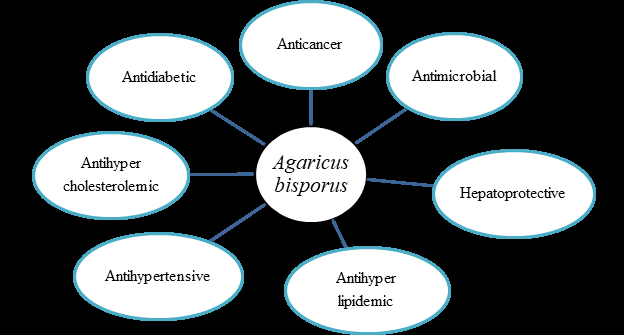
Antimicrobial
Extracts of A. bisporus that can be prepared with methyl alcohol can reveal antimicrobial activities against some bacteria, yeasts, and dermatophytes [11]. Microbial inhibition of A. bisporus extracts the potential use of the stipes of A. bisporus as natural antimicrobials [12]. The aqueous total protein extracts of the cultivated A. bisporus possess significant antibacterial activity, particularly against S. aureus and Methicillin-Resistant S. aureus [13]. Silver nanoparticles (AgNPs) are one of the most commonly used metallic nanoparticles, which possess potent antibacterial and antifungal characteristics. Agaricus bisporus is considered an important factor for biosynthesis of silver nanoparticles (AgNPs) [14]. A. bisporus had the second level (about 11%) after oyster mushroom Pleurotus sp. in synthesis important nanoparticles. synthesized the AgNPs using the A. bisporus extract [15, 16]. AgNPs from A. bisporus have a higher zone of inhibition against Methicillin- Resistant Staphylococcus aureus. Also, antibacterial activity of the synthesized A. bisporus-AgNPs against Gram-positive bacteria likes Staphylococcus aureus, S. typhi, Proteus sp. Enterobacter sp. and Klebsiella sp. [17, 18].
Anticancer
Agaricus bisporus contains bioactive compounds that exhibit anticancer properties. A. bisporus polysaccharide possesses strong immunostimulatory and antitumor bioactivity in vivo and in vitro [19]. A. bisporus contain three main polysaccharides α- glucan, β-glucan and galactomannan. Agaricus bisporus contain high amount of lovastatin [20] that exerts anti-cancer effects in the triple-negative breast cancer. Phytochemicals extracted from Agaricus bisporus suppress aromatase activity, inhibit breast cancer (BC) cell proliferation, and decrease mammary tumor formation in vivo [21].
Agaricus Bisporus as Antihyperlipidemic
Hyperlipidemia, represented by increased levels of triglycerides or cholesterol, is a dominant risk factor that contributes to the progression and development of subsequent cardiovascular disease and atherosclerosis, which is one of the most serious diseases in humans [22]. Extracts of A. bisporus give lovastatin drug which used for lowering cholesterol (hypolipidemic agent) in those with hypercholesterolemia to reduce the risk of cardiovascular disease [13]. Lovastatin exerts anti-cancer effects in the triple-negative breast cancer cell. Agaricus bisporus contain lovastatin that reduces the cholesterol level in serum and [23].
Agaricus Bisporus as Antidiabetic
Agaricus bisporus gives high amount of dietary fibers and antioxidants like vitamin C, D, and B12, folates and polyphenols that provide beneficial effects on cardiovascular and diabetic diseases [24]. A. bisporus contain numerous compounds with potential anti-inflammatory and antioxidant health benefits that can occur with frequent consumption over time in adults predisposed to type 2 diabetes [22].
Agaricus bisporus intake may be a viable dietary choice to prevent liver steatosis, which is an early reversible stage of nonalcoholic fatty liver disease in postmenopausal women [25] (Table 1).
| Pharmacological effects | Extracted substances | References |
|---|---|---|
| Antihyperlipidemic | Lovastatin | Ramirez G, et al. [26] |
| Antibacterial and Antifungal | Ethanol and Silver nanoparticles (AgNPs) | Sweedan EG, et al. [27] |
| Antioxidant | Phenols Selenium | Bhatia P, et al. [28] |
| Anticancer | α- glucan, β-glucan and galactomannan, methanol extract Ergosterol and phenolic | Usman M, et al. [29] |
| Antiproliferative (effects on human epithelial cancer cells eye surgery for glaucoma) | Lectin | Hou J, et al. [30] |
| Antidiabetic (Lowers blood glucose and cholesterol levels) | Dehydrated fruiting body extracts | Jeong SC, et al. [24] |
Table 1: Pharmacological effects of extracts from Agaricus bisporus.
Conclusion
A bisporus may provide significant support against malnutrition due to high nutritional and medicinal values have many usages in human dietary and pharmaceutical fields due to its composition originates from its chemical composition. Agaricus bisporus contains the essential amino acids useful as a food for the human health including cystine, methionine, threonine, isoleucine and phenylalanine. Extracts of A. bisporus give lovastatin drug which used for lowering cholesterol (hypolipidemic agent) in those with hypercholesterolemia to reduce the risk of cardiovascular disease and reduce the cholesterol level in serum and liver.
References
-
Rathore H, Prasad S, Kapri M, Tiwari A, Sharma S (2019) Medicinal importance of mushroom mycelium: Mechanisms and applications. Journal of functional foods 56: 182-193.
-
Colmenares CS, Sanchez JE, Mora VJ (2017) Agaricus bisporus production on substrates pasteurized by self- heating. AMB Express 7: 135.
-
Hilden K, Makela MR, Lankinen P, Lundell T (2013) Agaricus bisporus and related Agaricus species on lignocellulose: production of manganese peroxidase and multicopper oxidases. Fungal Genet Biol 55: 32-41.
-
Erhan S, Proestos C, Manoharadas S, Oz F (2023) Effect of different cooking methods on selected quality criteria and polycyclic aromatic hydrocarbon content of cultivated mushrooms (Agaricus bisporus). International Journal of Food Science & Technology 58(11): 5689-5700.
-
Naeem GA, Jaloot AS, Owaid MN, Muslim RF (2021) Green synthesis of gold nanoparticles from coprinus comatus, agaricaceae, and the effect of ultraviolet irradiation on their characteristics. WJST 18(8): 9396-12.
-
Pohleven J, Korosec T, Gregori A (2016) Medicinal mushrooms. MycoMedica.
-
Dhamodharan G, Mirunalini S (2010) A novel Medicinal Characterization of Agaricus bisporus (white button mushroom). Pharmacol Online 2: 456-463.
-
Buchner R, Voros M, Allaga H, Varga A, Bartal A, et al. (2022) Selection and characterization of a Bacillus strain for potential application in industrial production of white button mushroom (Agaricus bisporus). Agronomy 12(2): 467.
-
Shi Y, Chen QX, Wang Q, Song, KK, Qiu L (2005) Inhibitory effects of cinnamic acid and its derivatives on the diphenolase activity of mushroom (Agaricus bisporus) tyrosinase. Food Chemistry 92(4): 707-712.
-
Xu TB, Beelman RB, Lambert JD (2012) the cancer preventive effects of edible mushrooms. Anti-Cancer Agents Med Chem 12(10): 1255-1263.
-
Erdogan EA (2022) Antibacterial activity and antibacterial mechanism of ethanol extracts of Lentinula edodes (Shiitake) and Agaricus bisporus (button mushroom). Int J Environ Health Res 32(8): 1828-1841.
-
Ndungutse V, Mereddy R, Sultanbawa Y (2015) bioactive properties of mushroom (A Garicus bisporus) stipe extracts. Journal of Food Processing and Preservation 39(6): 2225-2233.
-
Atila F, Owaid MN, Shariati MA (2017) the nutritional and medical benefits of Agaricus bisporus: A review. Journal of Microbiology Biotechnology and Food Sciences 7(3): 281-286.
-
Kaur J, Dhiman D, Kalia A (2023) Mycosynthesized Nanoparticles. Myconanotechnology: Emerging Trends and Applications, pp: 108.
-
Sudhakar T, Nanda A, Babu SG, Janani S, Evans MD, et al. (2014) Synthesis of silver nanoparticles from edible mushroom and its antimicrobial activity against human pathogens. Int J Pharm Tech Res 6(5): 1718-1723.
-
Owaid MN, Ibraheem IJ (2017) Mycosynthesis of nanoparticles using edible and medicinal mushrooms. European Journal of Nanomedicine 9(1): 5-23.
-
Nojedehi ME, Malmiri HJ, Shahrouzi JR (2018) hydrothermal green synthesis of gold nanoparticles using mushroom (Agaricus bisporus) extract: physico- chemical characteristics and antifungal activity studies. Green Processing and Synthesis 7(1): 38-47.
-
Dhanasekaran D, Latha S, Saha S, Thajuddin N, Panneerselvam A (2013) Extracellular biosynthesis, characterisation and in-vitro antibacterial potential of silver nanoparticles using Agaricus bisporus. Journal of Experimental Nano science 8(4): 579-588.
-
Zhang Y, Ma G, Fang L, Wang L, Xie J (2014) The Immunostimulatory and Anti-tumor Activities of Polysaccharide from Agaricus bisporus (brown). Journal of Food and Nutrition Research 2(3): 122-126.
-
Zhang N, Liu Y, Tang FY, Yang LY, Wang JH (2023) Structural characterization and in vitro anti-colon cancer activity of a homogeneous polysaccharide from Agaricus bisporus. Int J Biol Macromol 251: 126410.
-
Venturella G, Ferraro V, Cirlincione F, Gargano ML (2021) Medicinal mushrooms: bioactive compounds, use, and clinical trials. Int J Mol Sci 22(2): 634.
-
Batool A, Farooq U, Shafi A, Abbas N, Rafiq Z, et al. (2023) Button Mushroom (Agaricus bisporus). In Mushrooms CRC Press, pp: 1-19.
-
Kala K, Kryczyk PA, Rzewinska A, Muszynska B (2020) Fruiting bodies of selected edible mushrooms as a potential source of lovastatin. European Food Research and Technology 246: 713-722.
-
Jeong SC, Jeong YT, Yang BK, Islam R, Koyyalamudi SR, et al. (2010) White button mushroom (Agaricus bisporus) lowers blood glucose and cholesterol levels in diabetic and hypercholesterolemia rats. Nutrition research 30(1): 49-56.
-
Panda SK, Luyten W (2022) Medicinal mushrooms: Clinical perspective and challenges. Drug Discovery Today 27(2): 636-651.
-
Ramirez AG, Caz V, Hernandez RM, Marin FR, Largo C, et al. (2016) Modulation of cholesterol-related gene expression by ergosterol and ergosterol-enriched extracts obtained from Agaricus bisporus. European journal of nutrition 55(3): 1041-1057.
-
Sweedan EG, Majeed SMA (2023) Effects of Silver Nanoparticles Synthesized from Phenolic Extract of Agaricus bisporus Against Pathogenic Bacteria and Yeasts. Nano Biomedicine & Engineering 15(1).
-
Bhatia P, Pandey S, Prakash R, Nagaraja TP (2014) Enhanced Anti-oxidant Activity as a Function of Selenium hyper accumulation in Agaricus bisporus Cultivated on Se-rich Agri-residues. Journal of Biologically Active Products from Nature 4(5-6): 354-364.
-
Usman M, Murtaza G, Ditta A (2021) Nutritional, medicinal, and cosmetic value of bioactive compounds in button mushroom (Agaricus bisporus): a review. Applied Sciences 11(13): 5943.
-
Hou J, Li Y, Zhou Z, Valiaeva N, Beadle JR, et al. (2011) Antiproliferative property of hexadecyloxypropyl 9-[2-(phosphonomethoxy) ethyl] guanine (HDP-PMEG) for unwanted ocular proliferation. Molecular vision 17: 627-637.
- Acido Labile or Gastro Irritant Apis and Enteric Release in Galenic Practice: An Overview
- A Study on Knowledge, Attitude and Practice of Hand Hygiene among Healthcare Professionals at a Tertiary Care Hospital, India
- Influence of Inoculum Concentration on In Vivo Incubation Period of Emmia lacerata, Pathogenesis and Management of Wilt in Pepper (Capsicum annuum L.)
- Vanilla’s Chemistry
- Marine Anti-Cancer Compounds and Adverse Effects of Global Warming on Oceans: An Overview
- Serological Investigation of Chikungunya Virus Antibody among Malaria-Suspected Febrile Patients in Some Healthcare Facilities in Rivers State