
Tourism and Municipal Solid Waste Management in Developing Economies: Challenges and Opportunities
Tourism is a driving force for an increase in municipal solid waste (MSW) in developing countries. An average tourist may generate more MSW than a local resident and the tourist destinations are often located in remote areas deprived of proper infrastructure and services for the management of MSW. This combination can lead to a vicious cycle of tourism that destroys natural environment and host communities. However, there are sustainability standards and good practices that will maximize benefits of tourism while minimize negative impacts. This paper uses Thailand as a case study for both challenges and opportunities tourism offers to MSW management. In addition, the revenues from tourism can be channeled for the improvements of the hard and soft infrastructures and the services in a systematical way.
Introduction
Tourism is one of the fastest growing industries. According to the World Tourism Organization, in 2017 it generated over 1.6 trillion USD or 7% of the world exports and the international tourist arrivals are expected to grow from 1.3 to 1.8 billion by 2030 [1]. This UN precedent growth of tourist activities can leave a large footprint on the planet. A recent study found that the Policy Article sector accounted for 8% of the greenhouse gas emissions between 2009 and 2013 [2]. There is a strong case for the tourism industries to reduce its impacts and conserve environmental integrity of the destinations. A locust model where a virgin location is discovered, exploited, degraded and deserted by tourists is not sustainable for businesses, host communities and the environment. In many regions of the world, global warming can lead to shortened tourist season and severely affects the viability of the industries.
Solid waste is another important issue for the sustainability of tourism. An average waste generation rate of a tourist can be considerable [3]. In addition, tourist destinations in developing countries are often located in remote areas lacking basic infrastructure and public services like proper waste collection and safe disposal. Although cleanliness or a lack of it might not be what attracts tourists for their first visit, a loss in amenity they experience during their trip can influence their decisions to come back.
This paper aims to outline not only the challenges that developing economies are now facing in terms of the growing amount of solid waste from tourism but also its contributions to solving the problem. Standards and best practices are available that show a way to develop sustainable tourism. In addition, there is an opportunity to channel the revenues generated by tourism to improve the infrastructure and services. But, first we need to understand the extent and nature of the problem.
Scale of the Problem
Thailand ranked 9th in the world in terms of the number of visitors and 4th in terms of revenues generated by international tourism [1]. An 8.9% increase had seen the international tourist arrivals rose to 32.6 million in the previous year. This was significantly higher than the global growth rate of 4-5%. Bangkok had the largest share of visitors followed by provinces with beach fronts like Phuket, Phangn Nga and Krabi in the South, Chonburi, Rayong and Trat in the East, and Phetchaburi and Prachuap Khiri Khan in the west. There is also a growing market for cultural and community-based tourism (CBT) in the north and northeast of Thailand. For example, the number of visitors in Chiang Rai had more than doubled from 1.4 million to 3.2 million during the past ten years [4].
However, there are indicators that the supplies of tourism might not be able to keep up and sustain the insatiable demands. Based on the Travel and Tourism Competitive Index (TTCI) produced by World Economic Forum, Thailand could improve its competitiveness only slightly moving from No [5]. 35th in 2015 to No. 34th in 2017. The performance in terms of environmental sustainability was in particular lackluster – dropping from the 116th to the 122nd.
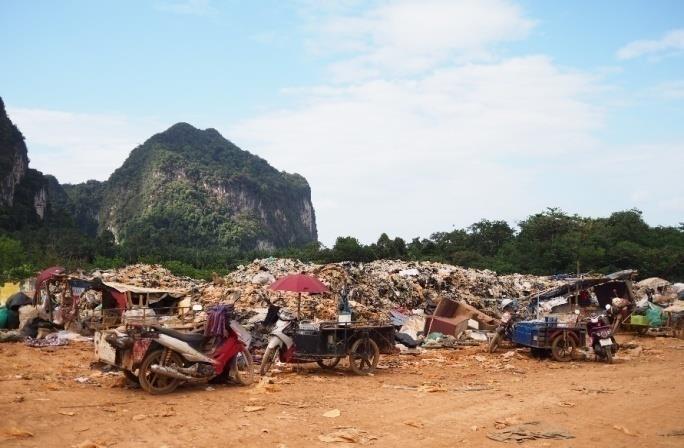
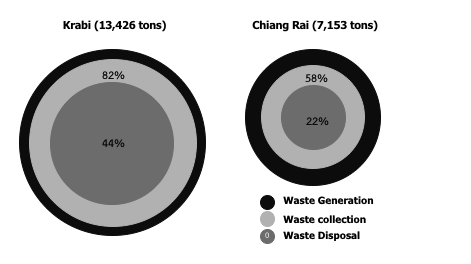
While it might be misleading to frame tourism as a culprit for the environmental problems, an increase in tourist’s activities was undeniably putting pressure in the precarious situation. According to the Pollution Control Department (2017), Thailand generated over 27 million tons of municipal solid waste (MSW) every year. Out of this amount, only 58% was recycled or properly disposed in controlled systems. There were 5.67 tons of MSW generated in areas where local governments did not have capacity to provide basic waste removal services. Unfortunately, many tourist destinations were located in these areas. Krabi is one of the top tourist destinations in Thailand. In 2016, there were 3.6 million tourists in Krabi with an average stay of 4.51 days and another 3.7 one-day excursionists who traveled to Krabi [4]. It was estimated that MSW directly generated at hotels, tourist attractions and transportation hubs in the province could amount to 13,426 tons-49 tons per day during the tourist season and 28 tons per day during the low season [6]. Although 82% of this tourist waste was in the areas with good service coverage, the disposal of the collected MSW remained a challenge. As waste overflowed the only sanitary landfill, only 44% or 5,868 tons were properly disposed of and the rest was open-dumped or burnt in open air. Figure 1 shows a pile of waste in the area around the landfill of Krabi Muang Municipality.
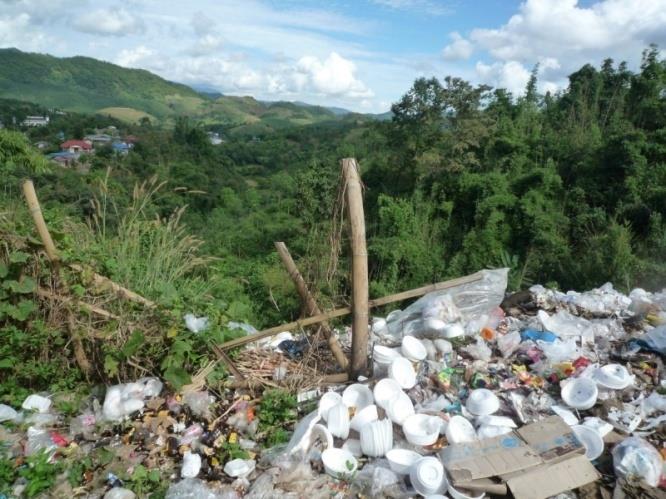
Chiang Rai is a new tourist destination in the North of Thailand. With over 3 million visitors, it was estimated that the direct generation of MSW from tourist-related sources stood at 7,153 tonsin 2016 [4, 6]. Although this was just over half of the amount of tourist waste in Krabi, the poorer service coverage meant that only 58% was collected and 22% disposed of properly. This left 5,567 tons to pollute the environment. Famous natural attractions like Phu Chi Fa and Doi Mae Salong were situated in localities without collection service and littering was common during the tourist season Figure 2. Figure 3 compares direct tourist waste generation, waste collection and disposal rates in Krabi and Chiang Rai, Thailand.
Sustainability Standards
Global Sustainable Tourism Council has outlined criteria related to the management of solid waste from tourism both at destination and enterprise levels [7]:
GSTC-Destination D10
The destination has a system to encourage enterprises to reduce, reuse, and recycle solid waste. Any residual solid waste that is not reused or recycled is disposed of safely and sustainably.
GSTC-Industry D2.4
Waste, including food waste, is measured, mechanisms are in place to reduce waste, and where reduction is not feasible, to re-use or recycle it. Any residual waste disposal has no adverse effect on the local population and the environment.
Nan Muang Municipality sets a good example for tourist waste management. It was chosen as ASEAN’s cleanest tourist city and awarded in the 4th ASEAN Environmentally Sustainable Cities in 2017. The municipality has been working with other authorities in a consortium led by the 6th Office of the Designated Areas for Sustainable Tourism Administration (Public Organization) or DASTA to promote source separation and recycling programs at various hotels, tourist attractions, and other establishments. Hotels and accommodations are also encouraged to switch to reusable bottles for drinking water and toiletries.
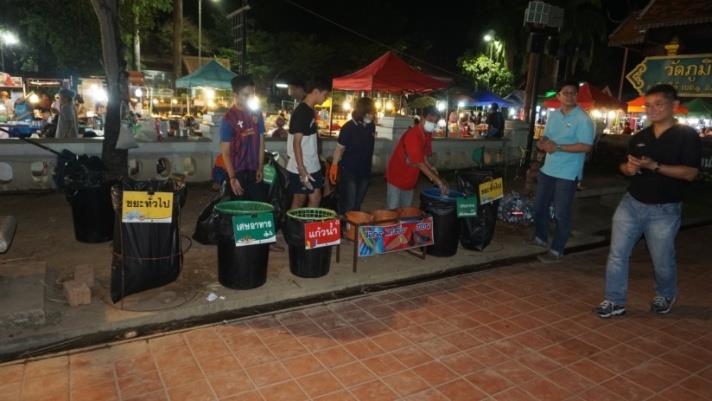
The municipality also tries to reach out to tourists. At the Kad Kuang Muang, a popular weekend market where the main street was turned into a walking street in the evening, waste stations were erected, as shown in Figure 4. Each station was manned with municipal officers and environmental volunteers including school students during the summer break. The staff informed the visitors how to sort waste. Besides recyclables, food waste was separated for the municipality’s composting program. In addition, plastic straws, spoons, and wooden sticks were diverted from the landfill. These items were later turned into craft products by local villages.
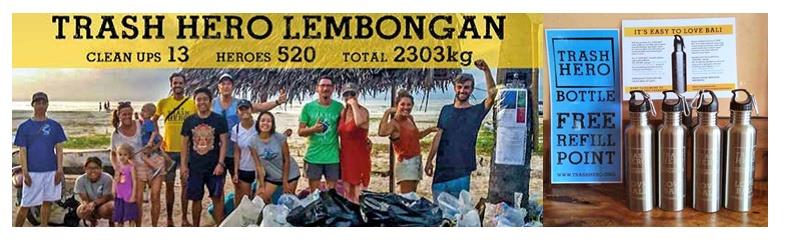
Another good example in Thailand is a network of clean-up volunteers under the name, “Trash Hero” (TH). Unlike many clean-up efforts which were PR stunts, TH emphasizes on continuity. Each chapter of TH organizes a local clean-up event at a pre-announced location every week. Under the motto “no cost, no sign-up, just show up,” more than 50 groups have been established since 2013.
working with local vendors and hotels to reduce plastic waste by promoting reusable bags and setting free water refill station. Figure 5 shows key elements of TH actions.
Policy Recommendations
Tourism generates massive revenues to the country. In Thailand, the revenues from tourism were equal to 49.9 million USD of exports in 2017. If a fraction of this wealth could be tapped, a significant improvement in solid waste management could be achieved. Figure 6 depicts how two economic instruments can be introduced to channel the revenues from the tourism industries to upgrade the waste management infrastructure and maintain the services.
First, Wongsa proposed that a carbon tax of 230 THB (about 7 USD) per person can be levied on international travelers to reflect environmental externalities from the consumption of natural resources and resultant emissions from the sector [8]. This money can be put in a national environmental fund to finance large scale projects to build state-of-the-art waste disposal facilities and other hard infrastructure. It can also be used to sponsored awareness raising campaigns and clean-up activities. Second, Manomaivibool and Dokmaingam suggested that the waste handling fees should be heightened to reflect the true costs of services. In addition, a unit pricing should be applied to tourist-related entities instead of flat-rate fees to match their seasonality [9, 10, 11]. This will ensure smooth running of the invested system.
Conclusion
Tourism is a stressor for the management of MSW in developing countries. An increase in tourist activities in remote areas can lead to pollution and contamination that degrade the destinations. However, sustainability standards and good examples exist where the powerful force of tourism is tamed. In the future, it is proposed that part of the revenues gained from tourism should be earmarked for the investment and the maintenance of the green facilities in order to make the development even more sustainable.
Acknowledgement
This paper is based on the authors’ experiences in DASTA projects that assessed the sustainability of various tourist destinations in Thailand in 2017 and 2018. In addition, the first author is thankful for the two research programs funded by the Thailand Research Fund (TRF) on “Efficiency and Government of Thai Public Policies” and “Efficiency, Competitiveness and Sustainability of Thai Tourism.” The opinions expressed in this paper, however, belong to the authors and may not reflect the funders’ perspectives.
References
-
UNWTO (2018) Why tourism? Tourism-An Economic and Social Phenomenon.
-
Lenzen M, Sun YY, Faturay F, Ting YP, Geschke A, et al. (2018) The carbon footprint of global tourism. Nature Climate Change 8: 522-528.
-
Manomaivibool P (2015) Wasteful tourism in developing economy? A present situation and sustainable scenarios. Resources Conservation and Recycling 103: 69-76.
-
(2017) Ministry of Tourism and Sports, Tourist Statistics, 2016 (by Regions and Provinces) Thailand.
-
Crotti R, Misrahi T (2017) The Travel and Tourism Competitiveness Report 2017. WEF, pp: 1-387.
-
Manomaivibool P, Anantanasan N, Wongsa K (2018) Efficiency, Competitiveness and Sustainability of Thai Tourism. Thailand Research Fund, Bangkok.
-
GSTC (2017) GSTC Criteria Overview.
-
Wongsa K (2018) Final Report: The Study of Environmental Impacts of International Tourism in Thailand from the Economic Perspective. Thailand Research Fund, Bangkok.
-
Manomaivibool P, Dokmaingam P (2017) Final Report: The Review of Solid Waste Management Cost and the Life Cycle Assessment of Solid Waste Management Systems: Principles and Customization for Local Governments in Thailand. Thailand Research Fund, Bangkok.
-
Manomaivibool P, Hempattarasuwan N (2013) Comparing Local Governments' Solid Waste Management Capabilities: The Case Study of Local Governments in Chiang Khong and Chiang Saen Districts. Public Policy Studies Institute, Thailand.
-
Pollution Control Department, Thailand 2017, State of Pollution in 2016. Pollution Control Department, Bangkok.
- Electronic Waste Management in the Top Ten Economies in the World: A Critical Review on Waste Generation, Regulations, Collection, Recycling and Environmental Challenges
- Some Challenging Transdisciplinary Aspects of the Sustainable Waste Management in the Permacrisis Context
- Use of Mobile Autonomous Systems for Pollution Control of Inland Water Bodies
- Environmental Impact Perspective Sustainable Online Textile Retailing: Harnessing Augmented Reality-Based Digital Twins in Bangladesh
- Composite Treatment Module for Removing Acidity and Metal (Loid)S from Acid Rock Drainage
- Household E-Waste Management Systems [E-Wms] in Malaysia