
The Energy Security of Eastern Europe in the Context of the Russian Ukrainian War
The present paper analyzes the biggest crisis associated with a globally extended period of instability and insecurity. In the context of the Russian-Ukrainian war as a geopolitical problem, climate change and the global energy crisis are the straws that broke the camel's back - especially in Eastern Europe - regarding the political decision to begin transitioning from a dependence on fossil fuels to renewable energy and/or decarbonization. Consequently, there is a need for diversification of the energetic resources. The big dilemma of these aspects remains the quality of the energetic resources, especially of nuclear energy, which seems to be the “Holy Grail” of decarbonization, and energy source distribution, so to be used in combination with renewable sources of energy. Besides the possible disadvantages, wind and solar energy require reliable storage of electricity on a large scale, which causes it to become extremely expensive. The paper presents a very optimistic perspective on the energetic analysis of the long-term trend for energy consumption and generation, as a case of the big players in carbon emission searching for the black swan of energy.
Energetic Challenges on Societies in Crises
We live through an extended period of instability and insecurity, especially one resulting from a series of catastrophic events, as the five permacrisis transitions: climatic, energetic, geopolitical, demographic, and technologic [1]. Permacrisis is used instead of policrisis, joining the prefix perma- (which means a fixed state) and crisis, resulting in a word that means ‘a state of permanent crisis’, according to Collins Dictionary [2]. The dilemma presented by decarbonization is that it is not possible to rely on just the development and investment into renewable energy, i.e., solar, hydro, wave, or wind energy. Since many renewable energy sources are dependent on weather conditions or topography, they cannot be considered stable, nor do they assure energy security, especially in the long term.
A nuclear reactor could produce a massive quantity of energy, but there are significant problems associated with nuclear power: the classical nuclear reactors are very expensive whilst also time-consuming to build. The biggest threat posed by nuclear energy is radiation polluting the environment in the instance of a leak, or an explosion in the reactor. This may happen because of a number of reasons such as damage during war, loss of control at the power plant, overheating, lack of the reactor coolant, or a natural disaster. In the living memory there are two such catastrophes, one that occurred in Chernobyl (1986), and a second in Fukushima (2011). Furthermore, since March 2022 the world is threatened with the occupation by Russian troops of the largest nuclear power plant in Europe as part of the military action commencing in this region. In the context of the permacrisis, with energy representing one of the five challenging transitions, the analysis undergone by this paper is focused on the energetic options and solutions for Easter Europe in the large global crisis. The once dilemma of energy diversification is not so anymore. The biggest energy security question for the Eastern Europe is now, how can we use alternative sources of energy with the goal of decarbonization which is one of the EU goals European Commission [3] in order to assure reliable, economically feasible, and geopolitically safer energy? Eastern Europe and the EU now consider that gas is no longer a reliable long-term option because of both Russian extortion and overdependence on overseas gas or oil. EU and Eastern Europe need climate-neutral energy and more autonomy in this respect, and, according to EU’s long-term strategy, it aims to have an economy of net-zero greenhouse gas emissions [3].
One of the most radical decisions for a green energy strategy was taken by Germany in June 2011 to phase out all nuclear stations by 2022, which was backed by most of the population. Because of the energy crisis, this goal was not fully achieved by 2022, and German Chancellor Olaf Scholz ordered the country’s three remaining nuclear power stations to keep operating until April 2023 [4]. In this respect, Germany is very close to reaching these goals, but it also gets more dependent on gas and LNG (Liquefied Natural Gas imported for a bigger price overseas to replace Russian gas). However, according to the Federal Ministry of Education and Research, Germany is attempting to solve the problem of lack of energy by developing hydrogen green energy, as it plays a central role in implementing the Paris Agreement on climate and in the development of the chemical industry as a whole Federal Ministry of Education and Research [5]. The only way to replace coal in the metallurgical sector (which is responsible for around 10% of the carbon emissions) is by using hydrogen.
One of the ambitious projects is shown by the agreements between Canada and Germany in August 2022 which focused on producing and supplying hydrogen in Europe [6]. Canada has a vast experience and possesses advanced technologies in producing green and clean hydrogen by electrolysis using renewable energy [7]. These projects and international partnerships could be a good example of green and energy independence for Eastern Europe. The EU also adopted the ‘Hydrogen Strategy’ in 2020 and put forward a vision for the creation of a European hydrogen ecosystem for research and innovation, to scale up production and infrastructure to match that of the international dimensions [8].
Nevertheless, 95% of today’s hydrogen is sourced from fossil sources. Research and development of hydrogen production is needed to make renewable hydrogen cost competitive against fossil hydrogen. This generates demands for fundamental research on new concepts and materials in electrolysis [9]. There are three major challenges for using hydrogen: production, storage, and end-use. All of these are parts of a bigger system and processes that are highly intensive in terms of material consumption, which, again, contributes to the pollution of the environment. Electrolysis itself needs electricity, which is likely to be sourced from either solar or wind power plants, which is much more expensive to generate than the electricity which is produced from fossil fuels or nuclear.
An Analysis of the Long-term Trend for Energy Consumption and Generation. A Case of the Big Players in Carbon Emission According to international trends and the projections of the International Atomic Agency, nuclear energy will contribute between 6% to 12% of global energy by 2050. This will happen because of the high energy potential and low carbon emission of nuclear sources. This is likely also to occur because of an overall increase in safety of nuclear power plants being based on SMRs (Small Modular Reactors) or SARs (Small and Advanced Reactors), [10] installed in a shorter time at the place of consumption (such as plants, factories, or towns). These will be more reliable in case of the occurrence of a natural disaster or a military conflict, but also will assure an easier and quicker cooling of a reactor in case of emergency.
Renewable sources have quite a bright future, according to Bloomberg New Energy Finance, for renewable energy will represent 62 % of all power generation by 2050 (Figure 1). Solar and wind sources alone will amount to 48% in 2050, whereas oil is predicted to decrease dramatically, along with coal which is due to halve in its use of generating power. Hydropower will continue as an energy source, but the investment in this will be kept at a similar level due to high costs, environmental problems, and geographical issues attributed.
![Figure 1: Global Power Generation Mix [11].](/fulltextimages/9991/fig_1.png)
Fossil fuels, nuclear, and hydro energy will continue to be used in the next 30 years because of geopolitical considerations. The production of solar panels, wind generators, and batteries for storage implies the increased demand of rare earth elements to be used, such as graphite, lithium, cobalt, indium, vanadium, nickel, silver, neodymium, lead, molybdenum, aluminum, zinc, copper, manganese, chromium etc. The World Bank forecasts a low-carbon future which will be very mineral intensive because clean energy technologies need more materials than fossil-fuel-based electricity generation technologies. By 2050 the increase in demand for graphite, lithium and cobalt will be around
500%, comparable to 2018 (Figure 2) (International Bank for Reconstruction and Development, 2020) [12]. Most of the critical elements required in producing clean energy technologies are found concentrated in select regions of the world, namely: Latin America, Africa, China, Turkey, Russia, Ukraine, Australia, and Southeast Asia. For example, 78% of graphite is produced by China and Brazil Government of Canada Band [13] 70% of cobalt is produced in the Republic of Congo Investing News [14], while 70% of lithium is produced by Australia and Chile (Government of Canada C, 2022) [15].
![Figure 2: 2050 annual demands from energy technologies as a percentage of 2018 production [12].](/fulltextimages/9991/fig_2.png)
Geopolitically, it is going to be very hard for EU, United States, and Eastern Europe to ensure energy security and independence for the sake of renewable energy. The only lithium producer in Europe is Portugal, with 60,000 tons of lithium reserves [16]. In this respect, Ukraine has one of the biggest reserves of rare earth elements in Europe and in the world, critical for renewable technologies. Its reserves include lithium, titanium, zirconium, nickel, cobalt, chrome, molybdenum, beryllium, tantalum, niobium, gold, lead, zinc, graphite, etc. The lithium reserves in Ukraine are about 500,000 tons [17]. The Russian-Ukrainian war was caused by disturbances to geopolitical, historical, ideological, and military substrates. But there is coincidental evidence in the fact that the war, which started in February 2022, happened to be after the signature on July 13, 2021, of the memorandum of understanding between EU and Ukraine regarding strategic partnership on raw materials, which also includes rare earth minerals. Therefore, it is considered that Russian aggression towards Ukraine may also be linked with the control of the rare earth minerals in Ukraine.
Sustainable Politics for Energy Security in Eastern Europe
The main problem in establishing midterm sustainable energy security in Eastern Europe is how the EU community and its country members could be rare earth minerals independent and, at the same time, contribute to decarbonization and to a net-zero greenhouse emission. This problem is tried to be solved in part by developing safer and more reliable nuclear reactors, making a transition from the massive classical nuclear reactors to SMRs or SARs that are easier to control and manage. If we analyze the 2050 energy generation mix from (Figure 1), we have very little percentage for other sources of energy, and this could be the “black swan” [18] of the energy security. One of the “black swans” is expected to be the experiment of the largest tokamak in France, scheduled to happen in 2025 by the creation of nuclear fusion and demonstrating the viability of building a nuclear fusion reactor [19]. If the experiment is successful, it is going to significantly bend the trends of the energy generation mix in the next 30 years, especially for the nuclear one. And this is realistic because on December 13, 2022 the first thermonuclear reaction happened, which produced more energy than it consumed. This milestone in the development of thermonuclear energy happened at Lawrence Livermore National Laboratory in California (USA) [20], a real breakthrough after 60 years of experiments. Science is continuously advancing, and “black swans” could be other fundamental discoveries to avoid intensive mineral use as a resource for energy production [1].
If by midterm (until 2050) the EU needs to decarbonize the energy generation and the chemical industry, then long term (after 2060) the technologies need to provide full autonomy for the end users and for the automotive sector (Figure 3). Unfortunately, renewable energy is not a sustainable solution for full autonomy or independence. The SMRs being produced in factories could be a solution for the big plants, factories, and towns, but it is not reliable and viable for cars and automotive sector. Thermonuclear energy also could be an abundant and safer energy source by 2050, but in terms of end-user autonomy and decentralization of the energy sources, the nuclear fusion could not play this role.
In the last years, important advances have been made in the storage of thermal energy by using salt, stone, or sand batteries. Special interest has been given to sand batteries, a method which uses pure quality sand that can store thermal energy up to one month. It could provide autonomic energy for a whole community. A viable example in this respect is the first commercial sand batteries project in Kankaanpää, Finland, which has a capacity of 8 MWh by heating the sand to 500C degree and with an efficiency of 95%. These batteries are commercially produced by the Finish company Polar Night Energy [21]. It could be reproduced on a larger scale and could cost much less than other conventional ways of storing energy. Also, storage batteries using gravity could be one of the ways to develop regional energy security by using renewable energy, although their cost are high, especially for countries such as the Republic of Moldova.
The puzzle of decarbonization and energy security and sustainability, both for the final consumer and for the national scale, can only be solved if science and the new technology will find the energy “black swan” which is a fully autonomic energy source that provides a certain independence from external sources. In this case, each country has its independent way of energy production, considering the natural resources and technologies available. For example, the Republic of Moldova is the most energy insecure country of Europe because it depends on Russian gas, has no rare earth minerals, just a small hydro energy on the Dniester River, and possess no net-zero emission technologies. In the future, the Republic of Moldova must import all its sources of energy and renewable technologies. But an important viable technology for the Republic of Moldova would be sand batteries because the country has an abundance of sand, thus enabling them to be built, and consequently, thermal energy could be stored for generating electricity for many communities and public buildings. This storage technology could work if the Republic of Moldova invested in renewable and biomass energy, which has growth potential.
The fully autonomic source of energy under discussion, with the potential to be discovered at the level of fundamental science, could significantly raise the energy security of the Republic of Moldova and many other developing countries, and this is the key to their sustainable development. Also, the installment of peace in the region could play a big role in the energy security of Eastern Europe by developing renewable technologies in Ukraine and the EU that will make countries such as the Republic of Moldova less dependent on Russian fossil fuels.
An Analysis of the Long-term Trend for Energy Consumption and Generation. A Case of the Big Players in Carbon Emission Other aspects we need to take into consideration are the bigger players in carbon emission, such as China and India. Globally, this issue will be tackled if China indeed decarbonizes its economy with the higher production capacity today. The pledge made by President Xi Jinping in September 2020 to the UN General Assembly was to have carbon emissions peak before 2030 and achieve carbon neutrality before 2060 [22]. China’s 14th Five-Year Plan (2021-2025) for National Economic and Social Development and the Long-Range Objectives Toward 2035 (14th FYP), a document of over 140 pages, is the most critical blueprint for bending China’s emissions curve in the next 10 years (toward the 2030 peaking goal). This is also the most critical time window for the world to avoid catastrophic climate change [22]. But these goals are achievable for China because it has the biggest number of solar panels and wind generators in the world, allowing them to even over perform on the renewable energy development goals.
They are also the largest producers of rare earth minerals, solar panels, and wind generators. Meanwhile, China is also planning to build another thirty nuclear power reactors by 2030 to bend carbon emissions and to cope with the growing demand for energy as well as to create the right energy system in combination with the renewable one.
The last but not least, besides energy sources and decarbonization issue, Eastern Europe countries need to invest a lot in the education of the population, applying innovative technologies and policies implementation for energy consumption reduction and optimization. As Ivo Šlaus and Jacobs Garry concluded in their research, the energy efficiency increased more than four times since 1830 in United Kingdom, Japan, and Austria Šlaus and Jacobs [23], and due to the right cultures, human development factors, education, and the modern technologies, it continues to increase even now.
Based on the mid- and long-term energy consumption and generation evolution and taking into consideration the parameters such as autonomy/energy security (national independence), cost optimization and the net-zero emission goal, we can see nine development scenarios or development quadrants (Figure 3).
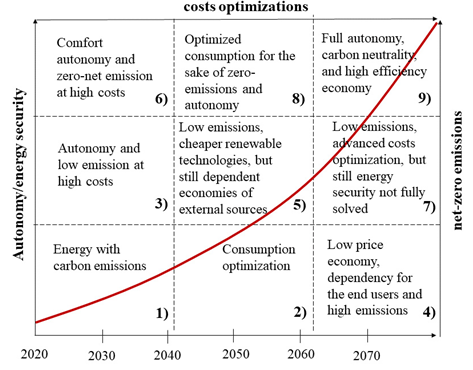
The European Union and China, as well as the UN, have important targets of carbon neutrality, energy security, and autonomy as well as high efficiency and costs optimization economy (quadrant 9, Figure 3); it needs a long way to pass, and this involves advanced technologies that could lead to the right economic system. All these targets need advanced innovative technologies at an affordable price to all nations, especially for Eastern European countries to buy such resources and technologies. In the next 20 years, our economies will need to implement decarbonization measures and to acquire cheaper technologies for renewable and energy storage, but it will still be dependent on the external resources (quadrant 5, Figure 3). Otherwise, the world is doomed to evolve either to lower carbon emissions, but with high costs (quadrant 3, Figure 3), or to cost optimizations and lower prices for the energy and services, but high emissions and pollution and high dependency on external sources such as fossil fuels, uranium, rare earth elements or renewable energy technologies (quadrants 2 and 4, Figure 3). But the “black swan” technologies need to be discovered and added to the fundamentals of sciences that still could not cover the energy potential and system to move towards quadrant 9. Alternatively, the Eastern European countries, together with the European Union, need to decide what is more important: cost optimization and cheap energy or energy independence/decarbonization in order to reach one of the quadrants (5, 6, 7, or 8).
Discussions and Conclusions
In the context of the permacrisis, energy representing one of the five challenging transitions, the analysis of this paper was focused on the energetic options and solutions for Eastern Europe during the big global crisis. The nations of Eastern Europe could have more energy options, because of their geography, technologies, geopolitics, and decarbonization goals. But the world needs to diversify its energy sources to create and ensure energy security for each country. In the long run, nuclear energy will stay in use and will make up between 6-12% of all energy production by 2050. It is also expected that a sustainable and reliable solution to utilize nuclear energy is by using SMRs or SARs. Renewable sources of energy are other alternatives to decarbonization, but they involve intensive mineral consumption, making them more expensive than fossil fuels. They are also highly dependent on the weather condition or topography.
In terms of energy security, stability, and reliability, renewable sources are still under question and many fundamental scientific-related problems need to be solved. Energy “black swan” is expected to bend by 2050 the current energy development trends whether they are thermonuclear, other types of energy storage, or other fundamental discoveries. In terms of carbon emission, end- users’ autonomy, and the feasibility of technology, we can forecast a three phase’s development trend by 2070 (See Figure 3): 1) energy with high emission (2020 – 2030), 2) low emission economy and cheaper renewable technologies (2030 – 2050), 3) full autonomy for the end users and carbon neutrality (2050 – 2070). For Eastern Europe, which is not a world production center, it is crucial to develop storage capacities to be able to use renewable sources, but for the creation of energy security, it is crucial to find the energy “black swan”, because, with the current geopolitics and present natural resources, it is unlikely to create security with reliable and sustainable energy.
References
-
Bendell J (2022) Replacing Sustainable Development: Potential Frameworks for International Cooperation in an Era of Increasing Crises and Disasters. Sustainability 14(13): 8185.
-
(2022) Collins Dictionary Word of the Year 2022 is permacrisis.
-
European Commission (2022) 2050 long-term strategy.
-
Pladson K (2022) Why can’t Germany break up with nuclear energy.
-
Federal Ministry of Education and Research (2022) Wissenswertes zu Grünem Wasserstoff.
-
Government of Canada (2022) Canada and Germany Sign Agreement to Enhance German Energy Security with Clean Canadian Hydrogen.
-
Frangoul A (2021) Canada is set to have one of the world’s biggest green hydrogen plants. CNBC Sustainable energy.
-
European Commission (2020) EU Hydrogen Strategy.
-
Borgschulte A (2016) The Hydrogen Grand Challenge. Frontiers in Energy Research.
-
IAEA (2021) IAEA Increases Projections for Nuclear Power Use in 2050. International Atomic Energy Agency.
-
Bloomberg NEF BNEF (2022) Global Power generation mix.
-
Hund K, Porta DL, Fabregas TP, Laing T, Drexhage J (2020) The Mineral Intensity of the Clean Energy Transition. World Bank Group, pp: 1-112.
-
Government of Canada (2022) Graphite facts.
-
(2022) Top 10 Cobalt Producers by Country.
-
Government of Canada (2022) Lithium facts.
-
Amoros R, Venditti B, Lam S (2022) The world’s top 10 lithium mining companies.
-
Kleinman Center for Energy Policy (2022) Lithium The Link Between the Ukraine War and the Clean Energy Transition.
-
Nassim NT (2007) The Black Swan: The Impact of the Highly Improbable.
-
Cotmore J (2022) Nuclear fusion Inside the construction of the world’s largest tokamak. Science Focus.
-
Bishop B (2022) National Ignition Facility achieves fusion ignition. Lawrence Livermore National.
-
Polar Night Energy (2022) An Innovator of Seasonal Heat Storages.
-
United Nations framework convention on climate change (2022) China’s net zero future.
-
Šlaus I, Jacobs G (2011) Human Capital and Sustainability. Sustainability 3(1): 97-154.
- Electronic Waste Management in the Top Ten Economies in the World: A Critical Review on Waste Generation, Regulations, Collection, Recycling and Environmental Challenges
- Some Challenging Transdisciplinary Aspects of the Sustainable Waste Management in the Permacrisis Context
- Use of Mobile Autonomous Systems for Pollution Control of Inland Water Bodies
- Environmental Impact Perspective Sustainable Online Textile Retailing: Harnessing Augmented Reality-Based Digital Twins in Bangladesh
- Composite Treatment Module for Removing Acidity and Metal (Loid)S from Acid Rock Drainage
- Household E-Waste Management Systems [E-Wms] in Malaysia