
Investigating Effective Methods and Factors in the Production of Compressed Charcoal from Agricultural Waste
More than 50,000 tons of charcoals are used annually in Iran, which will increase to 100,000 tons per year, taking into account the amount of charcoal exported to the Arab countries of the Persian Gulf. In order to produce the charcoal needed by the country in the traditional way, more than 300,000 tons of wood are cut and collected from the trunks and branches of trees every year, which will lead to the destruction of the country's forests and green resources. Agricultural by-products, especially rice, cocoa, rubber, pineapple and sugarcane, are produced in large quantities all over the world. Asia alone produces 4.4 billion tons of solid waste annually. The amount of agricultural solid waste produced in Ahvaz city is 2,500,000 tons, almost all of this amount is related to sugarcane cultivation and industries that exist in this province. Wood waste, sugar cane and grass are the most prominent sources of biomass energy and if managed properly, they can be used as a raw material to produce charcoal and create renewable and sustainable energy. The general purpose of this article is to investigate different methods of producing compressed coal from agricultural waste and the factors affecting its production.
Introduction
The use of renewable energy sources has a long history. Long before the discovery of coal and oil, renewable sources of biomass were used for various purposes such as construction, clothing and energy. Wind and water energy were used as energy sources in agriculture, and wood and peat were common sources of thermal energy. With the progress of the industrialization process of the world, the increase in demand for energy led to the increase in the use of oil and coal. The introduction of nuclear power in 1950 expanded the energy market. The need for research into alternative energy sources became apparent during the energy crisis of the 1970s, when energy shortages revealed the vulnerability of the economy. In addition, predictions of oil prices reaching 35 to 50 dollars per barrel in 1980 led to more efforts [1].
More than 95% of energy in Iran is provided by fossil fuels, and Iran is one of the largest consumers of fossil fuels and responsible for the annual emission of 1% of all greenhouse gases in the world. In addition, the production of greenhouse pollutants in Iran is 2.8 times the world standard and the amount of carbon dioxide is increasing day by day. These statistics show that the harmful effects and environmental pollution as a result of the consumption of fossil fuels in Iran are very serious and critical.
The increase in the country’s population has increased the energy consumption several times and since the main energy consumption in Iran is fossil fuels, any increase in domestic consumption will decrease oil exports and inevitably decrease foreign exchange income and ultimately increase Iran’s dependence on other countries. In this way, according to the many problems that Iran is facing due to the consumption of fossil fuels and on the other hand, the obligation that it has assumed towards the international agreements regarding environmental protection, it is necessary in its energy consumption pattern, on the scale Small and large, revision is slow and the only known way for this purpose is to use new energies. Agricultural by- products, especially oil palm, rice, cocoa, rubber, pineapple and sugarcane, are produced in large quantities all over the world.
Asia alone produces 4.4 billion tons of solid waste every year, the amount of agricultural solid waste produced in Ahvaz city is 2,500,000 tons, almost all of which is related to sugarcane cultivation and industries that exist in this province. The area under sugarcane cultivation in Iran in the crop year of 2020-2021 was 70 thousand hectares and it has been growing in recent years. Except for a limited area in the provinces of East Azerbaijan and Mazandaran, almost the entire land and sugarcane industry of the country is located in the province of Khuzestan. Iran has had good success in terms of the growth of sugarcane yield, so that during the mentioned years, the yield of sugarcane has increased from 6 tons per hectare. From every 100 tons of sugarcane, 32 tons of bagasse with 50% moisture are produced. Bagasse makes up about 20 to 30% of the weight of sugarcane, and in fact, it is the fibrous residue left after extracting sugar, which is in the form of small pieces of wood chips and straw yellow in color.
Charcoal is obtained from the burning of plant or animal organs, and it is a sponge-like and black substance, and it can be considered as pure carbon. More than 50,000 tons of charcoals are used annually in Iran, which will increase to 100,000 tons per year, considering the amount of charcoal exported to the Arab countries of the Persian Gulf. In order to produce the charcoal needed by the country in the traditional way, more than 1000 tons of wood are cut and collected from tree trunks and branches every year, which will not only cause the destruction and destruction of the country’s forests and green resources, but also spread The smoke resulting from the process of turning wood into charcoal will also cause irreparable damage in increasing environmental pollution. Rao, et al. [1] showed in a research that the solid part of sugarcane, fiber (bagasse) obtained from sugarcane industrial waste , is one of the largest sources of secondary cellulose in the agricultural industry also stated in their research that more than 54 million tons of dry bagasse are produced annually in the world, and this amount of bagasse produced as fuel in factories, biofuel and renewable source in It is used to produce electricity, paper, and building materials. This biomass provides an average of 35% of the energy needs of the world population. This number is between 60 and 90 percent among poor and developing countries [2]. Reported that wood waste, sugarcane and grass are the most prominent sources of biomass energy and if properly managed, they can be used as a raw material for Coal production and the creation of renewable and sustainable energy. Different agricultural residues can be properly compressed (briquettes) into a suitable source of renewable energy.
Briquetting is necessarily a mechanical process that requires capital for equipment and training to ensure the quality of the manufactured product [3]. The general purpose of this article is to investigate different methods of charcoal production from agricultural waste and factors affecting it.
Materials and Methods
The current research is a review study based on library sources and in the form of data collection, which was compiled and presented in this research after collecting the materials in a classified manner.
Background of Compact Coal Production
Compressed mold coal or briquette, which is also called clay and good-burning, is usually referred to as compressed and molded combustible materials. In addition to combustible materials, pieces, small and large metal shavings, alloy materials, refractory pieces and some other materials are also made into briquettes for reuse [4]. In the 20th century, businesses were formed under the name of producing biofuels, and in the 1950s, several commercial methods were tested to produce briquettes without the use of adhesives, and many factories around the world produced tens of millions of tons of usable and economical materials for They supplied domestic and industrial uses in the form of compressed coal [5].
During the two world wars, many families in European countries provided their fuel by compressing paper, raw waste and other flammable household waste. They did; For example, in Austria, briquette production was 150 thousand tons in the form of pellets in 2002, but with the rapid expansion of heating devices in 2010, it reached 0.9 million tons per year. In many African countries, such as Zimbabwe, Tanzania, In Uganda, Kenya, Sudan, Rwanda, Niger, Gambia, Ethiopia and Senegal, compacted or molded coal is used. In Africa, the skin of winter crops is often used as raw material for briquette production, cotton stalks are also used in small quantities for briquette production [6] during a survey conducted by FAO, many of the compressed coal production in East Africa failed, while other countries overcame their problems, the factors that caused the failure of the projects were the lack of proper use of machinery, the high cost of machinery spare parts, the low price of charcoal, which itself hindered The marketing of compressed coals and the lack of support from the government.
In a research conducted in Iran in 2016, a farmer and an architect designed and tested a compact charcoal production machine suitable for bagasse. In this research, the effect of ash particle size, temperature and molasses on the physical and thermal properties of produced coal (ash amount, density, amount of volatile matter, amount of fixed carbon and calorific value) was investigated. Their results showed that the effect of temperature on percentage of ash, percentage of carbon and specific heat is significant at the probability level of 1% and its effect on the percentage of volatile substances is significant at the probability level of 5%. Also, their results showed that reducing the size of the particles causes a significant reduction in the specific heat of the produced coal [3].
Characteristics of Plant Residues Suitable for Creating Compacted Briquettes
Plant residues that do not have any problems to collect and dry are usually wastes of rice, winter crops, coffee, palm, jatropha, corn and sugarcane. Materials should be granular and uniform so that they can be easily stored in warehouses and silos and be portable [7]. Biomass as a raw material for the production of compressed coal, in addition to being available and in large quantities, must have the following characteristics:
Low Humidity
The moisture content should be as minimal as possible; generally this moisture should be in the range of 10 to 15%. High moisture content causes many problems for drying and also has a lot of energy [8].
Ash Content of Compounds
Biomass residues usually have very little ash except for rice bran with 20% ash, but their ash has a high percentage of alkali minerals, especially potash. The amount of ash of different types of biomass indicates the quality of life. In general, the highest amount of ash indicates the undesiredness of the biomass [9].
Some of the suitable agricultural wastes for making compressed coal are: Rice Bran: Compared to sawdust, these agricultural residues have high ash content, higher potassium content and poor flow characteristics. However, rice bran is an exceptional biomass. It is commonly available and has a moisture content of 10%. In fact, it can be called an excellent fuel, although its calorific value is lower than that of wood and other agricultural products.
Peanut Shell: Since its ash is low (2 to 3%) and its moisture is less than 10%, it is an excellent material for creating compacted coal.
Bagasse: This waste has a moisture content of over 50% and a low ash content, and its heat value is 4400 kcal/kg. Due to its large amount in sugarcane producing countries including Iran, this product is also suitable for creating compressed charcoal after reducing the humidity.
Coffee Husk: This product has low ash and moisture content of less than 10% and is the best type for making compacted charcoal in areas where coffee is grown.
Mustard Stalks: Like cork, it also has suitable materials for movement [2].
Compact Coal Production Technologies
Compressed coal production technologies can be divided into high pressure compression, medium pressure compression, low pressure compression with the help of a heating device and adhesive materials, which depends on the type of biomass material, pressure and adhesive material used. There are different methods of joining biomass materials depending on its physical properties (moisture, density, volume and thermal properties). Compressing the biomass under high mechanical pressure leads to an increase in density in the biomass and cohesion of solid particles that form intermolecular bonds in the dense area. In order to connect biomass particles, materials with high adhesion (binders) such as molasses, corn starch and other organic materials that have adhesive properties are used. In the following, we will pay attention to the types of equipment made to produce compressed coal from biomass.
Production of Hand Made Compressed Coal
Manual molds are the simplest devices used to produce compressed coal (Figure 1) and in the manual molds used in Malaysia to produce breakers from charcoal powder, molasses is used as a bonding agent. After drying under the sun, the compressed coal reaches its final production with gentle heat in the furnace [10].
Press Wu
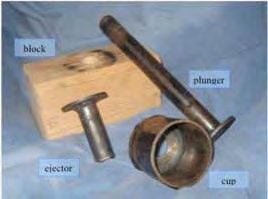
Developed by the University of Washington, the Wu press is made of metal or wood as shown in Figure 2. Wu press produces briquettes in 3 steps. Each step is associated with an increase in pressure. In Figure 2, its wooden sample is also shown, the reason for making it with wood is its abundance, cheapness and ease of working with it [11].
![Figure 2: Wu press produces briquettes in 3 steps. Each step is associated with an increase in pressure. In Figure 2, its wooden sample is also shown, the reason for making it with wood is its abundance, cheapness and ease of working with it [11].](/fulltextimages/10566/fig_2.png)
Ground Block Maker
The presses that are currently used to make earthen blocks may be modified to produce compressed coal. An example of it is shown in Figure 3.
It is quickly moved up and down. Changing the position of the lever upwards compresses the compacted coals in the downward course. The pyramids are then returned to their original position, lowered again, and the compacted coals are ejected from the mold. The compressed coals produced are placed in front of the sun to dry, this process requires at least 2 workers [12].
![Figure 3: It is quickly moved up and down. Changing the position of the lever upwards compresses the compacted coals in the downward course. The pyramids are then returned to their original position, lowered again, and the compacted coals are ejected from the mold. The compressed coals produced are placed in front of the sun to dry, this process requires at least 2 workers [12].](/fulltextimages/10566/fig_3.png)
Tubular Presses
Metal or plastic pipes make good molds for compacted coals, as compacted coals form cylinders. The schematic view of the tubular press is shown in Figure 4. The press consists of a cylindrical die mounted vertically on a chassis. The raw materials are poured into the pipe and compacted with the block maker. Then a hole is placed on the pipe and compressed coals are thrown into it with pressure. Then the compacted coals are dried under the sun before storing and using [12].
![Figure 4: The press consists of a cylindrical die mounted vertically on a chassis. The raw materials are poured into the pipe and compacted with the block maker. Then a hole is placed on the pipe and compressed coals are thrown into it with pressure. Then the compacted coals are dried under the sun before storing and using [12].](/fulltextimages/10566/fig_4.png)
Screw Press
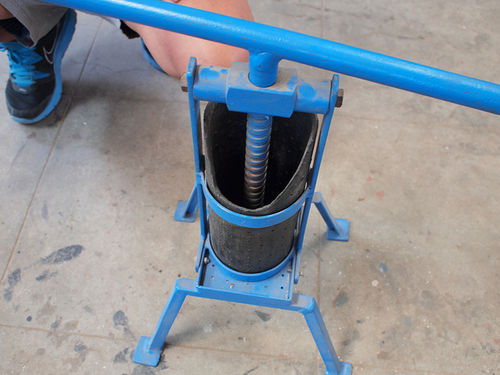
In this type of press, raw materials are compressed by lowering a metal disk vertically by a screw that rotates by hand (Figure 5). The screw press is mainly made of metal [12].
Piston Press
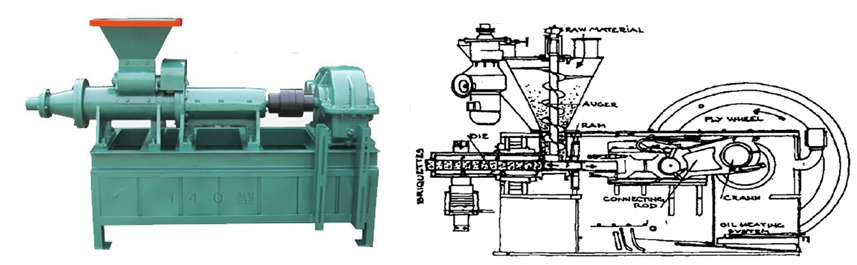
This machine works best with dry cellulosic materials (up to 15% moisture content) fed into the pressure chamber. As shown in Figure 6, a reciprocating piston sends the raw material under pressure to the bone crusher, which creates a long compressed coal. The flywheel that usually starts the machine produces between 300 and 500 kg of compacted coal per hour. The machine can be serviced every 500 hours or 1000 hours using relatively clean materials such as sawdust. The use of agricultural waste that has a high amount of silica or sand will significantly reduce the operating hours of the machine. The initial cost of this type of machine is high and compact coal tends to break down [13].
Extrusion Screw Press with Hot Plate
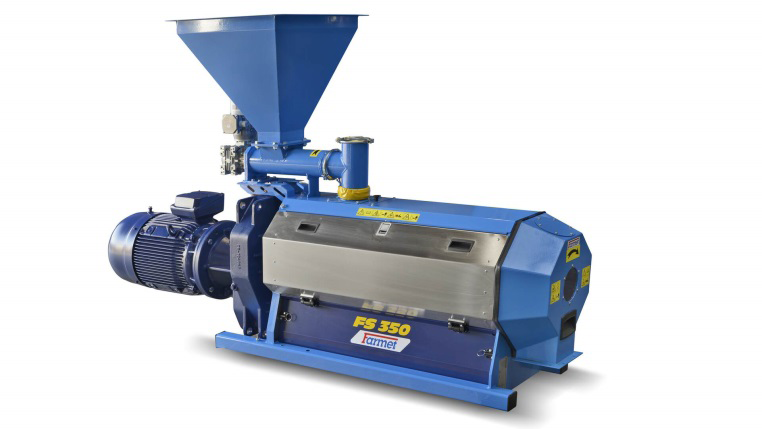
Extrusion screw press with hot blade is an industrial machine for producing compressed coals. This press generally consists of an electric motor, a tank, a heater and a spiral that condenses raw materials (Figure 7). Biomass raw material is sent from the tank to the screw. The electric heater of the blade softens the lignin in the raw materials and acts as an adhesive. A smoke collection system collects and removes the smoke created around the compact coal production process [13].
Conclusion
Disposing of solid waste produced from agricultural and industrial production activities is one of the serious problems of developing countries. To produce the charcoal needed by the country in the traditional way, more than 300 thousand tons of wood are cut and collected from the trunks and branches of trees every year, which will not only cause the destruction and loss of forests and natural resources, but also the emission of smoke from the process [14]. Converting wood to charcoal will cause irreparable damage in increasing environmental pollution. Using agricultural waste instead of using trees can play an important role in the expansion and development of green technologies. Considering the high volume of production of agricultural waste including bagasse in Iran and the problems caused by its storage, it is felt necessary to conduct research to convert these biomass materials into coal. Among the benefits of these researches, we can mention the creation of small jobs for villagers and the production of energy needed for areas that are facing the problem of energy supply. In fact, the use of this energy can be developed by making simple and cheap equipment and necessary training. Therefore, in this review, an overview of the researches conducted in this field, the methods of charcoal production from agricultural wastes and the factors affecting its production were done.
References
-
Onchieku J, Chikamai BN, Roa M (2012) Optimum parameters for the formulation of charcoal briquettes using bagasse and clay as binder. European Journal of Sustainable Development 1(3): 477-492.
-
Hall D, Coombs J, Scurlock J (1987) Biomass production and data. In: Coombs J, et al. (Eds.), Techniques in Bioproductivity and Photosynthesis. 2nd(Edn.), Pergamon, 2: 274-278.
-
Zarei Kordsholi HR, Memar Dastjardi R (2017) A review of effective methods and factors in the production of compressed charcoal from agricultural waste. First National Conference on Agricultural and Environmental Sciences of Iran Bavi, Iran.
-
Zarei H, Dastjerdi Architecture R (2016) Taraji construction and evaluation of a machine for the compact production of sugarcane bagasse master’s thesis on mechanics of agricultural machinery. Khuzestan University of Agricultural Sciences and Natural Resources, pp: 119.
-
Farhang P (2000) Big Book of Materials. Sepideh Sahar Publications, pp: 81.
-
Lardinois I, Klundert AV (1993) Organic waste options for small-scale resource recovery. Technology Transfer for Development, pp: 132.
-
Hood A (2010) Biomass briquetting in Sudan A feasibility study. Women’s Refugee Commission, pp: 2-95.
-
Amanor IN (2014) Design, Construction and Testing of a Briquetting Machine. Kwame Nkrumah University, Zambia.
-
Grover PD, Mishr S (1996) Biomass briquetting: technology and practices. Food and Agriculture Organization of the United Nations, pp: 1-46.
-
Singh M (2010) Fuel from the fields charcoal from agricultural waste. Practical action, pp: 1-9.
-
Legacy Foundation (2003) Fuel Briquette press kit. A construction manual.
-
Mac CD (1985) Understanding Briquetting. Technical paper, Volunteers in Technical Assistance VITA, pp: 1-18.
-
Faxälv O, Nyström O (2007) Biomass Briquettes in Malawi. Institution for Economic and Industrial Development, pp: 1-157.
-
Bhattacharya SG, Saunier N, Islam NS (1984) Densification of biomass residues in Asia, pp: 536-559.
- Electronic Waste Management in the Top Ten Economies in the World: A Critical Review on Waste Generation, Regulations, Collection, Recycling and Environmental Challenges
- Some Challenging Transdisciplinary Aspects of the Sustainable Waste Management in the Permacrisis Context
- Use of Mobile Autonomous Systems for Pollution Control of Inland Water Bodies
- Environmental Impact Perspective Sustainable Online Textile Retailing: Harnessing Augmented Reality-Based Digital Twins in Bangladesh
- Composite Treatment Module for Removing Acidity and Metal (Loid)S from Acid Rock Drainage
- Household E-Waste Management Systems [E-Wms] in Malaysia