
Navigating Software Engineering: A Scientific Index of Leading Researchers
In the rapidly developing realm of Software Engineering, the identification and recognition of pioneering researchers play a crucial role in fostering innovation, collaboration, and knowledge dissemination. This research paper introduces a novel approach to address the challenge of pinpointing influential experts within this dynamic field. Drawing inspiration from the concept of scientific indices, we present a comprehensive researcher index meticulously crafted to quantify the impact and influence of Software Engineering researchers. By employing a refined methodology that amalgamates citation metrics, publication records, and expert affiliations, this index establishes a navigational framework for researchers, practitioners, and students. The target researcher index website is "Adscientific index," a platform designed to collect researcher data from different countries, ensuring a global perspective. We explore the construction of this scientific index, detailing the metrics employed and the algorithms devised for ranking. The implications of this index are vast, offering a structured platform for collaboration, research focus alignment, and community engagement. As the Software Engineering discipline advances, this index serves as a foundation for recognizing the luminaries who illuminate the path forward, empowering all stakeholders to navigate the field with clarity and purpose. This research proposed researcher index combines established citation metrics, publication records, and expert affiliations to holistically evaluate a researcher's contributions, providing a data-driven perspective on their influence.
Introduction
Software Engineering is the core of technological advancement, driving innovations and reshaping industries and societies. In this rapidly evolving field, staying abreast of breakthroughs and identifying key contributors is essential for fostering collaboration, accelerating progress, and guiding future research. The challenge, however, lies in efficiently navigating the expansive landscape of Software Engineering researchers, each making distinct contributions to the ever-expanding body of knowledge. This paper addresses this challenge by proposing a pioneering solution a comprehensive scientific index designed to highlight and quantify the impact of leading Software Engineering researchers.
This research extends beyond conceptualization to practical implementation. The focal point of our endeavor is the “Adscientific Index” website a dynamic platform meticulously engineered to collate researcher data from diverse countries. This inclusion of global data enriches the index’s reach, offering a panoramic view of Software
Engineering expertise from around the world. This innovative platform aims to democratize recognition, bringing to the forefront researchers whose contributions might otherwise go unnoticed. The methodology underpinning the creation of the scientific index offers insights into the metrics employed and the algorithms devised for ranking researchers. We showcase real-world case studies that exemplify the index’s capacity to highlight the nuanced impact of individual researchers on the field. Beyond its immediate utility, this index carries profound implications for the Software Engineering community. It provides a structured framework for fostering collaboration, aligning research focus, and enabling interdisciplinary engagement.
Citations and Scientific Index for Researchers
The Significance of Citations for Researchers
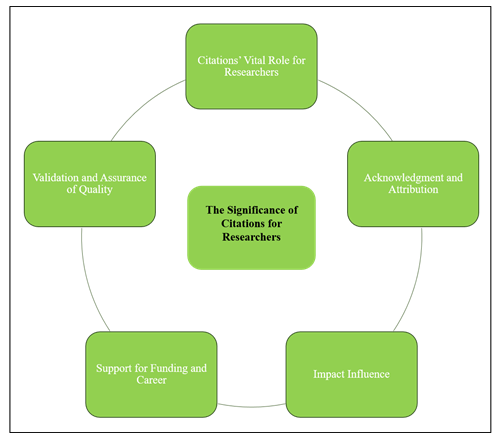
Citations hold great significance for researchers as they serve as tangible evidence of the impact, quality, and contributions made by a researcher in their specific field or area of study. Citations play an essential role in crediting the original authors of research articles or publications, enabling fellow researchers to recognize and build upon their work. They also contribute to establishing a researcher’s reputation and visibility within their academic domain. The quantity and caliber of citations received by a researcher serve as indicators of the influence and impact of their research. It reflects the relevance and importance of their contributions to their field of study. Advancement Citations are instrumental in supporting grant applications and career advancement efforts, including academic positions, promotions, and tenure. High citation counts can also influence the allocation of prestigious research grants and accolades. Citations offer assurance that a researcher’s work has undergone peer review and has gained acceptance within the academic community. They play a crucial role in establishing the credibility and excellence of the research conducted by a scholar. The following Figure 1 shows the significance of citations for researchers.
Scientific Index in Software Engineering
Scientific indexes [4, 5, 6, 7, 8, 9] represent a valuable tool for researchers, publishers, and funding agencies aiming to assess the influence and caliber of academic research. They serve as a means to pinpoint strengths and areas requiring further enhancement, aiding in informed decisions concerning funding, publication, and research strategies. A scientific index in the context of Software Engineering serves as a structured framework for assessing and quantifying the impact of researchers’ work within the field. Unlike traditional methods that often rely on publication counts or journal prestige, a scientific index encompasses a diverse array of metrics to comprehensively evaluate a researcher’s contributions. This holistic approach takes into account not only the quantity of publications but also the quality, relevance, and influence of their work on the advancement of Software Engineering practices and knowledge (Table 1) provides specific instances of scientific indexes for reference.
| Description | Functions | |
|---|---|---|
| Web of Science | Web of Science is a comprehensive scientific index that covers a wide range of academic fields, including science, social sciences, and humanities. | It provides access to journal articles, conference proceedings, and other scholarly publications, as well as citation data and other metrics for evaluating the impact and influence of research. |
| Scopus | Scopus is another comprehensive scientific index that covers a wide range of academic fields, including science, technology, social sciences, and humanities. | It provides access to journal articles, conference proceedings, and other scholarly publications, as well as citation data and other metrics for evaluating the impact and influence of research. |
| Google Scholar | Google Scholar is a free search engine that provides access to scholarly literature, including journal articles, conference proceedings, theses, and dissertations. | It also provides citation data and other metrics for evaluating the impact and influence of research. |
| PubMed | PubMed is a scientific index that specializes in the biomedical and life sciences. | It provides access to journal articles, conference proceedings, and other scholarly publications in these fields, as well as citation data and other metrics for evaluating the impact and influence of research. |
Table 1: Scientific Index.
The concept of a scientific index has proven invaluable in various disciplines for quantifying complex phenomena and facilitating informed decision-making. In the realm of Software Engineering, where innovation and progress are driven by the collective efforts of researchers, a scientific index emerges as a promising avenue to recognize and measure the influence of these contributors.
The metrics incorporated into a scientific index for Software Engineering extend beyond raw publication numbers. Parameters such as citation counts, co-authorship collaborations, expert affiliations, and the application of research in real-world contexts play integral roles. Citation metrics, for instance, reflect the extent to which a researcher’s work is referenced by peers, offering a tangible measure of influence within the academic community. Similarly, co-authorship collaborations provide insights into the researcher’s engagement in collaborative endeavors, an aspect that often propels innovation.
Ranking researchers within the scientific index involves the application of algorithms that weigh and combine various metrics. One such widely used algorithm is the H-index, which balances both the number of publications and the number of citations received by these publications.
By accounting for both productivity and impact, the H-index provides a multidimensional view of a researcher’s influence. Additionally, normalization techniques can be applied to account for differences in research fields, publication venues, and citation practices.
As Software Engineering continues to evolve with the rapid advancement of technology, the need for a scientific index becomes increasingly pertinent. By providing a structured and comprehensive assessment of researchers’ impact, this index contributes to shaping the trajectory of the field, fostering collaboration, and guiding future research endeavors. In the subsequent sections, we delve into the methodology employed to construct the Software Engineering researcher index, illustrating its practicality through case studies and real-world applications.
Methodology
The construction of the Software Engineering researcher index entails a meticulous blend of data collection, metric formulation, and algorithmic ranking. The objective is to create an objective and comprehensive representation of researchers’ impact within the field.
| 1 | Citation Counts | Reflecting the recognition of a researcher’s work within the academic community. |
|---|---|---|
| 2 | H-index | Balancing the number of publications with their respective citation counts provides a multidimensional view of influence. |
| 3 | Publication Records | Enumerating the volume of contributions, emphasizing both quantity and breadth. |
| 4 | Co-authorship Collaborations | Indicating the extent of interdisciplinary and collaborative research engagement. |
| 5 | Expert Affiliations | Recognizing researchers’ affiliations with leading institutions and their roles within the community. |
| 6 | Algorithmic Ranking | The aggregation of metrics involves algorithmic ranking to create a composite measure of researchers’ influence. While the H-index serves as a foundational algorithm, additional considerations are taken into account. These include normalizing metrics to account for variations in publication venues and citation practices across different subfields of Software Engineering. The use of weighted averages ensures that no single metric disproportionately impacts the final ranking. |
| 7 | Creating the Index | The culmination of data collection and metric formulation is the creation of the Software Engineering researcher index. Each researcher is assigned a ranking based on the composite metric derived from their publication records, citations, collaborations, and affiliations. This ranking positions researchers within a cohesive framework, enabling stakeholders to gauge their influence within the field. |
| 8 | Website Implementation | The researcher index finds its practical manifestation in the “Adscientific Index” website. The platform serves as an interactive repository of researcher profiles, providing a user- friendly interface for querying, filtering, and exploring the index. The website aggregates data from researchers representing diverse countries, fostering a global perspective on Software Engineering expertise. |
Table 2: A range of metrics.
The foundation of the researcher index lies in the compilation of accurate and up-to-date data regarding researchers’ publications, citations, affiliations, and collaborations. This data is sourced from reputable academic databases, including IEEE Xplore, ACM Digital Library, Scopus, and Google Scholar. The dataset spans a diverse range of Software Engineering topics to ensure a well- rounded representation of the field’s contributions. To quantify researchers’ impact, a range of metrics is employed to encapsulate different dimensions of influence in Table 2.
The methodology employed in constructing the Software Engineering researcher index combines the rigor of data analysis with the finesse of algorithmic ranking. The index contributes to a holistic understanding of their contributions to the field by quantifying researchers’ impact across multiple dimensions. In the subsequent sections, we exemplify the application of this methodology through case studies, showcasing how the index elucidates the diverse and substantial impact of individual researchers within Software Engineering.
Creating the Index
The result of this paper lies in the construction of the Software Engineering researcher index, a dynamic framework that quantifies researchers’ influence within the field. This section investigates the intricacies of index creation in Figure 2, detailing the process of metric aggregation, ranking derivation, and the practical manifestation through the “Adscientific Index” website.
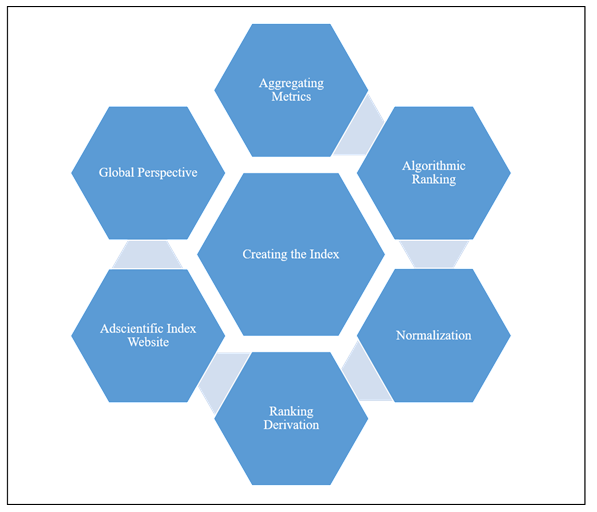
The creation of the Software Engineering Researcher Index stands as a testament to the integration of data, metrics, and algorithmic rigor. Through this comprehensive framework, the index empowers researchers, practitioners, and students to navigate the complex landscape of Software Engineering with clarity and purpose. The following Figure 3 shows the steps of creating the index.
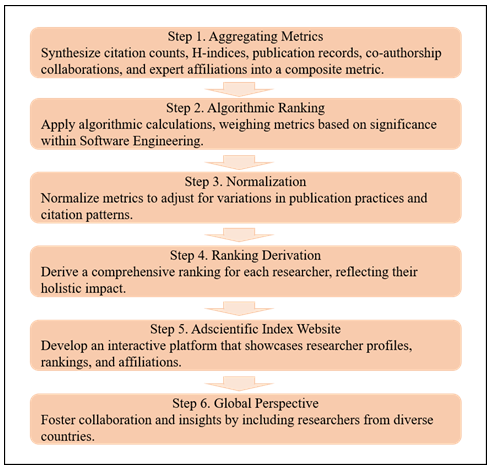
In the subsequent sections, we investigate the practical applications of this index, highlighting case studies that underscore its role in illuminating the contributions that shape the Software Engineering discipline.
Results and Discussion
The essence of the researcher index is brought to life through the “Adscientific Index” website, a dynamic and user- friendly platform. The website functions as an interactive repository of researcher profiles, each accompanied by their ranking, affiliation, and key contributions. Users can explore the index, filter researchers by metrics, and gain insights into the impact of experts from around the world.
The “Adscientific Index” website acts as a meeting point for Software Engineering researchers from diverse countries, enriching the index with a global perspective. The inclusion of researchers from different regions fosters collaboration, cross-cultural insights, and a more comprehensive understanding of the field’s evolution on a global scale. The following Table 4 and Figure 4 present the distribution of software engineering scientists across various regions.
| Region | Scientists | |
|---|---|---|
| 1 | Africa | 13.08 |
| 2 | Asia | 99.045 |
| 3 | Europe | 60.092 |
| 4 | Latin America | 12.033 |
| 5 | Oceania | 39.052 |
| 6 | Arab League | 12.381 |
| 7 | Others | 10.233 |
| Total | 245.916 |
Table 3: Software engineering scientists across various regions.
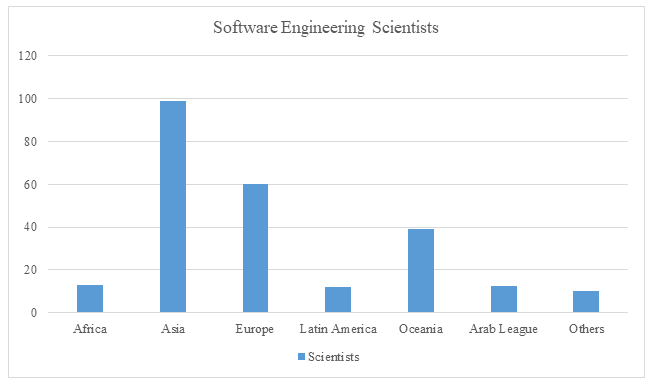
Asia stands out with the highest number of software engineering scientists at 99.045. This indicates a strong presence of research and development in this field in the Asian region. Europe follows with 60.092 scientists in software engineering. While it has a substantial number, it falls significantly behind Asia in this aspect. Oceania contributes 39.052 scientists. Although this is notably lower than Asia and Europe, it still represents a significant pool of researchers considering the region’s smaller size. Africa has 13.080 software engineering scientists. While the number is smaller compared to the regions mentioned above, it still showcases a presence of researchers in this field on the continent. Latin America is represented by 12.033 software engineering scientists. Similar to Africa, the number is smaller, but it’s a testament to the global distribution of researchers. The Arab League region has 12.381 software engineering scientists. This indicates a presence of research activity in the field within this region. The “Others” category, with 10.233 scientists, signifies that there are regions not explicitly listed but still contribute to the total count of software engineering researchers.
In summary, Asia dominates the software engineering research landscape with the highest number of scientists, while Europe, Oceania, and the other regions also make significant contributions. Africa, Latin America, and the Arab League regions have smaller but notable numbers, showcasing a global distribution of researchers in the field. In total, there are 245.916 software engineering scientists across these regions. This data highlights the global reach of software engineering research and the varying levels of engagement and development in different parts of the world.
Implications and Future Directions
The development of the Software Engineering researcher index not only introduces a groundbreaking methodology for quantifying researchers’ influence but also holds significant implications for the Software Engineering community. Furthermore, the index’s potential for growth and enhancement extends into various future directions, promising a profound impact on research collaboration, education, and the advancement of the field. The following Table 5 presents the significant implications for the software engineering community.
| Description | |
|---|---|
| Community Collaboration and Networking | Leverages the index to identify experts for collaboration and mentorship, fostering cross-disciplinary partnerships and innovative research. |
| Focused Research and Industry Alignment | Aligns research efforts with experts in specific areas, accelerating impactful solutions and informed research directions. |
| Educational Enrichment | Integrates index insights into curricula, exposing students to pioneers in the field and inspiring deeper engagement with Software Engineering. |
| Continual Refinement and Updates | Regularly updates metrics, algorithmic models, and data sources to ensure accuracy and relevance, reflecting the dynamic nature of Software Engineering. |
| Integration into Academic and Professional Settings | Incorporates the index into academic institutions, conferences, and events as a resource for expert engagement and collaboration. |
| Interdisciplinary Synergy | Expand the index to include interdisciplinary collaborations, promoting cross-domain synergy and innovation between Software Engineering and related fields. |
| Integration with Emerging Technologies | Explores integration with emerging tech paradigms, such as AI and blockchain, to enhance the index’s relevance and insights. |
| Global Expansion | Expand data collection to include researchers from additional regions, ensuring a more comprehensive representation of Software Engineering expertise. |
| Enhanced User Interaction | Enhances the “Adscientific index” website with interactive features, advanced search capabilities, and personalized recommendations for users. |
Table 4: Significant implications for the software engineering community.
As the Software Engineering researcher index takes its place within the landscape of innovation and discovery, the implications it carries are far-reaching. The following Table 6 presents the future directions for this research.
By guiding collaboration, education, and industry engagement, the index transforms the way researchers interact with their community and the knowledge that propels the field forward. As we embark on the path of these future directions, the index stands as a testament to the limitless potential of technology-driven collaboration and exploration.
Conclusion
In today’s fast-changing tech world, Software Engineering advances thanks to its leading contributors. This research paper has explored the development of a groundbreaking solution for the Software Engineering Researcher Index, as well as a specialized scientific index designed to illuminate the pathways of influence within this dynamic field. The researcher index goes beyond a mere collection of metrics; it encapsulates the essence of expertise, innovation, and collaboration that define Software Engineering. Through careful data aggregation, algorithmic ranking, and the “Adscientific Index” website, the index presents a comprehensive view of the field’s thought leaders, pioneers, and visionaries. As the index finds its place within the academic and professional echelons, it unites researchers, practitioners, and students in a shared pursuit of excellence. The implications of this index resonate beyond the confines of this paper. The Software Engineering Researcher Index embodies the spirit of a community united by a common purpose to propel the boundaries of knowledge and practice. As we navigate the uncharted waters of the future, this index becomes a beacon that illuminates our journey, reminding us of the pioneers who have carved the path, and empowering us to venture further with clarity, purpose, and a shared commitment to the ever-evolving landscape of Software Engineering.
References
-
Michael JK, Johan B, John TS (2007) Citation analysis. Journal of the American Society for Information Science and Technology 1986-2005.
-
Nicolasien J (2009) Bibliometric and citation analysis From the science citation index to cybermetrics. Journal of the American Society for Information Science and Technology 61(1): 205-207.
-
Alberto A, Guenther E, Michael JK, Carolyn SG, Don WT (2008) The impact of open access on citation patterns in astronomy.
-
Luanne F, Elaine GT (2005) A citation analysis of Canadian theses in library and information science.
-
Henk FM, Wolfgang G, Ulrich S (2004) Citation analysis in research evaluation. 1st(Edn.), Information science and knowledge management, Springer dordrecht, pp: 348.
-
Patra SK, Swain SC (2017) Citation analysis of international scientific journals: A bibliometric study.
-
Pal LK, Sharma K (2015) Citation analysis and impact factor of international scientific journals.
-
Jain NK, Dhar PD (2015) Bibliometric analysis of the research output in the field of nanotechnology in India during 2001-2010.
-
Tin HHK, Thu S, Maung KK (2023) A Study of Citations and their Influence within the Context of Scientific Research in Myanmar. Indian Journal of Science and Research 3(4): 186-194.
- Electronic Waste Management in the Top Ten Economies in the World: A Critical Review on Waste Generation, Regulations, Collection, Recycling and Environmental Challenges
- Some Challenging Transdisciplinary Aspects of the Sustainable Waste Management in the Permacrisis Context
- Use of Mobile Autonomous Systems for Pollution Control of Inland Water Bodies
- Environmental Impact Perspective Sustainable Online Textile Retailing: Harnessing Augmented Reality-Based Digital Twins in Bangladesh
- Composite Treatment Module for Removing Acidity and Metal (Loid)S from Acid Rock Drainage
- Household E-Waste Management Systems [E-Wms] in Malaysia