
Waste Management Concerns and Sustainable Urban Environment: Lessons from the Location of the Rumueme Ultramodern Abattoir
Location and waste management are crucial issues in the development of abattoirs in an urban environment. The study explored the locational and waste management implications of Rumueme Abattoir to improve sustainability within the urban environment of Port Harcourt City. The study adopted a quantitative approach using a descriptive research design. An impact zone of a 1.5km radius was delineated in the area of study using purposive and simple random sampling techniques to select studied communities and respondents of the study. Taro Yamane formula was employed to determine the sample size for the study at a 5% precision level. A total of 396 respondents were sampled to obtain relevant information for the study. The study found that there are both positive and negative implications for the location of the abattoir in the community. The positive implications highlighted were the growth of the local economy, employment opportunities, proper waste disposal, use of renewable energy, electricity and water supply and social networking. The negative implications were an increase in rents, pollution levels, security challenges, dust particles, indiscriminate dumping of waste, loss of biodiversity and deforestation if the positive implications are not handled properly. The study further revealed that the extent of the waste management methods employed implications positively were adjudged beneficial while the negative implications if the methods employed are not used will have very high negative implications. However, to address these findings, the study recommended that infrastructure and services such as electricity and water supply should be given priority consideration in the environment of the facility, and all stakeholders including government, residents and communities should be involved in the operational process for proper implementation of regulations and standards, a special purpose vehicle should be provided monitor activities within the environment and wastes should be treated before final disposal.
Introduction
The thought of siting an ultramodern abattoir in the Rumueme community is already generating palpable social and economic impacts. The urban environment attracts various developmental activities to cater for its continuously growing population, especially in developing countries [1]. The environment is a multi-dimensional concept composed of the biophysical, social and health dimensions. There is an intimate relationship between and within all dimensions of the environment [2]. There is a need for a cordial relationship between the environment and activities that take place in it to achieve environmental sustainability that will cause balance and equity in the development and growth of the urban environment. The choice of siting an abattoir is not something that can be done hurriedly without evaluating its locational and waste management benefits and challenges as animal rearing, slaughter and processing are complex and technical aspects of animal protein food handling, production, and consumption. These processes require speciality and professionals in the business to meet the acceptable prescribed standards and regulations to achieve good hygiene and public health conditions. For these reasons, special buildings, equipment, and facilities are required and designed to meet the specific needs and activities that take place in an abattoir [3]. Abattoir location and anticipated waste regeneration must be considered from the planning, design, and implementation stages. This will improve the environmental sustainability of the urban environment.
An abattoir is a facility where animals are butchered and processed for sale for consumption as protein food products. These facilities are available in urban areas such as towns and cities for meat supply for human consumption. The practice of animal slaughter to produce meat for consumption incidentally dates to the ancient past. The history behind public abattoirs has been traced back to the Roman Civilization and France between the 15th and 16th centuries [4]. Globally, millions of animals are being slaughtered daily in various slaughterhouses and the meat is retailed for consumption with the attendant waste products associated with these slaughterhouses which has become a major concern for the environment and public health [5]. On this note, the urban environment where abattoirs are located becomes important to government, local authorities, residents, and professionals such as town planners, public health officers and other allied professions. The environmental hazard and health risks imposed by the abattoir facility made its siting a concern to researchers. Further, since the wastes generated are contagious and of public health concern, the increasing concern for the urban stakeholders including the governments, communities, and residents of where the abattoir is located, and professions require informed decisions in the planning of the location and how the wastes to be generated can be handled. These considerations will evaluate the locational and environmental impacts of the facility on its surrounding environment in terms of hygiene and public health [4].
Port Harcourt City, as the economic hub of the Niger Delta in Nigeria, have a cosmopolitan population with millions residing. The provision of decent abattoirs that meet the accessibility and public health needs of the government and populace of the city to have a sufficient and quality supply of meat protein to meet her teaming population is vital. There is a need to explore the locational and waste management impacts on the urban environment to achieve sustainable development and growth in Port Harcourt City.
Statement of the Problem
Port Harcourt City is increasing in human population daily and requires enough meat protein for consumption. Initially, its abattoir facility was in the Oginigba community in the Trans-Amadi Industrial Area. The locational and waste management concerns in the Oginigba site resulted in hideouts for criminals, violent activities, and prostitution because of its location. Furthermore, the waste management handling methods resulted in poor hygienic, and sanitary conditions and public health risks to the populace living within the environment. These conditions have made the River State Government demolish the site and decide to relocate the facility to the Rumueme community to meet acceptable and global best-practice standards that are guided by regulations. The study will explore the implications of the location and waste of the new abattoir, for improving the management of such a facility in Port Harcourt City and its environs.
Aim and Objectives of the Study
The study aims to explore the locational and waste management implications of Rumueme Abattoir to improve sustainability within the urban environment of Port Harcourt City.
The objectives of the study are:
- Describe the locational implication of the abattoir in the study area.
- Assess the waste management implication of the abattoir in the study area.
- Identify sustainable measures to manage the locational and wastes management implications of the abattoir on the study area.
Scope of the Study
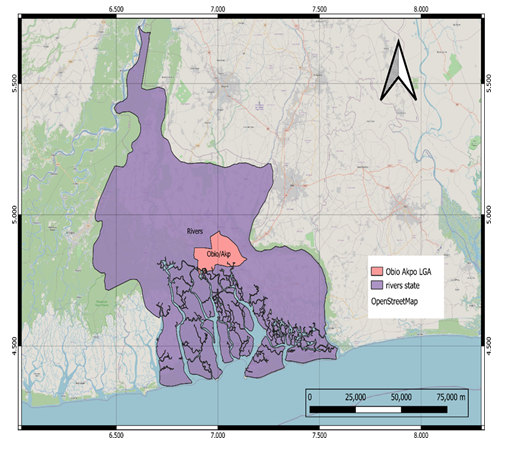
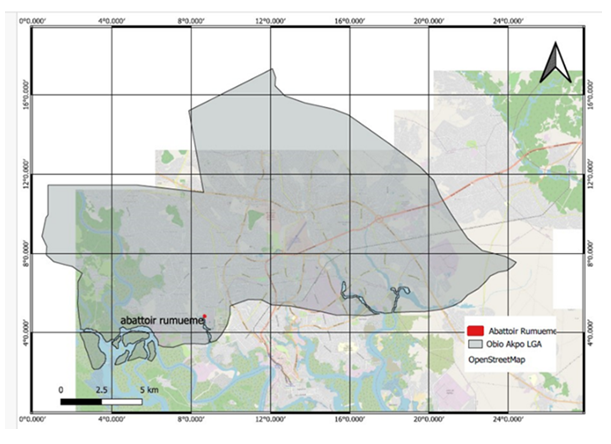
The scope of the study geographically covers Rumueme Community and its environs in Obio/Akpor Local Government
Area in Rivers State, Nigeria (Figures 1 & 2). The content scope includes describing the locational implication of the abattoir, assessing the waste management implication of the abattoir and identifying sustainable measures to manage both the locational and waste management implications on the study area.
Description of the Study Area
Rumueme is a community located in Obio/Akpor Local Government Area (LGA). Obio/Akpor LGA is within the city of Port Harcourt, one of the major centres of economic activities in Nigeria, and one of the major cities of the Niger Delta, located in Rivers State. The LGA territory covers about 260 km2. Obio/Akpor LGA has its headquarters at Rumuodomaya and its indigenous people are the Ikwerres.
Obio/Akpor LGA is bounded by Port Harcourt City LGA to the south, Oyigbo and Eleme LGAs to the east, Ikwerre and Etche LGAs to the north, and Emohua LGA to the west. It is located between latitudes 4°45’N and 4°60’N and longitudes 6°50’E and 8°00’E [6] (Figure 1).
The research area comprises the Port Harcourt ultramodern abattoir in Rumueme and its surroundings, located in Obio/Akpor Local Government Area. It is one of the major centres of economic activities in Nigeria, and a major city in the Niger Delta said to be the richest in the State. More goods and services are being made available to meet the demands of the growing population consequent on the rapid urbanisation and the rising industrial and commercial growth of the city [7]. The presence of oil and gas companies and related business activities drives the need for hospitality services, including hotels, restaurants, and conference facilities.
Literature Review
Locational Theories and Implications
Weber Location Theory: Alfred Weber’s work on location theory, also known as the Weberian model, explores the factors that influence the optimal location of industries. In his book, Weber proposed a theory that focuses on three main factors in determining the location of industrial activities: transportation costs, labour costs, and agglomeration economies. His theory aims to explain why certain industries are located in specific regions or areas. Weber argued that transportation costs play a crucial role in determining the location of industries.
According to his theory, industries tend to locate near their input sources or markets to minimize transportation costs. He believed that industries tend to locate in areas where labour costs are low, as this can provide a competitive advantage. Lower labour costs can lead to lower production costs, making the products more affordable in the market. Furthermore, Weber emphasized the concept of agglomeration economies in his location theory. Weber recognised that industrial agglomerations can enhance efficiency and productivity, leading to economic advantages for firms located in those areas [8]. Location theory is positioned in a global force field which leads to many rapid responses and behavioural adjustments of business firms so that stable and robust locations are increasingly replaced by nomadic types of business behaviour. The rapid emerging ICT and Technological changes encourage location theory to become a battlefield of industrial forces [9, 10].
Central Place Theory
Central Place Theory (CPT) is a geographical theory developed by German geographer Walter Christaller in the 1930s. This theory aims to explain the distribution and hierarchy of human settlements based on the concept of central places. Central places are settlements that provide goods and services to the surrounding population. The core idea of CPT is that there is an optimal spacing and arrangement of central places, which are hierarchically organised based on the range of the goods and services they offer (maximum) and the threshold population to support the goods and services produced (minimum). The theory assumes that settlements exist to meet the economic needs of the population rationally and efficiently. CPT provides valuable insights into the spatial arrangement of settlements; it simplifies the complex dynamics of real-world urban systems. Actual settlement patterns can be influenced by a wide range of factors, including historical, cultural, and political considerations [11]. The CPT helps to explain the spatial distribution and location of settlements, particularly in urban centres and their surrounding hinterlands. In that case, the higher-order settlement offers higher goods and services while the lower-order settlement offers lower goods and services. This condition determines the hierarchy of settlements within the region. Therefore, an abattoir as a facility that provides meat protein supply is usually located in a higher-order settlement that has large population (market demand) and is easily accessible (transportation benefit) to serve a broader region.
Locational Implication of Abattoir
In London, abattoirs play a crucial role in the supply chain of meat products, ensuring that the food industry meets the demand for various meat sources. They provide a centralised location for the humane and safe slaughter of animals, adhering to strict regulations and standards to ensure food safety and animal welfare. From a locational perspective, the establishment of abattoirs in London needs careful consideration. They are usually located in areas that have good access to transportation routes, such as highways and distribution networks. This allows for efficient transportation of animals and meat products to various markets within the city and beyond. Additionally, abattoirs need to be situated away from residential areas to minimise any potential negative impact on local communities. Noise, odours, and other associated environmental concerns are considered when determining suitable locations for abattoirs. Urban planning and zoning regulations help ensure that abattoirs are appropriately placed to minimise any adverse effects on nearby neighbourhoods [12].
In New York City, abattoirs serve a key role in the local food industry, ensuring a reliable supply of meat products to meet consumer demands. These facilities comply with stringent regulations and standards to ensure food safety, animal welfare, and environmental sustainability. When it comes to the locational implications, abattoirs in New York City are typically situated in areas with convenient access to transportation infrastructure. This allows for efficient movement of animals and meat products throughout the city and beyond, linking them to distribution networks and markets. Factors such as proximity to highways, logistical considerations, and transportation efficiency play a role in determining suitable locations. It is also essential to address environmental and community concerns related to abattoir establishments. Measures are taken to minimize the impact on nearby residential areas. This includes considerations for noise reduction, odour control, waste management, and adherence to relevant zoning and urban planning regulations. Such measures help ensure that abattoirs operate responsibly and contribute positively to the surrounding community [13].
Waste Management Concerns of the Abattoir
A study on the Environmental impact of slaughterhouses with special reference to India asserts that the major environmental problem associated with slaughterhouses has been found as disposal of untreated liquid and solid waste leading to contamination of shallow water tables and nearby water bodies. This can result in waterborne diseases among nearby residents [5]. For Gunorubon, et al. [14], their study on the production of glues from animal bones in Port Harcourt, revealed economic benefits from waste generated from the abattoirs as the bones generated can be used to produce glue. Their work investigated the production of glue from these waste bones thus providing an efficient method of waste bone disposal that does not pollute the environment and creates wealth and employment opportunities. Accordingly, there are hazardous effects of improper disposal of waste bones [14].
Mamhobu A, et al. [15] also agree that the waste generated in the abattoir is useful. The study was on a review of abattoir operations and waste management options, the study revealed that the liquid, comprising of the blood, wash waste and intestinal fluids is discharged without treatment into open drainages of waterbody often contaminating and depleting the water resources. The solid which includes bones, horns, and intestinal content can be used as manure. The bone is burned and crushed for bone meal. They further revealed that adequate and planned application is suggested for the use of abattoir waste as feed-in bio-digesters and the use of the bone for cleaning the produced gas into purer biomethane that can serve as an environmentally friendly fuel for roasting animal skin. The outcome of this review is the suggestion to produce biogas using abattoir wastes with the animal bone serving as a filter for purer biogas. The recommendation, therefore, is that with an appropriate and well-designed biogas plant, adopting this method of production and treatment will guarantee purified biomethane gas. The impact of abattoirs on the environment adversely contributes to various kinds of pollution including water, air, and land and also energy consumption levels [16], also noted the importance of efficient water management practices, such as recycling and reuse systems, to conserve water resources to minimise the environmental impact in the environment where the abattoir is located.
Methodology
To obtain the required data for the study, a quantitative research approach was adopted applying descriptive research design for collection and analysis of data. Also, a judgmental sampling technique was used to select 4 communities (Mgbuoshimini, Nkpor, Rumuepirikom and Oroakwo) which are proximate communities to the location of the Rumueme Abattoir (within a 1.5km impact zone) using Geographic Information System (GIS) technique (Figure 3). A total of 396 respondents were determined employing the Taro Yamane (1967) formula at a 5% precision level. The population of the 1.5km impact zone communities were projected from 1991 population figures to the study year 2023 at a 6.5% growth rate [17, 18, 19]. A simple random sampling technique was further employed to select respondents and distributed to the study communities based on the census population figures (Table 1). Direct observation and GIS tools were deployed to locate and characterise the study area on the subject matter. Correspondingly, content analysis was employed to analyse the qualitative data obtained from the interviewees and Statistical Package for Social Sciences (SPSS) Version 22 was used to process the quantitative data collected from the field survey.
| Sampled Communities | 1991 Census Population | 2023 Population Projection | Total Number of Households | Sampled Respondents |
|---|---|---|---|---|
| Mgbuoshimini | 5784 | 43,392 | 8,678 | 84 |
| Nkpor | 7922 | 59,431 | 11,886 | 113 |
| Rumuekpikom | 8333 | 62,514 | 12,503 | 118 |
| Oroakwo | 5719 | 42,903 | 8,580 | 81 |
| Total | 27,758 | 208,240 | 41,647 | 396 |
Table 1: Study Population and Sample Size.
Source: NPC, 1991; NPC, 2018; NBS, 2016; Researchers’ Computation, 2024. Table 1: Study Population and Sample Size.
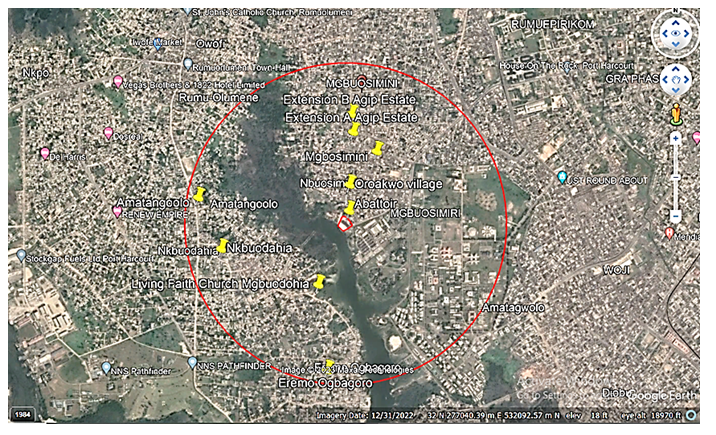
Source: GIS Google Earth and Researchers’ Modification, 2024. Figure 3: Map showing Communities within 1.5 km Radius of the Abattoir.
Results and Discussions
Locational Implication of the Abattoir in the Study Area
The dataset presented in Tables 2 & 3, showed that there are two types of locational implications of the abattoir in the study area. These two types of locational implications are both positive and negative in nature. These implications are discussed in the headings.
| Benefits | Cumulative | |
|---|---|---|
| N | % | |
| Proper waste disposal | 190 | 11.3 |
| Waste treatment | 115 | 6.8 |
| Recycling of waste | 105 | 6.3 |
| Use of renewable energy | 187 | 11.1 |
| Employment Opportunity | 274 | 16.3 |
| Growth of the local economy | 280 | 16.7 |
| Increase in turnover on goods sold | 167 | 9.9 |
| Increase social networking | 106 | 6.3 |
| Constant electricity supply | 154 | 9.2 |
| Provision of water supply | 102 | 6.1 |
| Total | 1,680 | 100 |
Table 3: ** Positive Implication of Location of the Abattoir.
Source: Field Survey, 2024. Table 2: Positive Implication of Location of the Abattoir.
| Adverse | Cumulative | |
|---|---|---|
| N | % | |
| Noise pollution | 121 | 10.3 |
| Water pollution | 105 | 8.9 |
| Air pollution (odour) | 149 | 12.7 |
| Dust particles | 83 | 7.1 |
| Deforestation | 60 | 5.1 |
| Loss of biodiversity | 79 | 6.7 |
| Environmental imbalance | 25 | 2.1 |
| Indiscriminate dumping of waste | 82 | 7 |
| Vehicular congestion | 54 | 4.6 |
| Displace of employment | 34 | 2.9 |
| Security challenges | 123 | 10.5 |
| Rent increase | 232 | 19.8 |
| Increase in diseases | 27 | 2.3 |
| Total | 1,174 | 100 |
Table 2: ** Negative Implication of Location of the Abattoir.
Source: Field Survey, 2024. Table 3: Negative Implication of Location of the Abattoir.
Positive Implication of the Abattoir
Thus, the dataset presented revealed in Table 2, showed that the positive locational implications of the location of the Rumueme Abattoir are numerous. The multiple responses from the respondents indicated that the modal positive implications were the growth of the local economy and employment opportunities accounted for 16.7% and 16.3%, respectively. They showed that the location of the abattoir generally will bring economic benefits to the 1.5km impact communities and further impact the entire economy of the Obio/Akpor LGA and by extension to the city of Port Harcourt. Other positive implications indicated by the respondents were proper waste disposal, use of renewable energy, increase in turnover on goods sold and constant electricity supply. These benefits accounted for 11.3%, 11.1%, 9.9% and 9.2%, respectively, cutting across environmental, economic, and social dimensions of the urban environment. The remaining locational implications were waste treatment, recycling of waste, increased social networking and provision of water supply accounted for 6.8%, 6.3%, 6.3% and 6.1%, respectively. These positive implications have equally shown that the location of the abattoir in the environment of Rumueme and its environs can contribute to realising environmental sustainability in handling wastes, social integration and improving sanitary and hygiene conditions of the environment. Equally, social amenities such as electricity and water supply may be provided to improve residents’ quality of life and promote urban growth and sustainable development.
Negative Implication of the Abattoir
As earlier indicated, the dataset presented revealed in Table 3, showed that the prevalent negative locational implication of the Rumueme Abattoir was rent increase as the facility has attracted other economic activities to the surroundings, especially around the 1.5km impact zone. This was indicated from the multiple responses of the respondents as 19.8% of them indicated an increase in their rents including residential apartments and shops used for other commercial activities. This implication is followed by pollution challenges as most of the respondents indicated air pollution (odour), noise pollution and water pollution accounted for 12.7%, 10.3% and 8.9%, respectively. These pollutions are attributed to the presence of the abattoir and the increase in human population and economic and social activities that are taking place in the communities within the 1.5km impact radius. These pollution sources are from electricity generators, vehicular movements, generation of wastes from the abattoir, economic and social activities, and residential development in the study area. Furthermore, the multiple responses of the respondents indicated that other negative implications were security challenges, dust particles, indiscriminate dumping of waste, loss of biodiversity and deforestation accounted for 7.1%, 7%, 6.7% and 5.1%, respectively. These locational negative implications have an array of physical, social, and economic implications affecting the urban environment. Because of many activities attracted to the study area security issues such as crime, and violent anti-social activities (cultism, prostitution, and drug abuse) have increased.
The increased population and human activities have increased the volume of waste generated and dust particles in the study area and encouraged the indiscriminate dumping of wastes in the environment as proper waste management methods are not employed to evacuate the generated wastes. The demand for land for physical development has also contributed to deforestation and biodiversity loss as large areas are cleared for housing provision and other land use accommodated in the study area affecting the urban environment and threat to sustainability. The least negative implications of the location of the abattoir as indicated by respondents were displacement of employment, increase in diseases and environmental imbalance as these conditions accounted for 2.9%, 2.3% and 2.1%, respectively. Many indigenous occupations were lost by the locales as new forms of employment accompanied the abattoir development and other socio-economic activities which brought about an increase in diseases and caused environmental imbalance between the natural environment (greenfield) and built- up environment (brownfield). These conditions have jeopardised environmental sustainability and development.
Waste Management Implication of the Abattoir in the Study Area
The locational of Rumueme Abattoir is significant to the urban environment of the city of Port Harcourt. The development of this facility potentially will generate waste of different kinds and will require sustainable waste management procedures to handle these wastes properly and efficiently. There are waste management implications to the location of abattoirs in any environment. In the case of Rumueme Abattoir, the location of this facility has waste management implications that are both positive and negative in nature to the study area. As earlier noted in Table 2, the positive implications of waste management attributed to the abattoir ranged from proper waste disposal, treatment of waste and recycling of waste practices. All these highlighted issues have their impacts on the environment. However, Table 4 revealed that the majority of respondents accounted for 38.6% of responses reported that the extent of positive waste management implication from the abattoir to the environment was “beneficial” as a result of adopting the mentioned waste management methods. This is followed by those that responded, “very beneficial”, “moderate” and “minor” accounted for 22.2%, 18.7% and 6.1%, respectively from the responses. These responses showed that employing sustainable and environmentally friendly methods of waste management has positive implications for the urban environment where such facilities are located.
| Positive Waste Management Implication | N | % |
|---|---|---|
| Very beneficial | 88 | 22 |
| Beneficial | 192 | 39 |
| Moderate | 74 | 19 |
| Minor | 24 | 6.1 |
| Not at all | 18 | 4.5 |
| Total | 396 | 100 |
Table 4: ** Extent of Positive Waste Management Implication of the Abattoir.
Source: Field Survey, 2024. Table 4: Extent of Positive Waste Management Implication of the Abattoir.
This will promote environmental sustainability, public health and good hygiene within the abattoir and its surrounding environment. This has indicated that there is a need for an efficient waste management system to promote positive urban growth and development that will not jeopardise environmental health and safety in the study area and the city of Port Harcourt. The wastes generated are of great concern to all urban stakeholders to enhance the quality of life and the well-being of the populace. For the case of the extent of negative waste management implications of the abattoir on the environment, if the mentioned sustainable and efficient methods in Table 2 are not employed, most of the respondents in Table 5 adjudged the implication to be “very high” accounted for 60.9% of the responses. This was followed by those that perceived the implications to be “high”, “moderate” and “minor” accounted for 16.9%, 14.7% and 4.5%, respectively. Only a few respondents that did not agree with any negative implications on the environment amounting to 3% of the responses. This indicated that from analysis that there is a correlation between the positive and negative implications of waste management not being properly handled. It is adjudged by the respondents from the findings that waste management should be given adequate attention by the operators of abattoirs and government as a regulatory and monitory organ to achieve a sustainable urban environment.
| Negative Waste Management Implication | N | % |
|---|---|---|
| Very High | 241 | 61 |
| High | 67 | 17 |
| Moderate | 58 | 15 |
| Minor | 18 | 4.5 |
| Not at all | 12 | 3 |
| Total | 396 | 100 |
Table 5: ** Extent of Negative Waste Management Implication of the Abattoir.
Source: Field Survey, 2024. Table 5: Extent of Negative Waste Management Implication of the Abattoir.
Conclusion
The locational and waste management implications of Rumueme Abattoir on the proximity communities and Port Harcourt City and Rumueme Town have highlighted several impacts that are both positive and negative as well as the extent of the implications as perceived by residents and businesses and likewise on the environment. These implications cover a large spectrum of the physical, economic, and social urban environment. The study highlighted that the positive locational implications were the growth of the local economy, employment opportunities, proper waste disposal, use of renewable energy, increase in turnover on goods sold, supply of electricity and water and social networking. Consequently, the negative implications discovered were an increase in rents, air, noise and water pollution to the abattoir and other socio-economic activities attracted by the abattoir. There are other negative implications such as security challenges, dust particles, indiscriminate dumping of waste, biodiversity loss and deforestation. The extent of the waste management methods employed implications highlighted in the study positively were adjudged by the residents and businesses as mostly beneficial to the environment while the negative implications if the methods employed are not used will amount to very high negative implications. Exploring these implications will engender informed insight into the locational and environmental decisions taken in achieving urban sustainability in the study area and the city of Port Harcourt. A thorough evaluation and careful planning would be essential to ensure the successful operation of the Rumueme Abattoir. However, to address the highlighted implications the study provides appropriate measures to enhance and mitigate these implications to improve operations of the abattoir and the quality of life and well-being of residents in the study area.
Recommendations
- In enhancing the functionality and sustainability of the abattoir, infrastructure, and services such as electricity and water supply should be given priority consideration in the environment of the facility.
- All stakeholders including government, residents and communities should be involved in the operational process for proper implementation of regulations and standards that will promote good sanitary culture, public health and good hygiene in the abattoir and its environs.
- A Special Purpose Vehicle to include all relevant authorities, technicians, and individuals to properly manage the abattoir and follow the planning process taking particular reference to monitoring.
- The government should provide more policies and guidelines that would regulate the management of waste by treating waste before final disposal to the environment.
References
-
Olawuni P, Daramola O, Soumah M (2017) Environmental Implications of Abattoir Waste Generation and Management in Developing Countries The Case of Lagos State Abattoir in Agege, Nigeria. Greener Journal of Social Sciences, 7(2): 007-014.
-
Obinna CV (2008) Environmental Impact Assessment The Social Dimension. King Jovic International Publishers, Port Harcourt, Nigeria.
-
Laucker S (2020) How to Choose a Business Location: 8 Factors to Consider. NerdWallet.
-
Bello Y, Oyedemi D (2009) The Impact of Activities and Management in Residential Neighbourhoods A Case Study of Ogbomoso Nigeria. Journal of Social Sciences 19(2): 121-127.
-
Jamal S, Almal U (2019) Environmental impacts of Slaughter Houses with Special Reference to India: A review. Journal of the Gujarat Research Society 21(14): 2212-2222.
-
Rowland JS, Piao SY, Lee DSLI (2020) Factors Affecting Agricultural Businesses in Port Harcourt City and ObioAkpor Local Government Area Rivers State Nigeria. Journal Of the Korean Society of International Agriculture 32(2): 120-129.
-
Ayo VO, Obafemi A, Ogoro M (2017) Mapping Land Cover Determinants of Malaria in Obio/Akpor Local Government Area of Rivers State. IOSR Journal of Humanities and Social Science 22(6): 29-40.
-
Weber A (1929) Theory of the Location of Industries. The University of Chicago Press.
-
Gorter C, Nijkamp P (2001) International Encyclopedia of the Social and Behavioural Sciences. In: Smelser NJ, et al. (Eds.), Pergamon, pp: 175000.
-
Ezenagu VC (2009) Regional Planning And Development. First Fountain Publishers.
-
Christaller W (1966) Central Places in Southern Germany. Prentice Hall 368(1): 1-360.
-
(2022) The FSA Strategy for 2022 to 2027, pp: 1-22.
-
New York City Department of Health (2023) New York State Department of Health Recognizes September as National Food Safety Education Month.
-
Gunorubon AJ, Misel U (2014) Production Of Glues From Animal Bones. ARPN Journal of Engineering and Applied Sciences 9(9): 1592-1597.
-
Mamhobu A, Welandu C, Kinigoma BS, Momoh YL, Oji AA (2020) Abattoir Operations and Waste Management Options: A Review. International Journal of Advanced Engineering Research and Science 6(12): 1-6.
-
Parker S, Thompson P, Kumar M (2017) Water Management and Sustainability in Times of Climate Change.
-
National Population Commission (1991) 1991 Population Census Report of Nigeria. Federal Government Press.
-
National Population Commission (2018) NPC Puts Nigeria’s Population at 198 Million.
-
National Bureau of Statistics (2016) General Household Survey Panel Wave 3 Post Planting 2015-2016.
- Electronic Waste Management in the Top Ten Economies in the World: A Critical Review on Waste Generation, Regulations, Collection, Recycling and Environmental Challenges
- Some Challenging Transdisciplinary Aspects of the Sustainable Waste Management in the Permacrisis Context
- Use of Mobile Autonomous Systems for Pollution Control of Inland Water Bodies
- Environmental Impact Perspective Sustainable Online Textile Retailing: Harnessing Augmented Reality-Based Digital Twins in Bangladesh
- Composite Treatment Module for Removing Acidity and Metal (Loid)S from Acid Rock Drainage
- Household E-Waste Management Systems [E-Wms] in Malaysia