
Inter-Arm Pulse Pressure Difference Superiority and Exercise-Induced Effect on it
The most popular definition of inter-arm difference (IAD) is more than 10 mmHg variation in systolic or diastolic pressure between two brachial arteries. IAD has been recognized as a risk factor for cardiovascular mortality and was found to be associated with poor prognosis. However, the pulse pressure appears to be superior in predictive value to the systolic or diastolic values alone since pulse pressure is related to both systolic and diastolic pressures; it is an index of traumatic stress of arterial wall and its increased value is known as an independent cardiovascular risk factor. In addition the effect of exercise on IAD is not well documented. So the objective of this study is to compare the systolic, diastolic and pulse pressure in right and left sides during rest and exercise and also to investigate the exerciseinduced effect.
Background and Objective
The most popular definition of inter-arm difference (IAD) is more than 10 mmHg variation in systolic or diastolic pressure between two brachial arteries [1]. IAD has been recognized as a risk factor for cardiovascular mortality and was found to be associated with poor prognosis. However, the pulse pressure appears to be superior in predictive value to the systolic or diastolic values alone since pulse pressure is related to both systolic and diastolic pressures; it is an index of traumatic stress of arterial wall and its increased value is known as an independent cardiovascular risk factor. In addition the effect of exercise on IAD is not well documented [2, 3]. So the objective of this study is to compare the systolic, diastolic and pulse pressure in right and left sides during rest and exercise and also to investigate the exercise- induced effect.
Material and Methods
The participants were 12 right handed, non-smoker and no obese healthy male collage students (mean age 21.75±0.5 years). Blood pressures were simultaneously measured in both side and in supine position by two well trained persons using a validated oscillometric devise (Omron). Exercise was done by alternative seat-stand commands for 20 times in 2 minutes. Paired sample T-test in SPSS 16 was applied for the intended analyses.
Results
The observations were summarized in the following figures:
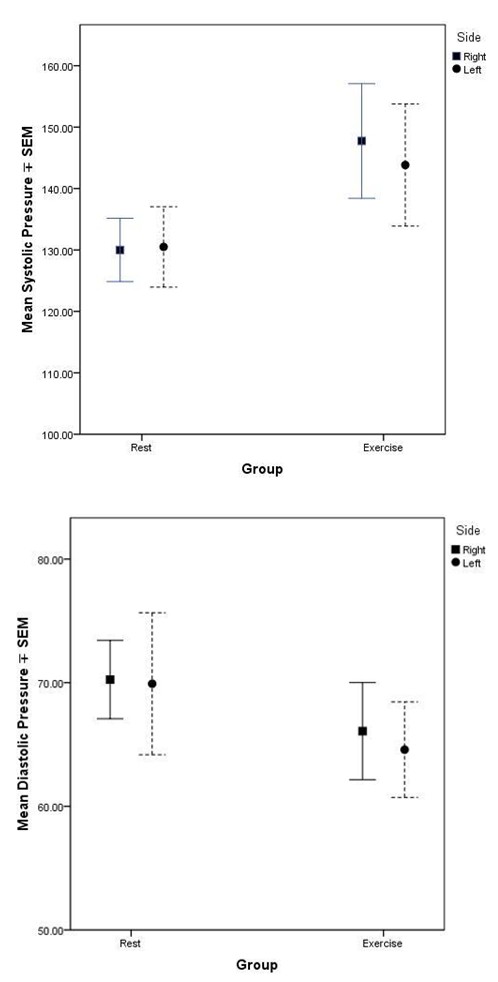
Figures 1a & b: Mean Systolic pressure & Mean Diastolic Pressure.
Minimum and maximum pulse rate revealed to be 50
and 100 with the mean of 72 pulses per minute. Mean rest
systolic pulse pressure in right and left upper limb was
measured 130±2.43 and 130.5±2.97mmHg, respectively.
The diastolic pressure was obtained 70.25±1.44 for the
right upper limb and69.92±2.61 for the left one, in rest.
After the certain physical activity, the systolic pulse
pressure was recorded 147.75±4.23mmHg for the right
and 143.83±4.51 for the left arm; the diastolic
$$ measurements \mathrm {were} 6 6. 0 8 \pm 1. 7 8 \mathrm {a n d} 6 4. 5 8 \pm 1. 7 8 $$
respectively for the right and left arm. Pulse pressure
increased from 60.25 to 77.4 and 60.6 to 81.7 for right
and left arm respectively after exercise.
Conclusions
Although there was not any significant difference of blood pressures between two sides, however the trends of systolic pressure increase and diastolic pressure decrease and the pulse pressure rise thereupon can be interpreted in favour of the above hypothesis.
References
-
Clark CE, Campbell JL, Evans PH, Millward A (2006) Prevalence and clinical implications of the inter-arm blood pressure difference: A systematic review. J Hum Hypertens 20(12): 923-931.
-
Clark CE, Campbell JL, Powell RJ, Thompson JF (2007) The inter-arm blood pressure difference and peripheral vascular disease: cross-sectional study. Fam Pract 24(5): 420-426.
-
Van der Hoeven NV, Lodestijn S, Nanninga S, van Montfrans GA, van den Born BJ (2013) Simultaneous compared with sequential blood pressure measurement results in smaller inter-arm blood pressure differences. J Clin Hypertens (Greenwich) 15(11): 839-844.
- Understanding Pediatric Multiple Sclerosis: Clinical Presentation, Diagnostic Criteria, Therapeutic Advances, and Supportive Care Approaches
- Hemophilia in Children
- Xia-Gibbs Syndrome- A Case Report
- A Study to Assess Effectiveness of Play Therapy in Reducing Post-Operative Pain among Children Age 2 To 5 Year who have Undergone General Surgeries in Selected Pediatric Hospitals of Vadodara
- Preterm Birth: Scope of the Problem, Cost of Care, Potential Complications and Current Guidelines for Management
- Noradrenaline: Can we Use it to Manage Hemodynamic Instability among Neonatal Septic Shock at the NICU?