
Rubinstein - Taybi Syndrome Associated with Amelogenesis Imperfecta – Report of a Rare Case
Rubinstein-Taybi syndrome (RSTS) refers to a specific pattern of physical features and developmental disabilities, which occur together in a consistent fashion. Individuals with RSTS have a short stature, developmental delay, broad thumbs and halluces and many other anomalies. The most commonly seen intraoral feature in RSTS patients is talon cusps. However, dens invaginatus, high arched palate, dental caries and malocclusions have also been reported in association with RSTS. The present article reports a rare case of Rubinstein-Taybi syndrome associated with an unusual intra oral feature like Amelogenesis Imperfecta which is not reported so far.
Introduction
Rubinstein Taybi syndrome is a rare syndromic disorder usually denoted in short as RSTS and numbered by 180849 (OMIM no). In the genetic literature, it is pointed by the synonym as ‘Broad Thumb - Hallux syndrome’ [1]. It is a rare genetic disorder characterized by various cranio-facio-dental features. This syndrome is usually inherited in an autosomal dominant manner or may be sporadic [2].
The most commonly seen intraoral feature in RSTS patients is Talon cusps in the permanent anterior teeth [3]. However, other dental and intraoral findings like Dens Invaginatus [4], high arched palate [2, 5], lower anterior teeth crowding [2, 3, 4, 5, 6, 7], anterior and posterior cross-bites [2, 8] and dental caries [5] have also been documented in these patients. But association of Amelogenesis Imperfecta in this syndrome is not reported so far. The present case, reports many features suggestive of Rubinstein-Taybi syndrome associated with a rare isolated intraoral finding like Amelogenesis Imperfecta. Moreover, literature shows countable number of this condition. Therefore, the purpose of this paper is to report a rare syndrome in association with another developmental dental anomaly like Amelogenesis Imperfecta in a 10-year-old Indian male child.
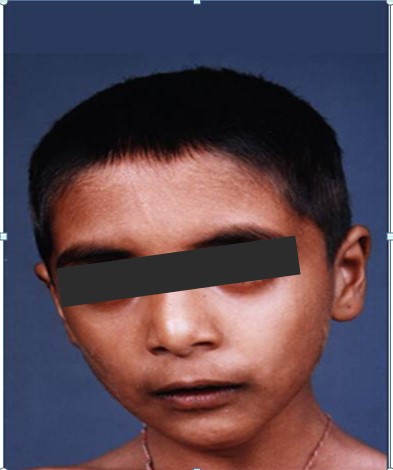
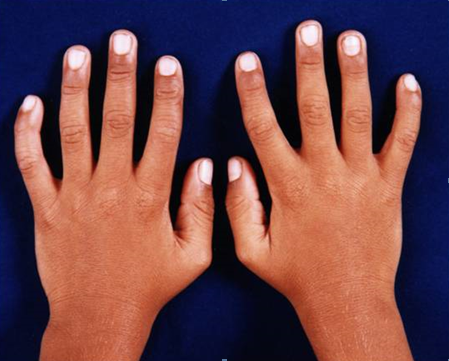
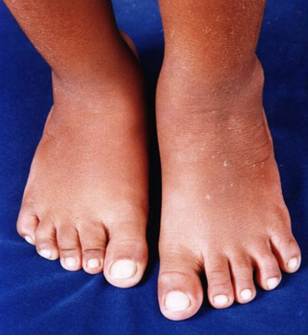
A 10-year-old male patient reported to a private dental office complaining of many decayed teeth in the mouth. On physical examination patient showed very short stature compared to his age and also showed some peculiar cranio-facio-dental features. On eliciting family history it was revealed that patient was born to parents of consanguineous marriage. Parents were informed about possible occurrence of syndromic disorder and referred to a paediatrician for proper diagnosis and to obtain consent for the treatment. After consultation with paediatrician the condition was diagnosed as Rubinstein-Taybi syndrome. Patient did not show any signs and symptoms of systemic or metabolic disorder. Patient had short stature and mentally retarded with Intelligence quotient (IQ) 30. Various clinical and oro-dental features were elicited in the patient. Beaked nose with columella protruding well below the alae nasi, folded epicanthal folds, bushy eyebrows and hypertelorism were observed as cranio-facial features (Figure 1). Broad and medially deviated right and left thumbs along with clinodactyly (finger curving to one side) of fifth little fingers in both hands (Figure 2), broad great toes with clinodactyly of right fifth toe (Figure 3) were also observed on physical examination of the child patient.
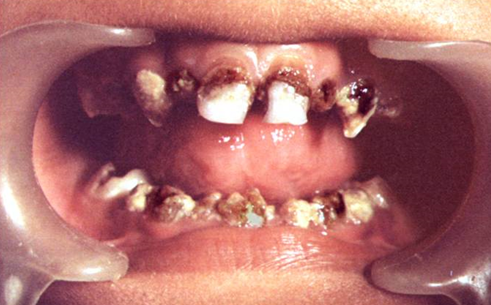
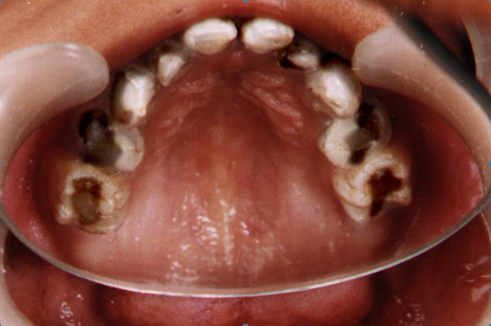
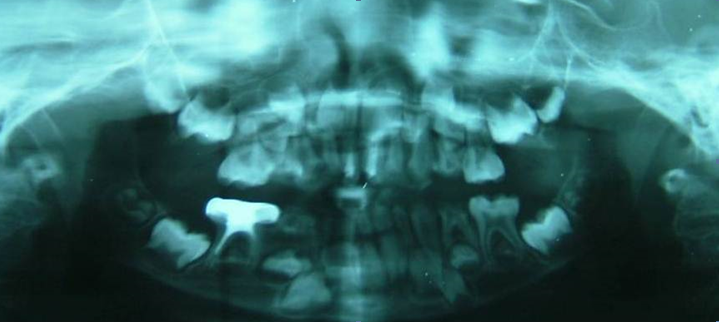
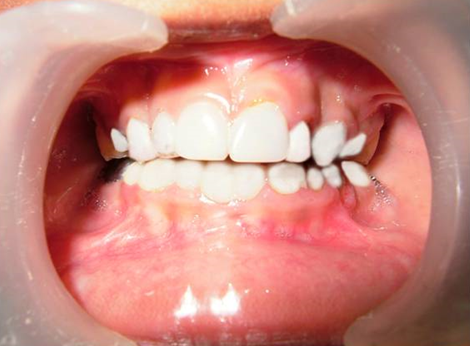
On intra oral examination, multiple carious primary and permanent teeth, poor oral hygiene, amelogenesis imperfecta, lower anterior crowding and mild marginal gingivitis (Figure 4), and congenital missing of some permanent teeth were identified. Amelogenesis Imperfecta was of hypo-calcification type since the enamel was poorly calcified and irregular with brown discoloration (Figure 4). Patient also exhibited high arched palate (Figure 5). In order to rule out presence of other dental anomalies, orthopantomograph radiograph was advised. Examination of orthophantamograph revealed no bony pathology and absence of enamel over many primary teeth confirming the diagnosis of Amelogenesis Imperfecta (Figure 6). Until initial clinical examination, the patient was fearful and apprehensive, but behaved very well after the behaviour modification technique of tell-show do was instituted. He was successfully managed for oral prophylaxis, pulp therapy followed by stainless steel crown and composite pedo strip crowns placement and finally esthetic rehabilitation was achieved with composite veneering for Amelogenesis Imperfecta (Figure 7). So successfully full mouth rehabilitation was carried out (Figure 7) for this patient and kept under recall follow up for every six months.
Discussion
Rubinstein-Taybi syndrome is a rare congenital syndrome characterized by peculiar multiple facial features. It was first described long back in the year 1957 by unknown author as described in the English literature. Later in 1063, Jack Rubinstein and Hooshang Taybi introduced for the first time and described in detail to the genetic literature [1]. The prevalence in the general population varies from approximately 1 case in 300,000 persons and is as high as one case per 10,000 live births [2]. Males and females are equally affected with no racial predilection [1, 2]. Distinctive facial features, growth and mental retardation, great toes and broad thumbs and presence of talon cusps in either primary or permanent anterior teeth as a peculiar intraoral finding are the main characteristics of this syndrome [3, 8, 9, 10, 11]. In addition to these findings, craniofacial abnormalities like microcephaly, downward slanted palpebral fissures, hypertelorism, long eyelashes, posterior rotated ears, beaked nose with the columella protruding well below the alae nasi, and pouting upper lip are usually found in this syndrome [1, 2, 4]. Other clinical features reported in the literature include cryptorchidism (incomplete or delayed descent of the testes in males), congenital heart problems, gastrointestinal tract abnormalities and recurrent respiratory tract infections [2, 4].
Most of the time, the parents of an individual with RSTS are not affected. Majority of RSTS patients show some degrees of language, mental, motor and social retardation with the most intelligence quotient (IQ) being in 30-79 range [3, 7, 8]. From behavioural aspect, these patients exhibit easy going, happier and friendly nature of behaviour. In the neonate, differential diagnosis should be carried out with other syndromes as most of the time this syndrome can be confused with the Cornelia De-lange syndrome, Trisomy 13, Apert syndrome and Pfeiffer syndrome. Therefore it is best to consider individuals without all the classic features of RSTS as having an “incomplete form” rather than an incorrect diagnosis [5, 12, 13, 14, 15]. Even though many publications of RSTS have been reported worldwide, but very few reports have emphasized the oral and dental aspects of Rubinstein -Taybi syndrome as evident from the literature. Extensive research on 45 RSTS patients living in Netherlands has been done and elaborated the oro-dental features documented from these 45 children affected with RSTS [9]. A dental anomaly frequently seen in RSTS patients is the occurrence of Talon cusps in either primary or a permanent anterior tooth which is a developmental anomaly of the tooth shape [3]. Literature shows a case of RSTS with occurrence of Dens Invaginatus on a maxillary lateral incisor [4]. Other intra oral features reported by different researchers are high arched palate, dental caries and dental malocclusions like severe crowding and cross bites [2, 3, 4, 5, 6, 7, 8, 9, 10, 11, 12, 13, 14, 15]. But association of Amelogenesis Imperfecta with RSTS patients is not reported so far as evident from the extensive literature review carried out on this syndrome. Therefore, the present case appears to be the first report of Amelogenesis Imperfecta in RSTS patients.
Currently, this syndrome involves a molecular level based diagnostic technique for the identification of CBP- gene which acts as a locus of RSTS and is usually located on the particular band 16p13.3. This novel test includes screening of gene encoding binding protein for cyclic adenosine monophosphate-response element binding protein (CBP) (CREBBP or CBP gene) that is responsible for the phenotype of RSTS [1, 3, 4, 5, 6, 7, 8, 9, 10, 11, 12, 13, 14, 15, 16]. In the case described here, we could not carry out genetic and molecular studies for the confirmation of this gene. However, the cranio-facio-oro-dental features encountered in this patient were more suggestive of particular features of RSTS and hence the final diagnosis of this condition was concluded as Rubinstein Taybi syndrome.
There is no definitive treatment mentioned for RSTS patients. Definite therapy mainly focuses on management of problems arising from wide spectrum of clinical abnormalities. Individualized surgical treatment based on findings in the patient is usually carried out. Cardiothoracic intervention is required in an individual with congenital heart problems. To improve grasp, oppositional function and comfort, hand or foot surgery is done. Physical therapy, speech and feeding therapy and, special education are important supportive measures required right from infancy through adulthood [3, 8, 9, 10, 11, 12]. Respiratory infections and complications from congenital heart disease are primary causes of morbidity and mortality seen in infancy. The survival rate is good, with more reports of adult patients surviving normal life along with RSTS [2, 3, 4, 5, 6, 7, 8, 9, 10]. Therefore, identification of multiple malformations by an early diagnosis is very important in these patients to provide multidisciplinary approach including initial evaluation, treatment and follow up. In the present case, as there was no definitive treatment required for the syndromic features, only pulp therapy, stainless steel crown placement and complete full mouth rehabilitation was carried out for the associated dental problems. In children with this syndrome, routine daily oral hygiene should be carefully monitored from the parents or guardians [3, 6, 8]. A nutritional and non-cariogenic diet should be implemented for prevention of dental problems. Regular dental care should be followed to obtain sound dental health and to prevent complications arising from the dental problems.
Conclusion
Most often, pediatric dentist or pediatrician is one of the first health-care practitioners, to treat children affected with unusual syndromes [17, 18, 19] including Rubinstein- Taybi syndrome. Therefore, knowledge about this syndrome among these health care professionals is highly essential to provide the most appropriate and comprehensive dental care/general health care in children affected with RSTS.
References
-
Boot MV, Belzen MJ, Overbeek LI, Hijimering N, Mendeville M, et al. (2018) Benign and malignant tumors in Rubinstein-Taybi syndrome. Am J Med Gent A 176(3): 597-608.
-
Lopez M, Garcia Oguiza A, Armstrong J, Garcia Cobaleda I, Garcia-Minaur S, et al. (2018) Rubinstein-Taybi 2 associated to novel EP300 mutations: deepening the clinical and genetic spectrum. BMC Med Gent 19(1): 36.
-
Lopez M, Seidel V, Santibanez P, Cervera-Acedo C, Castro- de Castro P, et al. (2016) First case report of inherited Rubinstein-Taybi syndrome associated with a novel EP300 variant. BMC Med Gent 17(1): 97.
-
Huang X, Rui X, Zhang S, Qi X, Rong W, et al. (2023) De novo variation in EP300 gene cause Rubinstein-Taybi syndrome 2 in a Chinese family with severe early-onset high myopia. BMC Med Genomics 16(1): 84.
-
Waite J, Beck SR, Heald M, Powis L, Oliver C (2016) Dissociation of cross-sectional trajectories for verbal and visuo-spatial working memory development in Rubinstein-Taybi syndrome. J Autism Dev Disord 46(6): 2064-2071.
-
Beets L, Fonseca CR, Hennekam RC (2014) Growth charts for individuals with Rubinstein-Taybi syndrome. Am J Med Genet A 164A(9): 2300-2309.
-
Park E, Kim Y, Ryu H, Kowall NW, Lee J, et al. (2014) Epigenetic mechanisms of Rubinstein-Taybi syndrome. Neuromolecular Med 16(1): 16-24.
-
Waite J, Moss J, Beck SR, Richards C, Nelson L, et al. (2015) Repetitive behavior in Rubinstein-Taybi syndrome: parallels with autism spectrum phenomenology. J Autism Dev Disord 45(5): 1238-1253.
-
Negri G, Milani D, Colapietro P, Forzano F, Della Monica M, et al. (2015) Clinical and molecular characterization of Rubinstein-Taybi syndrome patients carrying distinct novel mutations of the EP300 gene. Clin Gent 87(2): 148- 154.
-
Spena S, Milani D, Rusconi D, Negri G, Colapietro P, et al. (2015) insights into genotype-phenotype correlations from CREBBP point mutation screening in a cohort of 46 Rubinstein-Taybi syndrome patients. Clin Gent 88(5): 431-440.
-
Crawford H, Waite J, Oliver C (2017) Diverse profiles of anxiety related disorders in Fragile X, Cornelia de Lange and Rubinstein-Taybi syndromes. J Autism Dev Disord 47(12): 3728-3740.
-
Gils JV, Naudion S, Toutain J, Lancelot G, Bitach TA, et al. (2019) Fetal phenotype of Rubinstein-Taybi syndrome caused by CREBBP mutations. Clin Genet 95(3): 420- 426.
-
Marzuillo P, Grandone A, Coppola R, Cozzolino D, Festa A, et al. (2013) Novel cAMP binding protein-BP (CREBBP) mutation in a girl with Rubinstein-Taybi syndrome, GH deficiency, Arnold Chiari malformation and pituitary hypoplasia. BMC Med Gent 14: 28.
-
Demeer B, Andrieux J, Receveur A, Morin G, Petit F, et al. (2013) duplication 16p13.3 and the CREBBP gene: confirmation of the phenotype. Eur J Med Genet 56(1): 26-31.
-
Stevens CA, Pouncey J, Knowles D (2011) Adults with Rubinstein-Taybi syndrome. Am J Med Genet A 155A(7): 1680-1684.
-
Bartsch O, Kress W, Kempf O, Lechno S, Haaf T, et al. (2010) Inheritance and variable expression in Rubinstein-Taybi syndrome. Am J Med Genet A 152A (9); 2254-2261.
-
Nagaveni NB, Umashankara KV (2011) Hay-Wells syndrome of ectodermal dysplasia: A rare autosomal dominant disorder. Indian J Human Gen 17(3): 245-246.
-
Nagaveni NB, Shashikiran ND, Suma R (2008) Papillon- Lefevre syndrome: Report of two cases in the same family. J Indian Soc Pedod Prevent Dent 26(2): 78-81.
-
Sreedevi, Chaudhari S, Agnihotri PG, Reddy PB, Nagaveni NB (2011) Russell-Silver syndrome: A case report with review of literature. Indian Academy Oral Med Radiol 23(1): 74-76.
- Understanding Pediatric Multiple Sclerosis: Clinical Presentation, Diagnostic Criteria, Therapeutic Advances, and Supportive Care Approaches
- Hemophilia in Children
- Xia-Gibbs Syndrome- A Case Report
- A Study to Assess Effectiveness of Play Therapy in Reducing Post-Operative Pain among Children Age 2 To 5 Year who have Undergone General Surgeries in Selected Pediatric Hospitals of Vadodara
- Preterm Birth: Scope of the Problem, Cost of Care, Potential Complications and Current Guidelines for Management
- Noradrenaline: Can we Use it to Manage Hemodynamic Instability among Neonatal Septic Shock at the NICU?