
Social Return to Education: Empirical Study from Dhofar Region in Oman
A model was developed in this paper to examine the effect of wife and husbands' education, mother age, age at first marriage and child mortality on fertility among women in Dhofar Region, Oman. Econometric techniques are applied to examine social returns to female education. Descriptive statistics and ordinary least squares (OLS) methods are used for data analysis. The results suggest that mother’s education, child mortality, mother’s age and age at first marriage are important factors in determining the fertility level. Mother’s education, particularly secondary and university education, are found to have a significant negative impact on fertility, whereas child mortality, mother’s age and age at first marriage have significant positive impact on fertility.
Introduction
The future population size and age structure of any country depends basically on three demographic components: fertility, mortality and net international migration. Therefore, fertility is becoming one of the possible ways of retarding or reversing demographic ageing. A reversal of declines of fertility would lead the age structure of the population back towards a younger one, thus slowing down the ageing process. However, the recent experience of low-fertility countries suggests that there is no reason to assume that their fertility will return anytime soon to the above-replacement level [1, 2]. Unlike these countries, in the Cooperation Council for the Arab States of the Gulf (GCC), the rates of fertility and population growth are very high compared to world rate. This may be attributed to cultural factors that encourage high fertility, the spread of costs and benefits of children beyond the nuclear family to the extended family and the society at large and also due to immigration. Population of the GCC countries has jumped from about 14 million in 1980 to about 44 million in 2012 [3]. The population growth between 2005 and 2010 are averaged at 7.6%, with figures ranging between 15.1% in Qatar to about 2% in Saudi Arabia and Oman.
In early 80s, fertility rates, which measure births per woman, were quite high. For example, the average Omani woman gave birth to an extraordinary 8.32 children over her fertile years, and in Saudi Arabia, the corresponding figure was 7.02. The lowest figure, 4.63 in Bahrain, was still high by global standards. In 2005 - 2010, the fertility rate in most countries had decreased significantly (Figure
1). For example, the fertility rate in Oman is now 2.89 which is still higher than the world rate of 2.53 [3].
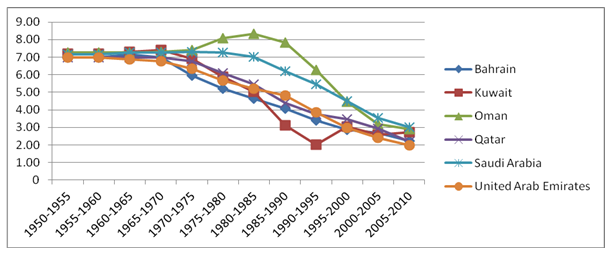
Source: United Nation, World Population Prospects, 2012.
This paper uses households’ data from Dhofar region in Oman to examine the factors affecting fertility, in particular, the effect of parental education. Most of the studies found that women’s education decrease fertility considerably. According to Easterlin RA [4] education can affect fertility through the supply and demand for children, as well as through the cost of regulations. On the one hand, the supply of children is determined by natural fertility and the survival rate of children. Education affects the supply of children through three intervening variables: age at marriage, child mortality and breast feeding [5]. As such, this paper this paper examines the effect of parental education on fertility, taking into account other factors such as mother’s age, age at marriage, women labour force participation, contraceptive use and child mortality.
Past Studies
Demand for children is affected by three sets of variables: first, direct economic costs and benefits of children, the costs related to time, income and wealth; second, preferences and norms; third, modernization, which has implications for all the other factors. With modernization, economic and time costs of children increase, the benefits decrease, and preferences and norms change [5]. Females’ education affects demand for children through the desired family size, economic, time and opportunity costs of children, children as old-age support and son preference [6, 7]. The economic benefits of educating girls are similar in size to those of educating boys but recent findings suggest that the social benefits from investing in females’ education are far greater than those from investing in male education. Female education has powerful effects on the total fertility rate and hence on population growth [6, 8] .
Maglad NA [9] used the micro economic model of household production to examine the determinants of fertility and factors affecting child mortality in Sudan [9]. He found that wife’s age and education, husband’s education, and household’s income, are important factors in explaining fertility and child mortality in Sudan. These factors explain more than 40% of the total variation in fertility for all women and above 50% of the variation in urban fertility. He observed that parental education affects demand for children negatively. In contrast to the Malthusian theory, Maglad found that fertility is negatively related to income. He argued that the income effect might have captured the price effect, reflecting the cost of children for parents with high income who desire high quality of children. Child mortality has a positive and significant effect on fertility, especially in rural areas.
Eltigani E [10] utilizes the data reported by 1988/89, 1995, and 2000 surveys of Oman. He showed that the underling contextual factors behind the rapid decline in fertility in Oman. Political stability over the past decades facilitated the implementation of successful and wide ranging socioeconomic development efforts leading to a rapid rise in the standard of living, and to a substantial improvement in the stock of human capital of the population. These developments, particularly the improvement in level of education and health status, provided the necessary and sufficient conditions for both the observed substantial decline in fertility during recent years and for further fertility decline in the future.
Céline Ferré [11] uses data from the Kenyan Demographic and Health Surveys yielding information on 18,777 women aged 20-49 when the interview took place. To get around the endogeneity issue between schooling and fertility preferences, the analysis uses the 1985 Kenyan education reform as an instrument for years of education. The authors find that adding one more year of education decreases by at least 10 percentage points the probability of giving birth when still a teenager. The probability of having one’s first child before age 20, when having at least completed primary education, is about 65 percent; therefore, for this means a reduction of about 15 percent in teenage fertility rates for this group.
Mouawiya & Carole [12] analyze the determinants of fertility in the U.A.E. using the Household Expenditure Survey (HES) 2008 dataset. They conclude that, the extensive use of domestic workers within U.A.E. households reduce to some extent the impact of female labor force participation on fertility in that they lessen the allocation of time females must devote to their children’s needs. Therefore, contrary to many other countries, the employment status of females is not very important in the determination of fertility. On the other hand the age at which a female marries or her age at first birth, along with higher female educational attainment, are shown to be the most important factors in causes of declines in fertility. The increase in the incidence of marriages to foreign females, the increase in birth intervals between kids and the decrease in the size of the residence for U.A.E. families have also contributed to the recent drops in fertility.
Evidence has shown that educating women can lead to improved economic and social outcomes. Specifically, recent empirical work, which has mainly focused on developing countries, shows that there are both positive economic consequences and social externalities arising from improving women’s education. For example, increases in women’s education have been associated with reductions in fertility [13]. Several studies in the recent literature have tried to establish a causal relationship between education and fertility in order to address the issues of reverse causality and possible omitted variables [14, 15].
Bagheri and Bahram [16] were assessed contraceptive use and attitudes in a random sample of 383 Iranian women that is selected through stratified random sampling method in the Khozestan province of Iran. From this data it was found that age, women's level of education, occupation of women and previous familiarity with contraceptive methods were the most significant factors influencing contraceptive use which affect fertility.
With the exception of Oman, G.C.C. countries implemented pro-growth policies which indirectly counter the declining proportion of nationals in the overall population and labor force. Governments started providing maternity benefits, children allowances and marriage funds to their citizens. However, these policies were aimed primarily at easing living expenses rather than directly targeting fertility rates among citizens [17]. On the other hand, Oman began in 1994 to promote birth- spacing among women of child-bearing age in an effort to increase the percentage of the economically active population relative to total population [18].
In light of the strong correlation between education and other characteristics influencing fertility, it is not surprising that the empirical evidence on the education- fertility relationship is inconclusive. Black, Devereux and Salvanes [19] uncover large teen fertility effects exploiting compulsory schooling reforms in the US and Norway. In contrast, McCrary and Royer [20] find no effects when they utilize variation in educational attainment due to school starting rules. However, this literature suffers from several weaknesses. Much of the literature [19] relies on difference-in-difference analyses, which are subject to endogeneity concerns if trends are not properly controlled for. A more recent literature attempts to address these earlier empirical challenges by employing regression discontinuity designs. For example, McCrary and Royer [20] exploit a discontinuity in exact date of birth, though they are unable to examine the impact of completed education and are limited to measuring fertility over a narrow age range.
Michael, Damon and Heather [21] examine the fertility effects of education. In particular, they exploit a quasi- experiment generated by a change in UK compulsory schooling laws. This reform was binding for many girls to attend an additional year of school. Their analysis reveals three main findings. First, an additional year of schooling had a significant impact on teen fertility, reducing it by around 20% at ages 16 and 17. Second, the additional schooling had at most a negligible effect on teen abortions. This implies that the teen fertility effects reflect a reduction in conceptions. Third, we cannot reject that an additional year of schooling had no impact on post-teen fertility and no impact on completed family size.
Women schooling is posited to result in lower fertility through four channels. Firstly, by raising the opportunity cost of women's time in rearing children, schooling raises the price of children (who are time-intensive) as well as the wage that women can earn in the labour market. Also, the wage benefit of schooling may induce women to get more schooling, thereby delaying the onset of child bearing. According to Shultz [22], the wage effect is such that the rise in the productivity of a woman’s time is expected to decrease her demand for births, because the increase in the opportunity cost of her time in childcare outweighs the increase in her income opportunity. This suggests that, for women the substitution effect of the wage rate outweighs the income effect, so that the total effect of women's education on fertility is negative.
Secondly, women with more schooling may develop higher aspirations for their own children, and invest in more schooling per child. This is the quantity- quality trade off. Thirdly women schooling may reduce fertility by lowering child mortality. Schultz [23] found that fully half of the effect of female schooling in lowering fertility was operating through its effect in lowering child mortality. Child mortality can affect a woman’s demand for births in two ways. First, since mortality in childhood is concentrated in the first years of life, parents may make an added effort to have an additional child when they lose one of their children. Second, in societies where child mortality has been stable or slowly declining for some decades, parents can adapt their fertility behaviour in anticipation of the average level of child mortality they expect to experience. In higher child mortality regions, for example, the anticipatory behaviour may take the form of earlier marriage and earlier initiation of childbearing [24]. Finally, educated women can learn about and use contraception more effectively than uneducated women [6].
Oman is a middle-income economy that is heavily dependent on dwindling oil resources. Because of declining reserves, Oman has actively pursued a development plan that focuses on diversification, where tourism and gas-based industries are key components of the government's diversification strategy. Oman total population was 2.34 million for 2003 census of which 27 percent were non-Omani and it was 2.604 million for
2010 [18], and a population density of 7.3 persons per squared kilometer. The crude birth and death rates are expressed per 1000 are estimated at 29.47 and 3.0, respectively, with a resulting natural population growth rate of 2.0 % per annum. Total fertility rate (TER) (live births per women 15-49 years) was estimated in 2009 at 3.3 [18]. These may lead to doubling Oman’s population in less than 30 years. In addition, low levels of female schooling may cause high demand for children, and thereby high fertility [10].
Methodology
Research methodology adopted in the analysis has two main components. The first relates to the data and information used in the analysis, while the second relates to the statistical regression adopted in analyzing the data.
Data
With regard to the data, the population under study consists of households in Dhofar Region of Oman with women who are ever married. The total number of population in Dhofar is 249,401 people (30,070 households) which represent 9.3% of the total number of population of Oman 2,604,094 (400,783 households) [18]. These households constitute the sampling units. From this population of households, a simple random sample of 330 households has been selected which represent 1% of the total number of households in Dhofar. Subsequently, data were collected on the relevant variables and statistical and regression methods were adopted to analyze the data. Descriptive statistics and ordinary least squares (OLS) methods are used. The Statistical Package for Social Sciences (SPSS) software is used for data analysis. To examine the differential impact of the level of schooling on fertility, three levels of education are distinguished, namely the primary, secondary and university levels in addition to read and write.
The Model
Based on the review in Section 2, it may be argued that the factors affecting fertility (F), measured by the number of children ever born, include among others, some socio- demographic variables such as education level of wife (Ew), education level of husband (Eh), wife’s age (Aw), wife’s age squared (A2w), age at first marriage (AM), women labour force participation (Lw), contraceptive use (C ) and child mortality (M) defined as the number of under five year deaths. Thus, the fertility equation may be written in the general functional form:
$$ \mathrm {F} = \mathrm {F} \left(\mathrm {E} _ {\mathrm {w}}, \mathrm {E} _ {\mathrm {h}}, \mathrm {A} _ {\mathrm {w}}, \mathrm {A} _ {\mathrm {w}} ^ {2}, \mathrm {A} _ {\mathrm {M}}, \mathrm {L} _ {\mathrm {w}}, \mathrm {C}, \mathrm {M}\right) \tag {1} $$ The control variables used for education are proxies for the productive value of time. For a woman, these variables are also proxies for her ability to practice effective birth control, as well as proxies for all other mechanisms by which education influences reproductive capacity, goals, and behaviour. Women’s age and age squared are included as explanatory variables to control for the biological supply of children and to capture the non-linearity of cumulative fertility with respect to age.
An OLS method will be used to estimate a linear form of Equation (1). Two models of the fertility equation will be estimated. The first, Model 1, is a basic linear equation of the form:
reflects current use of contraceptive rather than the use when the fertility decision was made.
Results
Preliminary Analysis
In this section we report the empirical results related to fertility in Dophar. Table 1 reports some preliminary sample statistics for the variables used in the analysis of fertility model. The mean number of children ever born is 3.3, which is lower than the 3.6 children in 2003 census, suggesting a decrease of 8.3% in fertility. It shows the declining trend in fertility in Oman in recent years.
The average child mortality is 0.15. The mean age for all women is around 31 years. The average age at marriage is 21.34 years. The average education years for wife and husband are 11.4 and 12.3 years respectively. We notice that the average education years of women and men decreases as women’s age increase while children ever born, child mortality and age at first marriage increases with women’s age.
- 2
- 0
- 1 w
- 2 h
- 3 w
- 4 w
- 5
- M
- 6 w
- 7
- 8
- F
- E
- E
- A
- A
- A
- L
- C
- M
-
-
-
-
-
-
-
-
- (2)
- In the second model, Model 2, contraceptive use variable will be excluded from Equation (2), since it
- Age Group
- Children Ever
- Born
- Child Mortality
- Age at First
- Wife’s Education (Years)
- Marriage
- Years
- 15 – 24
- 1.477
- 0.091
- 19.21
- 12.022
- 12.222
- -0.8209
- -0.291
- -2.512
- -3.265
- -3.599
- 25 – 34
- 2.688
- 0.106
- 21.515
- 11.91
- 12.819
- -1.631
- -0.431
- -4.595
- -4.413
- -4.556
- 35 – 44
- 5.294
- 0.206
- 21.956
- 10.882
- 11.897
- -2.9
- -0.534
- -5.981
- -14.382
- -5.215
- 45 – 54
- 7.6
- 0.6
- 22.7
- 5.4
- 8
- -3.627
- -1.075
- -5.293
- -6.132
- -7.379
- 55 +
- 12.5
- 1
- 23.5
- 0.5
- 3
- -4.95
- -1.414
- -3.536
- -0.707
- -4.243
- All
- 3.285
- 0.146
- 21.343
- 11.438
- 12.333
- -2.557
- -0.486
- -4.785
- -7.711
- -4.797
Table 1: Means and Standard Deviations of Variables used in Fertility model for all Women Ever Married by Age of
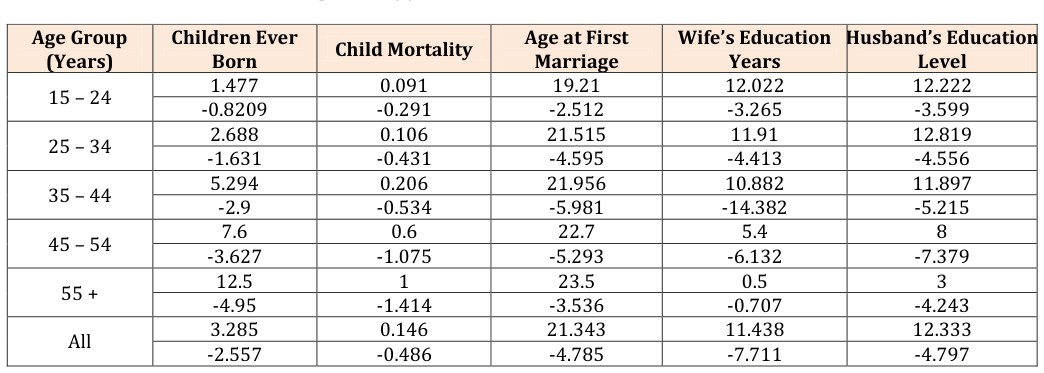
Table 2 gives the percentages of ever-married women and their husbands according to education level. Illiteracy is almost the same among women and men. Almost 50% of the women in the sample have secondary education. From the table, it can also be concluded that mother’s fertility behavior is inversely related to the level of education. The maximum numbers of children the women with university and secondary levels have are 2 and 3 children respectively while illiterate women have around 8 to 9 children.
| Wife’s | Husband’s | |||||||
|---|---|---|---|---|---|---|---|---|
| Education Level | Percentage | Mean | Percentage | Mean | ||||
| Illiterate | 3 | 8.6 | 2.5 | 6.2 | ||||
| Read and write | 9 | 5.4 | 4.6 | 4.9 | ||||
| Primary | 13 | 3.9 | 11.4 | 3.1 | ||||
| Secondary | 49.4 | 2.7 | 43.5 | 3.1 | ||||
| University | 25.6 | 2.1 | 38 | 2.7 |
Table 2: Education Characteristic of Ever Married Women. Source: Authors’ calculation.
OLS Estimation of the Fertility Equation
The OLS results are reported in this section. Table 3 shows the empirical results for two models. Model 1 includes the age of wife, age of wife squared (to capture the non-linearity of the model), age at first marriage, education years of wife, education years of husband, child mortality, work status and contraceptive use. Model 2 is estimated without contraceptive use.
| Regression coefficients | ||||||||
|---|---|---|---|---|---|---|---|---|
| Independent Variables | ||||||||
| Model (1) | Model (2) | |||||||
| Constant | 1.783 | 1.259 | ||||||
| -1.275 | -0.921 | |||||||
| Age | 0.228 | 0.238 | ||||||
| (2.736)** | (2.865)** | |||||||
| Age square | 0.001 | 0.001 | ||||||
| -0.573 | -0.487 | |||||||
| Age at first Marriage | -0.218 | -0.223 | ||||||
| (-12.889)* | (-13.395)* | |||||||
| Education years of wife | -0.049 | -0.046 | ||||||
| (-4.355)* | (-4.168)* | |||||||
| Education years of husband | -0.01 | -0.009 | ||||||
| (-0.604) | (-0.520) | |||||||
| Child mortality | 0.456 | 0.46 | ||||||
| (2.787)** | (2.808)* | |||||||
| Participation in labour force | -0.508 | -0.511 | ||||||
| (-2.566)** | (-2.571)** | |||||||
| Contraceptive Use | -0.257 | - | ||||||
| (-1.672)*** | ||||||||
| Adjusted R2 | 0.73 | 0.73 | ||||||
| F- Ratio | 108.055 | 122.391 | ||||||
| Number of observations | 324 | 324 |
Table 3: OLS Estimation of Fertility Model for Ever Married Women. Source: own calculation based on the questionnaire. Notes: • D
Table 3: OLS Estimation of Fertility Model for Ever Married Women. Source: own calculation based on the questionnaire. Notes:
- Dependant variable is number of children ever born.
- Values in parentheses are t- ratios.
- * means significant at 1%
- ** means significant at 5%
- *** means significant at 10% The two estimated models are significant at the 1% level, and the values of the adjusted R2 suggest that 73% of the changes in fertility are explained by changes in the variables used in each models. The results relating to an extended fertility equation are reported in Table 4. In this table we examine the effect of education levels on fertility behavior. Four levels of education are introduced, namely read and write, primary, secondary, and university levels, which enter the fertility equation as dummy variables, taking the value one for the particular level of education, and zero otherwise. The two models are significant at the 1% level and adjusted R2 are almost similar in both models (0.75).
| Variables | Model 1 | Model 2 | ||||||
|---|---|---|---|---|---|---|---|---|
| Constant | 3.36 | 2.514 | ||||||
| -2.363 | -1.803 | |||||||
| Age | 0.291 | 0.304 | ||||||
| (3.550)* | (3.687)* | |||||||
| Age squared | -0.001 | -0.001 | ||||||
| (-0.497) | (-0.563) | |||||||
| Age at first Marriage | -0.2 | -0.209 | ||||||
| (-11.700)* | (-12.426)* | |||||||
| Child mortality | 0.347 | 0.365 | ||||||
| (2.178)** | (2.270)** | |||||||
| participation in labor force | -0.54 | -0.552 | ||||||
| (-2.389)** | (-2.422)** | |||||||
| Contraceptive Use | -0.38 | -- | ||||||
| (-2.520)** | ||||||||
| Women Education | ||||||||
| Read and write | -2.183 | -2.053 | ||||||
| (-4.338)* | (-4.066)* | |||||||
| Primary | -2.466 | -2.374 | ||||||
| (-4.973)* | (-4.670)* | |||||||
| Secondary | -3.208 | -3.002 | ||||||
| (-6.520)* | (-6.135)* | |||||||
| University | -3.293 | -3.079 | ||||||
| (-6.063)* | (-5.690)* | |||||||
| Husband Education | ||||||||
| Read and write | -0.766 | -0.744 | ||||||
| (-1.275) | (-1.228) | |||||||
| Primary | -0.184 | -0.202 | ||||||
| (-0.350) | (-0.381) | |||||||
| Secondary | 0.047 | 0.06 | ||||||
| -0.093 | -0.118 | |||||||
| University | -0.251 | -0.239 | ||||||
| (-0.489) | (-0.463) | |||||||
| Adjusted R2 | 0.75 | 0.74 | ||||||
| F-Ratio | 69.34 | 72.918 | ||||||
| Number of observations | 324 | 324 |
Table 4: OLS Estimation of the Extended Fertility Model for Ever Married Women: The Impact of Education Level. Source: Authors’ c
Table 4: OLS Estimation of the Extended Fertility Model for Ever Married Women: The Impact of Education Level. Source: Authors’ calculation based on household survey, 2010. Notes:
- Dependent variable, fertility.
- Figures in the parenthesis are t ratios.
- Coefficient is statistically significant at 1%,
- ** Coefficient is statistically significant at 5%.
Discussion
Age has a significant positive effect on fertility, while age squared has a positive but insignificant effect on fertility, which is not consistent with economic theory; fertility function is increasing with age at a decreasing rate. The age at first marriage is the most important and significant variables that explain fertility behavior. In the two models, child mortality has a positive and significant effect on fertility. The estimated coefficients of child mortality are almost equal in all models, suggesting that an increase in child mortality will increase fertility by 0.5. Based on this; the average replacement coefficient is estimated at 0.15.
Women’s years of schooling have a significant negative effect on fertility in both models. One year increase of schooling will reduce fertility level by 1.52% than the average. On the other hand, husband’s education has a weak and insignificant negative effect on fertility. These results are consistence with most of the results in the literature Schultz, Ainsworth, et al. and Sid Ahmed [22, 25, 26].
As we expected women’s participation in labor force and contraceptive use coefficients have negative and significant effect on fertility. When we exclude contraceptive use in Model 2, adjusted R2 not change which indicate that contraceptive use is not important variable in determining fertility behavior. The relation and the significant of the age, age at first marriage, child mortality and participation in labor force and contraceptive use coefficients in Table 4 are the same as in Table 3. The coefficient for age square is negative but still it is insignificant.
All education levels coefficients for women are as expected; they are negative and significant with respect to fertility. Fertility decrease with the increase of women education levels, fertility decrease for woman that can read and write by 2.2 while for those who attend primary level is decrease by 2.5 (76% from the average). A woman with secondary and university levels of education would have 90% fewer births (3.0 fewer children) than the average of 3.3 children. On the other hand, husband education levels were found to have a negative but insignificant relation with fertility behavior. These results are consistent with Maglad and Ainsworth, et al. who found that in four sub-Saharan African counties the coefficients of husband’s schooling are negative but not significant. Also they are in line with Khraif results for Saudi Arabia [9, 6, 27].
Higher educational level predicted low fertility in all models in the present study. Our findings are totally consistent with international findings where the inverse relationship between women’s educational level and fertility has been universally acknowledged [28, 29]. The same findings were also seen in the Arab world, where studies of fertility from different parts of this region suggest that since the late 1970s there has been a steady decline in fertility and Oman is of no exception [30, 31]. Not only education can influence fertility but its interaction with the economic status can also do the same. For example illiterate women unlike the educated are at higher risk of having a large number of children with improvement in their economic conditions.
The present data suggest that in Oman the higher the education of a woman, the lower the fertility rate, which tend to agree with similar studies cited earlier. The high fertility rates in developing countries place heavy financial burdens on families with the resultant negative effect on economic growth and quality of life. Like elsewhere, Oman has traditionally had high fertility rates under the impression that some children may not survive into adulthood [32, 33]. With very limited or almost non- existent medical services prior to 1970, mortality rates, both for mother and child, were very high in Oman. However with improved medical facilities after 1970 and the resultant increase in life expectancy, coupled with high fertility, population growth increased rapidly [34]. Children are also perceived as gifts from God, and this perception might also encourage high fertility. This could entail difficulties in employment provision, infrastructure development and service delivery, particularly in education and health [35, 36].
The above explains to some extent the high fertility rates reported in this study. However there are indications that the rates are decreasing. Although this should be a welcome beginning, more concerted effort is needed to target women who are not yet benefiting from modern education. As family planning is sometimes viewed with suspicion in many traditional societies, its implementation needs to be handled with cultural sensitivity and skill for it to be acceptable [37]. The current emphasis of family planning programs should be on educating families to increase the intervals between births rather than focus on reducing the number of children. This apparently is more compatible with socio- cultural teaching especially in the Middle East. For such programs to work, less educated women will have to be especially targeted, as these are the groups with the highest fertility rates.
Conclusion and Implications
In order to understand the levels of fertility in general, and to examine the main factors affecting fertility in Oman in particular, the data of a recently conducted questionnaire were utilized and some statistical methods were used. The main findings are (1) mother’s education has a significant negative effect on fertility such that an additional year of schooling reduces fertility level; and (2) child mortality is considered as powerful factor that affects fertility. This result should encourage policymakers to move forcefully and aggressively against child mortality since a reduction in infant mortality will cause reductions in fertility.
It is shown in the previous discussion that Oman which recorded a high fertility rate during 1970s and 1980s has experienced appreciable decline in fertility during 1990s and the first decade of 21st century. The main factors behind the rapid decline in fertility are due to implementation of socioeconomic development programs like improvement in levels of education and of health status. Also in 1994, a birth spacing campaign was introduced by the Ministry of Health to control population growth and to allow for planned economic development.
All mother education levels have negative and significant effect on fertility, although the effect of secondary and university levels is high compare to other levels. This result indicates that most of the effect of education on fertility comes through delaying marriage. Mother’s education has a more pronounced negative and significant effect on fertility compared to father’s education. Father’s education has negative insignificant effect on fertility. Decline in fertility rate affects the age structure as it appears in the Oman's census, that the proportion of Omani population under 15 years of age declined from 51.6 per cent in 1993 to 40.6 per cent in 2003 further down to 35.2 per cent in 2010.
Pointing out that decline in the proportion of Omani population below the age of 15 years has resulted in an increase in the proportion of those in the “employment age group” between 15 to 64 years from 56.2 per cent in 2003 to its current level of 61.3 per cent of the total population. With population in the category eligible for jobs increasing there is a need to create more opportunities for them.
"More than one-third of the population in Middle Eastern and North African countries is under the age of fifteen in a majority of countries and, thus, has yet to marry and reach reproductive age. As a result, in most places the numbers of women of childbearing age (fifteen to forty-nine) will more than double in the next thirty years. Because there are so many young people, by one estimate the region's economies would have to generate half as many additional jobs by 2010 as existed in 1996 to avoid an increase in already high unemployment rates, particularly among young adults [38]".
In addition, the lower the levels of fertility decline, the more pronounced will be the ageing of the population of the country. One of the major consequences of population ageing is the reduction in the ratio between the population in working-age group 15-64 years and the population 65 years or older, or the potential support ratio (PSR). Everything else being equal, a lower potential support ratio means that it is much more burdensome for the working-age population to support the needs of the older retired population. In 1999 Oman was considered as one of the ten countries in the world of highest potential support ratio, but in 2050 it will not be of this group and this is due to fertility rate decline (United Nation, 1999) [39, 40].
References
-
United Nation (2000) Fertility trends among low fertility countries. _Population Bulletin of the United_ _Nations: Below-Replacement Fertility_, Special Issues Nos. 40/41. Sales No. E.99.XIII.13, pp.19-77. _2._ Lutz W (2000) Low fertility and population policy in Europe. In _Low Fertility and Policy Responses to Issues_ _of Ageing and Welfare. Korea Institute for Health and_ _Social Affairs & United Nations Population Fund_ _(UNFPA)._
-
United Nation (2012) World Population Prospects: The 2012 Revision. Department of Economic and Social Affairs, Population Division, Population Estimates and Projection Section, New York.
-
Easterlin RA (1983) Modernization and Fertility: A Critical Essay. In: Rodolfo A Bulatao, Lee RD, et al. (Eds.), _Determinants of Fertility in Developing_ _Countries_. London: Academic Press, New York, pp: 562-586.
-
Akmam W (2002) Women’s Education and Fertility Rate in Developing Countries, with Special Reference to Bangladesh. Eubios Journal of Asian and International Bioethics 12(4): 138-143.
-
Ainsworth, Kathleen Beegle, Andrew Nyamete (1996) The Impact of Women’s Schooling on Fertility and Contraceptive Use: A Study of Fourteen Sub-Saharan African Countries. The World Bank Economic Review 10(1): 85-122.
-
Shapiro D, Tambashe O (1994) Education, Employment and Fertility in Kinshasa and Prospects for Changes in Reproductive Behaviour. Penn State Department of Economics Working Paper. Pennsylvania State University 16(3): 259-287.
-
Murthi, Anne-Catherine Guio, Jean Drèze (1995) Mortality, Fertility and Gender Bias in India: A District-Level Analysis. Population & Development Review 21(4): 745 -782.
-
Maglad NA (1993) Socioeconomic Determinants of Fertility and Child in Mortality Sudan. Discussion Paper No. 686. New Haven, CT: Economic Growth Center, Yale University.
-
Eltigani E (2001) Levels and Trends of Fertility in Oman and Yemen. Workshop on Prospects for Fertility Decline in High Fertility Countries, Population Division, Department of Economic and Social Affairs, United Nations Secretariat, New York.
-
Ferré C (2009) Age at First Child Does Education Delay Fertility Timing? The Case of Kenya. Human Development Division, South Asia Region. Policy Research Working Paper 4833.
-
Mouawiya Al Awad, Chartouni C (2009) Explaining the Decline in Fertility among Citizens of the G.C.C. Countries: the Case of the U.A.E. Working Paper accepted for publication at Institute for Social & Economic Research (ISER), University of Essex, UK.
-
Osili U, Long B (2008) Does female schooling reduces fertility? Evidence from Nigeria. Journal of Development Economics 87(1): 57-75.
-
McCrary J, H Royer (2008) The Effect of Female Education on Fertility and Infant Health: Evidence From School Entry Policies Using Exact Date of Birth, unpublished manuscript, Michigan University.
-
Duflo Esther, Dupas P, Kremer M (2010) Education and Fertility: Experimental Evidence from Kenya? American Economic association 105(9): 2757-2797.
-
Bagheri M, Bahram N (2010) Prevalence of Contraception Usage and Family Planning in Iran. European Journal of Scientific Research 44(3): 457- 465.
-
Alnuaimi W, Poston D (2009) Polygyny and Fertility in the United Arab Emirates at the End of the 20th Century. XXVI IUSSP International Population Conference, Marrakech, Morocco.
-
Oman Population Committee (2009) Population and Development. 3rd (Edn.), Oman.
-
Black SE, Devereux PJ, Salvanes KG (2008) Staying In the Classroom and Out of the Maternity Ward? The Effect of Compulsory Schooling Laws on Teenage Births. The Economic Journal 118(530): 1025-1054.
-
McCrary J, Royer H (2011) The Effect of Female Education on Fertility and Infant Health: Evidence from School Entry Policies Using Exact Date of Birth. American Economic Review 101(1): 158-195.
-
Michael G, Damon C, Heather R (2011) The Impact of Education on Fertility: Quasi-Experimental Evidence from the UK.
-
Schultz TP (1981) Age of Individuals and Family Composition as Factors Underlying Distribution of Personal Income. Economic Growth Center, Yale University Center, New Haven, pp: 383.
-
Schultz TP (1973) Determinants of Fertility: A micro- economic Model of Choice. Economic Factors in Population Growth pp: 89-124.
-
Benefo K, Schultz TP (1996) Fertility and Child Mortality in Cote d’Ivoire and Ghana. The World Bank Economic Review 10(1): 123-158.
-
Sid Ahmed MH (2010) Non-Market Returns to Women Education in Sudan: case of Fertility. Journal of Comparative Family Studies 41(5): 783-798.
-
Ainsworth M, Beegle K, Nyamete A (1995) The Impact of Female’s Schooling on Fertility and Contraceptive Use: A Study of Fourteen Sub-Saharan African Countries. World Bank Economic Review 10(1): 85- 122.
-
Khraif MR (2001) Fertility in Saudi Arabia: Levels and Determinants. A paper presented at: XXIV General Population Conference, Salvador-Brazil, pp: 18-24.
-
Dyson T, Moore M (1983) On Kinship Structure, Female Autonomy, and Demographic Behavior in India. Popul Dev Rev 9(1): 35-60.
-
Mason KO (1986) The Status of Women: Conceptual and Methodological Issues in Demographic Studies. Sociological Forum 1(2): 284-300.
-
Chekir H, Farah AA (1999) Household Structure and Gender Perspectives of Reproductive Behavior of Arab Women, Evidence from Egypt and Tunisia. Proceedings of the Arab Conference on Maternal and Child Health.
-
Amin S, Lloyd CB (2002) Women’s lives and rapid fertility decline: Some lessons from Bangladesh and Egypt. Popul Res Policy Rev 21(4): 275-317.
-
Al-Rawahi S, Sharts-Hopko NC (2002) Birth spacing initiative in Oman. J Cult Divers 9(1): 23-26.
-
Kridli S (2002) Health beliefs and practices among Arab women. MCN Am J Matern Child 27(3): 178-182.
-
Eickelman C (1993) Fertility and social change in Oman, Women’s perspective. Middle East J 47(4): 652-666.
-
The World Bank (1998) World Development Report 1998/1999: Knowledge for Development. Oxford University Press, New York.
-
Zaidan ZA, Burke DT, Dorvlo AS, Al-Naamani A, Al- Suleimani A, et al. (2002) Deliberate self-poisoning in Oman. Trop Med Int Health 7(6): 549-556.
-
Naamane-guessous S (1993) Traditional methods still widely used. Plan Parent Chal 1: 14-16.
-
Drysdale A (2010) Population Dynamics and Birth Spacing in Oman. International Journal of Middle East Studies 42(1)**:** 123-144.
-
United Nations (1999) Population Division of the Department of Economic and Social Affairs. The World at six Billion.
-
United Nation Development Program (2005) World Population Prospects, Macmillan, New York.
- Origin, Evolution, and Functional Impact of Short Insertion- Deletion Variants in Human Genomes: A Review
- Harnessing Molecular Glues for Next-Generation Vaccine, Cancer and Cardiovascular Disease Drug Development: A Comprehensive Review
- Lateral Cervical Epidermal Inclusion Cyst in a Paediatric Patient: A Rare Case Report
- Malarial Plasmodium Falciparum with Hepatitis B and C Virus Infections among Blood Donors in Ife Central Local Government Area, Ile Ife, Osun State, Nigeria
- Withanolides and Withaferin A- What’s next in Ashwagandha Research
- Designing of Dual Pulse Photoacoustic Tomography for Imaging of Drug-Response and Tumor Growth