
Challenges of Online Medical Education in Khartoum Sudan during COVID-19 Pandemic 2021
Background: Education and teaching has been adversely affected since the emergence of COVID-19 pandemic. Millions of students have been affected by the closure of educational institutions, including medical colleges and universities to help students and save time, several institutes have turned to online education. Objective: To investigate the challenges of online medical education during covid19 pandemic in Khartoum state. Methodology: Descriptive Cross-Sectional study of six medical faculties which were selected by convenient sampling, an online author designed questionnaire was used. Excel and Statistical Package for the Social Sciences were used for data analysis, frequency tables and figures for analysis of data. Results: 328 medical students across six faculties responded 132 (40.2%) are males and 196 (59.8%) are females. 209 (63.7%) of them between 18 – 22 years old, 116 (35.4%) between 23 – 26 years old and only 3 (0.9%) exceeded 26. The study found that students encountered difficulties concerning poor internet connection, which encountered 242 (73%). Also the major challenges encountered by the students were not only technical issues but also teachers related issues as 234 (71.3%) stated that the incompetence of teachers while dealing with online platforms was a major issue for them. Conclusion: Within the scope of this study, students had a primarily unfavorable view of the implementation of online education, and a mixed approach is preferable
Introduction
Background
In November 2019, the coronavirus (COVID-19) pandemic began in Wuhan, China, and quickly spread to over 200 countries. It has wreaked havoc on the global economy and social life, putting more than three billion people under complete or partial lockdown [1]. The WHO has labeled the coronavirus disease 2019 (COVID-19) outbreak a worldwide pandemic since the first incidence in the UK. The statewide lockdown limits imposed to control disease spread and ‘flatten the curve’ have had an influence on many aspects of life, medical education has been disrupted as well, with lectures, clinical rotations, and important tests halted [2].
Teaching and education have experienced setbacks as well. The closing of educational institutions, including medical colleges and universities, has had an impact on millions of students. Several institutions have embraced online education to be benefit students and save time. The current technological revolution has created numerous opportunities for learning and knowledge sharing around the world, as well as increased accessibility and constant contact [1].
The bulk of medical universities in developing nations like Sudan lack well-established online and distant learning programs, although many wealthy nations do. The implementation of e-learning faces different challenges in developing countries than it does in developed ones [1]. We want to explain the issues that medical students and teaching faculty in the country are facing as a result of the unprecedented COVID-19 outbreak, so that we can help them find solutions.
Problem Statement
The outbreak of the COVID-19 pandemic has resulted in schools, colleges and universities shut all across the world. This has affected more than 91 percent of students globally with more than 1.2 billion children out of the classroom and 186 countries affected by the closure of schools as of 29th Apr 2020 [3]. In the African continent, the transition from face-to-face teaching and learning to online teaching and learning due to the closure of schools is not that simple as only 24% of the population have access to internet coupled with poor connectivity, high cost of internet bundle and recurrent power interruptions [3]. So we want to know what are these challenges that are facing the online medical education process in medical schools of Sudan.
Hypothesis
As for all developing countries it’s know that the overall infrastructure is poor as well as the internet services quality an access so there should be direct relationship between the quality of online education and the amount of challenges that encounter the student’s, teacher and the educational institute.
Justification
The necessity of this research particularly comes from the lack of previous ones in Sudan or in all East Africa, also as we know the first step in solving the problem is to identify it properly, so the contribution of this research is that it will shed the light to the areas of weakness and directly identifying the issues and obstacles towards implementing an effective online education in medical schools.
Research Objective
General • To determine the challenges of online medical education in Khartoum Sudan during COVID-19 pandemic 2021.
Specific
- To investigate perceptions of medical students on the role of online teaching in facilitating medical education during the COVID-19 pandemic.
- To identify the medical schools who implemented the online education program.
- To investigate student’s perception regarding the most suitable teaching methods.
- To identify the most used online learning platform
Literature Review
Historical Background
The continual rise and expansion of online course offerings as well as online academic and professional degree programs show that online learning has established itself as a crucial component of higher education. Students can benefit from a wide selection of online learning possibilities in the majority of subjects and disciplines, ranging from standalone online courses to entirely online undergraduate, certificate, and graduate programs. It might be difficult to decide which of the various possibilities to use to advance one’s academic and professional goals through an online program. When the School of Management and Strategic Studies at the Western Behavioral Sciences Institute in La Jolla, California, opened its doors in 1982, online education became a reality. Business executives received a distant education program from the School via computer conferencing. The University of Phoenix started providing educational opportunities online in 1989. Online education started to take off in 1993 after the University of Illinois released the first Internet web browser. New York University Online, Western Governor’s University, the California Virtual University, and Trident University International were among the organizations that established the first entirely online programs in 1998. Only 8% of students were taking online courses in 2000, but by 2008, that number had risen to 20%. The growth of online learning has also continued; by the autumn of 2013, about 30% of all postsecondary students were engaged in some form of distance learning. Researchers have shown high rates of attrition (between 20 and 50 percent) among students enrolled in online courses when compared to those who take conventional face-to-face courses, despite the fact that the data on online course and program completion are difficult. The global coronavirus outbreak in 2020 forced several universities to quickly switch to online learning instead of holding in-person classes [4].
Previous Studies
The research that were previously done on online learning during the COVID-19 crisis, as well as other studies about the difficulties of online learning and educational technology in general, are presented in the part that follows.
In order to assess students’ opinions regarding the future of mobile learning in light of the current pandemic at Kuwait’s basic education college, a study was conducted (Alanezi & AlAzwani, 2020). The study’s findings showed that students had positive opinions about using mobile learning in higher education. The study’s proposal for creating and instructing courses concerning the usage and use of mobile learning is a benefit. The sample size of this study (52 participants) is too small to generalize m-learning in higher education, which is one of its limitations [5].
A different study examined the difficulties with online learning in medical education during the COVID-19 outbreak by Rajab, et al. 208 students and faculty members from Alfaisal University’s college of medicine in Riyadh, Saudi Arabia, participated in the study. According to the study, the difficulties were coronavirus disease stress, anxiety, time management, assessments, online education, and technology use. Nevertheless, pupils praised the efficiency of online education during the pandemic [6].
Yildiz did a meta-analysis study about current trends in educational technology between 2015 and 2020. The study focused on a number of field-related parameters. The study’s conclusions showed that it was appropriate to use educational technology in teaching and learning [7]. The editorial board members Liguori and Winkler’s piece on the pandemic’s effects on entrepreneurship education. They demanded more research and materials on the difficulties with online entrepreneurship education [7].
Wolfinger looked at a case study for characteristics of adolescent online learners in Pennsylvania. The middle school virtual learning experience was the main focus of the study. The study focused on student characteristics, social support, academic support, and educational assistance. The findings demonstrated the significance of teachers in online education and how parents may support their children’s academic success [8].
At Qassim University in Saudi Arabia, Alturise (2020) did a study on the satisfaction of students and teachers with the online learning model utilizing the Blackboard platform. The study found that while e-learning is a step forward for education, there is still room for improvement in both online education and learning apps. During COVID-19, some scholars look into the difficulties and impediments to e-learning based on the facilities that various institutions give for them and their educational environment. The purpose of this study is to identify the difficulties faced by university students during the global pandemic and potential solutions that could enhance student performance and help them deal with these issues in the future [9].
Research Methods
Study Design
Descriptive Cross Sectional study design.
Study Setting
The study was held in the medical faculties in which there had been an implementation of an online education program during the COVID19 lockdown in Khartoum Sudan, listed below:
- Al Neelain University Faculty of Medicine-Stratum 1
- Alzaeim Alazhari University Faculty of Medicine-Stratum 2
- Omdurman Islamic University Faculty of Medicine- Stratum 3
- Bahri University Faculty of Medicine-Stratum 4
- University of Medical Sciences and Technology Faculty of Medicine-Stratum 5
- Khartoum University Faculty of Medicine-Stratum 6
Study Population
The medical students at the medical faculties in which there have been an implementation of an online education program during the COVID19 lockdown in Khartoum Sudan.
- Inclusion Criteria: Medical students at the faculties who have had an online education program in Khartoum Sudan.
- Exclusion Criteria: Medical students who have not participated in the online education program. Graduate students.
Data Collection Methods
The data were collected using an author designed self- administered structured questionnaire via google form Data collection instrument: Google form.
Sampling technique and sample size
Probability sampling method a Stratified sampling type, each stratum represents different university. Sample size The Sample size from each stratum will be calculated by the following law:
Sample Size = N) ÷1+N×D2) N= total number of the population D= level of precision = 0.05 A proportional stratified sampling Total Population is: 1270+1200+1750+1644+673+2100 = 8635 Sample size is: 8635 ÷ (1 + 8635× (0.05×0.05)) = 382
| Stratum | Percentage of total population | Sample size |
|---|---|---|
| Stratum 1 | 14.70% | 56 |
| Stratum 2 | 13.80% | 52 |
| Stratum 3 | 20.10% | 77 |
| Stratum 4 | 19.30% | 74 |
| Stratum 5 | 7.80% | 30 |
| Stratum 6 | 24.30% | 93 |
Table 1: Outlining the demographic (gender, age, university and year of medical faculty) of the students responding to the survey
Data Analysis
Data were analyzed using a statistical package for social sciences (SPSS) V.26 Program.
Results
The study adopted a descriptive research methods for the analysis of the collected data, and its findings focus on three main factors:
- The challenges and obstacles encountered during online medical education.
- The benefits of the online education.
- Students Attitude and perception of the online education.
A total of 328 medical students were included in this research, 132 (40.2%) are males and 196 (59.8%) are females. 209 (63.7%) of them between 18 – 22 years old, 116 (35.4%) between 23 – 26 years old and only 3 (0.9%) exceeded 26. 75 (22.9%) from Alneelain university, 60 (18.3%) from Bahri university, 60 (18.3) from Khartoum university, 54 (16.5%) from Alzaeim Alazhari university, 43 (13.1%) were from University of Medical Sciences and Technology and 36 (11%) from Omdurman Islamic University. 111 (33.8) of the students are in the 4th academic year, 86 (26.2%) are in the 3rd year, 70 (21.3%) are in the 5th year, 48 (14.6%) are in the 2nd year, 11 (3.4%) are in the 6th year and 2 (0.6%) are in the first year.
| Value | Frequency | Percentage | |
|---|---|---|---|
| Gender | male | 132 | 40.2 |
| Gender | female | 196 | 59.8 |
| Age | 18-22 | 209 | 63.7 |
| Age | 23-26 | 116 | 35.4 |
| Age | >26 | 3 | 0.9 |
| University | Al Neelain University Faculty of Medicine | 75 | 22.9 |
| University | Alzaeim Alazhari University Faculty of Medicine | 54 | 16.5 |
| University | Omdurman Islamic University Faculty of Medicine | 36 | 11 |
| University | Bahri University Faculty of Medicine | 60 | 18.3 |
| University | University of Medical Sciences and Technology Faculty of Medicine | 43 | 13.1 |
| University | Khartoum University Faculty of Medicine | 60 | 18.3 |
| Academic Year | 1st Year | 2 | 0.6 |
| Academic Year | 2nd Year | 48 | 14.6 |
| Academic Year | 3rd Year | 86 | 26.2 |
| Academic Year | 4th Year | 111 | 33.8 |
| Academic Year | 5th Year | 70 | 21.3 |
| Academic Year | 6th Year | 11 | 3.4 |
| Yes | No | ||
| I understand better from online lectures? | 99 | 229 | |
| I participate more in online lectures? | 72 | 256 | |
| Accessing online lectures is easy? | 218 | 110 | |
| Timing of online lectures is suitable? | 199 | 129 | |
| Online lectures were well structured? | 116 | 212 | |
| I was able to prepare myself well before the lecture? | 165 | 163 | |
| After the online lectures I feel well prepared for the practical part (DR, Lab, Round)? | 83 | 245 | |
| I generally prefer face-to-face rather than online learning? | 230 | 98 |
Table 2: Outlining the demographic (gender, age, university and year of medical faculty) of the students responding to the survey
The first research question was about the student’s perception of the online education experience. The results revealed 229 (69.8%) stated that their understanding on online education is worse than with traditional education methods, 256 (78%) participated less, 245 (74.7%) felt less prepared for the practical lessons and 230 (70%) preferred face-to-face rather than online learning.
The Second research question was about the benefits of online education and 254 (77.4%) of students stated time saving as a benefit, 16 (5%) though there is better teacher student interaction in online classes while 312 (95%) stated the opposite. Improved learning experience was only stated by 58 (17.6%), cost effectiveness of online education regarding the transportation fees was selected by 226 (68.9%) of the students. 297 (90.5%) of the students complained of no benefits whatsoever of the online education.
| Benefits of Online Education | ||
|---|---|---|
| Yes | No | |
| Time saving | 254 | 74 |
| Better teacher student interaction | 16 | 312 |
| Improved learning experience | 58 | 270 |
| Cost effective regarding transportation fees | 226 | 102 |
| More comfortable than face to face lectures | 108 | 220 |
| Flexibility of lectures time | 150 | 178 |
| No benefits | 31 | 297 |
Table 3: Benefits of online education.
The third question was about the reported challenges, the first issue was the poor internet connection were 242 (73.7%) faced this problem, students who did not encounter any problem during online classes were only 21 (6.4%), at the time of the classes 84 (25.6%) had difficulties in dealing with online platforms classes and 234 (71.3%) complained of lack of teachers training to deal with online platforms.
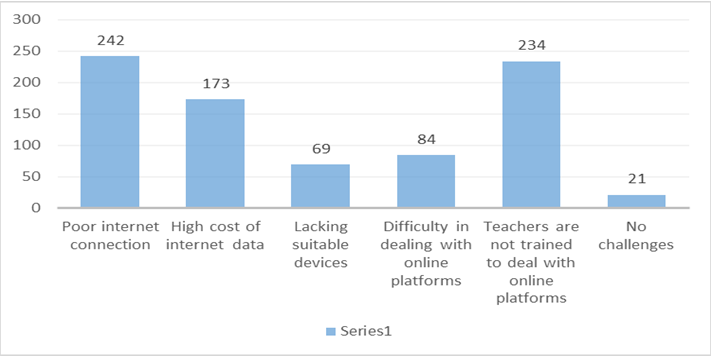
Regarding the general satisfaction status 38 (11.6%) of the students are satisfied with the online education experience, 172 (52.4%) are not satisfied and 118 (36%) are neutral.
142 (43.3%) preferred the traditional methods of learning (face-to-face) in the future, 134 (40.9%) preferred a blended approach between the two and 52 (15.9%) preferred an entirely online education.
| Frequency | Percent | Valid Percent | |
|---|---|---|---|
| Entirely online learning | 52 | 15.9 | 15.9 |
| Blended approach | 134 | 40.9 | 40.9 |
| Traditional learning (face-to-face) | 142 | 43.3 | 43.3 |
| Total | 328 | 100 | 100 |
Table 4: Student’s future preference.
Discussion
The continual rise and expansion of online course offerings as well as online academic and professional degree programs show that online education has established itself as a crucial component of higher education. Students can benefit from a wide selection of online learning possibilities in the majority of fields and disciplines, from individual online courses to comprehensive online undergraduate, certificate, and graduate programs. Thus, increasing studies about its effectiveness compared to traditional way of learning, and its challenges is a must.
The present study aimed to investigate the online education challenges faced by medical students during the current pandemic. Some of these challenges are online education challenges, student’s interaction with the teachers, and student’s satisfaction with online education.
In contrast to a study conducted at Alfaisal University’s College of Medicine in Riyadh, Saudi Arabia, which found that the challenges were communications, assessment, online education experience, technology use tools, time management, anxiety, and stress related to coronavirus disease, the results of this study showed that the students’ biggest challenges were a poor internet connection, a high cost of internet data, and the fact that teachers are not trained to deal with online platforms. Nevertheless, pupils praised the efficiency of online education during the pandemic [6].
Despite the fact that the majority of students thought that online learning was effective during the COVID-19 pandemic and that they would not prefer a “non-semester,” many students did not feel well prepared for practical courses based solely on online learning. These results are consistent with the literature [10, 11, 12]. Medicine, in addition to theoretical education, necessitates physical training and clinical patient care, necessitating “face-to-face” instruction. However, the benefits of online learning, such as time savings, ease of participation, cost effectiveness, and reduced time commitment, can be utilized to improve future medicine curricula.
The findings indicated that the main benefits of online education to students are the time and money saved from not having to travel, its flexibility, and the ability for students to learn at their own pace, which is consistent with literature[2]; however, these benefits may not apply to all forms of online education. Due to the absence of opportunities to connect with instructors, students may be put off by the limited synchronous components of pre-recorded lectures and tutorials [13]. Additionally, watching pre-recorded lectures while having the option of attending a live lecture has been demonstrated to have a negative correlation with learning performance [14].
Also, according to the study, medical students had internet connectivity issues as well as financial difficulties due to the high cost of internet data, which is comparable to the findings of a study conducted in Ghana by Eugene Adu Henaku [3]. Another study conducted by Mohammad Mahyoob on English learners revealed that the major challenges encountered by English language learners in online learning were technical issues as Some learners faced internet connectivity problems which is the same revelation of this study [15].
A study by Rajab revealed that there has been a positive impact of the COVID-19 pandemic on online medical education at Alfaisal University, an opposite to the finding of this thesis which may indicate a direct relation between the nation wealth and its effect on online medical education [6].
An interesting finding from the study of M Mobisha, et al. that even though the students have a personal laptop or mobile phone with high-speed mobile data and skills in operating them, they feel comfortable with traditional classroom teaching only. They prefer to be present in an actual classroom setting for better interaction, and understanding as well. An identical finding to our results [16].
Limitation of the study
To the authors knowledge this is the first study to look at the impact of COVID-19 on online education across Sudan, with responses from 6 medical schools. One of the strengths of this study is that the recruitment of a variety of medical students for survey distribution via a range of methods minimized potential response bias. However, this study also had some limitations.
Some medical schools may have been disproportionately represented with larger numbers of responses from some schools, for example Alneelain university, compared with University of medical sciences and technology, potentially skewing results due to sample bias. The study did not investigate the using of different online platforms. Further, some aspects of this survey depended on participants’ memory perhaps influencing their reporting, introducing elements of recall bias. Also the study was somehow a small scale as it only targeted 6 medical schools in Khartoum state
Conclusion
Within the limitation of this study, students showed a predominantly negative perspective on the implementation of online education, providing the chance to more investigation the challenges that encountered them and try to overcome it in the future. The study aims to explore and investigate online education challenges, and problems during COVID-19 encountered medical students in medical faculties in Khartoum state. The study found out that students encountered difficulties in regard to poor internet connection which encountered 242 (73%) of the participants. Furthermore, it reveals that the major challenges encountered by the students in online education were not only technical issues but also teachers related issues as 234 (71.3%) stated that the incompetence of teachers while dealing with online platforms was a major issue for them.
Recommendations
It is recommended that further research should be undertaken to understand the teachers’ views and experiences towards online education during the pandemic, to widen the view and knowing the whole scale of the challenges.
Declarations
• Research Ethics Approval and Participants Consent The study was approved by the Ethical Committee of the Federal Ministry of Health. Appropriate project information, including legally necessary data protection, had given to the participants. Their participation was voluntary and those who agreed signed an informed written consent. The data will be kept confidential and only used for the purposes of this study. All methods were performed in accordance with the relevant guidelines and regulations. The Ethical Committee of the Federal Ministry of Health approved all experimental protocols.
• Consent for Publication All authors give their consent for publication of identifiable details (tables, figures and text details), to be published in the journal.
• Availability of data and materials The dataset generated during and/or analyzed during the current study are available from the corresponding author on reasonable request.
• Competing Interests The authors declare that they have no known competing financial interests or personal relationships that could have appeared to influence the work reported in this paper.
• Authors Contribution Mustafa Sabir Abakar and Ezzan Kunna Kunna both wrote the main manuscript text and Mustafa Sabir Abakar prepared all tables and figures. All authors reviewed the manuscript.
References
-
Farooq F, Rathore FA, Mansoor SN (2020) Challenges of Online Medical Education in Pakistan During COVID-19 Challenges of Online Medical Education in Pakistan During COVID-19 Pandemic. J Coll Physicians Surg Pak 30(6): 67-69.
-
Dost S, Hossain A, Shehab M, Abdelwahed A, Nusair LA (2020) Perceptions of medical students towards online teaching during the COVID-19 sectional pandemic : a national cross survey of 2721 UK medical students. Medical Education and Training pp: 1-10.
-
Henaku EA (2020) COVID-19 : Online Learning Experience of College Students : The Case of Ghana COVID-19 : Online Learning Experience of College Students : The Case of Ghana. International Journal of Multidisciplinary Sciences and Advanced Technology 2: 54-62.
-
https://en.wikipedia.org/wiki/Online_learning_in_ higher_education
-
Alanezi YH (2020) Future of Mobile Learning During and After Global (Covid-19) Pandemic : College of Basic Education as Case. International Knowledge Sharing Platform 11(17): 1-12.
-
Rajab MH, Gazal AM, Alkattan K (2020) Challenges to Online Medical Education During the COVID-19 Pandemic. Cureus 12(7): e8966.
-
Yildiz EP, Alkan A, Esentepe K, Cengel M (2020) New Trends and Issues Proceedings on Humanities Current trends in education technologies research worldwide : Meta- analysis of studies between 2015 and 2020. New Trends and Issues Proceedings on Humanities and Social Sciences 7(1): 47-62.
-
Running head: Virtual Middle School Student Academic Achievement. 2016
-
Alturise F (2020) Evaluation of the Blackboard Learn Learning Management System for Full Online Courses in Western Branch Colleges of Qassim University. International Journal of Emerging Technologies in Learning 15(15): 33-51.
-
Schlenz MA, Schmidt A, Wöstmann B, Krämer N, Schulz Weidner N (2020) Students and lecturers perspective on the implementation of online learning in dental education due to SARS-CoV-2 ( COVID-1): a cross- sectional study. BMC Medical Education pp: 1-7.
-
Iyer P, Aziz K, Ojcius DM (2020) Impact of COVID-19 on dental education in the United States. J Dent Educ 84(6): 718-722.
-
Desai BK (2020) Clinical implications of the COVID-19 pandemic on dental. J Dent Educ 84(5): 512-512.
-
Keis O, Grab C, Schneider A, Öchsner W (2017) Online or face-to-face instruction ? A qualitative study on the electrocardiogram course at the University of Ulm to examine why students choose a particular format. BMC Medical Education pp: 1-8.
-
Zureick AH, Burk rafel J, Purkiss JA, Hortsch M (2017) The Interrupted Learner : How Distractions during Live and Video Lectures Influence Learning Outcomes. Anat Sci Educ 11(4): 366-376.
-
Mahyoob M (2020) Challenges of e-Learning during the COVID-19 Pandemic Experienced by EFL Learners. Arab World English Journal 11: 351-362.
-
Williams MM, Milon AM, Dennison MS (2021) An Online Survey to Estimate the Challenges in E- Learning in the Research Papers an Online Survey to Estimate the Challenges in E- Learning in the Southern Part of India During Covid-19 Induced Lockdown. ERIC 17(4): 35-43.
- Origin, Evolution, and Functional Impact of Short Insertion- Deletion Variants in Human Genomes: A Review
- Harnessing Molecular Glues for Next-Generation Vaccine, Cancer and Cardiovascular Disease Drug Development: A Comprehensive Review
- Lateral Cervical Epidermal Inclusion Cyst in a Paediatric Patient: A Rare Case Report
- Malarial Plasmodium Falciparum with Hepatitis B and C Virus Infections among Blood Donors in Ife Central Local Government Area, Ile Ife, Osun State, Nigeria
- Withanolides and Withaferin A- What’s next in Ashwagandha Research
- Designing of Dual Pulse Photoacoustic Tomography for Imaging of Drug-Response and Tumor Growth