
Contribution of Pharmacy Staff in Cotonou Pharmacies to the Management of Sexually Transmitted Infections with Urethral and/or Vaginal Discharge
Introduction: Sexually transmitted infections (STIs) remain a major public health issue worldwide. Some patients turn first to pharmacy staff for medicines. This study aims to assess the knowledge, attitudes and practices of pharmacy staff in Cotonou regarding STIs with urethral and/or vaginal discharge. Materials and Methods: This was a cross-sectional study with descriptive and analytical aims carried out on an exhaustive sample of pharmacy staff working in the pharmacies of Cotonou involved in the dispensing of medications. The data were collected and analysed using STATA version 15 software. Results: A total of 94 pharmacies with 732 people were included in the study. The average age of the respondents was 27.9 years. Females were the most represented (sex ratio = 0.4). Pharmacy assistants were the majority (81%). The average knowledge score was 11 ± 3.1, the average attitude score was 3.1± 1.4 and the average practice score was 6.8± 1.4. The overall knowledge- attitude- practice (KAP) level of pharmacy staff was average at 50.7%. Low KAP level was significantly associated with age, professional qualification, prior training or internships on STIs, and having received STI cases at the counter. Conclusion: The overall KAP score of pharmacy staff on STIs with urethral and/or vaginal discharge is average. This score is influenced by certain factors that need to be taken into account for the well-being of the population.
Fabrice Akpadjan1,2*, Hissein Ali3, Nadia Ntouala1, Laura Dotsop1, Blandine Omono1 and Hugues Adegbidi1,4
Keywords: STI; Urethral Discharge; Vaginal Discharge; Pharmacies; Cotonou
Abbreviations
STIs: Sexually transmitted infections; WHO: World Health Organisation; KAP: Knowledge; Attitudes and Practices.
Introduction
Sexually transmitted infections (STIs) are a constantly evolving reality and remain a major public health problem throughout the world [1]. The WHO estimates that there are 350 million new cases of STIs every year [2]. In 2020, the WHO estimated that 374 million people had contracted one of the following four STIs: chlamydia (129 million), gonorrhoea (82 million), syphilis (7.1 million) and trichomoniasis (156 million) [3]. Most of these infections can be diagnosed and treated easily [4]. It is only if they are not treated appropriately and at an early stage that they can lead to complications (infertility, maternal and neonatal mortality, etc.), sequelae and the risk of transmission to the partner(s), as well as other repercussions on the reproductive prognosis [4]. Most patients rely primarily on self-medication and pharmacy staff to obtain medicines. But the study of STIs falls within the field of venereology, which is a medical discipline in its own right. Dermatologists and venereologists are best placed to treat these infections. We therefore feel it is necessary to assess the knowledge, attitudes and practices of pharmacy staff in Cotonou pharmacies with regard to STIs with urethral and/or vaginal discharge, in order to provide appropriate solutions for improving the health of the population.
Materials and Methods
This was a cross-sectional study with descriptive and analytical aims, conducted over the period from September 2 to October 15, 2023. Sampling was exhaustive. All pharmacy staff working in pharmacies in Cotonou who were involved in dispensing medicines (pharmacists, pharmacists’ assistants and pharmacy auxiliaries) and agreed to answer the survey questionnaire were included.
The data were collected using a questionnaire based on a survey form comprising five sections: socio-demographic characteristics of the respondent, general data, knowledge, attitudes and practices (KAP). In the KAP section, knowledge was assessed by means of 18 questions. These questions covered definitions, aetiologies, means of transmission, clinical signs, paraclinical assessment, complications and means of prevention and treatment of STIs with urethral and vaginal discharge. Attitudes were assessed by means of 5 questions relating to staff perceptions of STIs with urethral and vaginal discharge. Practices were assessed by means of 9 questions relating to recommendations in practice (guidance and advice). The questions offered two possible answers: closed questions (yes or no, true or false and I don’t know) and multiple choice questions (several qualitative answers were proposed). Three scores were therefore created: a “Knowledge” score, an “Attitudes” score and a “Practices” score. Any correct answer was given a score of 1 and any wrong answer was given a score of 0. The score for each domain was the sum of the points obtained for each question in the domain in question.
To interpret the results, we drew on the model of Essi, et al. on the KAP survey in medical research [5]. The following were considered as: • Poor level: number of correct answers <50% • Insufficient level: number of correct answers between [50% - 65%] • Average level: number of correct answers between [66% - 85%] • Good level: number correct answers ≥85%.
The data were analysed using STATA version 15 software. Logistic regression was used to identify associated factors. The consent of each respondent was obtained. The anonymity and confidentiality of the data were respected.
Results
Socio-Demographic and General Data
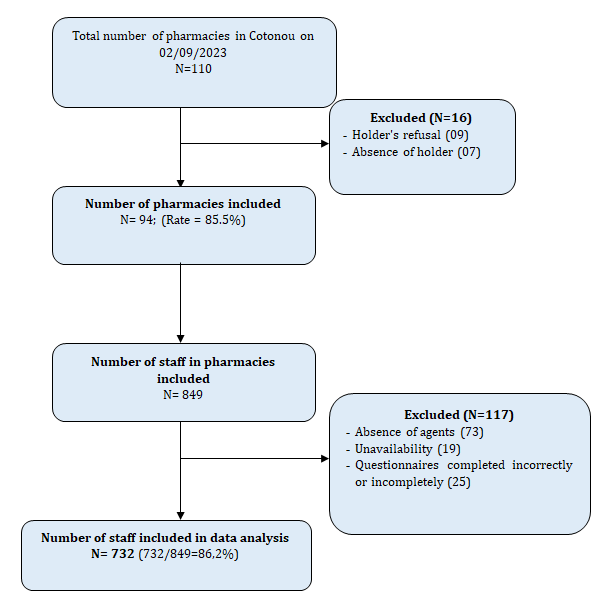
A total of 94 pharmacies were included in the study, and 732 people completed the survey questionnaire (Figure 1). The mean age was 27.9 years, with a standard deviation of 5.6. Females were predominant, with a sex ratio of 0.4. Pharmacy assistants were in the majority (81%), and staff with less than 10 years of experience were the most represented (91%). Table 1 presents some of the socio-demographic characteristics of the respondents. Of the 732 people surveyed, 87.4% said they had heard of STIs at least once before their medical studies. Table 2 shows other general data on STIs.
| Number | Frequency (%) | |
|---|---|---|
| Age (in years) | ||
| 20-29 | 541 | 73.9 |
| 30-39 | 152 | 20.8 |
| 40-49 | 33 | 4.5 |
| ≥ 50 | 6 | 0.8 |
| Sex | ||
| Female | 530 | 72.4 |
| Male | 202 | 27.6 |
| Professional qualification | ||
| Assistant | 103 | 14.1 |
| Pharmacy Assistant | 593 | 81 |
| Pharmacist | 36 | 4.9 |
| Number of years of experience | ||
| <10 | 667 | 91.1 |
| [10-20] | 57 | 7.8 |
| ≥ 20 | 8 | 1.1 |
| Country of diploma or training certificate issuance | ||
| Benin | 670 | 91.5 |
| Outside Benin | 62 | 8.5 |
Table 1: Distribution of pharmacy staff in Cotonou dispensaries by socio-demographic characteristics in 2023 (N=732).
| Number | Frequency (%) | |
|---|---|---|
| Having completed an internship or training on STIs (N=732) | ||
| No | 542 | 74 |
| Yes | 190 | 26 |
| If yes, at what point in your course? (n=190) | ||
| 1st year | 40 | 21.1 |
| 2nd year | 16 | 8.4 |
| 3rd year | 89 | 46.8 |
| 4th year | 53 | 27.9 |
| 5th year | 11 | 5.8 |
| 6th year | 190 | 100 |
| Duration in months (n=190) | ||
| 1 | 135 | 71.1 |
| 2 | 22 | 11.6 |
| 3 | 18 | 9.5 |
| 4 | 1 | 0.5 |
| 5 | 1 | 0.5 |
| Having participated in a PGE on STIs | ||
| No | 690 | 94.3 |
| Yes | 42 | 5.7 |
| Delay between the last PGE and the Survey (n=42) | ||
| <1 month | 31 | 73.8 |
| ≥1 month | 11 | 26.2 |
| Having received STI cases at the counter | ||
| No | 63 | 8.6 |
| Yes | 669 | 91.4 |
| Frequency (n=669) | ||
| <1 case per day | 382 | 57.1 |
| 1 to 5 cases per day | 283 | 42.3 |
| 6 to 10 cases per day | 4 | 0.6 |
| Age group of clients received for STIs (n=669) | ||
| [15 years to 30 years] | 553 | 82.7 |
| [31 years to 45 years] | 115 | 17.2 |
| ≥46 years | 1 | 0.1 |
| PGE: Postgraduate Education; STI: Sexually Transmitted Infection |
Table 2: Distribution of pharmacy staff in dispensaries in Cotonou according to some general data on STIs in 2023 (N=732).
Knowledge
- The majority of respondents gave a good definition of STIs with urethral discharge (65.3%) and vaginal discharge (62.8%).
- The bacterial origin of STIs with discharge was cited by the majority: 92.2% for urethral discharge and 91.3% for vaginal discharge.
- Almost all (99.2%) of those surveyed cited unprotected sex as the means of transmission of leaking STIs.
- The complication of STIs with urethral and vaginal discharge most frequently mentioned by respondents was sterility (97.1%).
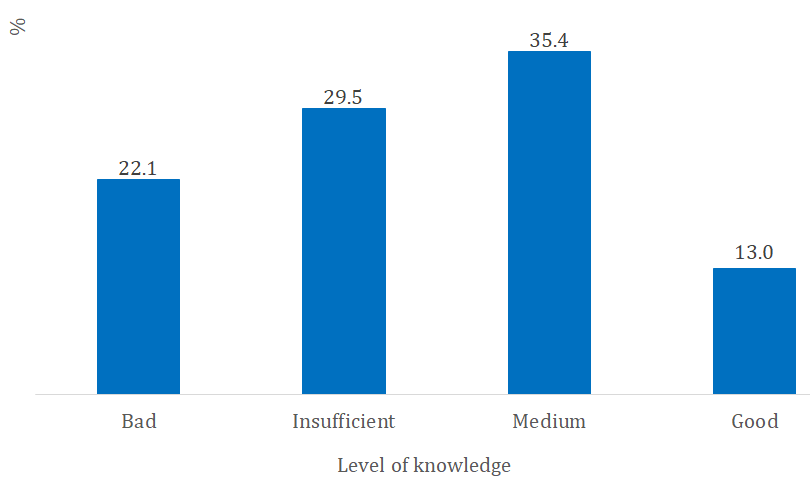
Out of a total score of 18 points, the respondents’ knowledge score varied from 1 to 17, with an average of 11 ± 3.1 points. Overall, the average level of knowledge was higher (35.4%), as shown in Figure 2.
Attitudes
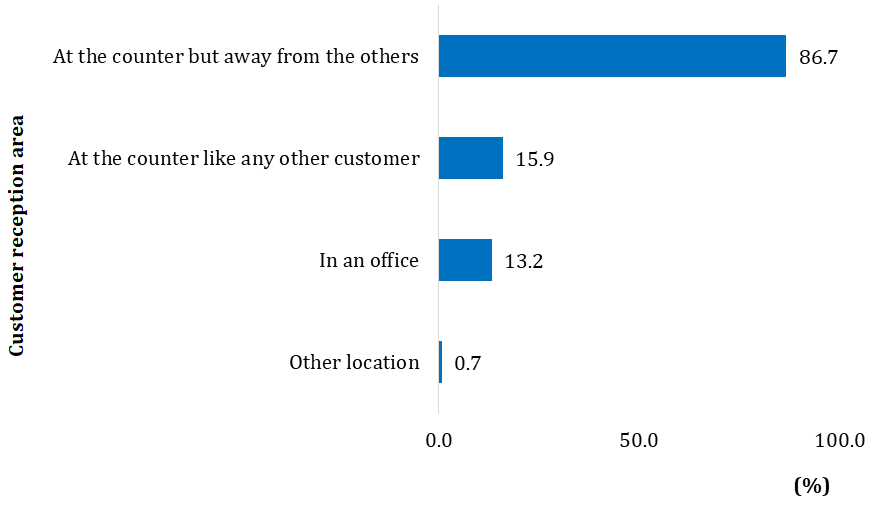
- Most of the respondents usually saw clients with STIs with urethral and vaginal discharge at the counter, but away from other clients (86.7%), as shown in Figure 3.
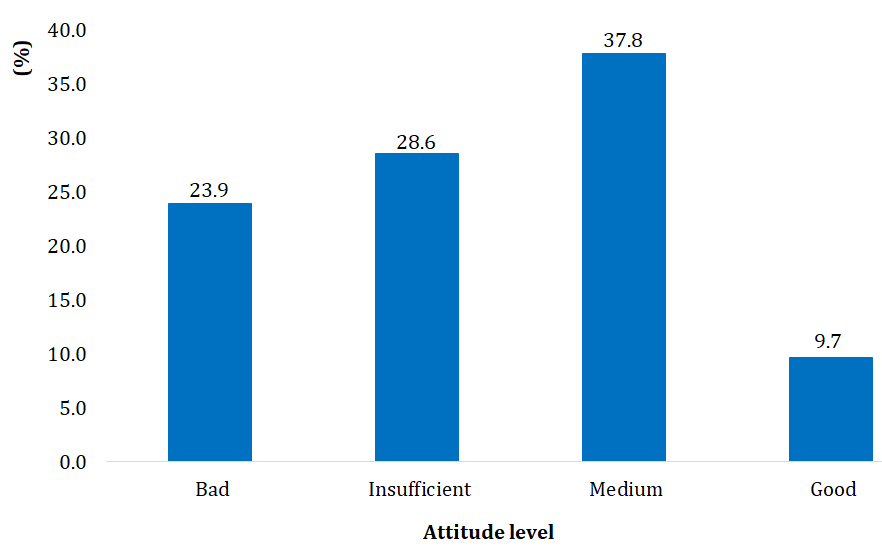
- Out of a total score of 5 points, the respondents’ attitude score on STIs with urethral and vaginal discharge varied from 0 to 5, with an average value of 3.1±1.4. Overall, 37.8% of respondents had an average attitude score for STIs with urethral and vaginal discharge. Figure 4 shows the respondents’ overall attitude score towards clients with STIs involving urethral and vaginal discharge.
Practices
Of the 732 people surveyed, 84.4% had already encountered customers complaining of urethral or vaginal discharge at the counter.
- The majority of customers complaining of urethral or vaginal discharge in pharmacies were seen by an assistant (83.5%).
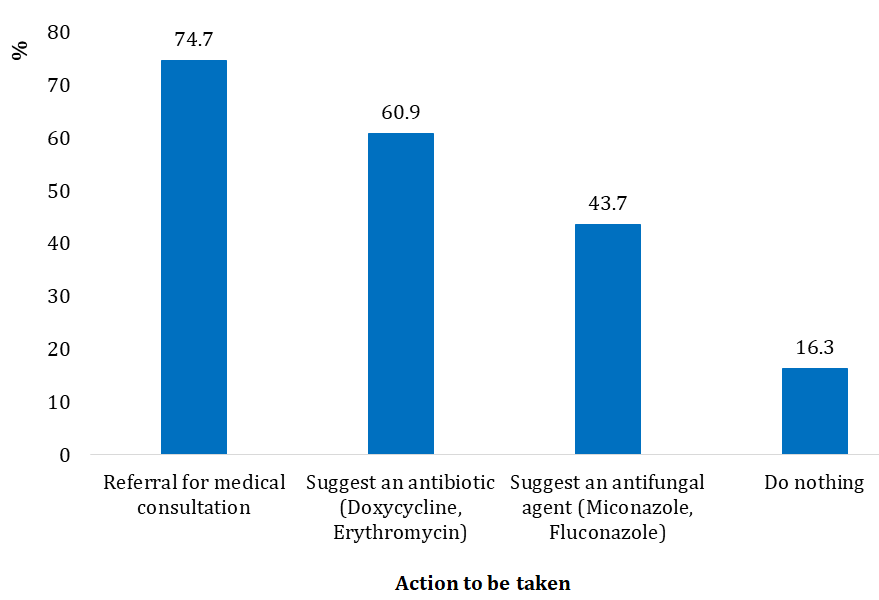
- When faced with customers complaining of urethral and vaginal discharge, 3 out of 4 respondents mentioned referring the customers for medical consultation. Figure 5 shows the distribution of respondents according to their behaviour when faced with a customer complaining of urethral or vaginal discharge.
- The dermatologist-venereologist is the 2nd most common specialist to whom pharmacy staff refers customers suffering from STIs, after urologists for urethral discharge and gynaecologists for vaginal discharge (Table 3).
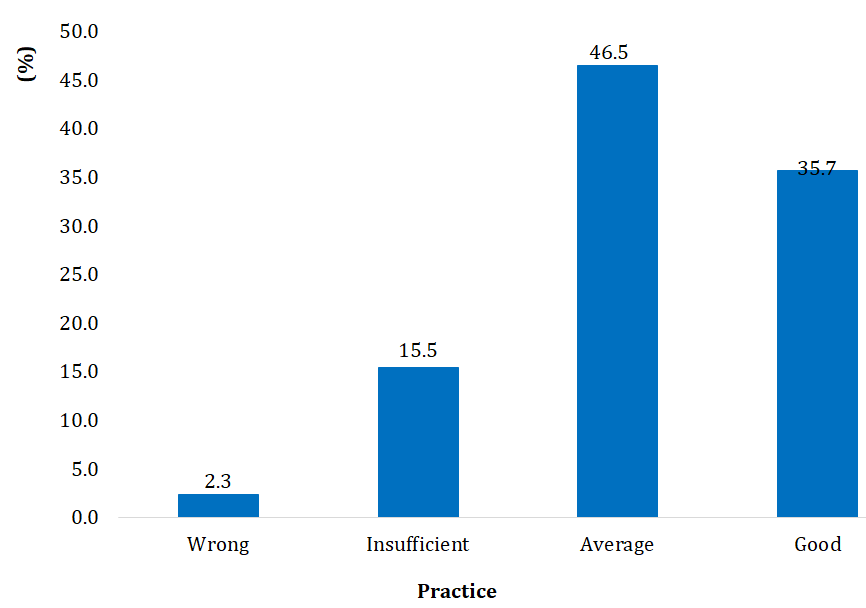
- Out of an expected total score of 9 points, the majority of pharmacy staff had an average score of 6.8±1.4 points. Figure 6 shows the distribution of respondents according to their practical score for customers with STIs involving urethral and vaginal discharge.
| n | % | |
|---|---|---|
| Specialist to refer a client suffering from urethral discharge | ||
| A urologist | 715 | 97.7 |
| A dermatologist-venereologist | 332 | 45.4 |
| A cardiologist | 57 | 7.8 |
| Other specialist to specify | 43 | 5.9 |
| Specialist to refer a client suffering from vaginal discharge | ||
| A gynecologist | 728 | 99.5 |
| A dermatologist-venereologist | 325 | 44.4 |
| A cardiologist | 54 | 7.4 |
| Other specialist to specify | 46 | 6.3 |
Table 3: Distribution of pharmacy staff in pharmacies in Cotonou according to referral specialist of customers suffering from ure
KAP (Knowledge, Attitudes and Practices) Overall
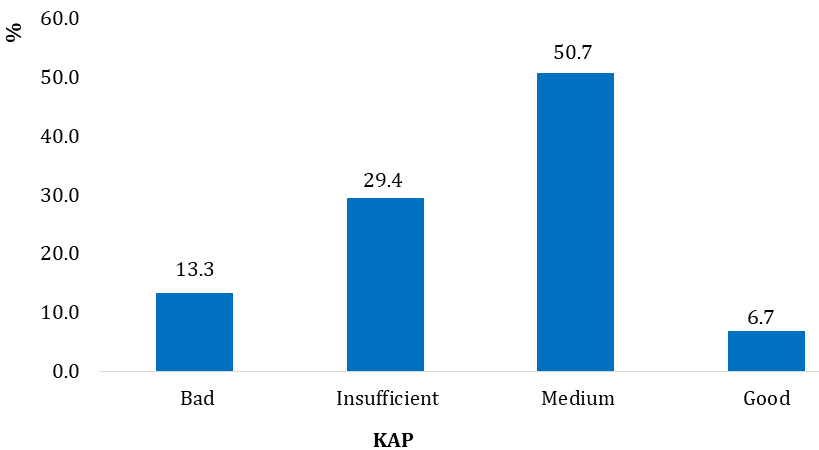
The overall KAP level of pharmacy staff was average for 50.7% of respondents, as shown in Figure 7.
Correlation between Level of Knowledge, Attitudes and Practices
There was a significant association between respondents’ level of knowledge and their attitudes (p<0.001) and practices (p<0.001). An increase in the knowledge score of the respondents was associated with an increase in the attitude score on the one hand, and in the practices score on the other, concerning STIs with urethral and vaginal discharge (Table 4).
| Parameters | Knowledge | Attitude | Practice | |
|---|---|---|---|---|
| Knowledge | Coefficient (r) | 1 | 0.066 | 0.013 |
| Knowledge | p | <0.001 | <0.001 | |
| Attitude | Coefficient (r) | 0.066 | 1 | -0.004 |
| Attitude | p | <0.001 | <0.001 | |
| Practice | Coefficient (r) | 0.013 | -0.004 | 1 |
| Practice | p | <0.001 | <0.001 |
Table 4: Correlation between scores for knowledge, attitudes and practices of pharmacy staff in Cotonou dispensaries on STIs with
Associated Factors
Using the correct KAP level as a reference, we identified the factors associated with the other KAP levels using multinomial logistic regression. Thus, the low KAP level was significantly associated with age, professional qualification, Age group (in years) <30 17.4 [5.5; 55.1] <0.001 12.3 [3.4; 44.4] <0.001 $$ \geq 3 0 \quad 1 \quad < 0. 0 0 1 \quad 1 \quad < 0. 0 0 1 $$ Gender Female 5.4 [2.6; 11.4] <0.001 Male 1 <0.001 Marital status STI training course and the fact of having received cases of STI at the pharmacy counter (Table 5). As for the average KAP level, associated factors were gender (p=0.042) and professional qualification (p<0.001). Women and pharmacy assistants therefore had an average KAP level compared to men and pharmacists and assistants (Table 6).
Bivariate binary logistic regression (Bad vs. Good) Multivariate binary logistic regression (Bad vs. Good) OR [95% CI OR] p OR [95% CI OR] p Single/Divorced/Widowed 6.5 [2.7; 15.5] <0.001 Married 1 <0.001 Professional qualifications Assistant 0.3 [0.0; 5.1] <0.001 0.1 [0.0 :2.9] <0.001 Pharmacy Assistant 95 [10.8; 837.2] 0.398 37.6 [3.1; 452.0] 0.193 Pharmacist 1 <0.001 1 0.004 Years of experience
1-3 2.2 [1.1; 4.4] 0.032 ≥4 1 0.032
Country of diploma or training certificate acquisition Benin 8.4 [2.6; 27.5] <0.001
| Outside Benin | 1 | <0.001 | ||
|---|---|---|---|---|
| STI training course | ||||
| No | 20.2 [7.4; 55.0] | <0.001 | 11.0 [3.7 ; 33.3] | <0.001 |
| Yes | 1 | <0.001 | 1 | <0.001 |
| Postgraduate education/Training on STIs | ||||
| No | - | 0.972 | ||
| Yes | - | |||
| Having received STI cases at the counter | ||||
| No | 14.1 [1.8; 107.8] | 0.011 | 41.0 [4.5 ; 376.0] | 0.001 |
| Yes | 1 | 0.011 | 1 |
Table 5: Factors associated with the poor KAP level of pharmacy staff in Cotonou pharmacies for STIs with urethral and vaginal di
Bivariate binary logistic regression (Average
vs. Good)
Multivariate binary logistic regression
(Average vs. Good)
OR [95% CI OR]
p
OR [95% CI OR]
p
Age group (in years)
<30
1.7 [0.9; 3.1]
$$
\begin{array}{l l l} < 3 0 &
$$ \begin{array}{l l l} < 3 0 & 1. 7 [ 0. 9; 3. 1 ] & 0. 0 9 8 \\ \geq 3 0 & 1 & 0. 0 9 8 \\ \hline \hline \text {Gender} \\ \text {Female} & 3. 9 [ 2. 1; 7. 2 ] & < 0. 0 0 1 \\ \hline \end{array} $$
3.9 [2.1; 7.2]
<0.001 2.0[1.1; 3.9] 0.042 Male 1 <0.001 1 Marital status Single/Divorced/Widowed
1.3 [0.7; 2.3]
0.466 Married 1 0.466 Professional qualifications Assistant
0.8 [0.3; 1.9]
<0.001 0.7[0.3 :1.7] <0.001 Pharmacy Assistant
95 [10.8; 837.2]
0.596 Yes 1 0.596 Table 6: Factors associated with the average KAP level of pharmacy staff in Cotonou pharmacies for STIs with urethral and vaginal discharge in 2023 (bivariate and multivariate analysis).
Discussion
General Information
Of the 110 pharmacies in Cotonou, we conducted our survey in 94 pharmacies, with a rate of 84.45%. This participation rate of pharmacies in a scientific study is comparable to that of Badoum G, et al. [6] on the attitude of community pharmacists in dispensing asthma medications in Burkina Faso, where the participation rate was 82.4%. Most of the people surveyed were young, with the 20-29 age groups the most represented (73.9%). This youthfulness of pharmacy staff was also revealed by Traore D [7] in his study of the problem of selling medicines in Mali, the case of the peripheral municipality of Kalaban-Coro in 2010, where more than half of those surveyed were aged between 21 and 30.
We noted a predominance of women (72.4%) with a sex ratio (male/female) of 0.4. Ganfon H, et al. [8] in their study on the knowledge and practices of malaria management by private pharmacy staff in five large cities in Benin, Burkina Faso and Mali in 2014, found a sex ratio in Benin of 0.53. This result is close to ours. This can be explained by the fact that women are more welcoming and are not very demanding when it comes to salary. They are content with little to meet their needs, and are therefore relatively more recruited in pharmacies. Pharmacy assistants were in the majority in our study (81%). Bouraima F, et al. [9] found a similar result (86.05%). The same finding was made by Mbow F, et al. [10] in their study on “private pharmacies in the provision of family planning services in Senegal”, with a participation rate of 66.7% of auxiliaries. This can be explained by the fact that pharmacies recruit more auxiliaries than assistants, because auxiliaries are paid less than assistants.
People with less than 10 years of seniority were the most represented (91.1%). Mbow F, et al. [10] found that 55.1% of respondents had less than 10 years’ experience. This result is also close to that of Barry M [11] in his study on “Management of sexually transmitted infections, contribution of private pharmacies in Ouagadougou”, where he found that 58.82% of respondents had less than 5 years of experience.
Of those surveyed, 91.4% said they had received cases of STIs at the counter. Barry M [11] found a similar result, with 91.25% of pharmacists and 99.5% of auxiliaries in the city of Ouagadougou stating that they had received STI patients in their pharmacies. This result proves that patients with STIs visit pharmacies before going for a medical consultation.
Knowledge
Our study revealed that most pharmacy staff does not have a good level of knowledge about STIs involving urethral and vaginal discharge. The means of transmission of leaking STIs cited by almost all respondents was sexual intercourse. Similarly, the use of condoms during sexual intercourse was mentioned as a means of preventing these STIs. In Barry’s study [11], sexual intercourse was also cited by the majority of respondents (91.85%). Most of them (69.70%) also said that condoms were a means of preventing STIs. In principle, pharmacy staff with a good knowledge of the means of transmission and prevention of STIs should play an important role in preventing STIs in pharmacies by raising awareness.
Attitude
Overall, 37.8% of respondents had an average attitude to STIs with urethral and vaginal discharge. The majority of respondents usually received customers with urethral and vaginal discharge at the counter, but away from other customers. A customer who comes to the pharmacy for advice on an STI should preferably be welcomed in a confidential area; this area should be large, with space for communication. The questioning carried out in the event of a spontaneous request must be as discreet as possible [12]. However, at the time of the survey we noted that some pharmacies did not have a sufficiently large space. Customers suffering from urethral discharge should be given preferential treatment in an office. However, 12.7% of respondents said that they received customers suffering from urethral and vaginal discharge in an office. Barry M [11] found a slightly lower result; 65% of staff said they received clients with STIs at the counter and 25% of staff said they received clients with STIs in a consulting room. This may be explained by the fact that pharmacies in Ouagadougou have a consultation room reserved for patient counselling. Tran B, et al. [13] in their study on the “management of sexually transmitted infections in private pharmacies in Hanoi in 2014”, had reported that the simulated patient (false patient) was welcomed at the counter in front of the other customers without any space for confidentiality.
Practice
Respondents’ experience of STIs with discharge was generally average in 46.5% of cases and good in 35.7%. Customers complaining of urethral or vaginal discharge were generally seen in pharmacies by assistants (83.5%) or full pharmacists (79%).
The majority of respondents said they would prefer to refer a customer complaining of urethral or vaginal discharge to a medical centre (91.4%). This proves that pharmacy staff has a good knowledge of their limits and of the best way to deal with customers suffering from STIs. Dermatologists and venereologists are the second most common specialists to whom pharmacy staff refers customers suffering from STIs with urethral or vaginal discharge. This shows that most people are unaware of the role of dermatologists in the treatment of STIs. In fact, a dermatologist is also a venereologist, and is therefore trained to treat all STIs. Information campaigns aimed at pharmacy staff needs to be launched.
However, a large number of respondents preferred to offer antibiotics or antifungals to customers complaining of urethral and vaginal discharge. Tran B, et al. [13] found that in 86% of cases of genital discharge, treatment was offered by pharmacy staff. This result shows that pharmacy staff is giving the usual and inappropriate drug advice in pharmacies, even though they are not qualified to prescribe antibiotics. This means that in 2023, pharmacies in Cotonou will continue to dispense antibiotics to the public without a prescription, despite the measures taken by Benin’s health authorities to ensure that antibiotics are dispensed only on prescription.
Correlation and Associated Factors
An increase in the knowledge score of the respondents was associated with an increase in the attitude score on the one hand and in the practice score on the other for STIs with discharge Low KAP level was significantly associated with age, professional qualification, STI training course and having received STI cases at the pharmacy counter. Respondents aged fewer than 30 were 12.3 times more likely to have a poor KAP level than those aged 30 or over. This result can be explained by the fact that older respondents have more experience, which enables them to have good attitudes and practices when dealing with customers, particularly customers with STIs. Pharmacy assistants were 37.6 times more likely to have a poor KAP than pharmacists and assistants. This result can be explained by the fact that pharmacists and assistants have received good training during their schooling, which also enables them to adopt good attitudes and practices. Respondents who had not attended an STI training course were 11 times more likely to have a low KAP score than those who had. Also, respondents who did not have the opportunity to see customers suffering from STIs at the pharmacy counter were more likely to have a poor KAP score compared to others. We can therefore deduce the need to provide ongoing training to pharmacy staff so that they can contribute effectively to the management and prevention of STIs in our underdeveloped countries.
Conclusion
The overall KAP score for pharmacy staff was average in 50.7% of cases. This score is influenced by certain characteristics that need to be taken into account in decisions to improve the situation. This study has shown that patients suffering from STIs visit pharmacies in Cotonou. Most of these patients are seen at the counter. Most of the staff offers these patients treatment, particularly antibiotics. A large proportion of staff is unaware of which specialist to refer STI patients to. It is vital for staff to be trained and retrained to update their knowledge of STIs, in order to improve the STI care circuit, particularly in terms of referrals and advice. The health authorities must take a number of measures and implement them to put a stop to certain practices, in particular the dispensing of anti-infective drugs without a prescription to customers with STIs, as this practice can lead to complications from STIs and probable resistance from the germs concerned.
Conflict of Interest
The authors declare no conflict of interest.
References
-
World Health Organization (2005) Guide pour la prise en charge des infections sexuellement transmissibles [En ligne]. Organisation mondiale de la sante, pp: 105.
-
Organisation mondiale de la sante (2016) Strategie mondiale du secteur de la sante contre les infections sexuellement transmissibles 2016-2021 [En ligne]. Geneve, pp: 64.
-
Organisation mondiale de la sante (2022) Strategies mondiales du secteur de la sante contre respectivement, le VIH, l’hepatite et les IST pour la periode 2022 a 2030. Geneve: OMS, pp: 136.
-
Agossa C (2006) Prevalence et facteurs de risque des infections genitales a Neisseria gonorrhoeae et Chlamydia trachomatis chez les travailleuses de sexe au Benin en 2003-2004 et evaluation d’un test rapide dans le depistage de la gonococcie genitale [En ligne]. [Memoire]. Quebec: Universite LAVAL-Faculte de Medecine, pp: 112.
-
Essi M, Njoya E (2013) CAP (Connaissances, Attitudes, Pratiques) en Recherche Medicale. Health Sci Dis 14(2) : 1-3.
-
Badoum G, Toloba Y, Thiombiano R, Ouedraogo G, Ouedraogo M (2015) Attitude du pharmacien d’officine dans la dispensation des medicaments de l’asthme. Rev Mal Respir 32(1): 18‑23.
-
Traore D (2010) Problematique de la vente des medicaments au Mali. Cas de la Commune peripherique de Kalaban-Coro. [These de Doctorat en pharmacie]. [Bamako]: Faculte de Medecine, de Pharmacie et D’Odonto-Stomatologie, pp: 75.
-
Ganfon H, Diallo T, Nanga C, Coulibaly N, Benao V, et al. (2017) Private pharmacy staff in five main towns in Benin, Burkina Faso, and Mali: knowledge and practices concerning malaria care in 2014. Medecine Sante Trop 27(2): 164‑169.
-
Bouraima F, Koukouroum A, Djibril S, Santos A, Avakoudjo F, et al. (2022) Connaissances et Pratiques des Pharmaciens et Auxiliaires des Officines de Pharmacie de la Ville de Parakou Face aux Topiques Auriculaires en 2021. Eur Sci J ESJ 10(4): 176‑190.
-
Mbow F, Nai D, Dwyer S, Jain A, Mane B (2019) Les pharmacies privees dans l’offre de services de planification familiale au Senegal : Une etude pilote [En ligne]. Population Council, pp: 41.
-
Barry M (2003) Prise en charge des infections sexuellement transmissibles: contribution des officines pharmaceutiques privees de Ouagadougou 2003 [En ligne]. [These de Doctorat en pharmacie]. Universite de Ouagadougou-Unite de Formation et de Recherche en Sciences de la Sante (UFRISDS) Section Pharmacie, pp: 149.
-
Fougere E, Lasry S (2021) Prise en charge des infections sexuellement transmissibles a l’officine. Actual Pharm 60(608): 16‑18.
-
Tran B, Khlue P, Strobel M (2014) Prise en charge des infections sexuellement transmissibles dans les pharmacies privees a Hanoi. Sante Publique 26(4): 491- 498.
- Epithelioid Granuloma; 3cases with Different Clinical Features
- Advancing Representation in Dermatology Clinical Trials: Ethical, Scientific, and Regulatory Imperatives for Inclusion Across all Fitzpatrick Skin Types
- A Case of Atopic Dermatitis with Concurrent Psoriasis Vulgaris: Successful Treatment with Upadacitinib
- Innovation Lifting Eyeshadow: A Synthesis of Makeup and Optical Illusion
- Distinguishing Superficial Actinic Porokeratosis from Actinic Keratosis with UVF Dermoscopy: A Case Report
- High Mobility Group Box 1 (HMGB1) in Cutaneous Inflammation: An Immune Modulator Bridging Cellular Stress, Ferroptosis and Danger Signaling