
Increased Risk of Covid-19 Related Death among Cancer Survivors: A Real-World Data Study
The coronavirus disease 2019 (COVID-19) has maintained a massive impact on global public health and the economy during pandemic. Increased risk of COVID-19 related death has been reported among cancer survivors. However, due to limited sample size in those studies, to what extent the previous cancer diagnosis may play a role in the determination of COVID-19 related death is still unclear. Using aggregated real-world data extracted from TriNetx electronic medical record data from 34 hospitals around the United States, we intended to fill the gap by assessing the relationship between prior cancer diagnosis in the past 5 years and COVID-19 related death within one month after the diagnosis of virus contraction. Our data showed significant increased COVID-19 related death among cancer survivors. The elevated risk was particularly evident among those who had cancers in respiratory, digestive tract, and blood.
Introduction
The coronavirus disease 2019 (COVID-19) has maintained a massive impact on global public health and the economy during pandemic. From March 2020 to October 2021, COVID-19 is the third leading cause of death after heart disease and cancer in the United States. The pandemic may also have indirectly led to increases in other causes of death, including heart disease, diabetes, Alzheimer disease, and unintentional injuries [1, 2, 3]. Increased risk of COVID-19 related death has been reported among cancer survivors. However, due to limited sample size in those studies, to what extent the previous cancer diagnosis may play a role in the determination of COVID-19 related death is still unclear. To fill the gap, we comprehensively examined the relationship between cancer status and COVID-19 related death among cancer survivors.
Methods
Data Source
TriNetX is a cloud-based federated network which aggregated de-identified longitudinal clinical data directly from the electronic medical records (EMRs) of the participating hospitals HCOs continuously. TriNetX allows real-time access to these aggregated real-world data along with the analytics to analyze research questions. TriNetX received a waiver from Western IRB since only statistical summaries of de-identified information, but no protected health information was included. In this study, we applied the searching criteria suggested by Zhao H, et al. [4] to search TriNetx electronic medical record data from 34 hospitals around from January 20th to May 4th, 2020, and identify COVID-19 cases and collect patient characteristics (e.g. cancer status, demographics, other chronic diseases). As the first case in U.S. was recorded on January 20th, we set the time period as from January 20th to May 4th, 2020. The outcome variable was death within a month after the COVID-19 diagnosis.
Statistical Analysis
In this study, we intend to examine the relationship between cancer status and COVID-19 related death among cancer survivors. The statistical tool embedded in TriNetx was used. Each patient characteristic variable, pre-existing chronic diseases, outcome variable (death), were treated as the categorical variable. First, we use the univariate analysis to calculate risk ratio (RR) to examine the association between all cancers and COVID-19 related death among COVID-19 patients. Stratified analyses by race, gender and cancer type were performed.
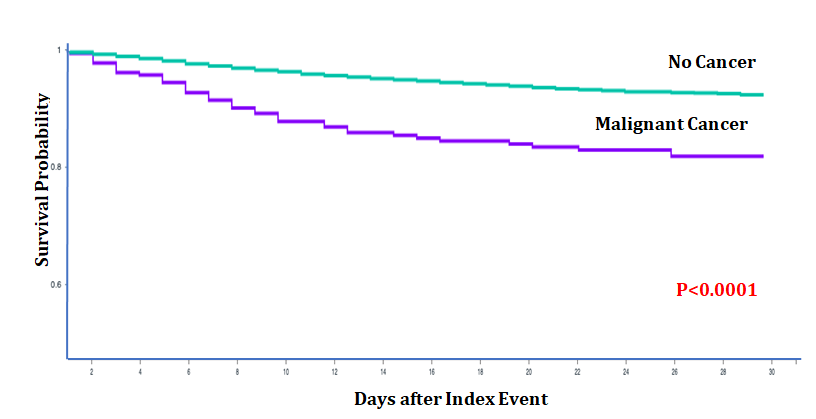
Propensity score matching was applied to adjust potential covariates, including demographics (e.g., age, gender, race), and pre-existing common chronic diseases [e.g., obesity, diabetes, hypertension, heart disease, asthma, chronic obstructive pulmonary disease (COPD), and chronic kidney disease (CKD)]. Additionally, we applied Kaplan- Meier analysis to evaluate the differences in survival between patients with malignant tumors and patients with no cancer.
Results
Our retrospective cohort included a total of 24,534 patients aged 18-80 years old who were diagnosed with COVID-19 from January 20th to May4th, 2020. First, we examined the association between all cancers and COVID-19 related death among COVID-19 patients (Table 1). Among the COVID-19 patients identified, 3,619 were cancer survivors with prior cancer diagnosis in the past 5 years. Death rate is much in cancer survivors compared to patients with no cancer. Among them, 4.53% of all patients, 3.69% of pts with no cancer, and 9.40% of cancer survivors die within 1 month after the diagnosis of virus contraction, respectively. In the univariate analysis, we found that cancer patients had 2.55- fold increased risk ratio (RR) of death than those without cancer. After the adjustment of demographics including age, gender and race, the risk was decreased, but still significant. The risk ratio was 1.46. Given that patient characteristics were associated with COVID-19-related death, we attempted to adjust them using 1 to 1 propensity score matching. The matching criteria included age of diagnosis, gender, race, obesity, diabetes, hypertension, heart disease, asthma, COPD, and CKD as appropriate (Table 1). After the adjustment of these demographics and other pre-existing chronic diseases, the risk was decreased, but still significant. The risk ratio was 1.42. Next, we performed the survival analysis using Kaplan- Meier estimate (Figure 1). Survival time here was the time from the date of COVID-19 diagnosis to patient death. The Kaplan-Meier survival curve showed that cancer survivors and COVID-19 patients with no cancer had statistically significant difference in the survivals (P<0.0001). Cancer survivors had worse survival rates compared to COVID-19 patients with no cancer.
| Total | Patients with No Cancer | Patients with Malignant Tumors | |
|---|---|---|---|
| Number of COVID-19 patients | 24,534 | 20,915 | 3,619 |
| Death ratio | 4.53% | 3.69% | 9.40% |
| Risk ratio* | 1 | 2.55 (2.25, 2.88) | |
| Number of Death | 1,112 | 772 | 340 |
| Death ratio | 4.53% | 3.69% | 9.40% |
| Risk ratio# | 1.1 | 1.46 (1.24, 1.71) | |
| P value | <0.001 | ||
| Risk ratio* | 1 | 2.55 (2.25, 2.88) | |
| P value | <0.001 |
Table 1: ** Association between All Cancers and COVID-19 Related Death among COVID-19 Patients.
*. Univariate Analysis. #. Adjusted by Age, Gender, and Race. $. Adjusted by Age, Gender, Race, Obesity, Diabetes, Hypertension, Heart Disease, Asthma, COPD, and CKD. Table 1: Association between All Cancers and COVID-19 Related Death among COVID-19 Patients.
After that, we further assessed the relationship between selected cancers and COVID-19 related death among COVID-19 patients (Table 2). When stratified by cancer sites, significant associations were observed between respiratory, oral, digestive, breast, male genital, urinary, blood, and skin cancers with COVID-19 related death in the univariate analysis. The most significant cancer site was respiratory cancer with a risk ratio of 6.49. After the adjustment of demographics and other pre-existing chronic diseases, the significant associations were remained for respiratory, digestive, and blood cancers (RR=1.89; RR=1.59; RR=2.08, respectively). Lastly, we examined the associations between death with race and gender among cancer patients contracting COVID-19 (Table 3). When stratified by gender and race, we found that male cancer survivors had higher risk of death than female with a risk ratio of 1.77. After the adjustment of demographics and other pre-existing chronic diseases, the significant associations were remained. However, the risk ratio didn’t show statistically significant difference between Blacks and Whites.
| Total Number | Death Rate | Risk Ratio* | P value | Risk Ratio$^5$ | P value | |
|---|---|---|---|---|---|---|
| No Cancer | 20,915 | 3.69% | 1 | 1 | ||
| Respiratory Cancers | 284 | 23.94% | 6.49 (5.21, 8.07) | <0.001 | 1.89 (1.31, 2.73) | 0.001 |
| Oral Cancer | 71 | 14.09% | 3.82 (2.14, 6.81) | <0.001 | 1.00 (0.44, 2.25) | 1 |
| Digestive Tract Cancer | 366 | 14.75% | 4.00 (3.10, 5.16) | <0.001 | 1.59 (1.06, 2.38) | 0.023 |
| Breast Cancer | 366 | 5.74% | 1.55 (1.02, 2.37) | 0.04 | 1.05 (0.58, 1.90) | 0.872 |
| Female genital Cancer | 153 | 6.54% | 1.77 (0.97, 3.24) | 0.064 | 1.00 (0.43, 2.33) | 1 |
| Respiratory Cancers | 284 | 23.94% | 6.49 (5.21, 8.07) | <0.001 | 1.89 (1.31, 2.73) | 0.001 |
| Oral Cancer | 71 | 14.09% | 3.82 (2.14, 6.81) | <0.001 | 1.00 (0.44, 2.25) | 1 |
| Digestive Tract Cancer | 366 | 14.75% | 4.00 (3.10, 5.16) | <0.001 | 1.59 (1.06, 2.38) | 0.023 |
| Breast Cancer | 366 | 5.74% | 1.55 (1.02, 2.37) | 0.04 | 1.05 (0.58, 1.90) | 0.872 |
| Female genital Cancer | 153 | 6.54% | 1.77 (0.97, 3.24) | 0.064 | 1.00 (0.43, 2.33) | 1 |
Table 2: Association between Selected Cancers and COVID-19 Related Death among COVID-19 Patients.
*. Univariate Analysis. $. Adjusted by Age, Gender, Race, Obesity, Diabetes, Hypertension, Heart Disease, Asthma, COPD, and CKD. Table 2: Association between Selected Cancers and COVID-19 Related Death among COVID-19 Patients.
| Number | Death | risk ratio* | P value | risk ratio# | P value | Risk ratio$^5$ | P value | |
|---|---|---|---|---|---|---|---|---|
| By race | ||||||||
| White | 826 | 79 | 1 | 1 | 1 | |||
| Black | 2,346 | 241 | 1.08 (0.85, 1.37) | 0.536 | 1.18 (0.88, 1.59) | 0.2754 | 1.06 (0.79, 1.42) | 0.68 |
| By gender | ||||||||
| Female | 1,968 | 137 | 1 | 1 | 1 | |||
| Male | 1,651 | 203 | 1.77 (1.44, 2.17) | <0.001 | 1.59 (1.28, 1.97) | <0.0001 | 1.41 (1.12, 1.78) | 0.003 |
Table 3: ** Associations between Death with Race and Gender Among Cancer Patients Contracting COVID-19.
*. Univariate Analysis. #. Adjusted by Age, Gender, And Race. $. Adjusted by Age, Gender, Race, Obesity, Diabetes, Hypertension, Heart Disease, Asthma, COPD, and CKD. Table 3: Associations between Death with Race and Gender Among Cancer Patients Contracting COVID-19.
Discussion and Conclusion
In the study, we reported the significant increased COVID-19 related death among cancer survivors. The elevated risk was particularly evident among those who had cancers in respiratory, digestive tract, and blood. As expected, the most significant cancer site was respiratory cancer, which includes cancers of the lung, larynx, trachea, and bronchus. Respiratory failure in COVID-19 contraction is a common feature in fatal cases and has been considered as a failure of the immune system to control the virus. Additionally, we found that male cancer survivors contracting COVID-19 were found to have higher risk of death than female cancer survivors.
Delayed treatment, COVID-19 related comorbidities, and reduced immunocompetence of cancer patients may play roles in the increased COVID19-related death among cancer patients. COVID-19 related comorbidities and older age are related to worse prognosis among COVID-19 patients [2]. Hypertension, cardiovascular disease, and diabetes were the most common comorbidity in patients death due to COVID-19. However, significant increased COVID-19 related death among cancer survivors persist even we adjust these covariates in the analysis. Cancer care has frequently been delayed or altered due to system- and patient-level factors related to the COVID-19 pandemic [5]. For example, recent data showed that half of European breast centers altered systemic treatments and one-fifth of breast cancer patients experienced delay in radiation therapy during the pandemic. Additionally, recent study confirms that immunocompromised patients more likely to die if hospitalized with COVID-19 [6]. Immune system of cancer patients can be compromised through multiple means, including immune suppression by the tumor and by therapies such as chemotherapy and radiation. Studies also showed that impairment of immune system after cancer treatment can last a long time. Further investigation in the factors contributing to the increased COVID19-related death among cancer patients, is needed. The strengths of this study included the large COVID-19 patient population around the U.S., and the utilization of real-time data. This study has some limitations. No individual level data and advanced data analysis tools were available at TriNetx. Nevertheless, findings from this study shed light on the importance of previous cancer diagnosis in the determination of COVID-19 related death. Additional research, particularly addressing the limitations mentioned above, is warranted to validate our findings, and further clarify the increased risk of COVID-19 related death among cancer survivors.
Acknowledgement
The project described was supported by CTSA award No. UL1TR002649 from the National Center for Advancing Translational Sciences. Its contents are solely the responsibility of the authors and do not necessarily represent official views of the National Center for Advancing Translational Sciences or the National Institutes of Health.
References
-
Shiels MS, Haque AT, González AB, Freedman ND (2022) Leading Causes of Death in the US During the COVID-19 Pandemic, March 2020 to October 2021. JAMA Intern Med 182(8): 883-886.
-
Murphy SL, Kochanek KD, Xu J, Arias E (2021) Mortality in the United States, 2020. NCHS Data Brief (427): 1-8.
-
Shiels MS, Haque AT, Haozous EA, Albert PS, Almeida JS, et al. (2021) Racial and Ethnic Disparities in Excess Deaths During the Covid-19 Pandemic, March to December 2020. Ann Intern Med 174(12): 1693-1699.
-
Zhao H, Fuemmeler B, Adera T, Leung E, Bacanu SA, et al. (2020) Patient Characteristics and Pre-Existing Chronic Diseases with COVID-19 Related Outcomes: A Real- World Experience. Biomedical J of Scientific & Technical Res 31(3).
-
Gasparri ML, Gentilini OD, Lueftner D, Kuehn T, Person OK, et al. (2020) Changes in Breast Cancer Management During the Corona Virus Disease 19 Pandemic: An International Survey of the European Breast Cancer Research Association Of Surgical Trialists (EUBREAST). Breast 52: 110-115.
-
Turtle L, Thorpe M, Drake TM, Swets M, Palmieri C, et al. (2023) Outcome of COVID-19 in Hospitalised Immunocompromised Patients: An Analysis of the WHO ISARIC CCP-UK Prospective Cohort Study. PLOS Medicine 20(1): e1004086.
- Epidemiological Surveillance and Rumors on Social Media
- Awareness and Treatment of Uncontrolled Hypertension in US Overweight/Obese Youths Aged 16–24 Years, NHANES 2021–2023
- Strengthening EPI Through Parental Engagement: Lessons from Dhaka Slums for IA-2030
- Mothers Knowledge of the Prevalence, Causes, Effects, Prevention and Control of Diarrhoea among Children in Ife East Local Government Area, Ile Ife, Osun State, Nigeria
- Covid-19 Reinfections Case Series from October 2023 to October 2024 in A General Medicine Office in Toledo (Spain)
- Water Contact! One Risk Too Many: Risk Factors Associated with Schistosoma haematobium infection in Osun State, Nigeria