
Mothers Knowledge of the Prevalence, Causes, Effects, Prevention and Control of Diarrhoea among Children in Ife East Local Government Area, Ile Ife, Osun State, Nigeria
Background: Childhood diarrhea remains a significant public health concern, especially in developing countries. This study aimed to investigate the prevalence, risk factors, and preventive practices associated with childhood diarrhea in Ife East Local Government Area, Ile Ife, Osun State. Methods: A cross-sectional study was conducted among two hundred (200) mothers with majority of the children in aged 5-7 years. Data were collected using a structured questionnaire, covering socio-demographic characteristics, diarrhea history, hygiene practices, vaccination status, and perceived knowledge of diarrhea. Results: The majority of participants were aged 26-30 years, married, and had secondary school education. Approximately 27% of children had experienced diarrhea in the past, and 20% had diarrhea within the past year. A significant proportion (11.5%) of children had been hospitalized due to diarrhea. Poor access to clean water and inadequate sanitation were identified as major risk factors. Consumption of undercooked or spoiled food, particularly meat, seafood, and eggs, was associated with increased diarrhea risk. Poor hygiene practices, including infrequent hand washing and improper food storage, were also linked to diarrhea. Most mothers had a basic understanding of diarrhea and its prevention methods. However, there were gaps in knowledge regarding the importance of seeking timely medical attention and oral rehydration therapy. Vaccination coverage was high for most vaccines, except for rotavirus, which had a low coverage rate. Conclusion: This study highlights the continued burden of childhood diarrhea in Ife East Local Government Area. Interventions aimed at improving access to clean water and sanitation, promoting hygiene practices, and increasing awareness of diarrhea prevention and treatment are crucial to reduce the incidence and severity of childhood diarrhea. Additionally, efforts to increase rotavirus vaccination coverage are essential to protect children from this preventable disease.
Introduction
Childhood diarrhoea is one of the leading causes of morbidity and mortality in children under 5 years of age and it is the second leading cause of death among children under five years of age worldwide (BBS, Bangladesh Bureau of Statistics UNICEF, United Nations Children’s Fund, 2007). Of the 6.3 million deaths that occurred in children under the age of 5 worldwide in 2013, 10% were attributed to diarrhea. In effect, 2,195 children die from diarrhoea every day, which is more deaths than AIDS, malaria, and measles combined. Seventy percent of these deaths are concentrated in 15 developing countries. Nigeria is one of these 15 countries and diarrhoea is responsible for sixty-nine thousand diarrheal deaths [1]. In Nigeria, diarrhoea is the second leading cause of death in under-five children (after malaria) with a prevalence rate of 18.8% making it one of the worst diseases in sub-Sahara Africa. In 2009, the WHO reported that Nigeria records at least 151700 child’s death per year (WHO). Such high incidences of diarrhoea might be associated with poor hygiene, standard of living, poverty, illiteracy, ingestion of contaminated water and foods [2].
Diarrhoea was listed as one of the three most prevalent waterborne diseases in southwest Nigeria after typhoid fever and cholera. Also, the molecular epidemiology of diarrheal pathogens, anti-diarrheal activities of indigenous medicinal plants, and the risk factors of childhood diarrhoea have been highlighted [3]. There seems to be uneven distribution or existence of discrepancy in the epidemiology of diarrhoea in Nigeria with more incidences occurring in northern Nigeria than in the southern Nigeria [4]. In northern Nigeria, the prevalence and determinants of diarrhoea among infants in primary health centers in Kaduna have been reported in which the authors highlighted proper hygiene, nutrition education for nursing mothers, meticulous hand washing practices and child immunization as pre-requisites in disease burden reduction [5].
The transmission of infection occurs by direct contact with the agent, through oral–faecal transmission routes due to poor water quality, unhygienic behaviours, improper storage of food and inadequate sanitation practices [6]. This may be because mothers lack of awareness about safe drinking water, hygiene practice, feeding children with hygienic food and defecation practices [7]. Diarrhoea can be prevented by avoiding contacting with causative agents, but children under 5 years of age are unable to protect themselves from these agents. They are under the care of their mothers; therefore, the maternal preventive behaviours for children are very important. There are many studies showings the incidence of diarrhoea related to maternal behaviours including hygiene practices, child feeding practices, safe water and defecation practices, therefore, the aim of this Study was to determine the Prevalence, causes, effect prevention and control of diarrhoea among children in Ife East Local Government Area, Ile Ife, Osun State, Nigeria [8, 9, 10]. Materials and Methods
Study Area
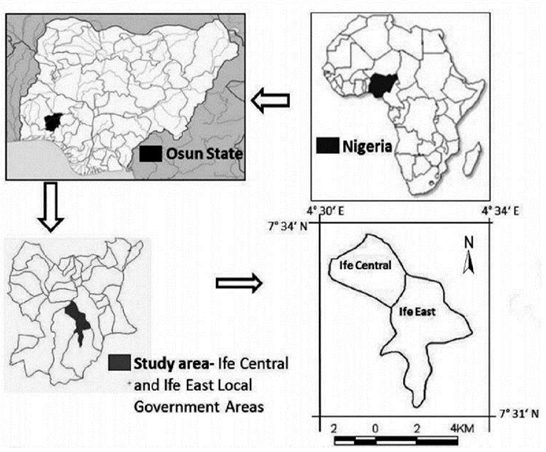
The study was conducted in Ife East Local Government Areas in Ile Ife, Osun State. The State (Figure 1) covers an area of approximately 14,875 sq. km and lies between latitude 7° 30′ 0″ N and longitude 4° 30′ 0″ E and it is situated in the tropical rain forest zone. The major sub- ethnic groups in Osun State are Ife, Ijesha, Oyo, Ibolo and Igbomina of the Yoruba people, although there are also people from other parts of Nigeria. Yoruba and English are the formal languages. People of Osun State practice Christianity, Islam and their ancient religion, the traditional faith. Ile-Ife is a semi urban area where agriculture is predominant occupation. It has a mean relative humidity of 75% to 100% and the average rainfall of 1,000–1,250 mm is usually from March to October.
Study Population
The study population comprise nursing mother within aged range 20 and 50 years who resided in Ife East Local Government Area, Ile Ife, Osun State. The women were approached and purpose of the study was discussed with them. They were informing that only those who consented will be allowed to participate in the study and that participation is voluntary.
Study Design
The study was conducted between August 2024 and October 2024. Prior to the collection of the data, structured questionnaire was designed to collect basic demographic information including age, residential location (Local Government Area), occupation and educational level and other information as regards the study.
Exclusive criteria: Respondents that are below and above aged range 20 and 50 years who resided in Ife East Local Government Area, Ile Ife, Osun State were excluded in the study.
Inclusive criteria: Respondents that are nursing mother within aged range 20 and 50 years who resided in Ife East Local Government Area, Ile Ife, Osun State were included in the study.
Sample Size
Size to be sample was carried out according to the method of Wang and Ji as indicated below.
$$ N = \frac {z ^ {2} p (1 - q)}{d ^ {2}} $$
$$ N = \frac {z ^ {2} p (1 - q)}{d ^ {2}} $$
Where; SS (N) = Sample size Z= degree of confidence (i.e 95% confidence interval which will yield 1.96) d = precision (5%= 0.05) p = the proportion in the target population estimated to have infection. q= 1-p Therefore, a total of 200 samples were collected from Ife East Local Government Area, Osun State.
Data Analysis
Analysis of the data was done using Statistical Package for the Social Sciences tool (SPSS) version 27.0. The descriptive statistic such as frequency in percentage was used to analyze the data form the respondents.
Results
A total of 200 samples; Majority of the area where questionnaire were administered are Itafaji and Safejo (8.5%) each (Table 1).
| Areas in Ife East L.G.A | Frequency | Percentage (%) |
|---|---|---|
| Itafaji | 17 | 8.5 |
| Aderemi | 6 | 3 |
| Alalamole | 8 | 4 |
| Apata ll | 5 | 2.5 |
| Asherifa | 5 | 2.5 |
| Eleyele | 14 | 7 |
| Erefe | 11 | 5.5 |
| Ifelere | 16 | 8 |
| Ifelodun | 8 | 4 |
| Ilode | 8 | 4 |
| Iloro | 6 | 3 |
| Lagere | 4 | 2 |
| Mayfair | 5 | 2.5 |
| Moore | 9 | 4.5 |
| Nata | 4 | 2 |
| Nato | 10 | 5 |
| Olowopoku | 11 | 5.5 |
| Olugbondo | 12 | 6 |
| Olurin | 11 | 5.5 |
| Omitoto | 8 | 4 |
| Safejo | 17 | 8.5 |
| Texaco | 5 | 2.5 |
| Total | 200 | 100 |
| Variables of the Parents | Number Examined | Percentage (%) in the pool |
| Age group (Years) | ||
| 20-25 | 64 | 32 |
| 26-30 | 66 | 33 |
| 31-35 | 27 | 13.5 |
| 36-40 | 35 | 17.5 |
| 41-45 | 5 | 2.5 |
| 46-50 | 3 | 1.5 |
| Marital Status | ||
| Married | 172 | 86 |
| Single mother | 23 | 11.5 |
| Separated | 3 | 1.5 |
| Divorce | 2 | 1 |
| Religion | ||
| Christianity | 156 | 78 |
| Islam | 44 | 22 |
| Occupation | ||
| Artisan | 64 | 32 |
| Trader | 55 | 27.5 |
| House wife | 15 | 7.5 |
| Civil Servant | 51 | 25.5 |
| Farmer | 15 | 7.5 |
| Level of Education | ||
| 2 | 1 | |
| Primary | 21 | 10.5 |
| Secondary | 89 | 44.5 |
| Tertiary | 88 | 44 |
| Ethnicity | ||
| Hausa | 1 | 0.5 |
| Ibo | 26 | 13 |
| Yoruba | 173 | 86.5 |
| Family Structure | ||
| Guardian | 14 | 7 |
| Parent | 186 | 93 |
| Total | 200 | 100 |
| Variables of the Children | Number Examined | Percentage (%) in the pool |
| Age group (Years) | ||
| 4months-1yrs | 25 | 12.5 |
| 2yrs - 4yrs | 52 | 26 |
| 5yrs - 7yrs | 74 | 37 |
| 8yrs - 10yrs | 49 | 24.5 |
| Sex | ||
| Male | 51 | 56.5 |
| Female | 113 | 43.5 |
| Level of Education | ||
| 37 | 18.5 | |
| Nursery | 51 | 25.5 |
| Primary | 112 | 56 |
| Total | 200 | 100 |
Table 1: Areas of the Samples collection in Ife East Local Government Area Ile Ife, Osun State.
Majority of aged 26-30 years (33.0%) had participated in this study. Majority of the women that participated were 33.0% (66/ 200), 86.0% (172/400) were married, 78.0% (156/400) were Christians, 32.0% (64400) were artisans, and 44.5% (89/400) had secondary school education and 86,5% were Yoruba (Table 2).
Table 3 shows the Socio- demographic Characteristics of the Children used in the study on Diarrhoea among Children in Ife East Local Government Area, Osun State, majority of aged 5-7 years (37.0%), 113/200 (43.5%) males and
112 /200 (56.0% ) with secondary school education had participated in this study.
Table 4 show mothers knowledge of the Prevalence and Management of Diarrhoea among Children in Ife East L.G.A. Osun state. 27.0% of the children have had diarrhea before, while 20.0% had diarrhea this year. Only 66.0% has heard about diarrhea infection, 10.5% had in the past month and
11.5% has been hospitalized due to diarrhea. 16.0 % live in area with poor access to clean water, 8.0% had taken medication that may cause diarrhea as side effect. The recurrence of diarrhea occurs among 8.0% children and only 8.0% had travelled to an area with poor sanitation.
| Questions for the Correspondence | Can’t say | No | Yes | Total |
|---|---|---|---|---|
| Have your child had diarrhea before this year? | 6 (3.0) | 140 (70.0) | 54 (27.0) | 200(100.0) |
| Has he/she had diarrhea this year? | 6 (3.0) | 174 (87.0) | 20 (10.0) | 200(100.0) |
| Did the health care provider tell you about diarrhea? | 0 (0.0) | 68 (34.0) | 132(66.0) | 200(100.0) |
| Have your child had diarrhea in past month? | 0 (0.0) | 179 (89.5) | 21 (10.5) | 200(100.0) |
| Have your child been hospitalized due to diarrhea illness? | 1 (0.5) | 176 (88.0) | 23 (11.5) | 200(100.0) |
| Do you live in area with poor access to clean water? | 6 (3.0) | 162 (81.0) | 32 (16.0) | 200(100.0) |
| Do your child take medication that may cause diarrhea as side effect? | 0 (0.0) | 184 (92.0) | 16 (8.0) | 200(100.0) |
| Do your child have history of diarrhea recurrence? | 0 (0.0) | 184 (92.0) | 16 (8.0) | 200(100.0) |
| Do your child travel to an area with poor sanitation? | 3 (1.5) | 181(90.5) | 16 (8.0) | 200(100.0) |
| Have your child eaten any food that was spoiled? | 9 (4.5) | 172 (86.0) | 19 (9.8) | 200 (100.0) |
| Did the health care provider told you not to drink unclean water? | 0 (0.0) | 62 (31.0) | 138 (69.0) | 200 (100.0) |
| Where you told that fly infestation to food is not good for your child’s health? | 1 (0.5) | 57 (28.5) | 142 (71.0) | 200 (100.0) |
| Have your child eaten undercooked meat, sea food or egg? | 9 (4.5) | 144 (72.0) | 47 (23.5) | 200 (100.0) |
| Have your child recently changed diet or eating habits? | 4 (2.0) | 134 (67.0) | 62 (31.0) | 200 (100.0) |
| Have your child experienced any vomiting? | 3 (1.5) | 96 (48.0) | 101 (50.5) | 200 (100.0) |
| 45 Have your child stools watery, bloody or mucus filled? | 2 (1.0) | 135 (67.5) | 63 (31.5) | 200 (100.0) |
| Did your child had a fever recently? | 6 (3.0) | 88 (44.0) | 106 (53.0) | 200 (100.0) |
| Have your child experienced any abdominal pain or cramps? | 4 (2.0) | 98 (49.0) | 98 (49.0) | 200 (100.0) |
| Have your child eaten raw fruit or vegetable recently? | 0 (0.0) | 135 (67.5) | 65 (32.5) | 200 (100.0) |
Table 2: Mothers Knowledge of the Prevalence and Management of Diarrhoea among Children in Ife East L.G.A. Osun state.
Table 5 show mothers knowledge of the cause of diarrhoea among children in Ife East L.G.A, Osun. 9.8% of the children had eaten food that was spoiled diarrhea before while 71.0% knows that fly infestation to food is not good for child’s health. Undercooked meat, sea food or egg were eaten
23.5%, 50.5% of the children had experienced vomiting while, watery, bloody or mucus stools are common among 31.5% children. Fever (53.0%), abdominal pain or cramps (49.0%) and 32.5% had eaten raw fruit or vegetable recently.
Table 6 show mothers knowledge of the effects of diarrhoea among children in Ife East L.G.A, Osun State. 67.0% know that malnutrition can trigger diarrhea, 79.0% know that diarrhea can trigger dehydration and loss of mineral salt while 75.5% knows that diarrhea can lead to fever among children. 72.0% agreed that poor sanitary condition leads to diarrhea. 67.0% agreed that lack of health education can lead to the spread of diarrhea while only 44.5% sought medical attention for their children diarrhea. Underlying conditions were seen among 33.5% children and 32.5 had experienced previous episode of diarrhea. Only 42.5% experienced weight loss when having diarrhea.
| Can't say | No | Yes | Total | |
|---|---|---|---|---|
| Do you know that malnutrition can trigger diarrhea? | 8 (4.0) | 58 (29.0) | 134 (67.0) | 200(100.0) |
| Do you know that diarrhea can trigger dehydration and loss of mineral salt? | 4 (2.0) | 38 (19.0) | 158 (79.0) | 200(100.0) |
| Does effect of diarrhea leads to fever among children? | 11 (5.5) | 38 (19.0) | 151 (75.5) | 200(100.0) |
| Does poor sanitary condition leads to diarrhea? | 7 (3.5) | 49 (24.5) | 144 (72.0) | 200(100.0) |
| Does lack of Health education leads to the spread of diarrhea? | 1 (0.5) | 65 (32.5) | 134 (67.0) | 200(100.0) |
| Have you sought medical attention for your child diarrhea? | 0 (0.0) | 111 (55.5) | 89 (44.5) | 200(100.0) |
| Does your child have any underlying conditions? | 4 (2.0) | 129 (64.5) | 67 (33.5) | 200(100.0) |
| Have your child experienced previous episode of diarrhea? | 2 (1.0) | 133 (66.5) | 65 (32.5) | 200(100.0) |
| Have your child consumed new or unusual food recently? | 2 (2.0) | 133 (66.5) | 63 (31.5) | 200(100.0) |
| Have your child experienced weight loss when having diarrhea? | 13 (6.5) | 102 (51.0) | 85 (42.5) | 200(100.0) |
Table 3: Mothers Knowledge of the Effects of Diarrhoea among Children in Ife East L.G.A, Osun state.
Table 7 show mothers knowledge of the prevention of diarrhoea among children in Ife East L.G.A, Osun State. 88.0% knows that washing hand before handling of food is good for the child, 95.5% know that covering food prevent flies and 96.5% knows that washing hand after going to toilet protect child from diarrhea. Washing of hand with soap and water before eating was seen among 92.0%, 84.0% drink water from safe source and 80.0% practice good hygiene during food Preparation. 78.0% make use of toilet or latrine for bowel movement and 81.5% store food at the correct temperature.
| Can't say | No | Yes | Total | |
|---|---|---|---|---|
| Do you know that washing hand before handling of food is good for your child? | 8 (4.0) | 16 (8.0) | 176 (88.0) | 200(100.0) |
| Do you know that covering food prevent flies? | 0 (0.0) | 9 (4.5) | 191 (95.5) | 200(100.0) |
| Does washing hand after going to toilet protect your child from diarrhoea? | 0 (0.0) | 7 (3.5) | 193 (96.5) | 200(100.0) |
| Does drinking water sterilized by boiling good for your child? | 0 (0.0) | 6 (3.0) | 194 (97.0) | 200(100.0) |
| Does your child wash hand with soap and water before eating? | 2 (1.0) | 14 (7.0) | 184 (92.0) | 200(100.0) |
| Do your child drink water from a safe source? | 3 (1.5) | 29 (14.5) | 168 (84.0) | 200(100.0) |
| Have you practice good hygiene during food Preparation? | 1 (0.5) | 39 (19.5) | 160 (80.0) | 200(100.0) |
| Do you use toilet or latrine for bowel movement? | 0 (0.0) | 44 (22.0) | 156 (78.0) | 200(100.0) |
| Do you store food at the correct temperature? | 4 (2.0) | 33 (16.5) | 163 (81.5) | 200(100.0) |
| Do you use water purification tables or filter when necessary? | 3 (1.5) | 29 (14.5) | 168 (84.0) | 200(100.0) |
Table 4: Mothers Knowledge of the Prevention of Diarrhoea among Children in Ife East L.G.A, Osun state.
Table 8 show mothers knowledge of the control of diarrhoea among children in Ife East L.G.A, Osun State. 82.0% knows that poor personal hygiene can cause/ trigger the transmission of diarrhea, 81.0% know that lack of good food and drinking water can cause or trigger the transmission of diarrhea and 82.5% give their children medication prescribed by healthcare provider. Only 86.0% drink enough fluids to stay hydrated, 80.5% monitor their children stool output and frequency while only 52.5% seek medical attention when the mother and children has the symptoms or persistence diarrhea.
| Can't say | No | Yes | Total | |
|---|---|---|---|---|
| Do you know that poor personal hygiene can cause / trigger the transmission of diarrhoea? | 3 (1.5) | 33 (16.5) | 164 (82.0) | 200(100.0) |
| Do you regularly honour appointment day with the healthcare providers based on your child health condition? | 3 (1.5) | 36 (18.0) | 161 (80.5) | 200(100.0) |
| Do you know that lack of good food, drinking water can cause / trigger the transmission of diarrhoea? | 12(6.0) | 26 (13.0) | 162 (81.0) | 200 (100.0) |
| Do you give your child the medication prescribed by the healthcare provider? | 8 (4.0) | 27 (13.5) | 165 (82.5) | 200 (100.0) |
| Do you know that lack of good toilet facilities can cause the transmission of diarrhea? | 5 (2.5) | 26 (13.0) | 169 (84.5) | 200 (100.0) |
| Do your child drink enough fluids to stay hydrated? | 4 (2.0) | 24 (12.0) | 172 (86.0) | 200 (100.0) |
| Do your child avoid close contact with others to prevent transmission? | 12 (6.0) | 31 (15.5) | 157 (78.5) | 200 (100.0) |
| Are you monitoring your child stool output and frequency? | 6 (3.0) | 33 (16.5) | 161 (80.5) | 200 (100.0) |
| Do you child eat food high in fibre such as fruit, vegetable? | 2 (1.0) | 36 (18.0) | 162 (81.0) | 200 (100.0) |
| Do you seek medical attention when you and your child has the symptoms or persistence diarrhea? | 0 (0.0) | 95 (47.5) | 105 (52.5) | 200 (100.0) |
Table 5: Knowledge of Control of Diarrhoea among Children in Ife East L.G.A, Osun state.
Table 9 shows immunization records of children in Ife East L.G.A, Osun State. 93.0% of the children were vaccinated with BCG, 89.5% with HBV, 91.0% PENTA, 90.5% OPV, 90.0% PCV, 89.5% IPV and the least was 12.5% with ROTA.
| Immunization | No | Yes | Total |
|---|---|---|---|
| BCG | 14 (7.0) | 186 (93.0) | 200 (100.0) |
| HBV | 21 (10.5) | 179 (89.5) | 200 (100.0) |
| PENTA | 18 (9.0) | 182 (91.0) | 200 (100.0) |
| OPV | 19 (9.5) | 181 (90.5) | 200 (100.0) |
| PCV | 20 (10.0) | 180 (90.0) | 200 (100.0) |
| IPV | 21 (10.5) | 179 (89.5) | 200 (100.0) |
| VITAMIN A | 20 (10.0) | 180 (90.0) | 200 (100.0) |
| MEASLES | 38 (19.0) | 162 (81.0) | 200 (100.0) |
| YELLOW FEVER | 40 (20.0) | 160 (80.0) | 200 (100.0) |
| MININGITIS VACCINE | 52 (26.0) | 148 (74.0) | 200 (100.0) |
| ROTA | 175 (87.5) | 25 (12.5) | 200 (100.0) |
Table 6: Immunization records of the Children in Ife East L.G.A, Osun state.
Discussion
The findings from the study revealed that majority of the correspondence were between aged 26-30 years, married, educated and had means of livelihood. Majority of the women that participated had secondary school education. This is similar to a study conducted in Odeda in Ogun State by Agbon et al, where majority of respondents were between 20-40 years, 79.1% were educated and that of Turyare in Somalia where respondence were between aged 25-34 years [11, 12]. This study also revealed that majority of children was between 5-7years and males. This is in contrast to a study conducted in Tanzania by Masuke, et al. where majority of children used for the study were 2years old and 46% were females [13]. It also revealed that most of children had primary education. This study also shows the mothers’ perceived knowledge of the prevalence of diarrhoea, where only 66.0% have heard about diarrhea infection, 10.5% had diarrhoea in the past month and 11.5% has been hospitalized due to diarrhoea. This is in agreement with Olaniyi and Oyerinde, where majority of mother had knowledge of diarrhoea in children. According to this study, considerable number of children had diarrhoea before (27.0%) and this year (20.0%). A significant proportion of children lived in areas with limited access to clean water, increasing their risk of exposure to waterborne pathogens. While less prevalent (8.0%) in this study, travel to areas with poor sanitation can still contribute to diarrhoea outbreaks.
In this study, consuming undercooked or spoiled food, particularly meat, seafood, and eggs, was associated with increased diarrhea risk. While not a major factor in this study, it is important to note that raw produce can harbour harmful bacteria if not properly washed.
A small percentage of children were taking medications that could cause diarrhea as a side effect. The study revealed a mixed picture of knowledge and practices, majority of mothers were aware of the importance of hand washing, food hygiene, and vaccination. However, some misconceptions persisted, such as the belief that only poor sanitary conditions lead to diarrhoea.
Most mothers practiced good hygiene, such as hand washing and food storage in this study, This was similar to the study conducted in Nepal by Ansari et al., where majority of mothers claimed that the occurrence of diarrhoea in children was preventable through preventive approach such as maintaining cleanliness and making a habit of hand washing before feeding the child and Mubarak et al, where most mothers prefer washing their hands before preparing food and eating [14, 15, 16].
There were gaps in other areas, including seeking medical attention for diarrhea and ensuring adequate fluid intake. Vaccination coverage was generally high for most vaccines, but the low coverage for rotavirus vaccine was a concern.
Conclusion and Recommendation
Conclusion
These findings highlight the need for targeted interventions to improve access to clean water and sanitation, promote proper hygiene practices, and increase awareness of diarrhoea prevention strategies. Additionally, efforts to improve vaccination coverage, particularly for rotavirus, are essential to reduce the burden of childhood diarrhoea in the community.
Recommendations
To address the burden of childhood diarrhoea, the following interventions are recommended:
- Improved Water, Sanitation, and Hygiene (WASH): • Expand access to clean water and sanitation facilities. • Promote hand washing with soap, especially before eating and after using the toilet.
- Health Education and Awareness: • Conduct community-based health education campaigns to raise awareness about diarrhoea prevention and treatment. • Target specific groups, such as pregnant women and caregivers of young children.
- Strengthening Health Systems: • Improve access to quality healthcare services, especially in rural and underserved areas. • Ensure adequate supply of essential medicines, including oral rehydration solutions.
- Vaccination: • Prioritize vaccination against rotavirus to reduce the incidence of severe diarrhoea. • Maintain high vaccination coverage for other childhood diseases.
- Nutrition: • Promote optimal nutrition, particularly for infants and young children. • Encourage breastfeeding and appropriate complementary feeding practices.
Implementation of these strategies will significantly reduce the incidence and impact of childhood diarrhoea in the target population. References
1. Boschi-Pinto C, Velebit L, Shibuya K (2008) Estimating child mortality due to diarrhoea in developing countries. Bulletin of the World Health Organization 86(9): 710-717.
2. Raji MIO, Ibrahim YKE (2011) Prevalence of waterborne infections in Northwest Nigeria: A retrospective study. Journal of Public Health and Epidemiology 3(8): 382-385.
3. Ugboko HU, Nwinyi OC, Oranusi SU, Fagbeminiyi FF(2021) Risk factors of diarrhoea among children under five years in southwest Nigeria. International Journal of Microbiology 2021: 1-9.
4. Matthew AK, Amodu AD, Sani I, Solomon SD (2009) Infant feeding practices and nutritional status of children in North Western Nigeria. Asian Journal of Clinical Nutrition 1(1): 12-22.
5. Dairo MD, Ibrahim TF, Salawu AT (2017) Prevalence and determinants of diarrhea among infants in selected primary health centres in Kaduna north local government area, Nigeria. Pan African Medical Journal 28(1): 151-151.
6. Endale H, Mathewos M, Abdeta D (2023) Potential causes of spread of antimicrobial resistance and preventive measures in one health perspective-a review. Infection and Drug Resistance 16: 7515-7545.
7. Joshi R, Kumar A, Masih S (2020) Food hygiene practice among mothers and its association with occurrence of diarrhea in under-five children in selected rural community area. Int J Med Sci Public Health 9: 179-184.
8. Magdalena I, Rantetampang AL, Pongtiku A, Mallongi A (2019) The risk factors environment and behavior influence diarrhea incidence to child in Abepura hospital Jayapura city. International Journal of Science and Healthcare Research 4(1): 171-180.
9. Shrestha A, Six J, Dahal D, Marks S, Meierhofer R (2020) Association of nutrition, water, sanitation and hygiene practices with children’s nutritional status, intestinal parasitic infections and diarrhoea in rural Nepal: a cross- sectional study. BMC public health 20: 1-21.
10. Vong P, Banchonhattakit P, Sim S, Pall C, Dewey RS (2021) Unhygienic stool-disposal practices among mothers of children under five in Cambodia: Evidence from a demographic and health survey. Plos one 16(7): e0249006.
11. Agbon CA, Okeke EC, Olawale IM (2010) Diarrhoea Management Practices by Mothers of Odeda Local Government Area, Ogun State. JHER 13: 58-64.
12. Turyare MD, Mativo JN, Kerich M, Ndiritu AK (2021) Prevalence and socio-demographic determinants of diarrhea among children below 5 years in Bondhere district Somalia. Pan African Medical Journal 38(1).
13. Masuke R, Msuya SE, Mahande JM, Diarz EJ, Stray- Pedersen B, et al. (2021) Effect of inappropriate complementary feeding practices on the nutritional status of children aged 6-24 months in urban Moshi, Northern Tanzania: Cohort study. PloS one 16(5): e0250562.
14. Mubarak MY, Wagner AL, Asami M, Carlson BF, Boulton ML (2016) Hygienic practices and diarrheal illness among persons living in at-risk settings in Kabul, Afghanistan: a cross-sectional study. BMC Infect Dis 16: 459.
15. Wahab A, Oni OJ (2020) Investigation of the use of photovoltaic solar water pump by occupants of residential buildings in Ile-Ife, Nigeria. Environmental Research & Technology 3(2): 71-80.
16. Mukhtar A, Izham MIM, Ravi SP (2011) A survey of mothers’ knowledge about childhood diarrhoea and its management among a marginalized community of Morang, Nepal. Australasian Medical Journal 4(9): 474-479.
- Epidemiological Surveillance and Rumors on Social Media
- Awareness and Treatment of Uncontrolled Hypertension in US Overweight/Obese Youths Aged 16–24 Years, NHANES 2021–2023
- Strengthening EPI Through Parental Engagement: Lessons from Dhaka Slums for IA-2030
- Covid-19 Reinfections Case Series from October 2023 to October 2024 in A General Medicine Office in Toledo (Spain)
- Water Contact! One Risk Too Many: Risk Factors Associated with Schistosoma haematobium infection in Osun State, Nigeria
- Evidence of Spatial Clustering Distribution Patterns of Malaria in Epe, Lagos, Nigeria