
Union Effects in Employee Performance and HRM Policies
This paper specifically studies union effects on the performance and productivity of the employee and on various Human Resource Management policies by examining the role of labor unions in the workplace. It analyses both negative and positive aspects of the unionism however it concludes that there are more positive effects of unions on productivity and management. It also attempts to analyze the positive effect of the unions on productivity and the overall impact on the management policies and on various management functions like controlling, planning, and organizing. We make comparison between unionized and non unionized organization by analyzing the effects on productivity and management. We also analyze the importance and roles of unions in organizations to remain competitive in the global environment.
Ali Soylu* and Preeti Singh
Lawton, OK, USA
Business, Cameron University Lawton, OK, USA, Tel: 580 581 2821; Email:
asoylu@cameron.edu competitive in the global environment.
Keywords: Productivity; HRM Function; HRM Practices; Industrial Relation; Unions
Introduction
The primary role of labor unions is to fight for its members so that their members will have better rights, working condition, wages, and benefits. On the other hand, management introduces and implements certain Human Resource practices that utilizes Human resources in building a competitive advantage and improve organizational performance. Results from empirical studies show that strong trade unions can influence a company’s HR practice by adopting softer Human Resource practices than hard ones [1]. Workers and the factory owners are always engaged in a dispute related to wages, bonus, number of working hours, overtime, pension, compensation, medical benefits or provident fund contribution, etc. In order to solve all the problems of the workers, the trade union movement was launched and, accordingly, various trade unions now exist that are constantly working for the welfare and betterment of the workers [2]. It is obvious that in any organization labor unions have had dramatic effects on organizations' relationships with employees. While some argue that labor unions have positive effects on work-life and employment, others say that there are also negative effects caused by union activities. It is also obvious that employees demand for better facilities, better salary and other perquisites from the employers. But on the employers’ side it is not always possible to provide all the benefits that the worker’s demand. Therefore, to increase their bargaining power within the organization, employees form unions. However, the objective of the unions is not only to increase the bargaining power. It is believed that the unions increase the productivity as well as the performance of the employee. However, in a recent study, Laroche and Wechtler [3] say that over the past three decades, there has been a great deal of interest in the relationship between unions and firm performance. Their results indicate that unionization in France is associated with poorer financial performance in the workplace. Their results also indicate that concentration-related profits do not provide an important source of union rents in France. In this context, the objective of this paper is to understand the effects of the unions on productivity and performance of the employees as well as on Human Resource Management Practices. For this, the answer to the question “what do unions do in the workplace?” is pivotal. The first part of this paper discusses the effects of union in employee performance and productivity and the second half of the paper discusses their role of unions in Human Resources policies and function. The unions have both positive and negative effects within the organization on the managerial practice. In some cases, unions may hinder the productivity or efficiency. Similarly, the monopoly face of unions arguably can also contribute to restraining as well as enhancing efficiency, although it is generally associated with negative outcomes for management and thus, the relationship of union policies to efficiency is a complex one [4]. However, ‘The Economist’ quotes in one of its blog articles [2] that one possibility is that, to the extent that unions do increase productivity, they do so by forcing less competent workers out of the labor market, because they are not worth union pay. This means that the unions also play a vital role in determining who deserves the equivalent pay and maintaining the standard of the labor. The unions in particular influence the labor market by making it a free entry and exit market, with more competent labors getting the job and less competent going out of the market. This process theoretically guarantees higher productivity. Unions have influence on management practices, recruitment, and selection process. In unionized workplaces, the role of union leadership is considered to be as important as that of management. They can influence the workers’ attitude towards workplace and the duties and responsibilities. They play a vital role in building the positive attitude in the organization by motivating the employees to work in the interest of the organization which is equal to saying that their influence can be as effective in the opposite direction. Workers’ attitudinal and behavioral reactions to HRM innovation can be influenced by the guidance they received from their local union leader. Thus, it can have influence on the leading function of HRM [5]. Since the main aim of the union is to increase the well being of the employees, the unionized firms invite completion among the existing employees by opening the job vacancy internally. The presence of a union increases the likelihood that a firm would post jobs internally for open competition among current employees. In a study of the auto parts industry, Kaufman and Kaufman (1987) found that union plants were nearly twice as likely to post jobs internally as their nonunion counterparts. The main objective of this paper is to explain how the unions affect the productivity and performance in the workplace along with their influence in the management. We will compare unionized and non- unionized organizations and discuss individual organizations to come to the conclusion.
Literature Review
There are two kinds of view about labor unions. One school of thought says that the unions are largely formed only to make an impact on the members’ wages, work conditions, better facilities, perquisites and so on at the expense of devotion to work and productivity. On the other hand, another school of thought says that the unionized organizations have better performances along with better facilities for the employees than the non-unionized organizations. While one set of analysts view the negative impacts of the unions on the organization, the other set of analysts view the positive side of the unions. Some analysts stress the adverse effects of union on productivity such as the loss of employment due to union wage effects. On the other side, some believe unions have beneficial economic and political effects. A significant number of experts [6, 7, 8] believe that the collective bargaining will lead to better management and higher productivity. Industrial relations experts have long stressed the ways in which collective bargaining can induce better management and higher productivity and note that unions can increase the development and retention of skills, provide information about what occurs on the shop floor, improve morale, and pressure management to be more efficient in its operations [7]. Freeman and Medoff (1984) [7] further argue that unions provide positive effect on employee productivity. They have found that in many sectors, unionized establishments are more productive than nonunion establishments, while in only a few are less productive. The higher productivity is due in part to the lower rate of turnover under unionism, improved managerial performance in response to the union challenge, and generally cooperative labor-management relations at the plant level. Unionized employers tend to earn a lower rate of return per dollar of capital than do nonunion employers. The return is lower under unionism because the increase in wages and the greater amount of capital used per worker are not compensated for by the higher productivity of labor associated with unionism. The reduction in profitability, however, is centered in highly concentrated and otherwise historically highly profitable sectors of the economy” [7]. On their study, Lua, Taoa, and Wangb [6] found a positive and statistically significant union effect on labor productivity, but not on profitability. Their study also found that, although unions do not directly contribute to positive wage gains for the workers, they do contribute to better employee benefits, increased signing of formal employment contracts and hence more harmonious employment relations in China’s private enterprises [6].
Effects of Unions on Productivity
Morikawa [8] analyses the relationship between labor union and firm performance in productivity and profitability by using data on more than 4000 Japanese firms, in both the manufacturing and non- manufacturing sector. According to Morikawa (2010) [8], the presence of labor unions has statistically and economically significant positive effects on firm productivity and unions' effects on wages are also positive, their magnitude being slightly larger than those on productivity and the decrease in the number of employees is greater at unionized firms than at non- unionized firms. Productivity is largely related to good employee skills, higher motivation, and better leadership under the influence of good planning and controlling. Organizations want to meet their long term and short term goals and wish to have a pool of good and efficient employees along with good co-ordination between the management and the employees. Generally speaking, it is less likely to have good management-employee communication in larger organizations. Therefore, whenever employees feel that there is lack of proper communication and that their voices are not being heard by the management, they form unions. The need of unions becomes apparent when working conditions are poor, benefits are inadequate or wages are low. Even though the unions are at first formed to increase the collective bargaining, eventually they end up with the effects on productivity and efficiency. The empirical evidence indicates that the driving force behind the introduction of HRM appears to have little to do with industrial relations, it is rather the pursuit of competitive advantage in the market place through provision of high-quality goods and services, through competitive pricing linked to high productivity and through the capacity swiftly to innovate and manage change in response to changes in the market place or to breakthroughs in research and development [1]. Its underlying values, reflected in HRM policies and practices, would appear to be unitary and individualistic in contrast to the more pluralist and collective values of traditional industrial relations [9]. When unions raise workers’ wages, firms have an incentive to augment the capital intensity of production, thereby raising labor productivity [10]. As discussed earlier, unions might affect the productivity both positively and negatively. It is common in unionized organizations that they provide training to the workers to improve the level of skills and productivity. In a non- unionized firm, the management imposes the production methods and determines the procedure of performing the task which is a huge source of discontent for the workers. On the other hand, the unionized workplace provides flexibility to the workers to alter the production methods and put a voice in production procedure that improves the productivity. Thus, this may have affect on the organizing aspects of human resource management. However, the influence of unions in every aspect such as promotion which in unionized organizations are based on seniority rather than the merit may hamper the productivity due to employee dissatisfaction. Moreover, unions can have a negative impact by using their monopoly position to drive up wages and to introduce restrictive work practices that inhibit management's ability to introduce high performance work practices. The union impact on things like apprenticeship and training methods, promotion policies, work organization, wage level and payments system and grievances procedure will feed through productivity [11]. Some of the reasons why the unions lower the productivity could be the restrictive work practices, the adverse impact of industrial action, less capital investment and lack of trust between the parties within the organization. Likewise the benefits of having the unions could be the management’s response to the union relative wage effects which could ultimately higher the productivity, lesser burden on the management to monitor the work procedures in the organization, the collective voice of the employees resulting in win-win situation for both the employees and the management, a reduced amount of effort for the manager to take care of individual grievances and complaints. This may also impinge on controlling aspect of the Human Resource Management. Unions affect the approach in which the firms respond to the changes in the economy. According to Freeman and Medoff, in cyclical downturns, in comparison to non-unionized firms, unionized firms tend to make more use of temporary layoffs and less use of cuts in wage growth. In retrospect, in cyclical upturns, unionized firms recall relatively more workers and nonunion firms tend to hire new employees. Thus, this may effect on the staffing function of the HRM. Likewise, in a decline that threatens the jobs of senior employees, unions negotiate wage and work-rule concessions of substantial magnitude while large nonunion firms that are trying to avoid unions through "positive labor relations," obtain higher wages and better working conditions as a result of the existence of trade unions. The average employed nonunion blue- collar worker may enjoy a slight increase in well-being because the threat of unionism forces his or her firm to offer better wages and work conditions, but the average white-collar worker appears essentially unaffected by the existence of blue-collar unionization [7]. Separation rate as we know is the difference between the number of people that lose jobs and the number who find jobs. Freeman and Medoff (1985) [7] opine that one of the merits of unions is that they reduce the separation rate but however it does not necessarily follow that it guarantees the improvement in efficiency which is only reflected by the rise in productivity. That is to say that even though the separation rate is reduced due to the unions, there is no guarantee that the productivity will increase as its result. Thus, though the unions play a vital role in maintaining the number of workers (sometimes more personnel than necessary), their voice in increasing the productivity and efficiency is more important for the firms than just ensuring the balance between the numbers of workers losing jobs and finding them. However, it is as well highly possible to have a positive impact on productivity as the separation rate decreases. In addition to the decrease in separation rate, it also helps in increasing the quality of the workers as the new technologies require new skills to increase the productivity therefore it further leads to good selection procedure as well as better investment scenario to ensure the higher ratio in productivity of the newly hired employees to the overall employees. The credit to the entire benefit of this process goes to the union’s effects in the reduction of the separation rate. Brown and Medoff suggested that the productivity between union members and nonunion members varies, using a production function derived from the Cobb-Douglas production function. Using CS data per state and per industry for 1972, and setting the logarithm of value added per worker as the dependent variable; and union membership rate, logarithm of capital–labor ratio, and the logarithm of workers per one firm as the independent variables. The productivity ratio of unionized workers over and above nonunionized workers as determined from the estimated coefficient was about 30 percent. Using panel data of firms that had established unions in the cement industry, Clark (1980) found a positive union effect. He also found that change in workplace activity was more a factor than change in the nature of the workers themselves. The productivity effect will not always be positive. Clark (1984) found that the union dummy effect on productivity was negative based on an analysis of pooled data in the manufacturing industry from 1970 to 1980. The labor market is highly influenced by the impact of the unions and therefore they have a huge impact on productivity. The finding suggests that unionization increased wages and compelled managers to raise productivity [12]. The unions force the less competent workers to go out of the labor market because they are not worth the union pay. This also eases the pressure on the management to distinguish between the good and bad workers as well as in paying only those that deserve the payment. Also it helps the management in reducing the effort in monitoring and controlling the labor as the market itself guarantees entry and exit of the labor which necessarily means that the labor should compete and put their effort to survive in the labor market. This ultimately leads to higher productivity and greater efficiency in work. Labor’s and management common identification with the principle that wages and productivity growth should keep pace with each other has played an important role in such growth. Under the long term employment system, productivity growth has been beneficial for both firm based labor unions and management [8]. On the other hand the nonunion firms always have the burden on the management to control the labor market. They have to monitor each worker and put a lot of effort to get rid of one employee and replace with another. Furthermore, it is only up to the management to make decisions while hiring new employees which in most cases would have been easier with the involvement of the unions as they know who would fit in and what exact skills would be required for the new hire to possess. Thus this may have hands on the staffing and controlling aspects of the management. The unionized firms reduce certain commitments from the management and thus reduce the extra work that the management has to accomplish. The regular appraisal of work which otherwise would have been a highly regular task for the management is greatly reduced in unionized firms because high standards are set by the unions for the workers in the labor market. Whereas, in nonunion firms, it is more likely that the management involve in activities and appraisal in order to keep the work at a standard level. Also in unionized firms where the pay is fixed by the unions, the relation between merit and pay is less while in nonunion firms the merit pay is a common phenomenon. Appraisal and merit pay were, however, more likely to be used in non- unionized plants, and the rate of change in high- commitment management between 1986 and 1990 was greater in nonunion plants [13]. Over the past two decades, non-union companies have used various tactics to develop worker satisfaction with the company itself and such tactics, including flexible work schedules, participative decision-making, information sharing, and merit-based pay systems, have had the dual purposes of keeping workers satisfied with their jobs and discrediting any perceived benefit of unionization [14]. In the context of the severe economic conditions and global recession like the current situations, the unions have even more role to play. In these situations rather than protecting the labor for their jobs, they focus on protecting the industry by working closely with the management, which ultimately protects the jobs with the industrial growth. Workers as a part of the management improve and expand the business to form a stable market for those who have lost their jobs. The trade unions also consider the question of contraction of workers' services in industrial and services sectors in situations other than severe economic conditions. “It has been noticed for the past several years that in the name of globalization of market, productive and service centers are engaging labor on contract basis, victimizing and eliminating permanent workers. The trade unions take seriously this alarming situation that leads to industrial disturbances contributing to more strikes and lockouts, thereby reducing production and prosperity of the country besides badly affecting growth rate”[2]. Khattar [15] states that progressive unions are associated with higher productivity, lower turnover, improved workplace communication, and better trained workforce. He furthers states that increased productivity implies economic growth and development. Under the conditions that the industrial relations are good with the management and unions working together it is likely that the productivity will be higher in unionized firms than in nonunion firms. The important aspect to this is that there needs to be a constructive dialogue and regular communication between the management and the staff so that there is a better appreciation of the health of the company and its future plans [15]. Another perspective to look at unionism is that from the public and private sector’s perspective. Evidently the working procedure, conditions, environment and goals and objectives of public and private sectors differ heavily. It is hard to say which sector could benefit more from unionization; however a study shows that the rate of unionization in private sector has highly reduced and if the study is to be believed there is more influence of unionization in public sectors than in the private sectors. “Between 1945 and 2009, the rate of unionization in the private sector fell from 45 percent to 7 percent, which is telling evidence of the inefficiency of unionization. The net effect of public employee unions is difficult to gauge, however, because most public employees have considerable economic leverage, even without unionization, simply as a result of their status as voters-imagine if the workers in a private company could vote in elections for the board of directors” [16].
Union Effects on the Management Practice
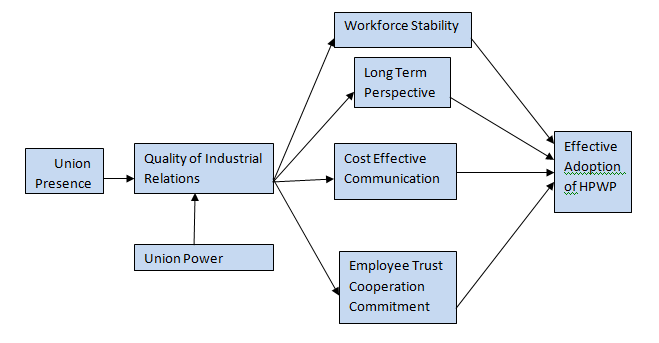
There is much less literature regarding how unions affect or influence management practices, and in particular human resources practices [17]. Union has influence on various human resource practices like recruitment, placement, training, retaining. Similarly, it also has effect on various functions of human resource management like staffing, organizing, planning etc. Union can add immense value to the employee welfare by assisting and persuading the organization to provide training to the organization. The union has to play a active role to force organization to train employee for their overall skill development as a fringe benefit since the core emphasis is on benefits. The connection between tenure and firm-specific training was strengthened in the presence of an active union [18]. Appraisal and merit pay were more likely to be used in nonunionized plants, and the rate of change in high- commitments management between 1986 and 1990 was greater in nonunion plants [13]. Hence they mostly rely on seniority system. Individual are not evaluated in the union setting so the system can affect many of the HRM practices. In a unionized setting, management hold the right to provide direction to its workforce, but some of the rights can be bargained away. The management has to negotiate with the union in most of the issues. In unionized workplaces, however, the role of the union leadership may be equally important and hence workers’ attitudinal and behavioral reactions to HRM innovation can be influenced by the guidance they received from their local union leader [5]. Therefore, the leading function of the HRM may be affected by the union actions. It is a well known fact that unions always focus for promoting and well being of employees within the organization. As a result, management must limit its channels of external recruiting, if possible, insisting the criteria for selection as to physical test only. Thus, this may affect the staffing function of HRM. In addition, firms that perceived their trade unions as being powerful were less likely to implement HR strategies to increase numerical flexibility indicators such as temporary employees, part-time employees, and subcontracting [19]. There are some basic differences between the evaluation criteria between unionized and non- unionized firm. Nonunion firms were more likely to employ more subjective evaluation criteria, while unionized firms employed more objective ranking evaluation such as the benchmark method in order to reduce favoritism and to maintain its ability to question management decisions [20]. Union also places a significant impact on the promotion and performance evaluation system of the organization. Unions are known for formalizing promotion procedure, by writing the policy in paper, as compared to nonunion firms. There is high degree of formalization in the seniority rule which may be unproductive for the management but it gives union substantial power in the challenging managerial decisions. Unions do not focus on individual evaluation so there is less incentive plan as compared to nonunion firms. Only 13.6 % of unionized firms used incentive compensation system such as merit pay, profit sharing, and straight piece rate plans, while 28% of nonunion firms had implemented a profit sharing plan [21]. Unions promote the use of novel HR practices. One argument, building on the concept of inefficiency is that unions may engender “shock” and “voice” effects, leading management to adopt more progressive, efficiency-enhancing HR innovations [4]. Thus many of the components of a high performance HR system (for example, training, fair selection processes, and priority given to internal recruitment) are consistent with the interests or demands of unions and may act as a complement to, rather than a substitute for, unionism [13]. Unions have got influence on organizing aspect of the HRM. They need to assign various authorities and responsibilities in order to fulfill the firms’ wide objectives. Union plays a significant role to bridge the gap between them by developing a good image of the management in the eye of the workers through their various incentive programs. Needless to say, managements that adjust to the union and turn unionism into a positive force at workplace reap the benefits in the long run [15]. Unions help to improve high performance of work. They encourage firms to work beyond their self interest and to take an organization-wide and long term perspective which ultimately leads to the development of the employee. Secondly, union networks developed to capture, disseminate and collect independent voice facilitate the implementation of HPWP, reducing the costs of HPWP implementation and maintenance [22]. Unions provide job security and help to foster a steady workforce which increases the net benefits of Human Resource Work Practice. Finally, union are the one who act as a bridge between management and employee and thus help to widen collaboration and commitment by building trust between them. There is evidence that employee voice makes an important contribution to workplace performance by avoiding costly disputes; reducing exit behavior, including quits, absenteeism, malingering and quiet sabotage; and facilitating employee involvement [23]. Union identify various rules and regulation that are utmost for the welfare of the workers and also been an influencing factor for getting these laws enacted. They have encouraged their members to exercise workplace rights and participate in programs by reducing fear of employer retribution, helping members navigate the necessary procedures, and facilitating the handling of workers’ rights disputes [24]. The effect of union on HR practice does not only dependent on each other but it is also determined by the relationship between the management and union. The outcome of union action on HR practices cannot be judge without considering the relation they have with each other. It can be conclude that productivity does not depend on what unions and management do separately, but on their relationship with one another and suggest that cooperative industrial relations promote the positive aspects of unionism and uncooperative industrial relations increase the negative aspects of unionism. It has been evident from above paragraph that industrial relation is one of the main components for the efficient productivity. At the same time it also has hands in the adoption of High Performance Work Practice by encouraging management to be committed to the welfare of the workers as well as focusing on management agenda. Union organizations with cooperative industrial relations are more likely to effectively adopt HPWP than organizations with adversarial industrial relations [22]. Thus, trade union movement played a significant role in shaping and influencing the direction of HR practices, lobbying for the introduction and enhancement of employment law, and driving individual employers to go beyond merely implementing the basic legal requirements, creating a virtuous circle for future progress [25]. Therefore, these may have influence on the planning aspects on the management.
There are many changes going on in the Human Resource area. One of the innovations in the HR field is the growth of Alternative Work Practices (AWP) which includes team development, quality circles and knowledge sharing which ultimately enhances productivity (Godard, 2007). There is high participation of workers in the AWPs approach because employees can share and apply their information and skills more completely. AWPs results in differential payment that reflects the authentic gain for employees. But such gains can be unfruitful if they substitute for collective bargaining which can lessen the desire for union representation. Unions may not only have an important role to play in ensuring that workers receive their fair share of any gains [26], but also help to overcome the barriers for the implementation AWPs approach in the organization. They may enhance the magnitude of productivity gains, in effect filling a new economic role. This could mean a higher wage payoff to AWPs in union than in nonunion firms, with positive implications for union demand [27]. The interrelation between union power, industrial relations and High Performance Work can be demonstrated form the figure below:
There are some limitations in this paper. The effect of union may vary if its effect is analyzed in particular country. Every country has its own political and legal environment which may have different effect of union in productivity and management practices. This paper is based on secondary information collected from the literature. Thus, it depends on the authenticity of earlier studies findings. There was not much source available that has been written in recent years. Further study can be done on the positive effect of union in productivity and particularly in HRM practices.
Conclusion
This paper basically finds that there is higher productivity in unionized firms than in the nonunion firms, however exceptions do persist. For several reasons, unions have a positive impact in influencing the labor and the labor market. Thus, unions have not only positive impact on the productivity of the organization but also have positive impact on the productivity of the whole industry. Moreover, unions have great impact on the economy that can change the economic status of the entire nation. According to some studies [3, 28, 29, 30, 31], unions sometimes do have negative effects in the organization and in the productivity. However, the overall analysis shows that they mostly have the positive impact and they increase the productivity and efficiency by reducing the workload of the management. The impact of union on productivity has been a topic of debate among analysts of unionism [7]. Historically, unions and management had never been together in the issue like productivity. Today managers view union as one of the important factors to compete in domestic and global market because they provide great support to management for accomplishing excellence in operations. Unions typically improve productivity by providing workers with an internal 'voice' at the workplace. It has also been discovered that managements have excelled in performance in the unionized firms. On the other hand, union can also be obstacle in the smooth functioning of the organization. In the unionized firms most of the decision is made through collective bargaining which some time may be unnecessary and time consuming. Taking this exception into consideration it can be concluded that the pressure that unions place on management has, most of the time, been helpful in creating superior and better balanced management. Hence it can be concluded that union opens door of communication between workers and management through collective bargaining process which probably enhance productivity and improve various function of Human Resource Management.
References
-
Aziz AA (2010) The Extent to Which Labor Unions can Influence Human Resource Practices in Bahrain, Master’s thesis, Open University Malaysia.
-
Reddy S (2009) Increasing contract labor will lead to industrial disturbances. The economic times.
-
Laroche P, Wechtler H (2011) The Effects of Labor Unions on Workplace Performance: New Evidence from France. Journal of Labor Research 32(2): 157- 180.
-
Verma A (2005) What Do Unions Do to the Workplace? Union Effects on Management and HRM Policies. Journal of Labor Research 26(3): 415-449.
-
Liu W, Guthrie JP, Flood PC, Maccurtain S (2009) Unions and the Adoption of High Performance Work Systems: Does Employment Security Play a Role? Industrial & Labor Relations Review 63(1): 109-127.
-
Lua Y, Taoa Z, Wangb Y (2010) Union Effects on Performance and Employment Relations: Evidence from China. China Economic Review 21(1): 202- 210.
-
Freeman RB, Medoff JL (1985) What do Unions do? Industrial & Labor Relations Review 38(2): 259- 263.
-
Morikawa M (2010) Labor unions and productivity: An empirical analysis using Japanese firm level data. Labour Economics 17(6): 1030-1037.
-
Guest, David E (1989) Human Resource Management: Its Implications for Industrial Relations and Trade Unions. In: Storey J (Ed.), New Perspectives on Human Resource Management, Routledge, London.
-
Fairris D (2006) Union Voice Effects in Mexico. British Journal of Industrial Relations 44(4): 781- 800.
-
Fernie S (2005) The future of British unions. In: Fernie S, Metcalf D (Eds.), Trade Unions: Resurgence or Demise? 1st (Edn.), Routledge, London.
-
Gupta B (2010) Wages, Unions and Labor Productivity: Evidence from Indian Cotton Mills, Economic History Review 64(S1): 76-98.
-
Machin S, Stephen W (2005) “Human Resource Management as a Substitute for Trade Unions in British Workplaces.” Industrial and Labor Relations Review 58(2): 201-218.
-
Popejoy, Steven L (2010) Effects of Right-to-Work Laws: Can They Include Higher Levels of Satisfaction for Union Workers? Journal of Business & Leadership: Research, Practice and Teaching 6(1): 89-98.
-
Khattar J (2009) Turn unionism into a positive force to reap benefits in long run. The Economics Times.
-
http://www.becker-posner-blog.com
-
Cristiani A (2009) Human Resource Practices, the HR Function and Trade union: Evidence from Uruguay, Lasa Conference.
-
Kennedy S, Dargo R, Sloan J (1994) The Effects of Trade Unions on the Provision of Training: Australian Evidence. British Journal of Industrial Relations 32(4): 565-580.
-
Gooderham PN, Odd Nordhaug (2000) Flexibility in Norwegian and British Firms: Competitive Pressure and Institutional Embeddedness. New Challenges for European Human Resource Management. St. Martin’s Press, New York, pp: 109-123.
-
Ng I, Maki D (1994) Trade Union Influence on Human Resource Management Practices. Industrial Relations: A Journal of Economy and Society 33(1): 121-135.
-
Fang Tony, Anil Verma (2002) Union Wage Premium. Perspectives on Labor and Income 14(4): 17-23.
-
Gill C (2009) Union impact on the effective adoption of High Performance Work Practices, Human Resource Management Review 19(1): 39-50.
-
Ramirez M, Guy F, Beale D (2007) Contested resources: Unions, employers, and the adoption of new work practices in US and UK Telecommunications. British Journal of Industrial Relations 45(3): 495-517.
-
Weil D (2003) Individual rights and collective agents: The role of old and new workplace institutions in the regulation of labor markets. National Bureau of Economic Research, Cambridge, pp: 9565.
-
Poil T, Aslett T, Knight J, Goss H (2005) Trade unions paved the way for progressive HR practice. Personnel Today p: 35.
-
Osterman, Paul (2006) The Wage Effects of High Performance Work Organization in Manufacturing. Industrial and Labor Relations Review 59(2): 187- 204.
-
Godard J (2007) Unions, Work Practices, and Wages under Different Institutional Environments: The Case of Canada and England. Industrial & Labor Relations Review 60(4): 457-476.
-
Doucouliagos C, Laroche P (2009) Unions and profits: a meta-regression analysis. Industrial Relations 48(1): 146-184.
-
Bennett JT, Kaufman BE (2007) What do unions do? A 20-year perspective. Transaction Publisher, New Brunswick.
-
Gill C, Meyer D (2008) Unions, employee relation and high performance work practices.
-
Koch MJ, Hundley G (1997) The Effects of Unionism on Recruitment and Selection Methods. Industrial Relations: A Journal of Economy and Society 36(3): 349-370.
- The Expanding Landscape of Road Rage: A Systematic Review of Conflicts Involving Drivers, Pedestrians, and Micromobility
- Validating Cognitive Models of Royal Navy Performance on Control Systems
- Comparing Standard and State-of-the-art Firefighter Coats on Postural Balance and Gait in a Live Burn Environment
- Investigating the Integration of Telemedicine into Clinicians Workflow: A Review of Methods
- Risk Assessment of Ergonomic Factors in a Textile Firm by RULA, REBA and Fine Kinney Methods
- Impact of Self-Esteem Training on Individuals with Disabilities Aged 17-30