
The Impact of the Ambient Conditions on the Desire to Stay for the Elderly in 3D Virtual Store
Virtual environments (VEs) technology applied in web shops provided a 3D perspective to customers for more real sense on goods and shopping environment. A sense of presence is one of the critical components required by any effective VEs. However, previous studies on cognitive aging have found that certain aspects of human information-processing abilities are negatively correlated with age. Therefore, when the quality of ambient condition is good, whether the perceptual confliction for the elderly will be less to influence the feeling of presence or not? An experiment addressed presence, and performance of 3D virtual store in the elderly participation with auto-stereoscopic, stereoscopic and monocular display in good/poor ambient condition. Results showed that 3D virtual store via auto-stereoscopic display with high quality ambient condition will produce good sense and realism in stereopsis, and high desire to stay. However, the response time of objects-searching with 3D displays was longer than monocular display.
Introduction
Computers with an internet connection used at home can provide the elderly a new channel to access to information and services, and can also be used to manage internet shopping tasks. However, the traditional web shops introduce commodities only by two dimension (2D) pictures and descriptive catalogue, which fall short in terms of reality and the interaction with goods. This kind design with poor reality and interaction will influence customers’ real shopping experiences; and what is more, they minimize customers’ desire to shop. Therefore, the elderly may find the barriers so great to prevent effective communication and shopping taking place [1]. Nowadays, such problems can be solved utilizing the technology of virtual environments (VEs). As the worldwide elderly population is rapidly increasing [2], the combination of VEs and the Internet would introduce a new mode of online shopping for this population. Therefore, we are deeply convinced that 3D virtual web stores will become increasingly popular in the future, and the elderly will become an increasingly important demographic for online shopping. How to show the 3D virtual stores? The principles of current popular 3D display technologies, which are generally categorized into four categories: 3D movies, on-stage holograms, holographic projections and volumetric 3D displays [3]. In general, the platform for showing 3D virtual store is volumetric 3D displays. A 3D display is a display device capable of conveying depth perception to the viewer by means of stereopsis for binocular vision. The most common types of 3D displays are stereoscopic and auto stereoscopic. Stereoscopic displays utilize the conventional stereo principle; that is, they are displayed separately to the left and right eye. Both of these 2D offset images are then combined in the brain to give the perception of 3D depth. Eyewear is needed to present binocular scenes; LCD shutter glasses create active 3D visualizations, and anaglyph- or polarization-based glasses produce passive 3D scenes [4, 5]. In contrast to the stereoscopic view, autostereoscopic displays yield more natural 3D images without glasses [6]. This type of display is realized by creating a fixed viewing zone for each eye (parallax-barrier or lenticular). In a more advanced approach, the parallax- barrier or lenticular viewing zones are combined with tracking for eye detection and viewing zone movement (shifting barriers or lenticulars, steerable backlight). In contrast to the traditional autostereoscope, multi-view autostereoscopic displays create a discrete set of perspectives per frame and distribute the views across the viewing field. These views are generally classified as spatial- or time-multiplexed displays. Spatial- multiplexed displays, however, tend to have lower resolution and poor alignment. Thus, time-multiplexed displays without alignment issues or reduced resolution have been proposed [7, 8]. A new time-multiplexed display with a dual- directional light-guide and a micro-grooved structure is patterned to restrict the viewing cones and display a uniform image [9]. Holography is a diffraction-based coherent imaging technique in which a 3D scene can be reproduced from a flat, 2D screen with a complex amplitude transparency (amplitude and phase values) [10]. To create a 3D hologram that can be viewed without special equipment such as 3D glasses, the wave front of light must be controlled using wavefront modulators such as spatial light modulators (SLMs) and deformable mirrors (DMs). A wavefront modulator is an optical manipulation device that can control the direction of light propagation. However, real time holographic displays are expensive, new, and rare. Although they have the only 3D display technology that provides extremely realistic imagery, their cost must be justified. Therefore, in this study, the platform for showing 3D virtual stores will be focused on the stereoscopic display and autostereoscopic display. This information will provide the manufacturers with an understanding of the elder consumers' behaviour. The 3D displays for showing the virtual store provide an ambient environment to let visitor immerse in the virtual environment. Additionally, the 3D virtual store is different from the common website store, and it is expected that viewing goods with lifelike 3D appearances may hold a special attraction for the elderly. Therefore, it is important that VE designers develop the illusion of being “present” in a VE for desire to stay [11]. Several researchers have found that presence is generally regarded as a vital component of VEs, as users must experience and interact with the VE in real time [12, 13]. Presence has been identified as the defining characteristic, a design goal or a desirable outcome of VE participation [14, 15]. Witmer (1998) defined presence as the subjective experience of being in one place or environment, even when one is physically situated in another [16]. Certain factors influence the degree of presence within a VE. For example, ambient condition is a primary factor in self- inclusion. People could use a variety of ambient condition to sense the shapes and distances of objects within the 3D environment. The perception of ambient condition might be made by cues which provide the onlooker with various types of visual information. When ambient conditions are improved with good 3D image quality and stereoscopic displays, however, in the elderly the normal aging process can trigger decreases in acuity of vision and cognition as well as physical impairments, which impact presence, particularly if sensory conflict is serious. Therefore, the purpose of this study was to 1) understand clearly the effect of quality of ambient conditions showed by 3D displays compared to 2D display (i.e. monocular display) on presence in the elderly within a 3D virtual store, 2) discuss the differences on performance of goods- searching task between two levels of ambient conditions presented among different display types.
Methods
The experimental environment was constructed by virtual developing software and presented on three types of displays: 46〞3D stereoscopic display (with active LCD-shutter glasses and two fields of 1080-line interleaved vertical resolution lines of 1920 horizontal pixels to show the two 3D images simultaneously with polarization, a 2000:1 contrast ratio), 46〞3D auto- stereoscopic display (free lenticular lens LCD version designed with 1920x1080 resolution, a 1200:1 contrast ratio) and 42〞2D monocular display (a general TFT- LCD display). The study is focused on the effect of auto- stereoscopic and stereoscopic display on presence for the elderly when the displays are really in visualizing 3D scenes, and these 3D display types are common commercial in market. The 2D monocular display is common used to show the VE in the past, but a 2D display only with monocular cues, and in this study designed as control set for comparing the difference of influence on presence with 3D displays (Figure 1). About the VE, the scene was designed as a retail store, which contained four subjective categories including stationeries, hand tools, cleaning articles and toiletries (Figure 2).
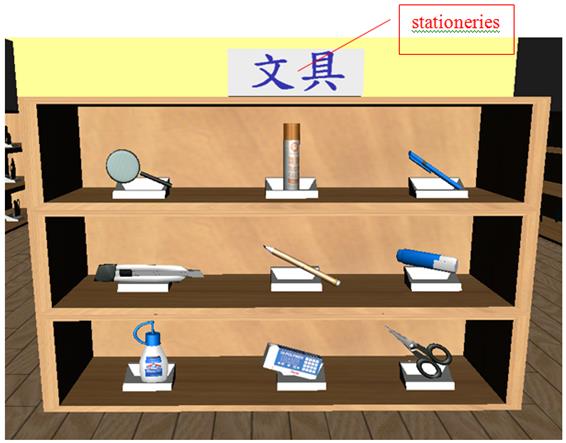
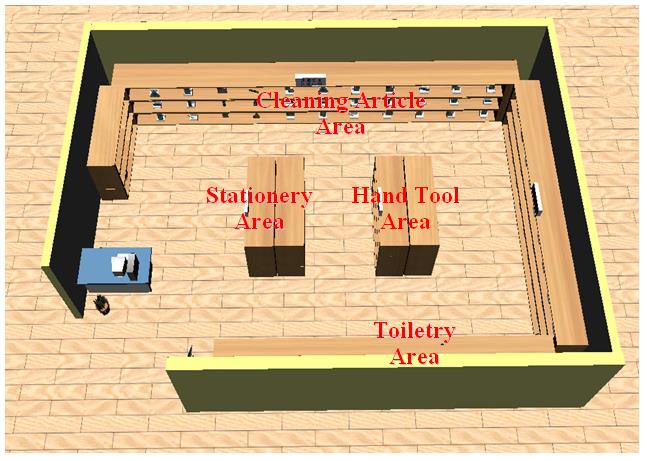
factorial design with six treatment conditions. Each participant was randomly assigned one of the six conditions to do the task of goods-searching. Therefore, there were ten participants randomly assigned to each one of the six conditions.
During the exposure period, there were eight target objects for which participants were required to search. However, only six of these objects were exhibited in the showroom. When the target object was found, participants were to move the cursor over the object and push the left button on the control device to identify the object. If the object was the target, the system would beep once to notify the participant. At the same time, the participant was to write down the correct position on the check sheet (i.e., each showcase was numbered). If the participant determined that a particular target object was not exhibited in the showroom, the participant was to mark “X” in the corresponding column. Participants were asked to complete one lap of the 3D store to ensure that the participants understood the basics of functioning within the VE. During the exposure, participants could freely involve themselves in the VE by manipulating the mouse button and rotating the scene around the vertical or lateral axes. They could also zoom in using the SHIFT key and zoom out using the CTRL key. When all six target objects were found, and the other two objects were confirmed to not be present in the showroom, the experiment was concluded. Finally, participants were asked to complete a presence questionnaire (PQ). The PQ was devised to measure user presence within a VE on a 7-point scale and consisted of 4 categories (control factors, sensory factors, distraction factors and realism factors) with 32 questions regarding user interaction [8].
Results and Discussion
To evaluate the effects of depth perceptual cues on presence we used 2 way analysis of variance (ANOVA). Table 1 shows that high-quality depth perception cues, i.e., 3D objects for multiple viewpoints, provided participants a sense of presence that was significantly higher than that they experienced with 2D objects. This result suggests that 3D objects may provide enough stereopsis and stereo acuity for users to identify objects, examine those objects from multiple viewpoints and interact with those objects, thereby allowing participants to experience a stronger sense of presence than did the 2D objects within the virtual store. In addition, there were significant differences among display types. Therefore, there was a need for further investigation into the effects of different display types on the sense of presence. A post-hoc test performed in Tukey was used for pair-wise comparison of display types, and the results are shown in Table 2. The results show that the sense of presence was stronger in 3D displays than in monocular displays.
- Sources
- Means
- SS df
- MS
- F
- P value
- Ambient conditions
- 2D objects 84.1
- 14539.3
- 1
- 14539.3
- 77.9
- .000*
- 3D objects 115.3
- Auto- 111.9 stereoscopic display
- 12759.6
- 2
- 6379.8
- 34.2
- .000*
- Display types
- Stereoscopic 108.0 display
- Monocular 79.2 display
- Interaction
- 90.1
- 2
- 45.1
- .24
- .786
- Error
- 10077.6
- 54
- 186.6
- Total
- 37466.6
- 59
- *p < 0.05 significance level
Table 1: Anova analysis of the effects of ambient conditions and display types on presence scores.
| Mean difference | Std. | |||||||||||||
|---|---|---|---|---|---|---|---|---|---|---|---|---|---|---|
| (I) Display types | (J) Display types | P value | ||||||||||||
| (I-J) | Error | |||||||||||||
| Stereoscopic | 3.9 | 4.32 | 0.371 | |||||||||||
| Auto-stereoscopic | ||||||||||||||
| Monocular | 32.700* | 4.32 | .000* | |||||||||||
| Auto-stereoscopic | -3.9 | 4.32 | 0.371 | |||||||||||
| Stereoscopic | ||||||||||||||
| Monocular | 28.800* | 4.32 | .000* | |||||||||||
| Auto-stereoscopic | -32.700* | 4.32 | .000* | |||||||||||
| Monocular | ||||||||||||||
| Stereoscopic | -28.800* | 4.32 | .000* | |||||||||||
Table 2: Tukey’s post-hoc tests for the effects of display types on presence. In this study, different situations of ambient cond
*p < 0.05 significance level Table 2: Tukey’s post-hoc tests for the effects of display types on presence. In this study, different situations of ambient conditions and different display types were compared better sense of presence than 2D objects, especially in 3D auto-stereoscopic display. The results also indicated that when the objects were designed with low quality depth perceptual cues (i.e. 2D objects), the feeling of the nature of the world would be lost seriously. If the 3D virtual store was shown on a 3D display with 3D objects, the 3D stereo pictures may provide enough stereopsis within the 3D displays to produce an enhanced binocular disparity for users examine objects from multiple viewpoints, of course, participants would feel better presence within the virtual store and desire to stay. In addition, 2D monocular display images provide a two dimensional representation of a three dimensional scene. Information pertaining to the third dimension (i.e. the range or distance to each pixel) is lost as the scene is flattened onto the image plane. Although the feeling of presence in 3D objects was better than in 2d objects within a 2D monocular display, the overall feeling of presence was less than 3D displays. The other interesting outcome from the rating items was that participants perceived the virtual store with 3D auto-stereoscopic display showed better presence in total ratings, even in sub-factor “Sensory” and “Realism” and subscale “Involvement/control” than 3D stereoscopic display (Table 3). It is possible to hypothesize that there are some disadvantages for the elderly to influence the feel of presence within a stereoscopic display. First, when worn for long periods, the ill-fitting pair of bridge and nose pads of glasses can pinch the nose. This pinching could cause pain to make glasses uncomfortable to wear. Second, while glasses provide a clear forward view, they can limit peripheral vision. Participants more likely have to move their whole head to point the glasses toward the object of view, fatigue and inattention would occur easily. Finally, the constant shuttering of glasses might bother some who are very sensitive to low refresh rates and cause flickering. Therefore, participants showed less presence within a stereoscopic display than auto- stereoscopic display.
| Display types | Sensory | Realism | Involvement/control | |||||||||
| Auto-stereoscopic | Mean | 32.85 | 17.5 | 49.2 | ||||||||
| display | SD | 5 | 2.5 | 9.11 | ||||||||
| Stereoscopic | Mean | 27.65 | 15.75 | 42.85 | ||||||||
| display | SD | 6.04 | 4 | 11.68 | ||||||||
| Monocular | Mean | 16.25 | 11.2 | 35.1 | ||||||||
| display | SD | 6.03 | 3.94 | 7.89 |
Table 3: Sub-factor and sub-scale scores of presence for display types Additionally, the current study, which examined searching
Table 3: Sub-factor and sub-scale scores of presence for display types Additionally, the current study, which examined searching performance within a virtual store (a movable task) with different level of ambient conditions and different types of display, who may not be able to fully benefit from 3D displays, found performance (response time of objects searching) was in fact lower than results produced from 2D monocular display under the same VE conditions. These results can be explained by assuming that the 3D virtual store with 3D displays in 3D objects would provide more in terms of interaction with objects, participants might involve in the VEs by clicking and holding mouse button for moving, dragging or zooming in/out the objects and overall environment. Therefore, response time of objects-searching with 3D displays was expected to be longer than 2D monocular display. In other words, participants are willing to spend more time to involve in the virtual store when good stereopsis shows on 3D display. However, participants required glasses to see the virtual store under 3D stereoscopic display, sometimes needed to stop or slow down operating to adjust glasses and forehead angle to increase response time. Finally, overall performance within the 3D virtual store was determined by the total time (seconds) spent searching for and confirming the target objects. The total time spent on finding six target objects in the showroom was recorded, and the correct positions on the check sheet were written down. The analysis of variance of the performance time is shown in Table 4. The ANOVA result indicates that there was no significant difference between low-quality depth perceptual cues and high-quality depth perceptual cues.
- Sources
- Means
- SS df
- MS
- F
- P value
- Perceptual cues
- 2D objects
- 753.1
- 120.4
- 1
- 120.4
- 0.06
- 0.811
- 3D objects
- 756
- Auto-stereoscopic display
- 692.4
- 1081410
- 2
- 540705.1
- 260.67
- .000*
- Stereoscopic display
- 941
- Display types
- Monocular display
- 630.3
- Interaction
- 2314.4
- 2
- 1157.2
- 0.56
- 0.576
- Error
- 112013.9
- 54
- 2074.3
- Total
- 1195859
- 59
- *p < 0.05 significance level
Table 4: Anova analysis of the effects of ambient conditions and display types on response time.
| Mean difference | Std. | |||||||||||||
|---|---|---|---|---|---|---|---|---|---|---|---|---|---|---|
| (I) Display types | (J) Display types | P value | ||||||||||||
| (I-J) | Error | |||||||||||||
| Stereoscopic | -248.65* | 14.403 | .000* | |||||||||||
| Auto-stereoscopic | ||||||||||||||
| Monocular | 62.05* | 14.403 | .000* | |||||||||||
| Auto-stereoscopic | 248.65* | 14.403 | .000* | |||||||||||
| Stereoscopic | ||||||||||||||
| Monocular | 310.70* | 14.403 | .000* | |||||||||||
| Auto- stereoscopic | -62.05* | 14.403 | .000* | |||||||||||
| Monocular | ||||||||||||||
| Stereoscopic | -310.70* | 14.403 | .000* |
Table 5: Tukey’s post-hoc tests for the effects of display types on response time.
*p < 0.05 significance level Table 5: Tukey’s post-hoc tests for the effects of display types on response time.
Conclusion
When the virtual store is more and more combined with people's lives, it does not only bring visually different feelings, but also produce a number of attraction for the elderly. Virtual stores with 3D objects and thus high-quality perceptual cues allow older users to experience good stereo acuity. The current study found that the elderly who browsed in a 3D virtual store with 3D objects did benefit from binocular disparity within a 3D display and were able to experience a good sense of presence. Our conclusion is that a presenting a virtual store via an auto-stereoscopic display with 3D objects will produce a good sense of presence and realism in stereopsis, thereby allowing the elderly to engage with and become desire to stay in the virtual store. However, the response time of objects-searching with 3D displays was longer than 2D monocular display. Online shopping has become quite popular since its first arrival on the internet. Along with elderly society’s coming, many older adults (i.e., the “silver tsunami” generation) have problems performing daily tasks because of restricted mobility, lack of transportation, inconvenience, and fear of crime [17]. Computers with an internet connection used at home can provide this population a new channel to access to information and services, and can also be used to manage internet shopping tasks. One of the primary advantages of VEs technology applied in web shops is its ability to provide a three dimension (3D) perspective to customers for more real sense on goods and shopping environment. When the elderly is growing rapidly worldwide [2], for this population, the combination of VEs and internet would introduce a new mode in online shopping. Additionally, because of the limited ability to act, the accidents may happen in the elderly when they are in shopping. The 3D virtual store will help the elderly to buy and own goods on the internet to reduce the occurrence of accidents for more safety living environment.
References
-
Johnson R, Kent S (2007) Designing Universal Access: Web-Applications for the Elderly and Disabled. Cognition, Technology & Work 9(4): 209- 218.
-
Jones S, Fox S (2009) Generations online in 2009. Pew Internet & American Life Project Report.
-
Yang L, Dong H, Alelaiwi A, Saddik AE (2016) See in 3D: state of the art of 3D display technologies. Multimedia Tools and Applications 75(24): 17121– 17155.
-
Benzie P, Watson J, Surman P, Rakkolainen I, Hopf K, et al. (2007) A survey of 3DTV displays: techniques and technologies. IEEE Transactions on Circuits and Systems for Video Technology 17(11): 1647-1658.
-
Lambooij M, Ijsselsteijn W, Fortuin M, Heynderickx I (2009) Visual discomfort and visual fatigue of stereoscopic displays: a review. Journal of Imaging Science and Technology 53(3): 1-14.
-
Fattal D, Peng Z, Tran T, Vo S, Fiorentino M, et al. (2013) A multi-directional backlight for a wide- angle, glasses-free 3D display. In: Proceedings of 2013 IEEE Photonics Conference, pp: 24–25.
-
Toyooka K (2001) The 3D Display Using Field- Sequential LCD with Light Direction Controlling Backlight. SID’01 Digest pp: 177-180.
-
Cornelissen HJ, Greiner H, Dona MJ (1999) Frontlights for Reflective Liquid Crystal Displays Based on Lightguides with Micro-Grooves. SID Symposium Digest 30(1): 912-914.
-
Chu YM, Chien KW, Shieh HPD, Chang JM, Hu A, et al. (2005) 3D mobile display based on dual-directional light guides with a fast-switching liquid-crystal panel. Journal of the Society for Information Display 13(10): 875-879.
-
Yu H, Lee K, Park J, Park Y (2017) Ultrahigh- definition dynamic 3D holographic display by active control of volume speckle fields. Nature Photonics 11: 186-192.
-
Sylaiou S, Karoulis A, Stavropoulos Y, Patias P (2008) Presence-centered assessment of virtual museums’ technologies. Journal of Library and Information Technology 28(4): 55-62.
-
Nichols S, Haldane C, Wilson JR (2000) Measurement of presence and its consequences in virtual environments. International Journal of Human-Computer Studies 52(3): 471-491.
-
Sheridan TB (1992) Musings on telepresence and virtual presence. Presence: Teleoperators and Virtual Environments 1(1): 120-126.
-
Wilson JR (1997) Autonomy, interaction and presence. Presence: Teleoperators and Virtual Environments 1(1): 127-132.
-
Steuer J (1992) Defining virtual reality: dimensions determining telepresence. Journal of Communications 42(4): 73-93.
-
Witmer BG, Singer MJ (1998) Measuring presence in virtual environments: a presence questionnaire. Presence 7(3): 225-240.
-
Czaja S, Lee C (2003) Designing Computer Systems for Older Adults. In: Jacko JA, Sears A (Eds.), The Human Computer Interaction Handbook: Fundamentals, Evolving Technologies and Emerging Applications, L. Erlbaum Associates Inc. Hillsdale, NJ, pp: 413-427.
- The Expanding Landscape of Road Rage: A Systematic Review of Conflicts Involving Drivers, Pedestrians, and Micromobility
- Validating Cognitive Models of Royal Navy Performance on Control Systems
- Comparing Standard and State-of-the-art Firefighter Coats on Postural Balance and Gait in a Live Burn Environment
- Investigating the Integration of Telemedicine into Clinicians Workflow: A Review of Methods
- Risk Assessment of Ergonomic Factors in a Textile Firm by RULA, REBA and Fine Kinney Methods
- Impact of Self-Esteem Training on Individuals with Disabilities Aged 17-30