
Occupational Health and Safety Risk Assessment for Demolition Processes in Construction
Construction is one of the most diverse industry sectors in terms of the possibility of injuring and endangering the health of workers. The increasing number of incidents on the construction site and their severity require additional emphasis on the development of the workplace safety plan and program. Therefore, before opening the construction site in order to assess the risk and analysis the safety it is necessary to determine safety hazards that may occur. In this paper, from the aspect of facilities demolition for characteristic workplaces, the Matrix 3x3 method, AUVA and FMECA method were applied. The risk assessment was carried out for three construction sites and three characteristic workplaces, the construction site manager, the machine operator and the labourer. Applied methods were analysed in order to determine their sensitivity on increased and unacceptable levels of risks.
Introduction
Every branch of industry generates specific risks of occupational safety that are arising from the work environment, the workplace and the necessary resources for the work operation. Increasing complexity of work processes requires more time and resources for organization of the same in a safe way. The building process has all the characteristics of a very complex process: each object that is being built is a specific, process requires a large number of participants and stakeholders, the problem of design and construction is present, a large number of different types of materials, tools and machinery is needed, the building process is exposed to weather conditions, the movement of workers, materials and machinery is present in one or more buildings, education of the workforce is low, and so on. Despite being one of the most significant branches, construction industry features the highest injury rate [1, 2, 3, 4, 5, 6]. The occupational health and safety system is based on the application of the prevention principles for injuries at work, illness or damage to the health of an employee which must be carried out before starting the works. This is a prerequisite for the opening of each construction site in the Republic of Serbia. Risk assessment of injuries at worker employee illness is based on the determination of safety hazards on the workplace and work environment which can cause injury and probability of their appearance and it is thoroughly defined in the Occupational Health and Safety Law of Serbia [7] as well as in Rulebook for risk assessment [8]. Prior to the commencement of the work, it is necessary to assess the risk from the aspect of safety and health of employees, taking into account selection of work equipment, conditions of working environment, personal protective equipment, materials used in the working process, adaptability of work places and work environment to the employees. Risk assessment at the workplace and working environment is introduced with the aim of complete elimination of safety hazards, which should be sought in the conduct of the procedure. However, as it is usually not possible, the level of safety hazards should be reduced to the lowest possible extent. By introducing the principles of risk assessment and implementing the prescribed assessment procedures, we can effectively perceive the safety and working conditions in all workplaces. The manner of implementing the risk assessment process is defined by a standardized set of steps that are in line with the recommendations of the relevant laws, as well as the recommendations of good practice. Figure 1presents an algorithm with these steps.
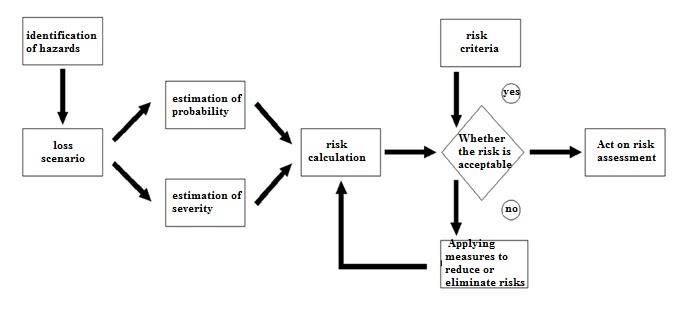
Methods for Risk Assessment
Risk assessment is a process based on precisely defined activities that need to be realized in order to define risk events that can lead to disturbances of the system being monitored [11]. As the construction industry is a non-stationary type of industry, in the sense that the process is being constantly modified and changed in order to build an object, the risk assessment process is more complex than other industrial branches. It is necessary to implement it for every construction site where the working conditions, workers, subcontractors, suppliers, applied materials, machinery and even contract documents are often changed [12]. In order to carry out a risk assessment, it is necessary to identify and analyse all possible sources of safety hazards, and then approach the evaluation of intensity - levels of risk ranking. Safety hazards are classified according to the current Rulebook of methods and risk assessment procedure for the workplace and working environment (Table 1).
Recognition Of Hazards On The Work Place
Grouping the hazards Groups of hazards Subgroup of hazards Šifra
Insufficient safety due to rotating or moving parts 1 Free movement of parts or materials that may cause injury to an Mechanical hazards that occur using equipment for Internal transport and movement of machinery or vehicles, as well as movement of certain equipment for work 3 Use of hazardous materials for operation, which may cause explosion or Inability or limitation of timely removal from the place of work, exposure to closing, mechanical shock, matching, etc. 5 work Auxiliaries for work (cables, chains) 6 Other factors that may appear as mechanical sources of danger 7 Dangerous surfaces (floors and all types of treads, surfaces with sharp Hazards that arise in relation to the characteristics of the workplace Working at altitude or depth 9 Working in a cramped, restricted or hazardous area (between two or more fixed parts, between moving parts or vehicles, indoor work that is
10 insufficiently lit or ventilated) Possibility of slipping or stumbling 11 Physical instability of the work place 12 Possible consequences or disruptions due to the obligatory use of resources or equipment for personal protection at work 13 Impacts due to illness of the work process using inappropriate or Other hazards that may arise in relation to the characteristics of the work place and the way of work (use of resources and equipment for personal Hazards arising from the use of electricity protective at work that burdens the employee, etc.) Hazard of direct contact with parts of electrical and voltage equipment 16 Hazard of indirect contact 17 Hazard of thermal effects developed by electrical equipment and installation 18 Hazard due to thunder stroke and the effects of atmospheric discharge 19 Hazard of harmful effects of electrostatic charge 20 Other hazards that may appear in connection with the use of electricity 21 Chemical damages, dust and fumes 22 Physical hazards (noise and vibrations) 23 Biological hazards (infections, exposure to microorganisms and allergens) 24 Harmful effects of microclimate (high or low temperature, humidity and Unsuitable - insufficient brightness 26 Harmful effects of radiation 27 Harmful climate effects (outdoor work) 28 Hazards arising from the use of hazardous materials (toxic substances) 29 Effort or physical strain (manual transmission of the load, pushing or Non-physiological position of the body (long-term sitting, standing, Efforts in carrying out certain tasks that cause psychological stress Conflict situations, insufficient motivation for work, management
- Hazards related to the organization of work
- Work longer than full-time (overtime), work night
- 34
- Hazards caused by other persons
- 35
- Working in an atmosphere with high or low pressure
- 36
- Work near the water or below the water surface
- 37
- Hazard due to the lack of technical and sanitary conditions in the
- Other hazards that occur in the work place
- Inappropriate ventilation
- 39
- Inadequate heating
- 40
- Inadequate roads, water supply, waste disposal
- 41
Table 1: Classification of Safety Hazards.
| Method | |||||||
|---|---|---|---|---|---|---|---|
| Level of risk | |||||||
| Matrix 3x3 | FMECA | AUVA | |||||
| Acceptable | 1-3 | R≤10 | 1-9 | ||||
| 10<R≤100 | |||||||
| Increased | 4 | 100<R≤200 | 10,12 | ||||
| Unacceptable | 6-9 | 200<R≤400 | 15,16,20,25 | ||||
| R>400 |
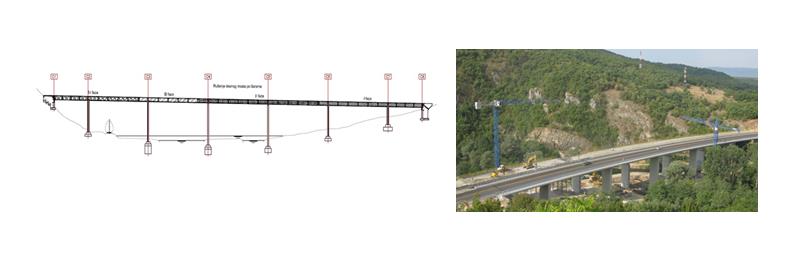
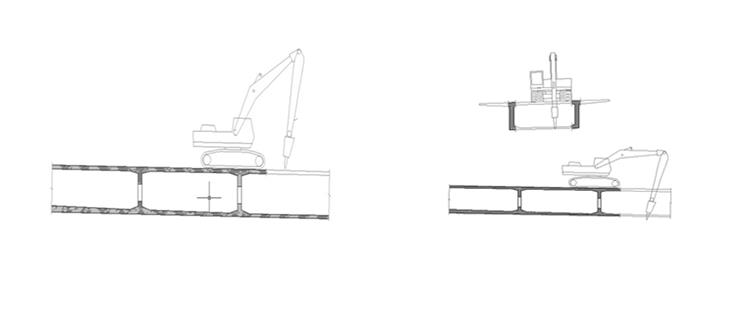
raking prop was made to the top and bottom panels, 15cm thick. The main bridge construction was rigidly connected to reinforced concrete pillars and it was not possible to demolish the bridge continuously due to the danger that parts of the main bridge construction would enter unfavorable static influences into the pillars. For this reason, only the panel elements of the box-shaped girder (footpath’s consoles, upper and lower slabs) could be independently demolished without supporting. For the further demolition of the main bridge girder it was necessary to set supporting scaffold in order to prevent deformation and entering of negative impacts in pillars of the old bridge (Figures 2 & 3).
TMD in Novi Sad, Building of the FTN Laboratory
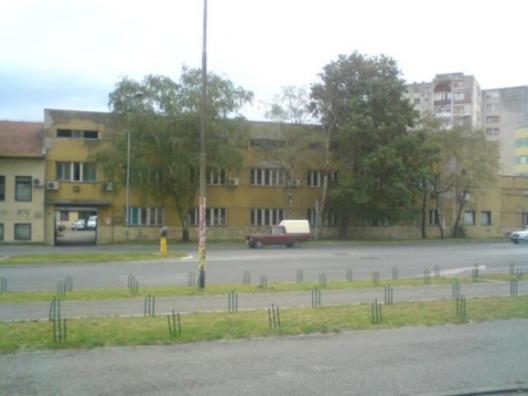
The TMD building (Figure 4) represented an auxiliary building of the Faculty of Technical Sciences in Novi Sad with offices and laboratories for the Department of Civil Engineering and Geodesy. TMD consisted of several mutually independent buildings with different heights and number of floors. Structures of the buildings were performed as massive with brick walls and belt courses. For all buildings the roof was designed as a wooden structure with cover of asbestos slabs on one part and a tile on the other.
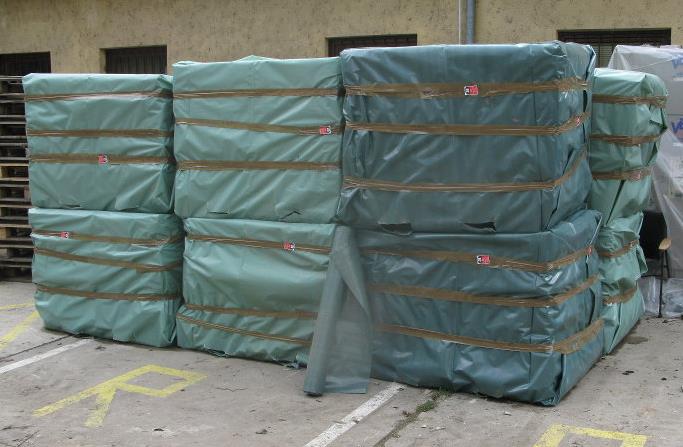
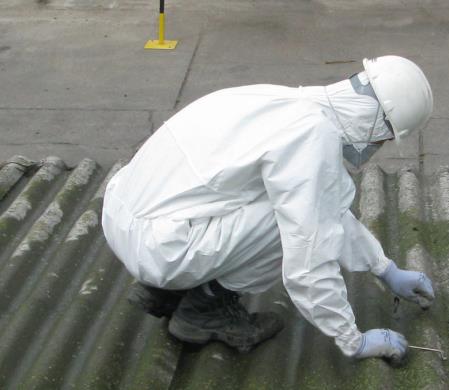
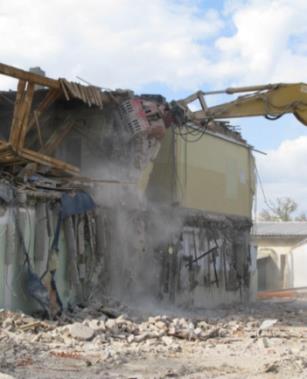
Demolition of the roofs was carried out by workers considering great among of asbestos plates (Figure 5) and the demolition of the building was carried out carefully by the hand of the excavator, without entering the zone of adjacent objects (Figure 6). Removal of waste was done according to the best practice and law especially in terms of asbestos plates (Figure 7).
NIS-Petrol Gas Station in Novi Sad
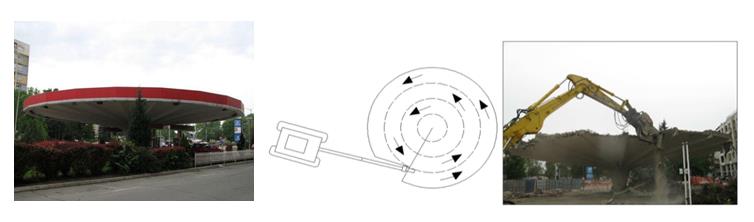
NIS-Petrol Station is a structure that consists of two independent parts that need to be removed. One part is a prefabricated type, while the second part is a reinforced concrete structure. Prefabricated building, which is removed, has P+0 storeys, while the reinforced concrete structure consists of one pillar with a circular slab above on it. The reinforced concrete circular slab is covered with profiled sheet. The first approached is demolishing the prefabricated building. Demolition of reinforced concrete structures is done by machine. Firstly, a specialized scissor excavator removes the profiled sheet and then follows the cutting of the reinforced concrete slab (Figure 8). At the end of the demolition of the slab, the removal of the reinforced concrete pillar by a pneumatic hammer is followed.
When analysing the demolition of these three facilities, the goal was to identify the number of safety hazards in which there may be a reasonable doubt that an increased risk will arise and determine which of the methods is more susceptible to these risks. Table 3 shows the identified safety hazards according to the Rulebook [8] with increased risk for all three characteristic workplaces that were considered at the the most complicated for use and it takes most of the time to come up with a list of safety hazards with increased risk. The complexity of the method and the process of obtaining results should not be a priority when choosing a risk assessment method. On the basis of the process of recording the organization of work, applied safety measures, identifying safety hazards and risk ranking, it was evaluated that in the case of demolition of the listed facilities, construction site manager, machine operator and labourer are high-risk jobs positions. Observing the number of safety hazards that arise from the site analysis, despite the fact that structures of the facilities were fundamentally different as well as the phases and methods of demolition, the greatest number of safety hazards were evaluated as increased while using FMECA analysis. The smallest number was obtained by analysing the AUVA method by a three-step scale.
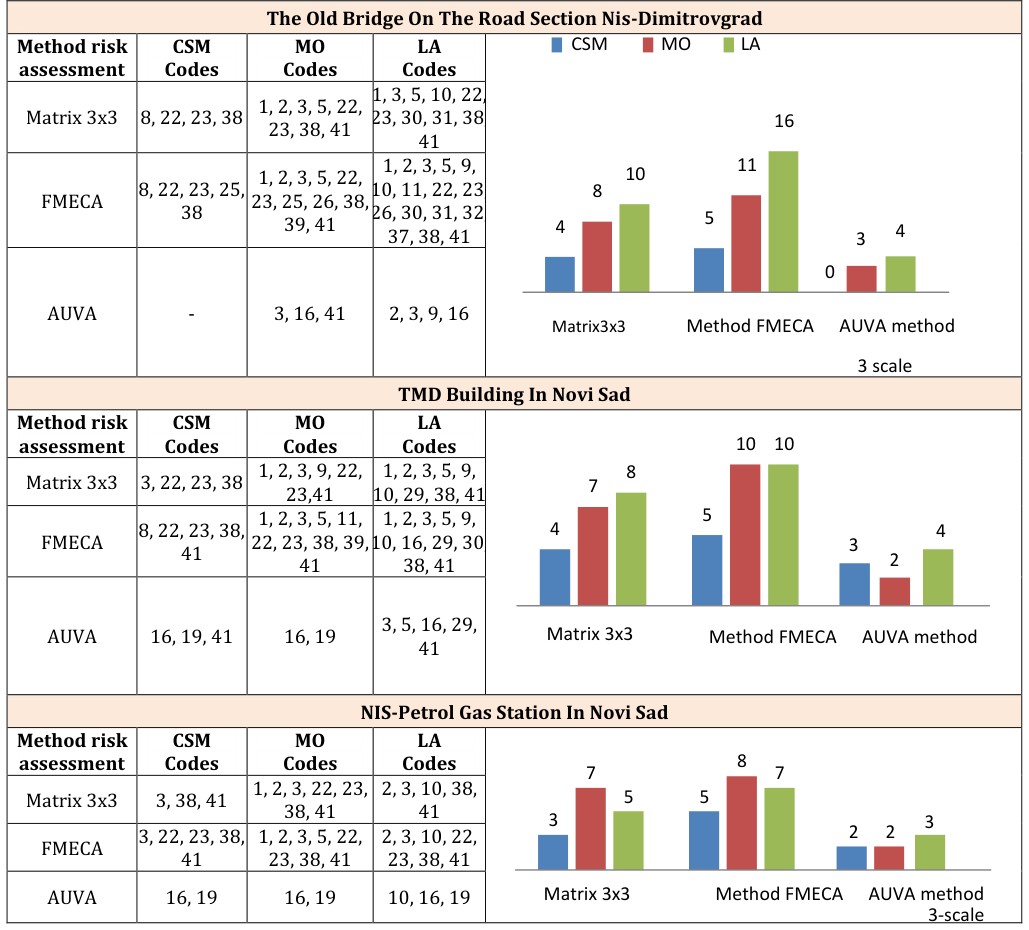
- The Old Bridge On The Road Section Nis-Dimitrovgrad
- Method risk
- CSM
- Codes
- MO
- Codes
- LA
- Codes assessment
- 1, 3, 5, 10, 22,
- 23, 30, 31, 38,
- Matrix 3x3
- 8, 22, 23, 38 1, 2, 3, 5, 22,
- 23, 38, 41
- 41
- 1, 2, 3, 5, 9,
- 10, 11, 22, 23,
- 26, 30, 31, 32,
- 1, 2, 3, 5, 22,
- 23, 25, 26, 38,
- FMECA
- 8, 22, 23, 25,
- 8
- 38
- 39, 41
- 37, 38, 41
- AUVA
- -
- 3, 16, 41
- 2, 3, 9, 16
- TMD Building In Novi Sad
- Method risk
- CSM
- Codes
- MO
- Codes
- LA
- Codes assessment
- Matrix 3x3
- 3, 22, 23, 38 1, 2, 3, 9, 22,
- 1, 2, 3, 5, 9,
- 10, 29, 38, 41
- 23,41
- 1, 2, 3, 5, 11,
- 22, 23, 38, 39,
- 1, 2, 3, 5, 9,
- 10, 16, 29, 30,
- FMECA
- 8, 22, 23, 38,
- 41
- 41
- 38, 41
- AUVA
- 16, 19, 41
- 16, 19
- 3, 5, 16, 29,
- 41
- NIS-Petrol Gas Station In Novi Sad
- Method risk
- CSM
- Codes
- MO
- Codes
- LA
- Codes assessment
- Matrix 3x3
- 3, 38, 41
- 1, 2, 3, 22, 23,
- 2, 3, 10, 38,
- 38, 41
- 41
- FMECA
- 3, 22, 23, 38,
- 1, 2, 3, 5, 22,
- 2, 3, 10, 22,
- 41
- 23, 38, 41
- 23, 38, 41
- AUVA
- 16, 19
- 16, 19
- 10, 16, 19
Table 3: Safety hazards with increased risk for workplaces.
operator. In all cases, the position of the construction site manager has been identified with the least number of safety hazards with increased risk. All identified safety hazards obtained by the 3x3 method were obtained by the FMECA method while the AUVA method, although giving the smallest list, nevertheless identifies some of the safety hazards with increased risk that are not obtained by the other two methods. The recommendation and conclusion obtained by this research would be that the FMECA method is the most sensitive to this type of risk assessment and that it provided the largest list of safety hazards that have an increased risk of occurrence. However, the AUVA method has revealed that some safety hazards can be considered as having an increased risk of occurrence, so it is best to use more comparative solutions and methods in order to find a final conclusion.
Conclusion
Construction is one of the most diverse industry sectors in terms of the possibility of injuring and endangering the health of workers. The increasing number of incidents on the construction sites and levels of their severities require additional emphasis on the development of the workplace safety plan and program. Therefore, before opening the construction site in order to assess the risks and analyse safety, it is necessary to determine high level safety hazards that may occur. There are many methods for risk assessment, none of them is universal. In this paper, three methods were applied and analysed (matrix 3x3, AUVA and FMECA)in order to identify high level hazards for of demolition works at three construction sites. For each of them three characteristic work places (construction site manager, machine operator and labourer) were analysed. Different results were obtained when performing the risk assessment and it has been concluded that all three listed sites had increased risks of safety hazards. According to the obtained data and the characteristics of the applied methods, it can be concluded that for the analysed facilities the highest sensitivity was shown by FMECA method. Using the FMECA method, a greater number of identified safety hazards with increased risk was obtained in relation to the other two methods. Due to professional illnesses that hazard can cause, it is best to use a method or combination of methods that will thoroughly analyse each identified hazard. The choice of demolition technology also influences the assessment of the risks as well as the health and safety conditions at the site. Since the analysed facilities were located in the populated parts of the cities or in the vicinity of used facilities, cutting or crushing technology is the most appropriate solution. When using this demolition technology there are increased risks for the following identified safety hazards: insufficient safety due to rotating or moving parts, free movement of parts or materials that may cause injury to an employee, internal transport and movement of machinery, the impossibility or limitation of timely removal from the place of work, exposure to closing, mechanical shock, chemical hazards, dust and fumes, physical hazards (noise and vibration). Accordingly, for this demolition technology, greater attention should be paid to the mentioned safety hazards involved in risk assessment. When assessing risks, the best it would be to form a team of competent individuals and use all the present databases. The health and safety professionals as well as construction managers should be very careful when using presented methods. Many poor decisions can be made if they rely only on the results obtained from the risk assessment.
Acknowledgment
The work reported in this paper is a part of the research within the research project TR 36043 "Development and application of a comprehensive approach to the design of new and safety assessment of existing structures for seismic risk reduction in Serbia", supported by the Ministry for Science and Technology, Republic of Serbia. This support is gratefully acknowledged.
References
-
Lingard H, Rowlinson S (2005) Occupational Health and Safety in Construction Project Management. Taylor & Francis, New York.
-
Baradan S, Usmen AM (2006) Comparative Injury and Fatality Risk Analysis of Building Trades, Journal of Construction Engineering and Management 132(5): 533-539.
-
Carter G, Smith DS (2006) Safety Hazard Identification on Construction Projects, Journal of Construction Engineering and Management 132(2): 197-205.
-
Borys D (2012) The role of safe work method statements in the Australian construction industry. Safety Science 50: 210-220
-
Choudhry RM, Fang D (2008) Why operatives engage in unsafe work behaviour: Investigating factors on construction sites. Safety Science 46: 566-584.
-
Pinto A, Nines LI, Ribeiro AR (2011) Occupational risk assessment in construction industry – Overview and reflection. Safety Science 49: 616- 624.
-
Occupational Safety and Health Law, Published in the Official Gazette Republic of Serbia, Nos. 101/05 of 21 November 2005 and 91/15 of 5 November 2015
-
Rulebook on Procedure for Risk Assessment in Workplace and Working environment, Published in the Official Gazette Republic of Serbia, Nos. 72/06, 84/06, 30/10 and 102/15
-
Starčević J, Ilić M, Paunović PJ (2010) Priručnik za procenu rizika, Belgrade.
-
Behm M (2005) Linking construction fatalities to the design for construction safety concept. Safety Science 43: 589-611.
-
Wideman RM (1992) Project and program risk management: a guide to managing project risks and opportunities. Project Management Institute, Newtown Square, Pennsylvania.
-
Mučenski V, Peško I, Trivunić M, Ćirović G, Dražić J (2013) Identification of Injury Risk in Building Construction-Education, Experience and Type of Works, Technical Gazette 20(6): 1011-1017.
-
Fera M, Macchiaroli R (2010) Appraisal of a new risk assessment model for SME. Safety Science 48: 1361-1368
-
Jocelyn S, Chinniah Y, Ouali MS (2016) Contribution of dynamic experience feedback to the quantitative estimation of risks for preventing accidents: A proposed methodology for machinery safety, Safety Science 88: 64-75.
- The Expanding Landscape of Road Rage: A Systematic Review of Conflicts Involving Drivers, Pedestrians, and Micromobility
- Validating Cognitive Models of Royal Navy Performance on Control Systems
- Comparing Standard and State-of-the-art Firefighter Coats on Postural Balance and Gait in a Live Burn Environment
- Investigating the Integration of Telemedicine into Clinicians Workflow: A Review of Methods
- Risk Assessment of Ergonomic Factors in a Textile Firm by RULA, REBA and Fine Kinney Methods
- Impact of Self-Esteem Training on Individuals with Disabilities Aged 17-30