
Monitoring Thermal Stress of Steel Re-Rolling Mill Workers
Monitoring heart rates using portable sport tester, this study investigated thermal stress as an important parameter of measuring physical effort of steel re-rolling mill workers. In all, 34 adult male subjects (age: 36 ± 4.1 years) volunteered for physiological tests that provided physiological reactions from the implication of their strenuous job-tasks and heat exposure. The subjective perceptions on the prevalence of heat stress, sweating, and heat exhaustion from extremely hot working environment was investigated using a questionnaire and ergonomic checklist. In findings, there were no significant differences of age, height, weight and rest pause except higher heart rates and sweat loss among most of the workers involved in strenuous job-tasks. The maximum working heart rate was measured as 140–190 beat per minute (bpm). The rise in oral temperature was found as 37.8°C (± 0.15°C) among the workers who worked in high heat and radiant environment. The results should however be compared with and confirmed for other stressful manual activities in high heat and radiant work environment. It would thus be appropriate to develop a local standard that can be useful to eliminate an eventual biasing effect of monitoring heart rates for measuring thermal stress for tropical countries. Further study is sought with the control subjects due to different socio-cultural, climatic and psychological factors of the sample used in the context of Bangladesh.
Introduction
The steel re-rolling mills/industry was established privately, and situated at Tejgoan Industrial area in Dhaka, Bangladesh. It produced steel rods, angles, and flat bars from billets, ingots or metal bars. The activities and work process were started inside the factory environment that caused a high temperature for heating up the metal bars, billets, and ingots at the natural gas fired furnace of up to 1000–1250oC. There were four rolling stations in each section. In each shift, two workers usually were standing at 2.5–to 4.0 meters away from the furnace, and just at opposite ends of the roller mills. Another two workers pulled out the hot ingots or billets (approximately 30–to 40kg) from the high heated furnace using long pliers and hooks. They brought the extremely hot metal bars or ingots to a roller conveyor, which takes the hot bars, ingots or billets to the extruders for successive operations. Both groups worked for repetitive manual handling tasks, 6-days work a week (except Friday) in a very high heated and radiant work environment. The workers wore a pair of long sleeved khaki pants and cotton shirts. Second-hand military boots were seen used instead of wearing sandals. Some plastic helmets were available at the factory sites but a few workers used these helmets, only when there was a severe incident or accident occurred recently. A few workers used eyeglasses and dirty hand gloves. Some others used helmet with radiant heat protector and ear plugs. Billet or ingot cutting task in radiant environment with and without protective clothing is shown in Figure 1.
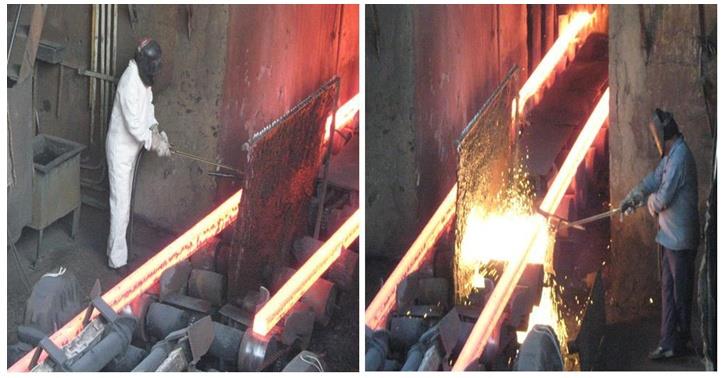
Figure 1: Billet cutting task in radiant environment with and without protective clothing. The rods were continually followed through each of the rolling stations, and sequentially become thinner and thinner, and longer and longer at each stage. The hooks and pliers were cooled systematically in a water bucket placed nearby. After the hot metal bars or ingots passed the motor operated rollers and extruders, they were moved down to the end of the rail, and the swinging platform. A piece of cloth was wrapped over the head and mouth of the workers for protection against the furnace heat and radiation temperature. In some cases, old and dirty leather hand gloves were used in both hands of the manual workers (Figure 2).
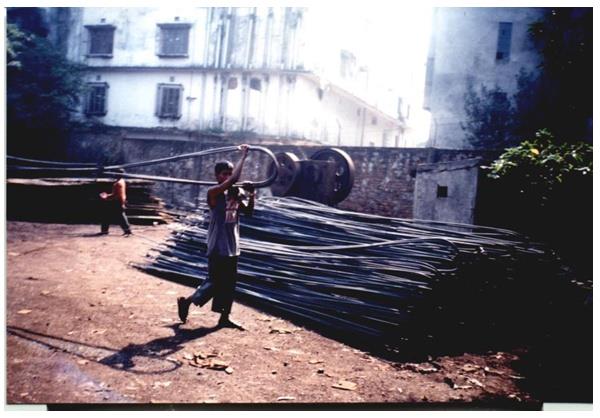
The rods were picked up with specially designed pliers and swung them down to the cooling bed (air-cooled). The rods are then cut to the correct length, bound in packages of 30–40 rods, weighed and carried over to a stockpile. Total production in this re-rolling mill was roughly 200 pieces per hour and per person/hour production was estimated approximately of 350 kg. Each exposure lasted for an hour, having two rest pauses for about 10 minutes each, while the workers were drinking tap water, eating nuts, betel leaf, smoking cigarettes, walking, sitting, and talking about women and sex. The factory building was made of a tin-shed structure, and was surrounded by brick boundary walls to protect properties, tools and materials from thieves. Additional heat was transmitted to the roof from the sunshine. The relative humidity inside the factory was lower than outside. Temperature was high inside the factory premises perhaps due to heating of metal bars. The workplace was observed as noisy, dusty and hot. It was also observed that humidity content inside the factory was lower than outside premises. Airflow was supplied, however, by two blowers in the rolling and swing section through a wide open-air gap between boundary wall and roofs. There was a very little control over the work organisation (less management function), pace of tasks, and the factory climate (heat, dust, noise). The task itself contributed to the additional workload on the workers exposed to high heat and radiant work environment.
Materials and Methods
After a series of meetings with the factory management and trade unions, a total of 34 healthy male subjects (age: 36 ± 4.1 years) were selected from a total of 250 workers. The subjects were divided into groups A & B since their job-tasks varied (Table 1). They volunteered for physiological tests and participated in the questionnaire interview to score their job-tasks with regard to various potential confounders. Five alternatives response were given points from 1 (not tired or satisfaction) to 5 (exhausted or unsatisfactory) to register fatigue by mean values. Exposure hours refer to the total number of employee-hours worked for a shift. Higher fatigue intensity was conjectured from for higher points. Group results were described by means of 95% CI (confidence interval). Group-means differences were tested and compared by student t-test. The crude prevalence of exposure outcome form the subjective scales were assumed using a binomial probability distribution. The climatic parameters such as air velocity (Vair, m/s), relative humidity (RH) and ambient air temperature (Ta°C) were measured at approximately 2 meters from the ground level by a thermometer (Anlor- GGA–65) and a hygrometer (Humicor, No. 86–22492). Physiological
parameters and metabolic characteristics were noted with the help of a medical doctor at worksite. The height was taken by a gauge meter, and weight was taken on a scale (± 20gm). The rise in oral temperature (Toral°C) was measured by a digital thermometer. Heart rates (HR) were recorded by a portable telemetric device [PE–4000, Polar Electro, www.polar.fi/sampola] throughout the whole shift which was convenient to wear by the subjects without much interfering with their job-tasks. An adjustable band containing the electrodes and transmitter was attached to the subject's chest (Figure 3). The receiver was in the form of a wristwatch connected by a special wire to avoid interference (magnetic fields, motor speed, compressor effects, sudden or continuous noise).
![Figure 3: A. Workers worked near the furnace, B. Heart rate was recorded by polar electro tester. The receiver had a memory function that records the mean heart rate (HRm) at every minute interval in beat per minute (bmp). The monitor was taken off at the end of the workday, and the recorded heart rate was read off onto laptop computer using software (PC/XT/AT/PS-2, Win version 4.10). The data were then subjected to statistical treatment, which determined the work effort (increased working heart rates) and workers' physiological response such as rise in Toral. Energy expenditure indicates physical effort involved in a task which was also evaluated by Spitzer and Hettinger [1].](/fulltextimages/1568/fig_3.jpeg)
Figure 3: A. Workers worked near the furnace, B. Heart rate was recorded by polar electro tester. The receiver had a memory function that records the mean heart rate (HRm) at every minute interval in beat per minute (bmp). The monitor was taken off at the end of the workday, and the recorded heart rate was read off onto laptop computer using software (PC/XT/AT/PS-2, Win version 4.10). The data were then subjected to statistical treatment, which determined the work effort (increased working heart rates) and workers' physiological response such as rise in Toral. Energy expenditure indicates physical effort involved in a task which was also evaluated by Spitzer and Hettinger [1].
Heart rate and Toral give the combined effect of both workload and environmental heat load. The severity of physical strain involved in a job-task is reflected by the increase in heart rate and Toral. Indirect way of calculating HRmax value was obtained from a formula as HRmax = (220–age) or (200–age) bmp (beat per minute). In this case, worker age indicates the chronological age similarly illustrated by Kamon and Ayoub [2]. Physical work capacity was estimated from both direct [3, 4, 5] and indirect measurement [6, 7, 8, 9, 10]. The indirect measurement involves the linear relation between heart rate and VO2 at steady state condition that was also illustrated by Margaria, et al. [11], Gupta et al. [12] & Malchaire [13, 14]. Most of their tests on metabolic responses were valid for 80–to 200 bmp. The O2 uptake [4] was also obtained from a liner correlation (e.g., 100 bmp = 0.33 VO2). This correlation was used to extrapolate O2 consumption at a steady state condition. Task data and work-rest schedules were described as the external factors to establish the pattern or type of work they performed. The job-tasks were sampled systematically at 10 minutes intervals by the job-tasks and activities they performed using work sampling technique.
Results
Workers' physical characteristics are shown in Table 1. It reveals some physiological data that are important for general health and safety inspection. The subjects seem under weight and malnourished. There were no significant differences of HRmax values found from the indirect measurement. No significant differences in their age, height, weight except work experiences was found between the workers in group A and B. The respective Toral was 36.7 ± 0.10°C in group A, and 37.8 ± 0.15°C in group B.
| E | xperienc | e | Weekly | Working | ||||||||||
|---|---|---|---|---|---|---|---|---|---|---|---|---|---|---|
| G | rou | p | Job-tasks and activities performed | |||||||||||
| (years) | salary | hours | ||||||||||||
| A | 4 ± 4.3 | 40 US $ | 8 hours | Raw materials preparation: cutting metal plates, carrying, lifting, pushing, throwing metal pieces into the furnace, cleaning slugs, etc. | ||||||||||
| B | 8 ± 2.2 | 50 US $ | 6 hours | Rolling / swing operations (pulling out heated bars from the furnace, push them onto the conveyor rails, move hot slabs using long pliers and hooks, draw the rods, and similar tasks. |
Table 1: The perceived stress from work environment (e.g., heat, noise, dusts, fume and smokes) is summarised in Table 3. The ris
Table 1: Job-tasks and routine activities and demographic factors of the workers The factory climate data and environmental variables are shown in Table 2. The perceived stress from work environment (e.g., heat, noise, dusts, fume and smokes) is summarised in Table 3. The rise in Toral indicates physical work efforts as well as environmental heat load originates from the furnace heat, as well as from hot and humid climate. This was also considered to be equivalent to the rectal and core temperature followed by Mairiaux, et al. [15]. It was also because the study considered the oral temperature as an index of core temperature during heat Minard, et al. [17] illustrated physiological response to heat.
| Working sections | Light intensity (Lux) | Tair (o ) C | RH (%) | Noise [dB (A)] | Vair (m/sec) |
|---|---|---|---|---|---|
| Metal cutting section | 800–900 | 31–35 | 58–60 | 110–115 | 0.8 |
| Station at pulling hot bars | 120–200 | 45–50 | 46–50 | 90–95 | 1.1 |
| Rolling stations | 190–260 | 48–50 | 44–50 | 98–110 | 1.2 |
| Swinging station | 200–250 | 45–50 | 40–46 | 98–110 | 1.2 |
| Rod binding section | 800–900 | 32–34 | 60–62 | 80–90 | 1.1 |
Table 2: Comparing with the recorded heart rate, each subject was observed for his activity; however, all subjects did not comple
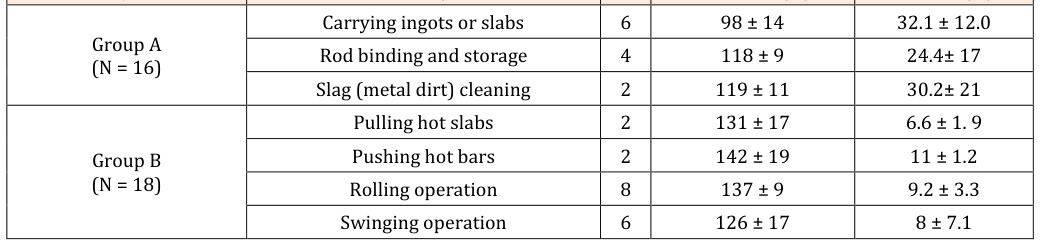
Table 2: Environmental variables/parameters at different working station/section Except carrying (HRmean = 98 bmp), all tasks required a high-energy consumption. It showed a HRmean ranged from 112 to 142 bmp (Table 4). This indicates that the job-tasks were heavier than usual. In all, eight activities were identified, four in each group. The heart rate distributions for these types of job-tasks and activities are summarized in Table 3. Comparing with the recorded heart rate, each subject was observed for his activity; however, all subjects did not complete a full activity against the time frame. It was also perhaps due to breakdown, mechanical fault, incidents or accident occurrences in the factory premises. The subjects spent a large percentage of their working time (32.1 ± 21) for carrying ingots and handling the raw materials. Some activity such as moving hot slabs showed high heart rates but it occupied less than 12% of total time spent for. For cleaning slugs and/or unblocking the furnace (sustained physical activity), however, they have had sufficient time to recover during the periods of observing the job-task, the mechanical process as well as the manual operation.
- Subjects
- Jobs and tasks/activities
- N mean HR (± )
- % time (± )
- Carrying ingots or slabs
- 6
- 98 ± 14
- 32.1 ± 12.0
- Group A
- (N = 16)
- Rod binding and storage
- 4
- 118 ± 9
- 24.4± 17
- Slag (metal dirt) cleaning
- 2
- 119 ± 11
- 30.2± 21
- Pulling hot slabs
- 2
- 131 ± 17
- 6.6 ± 1. 9
- Pushing hot bars
- 2
- 142 ± 19
- 11 ± 1.2
- Group B
- (N = 18)
- Rolling operation
- 8
- 137 ± 9
- 9.2 ± 3.3
- Swinging operation
- 6
- 126 ± 17
- 8 ± 7.1
- Subjects
- Jobs and tasks
- N
- Mean HRw mean HRr
- HRw/HRr
- 50% Level
- Metal cutting and hammering
- 4
- 109 ± 5
- 80± 4
- 1.36
- 0.78
- Carrying ingots or slabs
- 6
- 103± 4
- 67± 11
- 1.54
- 0.72
- Group A
- (N = 16)
- Rod binding and storage
- 4
- 98 ± 11
- 77± 7
- 1.27
- 0.89
- Slag cleaning
- 2
- 89 ± 14
- 69± 10
- 1.29
- 0.91
- Pulling hot slabs
- 2
- 143± 12
- 83± 9
- 1.72
- 0.78
- Pushing hot bars
- 2
- 162± 9
- 99± 12
- 1.54
- 0.85
- Group B
- (N = 18)
- Rolling operation
- 8
- 157± 13
- 96± 8
- 1.64
- 0.91
- Swinging operation
- 6
- 146± 7
- 88± 7
- 1.66
- 0.89
Table 3: Mean hear rate (RHmean) and percentage of time spent for various job-tasks/activities
- Subjects
- Jobs and tasks/activities
- N mean HR (± )
- % time (± )
- Carrying ingots or slabs
- 6
- 98 ± 14
- 32.1 ± 12.0
- Group A
- (N = 16)
- Rod binding and storage
- 4
- 118 ± 9
- 24.4± 17
- Slag (metal dirt) cleaning
- 2
- 119 ± 11
- 30.2± 21
- Pulling hot slabs
- 2
- 131 ± 17
- 6.6 ± 1. 9
- Pushing hot bars
- 2
- 142 ± 19
- 11 ± 1.2
- Group B
- (N = 18)
- Rolling operation
- 8
- 137 ± 9
- 9.2 ± 3.3
- Swinging operation
- 6
- 126 ± 17
- 8 ± 7.1
- Subjects
- Jobs and tasks
- N
- Mean HRw mean HRr
- HRw/HRr
- 50% Level
- Metal cutting and hammering
- 4
- 109 ± 5
- 80± 4
- 1.36
- 0.78
- Carrying ingots or slabs
- 6
- 103± 4
- 67± 11
- 1.54
- 0.72
- Group A
- (N = 16)
- Rod binding and storage
- 4
- 98 ± 11
- 77± 7
- 1.27
- 0.89
- Slag cleaning
- 2
- 89 ± 14
- 69± 10
- 1.29
- 0.91
- Pulling hot slabs
- 2
- 143± 12
- 83± 9
- 1.72
- 0.78
- Pushing hot bars
- 2
- 162± 9
- 99± 12
- 1.54
- 0.85
- Group B
- (N = 18)
- Rolling operation
- 8
- 157± 13
- 96± 8
- 1.64
- 0.91
- Swinging operation
- 6
- 146± 7
- 88± 7
- 1.66
- 0.89
Table 3: Mean hear rate (RHmean) and percentage of time spent for various job-tasks/activities
environment, physiological imbalance, and other confounding factors. The extra heart rate increased perhaps due to metabolic and thermal stresses, which exceeded the normal limit [e.g., 25–30% increase] as per research conducted by Astrand and Rodahl [18]. While there is an increased heart rate than the tolerance limit (e.g., 110 bmp) as per WHO [19], the cardiovascular load will then appear in human performance. In this study, Tbody was found little lower than 38oC as Parsons [20] indicated and suggested for. However, the human body must maintain a Tcore near 37oC as Vogt [21] conducted a research and suggested for.
Discussion
Workers' health and safety describes such work situation when the work-related risks are minimised from an uncontrolled and unwanted condition of a system or disturbance form the hazardous and unhygienic work environment. In hot and radiant work environment, the body can adapt to heat but not to dehydration [22]. Thus, one must drink fluid and plain water which counteract the risk of heat exhaustion and dehydration. Diluted sugar additives may help to postpone muscle fatigue by reducing glycogen utilisation. Liberally salted food during meals can counteract salt losses [23] but this can generate stomach upset, nausea or vomiting for some people. Activities are to be allowed on the condition that work- rest patterns are suitable. Certain measures [24] should be considered to avoid strenuous tasks in heat and radiant work environment. Implementing international standards [20] and control measures [25, 26], the incidence of heat strain and the severity of heat stress can be optimised or minimised. The suspected bad or negative effects of workplace environment (e.g., excessive noise, heat load, dusts, smokes, fumes) and the wide range of climatic variations and conditions as appearing during seasonal periods should be taken into account. It is difficult, however, to evaluate role of heat, radiation, and the strenuous physical job-tasks on the mental or intellectual performance [10] that are particularly vulnerable to heat exposure and radiation effects. To improve the tolerance to elevated Tcore, a suitable indoor climate should be maintained, however. Fatigue due to strenuous activity in the excessive heat, worker’s circadian rhythm might be the contributing factors to high HRm but this factor should be considered for, and validated according to the research conducted by CIWE [27]. The percentage of heart rate increase is supposed to be used as a dependent variable while heat load and individual's physical factors are independent. A definite correlation was found that when any of the work strains become excessive, the probability of subjective variations may change, however. Physiological balance is necessary for recovering from an excessive workload. A better- designed work-rest schedule would reduce heat load by minimising the severity of heat exhaustion. Due to the financial limitations, extensive changes may not be possible for implementing preventive measures. Simple modifications can however result in massive benefits, such as: reduction of working time through a revised shift schedule; proper clothing and screens to relieve the consequences of radiant heat and skin burn; proper operation and maintenance of rollers and swing mills; changing the infrastructure such as lay out, production line, work-pattern; and developing an efficient control or ergonomic measure [28]. The management was sceptical about this study would cause a disturbance of the worker job-tasks and activities and a loss of production. The labour union was reluctant in this matter but they allow volunteering their workers. The workers and labour unions were afraid of the management in case if they might lose the job, or be fired after testing them unhealthy and ill. The subjects volunteered in this study were also afraid on the speculation that this study might prove them physically weak and inefficient. The subject’s nude-body weight was not possible to measure because of cultural restrictions and religious restraints. The impact of the micro-inner clothing climate on thermoregulation was not considered either. Possible errors are due to uncontrolled climatic variations (e.g., wind effect) and physiological data (HR, Toral or Tbody) that were measured in the factory premises instead of the controlled laboratory conditions. Malchaire [13] argued that any attempt to validate methods in the field study doomed, as errors are likely to occur in the input data due to variation of metabolic rate, thermal insulation of clothing, measurement of heat radiation, humidity and air velocity. Metabolic rates such as sweat loss and actual energy expenditure (VO2) were not measured accurately. VO2 or energy intake and the prevalence of heat stress should not be used in such a situation that would compromise work organisation for economic efficiency. This study was conducted in the field without controlled environment. The highest Toral $$ \mathrm {E} = \frac {1}{2} \mathrm {A} ^ {2} + \mathrm {B} ^ {2} $$ Tcore was found as 37.8oC in group B. The workers were intervened to deal with the problem and it took time to re-start the original activity, when something went wrong with the operation. In addition, personal factors were unidentified such as chronic fatigue, tiredness, psychiatric disorder, sleep disturbance, digestive problem, and cardiovascular complaint, social or domestic disruption. This problem may be associated with shift-work may find a correlation with heat stress. In regard to validity and consistency, the assessment of work strain and heat stress is almost impossible using only a simple and standardised method. Hall [9] and Kähkönen, et al. experienced similar problems when testing such a method in Africa. Kirk and Parker [29] have also had similar experience about measuring heart rate and hear strain indices. Whatever the case, a good difference of heart rate fluctuation should be verified. In this study, few worker’s heart rate were recorded manually due to the fact that portable heart rate monitor did not show up the bmp (beat per minute) automatically. The authors are not sure about how Yoopat, et al. [30] conducted their studies in Thai steel mills workers and recorded their heart rates on sites. In this study, individuals' work culture, personal technique, level of nutrition and psychological behaviour were not identified. Only a total of 34 selected subjects were volunteered for and participated in this study. Such a small number of study subjects may not be enough to make ergonomic recommendation. It is also unlikely that the sample studied for, was not representative enough or sufficient for other working groups, those are involved in psychically stressful jobs in extreme heat and radiant work environment.
Conclusion
Physiological evaluation of heat stress and assessment of work strain through physiological reactions may not give enough evidence on correct information. The frequency of occurrences on the effects of strenuous tasks and heat-load are not easy. The interactions between the physiological, psychosocial and environmental factors were complex. For the assessment of physical effort, and to establish of control measures, the results are not, however, necessarily being error-free and accurate. The reason is that individuals' differences in heat acclimatization, dehydration or diet were not considered in this study. Bangladeshi workers usually have a poor diet (rice, lentils, vegetable) and low nutrition, which will have the inevitable outcome of poor productivity and inefficiency. The subjects worked for strenuous activity that required large energy expenditure to withstand the physical exertion. If they are malnourished, it will result that they must be well fed. Due to a low body weight and working at slow pace, the job-tasks may be heavier, and often it may cause low production. Nevertheless, a high level of motivation was observed among the workers that might counteract some of the detrimental effects of radiant and heat-load. International limits for heat exposure and heat stress standards maybe not exactly correct for the steel mill workers in Bangladesh due to local factors and variable climatic conditions. It would thus be appropriate to develop a local standard and work- related regulation that can be useful to eliminate an eventual biasing effect. Further studies and research are to be conducted on a more sample subjects. The results of such studies and research should also be compared with, and confirmed in other physically stressful and manual activities, similar to this study but with the control subjects.
Acknowledgement
The authors are grateful to the factory owner and the staff of Tejgoan Re-rolling mill (Dhaka, Bangladesh) for providing access into their factory premises. The authors would like to acknowledge the worker co-operation while they volunteered in this study and research.
References
-
Spitzer H, Hettinger T (1982) Tables of energy expenditure during physical work (in German). Beuth Verlag, Germany.
-
Kamon E, Ayoub M (1976) Ergonomics Guides to Assessment of Physical Work Capacity. In: American Industrial Hygiene Association, Cincinnati, USA.
-
ISO 7243 (1989) Hot environments-estimation of heat stress on working man, based on the WBGT- Index. International Standard Organisation (ISO), Geneva, Switzerland.
-
Kamon E, Belding HS (1971) The physiological cost of carrying loads in temperature and hot environment. Human Factors 13: 153-161.
-
Kähkonen E, Swai D, Dyauli E, Monyo R (1992) Estimation of heat stress in Tanzania using ISO heat stress indices. Applied Ergonomics 23(2): 95-100.
-
Kitumbo HI, Kitunga LJ, Mlungura YO (1996) Heavy physical work in Tanzania. African Newsletter on Occupational Health and Safety 6(2): 102-104.
-
Kuorinka I (1983) Work capacity with respect to tropical climate and diseases. In: Shahnavaz H, Babri M (Eds.), International Conference on Ergonomics on Developing Countries, Lulea, Sweden, pp: 77-85.
-
Hettinger T (1980) Assessment of work strain and workload through physiological reactions in industry. Arbeitssicherheit Freiburg Haufe (in German).
-
Hall SA (1971) Heat stress in outdoor manual workers in East Africa. Ergonomics 14: 91-94
-
Vogt JJ, Mayer-Schwertz MT, Metz B, Foehr R (1973) Motor, thermal and sensory factors in heart rate variation: a methodology for indirect estimation of intermittent muscular work and environmental heat loads. Ergonomics 16: 45-60.
-
Magaria R, Aghemo P, Rovelli E (1965) Indirect determination of maximal oxygen consumption in man. Journal of Applied Physiology 20: 1070-1079.
-
Gupta SJ, Dimri GP, Malhotra MS (1977) Metabolic responses of Indians during sub-maximal and maximal work in dry and humid heat. Ergonomics 20: 33-40.
-
Malchaire J (1994) Heat Stress Evaluation. Lewis Publishers, Florida, USA.
-
Malchaire J (1995) Methodology of hot working conditions in the field. Ergonomics 38(1): 73-85.
-
Mairiaux P, Sagot JC, Candas V (1983) Oral temperature as an index of core temperature during heat transient. European Journal of Applied Physiology 50: 331-341.
-
Richardson GI (1985) A review on human thermoregulatory response and its simulation. RAF Institute of Aviation Medicine (IAM Report No. 643), Hampshire, UK.
-
Minard D, Goldsmith R, Farrier JrBH, Lambiottee JrBH (1971) Physiological evaluation of industrial heat stress. American Industrial Hygiene Association Journal 32: 17-28.
-
Astrand PO, Rodahl K (1986) Textbook of work physiology 3rd(Edn.), McGraw–Hill, USA, pp: 351-360.
-
WHO (1969) Heat factors in workers under conditions of heat stress. Technical Report. Series Number 412 (421p) World Health Organisation (WHO), Geneva, Switzerland.
-
Parsons KC (1995) International heat stress standards: a review. Ergonomics 38: 6-22.
-
Vogt JJ, Foehr R, Kuntzinger E, Seywert L, Libert JP, et al. (1977) Improvement of the working conditions at blast furnaces. Ergonomics 20: 167-180.
-
Gopinathan PM, Pichan G, Sharma VM (1988) Role of dehydration in heat stress-induced variations in mental performances. Archives of Environmental Health 43: 15-17.
-
Deschamps A, Levy RD, Cosio MG, Marliss EB, Magder S (1989) Effect of saline infusion on body temperature and endurance during heavy exercise. Journal of Applied Physiology 66: 2799-2804.
-
ISO 12894 (1993) Ergonomics of thermal environment-medical supervision of individuals exposed to hot and cold environment. International Standard Organisation (ISO), Geneva, Switzerland.
-
Minard D (1976) Physiological strain in steel workers in relation to a proposed standard for occupational heat exposure. In: SM Horvath, RC Jensen (Eds.), Standards for Occupational Exposure to Hot Environment (NIOSH 76–100), USA, pp: 109-115.
-
NIOSH (1986) Criterion for recommended standard on occupational exposure to hot environment. National Institute for Occupational Safety and Health (NIOSH 86-113), Cincinnati, USA.
-
CIWE (1990) A preliminary report: thermal conditions in selected steel factories in Punjab. In: Centre for the Improvement of Working Conditions and Environment, Directorate of Labour Welfare, Punjab, Pakistan.
-
Tornberg VP (1996) Ergonomic principles in solving problems of heavy physical work. African News letter on Occupational Health and Safety 6(2): 108-112.
-
Kirk PM, Parker RJ (1996) Heat strain in New Zealand manual tree pruners. International Journal of Industrial Ergonomics 18: 317-324.
-
Yoopat P, Vanwonterghem K, Intaranont K (1998) An assessment of workload in Thai steel industry. Applied Ergonomics 29(4): 267-271.
- The Expanding Landscape of Road Rage: A Systematic Review of Conflicts Involving Drivers, Pedestrians, and Micromobility
- Validating Cognitive Models of Royal Navy Performance on Control Systems
- Comparing Standard and State-of-the-art Firefighter Coats on Postural Balance and Gait in a Live Burn Environment
- Investigating the Integration of Telemedicine into Clinicians Workflow: A Review of Methods
- Risk Assessment of Ergonomic Factors in a Textile Firm by RULA, REBA and Fine Kinney Methods
- Impact of Self-Esteem Training on Individuals with Disabilities Aged 17-30